
NastyGal Founder: I Was A Stripper! A Shoplifter! Then Built A $400m Business! Sophia Amoruso
嘉宾:Sophia Amoruso
全文文稿 · 按对话顺序保留完整内容,深入理解上下文。
§01Transcript — part 1
From taco night in Tulum to sushi in Tokyo, every bite is rewarding and post-worthy with Amex Gold's 4x membership rewards points at restaurants worldwide. Wherever you dine, points are piling up. So bring your friends along for your next course, because it’s not all about the posts—it’s about the company and the memories. How can Gold from Amex sweeten your next food moment? Learn more at americanexpress.com/explore-gold. Terms and points cap apply.
Didn't you get an offer to sell the company for $400 million?
Yeah, I did.
Which would have made you super rich. Why didn't you say yes?
You’re very good at this.
Sophia Amoruso, founder of Nasty Gal, a best-selling author, and a powerhouse in the entrepreneurial world.
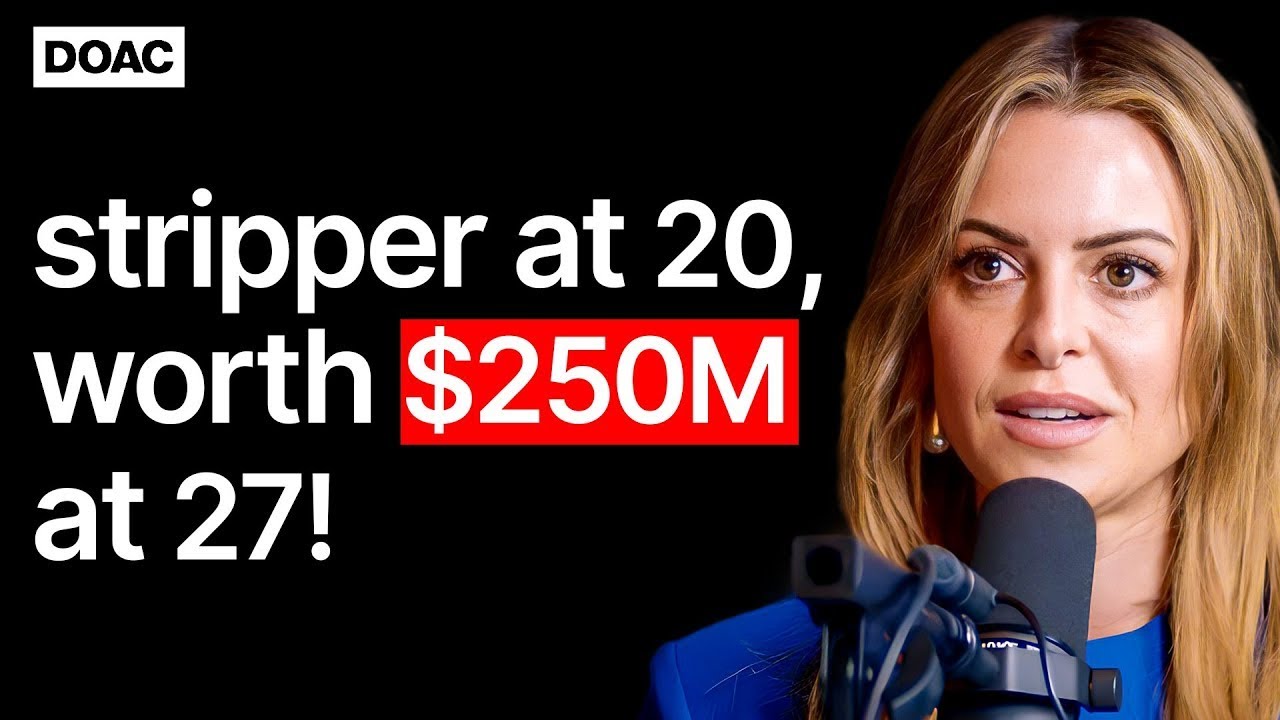
I was rebellious from a very early age. I was a stripper. I wasn't even 21; I used someone else's ID to work there. I built an online business, and the first thing I sold online was stolen. I'd get a whole shopping cart of stuff and put them on Amazon for ten cents less than other resellers. And then I got arrested for shoplifting. I'm a little dark. I realized I could connect my creativity to something legitimate and started Nasty Gal selling vintage.
Nasty Gal went from $150,000 a year to doing $150,000 over lunch.
I didn't realize the amount of responsibility I had being the poster child of entrepreneurship. Then I was this Girlboss, but my naivety and lack of experience did send me to the grave. Nasty Gal fell apart after ten years. My husband of like a year left. The headlines weren't nice. Then Netflix comes out.
What is it like from a mental health perspective?
It’s hard to pull yourself out of a hole when you don't want to get out of bed. It challenged my confidence and I'm still like, "I don't belong here," but "I don't belong here" is also a really great motivator. "I don't belong here" means I don't fit in, but that’s going to be a superpower. I can do things differently.
What was the plan in life at that point?
Oh gosh.
Sophia, take me back to those suburbs in San Diego and give me your earliest context.
Wow. I was born in San Diego at Sharp Memorial Hospital. Only child, eternally an only child. I think I wound up having the personality of probably seven children and the challenge of maybe seven children for my parents. We moved a few times. Our house was happy-ish when I was young. I lived in San Diego until I was seven, and it’s a beautiful place. I so wish we would have stayed there, but we moved to beautiful Sacramento, California.
That was really the suburban experience. When you're a little kid, you don't know what a suburb is and chasing the ice cream man is great. But once you get older, living in the suburbs—if you have any amount of curiosity about the world—the homogeneous nature of living in the suburbs is something that totally crushed me. I knew there was more out there and I didn't know what it was, but I wanted out from a very early age.
What did you want out of at a very early age?
Oh, yeah. I wanted out of my family home. It wasn't happy. My parents didn't get along. I was playing referee.
Really? At what age?
Starting at like ten or something. It just wasn't a super happy place and they didn't always agree on how to raise me. I think when your parents—everybody's relationship has issues—but when you have a sibling, I think you can go be like, "That's funny," or whatever, and just go play with Legos or ride bikes. But being isolated in a house that wasn't super happy as an only child made it worse.
I just remember so many drives, silent car drives where I was in the backseat alone. I remember the silence and the light of the streetlights washing over the car in silence with my parents in the two front seats. They were really only affectionate after an argument and even then it was like hand-holding or something. They were very strict as well. I had to beg to go to a boy's birthday party in sixth grade. We weren't super religious, but my mom grew up in the 50s in a Greek Orthodox household. Not puritanical because that sounds less cultural than Greek Orthodoxy, but strict.
What about money? A lot of arguments happen in households because of money.
Yeah. My dad did loans and my mom sold houses, specifically tract homes in the suburbs. They were both working with builders and banks and manufactured homes. By the time I was maybe ten, my mom was working in the model homes that are all dressed up, where you can tour them and pick your manufactured home. There was like a fake keyboard in there and all kinds of funny things to play with.
I was with my dad on weekends. They both worked entirely on commission. I've never seen either of my parents work for a salary. My mom’s dad didn't work for a salary; my dad’s dad owned a motel. They all grew up on a motel. So there's generations of my family who wouldn't necessarily call themselves entrepreneurs, but they're people who ate what they killed, and that’s what I witnessed.
Money was good, I think, when we were in San Diego. I think it got tougher over time. I remember very vividly being in a credit counselor's office. I just can't believe they brought me, but there was no nowhere else they would have put me. Watching them cut up their credit cards—cutting their credit cards in half and putting them in a clear jar with other people's cut-up credit cards—and filing for Chapter 11.
Bankruptcy?
Yep.
Did you know what was going on?
No. I still don't know exactly what happened.
As an adult, are you able to look back on that first chapter of your life and figure out how it had a lasting impact on various elements of who you are today?
I think it allowed me, even though it was so challenging younger in life, to learn how to assimilate into different environments and to entertain myself independently. To realize that authority—adults were not trained to be parents and weren't any further along with their maturity sometimes than I was at my age. I looked at teachers and thought, "Wow, you have domain expertise, you know some stuff, but I can tell that you're morally bankrupt and I don't trust you. Why have I been put in your hands?"
I think the thing that had the biggest impact on me is how critical my dad was. He's half Italian and half Portuguese, and his dad was a mean, mean guy. My dad’s very charismatic and I love him, and he’s super chill now, but when I was young, he had a lot of pressure on him and he didn't really have the best model of what a great parent looked like. I can't say he was a bad parent; he did his best. I know that both of my parents did their best with the ingredients they had to be parents.
But it instilled in me this unfortunate, but also very fortunate, habit of always peeling back another layer of the onion, examining myself, and having a real internalized drive to do better through self-criticism that has worked very well for me. That’s been challenging; it’s challenged my confidence over time, but it’s also been a superpower to hold myself accountable because I'm always almost second-guessing myself, but also in a very Jesuit way—a way where I can see both sides of everything, challenging my doubts and my ego.
The problem with that is sometimes it’s hard to differentiate between the two—what is fiction and what isn't, and which of my self-critiques are accurate. I want to be, and I think I am, a pretty self-aware person. Even with the things that I'm not great at, I'm super proud of that because I've got a ton of advantages and things that I'm really great at. But I think it was the criticism I experienced early on in life for so long that instilled that in me, and I've learned how to turn it into something that’s more balanced than what it was when I inherited it.
When you inherited it?
When it was handed to me. The model I had, the level of critique I had that didn't have the counterpoint that I'm able to provide for myself.
You're talking about your father here?
Yeah. He would critique me.
When you say critique, do you mean like, "Oh, that’s naughty, don't do that"?
No. No, like, "That's not how you do something," or "Why’d you do it like that?" or "Can you not?" or... I mean, I love my dad. As both of my parents have gotten older, they split when I was 17 and I've just watched them both become such better people. I remember congratulating them when they finally split up. I was so glad at 17 years old, and I was also like, "I'm out of here. See ya."
You seemed to become a bit of a rebel. You know, from when you moved out of your parents' house, for the next couple of years, the behavior looked really rebellious.
Oh yeah, no, I mean, I was rebellious from a very early age. I remember in middle school a teacher—I was eating an apple in class. I was eating an apple, it was healthy, I was hungry, I've got agency over my body, I didn't know what that word meant. "I'm hungry, I'm going to eat food. I'm human, I'm hungry, I'm going to eat food in the middle of class." But how could you tell someone not to eat when they're hungry? It's like a simple bodily function and it keeps me healthy and it's going to make me a better student.
And the teacher told me to throw the apple away. I just stared at the apple and of course, I had the attention of the entire class. I got up and I sauntered over to the trash can super slowly and I just ate the apple all the way to the core super fast, finished the apple, and was like *ding* in the trash can.
So I was like that. If someone said not to do something, I did the thing that they didn't say I couldn't do that was similar. I was pushing it. And then by the time I got to high school, I was going to the Anarchist Bookfair in San Francisco. I was sure capitalism was the worst thing ever. I was very angsty. I thought that adulthood—it’s funny, there’s a Netflix series about my life and the first thing that the character says is "Adulthood is where dreams go to die." It’s so weird to reference your own Netflix series, like, who does that? But that’s how I felt.
I wasn't trying to be a child, but I also didn't want to go work in an office. I also wasn't ambitious. So somehow along the way, that lack of desire to live a conventional life became something that turned into ambition because I—not even ambition, just curiosity—something that I was good at and eventually built a business.
But in high school, I remember there being bells. Like, a bell that rings and you go from one room to another room all day. A bell rings, you sit at a desk, a bell rings and you stand up and you shuffle over to the other room and then you sit down and you memorize some stuff. Like, this is my youth? I was sure I was being trained for something super mediocre. Not that I wanted excellence, I just wanted out.
Why are you like that? Because you know, all the other kids were cool with it.
I think I came out like that. I actually think I came out like that. It is not—I mean, I might have some hereditary just kind of like Italian, I'm not sure what or something. It wasn't a nurture thing. That was a nature thing or I don't know, I just hatched out of a disco ball. But that’s the way I came out.
I had Gabor Maté here, who just interviewed Prince Harry in a little pay-per-view therapy session or whatever. Gabor Maté said something to me that I've been pondering ever since. He said that as children, we're like narcissists, and we are that way because it helped us to survive. So we think that everything is about us when we're babies and young. So if the parents are arguing, we actually interpret that as there being something that has to do with us, and that’s the way we view the world as a survival mechanism. He says one of the things that happens when we are a young child and we're in a house where there's lots of arguing and lots of drama and shouting is we learn to avert our attention as a way to help us deal with the emotional distress. And that develops into something they call ADD and ADHD.
I took Adderall this morning. Just to prepare for the podcast. Just kidding. No, I have major ADD.
ADD?
Yeah. But they diagnosed me as a kid and I was like, "No, this is mind control. Forget it. I'm not focused because I thought it was situational. I thought it was my environment." And it maybe was partially because I wasn't interested in what was happening and distracted because I was curious about other things. But also, it’s a real thing. It wasn't until a few years ago that I finally realized it was a thing and sought treatment, and it’s helped, but it’s helped marginally.
How did you realize it was a real thing a couple of years ago?
I go to a psychiatrist and I talk about what’s going on with my brain and do what I can to help myself holistically. But also I know I'm also predisposed to depression. Not predisposed; I've suffered with depression my whole life.
Since when?
My whole life. I can't remember an age where I wasn't depressed. I wasn't always miserable, but I'm kind of a dark—I'm a little dark. And that’s not something, you know, it’s hard to pull yourself out of a hole when you don't want to get out of bed. To have the willpower to just get over depression and put on a happy face and whatever people do—get in an ice bath and jump in the sauna and meditate and... you know, I'm still struggling to be the well-rounded person, but I'm functional.
I think we're all struggling to be a well-rounded person.
I don't know. Some people seem to have these parents that teach them that and they come out and they're like, "boop boop boop boop boop," and it’s not, you know... that’s almost diminishing to be like "blah blah blah blah blah." But yeah, there's people who just seem to... and some people come out of the womb like that. I know parents that are creative, chaotic. I know people who are well-rounded whose parents were addicted to drugs and somehow they just wound up like that. How to attribute that to your parents, that's a hard correlation to make.
You said a curious phrase there which made me ponder. You said, "I'm a little dark." What do you mean by "I'm a little dark"?
Why are you giggling? You’re making me think you are a little dark.
I am. I'm not evil. God. I'm not a witch. I guess I've just, like I said, I've struggled with depression. I'm not a bubbly person. I'm not someone... as a child, my mom has said, "You only laughed when something was really funny." I think kids run around like laughing and smiling because they're children or something, but I had to have a reason. I'm not sure why and it’s still kind of like that. And maybe it’s, I don't know, as an adult it’s become something that requires... it’s just being genuine and maybe I'm not... I think maybe I'm not impressed. Maybe in general I'm just skeptical.
You went to see a psychiatrist when you were 16?
Oh, I went to a psychiatrist when I was like 10. I mean, I was in therapy when I was like 10, 11, trying to be diagnosed. Like, "What's wrong with her? Why can't she stay on task? Why is she so weird? Why doesn't she get along? Why is she distracted?" So I have report cards that say "Chooses to disturb others," "Doesn't stay on task." It’s stuff like that. It was like I was always, you know, not paying attention, curious about something else, engaged with something else. It wasn't always to be rebellious; sometimes it was very good-natured and I would get in trouble for things that I didn't think were bad or intended to be bad. But it was also just very—a very willful, independent thinker who didn't fit into a traditional educational environment. And you know, that’s something for whatever reason seemed to be needed to be diagnosed. But then I was like, "No, no, I'm not taking Wellbutrin and I'm not going to take..."
What's that?
It's like an antidepressant. I didn't take it. I was like, "No, I'm not taking any of this."
And what age was that?
That was by high school. So 15, 16. I was like, "This is... I don't feel like myself, I feel wired and weird." And I think I got Ritalin and someone tried to buy it off me in high school and I was like, "What? What? I don't even get it." And I was like, "I'm throwing this stuff in the trash." I didn't take it.
And so then you get diagnosed and prescribed an antidepressant at 16-ish. Your parents break up at 17-ish. You leave.
I move out. I move out at 17 before I graduate high school. I was homeschooling, so I got my diploma in the mail. I thought the most embarrassing thing would be to wear the cap and gown. I was like, "What is that? I don't understand. What's the tassel? Why do you have to wear a robe? What is this robe?" I wouldn't have been proud standing in a group doing some group thing. I'm not a group person, even though I've built a lot of really powerful communities. I don't assimilate well into groups, and I think groups are responsible for the most heinous things in human history. So I moved into a closet under the stairs for $60 a month.
Whose stairs?
These guys that were like in bands and artists who I'd met going to shows because I was really into music and went downtown in Sacramento and saw music.
What was the plan in life at that point? Was there a plan? You know, you’re like 17, 18.
Nobody told me there was a plan. I first wanted to go to Reed College, but that was expensive. But then I wanted to go to the Evergreen State College. So by the time I was 18, I had moved to Olympia, Washington, to get residency to go to the state school called the Evergreen State College, which is a super duper hippie state school that’s interdisciplinary and there’s no majors—to the point of it not really being worth going. But if I was going to go to college, I was going to go to a place like that. But even state tuition was expensive, so I lived in Washington state for a year to get residency so I could go to that school. And by the time I got residency, I was like, "This school’s not going to do anything for me."
You described this chapter of your life as being very lost.
Super lost. Super lost. I was looking for my—I kind of hate this word—tribe. I was looking for people like me. I thought I would find people like me and then all would be well. Like some Disney character, the Ugly Duckling or someone who loses their... lost from the wolf pack. I don't know what these movies are. And then they find their family and people understand them.
So from the time I was 17, I moved from downtown Sacramento to Olympia, Washington—lived in two places there—Seattle—lived in two places there—San Francisco—lived in one or two places there—Oakland with my alcoholic fry-cook boyfriend I had met in Olympia. We couldn't get jobs and my parents were like, "Yeah, we can't help you with college stuff." So then we moved to Portland. I was a stripper. I was lost. I was lost.
That’s an interesting turn of events.
Yeah, that was an interesting turn of events.
That chapter of your life in some ways mirrors the transience of the start of your life. You said you moved to like eight or ten different schools when you were young, and then when you leave the nest, you end up bouncing around, as in your own words, looking for your family.
I was looking for some place to belong and I never found it, and I kind of love that because it’s forced me to make my own and forced me to stay a creative thinker. And also, I don't know—this isn't fair—but the people in some of those communities peaked and never left. It’s like, you know, I listened to pop punk in high school. Can you imagine—I'm sorry if anybody listening is like never graduated from listening to pop punk—but if you don't graduate to metal or some other more sophisticated but less juvenile variety of rock, it’s the same as finding some comfortable community when you're 20 and then never leaving. Like, that sounds awful to me. So I'm glad I didn't find a comfy place, and it’s been uncomfortable since then.
How long did you try the stripping thing?
I don't know. I mean, when you're in your late teens, early 20s, time just feels like a decade that I was bouncing around to these places. Probably three or five months. It was fun! I loved it. Nobody pulled anything. I never got messed with. I drank my White Russians and ate the Subway sandwich from next door and played Photo Hunt. I wasn't even 21; I used someone else's ID to work there. And I got to dance to music that I liked, I made money, I didn't really have to engage with anybody, and I got really comfortable with my body in a way that I hadn't before, and that was cool.
You know they say—I read in your book where you said that you believe you hold the world record for having the most shitty jobs back-to-back throughout that period of your life. They say—I've learned from this podcast—that every job teaches you something, and that thing can be applied to business. There’s always a transferable skill or whatever learned. What was the transferable skill that you learned from stripping that you think has probably stayed with you today?
I think that even though I wasn't... didn't have the upper body strength to be the traditional one upside-down swinging around, what I could do—which was shuffle around and whatever—was enough and still charismatic enough and great enough to entertain other people. And then being comfortable with my body. It’s like exposure therapy. You know, I was the girl at 18 who would like make out with someone and then if I was naked or something, I'd like put on my clothes to go to the bathroom or something. I didn't sleep with anybody until I was 19, so I was kind of a late... and by 20, I was stripping in Portland. That escalated quickly.
I'll tell you the crescendo of that experience. So, dating Wade the alcoholic fry-cook who was 10 years older than me. I went off birth control for like one day and we were hardly even engaging in the way that someone might get pregnant—like so briefly, like that day and then no other day. I wound up pregnant. So I'm like 20, maybe 19, and I went to the sliding-scale women's clinic. But it was the only day I could get in, but it also happened to be the day of my court date because I had gotten arrested for shoplifting.
So I had to have the women's clinic write an excuse to the court telling them why this poor girl couldn't make it to her court date. And the whole thing, they were just—I kept following up to be like "When is it rescheduled?" and I think they all just felt so bad for me, it kind of vanished. But that was like, "Okay, no more shortcuts." It wasn't like "I'm going to go be a CEO," but it also just taught me that breaking some rules puts you in other people's hands. I was being arrested, I'm not as autonomous as I would have liked to have been. And even with stripping to a certain extent, it was a shortcut; I was trying to evade working hard. But it was also a lot of fun. But that was really a low point. I've had lots of low points, but at least it’s been like this, right? It’s been like this. Doesn't ever go that low.
There's clearly a slight issue here with authority. It feels to me like the ultimate authority, which is the law, eventually was like, "You can't mess with us. We're not the teacher."
Yeah, it was like, "Okay, maybe just figure out how to get along." You know, it wasn't like "Wow, I'm going to go have a career and do everything differently," but also I just didn't want to cut corners. I didn't want to end up not in control of my environment or stuck in jail or something stupid.
Shoplifting.
Why’d you make that sound? I don't know. It was fun.
What was your favorite thing to steal?
I don't endorse shoplifting. Neither do I. My rationale for shoplifting was that there was so much excess in our culture that it would never make a dent to steal organic tampons from Fred Meyer, which is like Target in Portland or whatever. So when I did get caught—and this was my favorite thing—was just walking out with stuff. I would get a whole shopping cart of stuff. I had a little teeny tiny little razor thingy, so I knew where the sensors were and I would cut them off if they were there and pile a shopping cart high and just walk out with no bags or anything. I did it at grocery stores, I furnished apartments, I walked out of places with literal rugs this high. Just walked out because nobody expects you to be that obvious about it; they're looking for somebody who’s putting stuff in their pockets. And when I did get caught, I had like a George Foreman grill, I think a basketball, organic tampons, some food, really nice shower curtain rings. They were metal and then they had ceramic—they were heavy and they had like a ceramic thing that said "Hot" and the other one said "Cold" and I was like, "Yes, this is luxury." It’s worth jail time. So that was, yeah.
And you know, I built an online business and the first thing I sold online was stolen. So another thing—and I learned this from people who were professionally trying to evade getting jobs and participating in capitalist culture, which is a privilege, it’s lazy, it was a quasi-political lazy excuse for just not working hard. Anyway, I learned from some of the best.
I had a friend who had written a book called *Evasion*, literally. And I would go into Barnes & Noble and they had a no-chase policy. Like, I knew what the policies were at these places because if their employees chase someone shoplifting, it’s going to cost them way more if they get knifed or something than it would for them to lose a few books. And so I would go on Amazon and I would look at the best-selling books—this is in 2002, 2003—and even look at the ratio of most expensive book to least pages so I could stack them, as many of them as possible. And I would just walk to the front—the front of the store would have all the best sellers in huge stacks and I would just pile them high. I looked like an employee who’s carrying a huge stack of books. I was right in the front of the store and I just walked to my car. And I’d put them on Amazon for ten cents less than all the other resellers, I’d sell them overnight, I’d ship them Media Mail, and I’d pay my $350 a month rent.
Why weren't you scared?
I think I was. But it’s when you get scared that you get caught. And it’s when you hesitate you fail. It’s the same thing. If you're snowboarding and you're like, "Uh oh, it’s kind of icy, let me look down," you're just *poof* catching an edge. If you're surfing and you look at the nose of the board, *poof*, right?
So even that taught you a life lesson.
I guess. I'm not proud of this. I was really young and I was finding my way. I never stole from individuals; that was not on-thesis for me. I couldn't justify it, I would never feel comfortable doing it.
When your cat is acting weirder, or your dog is being louder, your turtle moves slower... Hello, Ted! Your cat seems thirstier... Whoa, slow down buddy! Or your puppy is acting clumsier... Day or night, if you don't know what's wrong, know where to go. Veg ER for pets. This is Kate. Veg: the better, kinder ER for pets.
Time is precious, and so are our pets. So time with our pets is extra precious. That’s why we started Dutch. Dutch provides 24/7 access to licensed vets with unlimited virtual visits and follow-ups for up to five pets. You can message a vet at any time and schedule a video visit the same day. Our vets can even prescribe medication for many ailments and shipping is always free. With Dutch, you'll get more time with your pets and year-round peace of mind when it comes to their vet care. Go to dutch.com to get vet care that is always there for just $92 a year.
So by this time you're getting a little bit acquainted with the internet and selling things on the internet, clearly, because you're selling stolen stuff. Vintage. Why vintage? Why did you start to sell vintage clothes?
Yeah, so by 2006, I had gotten some real jobs after I had worked in shoe stores and record stores and photo labs and Subway again, dry cleaners.
How did you get on with those jobs?
They didn't last very long. I liked jobs where I was alphabetizing, so record stores, photo labs, bookstores. I like paper, it makes me feel important for some reason. Mailing things, I don't know. It worked out with my eBay store.
And the last job I had was in the lobby of an art school in San Francisco at 79 New Montgomery Street called the Academy of Art University. It was a job I got because I needed to get health insurance and at the time you couldn't get health insurance with a pre-existing condition.
Is this your hernia?
Yeah, the hern. The hern. Yeah, so a hernia—if you don't know what it is—is a hole in your muscle wall that your guts poke out of and it makes a little bump. I had one kind of in my groin area called an inguinal hernia. It didn't hurt, but they're kind of dangerous because they can—if your muscle tenses up or something—they can get strangulated and necrotic, which is a disgusting word.
So I had to get it fixed. But before I got it fixed, it was kind of fun. I shaved everything but the hernia. My poor boyfriend, my poor boyfriend. And yeah, it was entertaining, it was kind of funny to have like a small lump in my pants for a few weeks or something.
But at the time, you could not get health insurance with a pre-existing condition. Even with depression. If you had medical records that said you had depression and your insurance lapsed, insurance companies would decline you. Now, that’s not the case. You can have a pre-existing condition and apply for health insurance, you'll be given health insurance. You could only get health insurance with a pre-existing condition like a hernia with group health insurance with a job.
So I had to go find a job that had health insurance and I got this job in the lobby of the art school as a Campus Safety Host, which was a different way of saying "you're cheaper than a unionized security guard." And I wore a starchy white shirt, it was like men's clothing. I had to wear this awful uniform with like a magnetic thing here that had my name and the school’s logo on it and check students in and say, "Hi, you need to sign in. Can I see your ID?" That was the extent of my job.
Were you doing anything sort of criminal at this point?
No. So all of my money came from that job and... yeah. And so there was a three-month waiting period for health insurance. And while I was there, I had time to... I had some downtime in this lobby and there’s a computer. And there was no Facebook or Instagram at the time—this is 2006—and I was starting to get friend requests from these eBay sellers on MySpace.
I wore only vintage. I was like rooting-tooting-scooting to like oldies and rock and roll and dive bars and subsisting on burritos. I loved vintage, I wore vintage. I wasn't necessarily into fashion and I didn't want to be in fashion, but I loved style and I loved vintage and I loved thrifting. And I saw what they were doing and their auction prices were crazy. Like, I thought Haight Street was expensive because I had shopped at thrift stores and found great stuff.
And saw what their auctions were going for, and these were actual prices that the customer was determining. They would start the auction price at $9.99 and these things were going for like $200, $300. And they were just making it look like something that Sienna Miller or some boho—at the time it was like boho, Olsen twins, Sienna Miller kind of vibes. And they would do that, put this stuff online, and the customer determined the price.
And it was so much money. And so I thought, "Okay." So I waited my three months for my health insurance because there was a three-month waiting period. I got the hern fixed. And I started an eBay store and I wasn't trying to be an entrepreneur; I was trying to legitimately not work for anybody. And that’s when I realized that I could connect my curiosity and independence and creativity and resourcefulness to something legitimate that made money, that I learned from every step I was taking, and started Nasty Gal selling vintage out of my boyfriend's apartment.
Before that point, would people have called you lazy or unmotivated?
I didn't know any people who would have said something like that because my friends were just like me. So people, objectively then, objectively? I think just lost. Lost. I think it would be a judgment to say I was lazy.
I can relate to so much of what you've said, especially all the stuff about authority. Like, I just decided to stop going to school and I was polite about it, but I've always had a challenge with authority. Every job I had through that period of my life lasted for three months. I was just call center hopping. Get to the bonus threshold, quit, gives me two months where I don't have to get a job, call up another call center.
I employed those people.
Yeah, I’m one of them. And it’s funny because I think people would have looked at me in school and stuff and said—like, written me off—"Oh, he’s lazy." Well, like my thesis is that most people are lazy and you should be lazy for things that you absolute hate doing. Like, you should be.
Yeah, I'm only motivated by things I'm curious about. If someone assigns me something—like, I've tried to write a second book. I published two books after *Girlboss*, which was a thing. I can't... I cannot be assigned something. It either comes out or it’s not there.
Do you think that’s the rebel in you?
It is, but it’s why everything I do is so inspired and honest and—I don't want to be like "I am unique"—but because you never accepted or learned compliance. It’s an actual representation of who I am and what I think and how I feel and my perspective, instead of a manufactured version because somebody has given me an assignment.
Like you didn't even want the bell in school to tell you what to do.
No.
It's a gift and a curse, though, right?
I mean, it’s pretty logical that you would question what a bell ringing and someone moving from one room—the same room to the next room every single day...
Do you think anyone else questioned it?
No. No. But if you really think about it, it’s pretty wild, right?
That eBay store that you start in your free time when you're working that job that you took to fix the hern, it was successful. And you know, you kind of frame it as you saw maybe a price arbitrage or whatever. But it’s more than that, right? It’s more than that to be successful. At that time, I'm sure a lot of people saw that price arbitrage and they didn't build a Nasty Gal. So when you reflect on why and how you were particularly successful, how do you diagnose that?
I reverse-engineered everything everyone else did and did a better job and did it with my signature on it.
Do you think—and I'm thinking now about that bell again in school, where you were like analyzing the bell when no one else was—do you think that kind of default to thinking in terms of first principles, like asking the question "Why? Why the fuck do we do it that way?" has been part of the reason why that eBay store was successful?
I think so. I think most people that start an eBay store are copying what other people are doing, they might reverse-engineer some things and see what their competitors are doing, and I did that, but I just did it ten times better with a totally different spirit, with excellent copywriting, with great styling and great models, and increasingly better photography. And I was extremely resourceful. I would buy stuff on eBay and sell it for more than I paid for it. I was searching for Yves Saint Laurent just misspelled, you know.
But even that’s first principles thinking. That’s like... you've got convention on one end which says just like do what’s being done, and then you've got these like first principles thinkers who kind of think first about what they know to be true, and they're really good at filtering out convention. They can kind of see through it at the truth. Whereas convention, like, is safety, it’s comfort, it guarantees you a pre-tried blueprint, so people follow that. But then these other little rebels, they have this almost inbuilt ability to just fucking see through to that truth that nobody can see. And in that case, I mean, that’s a great idea, but even caring more about the copy and you having your own belief as to why the copy mattered or the photography, like why photography really, really mattered.
On eBay.
Yeah, on eBay, which a lot of people wouldn't have had.
And it was called Nasty Gal. The spirit of it was really irreverent. At the time, the eBay sellers were selling like... you know, it was called Mamma Stone Vintage was a really big one and it was all very hippy-dippy and vintage-y. And mine was vintage-y, but it was like very hard-hitting, edgy. I named it after an album by a woman, Betty Davis, who had an album called *Nasty Gal*. She was so stylish. In the 70s, put out some incredible records, was married to Miles Davis for a short period and was allegedly too wild for him. Her lyrics are just so... and I was stripping to her music when I was like 20. And then I was like, "Cool, Nasty Gal." And it cut through the noise.
And I think when you start a business and you don't need to survive, you might have more time to navel-gaze or you might do things super conventionally. But when you need to survive, there are certain things that other people have done right that you can see, you know, accelerate what it is that you may do on your own, but learn from them and then also take and make your own way. I think had I tried to do things completely differently than everybody else, I wouldn't have survived. I would have been dead in the water.
You're speaking to something really interesting there, which is this balancing act between naivety, which is great for innovation, and then convention, which is great for staying alive. I'm talking about like the Nasty Gal needing a CFO.
Yeah, I've been to hell. I've been... I died and now I'm in the afterlife. It did send me to the grave. My naivety and lack of experience did send me to the grave.
It happened so fast. That's a quote. "It was shocking how fast it all happened." Nasty Gal went from doing $150,000 a year to doing $150,000 a day and then $150,000 over lunch.
Yeah, $150,000 over lunch. It was either a day or over lunch that we all worked out of this warehouse. It was a bunch of kids in the East Bay in Emeryville. I had this 7,000 square foot warehouse which I thought was the hugest thing. And I was like, "When we hit $150,000 a day—God, was it a day? It must have been the holidays—I was like, 'I'm going to get a bounce house.'" You know those things that people jump on, the inflatable things that children jump on?
A bouncy castle?
It was an upside-down horse and its legs were in the air. When you jumped on it, the legs like...
That’s what you wanted?
And in between, you know, on our breaks, we got to jump in the bounce house. I was like 23, 24 years old. It did happen really quickly.
To be fair, now you say it, when we raised investment for the first time, the first thing I bought was a £13,000 slide—big blue slide—which we had in our office. That was the first thing I bought before we got desks. So talking about naivety.
I paid off my mom’s mortgage.
Oh, did you? Okay, I couldn't do that with investor capital, but I probably...
No, it wasn't with investor capital. No, it was the first time I made money.
My slide was with investor... okay, yeah. They actually, those investors did really well; they got bought out within six months, so they got a big return. But good job.
Yeah. What do you attribute at such a young age—I'm just going to interview you for a second—because you couldn't have had a ton of experience under leaders to give you a model of what leadership looked like. You were naive, you know, could you... I couldn't empathize with the people I was managing because I had never experienced leadership and I just showed up and I did what I—what needed to happen and what I said I was going to do. I didn't understand that people needed to be held accountable because I held myself accountable, especially C-level executives and grown-ups whose careers were longer than I had been alive. Like, how did you do that at such a young age?
Well, I think I—I think I messed up. I think like for the first two years, I hired people that were very, very inexperienced. I reflect and I go, "I think I did that because I thought they were easier to manage." And I couldn't fathom the concept that I could hire someone who was two times my age and three times my experience and A, they'd want to come here and be with us with our slide and dogs and tree and basketball court and ball pool, and they would like take us seriously. But also like be like, maybe there was an insecurity about how I'd manage them.
And so what ends up happening is you—I hire lots of like young people. You know, I remember the BBC did an article saying, "Is this the youngest company in Britain?" because I think we were like—our average age was maybe 20 or something, and we had like—we had almost 100 people. You know, and you feel the strain of that. You feel things breaking. You’re like... this is where you go, "Convention is right about some things." Processes, HR, finance. You feel things breaking at the seams a little bit because of the growth. And then at some point, an adult enters the room and you go, "Oh, I get—I get this."
And so we hired some—some really, really great people. And the great thing is great people hire great people. So we went from being this kind of very lopsided and inexperienced organization to being a balanced one. And I say balanced because it’s my belief that to own the future, you have to understand the present, which is why you want to hire a 16-year-old that gets TikTok or whatever. And you also need to hire someone that’s maybe a little—much—double their age, experienced in client services and understands the old rules of the game. If you understand both games, you can understand the game of the future, I think. So made a lot of mistakes and nearly went under several times and had to call people and beg for money in the lead-up to payday, but somehow managed to survive.
But going back to you now, I feel like we missed a part because you know, you’re at the recep—you went from starting that store to bouncing around on that bouncy castle thing. Between there, between that—bouncing on that horse castle...
Horse castle.
...and starting the store, what happened?
So, first year, just on eBay, did $75,000 in revenue. I was the only employee, it was just, you know, it was pure cash. All of the money just went back into the business. I didn't even know what expensive things I would have wanted. I had never eaten an oyster, you know. I was drinking like Budweiser and eating still like eating subsisting on Boston Market and like Starbucks. So I didn't spend any of that money. I thought building a business—and I think for the most part it is—was selling things for more than you bought them for and not spending all the money. That’s it. That’s all.
And so I bought things, I sold them for more than I paid for them, and no one else would have given me money. Parents weren't going to give me money. I don't even think I had a credit card at that age. I didn't understand what venture capital was and I was living in the Bay Area. And had I not built the company to eventually, you know, a $28 million run rate super profitably, I would have never known.
And so yeah, year two, left eBay about halfway through and launched my own website NastyGalVintage.com and did $250,000 in revenue. The next year did $1.1 million, the next year did $6.5 million, the next year did $12 million. And I was coming off a $12 million year revenue, owned 100% of the company, had a bunch of kids working for me.
And that’s when venture capitalists came in. And at that point, you know, we were selling non-vintage stuff. What really allowed the company to scale was going to trade shows and showrooms and curating from the market based on what I had learned from my customer having sold vintage to them. So I knew them very, very well and that gave me the ability to then go buy greater breadth and depth in things I knew they would love.
And that's what, 2011, 2012? That venture capital comes in?
2012 was when Index Ventures invested $60 million.
Sixty million dollars?
On a $350 million valuation.
On a business with a $28 million run rate?
Yeah.
You were profitable at that time?
Significantly. Pretty significantly. I have...
Like 10% or 20% or something?
I don't know. I didn't know. I didn't even look at that. I never had to learn to read a P&L because my company was profitable and I just, you know, generally knew how much it cost to run. I didn't... and I didn't spend... I didn't buy expensive office chairs.
Did you know your like gross margins on your...
On the product, yeah. On the operating margins, no. I don't think I understood what an operating margin was.
Pretty incredible that you can be running a business that’s generating—has a $28 million a year run rate—and not know what operating margins you're dealing with or what your net profit is.
It's a luxury, but it was also a disadvantage once we plowed $60 million into the business and things got a lot more complex and a lot less profitable.
You talk about that $60 million going into Nasty Gal in 2012. What did it break?
I mean, we no longer had to live within our means. That’s what investor money does unless you maintain profitability and keep that money in the bank for, you know, another time or pocket all of it as a founder. We, you know, I had hired a COO at that time, I had a top-tier investor on my board, and very little like historicals, data, financials to base the future growth on, but it had been exploding, just continued to be exploding, and with that capital behind us, we could grow even faster. And the expectation was that the next year we would grow from $28 million in revenue to $128 million in revenue. We just rounded up by $100 million and then we hired into that and we bought into it.
Oh, you believed it and everyone believed...
I had grownups forecasting this stuff with me! I relied on them. It’s why I brought them in. "You hire the right ones." Clearly, I didn't pick the right ones or I'm not sure what happened, but I remember sitting in a room with them and us deciding. I didn't push for it; this wasn't, you know... we're going to just grow by $100 million this year and someone put a plan together and this is... we hired 100 people. It was like the Tower of Babel. You know that story?
No.
You don't know? It’s like a biblical story where people are building this tower or something but they all speak different languages and... I could be completely wrong, I don't think I am. But none of them get along or understand one another and it was... it was just a mess trying to integrate 100 people into a company in a year, especially a company with no processes and no real intentional culture that had been established. No real intentional anything other than the brand, the spirit of the brand, what needed to be done. It was like a family business that just got really big. It was—I was a kid.
How were you feeling in terms of—at this point—in terms of what’s going on around you? Sixty million dollars has just come into the bank account, you're looking at it thinking, "That’s a big fucking number." You're, you know, because you have a valuation of 350...
I'm worth $280 million on paper at this point.
Right. And wherever you go, they'll lead with that and remind you of it, and you'll be treated as such, even though it’s paper and it’s not real, it’s not the cash in your bank account. How—how does that make you feel when you... you know, then they put you on the front cover of *Forbes*? How does that make you feel?
It was a blast. I didn't do any of it to have glory or go on a victory lap and I wound up with it and I embraced it and I had a lot of fun. It distracted me. You know, the book in 2014 turned into a phenomenon. You know, it was champagne clinks for some milestone with the company or new hire, promotion at any given time. I—people would come up to me and say congratulations and I had to ask which thing they were congratulating me for. It was just like oysters for everybody. I finally, you know, I got better taste in wine. I got better taste period, thank God. But now I spend less money with the good taste that I had to spend a lot of money to acquire. A lot of my own money.
But did you feel... did you feel like it made sense? Like the image that had been built of you at the time that the world is now like, "Oh my God!" Did—is that what was going on inside?
I think it made sense. I think it was a freak show. I was a community college dropout who bootstrapped a business to $28 million in revenue super profitably. You know, investors came out of the woodwork, top-tier ones, anointed me as someone who could pull it off, and I didn't know what I was signing up for or what I was supposed to pull off, but it was considered a rags-to-riches story and...
Imposter syndrome? Any of that?
For sure. Yeah. I mean, I still walk in rooms and I'm... here! I was talking to your team and I was like, "Oh my gosh, you guys have really big people. I hope I can keep up. I say 'like' a lot. I'm intimidated. I hope I can provide some value. What are the comments on YouTube going to say? Is this going to be a valuable conversation? I really hope people like it." You know, and she was like, "What? You wouldn't be here if that wasn't the case. What—what are you talking about? You're great."
But I get nervous, right? I get nervous on stages and I'm still like, you know, "I don't belong here," but "I don't belong here" is also a really great motivator. "I don't belong here" is "I snuck in the back door." "I don't belong here" means I can do things differently. "I don't belong here" means I don't fit in, but that’s going to be a superpower. And I think it’s okay to feel like an outsider or an imposter sometimes because you find yourself in places where you—you have an outside perspective and are able to learn things unlike the people who were invited to the table who all showed up there with the same pedigree. And then you get to make oblique connections between who you are, where you came from, and then the door—the room that you just snuck into as an imposter. And that is radical.
Would you remove that self-doubting voice if I put a button in front of you and said, "You press this, you'll never doubt yourself again"?
No. That’s so boring! I had a coach recently and he was lovely. We did five sessions. He was like $5,000 a month and I was like, "Taxes. I'll buy something else to save on taxes." And he was like... he asked me that question and I was like, "But what would I struggle with? Who would I be if I didn't have challenges and I was happy all the time? It’s like the scaffolding would fall apart or something." That’s a story I tell myself. But it’s fun to have a dark counterpoint to hold yourself accountable and be like, "Maybe it’s that or not that," and I think that counterpoint is an opportunity to gain self-awareness.
Do you think it’s additive to your performance or reductive?
I think it can slow me down and I can make really slow decisions because I doubt myself. But beyond that, I think I've found a way to harness it that really works for me.
Have you developed like a decision-making framework to help you navigate the two voices in your head? It’s funny because when you were describing your mother and your father, it felt like those were the two voices. Your mother would seem to be very supportive, your father somewhat critical at times or pessimistic. Have you found a way of being able to juggle those voices so that you can make decisions decisively and quickly?
No. Mm-mm, no. So I can have these conversations, and when I do make a decision—I've learned to be slower with making decisions because I either make them extremely quickly or slowly on accident. And so I want to be very deliberate in the decisions that I make now and think more critically rather than navel-gaze or be reactive to something.
I went to this retreat—even though it’s not really a luxury experience—with 30 other people called the Hoffman Process. And it’s seven days with no phone, no internet, no books, no music. You're with 30 other people and you're going through this process of mapping your patterns from your childhood against your parents and how—how you inherited that, and it’s all directly correlated. And basically graduating from your emotional child into an emotional adult. Super embarrassing, weird process, like so dorky.
And everybody came with something different to work on or what emerged for them. You know, "I feel unloved, I feel unlovable." I don't feel unlovable. My thing—and it sounds really weak—was like, "I don't trust myself." I don't think I'm deceiving myself, but I think I can rationalize a lot of things to the point where I'll tolerate them too long. And that’s gone for relationships, that went from my most recent relationship. And so that’s a strange thing, "I don't trust myself," because I do have these voices—it sounds... I don't have voices in my head, but I can see things from any perspective and not be totally attached to either one, to the point of being slow and asking for too much advice.
In that retreat, did you have to sort of go upstream and figure out where that belief started? Is that the point of that retreat?
§02Transcript — part 2
Mm-hm.
Did you figure it out? Did you go upstream?
What a good question. You're very good at this. Oh, thank you. Yeah. I think it was that my parents didn't agree on how to raise me, that I felt misunderstood, that my good intentions were sometimes construed as troublemaking, that the fact that I didn't fit into the environment I was raised in—I was not accepted and I was some kind of weird deviant when I was just being myself and felt punished for being myself.
And I think that gave me like a lack of confidence or something. And I don't identify with being an unconfident person, but when it comes to decision-making, when everyone around you is telling you a different story about yourself than you have and doesn't understand why you operate the way you do that is really with integrity and in line with who I was and what I needed to be successful as a child—if other people like live in a different world and don't understand that those are your needs, you just feel wildly alone and think, "Wow, I am a freak." And that found its way into my career through the public too, which has been super fun, being told I'm something that I'm mostly not.
What have you been told you are?
Oh gosh. So Nasty Gal fell apart after 10 years. It was a quick rise and it was a slow rise and it was a relatively quick fall—couple of years in the making. And when it did fall, the headlines were crazy because I had had all this press from this book I published and being the poster child of entrepreneurship, going on the victory lap. *National Enquirer* had a picture of me and it said "Rags to riches," like straight-up tabloid American Dream stuff, like a caricature.
And I didn't realize the amount of responsibility I had to other people as an example—I kind of did, but as some symbol for entrepreneurship or my generation, the generation of the entrepreneurs coming up behind me, or at least what the press thought I was responsible for.
The—you know, there were headlines like "Does the failure of Nasty Gal mean millennials aren't ready to lead?" It’s like, wait, how is one example representative of a generation? And I've also read headlines like when the Netflix series came out, "The worst thing about Netflix's *Girlboss* is its source material." Not even the show, just me. But I'm not bad. I don't believe—I don't believe it.
How does that make you feel at the time, though?
By the time that Netflix series came out, I had been this hero as an entrepreneur. Then I was this Girlboss because I wrote a book called *Girlboss* and it was pink and I was like this and I looked like I knew what was up, but it was like 27. And then there was the me whose company fell apart, the CEO, there was the Girlboss who had built a toxic culture or just no intentional culture at all that warped into something that wasn't perfect but wasn't... I still don't think it was the worst.
And now this person, this conflation of all of those things with this girl on this scripted comedy, which came out four months after I left Nasty Gal. So the biggest kind of personality or whatever identity crisis was—I'm on the cover of *Forbes* in June, I think, of 2016. July of 2016, my husband of like a year is like, "Meh, I changed my mind." And I'm like, "Oh my God, that wedding was so expensive." It was devastating, but I'm just like, "God, that wedding was so expensive." It was a great party.
So in that space of like 12 months, you're on *Forbes*, husband leaves, Netflix comes out, Nasty Gal goes under.
Nasty Gal goes under, then Netflix comes out.
Ooh, ooh.
So the show had been shot when things are all like up and to the right. And you know, we were working through challenges, there had been some layoffs, but the company was still, you know, $100 million a year—not profitable anymore, but a great brand and something that was valuable and eventually, yeah, like fell apart. And that—the—there was really a conflation of the hero, the failure, and now this girl four months later who’s a caricature of a person I was when I was 22 in a scripted comedy playing someone named Sophia starting an eBay store called Nasty Gal.
When for the first time in 10 years in my adult life since I was 22 years old, I am no longer associated with the thing that I had built. And now there are 130 million homes in 195 countries watching a story of someone that I was no longer—and no longer—had trying to move on. To move on when there’s a full PR campaign about who you used to be.
You're someone who’s, as you said, you've had a long history with mental health challenges. What is it like in that—in that 12-month period? What’s going on from a mental health perspective?
I had fallen in love again. I think I was still like traveling. I started another company. I maintain my mental health partially because I keep going. You know, I don't stop and like lick my wounds. I think I was also—I was also on antidepressants. I wasn't jumping for joy, but I also knew that there was a huge community that still supported me who had read my book—500,000 women who bought it—and I went on to start a company called Girlboss right as the Netflix series was hitting, put on our first conference, and I had my podcast and I moved on quickly. And even though the headlines weren't nice, the people who followed me, my friends, my relationships, everybody in my network—nobody bailed. Like, the girls who were inspired by *Girlboss* were refreshed that I had faceplanted publicly because everyone else is faceplanting in private.
And in the same way that watching some random community college dropout from Sacramento start a business with an internet connection and a computer gave them license to—yes, they were inspired, but also embrace their own failures because the hero faceplanted publicly. And that can also inspire people.
This is hopefully the most cliché question I ask, but I want—I want to know because you have a—from your—from that experience, you have amazing feedback. You have amazing insight, invaluable insight I would say, because when I think about the things obviously that have taught me the most, it’s not when things go right; that’s a validation of your hypothesis. It’s when things go tragically wrong and you go, "Oh, okay, fuck. I have all of this new information about which has corrected my hypothesis."
So when you—if we go back and think about that fundraise, for example. A lot of people will hear that you raised a company—raised investment at $350 million and think, "Amazing." That’s when people clap, right? They get the champagne out in the office. For people listening that aren't in business, they might not understand how that can also be a key reason why the company ultimately went under. The $350 million—why did a big valuation hurt you?
Yeah. I think the $350 million valuation—as celebrated as it was and how wealthy I was on paper at this point—was the—was the nail in the coffin. I think it was—it was then in 2012 where we were overvalued and the expectation was—was that the next round of fundraising that we do is at a over a billion dollar valuation. And so the company’s doing, you know, on an upswing to $28 million in revenue—that’s like over 10 times revenue.
And it’s a fashion business. This isn't a technology business. This isn't Uber, this isn't an infinitely scalable marketplace. It’s e-commerce. It was a different era of e-commerce. It was pretty early; it was the era of Fab.com, which like imploded, and One Kings Lane and BeachMint and Shoedazzle. There was no playbook, there were no e-comm veterans or, you know, performance marketing people who had been in those jobs for even very long. I was hiring executives who had worked at like Macy's, right? Nobody had like e-comm... it wasn't called direct-to-consumer at the time. It was very, very different. There’s no Shopify.
And we were overvalued. And I didn't know that. I didn't even negotiate, I hardly negotiated. I didn't shop a term sheet around and say, "I'm going to pick the highest price from different investors." I only had one term sheet and I was like, "Great, I like you."
Index Ventures, which are phenomenal.
I was like, "You're awesome. You can—I—you get it." You know, what Danny said when he invested was something none of the other potential investors said, and that was, "You have a community." And I was like, "Yeah, we do have a community."
But when you have that much money, you don't know there’s been a nail in the coffin or that there’s a coffin and that you might be on your way into it or maybe already laying in it, but just several years in the future. And when things are up and to the right, you don't see what’s lurking kind of below the surface. So when the tide lowers, right, you see the mud, you see weird crab shells, sometimes—hopefully not—you see trash. And it’s only when things recede that you see the mud that’s underneath.
And when you're on a victory lap and you're hitting milestones, everything’s great and everybody loves their jobs and you're a hero. And as soon as things go a different way, as soon as there’s layoffs—yeah, there are things kind of—there are things lurking below the surface that were dynamics that were already happening that because everything was going so well, were harder to notice.
And you know, it’s hard to be a CEO, it’s hard to be a founder. I think something a lot of people don't realize is that you only know 10% of what’s happening in your organization. I had hundreds of employees. And ultimately everything was my responsibility, but I am held accountable for 100% of what’s happening. And when something goes wrong or something’s mismanaged or someone has a bad experience in the company, the assumption is that I have signed off on it, that that is how I want things to be. And these things are happening—you know, cattiness and fiefdoms and silos and duplication of effort and all the, you know, the entire spectrum of things that are no fun at a fast-growing company. I didn't know were happening until we laid people off and then they were like, "Hey, we didn't like it there." I'm like, "Okay." And some of that was totally overblown. But also, anything that any employees ever said about me or I've read, even though I don't agree with all of it, it’s been an opportunity for me to learn and take from that how I could be better because there’s truth to almost everything.
Didn't you get an offer to sell the company completely for $400 million?
Yeah, I did. I owned 80% of it.
So that would have made you, you know, quick math, I don't know, very fucking rich. Super fucking rich. And why—why didn't you say yes?
I went to my investor and I said, "What do you think about this?" And he said, "You need to ask for more." I controlled the board. I owned—you know, I owned the majority of the company, but I also took advice from people who I thought knew more than me. But I didn't know that my interests weren't necessarily aligned with the interests of my investor, whose interest is to—whether I'm worth it or not—have a piece of paper to show his investors that says I'm worth, instead of 350, look, they're now worth a billion. And they just make up these numbers and then they can show their people that your company’s worth more. And that was his—that was in his best interest and that’s what he was giving me advice based on.
Are you mad that he said that?
I'm not mad. I'm not mad.
Do you wish you made a different decision? Is that a regret?
It's a—it's a partial regret, but I also know that no deal actually happens. They're not a real acquisitive company; they could have tried to acquire the company. I don't even know if they've acquired anything. Integrating it into their company, if I had an earn-out based on them, you know, controlling it and me trying to hit performance benchmarks—even if I had sold the company to them, who knows how it would have played out. I would have made a bunch of money, my life could have been miserable, but 99% of the time, deals fall through. There’s also in those situations a lot of people trying to get into the data room, so they make an offer so they can see your numbers and what you're doing and how your business is working out and then they pull the offer later once they've had a look into the data room and due diligence.
And copy you. Exactly.
Yeah, exactly. So we didn't get that far. I don't regret it. Um, but yeah, that was a big thing. You know, for me that would have been a lot of money; for him, it was just a teeny tiny bit more than what he had paid for it. So that’s not a lot of—that’s not much of a markup for him.
What is the advice you're giving now to—to women that are, and men, that are looking to start companies that are within your community, the communities you're building, within your portfolio companies now that you're an investor? You know, like I think I can think of the first piece of advice that I give young founders when they come to me. I'm wondering what your like first piece of advice is.
I think for bootstrap founders the advice would be different. For founders in my portfolio companies who are raising venture capital, my advice would be get as far as you can before raising a single dollar. Validate your idea as soon as you can with the ugliest, like most basic, quickest thing. Your first product should be super ugly. Get it in front of people and get some idea of whether it’s valuable or not before you go raise money, before you even try to market it. Talk to every customer, every potential customer, and bootstrap it as long as you can, if you can, because when investors do come in, your company’s going to be worth more than if you had raised money when you just had an idea and were asking for a check.
When you do raise money, having a reasonable valuation is important. And a lot of founders optimize for price because the bigger price an investor pays, the more ownership the founder has.
The more they're worth, right?
The more they're worth and the more eventually they could make if they sell the company. But when you have a valuation that’s in line with the market that makes you an attractive acquisition, something someone might pay a multiple for—that 10%, say you're diluted down to 10% or 20%, but you sell your company for $500 million, you're in much better shape than raising $350 million and owning 80% of it and it going to zero or whatever.
So, and I think where things are right now with venture is a place that is—is close to that. And founders aren't greedy. Founders who are raising money in this market know it’s really, really hard. They don't want to be overpriced because the people who raised money over the last few years raised it at such a high valuation, these founders—nobody’s going to reinvest in them! They've blown through their money, they thought they were, you know, they're on an upswing. Their company might be doing $2 million in revenue, but they—someone told them they were worth $80 million and now nobody’s going to give them money. I've as an angel investor, I have three of these right now. And it’s like Hail Marys. Two of them have figured out how to survive; one’s like, "We have another term sheet." I mean, I've been there.
What about the psychological advice you'd give to a founder?
I would say to listen to your gut. You know, there’s going to be a lot of voices around you and there are people who know more than you and have experience and you should listen to them, but you should also always maintain and continue to cultivate a voice that—when you know it should—is able to supersede any advice that anybody gives you.
I think it’s easy to take all the advice because you're an inexperienced founder and—and to lose touch with your intuition, and it’s probably what got you to where you are as a founder without the money and without the experts. And if you just rely on the money and the experts, you're losing the thing that made what you're doing special in the first place.
Which—which day was your hardest day of the last—since you—since you first started that store on eBay? Is there a day you look back and go, "You know what, that period or that day was just the worst, the hardest, the darkest"?
Honestly, and it’s weird, the hardest day was when my husband left. And I don't miss him and I don't wish we were still together. I don't really think about him. I mean, that was in 2016. But I had agreed to take a big swing in my personal life and make a huge commitment, and I thought that bumps in the road were like to be celebrated. I thought it was like, "Wow, okay, you're not feeling great about things. We're going to work through this and we're going to be so much better as a result of it because I see commitments as things that go up and down and if you're in a commitment together, you're committed to working through those things and it all comes out in the wash because you have that level of commitment to the other person." And that wasn't the case for him.
And so I—I felt like I was like hallucinating, you know. I—like went to a hotel for a week, I couldn't be in the house. It felt like a crime scene with his stuff around. And um, yeah, a whole—a whole week at the Beverly Hills Hotel with three poodles is quite the scene with them. You know, chain-smoking in the courtyard in a bathrobe.
Has that experience put you off being a CEO of a big company?
I mean, I—yeah, everything I've experienced has put me off from being the CEO of a big company. I'll never do it again.
Why?
I just don't want to. That’s not the job I want. I'm an early-stage founder. I'm a master at creating brands that cut through the noise.
What happens, though, if one of—you're running a number of businesses now—you've got your fund...
Yep, Business Class.
Business Class—but what happens if it becomes globally, you know, globally successful then you're back to being a big CEO again, no? Or you step out the way?
I would have to work really hard to make it that and I would have to invest in that and hire into it. That wouldn't happen by mistake. I have one employee on Business Class. Business Class is super profitable. I launch it twice a year, it’s pre-recorded. So Business Class is my entrepreneurship program that I have two cohorts a year—um, April I'm launching it and then I launch in the fall.
And it’s an incredible product, but it’s also something that is relatively self-led for the students. It’s eight hours of video and 300 pages of worksheets and over 60 hours of interviews with me, like this, with entrepreneurs. And you know, students get lifetime access, so you know, they can take it over the first seven weeks, they can take it over the course of a year or the next few years. Um, but it’s not something that requires a ton of my time outside promoting it twice a year.
And I built it for that. I built it for that. I'm using Kajabi and Drip for email and you know, whatever Zapier and a variety of tools that allow it to be relatively low-lift, light on human capital. Still a lot of effort to promote, um, and something I do engage with throughout the year and do weekly calls with students and post in the lounge which is our community.
But you're intentionally keeping it...
That's it. No, yeah, I'm playing—I'm not playing small with Business Class, I'm playing to my strengths. That’s big. And with Trust Fund, this venture fund that I'm raising right now, which is a $10 million fund, what I get to do is not run a big company and keep trying to apply this stuff that I've learned over, you know, over time. I get to go from zero to one over and over and over again with early-stage companies.
And at a fund, I get to be in the weeds. If I hired a bunch of people, I—they don't want me to be in the weeds. Executives don't want you to micromanage, but I get to look at all the decks and I get to text the founders and say, "Here’s what I think you should do. I can be helpful." And it’s so rewarding to harvest all of my hardship on behalf of a new generation of founders and help them see around the corners that I wish someone had shown me around. And I get to keep my firm small. Even if I have a $50 million fund, I can do that with a few people. Um, and I'm using the assets that I have—I'm the product. My relationships and my network and my access to deal flow is my product. My expertise and ability to help founders is my product. Million social followers and being able to amplify them is my product. The engaged community I have who’s interested in the kinds of things I'm investing in will actually use them is my product. And I don't—I'm just—it’s right here and it’s in Airtable.
The intentionality is what I find most inspiring because so many people get dragged by the temptation of like external expectation. If it’s great—Business Class is great by all accounts, I've been on the website, went onto... I saw that the waiting list is open for 2023.
Yeah, so it’s launching in April. The spring cohort launches in April, so you can enroll for like a 10-day period at the end of April.
When things are great, we get dragged by our own success. What you're saying is you're going to be intentional and you've designed it so that that’s impossible. So that you can't get dragged. Because someone’s going to come along and say, "We love this, we're going to give you a check. We love this, we'll turn it into some boxer shorts or some teddy bears."
Yeah, no. No, I—I have had the privilege of knowing what’s on the other side of success and that a lot of it is not what you sign up for, and that when you are successful you're stuck in it. So I've spent a lot of time thinking about what success looks like for me and what I want my life to look like and how many people I want to have around me and the kind of stakeholders I want to have so that I'm set up for success when Trust Fund is super successful—which I can stay nimble with—and with Business Class I've engineered that. Revenue was down last year to the year prior, and that’s okay. It’s still profitable. I'm not going to hire a bunch of people or a CEO or plow a ton of money into it trying to solve problems and pivot things.
So if I come along and say, "I'm going to invest 10 million, Sophia..."
We're going to hire a CEO.
Okay. But you take the money.
Yeah. Take the money! Just for the record, guys, when it’s there, take real money. Take—take the money.
Magical thinking. What is that?
Yeah, I mean you can call it magical thinking, you can call it manifestation, you can call it prayer, you can call it whatever you want. I think it’s, you know, casting the line out, not knowing what you're going to catch, trusting you're going to catch it, and you'll pull it back.
Magical thinking is like *Indiana Jones*, where there’s the vast chasm between whatever and the Holy Grail and he has to trust that there is an invisible bridge. And he grabs some gravel and he throws it out across this literal kind of canyon and the gravel just falls on a clear bridge, and he had to trust that when he walked across that, he wouldn't fall. And so I see magical thinking as, you know, thinking beyond what might be obvious, thinking you're capable of doing things that you shouldn't be, thinking you can belong in places that you never thought you could, thinking you can accomplish things that you're completely unqualified to because nobody’s qualified to. Being able to see yourself in a life and a world that’s beyond your wildest imagination and just staying there.
We have a closing tradition on this podcast where the last guest leaves a question for the next guest. Your question is, unfortunately, not the hardest question in the world. I really wish you'd been given a real stitch-up one. But yours is a fairly straightforward question, which is: what is your proudest moment?
My proudest moment is paying off my mom’s mortgage. I mean, that I can do that? That was crazy. That was the first thing I did.
What about this, then: what’s going to be your proudest moment?
This requires a little bit of magical thinking. Understanding what is meaningful in my life and actually spending time on it.
Haven't figured that out?
No. There are meaningful things, but what is the... people have kids and that’s like obvious. And I don't know if I'm going to do that. I am super agnostic about it; it’s really strange. I'll be 39 in a month. But I think like finding that and hanging onto it. Like what is the—is there some big meaningful thing that I'm going to find and cling to until I die? You know, and it’s easy when it’s family or easy when it’s a kid and you can create these meaningful things in your life. But what—what’s that going to be for me? When I'm dying, what is it—what will it all add up to? I don't know.
Sophia, thank you so much for your time. Thank you for the inspiration. You've been an inspiration for me for many, many years, and that’s why I reached out to you to sit here with you. And you are absolutely a superstar in many, many respects. But you're built for podcasting, but also because of your inclination to be open and honest and vulnerable. You're incredibly inspiring in the stories you tell and the way that you tell them. So thank you so much. It’s a real honor to meet you and I'm equally privileged that you said yes to come and do this, because it means a lot to me. And I mean that. I'm not gas—I'm not just gassing you up or anything, I mean that. So thank you.
Oh my gosh. No, no. Thank you.
You're superb. And I can't wait to see what you do with both Trust Fund and Business Class because they look like exceptional projects. I've looked into the reviews of Business Class, and with your fund, with the amount of information you've learned from your twisting, turning professional career, you clearly have a huge amount of intellectual leverage and firepower that makes for a great fund founder. So I look forward to seeing what you do there.
Thank you. Thanks.
Time is precious, and so are our pets. So time with our pets is extra precious. That’s why we started Dutch. Dutch provides 24/7 access to licensed vets with unlimited virtual visits and follow-ups for up to five pets. You can message a vet at any time and schedule a video visit the same day. Our vets can even prescribe medication for many ailments and shipping is always free. With Dutch, you'll get more time with your pets and year-round peace of mind when it comes to their vet care. Go to dutch.com to get vet care that is always there for just $92 a year.
It's tax time y'all. If you want to file free, this next one's for you. Now taxes is so free. File for free. 1040 only. Roughly 37% of filers qualify. 1040 only. This is tax. Love that jam. Up next, commercial. Intro TurboTax Free Edition. See if you qualify at turbotax.com/free. No schedules except for earned income tax credit, child tax credit, student loan interest, and schedule 1A.