
How To Finally Stop Procrastinating: Oliver Burkeman
嘉宾:Oliver
全文文稿 · 按对话顺序保留完整内容,深入理解上下文。
§01Transcript — part 1
The thing I think about most, especially when I’m on the go but also when I’m sat here in The Diary Of A CEO studio, is the Wi-Fi and internet that we have to work with. In fact, anytime I’m filming away from the studio, one of the first things I do when I arrive is open up an app and do a speed test to see how strong the signal is.
The number of screenshots I’ve sent to my team about Wi-Fi signals at different locations is actually pretty crazy. It matters that much to me because it's such a competitive advantage to have fast Wi-Fi. On any given day, if I’m recording hours and hours of footage with a podcast guest, I then often have to have my team send that across to our London team who then do the edit.
So fast Wi-Fi and internet is not a nice-to-have; it is absolutely business mission-critical. When it came to finding the best provider who could supply internet and Wi-Fi to our new LA studio, which I’m sat in right now, we looked at every single option.
Of all the providers, the one that came back with the steadiest connection as well as being the cheapest was today’s sponsor, Spectrum Business. Spectrum Business keeps businesses of all sizes connected with fast, reliable internet, advanced Wi-Fi, phone, TV, and mobile services. Millions of business owners already rely on Spectrum to keep their operations connected. So, if you want to join them, head to spectrum.com/business to learn more. That’s spectrum.com/business. Restrictions apply; service not available in all areas.
Are you doing a few things every day that your ancestors would have done 250,000 years ago?
Oliver Burkeman. He is a journalist, a writer, and one of the greatest thinkers I’ve had the pleasure of sitting with here on this podcast.
People talk all the time about the importance of learning to say no. There’s a subtext there. They think what that means is if you just learn to say no to all the stuff you don’t want to do, you can spend your time doing the stuff you do want to do. It’s way harder than that. You have to say no to things that you do want to do.
We are wired for racing through things. All of us who are sort of moving at this speed need to experiment a little bit with what it feels like to just slow down to the speed that things take.
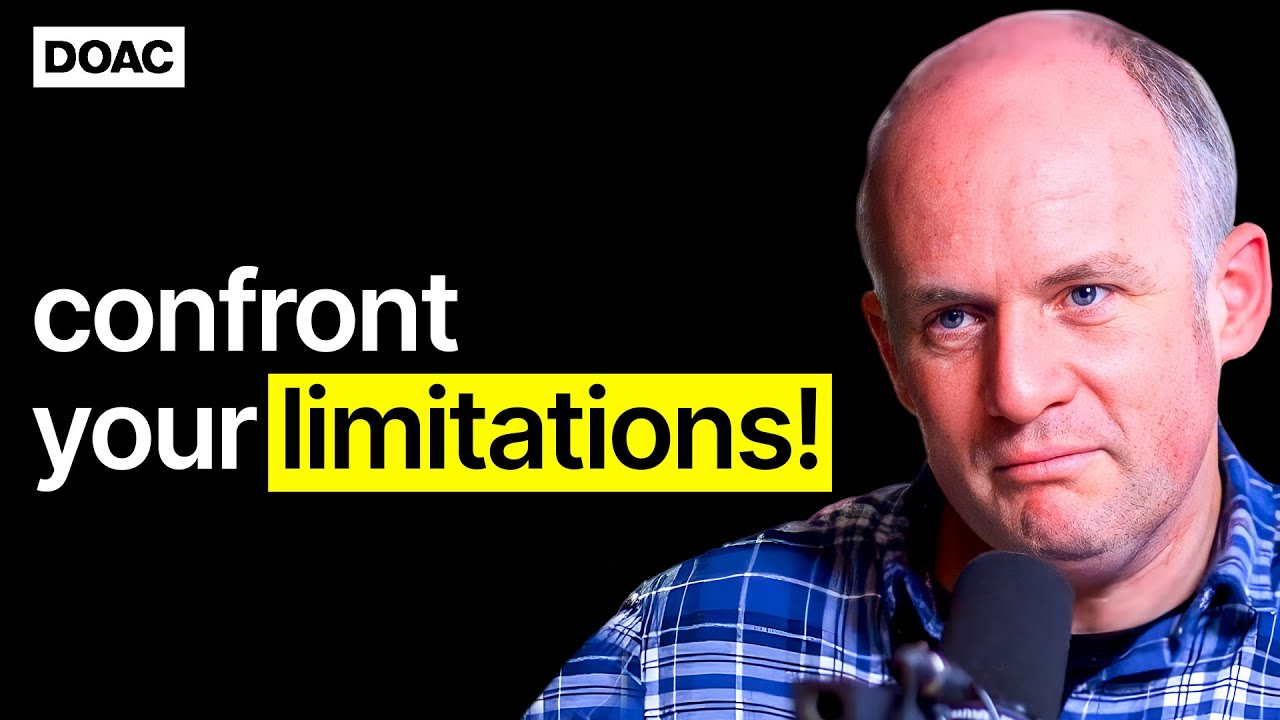
Any action that actually brings things into the world involves a confrontation with your limitations. Getting through that discomfort to what lies on the other side is so empowering.
Without further ado, I’m Steven Bartlett, and this is The Diary Of A CEO. I hope nobody’s listening, but if you are, then please keep this to yourself.
As a journalist, I was quite surprised to read some of the articles you'd written, and the subject matter wasn't necessarily always about the news or what's going on—it wasn't gossipy. It was quite existential and deep, about regret and life and happiness and these kinds of things. Where did the desire to talk about and to write and research those topics come from in you?
That’s a good question. I think early on when I was a journalist, I was doing whatever I needed to do and a lot of that was more newsy. But I’ve always wanted to try to bring into that kind of daily context these big, serious ideas. I think it's just because I'm fascinated by them, and I think I'm fascinated by them because on some level I struggle with them.
I don't think anyone, if they're honest, writes about happiness who is just completely happy all the time because then that topic is boring to that person. I think I'm probably a pretty anxious person going back—less so now, having spent years kind of therapizing myself in public in columns and books.
But that sense that you sort of need to find some secret to address your own issues—and also when it comes to sort of productivity and time management and all those topics—it’s like, maybe if I could find the system that would put me in total control of my time, then maybe I wouldn't need to feel worried about the future and things like that. We're all just sort of revealing our deepest issues in the things we choose to focus on and write about.
You alluded to it a little bit there, but you said one of the books you wrote was called *The Antidote: Happiness for People Who Can't Stand Positive Thinking*. Interesting title. What was the inspiration, and were you struggling with unhappiness?
By the time I wrote that, I had given all these things a lot of thought. I'd written this column for *The Guardian* for quite a few years and I sort of noticed this pattern emerging in the approaches and the philosophies that really seemed to do something for me—to sort of lift my spirits, help me navigate the world a bit more calmly and effectively.
And they were not what I call in that book "positive thinking." They were not "fill your mind with upbeat thoughts" and "set incredibly ambitious goals and try to push yourself relentlessly towards achieving them." It was actually much more to do with being open to negative stuff and being willing to feel anxiety, insecurity, uncertainty, and the potential for failure. All those things are actually a much more resilient way to be in the world, I think.
Plus, I guess it’s the contribution that I can make to the world of self-help and things like that—to bring my kind of pessimistic, slightly sardonic, British northern perspective. I don't know where this comes from culturally, really, but of a field like the self-help industry, just so much of it is rubbish. And at the same time, the topic that this is ultimately about is really important and you can't just dismiss it completely.
What would you say are some of the big sort of central misconceptions about how to become happy? Or what is it that fundamentally makes us unhappy? I sat here with Mo Gawdat, who wrote a book about happiness, *The Happiness Equation*, and he talks a lot about expectation management. When your expectations are too high and if your expectations go unmet, then we’re unhappy.
In a lot of your writings, you talk about being a bit more aware that any lack of productivity or hardship or struggle isn't a sign of our inadequacy as humans; it’s very much the nature of a full life.
In terms of misconceptions, I think the sort of fundamental one that I was writing about in that earlier book is the idea that happiness is best achieved by aiming for happiness. Setting out in your life to "get happy"—there's something amiss with this notion.
Happiness is the kind of thing that seems to arise as a byproduct of certain kinds of meaningful activity. But if you make it the goal of your life, you can sort of bear down on it too much and then it sort of goes away. The book on some level is about turning your attention away from happiness and finding happiness that way through the pursuit of reality—through engaging in meaningful activities.
We can talk about what "meaningful" means, I suppose, but not sort of "what will make me feel better or best" as the navigation aid that you use in life, and then happiness coming as a secondary effect of that. I think the crassest kind of positive thinking fails just because the human mind does not work like that. If what you decide is that you're always going to fill your mind with positive, upbeat, optimistic thoughts, then every negative thought that creeps in is like a new failure and something to feel stressed about and something to try to stamp out. That’s just sort of not true to the situation of who we are, which is a big mixture of all sorts of feelings.
So if we’re not aiming for happiness then, and we’re aiming for kind of the meaningful activities in the process, what have you come to learn are the meaningful activities that end up creating the byproduct of happiness?
It’s the question, and I don’t think I’ve come to the final answer in any of this. But I think "meaning"—it’s a really fascinating idea because I think people know in a sort of intuitive way whether what they’re doing is meaningful.
There’s a question that I write about that comes from a psychotherapist called James Hollis, whose work has had a really big impact on me, which is to ask of a choice or of a life path that you might be on: whether it’s enlarging you or diminishing you. I don’t think this language works for everybody, but for me, it’s like, "Oh, okay."
You can tell that there are times when life is not enjoyable, but it’s about growth what you’re doing. It’s like, it’s good that you’re doing it and it’s meaningful that you’re doing it. And then there are times when life might be perfectly fun, but if you really stop and think about it, it’s missing the point somehow.
I think an acute example of this that most people will have experience of is if a friend or a relation of yours is going through a crisis and you’re helping them out in some way. You’re there to just provide some company. I recall one example when some friends of mine were going through a really awful thing and I was literally doing the dry cleaning for them. It was just like they just needed help in this kind of way.
You have that feeling of "I’m in the right place here. There isn’t something else I ought to be doing now." Doesn’t mean it’s fun, because the whole situation is awful. Doesn’t mean it’s some great activity, because doing someone’s dry cleaning is not necessarily a great activity, but you know that you’re in the right place. I think that we can hope to have that feeling about quite a lot of the work and other things that we do in non-crisis moments. That’s how I kind of think about that. This is a good use of this day of your very limited time on the planet.
One of the things that I’ve used that seems to be pretty correct when I’m trying to figure out what is meaningful and gives me that feeling of fulfillment that I’m in the right place, as you describe it, is when I look back at the human struggle over thousands of years. Really, what made us survive? It tends to be the case that I feel best when I’m doing the things that are kind of in line with how my ancestors lived.
On one hand, you could say eating certain things and drinking and sleeping, but then, as we kind of described it there, it’s like banding together and collaborating. Ultimately, that’s central to why we’re here. And so it’s conceivable that our ancestors might have left that message in my genetic code to say, "Steven, not only are you going to struggle forward, but you’re going to do it together."
And so when you helped your friend with their dry cleaning, that was a really human act of banding together and support. But I feel like we’ve kind of lost track of those fundamental human things. Whenever we do them now—which is like helping each other, eating stuff that’s grown from the ground—the over-stimulation of digital items and screens in our lives, loneliness... these are all callings to get back to our tribe.
In fact, I’m coming to learn, despite what the happiness industry sells you, it actually might be really, really fundamentally simple in a way, which is trying to be more human.
Yeah, that’s such a good point. I’ve heard somebody express this as: you should ask, "Are you doing a few things every day that your ancestors would have done 250,000 years ago?"
Exercise.
Right. Being together in our tribes. Right. Being outdoors. The studies on being outdoors are really startling. And I think the problem is so many of us now—I mean, writers are the sort of ultimate example—but so many of us do what we mainly do with our days, which is manipulating symbols in one way or another. Images, words, ideas, all day long.
A lot of these things are so new. Writing is an incredibly modern invention on the evolutionary timescale, let alone podcasting. This is a sort of very low-grade productivity idea that I’ve written about and I think is really important: to try to think about anything you’re doing in terms of physical actions and physical next actions.
One thing I do when I’m writing, for example, is I sort of set goals that are to do with creating physical documents. I’m going to do this, I’m going to write this, I’m going to print it out, and it’s going to be something on my desk to hold in my hands that I did today. It’s very easy to get lost in that world that doesn’t have hard edges, that doesn’t have a physicality in it. It’s very alluring because it feels kind of God-like in that world if you spend all day with your head mainly occupying cyberspace or the metaverse. But yeah, you miss out on that essentially human stuff that you’re talking about.
And in your new book, you talk a lot about stripping back a lot of this bullshit that has consumed our lives—the complexity and these narratives which have been kind of sold by the happiness and efficiency and procrastination industry. Your new book, *4,000 Weeks: Time and How to Use It*, which I found incredibly important—I think that’s the best way to describe it.
I really want to go through a couple of the points in the book that I found compelling. The first is Chapter 1: The Limit-Embracing Life. You talk about this concept of embracing our limits. What did you mean by that?
Seems to me, and it’s certainly my experience, but I think it is more universal than just my issues, that a lot of what we do, the way we behave in the world and the way we try to manage our time especially, it’s all really based around trying to avoid confronting something about our situation.
It’s a kind of an emotional avoidance. It’s to avoid feeling what it is like to be who we are, which is finite human beings. *4,000 Weeks*, the title refers to the approximate length of average lifespan in the West.
Which is terrifying, by the way.
It is terrifying. It doesn’t sound like a lot. It was a risky decision, I realize in hindsight, to give the book this title because it might just cause people to run away from the bookshop and not buy the book. But anyway, we’re very finite in our amount of time. We’re obviously finite on the daily level, but also finite in how much control we can exert over it.
Nobody knows what’s happening in the very next moment. You can take actions to increase the likelihood that what you want is going to happen, but we’re all totally vulnerable to events and to every moment. It’s increasingly impossible to have complete knowledge about anything that you’re doing or any sphere in which you’re acting.
And then relationships inherently involve—romantic relationships, but all relationships—just inherently involve this kind of vulnerability to other people and things they might do to hurt you or bad things that might happen to them that would cause you to suffer. So we’re in this kind of very, very limited situation.
The main argument of my book is that if we followed through the ramifications of that, we would use our time in a somewhat different way and actually, I think, a more relaxing way. I don't think it's a kind of recipe for stress, although the title is probably a recipe for stress.
In productivity, for example, the quest to try to do everything, to become limitlessly optimized so that you can handle all your incoming email, you can pursue all your ambitions and business ventures, you can meet all the obligations you feel from your family and friends or from society... that’s trying to become unlimited. Trying to become limitless.
There are lots of other examples of this where I think what we’re really doing is just trying to avoid feeling our finitude. Some people want to say, "Well, isn’t it great to believe that we’re limitless because then you can do astonishing things?" And I want to say no. I think the kind of limitation I’m talking about—confronting it and feeling it and living into it—is actually the precondition of doing the most extraordinary things with a life because you get to give up on this impossible quest to fit yourself to every expectation that the world might have.
One in which you can only fail and feel inadequate.
Right. And just focus on doing those few things. The great inventors and the great entrepreneurs of today and the historical figures—they did things that people previously thought were impossible, yeah. But they very, very deliberately understood that using their time the way they wanted to use it meant sacrifices. It meant neglecting things that would be completely good things to do.
I’m sure you know what I’m talking about here. It’s like you have 25 things you could do. It’s not that only one of them is any good—24 of them are good. But even so, most of them are going to have to—you’re going to have to be able to withstand the anxiety of just neglecting most of them in order to focus on one or two others.
And fundamentally, you believe—which I also completely agree with—is in fact why I have this sand timer here, which I just picked off my desk before we started recording. You believe that people do go through life not realizing or believing that they will die. It’s almost like humans aren’t able to understand the concept of infinity and they’re also not able to understand the concept of finality. The fact that I will come to an end. So we don’t live in such a way, with such a belief.
If you look at a lot of the decisions I make, you would assert that I’m living like I think I’m going to live forever because of my misprioritization of things that actually clearly matter more. And this kind of constant deference of happiness to the future: "I will be happy when..." And then we live in—one of the things I say in my live show is I say to the audience that if you think about it, probably about 90% of this audience are currently living in a way in which a previous self of them told themselves if they got here, they would be happy. But their current self is saying, "Not now. We’ll be happy when..." So they’re deferring it again off into the future. People don’t live like they know they’re going to die, essentially.
Right. And I think something it's important to say about that is I think that mindset—I've seen it called, and I refer to it in the book as, the "when I finally" mindset. It's like, when something happens, then the moment of truth is going to come and after that life is going to be fulfilling and easy—but not yet.
It obviously, as you say, totally drains the meaning out of life in the present. But it serves again this purpose of avoidance because if you're always storing up fulfillment for the future, you don't have to acknowledge the fact that this is it. Life isn't a dress rehearsal. You've got to do things now if you're ever going to do them.
There's a great quote from John Maynard Keynes, the economist, that I use in there about how people who live in this mindset—and he's talking about pretty much everyone really—they're trying to secure for their actions a spurious and delusive immortality by always pushing them into the future.
So the man who thinks like this, Keynes writes, doesn't love his cat, but only his cat's kittens, and not really the kittens, but the kittens' kittens, and so on forever. And so the downside is that you never get to enjoy and value and find fulfillment in life now. But the upside is it sort of helps you feel like you might live forever. It's kind of useful to be putting things off because it helps this act of denial that we're all engaged in.
It also means that we continue as humans to struggle forward. We continue to take on struggle, whether it's challenge or ambition. We continue to be ambitious. And then I go, well, maybe that's also what allowed our ancestors to give birth to us. Because if our ancestors weren't trying to build a better tomorrow and kind of deferring gratitude to the empire that they were trying to build, then maybe we wouldn't be here. So is it a human thing to also kind of defer our happiness to the future?
I think it must be and really is, and I think we are sort of goal-seeking organisms. I think it's hugely compounded by the culture in which we live and the economic system in which we live. I think it's sort of gone into warp speed in a way that we could step back from.
But I also think that it’s not about giving up goals. It’s not about stopping trying to achieve things in the future. It’s about not investing the whole value of what you’re doing in those future outcomes. You can’t build anything—a relationship, business, creative work—you can’t do it unless you are partly focused on where you’re going. But you don’t have to be exclusively focused on where you’re going, and I would say you probably shouldn’t be exclusively focused on where you’re going because it will damage the product that you’re creating as well.
You might fall into the "efficiency trap," as you call it, which is Chapter 2.
Right. You get completely fixated on valuing the present only in terms of how it’s going to help create the future thing. And then you find what happens is that actually you get further and further away from achieving that thing because in trying to make yourself more efficient, in trying to sort of process more and more tasks to get closer to your goal, you make yourself more efficient and then more and more tasks flood in to fill the excess capacity.
This is Parkinson’s Law and a whole lot of other kinds of—it goes by a whole lot of names—but it's this idea that if all you do is make yourself more efficient, then you'll just be dealing with a greater incoming volume of things.
And "Inbox Zero" I felt was the perfect example of that in your book, where the better you get at sending emails and replying fast, in fact, the more replies you get. People come to know you as having a reputation of "he emails back quickly," which is going to beget even more emails. And then the challenge of getting to Inbox Zero becomes increasingly harder and then you find yourself drowning.
Yeah, absolutely. When you spell it out like that, it's like, of course. I remember when I was a young journalist sort of feeling overwhelmed by the number of articles I was being asked to write. So you get really, really better at writing them really fast, and you get a reputation for being able to write quite a long, complicated article in a short amount of time. Who's the editor going to ask when the next one comes up? I got a lot of benefit from being the person that the editor asked, but it certainly didn't make me less busy.
I think I have that a bit with my PA at the moment. She—I've got a reputation with her of being able to do 15 meetings a day. So my calendar is now 15 meetings a day and we've actually forgotten about the concept of like, "I need to eat at some point." I looked at my calendar the other day and I was with her in the car and I go, "Isn't it funny? Like every minute of the next 14 hours is scheduled, but there's no space for lunch or just calling, sending a voice note to my girlfriend."
I've kind of misprioritized my life, but again, it's because I've not fought back against it. By being successful at being efficient, I've brought more efficiency into my life and taken away things that give me meaning, like connecting with my girlfriend or my mother or my family or passions.
For me, when I've got into that kind of groove, that place where you're sort of pursuing efficiency at the expense of everything else, part of what's going on was always to do with self-worth. It's this idea that you've got to get to this point where you are this optimal and this efficient and productive that you wouldn't really be justifying your existence on the planet somehow if you didn't do all these things.
I think lots and lots of people who sort of accomplish stuff are driven to accomplish stuff because they feel like they need to accomplish stuff—like it's not okay if they don't accomplish stuff. And so that is a kind of never-ending treadmill as well because why are you going to decide that any particular given level of output or accomplishment is the one where you can relax?
One of the things I'm always at pains to try to get across talking about this book is that this is meant to be a relaxing message. I think this is a liberating message that can be like a weight off your shoulders because if you see that what you were doing was trying to do an impossible amount in order to feel like okay about yourself on some deep, buried level...
Well, if you really begin to internalize that it's impossible, then it can't be what you need to do in order to feel okay about yourself. Maybe you're okay already, and then the things that you do in the world are kind of extra. And then I think the message of our being finite, the message of our being limited, is not "So now you've got to like squeeze value out of every moment and go base-jumping every weekend or something, otherwise have you really lived?"
It's much more like, "Okay, oh, great. The pressure's off. I can't do an impossible amount. I can only do a few of the things that seem like they matter. So all I need to do is choose for now which ones seem the most important and focus on them and give my energy to them." It's much more doable.
I can completely relate to that attachment of efficiency to self-worth. It felt so—it felt like you were calling me out as you said it. And the other thing I have, which I've just realized as you were saying, was because I've become successful in the eyes of society, quote-unquote, I'm now also trying to live up to my own external reputation that people have of me.
People say, "Oh, Steve, you never sleep. You're so—you work so hard." So when I have days where I don't work really hard and I clearly just achieved nothing that day, I'm like haunted by my almost my reputation, which is largely false. My reputation that I don't sleep and that I'm working all the time and that I'm super productive and that I'm organized and I don't procrastinate—I'll tell you now, it is a load of bullshit.
Some days I do like—a lot of days I do way less than the people around me. But I have these moments now where if I have like an unproductive day or I've slept until midday for whatever reason—which happens a lot, by the way—or I've procrastinated, which happens every day, or I'm really unproductive, I go, "Bartlett, you're not being Steve Bartlett. You're a failure. You're letting down your reputation. You're a fraud. You are a fraud." I get that a lot—that feeling of—it doesn't cripple me, but that feeling of "Oh, if I look at today and I look at the reputation of Steven Bartlett, I am a fraud."
It's fascinating. I think it must be a lot worse with a high public profile, but I do think it's kind of almost a universal trait that a lot of people have. A lot of people who are sort of—well, thinking back we talked before about—I was sort of just your garden-variety high achiever at school, the kid getting their A-grades or whatever.
A lot of people in that situation have what is called in psychology—you probably know—a fixed mindset rather than a growth mindset. So one of the consequences of this is every time you do well, it's not something to be happy about because you did well; it's like something to feel pressure about because now that's the bar that you've got to reach next time.
And it's like, suddenly your success has become this standard that you've now got to meet every single time in the future. And that is like—it's an agonizing way to live. Usually that's people thinking that their inner critic demands it or their parents demand it. Obviously, the bigger your audience, the more you can fall into thinking that there are hundreds and hundreds of thousands of people who demand it.
But of course, that also gives you the power to do something very helpful and liberating for those people when you break the fourth wall and point out that it isn't like that.
The other one I always get is "morning routine." People will send me the DMs on Instagram like, "Steve, can you tell us your morning routine?" And I can almost imagine them at home like sending the DM and being sat there with their notepad ready for my response. And I'm like, honestly, sometimes I get out of bed at 11:00. Sometimes I don't sleep, so I end up getting out of bed at 1:00. Sometimes, you know, I'll get out at 6:00. There's no green juice. For me, there's no yoga. There's no continual meditation or run or whatever. It's a sloppy mess, the whole process. The whole process of me waking up is a really sloppy mess.
I'm trying to improve. I bring people here that talk about morning routines—it still doesn't seem to work. But despite of that, I'm happy. My businesses have gone well. My—I managed to achieve my ambitions, despite of my total imperfection in most key areas that the happiness industry would assert because they need to sell you complex things, or else why would you buy it if the truth is that you're going to be imperfect and that's okay? Maybe "I'm okay," you said. If that's the truth, it's hard to sell you it. But that's the truth as I know it and that's why I enjoy these conversations.
One thing I did talk about there was procrastination. This is a topic which I think honestly plagues people into feeling like they are inadequate. If I make a video on my Instagram about procrastination, it will outperform everything. Relationships perform the best; okay, number two is anything with the title "procrastination." Maybe I'll title this video about procrastination and it'll do really well. Why do people procrastinate?
Well, they watch those videos presumably while they should be getting on with the work in question. That's probably why procrastination videos are really popular.
On one level, there's lots of different reasons: fear of failure, fear of success, fear of all sorts of different things. But at a deep level, I make the argument anyway, you don't want to feel what it feels like to be limited and imperfect. And so if you hold onto a project, if you keep it in your mind in the world of fantasy, it can stay perfect. It can be later that you're going to do this great thing.
Any action that actually brings things into the world involves a confrontation with your limitations. Maybe you're not going to have the talent for it. Maybe it's not going to be well-received. Maybe it's going to be too complicated.
If I'm trying to write a chapter of a book, the stakes are high for me because I want it to go well, but I don't know that it is going to go well. I want it to be well-received, but I don't know that it will be well-received. It's so much nicer to just spend that time doing something kind of pointless and scrolling around or whatever because I don't have to confront my limitations.
And what I want to try to convey in that topic in this book anyway, I think, is to say, "Look, bringing anything into the world—studying for any qualification, doing any kind of creative work, launching any kind of business—the imperfection is guaranteed." Like, you definitely aren't going to get to bring it into the world in exactly in tune with your fantasy. And everyone is in the same boat, and this is completely unavoidable and baked in.
So you might as well do it, right? Because I think people get caught up in themselves. They think, "Well, I'm going to make a fool of myself" or "I'm going to let myself down" or "I'm going to let my friends or my parents down." But it's like, no, the imperfection, the fact that it will stumble and not be everything you dreamed it could have been—that ship has sailed. That's just for everyone. So now can we just move forward and do our imperfect things? And lots of them will turn out to be fantastic things, but they will all be imperfect because that's what it is to bring things into the world as a human being.
Knowing that and having written a chapter in your book called "Becoming a Better Procrastinator," do you still procrastinate?
Yes. I always feel like—my point about—I get asked this question and I'm always like, "Look, you've got to compare me with who I was before, not with this perfect person, because I am not that perfect person, but I am a lot better at it than I was."
Where I stumble on that is not so much anymore with the idea that it's got to be like perfect standard, because if you spend a few years as a journalist you get that sort of beaten out of you. Deadlines come, you just got to send the thing in, and you stop thinking after a while that your glorious prose has got to be perfect. You can't let it out of your sight until it's perfect because it's just never how it works.
Where I still run into trouble is that I do feel this urge to feel in control of all the things that are going on in my life and all the things going on in my work. So it's very tempting for me to say, "I've got to write that really important thing or I've got to think through this really important thing, but first I'm going to make sure that all my inboxes are under control and then I'm going to do all that admin about finances that I'd left and I better sort of rearrange my desk so that all the pens are straightened," whatever.
Displacement activities. Things that make me feel more in control of my world but actually don't move the things that I care about forward the most. I'm getting better on that too, but that's the thing—that's where the struggle is for me. I will definitely spend long periods of time getting my ducks in a row and clearing the decks. I write in the book about how you've really got to try and fight this urge to clear the decks because they will never be clear. So you've got to just get on with things, but work in progress for sure.
When your cat is acting weirder, or your dog is being louder, your turtle moves slower... hello, Ted? Your cat seems thirstier. Whoa, slow down, buddy. Or your puppy is acting clumsier. Day or night, if you don't know what's wrong, know where to go. Veg ER for Pets. This is Kate. Veg: The better, kinder ER for Pets.
The American Express Corporate program is more than a card; it's a complete solution. Apply for the right card for your employees, from everyday spenders to frequent travelers. Issue virtual cards to suppliers or project teams for added security and flexibility. Simplify accounts payable with American Express 1AP, helping your company automate supplier payments. The American Express Corporate Card program grows with you. Terms apply. Enrollment required and fees may apply, including an auto-renewing monthly platform access fee. Suppliers must be enrolled and located in the United States.
In that chapter about procrastination, you talk a lot about focus as well and this idea of avoiding your middling priorities, which I thought was really good advice. Could you talk a little bit about the importance of avoiding middling priorities?
Certainly. The story that dramatizes this is this idea that some people may have heard about—it’s attributed to Warren Buffett, but I think probably it didn’t come from Warren Buffett. People often just take wise sayings and say that Warren Buffett said that.
I wish they’d do that with me.
It’s Warren Buffett, Buddha, and Confucius, basically. So hopefully you as well. Right, right. But he is supposed to have been asked, "How do you decide what to prioritize in life?" and to have replied that you should make a list of your top 25 goals in life and order them numerically from 1 to 25. And then take the top five on that list and really focus on them in your life, and take the next 20 and avoid them like the plague because they are the ones that you care about enough to let them distract you from the top five, but not the ones that are easy to let go of because you don't really care about them.
They belong in this middle zone. Whether or not that exercise is a useful exercise, the principle here is that you have to sort be especially wary of claims on your attention and your time that do matter a bit, but just not as much as the things that you care about the most.
People talk all the time about the importance of learning to say no, right? But people often, I think, in the—there’s a subtext there. They think what that means is if you just learn to say no to all the stuff you don’t want to do, you can spend your time doing the stuff you do want to do. But I quote actually Elizabeth Gilbert, the writer, in the book saying like, "No, it's way harder than that. You have to say no to things that you do want to do." Because there are more things that matter than you have time for.
So middling priorities are, you know, that friendship that, yeah, it's fine, it's nice when you meet up with that person, but it's not—neither of you are getting that much out of it and it's taking another hour away from, I don't know, your partner, your child, your best friend. Definitely sort of work projects that sort of, yeah, you can do them, you could handle that, it might make you a little bit of money or whatever, but it's just not—it's not the number one thing. Takes quite a lot to resist those because they—they're not unimportant. They're just not important enough.
And it feels like more is more, but as the phrase goes, in this context, less is more. I've observed that in my life anyway—if you want to be successful in business, then focusing on one as opposed to having three startups is much better. But some people will brag about how many businesses they run or how many things they do, as if they believe that that makes them more valuable. They'll brag about how many friends they have as opposed to the quality of them. And it tends to be the case that that phrase "less is more" is true in the sense of focusing on less things gives you much more meaning and depth in life, and that's ultimately what matters.
Yeah, and actually I think it's probably the way to accomplish more things as well. One thing that I've found—I can't talk on the level of businesses launched, but only on the level of articles and books written—is the degree to which I can do things sequentially and train myself to do one big thing at a time and wait until it's finished before you move on to the next one.
Takes kind of guts to do it because it feels better to have a finger in every pie at once, but to the extent that I can do that, to that extent I get more of those things done because you make most of them wait, you focus on one, you do it, and then it's finished, and then you bring the next one in and you do that. It's so tempting to sort of dissipate your energies because I think it makes you feel—back to the same idea—it makes you feel limitless. It makes you feel like you can wrap your arms around the whole world. It stops people, in the case of my work, it stops people pestering you because, like, "Where's that thing you said you'd do?"
And it's very nice to live in that world of multitasking and multiprojects, but it's not the most effective way to get the things done.
Yeah, I'm struggling with that, I think, for sure. And I think as well, when you've got more opportunity—I get a lot of people sending me a lot of things to do these days, a lot of things that I could do—it becomes an even greater and more important skill to master. We had one day last week where they're like every journalist across these multiple newspapers wants to speak to you about this donation I made.
And there's part of me that goes, "Oh, yeah, that's great. I'll do all of these TV things that day." But then, of course, it comes at the cost of something else. And we never really focus on the cost, right? It seems like—and that's kind of the curse I have in my mind sometimes—is I'm too focused on the benefit of doing the thing as if—which is basically the premise of your book—as if my time was unlimited.
You know, it's like I remember reading about this thing which has weirdly stayed in my mind for many years: this idea that they believe humans can only juggle a certain amount of balls because of the physics of a ball going up and then the speed in which one could possibly move. So they think it's 14. And nobody's been able to break the world record ever.
Is that the record?
The 14th ball. No one's ever been able to juggle more than 14 balls. And that record has held because of the physics of the balls going up and the way that they would collide if you made it 15. And that made me think there is a physical limitation to the amount of balls we can physically juggle as humans, and the balls you pick up come at the expense of the ones you don't.
And that's—I've tried to remember that—that I have to pick my 14 balls in life—not fucking 14, I can probably do two—but I have to pick my balls in life and realize that every one I pick is at the expense of another. And even looking at—I write in my book that I really love waffles, but I also like to want to have a six-pack. I can only pick one. Really, I can only—you know, it's a metaphor, but like I have to choose which one's important.
And it's the same with cheating. Some people might like having sex, but they also might like having a relationship, and you have to realize that if you want to be in a faithful relationship, it comes at the cost of something.
Right. And I think that, you know, we spend so much effort trying to avoid thinking about costs or trying to avoid incurring them. But again, there's something freeing about seeing that you are always incurring costs. Every decision to spend an hour doing anything is a decision to not spend it doing other things. Every path you choose, you're declining to choose all these other paths.
It's painful because it means that loss is built into living a human life, but it's also like it's so unavoidable. Like, there's nothing that can be done about that—that's just built into being finite. So in a way, we can relax about that a little bit.
And to be fair, if there wasn't cost, though, things wouldn't be special. Like if life was forever, if I could have the best of both worlds, then the one I choose wouldn't have it—scarcity adds value, they say.
Totally. I mean, there's been philosophical work going back on: "Would you actually want to be immortal if you could?" I agree, yeah, I don't think you would. Because I think, as I write in the book, like if you were immortal, the answer to the question "Should I do X with my day today?" would always just be "Who cares?" because if you didn't do it today, you could do it on any number of other days stretching off into infinity. So I think absolutely. It’s not pleasant to confront our finitude, but life would have no meaning if it didn’t stop.
You write about watermelons in your book. Chapter 5 is about the "watermelon problem."
The famous BuzzFeed watermelon. This was what, five years ago now? Two journalists from BuzzFeed put rubber bands around a watermelon and they just kept adding rubber bands. I think it was like 600 and something rubber bands before the watermelon just exploded. That was the end of the Facebook Live.
But the point that I’m using it to make is that millions of people watched that. And I’m not—I don't think there’s anything terrible with spending an hour of your life watching people put rubber bands around a watermelon—but they didn't *choose* to watch it.
That’s a very clear example of the way in which, especially in the sort of attention economy that we live in now, your attention is incredibly important because what you pay attention to just *is* your life. What you pay attention to over the course of a life is just what your life was. And yet it's very easily hijackable.
And nobody who ended up watching that hour got up that morning thinking, "What I'd really like to do today is spend an hour watching people put rubber bands around a watermelon." So it's just really the question of distraction, the question of how we steward our attention. And again, if you want a break in the middle of the day and someone's doing some stunt involving a watermelon, fine. But just bringing consciousness to that fact that when we pay attention to things, we are *paying* very literally with little chunks of our life.
Have you found any practical ways to make yourself less distracted by such compelling videos?
There's really two parts to this, I think. One is, especially in the modern era, the source of the distraction. So definitely, like I don't have social media on my phone; I do that on a laptop exclusively. I've sort of—I have a set of ever-shifting and never perfectly observed set of personal rules about when I will turn to my email and when I will turn to the internet and when I will be sort of offline and focused on writing and thinking.
But the other side of it, I think, is the distractability. Not just the things that are reaching out to grab our attention, but the fact that we kind of go along willingly with this stuff. And again, it's just my one thesis, but I think the reason that we're doing that is because it's much more comfortable than focusing on hard stuff.
Focusing on hard stuff is unpleasant sometimes because it brings us into contact with our limitations, and then distraction is a much nicer thing to do with that time because it doesn't. So really a big part of this for me—and it's been definitely a slow, gradual thing; it's not a sort of one clever trick or something—is just to expect a certain amount of discomfort in things that matter.
Just to expect that writing—I keep using this example because it's personal to me—but like that it feels difficult. Cal Newport, who wrote the book *Deep Work and Digital Minimalism*, has this argument that what people call "writer's block" is just the feeling of writing. Because it's a hard thing to do and sometimes you might get into flow—great—but most of the time it's probably going to be a question of like, it's like a little bit hard.
And the analogy that people always use is with weightlifting. You don't expect that to feel non-uncomfortable. There are certain areas where growth involves discomfort and we're okay with that. And then there are other areas, often involving cognitive activities, where we're somehow deeply offended that it feels a bit difficult to do it. But no, it does.
The other thing that I always think is extraordinarily difficult is really listening to another person. It never really gets super easy, that, I think—especially in relationships, to sort of really concentrate on what someone is saying and not just be thinking, "Oh, but then when they're finished, this is what I'm going to say." It takes effort. And if your response to that feeling of effort is like, "I can't feel effort, it must be easy," then it's going to be much more tempting to just be like checking your phone when you should be listening or something. So just a bit of a willingness to experience mild discomfort. I think it's kind of a superpower.
Yeah, and obviously there's a lot of social narratives that kind of point at it as being a failure. Like you're right, even the phrase "writer's block." The word "block" doesn't feel like very natural; it feels like there's something that must be urgently cleared.
You've got a disorder, right. It’s like a disease.
And it's so funny because you said at the start of this some of these new inventions are really holding us back, like words and vocabulary. Even I talk a lot about in my book the idea of "finding your passion." There's so many like things hidden within that phrase. First, you have to go and search for it because of the word "find." So people go off in search of this thing that they think they can find. It alludes to the fact that it's singular, because the word "passion" is singular.
So I'm looking for an Easter egg somewhere which I need to go and search and find, and if I don't find it, then I'm a failure. And much of the messages I get in my DMs are kids that are feeling inadequate and like they are a failure because they haven't found their passion. When if you just say, "Well, maybe it's not something that you have to go and search of necessarily, and maybe there's more than one," it can be a really liberating thing.
And I think words generally are really constrained and they cause people a ton of pain. "Are you in love?" My mom comes home—I'm dating someone—she goes, "Is it love?" Immediately my brain scrambles trying to figure out if what I feel is the same as the definition that she feels, because I said I loved peanut butter, but this is different. And it also begets a binary response: yes or no.
Yeah, makes you so self-conscious that you can't actually give yourself to the experience. That's reminding me of when I became a father. Literally 95% of people who I interacted with who were parents themselves already would say, "Oh, you should really savor these early months with the newborn baby. It's so special, you should really savor it."
And this is true; it is incredibly special. But all it did to me was have me thinking like, "Oh my goodness, am I savoring this in the right way? Am I..." and then, of course, you're certainly not savoring it in that time because you're just like lost in your head. It's just another example of it.
And I guess the antidote is to liberate yourself from the expectation of words and phrases and social expectations that you should feel and act a certain way and be able to answer certain questions.
Yeah, or just to understand that things are complicated and you only—they sort of congeal over time and you sometimes only understand things in the rearview mirror and you just sort of have to navigate intuitively. You probably do know when you're in a relationship and you don't know if it's love, you probably do know if it feels like it's got forward motion or if it feels terribly stagnant, or if it feels... you can sort of intuit these things even if you can't slot them into these kind of rigid categories.
I might get this quote wrong, but when you're talking about cognitive behavioral therapy, and in fact we can achieve a form of—which may be better than cognitive behavioral therapy—of that therapy with self-analysis in various ways. For me, this podcast and the diary that I had to keep originally when it first started to do it, and also this obligation I have to make content for the world, has been one of the greatest forms of therapy I've ever encountered. And I always think it's like one of the unappreciated ways to arrive at self-awareness, overcome your own bullshit, and—which is having to write, having to think, and having to try and find the truth in your own experience. Can you relate to that?
No, totally. And for me, there's lots of research about how writing down your personal problems, for example, is incredibly—journaling, it works and it's proven to work. It's not necessarily because you come up with solutions, although that can happen. It's because you end up—you sort of have to take this third-person stance on your own mental contents, and you have to do that for sure if you're trying to package it in some form that other people can benefit from or can understand.
So writing for an audience is absolutely an example of that. There's something incredibly powerful in seeing your issues, your interests, whatever, from the perspective of another person. I think it's related to that thing about how so often in life, you know, our friends can see what we need to do or what's needed in our lives a bit more clearly than we can because you sort of—you can't see the wood from the trees inside your own head. But they can be like, "No, very obviously you need to do this and then this." So it's a little bit of that effect as well.
And how you can always give better advice than you live by.
No, absolutely. Tell me about it.
The consequences of having this highly efficient, productivity-focused life, you see it in people. You were talking earlier about the great innovators of the world that manage to focus on a set of priorities. But when you ask these people if they're happy, like Elon Musk—if he's happy, no one thinks Elon Musk is happy. And I think he said in the Rogan interview that "you wouldn't like to be me, you wouldn't like to be in my head." But we still seem to pursue that over what we think will make us happy anyway.
I think that all of us have something inside us that we're sort of here—if this doesn't sound too supernatural—that we're sort of here to express and to put out into the world. I think it gets complicated because some people—I don't want to accuse Elon Musk of this, but I think it's probably very often true of a certain kind of very driven people—it's not just that they're sort of trying to bring their gift into the world; it's an odd and not necessarily helpful way to try to sort out certain like psychological issues they have.
So they feel that they have to achieve a certain amount because they were not given sufficient unconditional love by their parents, so they need it from the world. Or they feel that they need to justify their existence in some way. And then it gets hard to know when to stop; it gets hard to tell the difference between success and things that are truly bringing you happiness.
But at the same time, right, it's important to not suggest, I think, that the ideal is to be for everyone to be so completely chilled out that all you would want to do is lie in a hammock on a beach and sort of not create things in one way or another. That might be appropriate for some people, but there is this fear when I talk about this stuff and write about this stuff of like, "Oh, wouldn't it lead you to just think, well, why do anything? Wouldn't it all just lead us to be sort of nihilists in that way?"
And I don't think so, for that reason. But I also think, like, let's cross that bridge when we come to it. We're already so driven and so sort of trying to get more and more and more done that there's not a huge risk yet of us becoming so Zen about all these things that we kind of stop achieving entirely.
I pondered that a lot in my life—this idea that, because one of the things you said earlier was "maybe I'm okay." This kind of realization that maybe I am already enough. Maybe none of these goals are going to increase my value. Maybe even if I become a multimillionaire, Steven Bartlett is just going to be worth one Steven Bartlett still.
I pondered that when I became a millionaire, right, when my company listed on the stock market. And I thought, "Well, this doesn't feel any different. In fact, the anticlimax makes me feel pretty bad." The expectation that I was going to feel like I was more worthy—the anticlimax of that has made me feel worse.
And then asking myself the question: "Well, if I am already enough, then what's the point in striving for more?" And my conclusion on all of this ponderance was that realizing that I'm enough is actually the foundation for real ambition.
When I was insecure enough to believe that money or a Lamborghini might make me more, I was striving for things that weren't my real ambitions; they were social ambitions. And the minute you realize you're enough and that Lamborghini isn't going to do it, then you start replanning your ambitions and go, "Do you know what? I actually love doing this piano and hanging out with my niece." So that feeling that I am enough is the foundation for real ambition.
Totally. Yeah, no, I think that's a great—that's such a good way of putting it. I mean, the way I've sometimes thought about this is like ambition and achievement and creation—they don't have to be the thing you're doing, the thing that you need to do in order to *get* somewhere. They can be the thing you do just to express the fact that it's great to be here and that it's great to have these skills and these opportunities.
I'm not religious, but there is this idea in Christianity that I keep running up against now because people contact me and say, "Have you thought about this because it's clearly related?" This notion of grace—that you can't justify yourself by your works in the world. You can't sort of achieve salvation by what you do. But you also don't—in this model anyway—you don't need to achieve it either because you're already justified in the eyes of God, if you're a religious person.
And so the reason that you do things like this, from the reason that you then do stuff in the world, is—is again it's just like, yeah, it's for the—it's an act of like glorification or worship, right? Or for as we were saying, like just expressing the fact that it's great to be able to do these things and like, hey, you could never have been born. So it's not a reason to not do things; it's that you're not doing them to try to justify yourself in the eyes of the world. Doesn't mean you don't do things; it just means you do them from a different motivation, which is like, "Hey, I get to do these things. That's great."
I feel like these existential thinkers are somewhat tortured sometimes. Do you relate to that?
Sure. I mean, I think, you know, there's a philosopher who died recently, Brian Magee, who talks about the distinction between people who sort of "have" philosophical problems and don't. And what he means is that from the age of like five, he can remember lying in a field looking up at the sky and thinking, "It can't be that the universe stops somewhere, but it also can't be that it goes on forever. Like, what?"
And saying that there are people who are sort of troubled by these things in some real personal way, and then there are people who are not troubled by those things. They may be very intelligent and deep people, but they don't have these kind of "Hold on, what is it all about? What was it?" and anyway, I'm one of the people who does and it sounds like you are too. But yeah, there would be something nice to not be, perhaps.
In your book, you say that we're addicted to the speed of life. Is that true, and why is it an addiction?
I'm talking there about the sort of acceleration of the culture—the fact that everything moves so fast that we're able to do so many things so much more quickly. Travel, communicate, cook food than we once could. And how—and why that—if you stop and think about it, it's really weird that all that technology and all that acceleration has not left us feeling more relaxed and chilled out, right? Because it saves time.
The world that has 747s in it and microwaves in it and the internet in it ought, by rights, to feel much calmer because all this time is saved. But of course, it doesn't have that effect. It makes everybody feel more impatient and rushed.
And I think the reason that the frame of addiction makes sense—I'm drawing on the work of a therapist called Stephanie Brown who was herself an alcoholic, got sober with AA, then started being a therapist in Silicon Valley to various people in the sort of first dot-com boom around 2000. And seeing in them this trait in their addiction to what she called their "addiction to urgency," their "addiction to speed," that reminded her very much of her youthful experiences as an alcoholic.
Namely, that your life speeds up, you feel overwhelmed, you think that going faster has got to be the solution, right? If you go even faster then you can cope with all this rush of incoming information, incoming opportunities, whatever it is. So you go faster, but then you find that actually that's just increased the speed of everything and now you need to go faster still and it's a sort of—it's a spiral and you crash.
There's controversy about talking about addiction—whether it should be kept as a sort of strictly kind of medical idea—but I think that's really—it resonates with me because I feel like it's very tempting in this world that feels like there's so much stuff to stay on top of and it moves at such a tempo. There is this notion that like the only solution is for you to go even faster than it to be able to encompass all of that.
And this is—this is not going to work because you are never going to be able to—you know, there is an infinite supply, right? There's an effectively infinite number of emails you could receive, demands your boss could make, opportunities you could pursue, businesses you could start, whatever. To getting faster at going through an infinite supply—you don't get to the end of that because it's infinite.
So Stephanie Brown's advice to her clients, and I think it's very useful, is that all of us who are sort of moving at this speed need to experiment a little bit with what it feels like to just slow down to the speed that things take. And say, "You know what? I'm going to read this novel and it takes my time and I need to read slowly and focus."
I'm just going to—yeah, it's not going to feel great at first, right? Because we are wired for racing through things and it doesn't feel great at first, but it is a path to a much deeper kind of engagement with the world.
One of the things I do in the book is write about this exercise that I did that is recommended by an art historian at Harvard University who I went to interview. She has all her students choose a painting and go and look at it for three hours. Like sit on a little bench, whatever, and just look at that painting for three hours. Take notes if you want, but you're not allowed to get up.
And she knows it's like completely insane for almost anybody today to envisage doing something like that for three hours. But that's why she suggests it. And, you know, for the first hour, it's incredibly uncomfortable because you're not in charge anymore—you can't race through the day in the way that you were accustomed to doing—but it is so useful because getting through that discomfort to what lies on the other side is so empowering.
I think patience is really a kind of a superpower in the modern world. And in the context of a painting, what happens is you literally see things in the painting that you hadn't seen in the first 45 minutes. I mean, it's bizarre. In the context of work, creative work, business, I think it's more just that when everyone is racing as fast as they are today, there's actually real power in being able to resist that and let things take the time they take and think about something for a few more days if that's what it takes. Like, you actually can have more success that way as well as feel less like a headless chicken.
Is there a role of impatience, though? Is there a role somewhere in life for impatience?
Depends how you define it. All right, so in the book I'm talking about impatience as wanting things to go faster than you can have them go. So then I'd say like, no, there's never any—even if you're sort of driving somebody to the hospital because they're going into labor or something, right? I mean, it's like you should do that really fast, you should be urgent, you should prioritize that, and you should, you know, go as—you should drive as fast as is practical.
But even then, it's probably not worth feeling frustrated that you're stuck in traffic or something, right? I mean, it's—so if impatience is that kind of frustration at the fact that you have limited control over how fast the world goes, how fast something happens, then no. I mean, it's—it's just wild, right? We now are much more impatient—like if a webpage takes five seconds to load, like you can *feel* it. It's ridiculous. But as if somebody says, "Yeah, I'll put that stuff in the mail and you'll get it in three days," you're like, "That's fine," right? It's—it's just—
Speak for yourself.
Okay, all right. The mail? I'm sure, yeah, those of us who still use the mail, right. But like that—the faster things get, the more offensive it is when they still only take a few seconds—when there's a few seconds' delay. If we're using the word in another way to mean having a sort of hunger for things to change in your life or change in society, you know, you're not willing to sort of sit around and be a doormat while things—when you could change things, then sure, I think that's a different kind of impatience and I'm sure it has a role.
In your book, you talk about embracing "radical incrementalism." What does that mean for you?
This is the idea that there are contexts where really being willing to make progress on the basis of little and often, right? Kind of gradual progress—to do a tiny bit at a time and not kind of binging on the things you're trying to achieve can be really powerful.
Again, I'm sorry to keep coming back to writing as an example, but the work that I'm drawing on there is from a psychologist called Robert Boice, who studied academics who write and trying to figure out like, who are the ones who actually get a ton of papers published and a ton of books written, and who are the ones who get mired in procrastination and paralysis.
And he found that the really productive people in that sphere were the ones who made writing a modest part of their daily life, right? It occupied like a couple of hours maybe, as opposed to the ones who made it into this huge thing that then became very intimidating and they got all sorts of like psychodramas going on with it. Because it was something they were willing to sort of do for a little bit, leave aside, come back to.
And I think this applies to especially applies to anything that is like brain work, but I think it applies to pretty much all all kinds of endeavor, right? There's often a huge benefit in being willing to say, "Well, I'm going to work on this for a tiny amount of time today and I'm going to stop, even if I'm on a roll," right? When my time is up, I'm going to stop and then I'm going to come back—it makes it something that you can sustain day after day after day.
If you do the opposite of incrementalism—if you give this sort of absolute center stage in your life—then if it goes well, great, but if it doesn't go well, it becomes this kind of huge, intimidating thing. And I've found that, you know, if I'm working on a book, say, really sort of almost embarrassingly small workdays on it regularly done day after day after day, so much more productive like in terms of the actual output.
What about deadlines, though? Because when I wrote my book, I think the deadline of having to send it to the publisher just hung over me and was like forcing me to, "Okay, Steve, today you have to write 3,000 words."
Yeah, I think deadlines have their role, right? And I, you know, I would have got nowhere without deadlines in newspapers because they sort of helped me sort of bust through perfectionism and stuff because it was just literally, you know, it's—I did these things on a—I would write these kind of features for *The Guardian* where I had to like the idea came to me or was given to me at like 10:30 in the morning and 5:00 PM they needed a 2,500-word researched article. You'd just be like, "Okay, I've just got to do it."
But in a way, I'm sort of training myself out of that now, and I think to make it isn't a—it's perfectly okay and it's fine, but it isn't sustainable. I think that to really over the long haul be able to do something like like writing, I found, requires that I acquire this ability for sort of dogged persistence rather than, you know, cruising to the to the deadline.
Another topic that people hate talking about, or at least it seems to make people really uncomfortable—and I sometimes I just bring up the conversation because I like to see—I find the reaction to be really fascinating—is this idea which you talk about, which is that we need to embrace our like relative irrelevance in the world. Oh yeah. And when I say this to people, you can see it sometimes shattering something in them—the idea that they don't matter. In the grand scheme of the universe, they really don't matter. What is the upside of embracing my own irrelevance, and do I matter, Oliver?
Depends what you mean by "matter."
Do I matter in the grand scheme of the universe?
I don't really think any of us—I mean, I think, what I'm—what I want to say about this is if you adopt a cosmic timescale, right, if you look at the history of like the cosmos or even just the planet, like no human life or even anything that is done in a human life, you know, almost nothing will outlive us.
And the things that do outlive us slightly, you know, people inventing great scientific breakthroughs or something, even then the period that these have been relevant if you look at the cosmos is still like a tiny blink of an eye. So I think there is a sort of inbuilt bias that most of us have—not just the ones who are megalomaniacs, but almost all of us—to think sort of subliminally of history as having led up to like *our* bit of history, right? And then to think of the decisions that we take and the things that we're doing as fundamentally the most important things that are going on in that bit of history.
And that's—on some level we probably have to, right? Just to sort of to be able to like get up in the morning, you can't think of yourself as this kind of tiny pinprick of light in the middle of eons of darkness of the cosmos from the Big Bang to when the universe ends or whatever. But actually, you can really get bogged down in that. You can really be like—well, you can spend a long time mired in indecision about things because you've built the stakes up in your head to an enormous degree.
You can really get sort of depressed about whether you can really have an impact on things because it has to be something that lives for millennia after you're gone or something. And when you realize how little most of it's going to matter quite soon—I some people do go down that into like despair and horror—but I think that is a reason to be like, "Why not take the risk? Like why not do the bold things?"
It’s like the stakes are a lot lower than you thought. The universe doesn't really care. You don't need to worry about whether you're fulfilling your purpose that the universe had laid down for you because there kind of isn't one. And that's actually a bit liberating.
It's a reason to sort of experimentally do the things that seem to you like the coolest things to do. Then what you can do is you can use a definition of "mattering" according to which so much that we do matters, right? Because I think it's difficult for people to remember that like, I don't know—I don't want to use a definition of a meaningful life that rules out some very mundane things like caring for a sick relative, cooking nutritious meals for your kids, making your neighborhood a slightly more beautiful place to live in. We don't want a definition of a meaningful life that says none of those things are meaningful, surely.
And so, yeah, I can imagine that it's an interesting issue for people who look up to you specifically, for example, thinking that they've gotta emulate you in order to be doing something meaningful rather than be inspired by you, which is a different point, right? Because actually very, very everyday, mundane things can be meaningful and it's quite possible that the most fulfilled people on the planet are precisely the ones you never hear from because they're doing low-profile things.
And then, you know, I have this theory—maybe it's insulting to you, this theory—but I have this theory that like the more of a public profile someone has—and I have a modest one, so it applies to me too—but like that's probably like to that degree is like they're screwed up in some way because they have some problem with not being ordinary.
I'm deeply offended. I'm deep—by the truth! And then you know the Hollywood A-list—those people are probably the most screwed up. No, it is—I mean, it definitely begets more problems. I noticed that this week: I had a journalist email me saying that "five years ago one of your ex-employees says your dog did a poop in the office and you didn't pick it up." And I thought, "Fucking hell, this is what my life has become."
Like genuinely, and I was ponder—I’ve been pondering it ever since I received that email, that now that my life is of a somewhat public interest, it means every—every like fault I might have made or didn't make—I'm now going to be like scrutinized for and I'm now going to have to justify because if I don't, then my life could be canceled. Which is a tough bar to live by, and one I wish I didn't have to live by, to be honest.
But it—it is fascinating because if I had said that, you know, our own death and irrelevance could be a motivating force, it doesn't appear on the surface that that makes sense. But I completely agree that my own—like the finality of my life and my own irrelevance are two things that liberate me from getting caught up in the idea that a comment on Instagram matters or how my hair is matters. And that hopefully liberates me enough to go in the pursuit of things that do provide me with my own subjective meaning in life.
Yeah, and that help other people and lift other people up, right? It's not that—when I talk in the book about "cosmic insignificance" and I sort of mean that, right? It's like from the perspective of the cosmos, no, it doesn't matter. But that doesn't mean that it doesn't matter. It can matter to people here today, you know.
§02Transcript — part 2
One of the things we do in this podcast—a long-standing tradition—is we ask people who have just come in to leave a question for the next guest. So the last guest leaves a question for the next guest. Before I do that, in the back of your book, you leave the reader five questions for them to ponder. I wanted to ask you one of your own questions from the five that you left. So I'm going to go for Question 4: "In which areas of your life are you still holding back until you feel like you know what you're doing?"
Yeah, this is definitely one that speaks to me. I mean, obviously I put the questions in because they speak to me, but like this is this difficulty that I think we all have but I really have had with realizing that like on some level everyone is winging it. So it sort of speaks to impostor syndrome and things like that and and and and not launching into things until you feel that you're ready.
Recently since the book was out, I've been giving more sort of talks and speeches than I have ever done in my life before, and you know, I've sort of been forced into not holding back on that because the invitations come in and I say yes to them and then it's like, "Oh my God, I've got to do this." That is something where I feel perpetually unready and if it was up to me, I would probably have left it you know—some more, I mean it was up to me, but like if I'd felt that it was up to me, I would have left it some more years to sort of get really good at doing that and and I'm and I'm not ready. But it seems to be going okay. I kind of evaded that question by starting by giving you an example of something where I'm not holding back because I'm actually doing them. But—
I think that answer was really good. Does it count? Okay. No, it does count and it really speaks to—because I also believe that had it been of your own choice to get really good before you do it, you probably never would have done it. Which is what most people—it's like the trap of the mind: "I will launch my business when I have some time" or "I will launch when I am—I've learned something." But we never—there's never a perfect time. So unfortunately we're forced into picking an imperfect time, and "now" is always an imperfect time. So I always try and implore people on that basis to do the thing that they think the perfect day will enable.
Now to ask you the question that our previous guest did leave. Do you do enough to keep learning?
That's a very good question. No, I—there are definitely—I definitely aspire to make more space in my days for especially for reading.
Why?
Because it gets squeezed out by by doing things related to writing and books. It actually gets hard to sort of keep that section of of time for just sort of the exploration of ideas in in that way. On the other hand, I want to say that things like becoming a parent, even things like moving back from New York to the UK—like there are certain ways in which you learn that are not like book-based learning and you just sort of are dragged forwards in your education whether you like it or not. And I think in those ways, it's more a question of seeing what you're being taught and that you are learning than needing to make more time for learning. But that's an interesting question.
But also in your being pulled into speaking more and all that, that—
Yeah, absolutely! New skills that you have to sort of—you're doing that. Yeah, no, totally. But it is—but it is—just the honest answer is it is something that I I don't feel sort of satisfied about in terms of my the apportionment of my of my time at the moment.
What about stuff like this and coming here today? How did you feel about—
No, this is—I love this kind of conversation and and I think obviously you learn from it completely. But so I think what I'm talking about is sort of yeah, I guess it is the I guess it is exposing myself to new avenues of thinking that are not sort of jumping off from things that I've already thought about. Yeah, I don't know. Yeah, I—this kind of conversation is great.
Well, thank you, and thank you for writing such a brilliant book. One that I feel like is going to liberate people from a lot of bullshit that's holding them back in many, many ways—from stress to anxiety to feelings of inadequacy because we're trying to live up to a social expectation that is un-unachievable. And I think I know for a fact that, based on the questions I get asked a lot in my DMs, that my audience should read this book.
So I implore them to do so because also the way that you write is from such a nuanced human perspective, which is avoiding the like cheap answers or the binary answers to to some of the big questions about life, productivity, efficiency, and everything that plagues us in the modern world. So thank you for writing such a great book, thank you for your time as well, and yeah, it's been an absolute pleasure chatting to you.
Thank you so much, that's so kind of you to say. I've really enjoyed it.
Thank you.
From taco night in Tulum to sushi in Tokyo, every bite is rewarding and post-worthy with Amex Gold's 4x Membership Rewards points at restaurants worldwide. Wherever you dine, points are piling up. So bring your friends along for your next course, because it's not all about the posts; it's about the company and the memories. How can Gold from Amex sweeten your next food moment? Learn more at americanexpress.com/explore-gold. Terms and points cap apply.