
Chris Eubank Jr. Opens Up About His Grief, Living In His Father’s Shadow & His Future
Guests: Chris
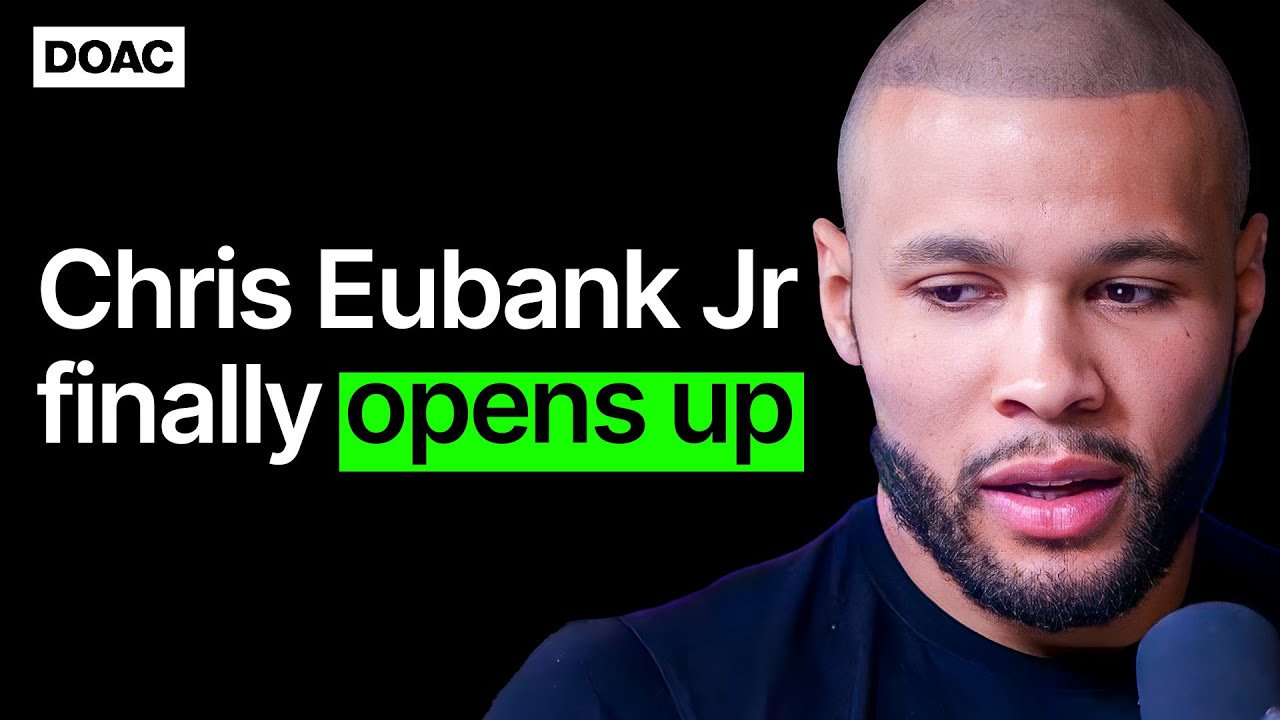
Full transcript · Read the full conversation in order, with its original context.
Contents1 chapter
§01Transcript — part 1§01Transcript — part 1
Paying extra for tire care is BS. Bad service. So at Midas, we’re rolling out our BS-free tire guarantee, included with paid installation and tax on every purchase. You’ll pay nothing for flat replacements, nada for flat repairs, and zilch for tire rotations every 5,000 miles. That’s zero dollars for all that. So with this limited lifetime tire guarantee, you’ll pay a whole lot of nothing compared to what the other guys charge for tire care. That’s the BS-free tire guarantee, only at Midas.
I don't do a lot of interviews like this, so there are not a lot of people that do get to see this side of me.
Chris Eubank Jr.! The biggest fight of his life!
Growing up, I was always Chris Eubank's son. A lot of people would say, "He's trying to steal your son's limelight." To a certain extent, maybe he was. I have to do something here to where people know me for me.
I got myself into this gang. Some kid had gotten my number. He was like, "Wait till I find you." I went into school with a baseball bat to find this kid. I’d take the baseball bat out. That changed the path of my life.
The first time I went to Dubai, there was a young guy there and offered to train me. That was your brother.
I just started crying, man. That was one of the worst days of my life. I knew my brother was in Dubai and I didn't go and see him. That would have been the last time I would have seen him before he passed.
A man named Nick Blackwell, he got taken to hospital. He actually died on the way to hospital. They had to revive him with an adrenaline shot. Those types of incidents are what put things into perspective and make you think about what you're doing.
Have you ever had this conversation with your father about your emotions?
This is too much.
So without further ado, I’m Stephen Bartlett and this is The Diary Of A CEO. I hope nobody is listening, but if you are, then please keep this to yourself.
Chris, one of the really remarkable things about your story that I was—that kind of broke the mold a little bit—was someone that comes from a family, as you described, where you did have comfort because your father was very, very successful in his career. It seems like a little bit of an anomaly that you had such discipline and appetite for struggle and pain, because usually that comes from, typically, stereotypically, that comes from a background of intense hardship. So I guess my question is, where did that come from in you? And is that something you saw in all of your siblings?
I always had that very competitive personality. Before I found boxing, I was heavy into sports in school: cricket, rugby, football, athletics, swimming. I just got a high off of competing and winning. Just competitive. That's all I wanted to do was test myself against other guys. And then obviously when I found boxing, I quickly understood that this was the ultimate form of competition. You couldn't get anything more intense, more hardcore, more pure than two guys putting gloves on, getting into the ring, and going until somebody can't go anymore.
Do you have that from your dad at all? Was he ever pushing you in those early years before you even knew he was a boxer to be competitive, to win, and that that was important? Or was it more just innate in you?
It's funny, my father actually, he was the opposite in terms of supporting or pushing me towards boxing. He banned me from going to boxing gyms for a couple of years. He didn't think I'd be tough enough. So I was begging him all the time, "Let me go to the gym, let me go and spar, let me go and train," and he would just tell me, "No, no, you're not going. Stick with your athletics, stick with your rugby, stick with your football, stick with your studies." That was a big thing for him because he didn't have that education growing up.
He said boxing is going to be too tough. You've got so many—look at where you are. You're in a mansion. You go to private school. You've got everything you need and want here. Why do you need to go down to the gym and get your ass kicked every day? So it took years of me nagging and begging, "Let me do it, let me do it." Finally, he gave in and I guess the rest is history and now we're here.
When I was younger, I remember my older brothers could all eat really spicy food. And I remember someone saying to me at the table—maybe one of my brothers, maybe my mom—she was like, "Don't give that to Steve, he can't eat it." When I heard that, it sounded like a challenge to me. Now when you said that about your dad, it almost sounded like a dare. It sounded like a challenge. Did you receive it like that, him saying you're not tough enough to do that?
Absolutely. As a kid, when you're told you can't do something, you want to do it ten times more.
Do you think he was aware of that? He’s a smart man.
I’ve never thought of it like that. I’ve never thought about that—like, was he trying to bait me? Was he saying this or stopping me so that when I actually did start, I would go so hard that I would actually make something of myself in the sport? I have no idea. If he did, then that's a hell of a thing.
But I genuinely think that he did really think I wasn't tough enough. I mean, world champions, the best fighters in the world, generally come from poverty, from hardship, from broken homes. And they fight because they have to fight. There's no other option for them. If they don't win, if they don't succeed in boxing, they don't eat. They don't have a home to go to, they can't pay the bills. So that's what fuels them to make it. They have no choice. Whereas me, I had many choices.
So in a way, I see it as actually more of an accomplishment because I didn't have to go through everything I went through to get to where I am today. 34 fights, 32 wins. The pain, the hardship, the sacrifice, the suffering. I didn't have to do any of that. I could have stayed in school. I could have kept the rugby up or the football or the cricket. And I would have made it in any sport that I wanted to make it in. I know that.
Why?
Just because of my passion and my drive. Once I zone in on something I want to do, nothing else matters. And I will do it, and I will get there by any means necessary. People that don't know about boxing or don't know how to fight, they think that you've got to be big and strong and mean and full of hate, and that's what enables you to be a great fighter or to be able to win in the fight game. And sure, some of those things are going to help you—speed, power, all of that stuff plays a big part, for sure. But the biggest part of being able to be a great fighter is this [points to head].
A lot of people don't realize that or don't know that it is, in my opinion, I don't know, 70, 80% mental. The balls and the grit that you have to have to walk through crowds of thousands of people, and while you're walking there knowing that once you get to that ring and walk up those stairs, you're going to have to take off your jacket, the bell's going to go, and you're going to have to fight somebody. You're going to have to get hurt and you're going to have to hurt somebody in front of thousands of people and millions of people around the world. That in itself, that walk, most people on the planet could not do that. Just the walk, let alone the fight part. It takes a lot of mental strength. It takes a lot of guts, a lot of heart. Mental strength is a huge thing in boxing.
It's a big thing in life, even outside of boxing, in business and in all I think great endeavors. Do you think it’s something that you can—from what you've seen in the gym—something you can teach or train?
I think you can.
Have you ever seen it taught to someone that didn't have it?
I’ve seen fighters improve. I’ve seen fighters over the years become more confident in their abilities and that does transfer over to their performances in the ring. I think to a certain extent you do have to have that strength, that belief, and that courage, that mental fortitude to fight. It can be enhanced in some ways, but only to a certain extent. Because at the end of the day, there are going to be times in training, sparring, and definitely in the fighting where you're going to get hurt. You're going to be in a position where you're questioning yourself: "What am I doing here? Am I going to be okay? Can I beat this guy? Should I give up? Should I find a way out? This is too much." Every fighter experiences that moment.
Have you experienced that?
Yeah. In a fight? There's one time where I was close to giving up. One time.
I went to Cuba before I turned pro. Out there obviously they have the Olympians and their Olympic training is second to none. These guys are animals, they're monsters. In Cuba they have this thing called technical sparring, which I had never done and I never did ever again until maybe up until two years ago. But technical sparring is basically you're sparring but you're not sparring to hurt the guy. You're sparring to work on technique. So it's like an agreement: "All right, listen, I’m not going to go all out here. We’re going to work on the jab today, or we're going to work on foot movement. We’re not trying to bang each other out." They’re big on that, technical sparring.
I had never done anything like that. My whole mentality was: if I’m going to spar you, I’m going to try and get you out of there. Because that's how my mentality is going to be when I’m in a real fight. So I need—that's just how I need to be. The Cuban Olympic heavyweight representative walks up the stairs and gets into the ring. I thought he was coming into the ring to shadowbox and warm up for his sparring session with somebody else. He said, "No, no, no, you guys are going to spar." I was like, "He’s about three times the size of me. What do you mean?" He’s like, "Yeah, yeah, it's okay, it's okay. He’ll work with you, he'll work with you. Technical sparring." So I thought sure, that's fine, let's go.
First round goes, first bell goes. This guy sprints over to me and just starts laying into me. The biggest shots. Bang, bang, bang! Head up, moving out of the way, dodging, running around the ring, and he's just coming at me and I can't get this guy off of me. He knocks me out of the ring. He punches me, I fall out of the ring, I drop down. It's like a three, four-foot drop onto concrete. My knee hits the concrete. My leg goes dead. This is the second round that this happened. I still have one more round afterwards.
So I’m getting up, leg's completely gone. I’m looking up, and this heavyweight is leaning over the ropes looking at me, looking down at me. And I have a decision to make. Do I get back in, or do I say, "Listen, my knee’s bad, you're too big, I’ve got a concussion, let me just take a break." So I’m sitting there looking around, everyone's looking at me. My dad's there. I was like, "You know what? Let's go." Walk back up, knowing what I was about to receive as soon as I got back in the ring. And that's exactly what happened. He just starts laying into me again for another two rounds.
But my whole thing was, I have to finish the three rounds. Why? Because I said I was going to do the three rounds. I said I would spar him three rounds. I’m not leaving this gym with everybody knowing that I quit.
Why not?
Why not? Because I couldn't live with myself. I’ve got to go home and go to sleep. How am I going to go to sleep with that on my mind? I can go to sleep with getting my ass kicked by a guy who's three times bigger than me. I can sleep like that. I can't go to sleep knowing that another man made me quit, made me run out of the ring. No. So I got back into that ring and I took my beating like a man. And from that day on, I was never scared again. So that was the worst experience of my life in terms of boxing, but it was also the best experience because I knew what I was capable of. I knew I had it inside me to not give up. I knew I could take a shot. I knew I had what it would take to make it. If he can't make me quit, who's going to make me quit? Nobody. So that stuck with me for the rest of my career.
Something really interesting which I gained from that, which is like we basically create a personal philosophy or story with ourselves. And in that moment, when you're looking up and stepping back into that ring with that massive guy in there, it's like you're writing or making a story about yourself, one that will probably follow you forever. And I think about this sometimes when I’m on my own and I’m on my Peloton, and I’m either exhausted or knackered and I know there's seven minutes left. And I know I can just get off it, but this thing in my head goes: "But then Steve, you're changing your own personal story, which is that sometimes Steve quits when it's hard." And the thought of having to live the rest of my life with that—and it sounds like a very strange thing I’ve never said before—but the thought of having to live with that personal story, that personal philosophy that that's who I am, is never worth getting off the bike. Because okay, it's seven minutes today, but it's a lifetime of thinking that's who I am. And it sounded like that in that moment. You had a choice about who you were going to be. And it's a self-thing. I know there's other people there, but sometimes when, I’m sure you have it in the gym or whatever, when no one's around, it's just you and you. You have a decision to make about who you are, right?
No, that actually—that's actually when it happens the most. There are times, I’ll be on the treadmill or I’ll be running and I’ll get a cramp in my calf. I’ve still got eight minutes to go.
Because you said you were going to do—
Because I’ve set the timer for 40 minutes on the thing. So I’m on 32 minutes, the cramp starts going. You're on the treadmill, you’ve got eight minutes to go, and I’m running like this now [mimes running]. But I’m not getting off the treadmill because I’ve got to do the eight minutes.
Why? No one's there.
Nobody's there, but if the treadmill can make me quit, what happens when I get into the ring with a guy who's hit me and I’m hurt? He’s going to make me quit too. So I’m on that treadmill for eight minutes like that, just trying not to get the pressure on this leg. But I’m finishing the 40 minutes. Now that is huge because it teaches you to believe and to know that no matter how hard things get, you will find a way. You’ll find a way. It doesn't matter who's watching. You know. Because yeah, no one's around right now so no one would know if you took that break. But what happens when you're in a situation where the world is watching and you're in that same position of pain or of uncertainty about, you know, you've got a big speech or something's happening and everyone's watching and you don't really want to keep going? Then you'll get that same feeling: "You know what? I’m going to do it." Not "All right, well listen, I’m done, I can't do this, it's too much." You don't ever want to put that spirit inside yourself. You’ve got to keep those demons out. And they are demons. And if you let them in enough, they take over. I don't let anything like that inside me. I always beat what it is that's in front of me, whether it's mental, whether it's spiritual, whether it's physical. I always make sure I come out on top.
One of the ways we learn about who we are and our self-story that I was talking about there is by looking at others. We can sometimes compare ourselves to our peers or those around us or whatever it might be and say, "I know that I’m different because everyone around me isn't like this thing. They're not like—they don't have this trait or quality or think in this way that I do." When I look at your career and what you've done, it is remarkable because, as you said, you had so many other choices but you chose what I consider to be the most tumultuous, struggle-filled one. And so I ask, when I sit here I go: what is it about you that's made you where you are today in this great champion? The character traits, the attributes? What is it?
I’ve always had a strong mind. I’ve always had a strong soul. I’ve always known what I wanted to do and that I was never going to stop until I did it. I had a lot to live up to. Growing up, I was always Chris Eubank's son. From an early age, I was like, "Yeah, but that's not my name. My name is Chris." He made it even harder by calling me Chris. He made it even harder, this guy. But I knew that that would not—I couldn't go the rest of my life as that, as just being "the son of." "Oh, that's Chris Eubank—" No, I have to do something here to where people know me for me.
That was a big driving factor: becoming my own man, doing something that people would be proud of and that my family would be proud of and that I could say was my own. Now some people would say, well then why did you go into boxing, which is the same sport your dad did? It's a good question. I mean, I guess that competitive soul inside of me maybe wanted to see if I could be better than what my dad was. See if I could be better than the guy who said I wasn't tough enough. I’m sure that was in my mind in the early stages.
Now that I’ve done so much, it's not at all. I don't ever compare myself to my father. People do all the time: "Oh, who would win in a fight if you and your dad fought?" or "Would you ever spar with him?" I don't think about any of that. I just have to be the best fighter I can be because at the end of the day, especially in boxing, you're only going to be competing with yourself. That's how you elevate, that's how you get better. Not by focusing on other people. And I think that that goes for any industry. If you're constantly looking at other people and what they're doing and why they made it or why they didn't make it, you're losing out on you and what's best for you and how you're going to progress.
I never looked up at anyone and said, "Oh, I want to do that and I want to be that." I just always just thought to myself, "You know what? This is going to be so hard as it is. I don't want to put any added pressure on myself. I don't want to—can I get as many wins as my dad? Can I be more famous or make more money?" All that stuff is just—it just messes with your mind. So you just have to focus on day by day, week by week, fight by fight, just being the best you can be.
And that's what I did and I just built that up over the years until I had made my own name and made my own path. My father's always been there. He’s always been there to support me and guide me. I think he’s now taken a back seat a lot, a lot more than he was originally. He was front and center at the beginning of my career. You look back on YouTube at the press conferences and the weigh-ins, he was right there, and he'd be talking on my behalf sometimes. A lot of people would say, "Oh, you're trying to steal your son's limelight." To a certain extent, maybe he was, or maybe he—I don't think he was doing it consciously, like "Oh, I want to steal his son's—" but it's just he's such an entertainer, he's such a people person that he just couldn't help himself. He’d have to get up in the middle of a press conference and do some poetry or talk shit to my opponent. He had to, that's just who he is.
And early on, I actually didn't mind it because I was so hell-bent on just becoming a good fighter, I didn't even really want to talk to the public. And I always got, and I still do get, a lot of trolls online, social media. So it gave me like kind of a bad taste for publicity and media and—so I didn't really even want to deal with that. I just wanted to fight. I just wanted to get my record up so that people could start saying, "Okay, yeah, this kid's a bad boy." That's all I cared about. So it was actually—he actually did take a lot of pressure off of me by him kind of doing the talking for a certain amount of years.
Now that I’m established, now that I am where I am in the sport, that isn't needed. I’m 32 years old now. I can't have another man at my press conferences speaking on my behalf. It just isn't going to fly. So for the last few years, he hasn't been doing that.
I’m comfortable in front of a camera now. I wasn't comfortable at the beginning. At the beginning, I was very—and I look back, and I look back at all these pictures I used to take with fans and interviews, and I was always very serious and stone-faced and not fun to really listen to in interviews. And people would say, "Oh yeah, I met you, I met you a few years ago. Look, look, here's a picture." And then I’d be standing up something like this [mimes stone-faced pose].
Why was that? You just had a bad opinion of that kind of—
No, I just—I was just so serious. I was just so obsessed with boxing. And for me, when I’m in the fight, I don't play. Some guys, they walk in into the ring, Manny Pacquiao, Anthony Joshua, and they're high-fiving guys and smiling and dancing to the music. I’m not that guy. I can't be like that. If I know I’ve got to fight, I’m a barbarian. It's wartime. And even though I’m light outside of the ring now as an adult, even now I still once it's fight time, I’m not smiling. I’m not a nice guy.
At the start of my career, I guess I couldn't separate the fighter from the guy in the street. They were the same guy. So whether I was in the ring or I was taking a picture with a fan, I wasn't smiling. I was a serious dude. Now, as you get older, you understand you can't be like that around normal citizens because it's just weird. You have to be able to smile. I smile in all my pictures now because these pictures, they have them for the rest of their lives and they show them to their friends, their family. And what do you want? Do you want that, or do you want "Oh, he's a nice guy" or "Oh, he's an asshole, he couldn't even smile, he looked so serious, he didn't look like he wanted to be there"? That's one thing I’ve learned is very important: being in the public eye, you have to give people time and you have to be happy about it. Because one encounter is not just one encounter. If you meet somebody, you're actually meeting their friends, their family, their son, their daughters. That one person, it's a spiderweb. So that one person is actually a thousand different people. And it's either going to be: "He was a really good guy, he was a cool guy, he took a picture and he spent time and talked to me." That's the story that goes out to the thousand people. Or: "What an asshole, what a wanker." Which one of those stories do you want being spiderwebbed out into the universe? And it all comes back around because you meet the friends, you meet the family, you see the tweet. So good energy, positive vibes, give people your time because those pictures and those stories stay with them for the rest of their lives and become your karma. It becomes how people treat you that you've never met before. You really got to be aware of the power of your energy towards other people. If you give off bad vibes, then you get bad vibes. If you're a good person, if you give people time, it all comes back around.
There's been this kind of perception because of that, because of you were very stone-faced, that you're unemotional. I’m sure you've heard this before. What's the truth in that? Are you unemotional?
I’ve heard that word many times throughout the years with girls I’ve dated. That's always been a really bad or hard thing for them to get past is that I’m not an emotional guy. Apparently, I’m very hard to read when I’m in a relationship or on a date or whatever it is. They don't know if I even like them. Am I emotional? No, I’m not. I have emotions, obviously, but for you to upset me is damn near impossible. I will never—I don't think I’ve—I can't remember the last time I shouted at somebody. I don't have that emotion to—if you do something wrong to me or disrespect me or—okay. And then I just never see you again. I don't get that like "What are you doing?" like that so many people get. I don't have that in me, I don't know why. If I knock somebody out in the ring, I stand there and I look at them while they're on the floor. That's it. 99.9% of fighters, they knock a guy out, they're jumping up onto the ring, high-fiving people, some people crying. I don't have that emotion. It's like, yeah, I knocked you out. This is what I said I was going to do. This is what I’ve trained for for my whole life. So yeah, that's what happened.
Do you ever worry though that that's going to get in your way a little bit in terms of, especially romantic relationships? Women are a little bit more emotional than men. They're more in touch with their feelings. The data shows that quite clearly. So do you ever think that's going to inhibit you from forming romantic relationships?
I mean, I’ve never really thought about it and it's not—because you said you wanted kids, I remember hearing you say that. Of course, yeah, I mean who doesn't? Well, I mean some people don't, but eventually I do want a kid. But you know, the woman I’m going to have a kid with is not going to be a woman that needs an emotional man. Some women don't need that.
Was your father emotional?
No. No.
Your mother?
Yeah. Yeah.
Father emotional at all?
No.
Affectionate?
I knew he loved me and that I knew I could—I knew he wanted the best for me. He was emotional enough for me to know that that's my dad and I would do anything for him and I love him. Some people don't have that relationship with their dads. I love my dad but I respected him and I feared him. I did fear him. So—and that was because he was very strict growing up. I couldn't get away with anything.
I think that sometimes about myself. I think, you know, I actually grew up—I still to this day call my mom and dad by their first names. Never called them Mom and Dad. And then I think there was a lack of affection and emotion in my childhood, so I had to kind of learn growing up how to be affectionate and emotional. I remember someone calling me their best friend and me feeling this like internal repulsion. Like "What the fuck?" And then when I would get into a relationship—well no, this was even worse—when I’d find someone that I fancied and I’d pursue them, the minute they showed interest in me, I’d reject them. And so until I realized that was going on and I had this like weird thing in me, it controlled me and it meant that until about 27 I’d my first proper relationship.
Wow. Yeah, that's—
Because I’d learned a bad model of affection, relationships, and emotions. So—
I feel like I’ve become a little bit more emotional as I’ve gotten older. Before, nothing could phase me. Doesn't matter what would happen, nothing would phase me. Up until a few years—maybe over the last like two or three years—there's been a few times where I’ve watched movies and I’d get this like, you know, something sad would happen and I’d get this feeling, you know, like—and I never cried, but like that start of like "I might cry." And I was like "What the hell is this?" like "This is weird." And that's only started happening over the last couple of years. So I don't know if I’m becoming more mellow or—I don't know. But I’m just not an emotional person. I haven't cried, you know, the last time I—well, the last time I cried was I was 12 years old. And then I cried again when my brother died last year. So that's 20 years. In 20 years I’ve cried once. So yeah, I mean I guess you could say I’m not emotional.
But that's what I needed to be to do the things I’ve done in the ring. That was my journey, that was how I was able to do it. I had to get my emotions out to be able to perform ice-cold. Some guys use their emotions to help them fight more. That was my path. If I ever felt emotions getting involved in—whether it was hate or anger or being afraid—I noticed that it affected my fighting negatively. I would make mistakes. If I went into a sparring session and I really didn't like the guy, and I went out there and really tried to hurt him, I’d actually hurt him less than if I was just cool, calm, cold, and calculated. I’d make mistakes. I’d attack when I wasn't supposed to attack or I’d move and I’d do certain things which I’m only doing because I just want to get him. And boxing is a chess match at the highest levels. You have to think about everything that you're doing. The guys that think while they're in the ring, not just react, those are the guys who make it to the top of the top.
Have you ever had this conversation with your father about your emotions? About dealing with emotions, suppressing emotions, whatever? Because I struggle to believe that you're not emotional. As you've seen, it does come out in you, but it just seems like you've learned how to suppress and not express those emotions.
I have never had this conversation with my father. No, we've never talked about emotions or feelings. I’m not going to say he's not that type of guy because he actually may be now at this stage in his life. He’s found God, he's very religious now. So maybe I actually could have this conversation with him, but 10 years ago, 20 years ago, there's just no way. I could never sit down with him and talk about my feelings. He’d be like, "Feelings? Let me take my belt off and show you about feelings." Really? It was not—very strict, very—yeah, very—I got away with nothing as a kid.
But I think I needed that because I was very boisterous, I had a lot of energy. I got myself into this gang when I was a kid and I was going around, I was fighting, I was skipping school. The only thing that somewhat kept me in line was knowing that if I got caught or if I went too far, my dad was waiting for me at home.
Do you really think he would have taken his belt off if you had tried to chat to him about your feelings?
I’m exaggerating that part, but listen, the belt came off many times when I stepped out of line as a kid. That strictness, those punishments stopped me from going even more overboard than I already did. And I did go overboard. You can go on YouTube right now and see a video of me street fighting at 16 years old in a car park in Brighton. And I was doing that every other week. So imagine what I would have been doing if I could just have free rein, if I had nothing stopping me from doing anything. I’d be in jail, 100%.
We’re Jamaicans, we’re built differently. There’s just something in our DNA which we have this thing where we like to cause trouble, man. I don't know why. My father was the same. He got into all types of trouble as a kid: stealing and getting arrested and fighting. That's just—I don't know, we just come from a bloodline of ruffians. That's just how we are. I’m a lot more refined now as an adult. I look back at some of the things I was doing and I’m just like, "What was I thinking?"
I remember I went to college for maybe a month or two before I ended up moving to America. Some kid from the school that was opposite from the college had somehow gotten my number and I had gotten in a fight with his brother, and these were two really big kids. He called me at like 2 a.m., woke me up, and he's like, "Yo, who do you think you are? I’m going to fuck you, I’m going to eat you, I’m going to do all this stuff to you. Watch, wait till I find you, watch." Hung up the phone. I knew who the kid was because I heard—I knew his voice.
The next day I went into school with a baseball bat in my gym bag. So I have the gym bag, so obviously no one can see it. Lunch bell rang, went picked up my bag, started walking across to the other school to find this kid. And when I say find him, I mean like I was walking in and out of classes. I was opening the doors and seeing—and the teacher was looking like, "Who are you? What are you doing?" I’d be like, "Don't worry about it." So I was walking from classroom to classroom to classroom on my own to find this kid with the baseball bat in my bag. I thank God, I thank the good Lord above that I didn't find him. That I didn't see him because I walk into a classroom or I see him on the football field, I take the baseball bat out and I hit him with it. Finished. One, I could kill the kid, I’m in jail for the rest of my life. I would have been banned from going to America. So my whole foundation, everything that I learned going over to the States at 18 years old, having my first amateur fights, training with Floyd Mayweather and his father—that would have all been washed away. I would have never done it. So I would have never done anything in boxing because that start was what built me up. So I just thank God that he wasn't there that day because that could have changed the path of my life.
And I just look back at that like, "What were you thinking? Like how stupid could you be?" But obviously as a kid, you're not thinking about consequences or America. You're just upset that some kid called you up and called you an asshole and said he's going to mess you up the next time he sees you. You're not thinking about traveling and getting bans and going to prison and you're just thinking "I want to be a big man and show everyone I’m hard." So it's just—you have to have—that's why I say I thank God for my father as well for how strict he was because there were other times where there were things that I was going to do but I didn't do them because I didn't want to suffer the consequences of my old man.
You talked earlier about the death of your brother, Sebastian. The first time I went to Dubai, I went to the gym there and there was a young guy there, came over and offered to train me. And he trained me for about, I think, two weeks individually. That was your brother. I’ve got loads of photos, hundreds and hundreds of photos of him training me on the bags there. I remember him as being just the most generous, pure—pure is the word that I always come back to—giving person. He didn't ask me for any money. He never asked me for a thing. He trained me on the bags both times that I came to Dubai. And I wasn't—he didn't necessarily know who I was or what I was doing, but he did that out of the goodness of his heart. And then he continued to message me and speak to me on Instagram about superfoods and we talked a lot about that. Obviously, there was a tragic accident and he passed away from that. What can you tell me about that incident and the lasting impact that's had on you and those around you?
I mean, this is fresh. This only happened a year ago. And I never had to—I’ve never dealt with anything like that in my life. I told you I’m not an emotional guy. I told you the last time I cried, I said I was 12 years old. But the day I found out, I cried the whole day. I cried the whole day, I cried for like two days straight.
Yeah, my dad actually—I had COVID when I found out. My dad came to my house, he woke me up, he said "Come outside." And I thought I’d done something wrong because he had a look in his face which was—I just couldn't describe it, but I knew something was wrong. So I thought that, you know, I don't know, I wasn't sure what I was about to hear. He took me outside. My little brother Joseph, he lives with me in an outhouse, so he lives there. He went and got him and he sat us down and he told us. And yeah, I just started crying, man. That was one of the worst days of my life.
And it's just so crazy to think that somebody that is so healthy—like you said, he was telling you about the superfoods and he trains every day, peak physical condition—can just have a heart attack and just be gone. It still just blows my mind. I thank God that he didn't suffer, he didn't really feel anything, he just went. And I also thank God that he had a son. His son was born maybe a month before he passed. Raheem. And he looks just like him. So we have that. We have Raheem to carry on his legacy and I thank God for that every day. He’s just now starting to walk, learning how to walk. He has seven or eight teeth. He’s a great kid, very good-looking kid.
I guess that one instance, I feel like that has made me more of an emotional person since that's happened. It makes you think just like how—before something like that happens to you, you hear about all that stuff on the news and to other people and you see it in movies and it's just like "Oh well, whatever," it doesn't really register. But when there's a death in your family, then the next time you hear about someone passing away, then you get that immediate feeling of what you dealt with and then you start to sympathize and empathize with the people that it's happening to that you don't know. And I never had that emotion before until this happened.
And it just—like I said, I had COVID and that meant that I actually couldn't make it to his funeral, which is just crazy. I was in Florida for the whole of COVID. And when I say that these guys didn't care in Florida, the beaches were full, no one's wearing masks. I remember going to the beach and I would walk along the beach, thousands of people, and I’d be wearing a mask. This was like peak COVID, and people would be looking at me like "What are you wearing a mask for?" They did not care. I went to Texas, I was in Dallas for a month, I was partying every night. Never got COVID. And then the day my brother dies, I have COVID and I can't get on a plane and fly to Dubai for his funeral because I have COVID. And in the Muslim religion, they have to bury him as quickly as possible. They couldn't wait. And I thank God that my family were able to go out. I had to stay.
I don't believe in regrets. I believe what's meant to be will be and you should be happy with whatever happens in your life. But I would say there is one regret I have in my life and that was—I actually went—so I hadn't seen my brother for quite some time. And I was—I had a holiday. This was maybe three or four months before he passed away. I had to stop off in Dubai. I stopped off in Dubai for like a couple days before I flew to this destination. And I didn't want to see anybody. Nobody knew that I was making this trip. I knew my brother was in Dubai and I didn't go and see him. I just didn't want people knowing I was in Dubai so I just stayed in my hotel room and I didn't see anybody. And then I left and I went to the next destination. That's probably the one regret I have in my life now is that I didn't go and see him because that would have been the last time I would have seen him before he passed.
These things just teach you you've got to appreciate and you've got to not take anything for granted. Nothing is guaranteed. The people you love, be with them as much as you can. Appreciate them, enjoy them. Don't get into fights. Don't do things which are just wasting time because one minute they're there and one minute they're gone. And then you've got to think about all the things you could have done with them or should have done with them that you didn't because you're too busy or you're "Oh, I’ll see them again another time." It's crazy how the world works, but yeah, appreciate everyone at all times. Family is number one. Don't let anything ever get in between that and don't take it for granted. That's one thing I’ve learned.
You now investing a lot of time in your relationship with Raheem?
Absolutely. Yeah, we’re on the phone all the time. I’ve got a million videos of him on my phone. My brother's wife, Salma, she sends me videos every day of Raheem. They’re coming over to England actually in a month or so. And yeah, so Raheem is now my son. That's how I feel. It actually makes me want to have a kid. I was never really planning on having a kid until after my career and I still may not, but I want Raheem to be able to grow up with my son. I don't want them to be too far apart. Me and my brother Seb, we were a year and a half apart so we were very close, we did everything together. So I want Raheem to have that. So within the next few years, we'll see what happens.
One of the things I couldn't quite ascertain from Googling was if you are in a relationship or if you're dating. You keep all that stuff very private. I don't blame you to be honest, but I couldn't quite ascertain where you're at with that. Most things said you weren't, but is it a part of your life?
Absolutely. Yeah. One thing I’ve learned is that relationships and social media don't mix. I’ve just seen social media mess up so many relationships that I just decided a long time ago that whoever I was with is not going to be a public relationship. My life is public. People can see what I’m doing every day. I want something that's for me. And you've got so many girls out there who they're just clout chasers. They just want to say, "Look at me, look at these pictures, we went here, we went there." I don't need that in my life. I’ve got enough clout, I’ve got enough attention on me. So I keep my private life private. So much so that I’ve actually seen comments online saying that I’m gay! "This guy's never in pictures with girls, he's never got any girls in his Instagram. I think he's gay." I’ve seen that multiple times and it just—I laugh my ass off whenever I see that. But yeah, I just don't believe in mixing the two. I don't see any positives from it. People see something—if they see people happy, some people, "Oh, that's great," but there's a large percentage of people that if they're seeing something happy, they want to try and make it unhappy. That's what, as crazy as that sounds, that's what some people do. So I’m not going to let anybody take shots at or try and muddy my relationship because I’ve seen it happen before, it happens all the time. I believe a private life should be private and that's how I’ve chosen to keep my relationships.
Good to hear. I agree.
I’m not gay. [Laughs]
You talked a bit about Seb there and his approach to health and fitness. I actually looked back through my conversations with him before you came and all of our conversations were about health and fitness. He’d ask me a few things about social media and some advice there, but did that incident also impact how you view the health implications of the sport that you do? Because, you know, you can get one hit in boxing and it can cause really bad damage, right? Did that bring it more into the spotlight for you, the fragility of your health? I hear a lot of boxers talk about not overstaying their welcome. Tyson Fury this weekend after he won the fight talked about that as well. Is that front of mind for you when you think about your career?
I wouldn't say that what happened with Seb has—no, it hasn't affected how I think about boxing. I’ve been in this game for a long time. I’ve been in fights where I’ve hurt people to the point where they have been in a coma. I fought a man named Nick Blackwell years back and, you know, he got taken to hospital. He actually died on the way to hospital. They had to revive him with an adrenaline shot and he was in a coma for two weeks. That was national news. Those types of incidents are what really put things into perspective and make you think about what you're doing and the risks and the implications.
As a youngster, you don't think about it. When something like that happens, then you do think about it and you think about it even more as you get older. Because as you get older, especially in boxing, you're affected more by the punishment you take. I feel like when I was young, it's like I could do anything and I’d never get hurt. At 32, you pick up silly little injuries and the shots you take, you feel them that little bit more than you used to. And you start forgetting things.
Do you think that's correlated, that forgetting things? What, you would forget like a name or something?
Like my recall is a lot worse than it used to be. In my 20s, if I couldn't remember something, I’d sit there and within five seconds I’d get it. You know, you do that thing when you think about it, "Oh yeah, that's what it was." Now it's 10 minutes. It's really embarrassing to say, but I forgot the name of somebody one time. It took me a week, every day sitting there throughout the day whenever I would remember, "What was the name? What was the name?" and then a week later, bang, it just came to me. I couldn't—it was just nuts. Because now I force myself to remember because it's like you're training your brain. It's called recall. So I’ll force myself—if I, you know, I could easily just go on my phone and "What was the name again? Google. Oh yeah, that was it." But now I force myself to pull it out of my mind. And that there was one particular name and it took me a whole week before it just snapped back.
Do you have recall apps on your phone? I read that somewhere that you had like an app on your phone to help you train your brain.
Yeah, so I have an app now. It's called Elevate. And it's basically going to the gym but for your brain. So I’ve got it here. You’ve got like spelling, recall, eloquence, precision, you have—it's games, games that you play. Vocabulary, math equations, just little games to play each day and it just keeps your mind working. Your brain is like a muscle. If you keep using it, the more you use it, the better it gets, the stronger it gets. And I think it's important, you know, especially because as you get older, I do, I notice it. Sometimes I’ll go into a room and I’ll put my phone down somewhere and then I’ll walk off and "Where’s my phone?" and then I’ll walk around the room looking for the bloody phone. This should not be happening. Is that from getting hit in the head? I don't know, is it just I’m getting old? I don't know.
Sounds like me to be honest and I don't get hit in the head.
I don't drink. I’ve got friends, they drink every night and they're very smart guys. They’re in business, they're in economics, they're in tech. But they drink a lot sometimes. Drinking kills brain cells, just like a punch would. But they seem to be okay. So maybe that impact is just different. I don't know.
We talked about feelings earlier and how there's been a lot of generational changes around men expressing their feelings. And one of the big changes I think I’ve seen in the last 10 years, from 10 years ago when I was 19 to now, is this topic of mental health and men. And I think it's really been pushed to the forefront because the stats around mental health in our country—you've heard them, we've all heard them—that the biggest killer of men under the age of 45 is themselves. And a lot of people point and go, "Well, why is that?" A lot of the mental health charities cite that men don't express themselves enough, they're not emotional, they don't talk. We've had all the campaigns about talking and those kinds of things. Have you ever experienced anxiety or depression or any sort of mental health ailment?
That's one thing that I do thank God for is that I’ve never experienced any of that. It's hard for me to relate to hearing about people with depression and anxiety. I’ve just never experienced anything like that. I know it's a thing, but I’m just an extremely happy and content person. I’m not saying that to big myself up, that's just how I am. It doesn't matter what happens, I’ll find the bright side. Or if there's something bad going on in my life, I’m able to just cut it off and move on or deal with it to the point where it stops being an issue.
I’ve never been the type of person that will let something affect me. From day one in my career, I’ve been a target. I get a serious amount of shit online. To this day. Haters, doubters, non-believers. I have like a whole army dedicated to just sticking it to me on a daily basis online. It's unbelievable. And the funny thing is, if I walk out into the street, it's pictures, autographs, it's love. None of these guys are around.
Why is that?
I got it at the beginning. Well, actually, I didn't get it. At the beginning, it really got to me because I’m young, I’m coming into the game, I’m trying to be the best I can be and I’ve got people constantly coming at me: "Oh, you think you're your old man, you're a copycat, you'll never be as good as him, you're a wannabe." And when I first started experiencing this hatred and this trolling, it did affect me. I didn't get depressed because I’m not that type of person, but angry. "Why are these people saying these things? What have I done to them?" I couldn't understand it.
Maybe that is why I had for so many years that kind of stone wall when I was taking pictures or doing interviews, because I’d seen so much negativity online. But then after a while, I don't know, it just switched one day. And I was just like, "Hold on, why am I getting upset? Why am I getting pissed off with these random guys?" I know what it was. It was some guy wrote something on my Facebook. I think I just had a fight and he said, "Terrible performance. You're an embarrassment to your family name. I hope you get knocked out in your next fight, you scumbag." Right? I’m a 22-year-old kid. I clicked on his profile. I was like, "I’ve got to see who said this. I mean, who is this guy? He must be some amazing guy to be saying this to me." And it was this fat, bloated nobody. And he was sitting on his couch with a beer. That was his profile picture. And he had this cat next to him. And he was in shorts and like a tank top. And I was like, "Hold on, this is the guy that just called me a scumbag? I’m letting this guy affect my day?" No, no, no. This has got to stop.
And from that day on, I just realized it's not even me. It's they're unhappy with themselves. They're not unhappy with me. The people that are trolling, they've got whatever they've got going on in their lives, they're upset, they're unhappy, and they're projecting that onto other people who are doing well for themselves. "Oh, he's looking—look at him, he's got all that, you know, let me see if I can bring him down. I’m upset, so let me see if I can make him upset." That sounds crazy to me to do that, but that's what I’ve come to understand that some people do. As soon as I realized that, I never worried about trolling or bad comments again. I actually and now I actually enjoy them.
You also must know that it's profitable for you. Absolutely. Mayweather taught us that.
Absolutely, yeah. I mean, in boxing, that's another thing which made me stop worrying about it because I knew after a while I started seeing these trolls at my fights. I’d be walking to the ring: "Boo! You're going to get knocked out! Wannabe!" I’d hear all this stuff walking to the ring. And then I thought, hold on a second, that guy bought a ticket. He paid to be there to shout at me as I walk past. And I’m getting a percentage of that ticket. What am I upset about? All right, he shouted at me, but I’ve just made some money off the guy.
So then I understood: right, you have to be a villain or you have to be a hero in the sport of boxing. Love or hate, you can't be in the middle. I have a lot of fans and I have a lot of haters. Both buy their tickets, both buy their pay-per-view subscription to watch on TV, both get online and talk and build the profile. The guys that are in the middle, they're the guys who don't do well because when you're neutral in the sport of boxing, people don't tune in. They don't talk. They're not interested. It doesn't matter how good of a fighter you are, if you're not a character that can inspire emotion, whether good or bad, then on a Saturday night when you get into the ring, the people will be sitting there when they get off work or wherever they are, "Oh yeah, he's fighting tonight, but there's this really hot girl and she's going to be at this club. Yeah, I’m going to go to the club. I’ll watch the replay or I’ll just find out what happened the next day."
That's what happens when you're neutral or when people aren't really that interested. If they hate you, "Forget the girl in the club, I’m going to that fight to see him get knocked out. Let's go!" And if they love you, "Forget the girl in the club, I want to be there when he wins." Those are the guys, love and hate, that will tune in, that will watch you every fight, that will talk about you. So that's one thing I learned early on: you have to be a character, you have to be something that people can either get behind or get against. And that's very much I feel what I am. At the beginning, most people were against me because they saw me as a gimmick, as somebody who's just trying to make a quick buck, use my name to get a bit of profile, have a few fights and then probably go on Love Island or Big Brother or whatever it is. But then obviously as the years went by, win after win after win, a lot of the haters turned into fans. There's still a lot of haters left, but we're working our way to making them into fans slowly but surely.
Quick one: we bring in eight people a month to watch these conversations live here in the studio when we're here in the UK and when we're in LA. If you want to be one of those people, all you've got to do is hit subscribe.
Do you feel like your career is complete? And if the answer is no, what do you think is required in terms of your boxing career, with the knowledge that, as you said before we started, there is a window of time where you get to do this and you get to do it at the highest level? What is required, if the answer is no, to make you feel that your career was complete?
It's an absolute no. I’ve had a lot of great fights, I’ve had a lot of great wins, but there's still so much more left. There are still so many more big fights out there for me to take part in and to win. I want to capture these world titles. I’ve been a world champion at super middleweight, I’m back down at middleweight now. And you know, the map is wide open. There’s a lot of great fighters and they have belts and I can get in with these guys and I can beat these guys.
Boxing, you do have a short window, but I live my life correctly. I live the boxing lifestyle. Boxing is not just a sport, it is a lifestyle. Outside of a fight camp, I’m not drinking, I’m not doing drugs, I’m not overeating and blowing up in weight, which so many fighters do, and then they have to spend weeks or months cutting that weight back off to make whatever weight they're going to be at on fight night. I don't do any of that. I stay in the gym, I stay dedicated, I stay healthy, I stay responsible. So that being said, I will be able to fight effectively until I would say until I’m 37, 38, 39 years old. I’m 32 now. My father retired at 32. Retirement isn't even close to what I’m thinking about.
I am financially stable, but there's still so much more money out there to be made. There's still so much more accolades out there to collect and I still have a lot left in the tank. So to answer your question, no, my career is not complete, far from it. Even though I’ve had 34 fights, more fights than a lot of fighters have had and 32 wins, it's still not complete. There's still so much more I’m going to do and the next few years are the money years and they are the years where I need to fight the best, beat the best, and really cement my legacy.
We have a closing tradition on this podcast where the last guest asks the next guest a question. They never know who they're writing it for. They said, "Hello." Which is the first time anyone's said hello, but, "Hello, I was wondering what you believe happiness is and how it can be achieved."
As I said before, I’m an extremely happy person. I may not look it at times, but I’m very content. I don't get angry. I don't shout. I don't put other people down. I don't wish bad on other people. If someone's successful, if someone's doing better than me, I look up to that. I praise that, I respect that. Other people, they see people succeeding or doing better than them and they think, "Oh, you know, I wish he would trip up. Why’s he got all that? Why’s she doing that and I can't do it?" Don't be like that.
You can never be happy if you're constantly comparing yourself to other people and not wanting the best for everybody, including yourself. Life’s a mirror. Whatever you're projecting is projected back to you. If you're negative, that's what your life is going to be. And that's whether it's thoughts, whether it's tweets, whether it's what you're saying to people. Everything comes back around. So happiness is positivity. It's being a good person. It's being a genuine person. Don't lie to people. If you think something's wrong, say it. If you think that somebody is doing something wrong or that they're on the wrong path, help them. Because you're helping yourself. Be positive. That's the key to happiness.
Chris, thank you for doing this. It's been a huge honor and I can't wait to see what you do over the next couple of years in your money years, in and out of the ring.
And I thank you for giving me the opportunity because there are not a lot of people that do get to see this side of me. All they see is the big bad guy in the ring throwing punches. I don't do a lot of interviews like this, so yeah, I appreciate you putting me on here and hopefully the fans get to see a different side.
When your cat is acting weirder, or your dog is being louder, your turtle moves slower, your cat seems thirstier, or your puppy is acting clumsier. Day or night, if you don't know what's wrong, know where to go. VEG ER for pets. The better, kinder ER for pets.
Paying extra for tire care is BS. You know, bad service. So at Midas, we’re rolling out our BS-free tire guarantee, included with paid installation and tax on every purchase. You’ll pay nothing for flat replacements, nada for flat repairs, and zilch for tire rotations every 5,000 miles. That’s zero dollars for all that. So with this limited lifetime tire guarantee, you’ll pay a whole lot of nothing compared to what the other guys charge for tire care. That’s the BS-free tire guarantee, only at Midas.