
FBI’s Top Hostage Negotiator: The Art Of Negotiating To Get Whatever You Want: Chris Voss
Guests: Chris
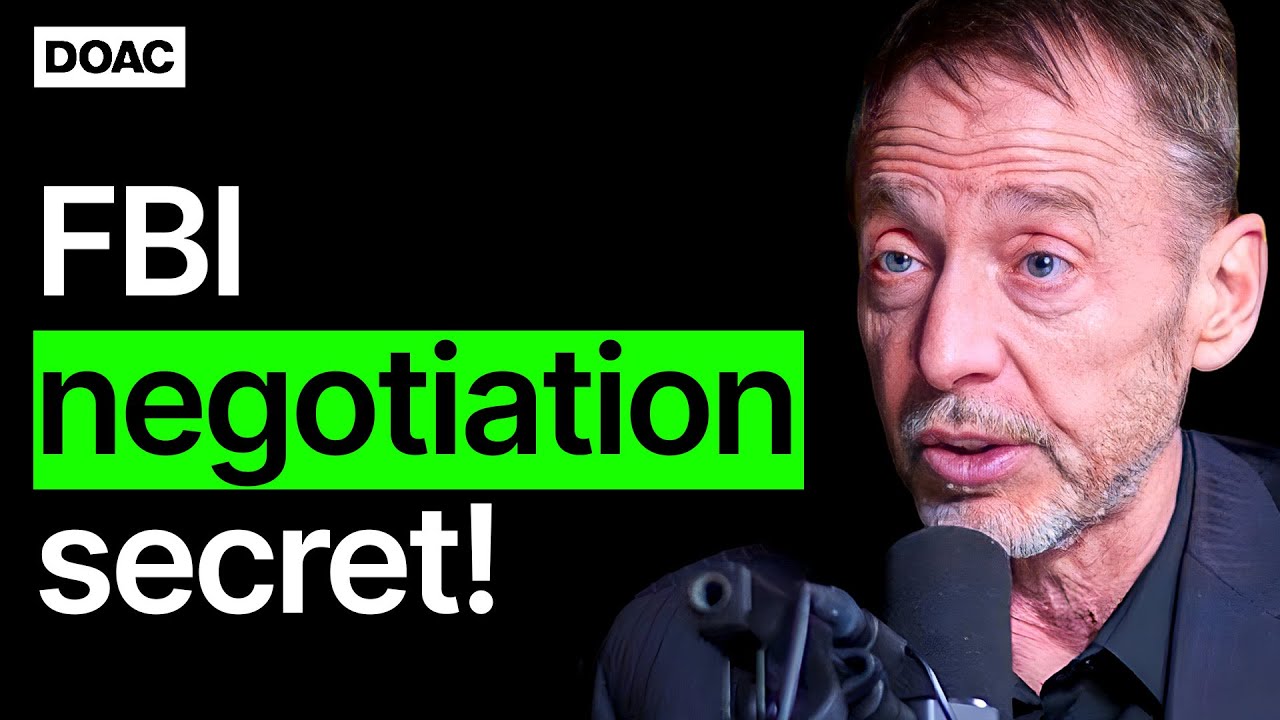
Full transcript · Read the full conversation in order, with its original context.
Contents1 chapter
§01Transcript — part 1§01Transcript — part 1
The thing I think about most, especially when I'm on the go but also when I'm sat here in the Diary of a CEO studio, is the Wi-Fi and internet that we have to work with. In fact, anytime I'm filming away from the studio, one of the first things I do when I arrive is open up an app and do a speed test to see how strong the signal is.
The number of screenshots I've sent to my team about Wi-Fi signals at different locations is actually pretty crazy. It matters that much to me because it's such a competitive advantage to have fast Wi-Fi. Because on any given day, if I'm recording hours and hours of footage with a podcast guest, I then often have to have my team send that across to our London team who then do the edit.
So fast Wi-Fi and internet is not a nice-to-have; it is absolutely business mission-critical. So, when it came to finding the best provider who could supply internet and Wi-Fi to our new LA studio, which I'm sat in right now, we looked at every single option.
Of all the providers, the one that came back with the steadiest connection, as well as being the cheapest, was today's sponsor, Spectrum Business. Spectrum Business keeps businesses of all sizes connected with fast, reliable internet, advanced Wi-Fi, phone, TV, and mobile services. Millions of business owners already rely on Spectrum to keep their operations connected. So, if you want to join them, head to spectrum.com/business to learn more. That's spectrum.com/business. Restrictions apply; service not available in all areas.
Two of the three remaining hostages were killed, and they were shot by friendly fire. That was the first time that I'd worked anything where people had gotten killed.
Former FBI kidnapping negotiator, best-selling co-author, and the founder and principal of the Black Swan Group, I'm joined by Chris Voss. How important is it generally in negotiations to listen?
Whether it's business or law enforcement, if I take the time to really hear somebody out in our first deal, then every deal after that will come to me faster. It's critical.
I'm so compelled to ask you: what is the cost that we don't get to see of your job?
You get really wrapped up in your work, and I think you tend to become distant in your personal life. The closer you are to someone, sometimes it's just really harder for you to see things from their perspective. The truth sometimes is a knife to the heart, right?
Like you go through a traumatic event. Are you traumatized by it and never recover? Or is there post-traumatic stress growth, where you took that and decided to be better than you ever were before because you never want to let that happen again?
So without further ado, I'm Stephen Bartlett, and this is The Diary of a CEO: USA Edition. I hope nobody's listening, but if you are, then please keep this to yourself.
Chris, you've lived an extraordinary life for many, many reasons, which I'm sure we're going to go into. But I guess my first question is: what do I need to know about your upbringing, your early years, if I am to understand the man you are today?
Well, I think really that my father just required that we work hard and that we figure stuff out. My father was an entrepreneur. No matter how old you were—I started working for him probably when I was about eleven—but the downside of working for a guy that would never ask you to do anything he wouldn't do himself... if there isn't anything that he wouldn't do himself just because it needed to be done, then you get asked to figure out some crazy stuff.
Middle-class entrepreneur, blue-collar guy, and I remember I think I was about eleven, he decided he wanted a new garage in the backyard, and we had to get rid of the old garage. He handed me and my thirteen-year-old sister crowbars and said, "Go out and tear down the old garage."
You just had to figure stuff out. And so I really grew up in an environment of working really hard. He never preached ethics, but we were very ethical—honest, hard-working, and figure stuff out. If that's your attitude, there isn't that much you can't do. That was kind of drilled into me at an early age: figure it out, work hard, be honest.
So if I hit fast-forward on your life from that point and I go into your days in the SWAT team for the FBI, how long were you working in the SWAT team with the FBI?
I was technically a member of the SWAT team for about a year. I was in Pittsburgh, was on that SWAT team, and then I got transferred to New York. I decided to try out for the FBI's equivalent of the Navy SEALS, the FBI's Hostage Rescue Team.
I tried out for that team and I re-injured my knee. So I never technically made that team, nor when I was in New York was I on the New York SWAT team. But I had been on the SWAT team in Pittsburgh for about a year.
You injured your knee during training?
Yeah, it was torn up originally in college. My view is the worst things that have happened to me have always led to better stuff. I would never have become a hostage negotiator if I hadn't torn up my knee.
When I was trying out for the Hostage Rescue Team, then I re-injured it and went to a doctor to have it rebuilt for a second time. At that point in time, I thought, "Well, I don't know how many times they can put Humpty Dumpty back together."
I love crisis response because you've got to make a decision. I've been very much a decision-oriented guy. President Kennedy talks about the dangers of comfortable inaction; I've always hated that. So, I wanted to stay involved in crisis response. We had hostage negotiators. My son and I like to joke that one of the Voss family mottos is: "How hard can it be?"
I remember thinking, "How hard can it be? They talk. I talk every day. I can talk to a terrorist."
When you injured your knee and you're thinking about what to do with your life, I read that you had a chat with a lady about options, and she basically rejected you?
Yeah, she said, "Go away." She was the head of the hostage negotiation team for FBI New York. She was on one of the terrorism squads close to mine, and I knew she was in charge of the program. I thought the willingness to learn was adequate.
So I sought her out to express my interest and kind of presented myself like, "Ta-da! Here I am! I'm wonderful, look at me, I'm willing to learn." And she was just like, "Go away. Everybody wants to do this, it sounds cool, everybody wants the T-shirt."
She asked me about any previous experience or credentials I had. I didn't have any. One after another, I was like, "Nope, no education, no background, no experience." None of this, none of this, none of this. And finally she just said, "No, you can't do it, stop bothering me."
I thought, "There's got to be something I could do." I've always kind of been proactive. There's a principle that we operate on now, which is: never ask advice from somebody you wouldn't trade places with, or never take direction from somebody who hasn't been where you're going. I just thought it made sense to go to the right person and ask, which is kind of how I got into the FBI in the first place.
I said, "There's got to be something I could do. What is it?" And she said, "You know what? There is. Go volunteer on a suicide hotline. But until you've done that, don't bother me." It just seemed really obvious to me: okay, this is somebody who knows, I'll do it.
So I went and did it, and I went back to her and I said, "I've been volunteering on a suicide hotline for the last five months." And she's like, "You what?" She was shocked. She said, "I tell everybody to do that. Nobody ever does it."
When I went back to her, I said, "I'm including the story in the book." She said, "I told over a thousand people over the course of my career to volunteer on a hotline, and only two people did it, and you were one of them." I thought that's just so obvious.
What was that like, that suicide hotline? Five months you did that.
I actually volunteered there for a total of three years. Then I got involved in the board, the funding, the operation, and I taught there too because I was so into it. It was so valuable. I went there to learn a skill, and I ended up learning a skill and serving the community, which then was no better secondary bonus than to do something that benefits you and have it benefit everybody else too.
Difficult, though?
If you take the training, you're willing to learn. The training was phenomenal, and I went there to learn, so I soaked it up like a sponge.
Emotionally difficult?
It can be, depending upon how vulnerable you make yourself. What I used to tell the volunteers there is that on a crisis hotline/suicide hotline, the biggest problem is volunteer burnout. It is difficult emotionally if you go there to help and you want so much to help, and there's a lot of people that make it extremely difficult to help them. That can be emotionally draining.
Now, I went there to learn versus help, and the help was a secondary benefit. So the really difficult types—we used to call them frequent callers—they didn't suck the life out of me; they fascinated me. Like, "This is crazy, I've got to learn how to communicate with these people."
These are no different than the people that are very difficult in business negotiation because how you do something is how you do everything. Way back then, I learned this thing called the "Drama Triangle," which was kind of three archetypes of difficult people. We're seeing that show up exactly in business negotiations. Human behavior is human behavior, period.
What is that triad?
Well, the way I learned it way back then was: there's the Victim, the Protector, and the Persecutor. Someone who comes on a hotline really portraying themselves as a Victim, they're trying to draw you into being the Protector or to give advice. "I need your advice" might be what they would literally say.
And then if you're dumb enough to give advice, then they switch from being the Victim to the Persecutor and they attack you for your advice. As soon as you back off, then they go back to being a Victim again to try to lure you into giving them advice so that they can attack your advice.
What they told us were the earmarks of: "Watch out for somebody trying to lure you into giving advice versus being a great sounding board, helping them discover the answer on their own." Then in 2002, much later, I ran across Jim Camp's book *Start with No*, and he talked about effectiveness in business negotiation: helping your counterpart discover the best answer. Because if they discover something that's mutually beneficial versus if you offer it—if they discover it, it's their idea and they're going to do it.
If you offer it, you're giving them advice, and they've got no emotional ownership and they're less likely to do it. So he called it "helping them discover the best deal." Back on the hotline days, it was just "guided discovery"—helping them discover the best outcome.
From those three years volunteering at the suicide prevention line, was there anything else that you really learned about the nature of human beings that has stayed with you still to this day in business and your days as an FBI negotiator?
Still actually pulling the lessons out of it. People are... their thoughts are most dominated by loss. What are they worried about losing? What's their vision of loss over the future? Daniel Kahneman won the Nobel Prize in 2002 for "Prospect Theory"—economic Nobel Prize on human behavior—which is: loss looms larger than gain.
Some people are putting it at a two-to-one ratio. Nobody ever puts it at less than two-to-one. Loss stings twice as much as an equivalent gain. I've heard people talk about it being as much as nine-to-one. Somewhere between two and nine times, your vision of loss is going to determine your behavior.
That was really... we were taught on the hotline and taught in hostage negotiation to look for the loss. Somebody's taken hostages, they've suffered a personal identity loss somewhere along the lines, and there's probably a triggering event in the last 24 to 48 hours. But look for the loss.
Then Kahneman comes across in 2002—Danny Kahneman and Amos Tversky. Tversky had died by the time they awarded the Nobel Prize, which is why he didn't get it along with Kahneman because they are not giving it after somebody's died. Saying that, "No, this is just human behavior, period. Period." Not just hostages, not just people in crisis, but it's the single dominating influence of all human decision-making. Not the *only* influence, just the biggest. Learning how to cope with that on a hotline is exactly what we're doing these days in all our interactions.
Is there a way to leverage that to your favor when you're negotiating with someone?
You can. You have to be really careful with it, which is really the whole reason to use empathy as an approach. Because if you don't use empathy, then *you're* the hostage taker. You are trying to use leverage against them. It's such a blunt force trauma concept that if you don't do it gently with empathy versus sympathy—empathy is not the same as sympathy—but you're going to seem like a hostage taker yourself if you start out by saying like, "Look, man, I know you've got a lot to lose if you don't make this deal." Well, that's trying to trigger loss, but I seem like a hostage taker myself if I do that. So I've got to work my way into a position where I can get you to realize that that's the case.
When you became a hostage negotiator, when was your first real job?
It was the Chase Manhattan Bank robbery. Bank robbery with hostages, which, although it happens in the movies all the time—Bruce Willis, Samuel Jackson, Kevin Spacey, Eddie Murphy, they're negotiating hostages out of banks in every movie about it—in real life, it's a really rare event.
Like, it was a bank robbery with hostages in New York City, and there hadn't been a bank robbery with hostages in New York City for over 20 years. People get taken hostage in bank robberies, but generally, the bad guys are gone before the police show up because they know if the police get the place surrounded, their chances of getting away are low. So they're going to be gone. But to trap bank robbers in a bank with hostages is really, really rare.
That happened about a year and a half after I got out of the negotiator training. I was still volunteering on the suicide hotline, so my skills... you fall to your highest level of preparation. I was ready to go when they put me on the phone because I had been... negotiation is a perishable skill, and I'd been working at it. My skill level was really high at the time.
Are you nervous when you get that phone call about that bank robbery?
No, I was ready to go. I was doing it because I wanted to get involved. I wasn't doing it to get the T-shirt. As a matter of fact, I was never asked to go. A friend of mine had taught me, by having made a mistake previously, I'd learned the lesson of just "show up." If something's going down, show up.
I heard this advice from a government official not that long ago, and he said, "Run to trouble. Always run to trouble." There's a whole bunch of reasons for that, whether it's business or law enforcement. One of the nice things about running to trouble—running into, figuratively, theoretically running into the burning house—is you don't get criticized as much.
You run to trouble, if you're running into a static situation or something a bunch of people have been dealing with for a while and it's just been sitting there in deadlock, whatever you do, people are going to criticize you. Because they failed, and you're doing something different and they don't want to see you succeed. But if you're running to chaos, you're running to trouble, the criticism is much lower. Nobody's dealing with it, somebody's got to do something, decisions have to be made. It's a great strategy: run to trouble.
And I had come to like that a lot. So I'm sitting at my desk in New York, my buddy Charlie walks up and says, "There's a bank robbery with hostages in Brooklyn, let's go." I looked at a police detective colleague because I had an interview scheduled that morning. I said, "Can you cover the interview?" He says, "Yeah, I got it." And we go to the bank and we show up.
A team forms—FBI and NYPD both show up because it's a bank. We know the PD negotiators really well; the commander, Hugh McGowan, super sharp guy, knew what he was doing. He integrated the team. First negotiator on the phone was a PD detective. He points at me and says, "You're the coach." We stood up the rest of the team around Joe, the original negotiator. Joe talks the situation into stalemate, which is not a bad thing because the threat level is not coming up. And Lieutenant McGowan looks at me and he says, "Okay, you're up." And he handed me the phone.
And what was your job at that point? What was the bank robber asking for and what was your objective?
We didn't know it at the time, but the bank robber was actually the classic "Great CEO Negotiator." The great CEO negotiator is going to act helpless at the table because they don't want you to force them into a commitment. I found this out some years later when I was learning negotiation at Harvard. They call the business strategy "blame somebody who ain't in the room."
So a great CEO negotiator is going to be like, "Look, man, I got a board of directors. I've got to be careful what I commit to here because this board of directors... I do the wrong thing, these guys are going to fire me. They're going to throw me right out of this company." And if the guy does that, he's got all the power in the world. He doesn't care about his board of directors; he just doesn't want to get backed into a corner.
So the bank robbery... we get on the phone with this guy, the guy who orchestrated the whole thing, and he's like, "Man, I'm scared of these guys in here. These other guys that I'm with, man, they are dangerous. Like, I'm scared of them. They might hurt me. So I've got to be careful what I say to you. And oh, here they come now, and I've got to hang up the phone."
He was making it all up. Initially, our initial assessment is this guy's an inadequate personality, he's scared to make a decision. Complete smoke screen on his part. So we're in the negotiation for several hours, we've got the bank surrounded, and then the investigators on the outside... and this is a residential commercial area of Brooklyn, so there are cars everywhere.
They identify the owner of every vehicle on the outside and talk to them, except there's one van out there and it belongs to this guy. And as it turns out, this guy is running a cash-courier business that services this bank. And they can't find this guy; he is nowhere to be found.
So they go to his address and they say, "Hey, do you know this guy?" And "Will you come to the scene of the bank and listen to the voice?" because we're running the negotiations on speaker outside to the commanders. And the witness comes in and says, "Yeah, that's this guy's name," happened to be Chris also.
So they voice-ID this guy, and he has never given us his name. This is another great technique: if we meet and I don't give you my name, it unsettles you. You don't feel you've connected with me. And this guy would not give us his name.
So, we've got a voice-ID on him. The lieutenant says, "You're up next. I want you to confront this guy about his name as quick as you can. And we're not going to do normal smooth hand-off, you're just going to start talking." Normally, the protocol is if you hand off from one negotiator to another, the second guy comes on, he says, "Look, I've been here the whole time and I've heard everything that's going on, and here's everything that I've heard." Because you don't need the other guy on the other side saying like, "Where do I start with this guy? Do you have any idea what's going on?"
It's a smooth transition, but the lieutenant's gut instinct is: "Yeah, we're not going to do this. This guy's a manipulative guy in a really subtle way. We're going to start taking back control. And we're going to start by not doing a smooth transition."
So I get on the phone, I'm talking to this guy. Now this is a cagey dude. We shift with no intro. So what does he do in order to remind us that he's got hostages, but also not raise the threat level? Because he's got to genuinely be concerned that the snipers are going to put a red dot on his forehead and the next thing's going to happen is he's going to be at the pearly gates explaining his actions over the last 24 hours.
He goes and gets a hostage and puts her on the phone. We've been here five hours, we've got no confirmation of the condition of the hostages other than him saying, "I'm taking care of the girls, everything's fine. As a matter of fact, I've got to hang up the phone because they're hungry and they want to get something to eat." All kinds of smoke screens.
So I'm on the phone and I hear this female voice come on go like, "I'm okay, I'm okay." And I'm like, "Who's this? What's your name?" "I'm okay." And that's the last I heard of her. He comes back on the phone, pretends like this didn't even happen.
So I'm like, "Alright, this is a cagey dude. We're going to go forward. I'm going to find a way to hit him with his name but do it gently." So I start talking about his van outside, which he knows is out there; he just doesn't know that we've identified it. And I said, "You know, we've got a van out here and we've found the owners of every van and spoken to them, except one." And he goes, "We have more than one van."
Now, I've got no idea what this guy is talking about. So I did what we refer to as a "mirror"—I just repeat the words because my brain is like, "What is this guy talking about?" So I go, "You have more than one van?" He goes, "No, we only have one van." I go, "You only have one van?" And he goes, "Yeah, yeah, and you chased my driver away." I go, "We chased your driver away?" He says, "Yeah, when he saw the police, he cut and run."
Now, this super control-freak guy is now blurting stuff out as a result of my mirror, my technique, that he did not mean to say. This ends up convicting his getaway driver, who had gotten away, and we didn't even know there was a third guy.
How did that case end?
Everybody came out.
Why did the bank robber concede in the end? Did he get anything he wanted?
No, didn't get anything. You know, how do you negotiate when you're not going to give them anything? You help them see a different vision of the future is what it really boils down to. And what you really want them to see is a vision of the future where they live, and then you're hoping the survival instinct kicks in.
When the second guy got on the phone with me, his principal concern was getting killed. And his secondary concern was being handled roughly when he came out. Of course, he knew that they had beaten the women on the inside, and that may contribute to his being handled roughly when he came out. But he, number one, didn't want to get killed. And number two, my opening line was, "Look, when you come out, you'll be treated with dignity and respect." And I said that to him enough times that he decided it was going to be true, and he asked to meet me face-to-face out in front of the bank.
Was he treated with dignity and respect when he came out?
1,000 percent. You've got to keep your promises. This was one of the things when I was teaching negotiation at Harvard. My academic brothers and sisters up there were like, "Would you lie to get the guy out?" And my answer was no. And they'd say like, "Yeah, but let's say, let's pretend, let's imagine that a terrorist has got a nuclear bomb in Boston and you know that if you lie to him, he won't set the bomb off. So how do you answer that one?"
And my answer is, "Well, number one, the guy's probably testing me to see if I'll lie. So I've got to watch out that it's not a trap. Number two, if he's not testing me, he's going to be a better liar than I am and he's going to sniff it out. You can't lie to a liar, you just can't, they're too good at it. And then number three, even if I lied to him and get him out, someone's going to find out that I lied, and I will always have the reputation of being a liar, and I can't risk my reputation."
So if I've got hostages and I call you and I say, "Listen, I want a car"—I think I saw this one on your YouTube channel—"I want a car in 60 seconds outside." What's the first thing you say to me? You want to try?
Yeah, let's do it. You're the bad guy.
Chris, I'm going to blow this woman's head off if you don't give me a car in the next 60 seconds.
How am I supposed to do that?
Not my problem. You've got 55 seconds.
Alright, so if I wanted to do it, it's just madness out here, it's chaos. I mean, this is Ringling Brothers Barnum and Bailey Circus is organized compared to the nonsense that's going on out there. So even if I wanted to do it, I can't do it in that timeframe.
I'm sure you're the FBI, you're the police... you can make anything happen. 50 seconds.
Seems to me like you're not going to give me a chance.
I'm giving you a chance right now. 50 seconds, Chris. There's plenty of cars out there. Go get one of the cars and pull it up outside or I'm going to blow her head off.
Seems like you have a reason to live.
I do have a reason to live. That's none of your business.
No, I'm not trying to find out why. I mean, my first number one thing is to make sure that you live.
So get me a car and I will drive off. Honestly, you've got 45 seconds. I don't want to talk anymore.
If you're not going to give me a chance, how am I supposed to do it?
I'm giving you a chance. 45 seconds, that's plenty of a chance.
Like to even find... get all the commanders together and get them to think about this, which they're probably not going to do anyway. I will go and talk to them. But how am I supposed to find them all, talk to them, get them to think about it in 45 seconds?
Okay, how long do you need?
Alright, now first of all, I want you to understand, I don't think they're going to do it.
Well then I'm going to blow her head off.
That would be your choice.
See, now so the other thing too is: hostage negotiators are successful 93 percent of the time, which is one of the things that I learned in the business, which means seven percent of the time, they just ain't coming out.
Now, we have to do everything we could possibly do in the meantime, but our number one goal is not putting any additional people at risk. Like, I get this question all the time: "If you think it's going to save a hostage, why don't you just give them a car? Let them go and save those hostages." Well, I can't put additional people at risk.
And by the way, while we were doing that... I don't know if anybody put a clock on us, but we went more than 45 seconds.
True.
And what were you thinking as we were going through it?
Um, all the questions you were asking me felt like they were dragging me away from my objective in quite a tactical way. So I was thinking, "This is annoying, he's making me talk and I don't want to talk." That's kind of what I was thinking. And then yeah, the questions you asked were making me ponder, and they were making me abandon my focus, which was to just get this car and kill this woman.
Right, see, which was... I wasn't asking you that stuff to get you to answer. What I was really doing was exactly what you talked about: get you to ponder, get you to think. What Kahneman has talked about in his book *Thinking, Fast and Slow*: "pondering" he would call "slow thinking," in-depth thinking where you really think about stuff and then *you* really make the decision and *you* really make up your mind. Instead of me trying to hustle you into something really quick, but it wouldn't be your decision. And the whole point of getting somebody to ponder something is so that when they do come to a decision, they own it.
When you said the thing about "Even if I wanted to do that, I couldn't do that in 45 seconds" or whatever, I liked that sentence because obviously there was a degree of empathy there. "Even if I wanted to." It wasn't attacking me too much, and you made me ponder the reality of the fact that it's not even possible. My demand is not even possible even if you were on my side. So that was a very good question to make me ponder myself to realize that what I'm asking for is not going to happen.
See, there's another reason why I said it like that too. Because a lot of people, if you ask for something in a business deal that they're not going to give you, they give you the classic American lie: "I'll try." You know, maybe it's a lie in the English language. But you know in any kind of deal, somebody looks at you and says, "I'll try," you don't get a good feeling.
And you get "I'll try" enough times, you know right away it ain't never happening. So I didn't do "I'll try." I basically said, "I don't think it's going to happen, but I'll check." Because I'm trying to shift us out of an adversarial into a collaborative conversation. And so what I'm basically saying is like, "I don't want to mislead you, I don't think this is going to happen. I will be your advocate."
How important is that collaboration?
No relationship survives long-term without collaboration. Just ain't going to happen.
So you're giving me the impression that you're actually on my side to some degree and that we're collaborating to find an outcome together?
Yeah, and point of fact, see, the crazy thing is: hostage negotiators have repeat customers. If I get you out alive, the chances of you straightening out your life are not great, and the chances of you ending up in another hostage siege are high, if you don't get killed otherwise. And you've got to have a memory of the last hostage negotiator trying to work *with* you versus the guy who hustled you and lied to you.
So if you always look at all interactions as if you're going to have to pay for everything you said eventually... which means if you lie, you're going to pay for it. If you did everything you could to be collaborative, then your counterpart's going to remember that in the future. Like, "Well, it didn't go my way, but at least the guy didn't lie to me."
It's karma, isn't it?
It's karma. 1,000 percent it's karma.
No two companies are alike. That's why the American Express Corporate program can help you customize rewards, reporting, and billing options, all designed for your business. Build your program with American Express at americanexpress.com/corporate. Terms apply.
Support for this podcast is brought to you by Walden University. Ever catch yourself thinking, "What if I could go after what I actually want and really make a difference?" You're not alone, and that's exactly why I want to tell you about Walden University. For over 50 years, Walden has helped working adults like you get the 'W' with the knowledge and skills to build the future you want and make a difference where it matters most. If you've been waiting for the right moment, this is it. Head to waldenu.edu and take that first step. Walden University: Set a course for change. Certified to operate by SHEV.
I'm a big believer in karma. Very much.
How important is it generally in negotiations to listen? Because a lot of people think they can overpower someone with just talking at them.
Yeah, and what they're called is "they can't hold a job." You... and there are a lot of people that are very visible that are doing that. In the moment, they might look very good. But what ends up happening is they're frequently initially extremely successful and then their success rates drop off a cliff. And then they don't hold a job because they were awesome in their first quarter and had a continuing steady decline in their productivity till it went to zero, and they can't be tolerated anymore.
But everybody sees a really loud guy or girl getting deals, and they're the ones that make the most noise about it. So your original question is: how is important is listening? There is no negotiation methodology that doesn't list listening as an advanced skill. No matter what school of thought somebody's in, in negotiation, they all list listening as advanced. Far more difficult than simply keeping quiet. It's critical.
And you will actually end up increasing the velocity of your deal cycles by listening, which a lot of people think it's really counter-intuitive. But I did an interview with Mark Cuban six or seven months ago and I talked about listening. And he's like, "Yeah, if I take the time to really hear somebody out in our first deal and pay attention to what's important with them, then every deal after that will come to me faster, having done it right up front."
And it'll increase the velocity of my ability to make deals with them because they'll trust me, they'll know that I hear them out, they know that I'm looking out for them. Consequently, it doesn't take me a long time to establish trust, and we come back, we come to the table, we get right down to it. It really increases the velocity of my ability to make deals. And a lot of people can't see that because, "I've got to hear them out, I've got to find out what their point of view is..." It seems highly inefficient. But what it is, is incredibly efficient long-term.
And then as it relates to speaking, when you were talking to me then in our little dummy negotiation, I noticed the tone of voice you took was very calm. You list in the book three different voices available to negotiators. Give me a flavor of those three voices that are available to negotiators.
Well, there's three natural types in humans: Fight, Flight, or Make Friends. These are our caveman ancestors that lived—either fought the saber-toothed tiger, ran from the saber-toothed tiger, or figured out a way to make friends with it. And the indecisive caveman got eaten by the saber-toothed tiger, doesn't have any descendants.
And we've got substantive reason to believe that that exists globally regardless of gender, ethnicity, religion. The three types the globe splits pretty evenly into thirds. Got a lot of data on it. Our brothers and sisters at Harvard pretty much agree based on their experience; Wharton has pulled a lot of the same data, comes very close to the same.
And each type has a voice. The voice of the assertive—natural-born assertive, which I'm actually a natural-born assertive—is more the Donald Trump style negotiator: attacking, blunt, direct. Ivanka Trump once described her dad, Donald, and said, "He's not blunt, he's just direct." Well, he's just an example. But what I think is direct, you feel like you got hit in the face with a brick. Which is always counter-productive long-term, always, always, always long-term counter-productive. Inhibits your ability to make deals; people get tired of getting hit in the face with a brick, so it wears them out.
Then there's the very analytical type, which was that soothing, calming voice that I was using. Triggers a neurochemical response in you; it actually calms you down neurochemically. It's an involuntary automatic response. Now you can fight it, you can fight your way back out of it, but you can't stop me from getting the calming neurochemicals started in your head.
And with... if you're careful not to seem either cold or condescending, that tone of voice is what the great TV interviewers use, the great news anchors, because there's a lot of... there's confidence and calm simultaneously, and people really like it.
And then there's the smiling voice, a friendly voice, and somebody just smiles when they speak. That triggers a different neurochemical reaction—the people that you automatically like right away as soon as you lay eyes on them or as soon as they start speaking. There's an advantage to that. So I was using, in an emotional situation... and if you're in an emotional negotiation, you want to go with the soothing voice and smile, sprinkle that in. Now you kind of get the combination of both of them and it's collaboration. You're going to want to collaborate with me if I use that voice.
I guess it's an attempt, as you say, to pacify them.
By the way, you've got a pretty good voice. You're basically downward-inflecting. Your voice portrays... first of all, it's very genuine, but it portrays a guy who's actually really thinking about what he says and he actually listens.
Oh, that's very kind, thank you. But she's still going to die.
In chapter three of your book, you talk about labeling their pain. I found that a really interesting concept. "Don't feel their pain, label it." I think that's probably a mistake I've been making. I actually was thinking about that in the context of my romantic relationships. When my girlfriend is talking to me as a way to create that bridge, how do I create that bridge by acknowledging or labeling her pain? Can you explain to me what you mean by labeling their pain?
Think of whatever the negative emotion that they're feeling is, the elephant in the room.
So if I'm holding someone hostage and I'm crying...
I'm going to say, "Sounds like you feel like you're out of control. Sounds like you feel that you're going to have to do something you really don't want to do."
And what does that do to me when you do that?
And this is one of the few in the Black Swan method that's also backed up by neuroscience. Like, we know intuitively that this stuff works because we're proving it over and over again. We're walking the talk, we make our own deals very effectively, and the people that we coach make their deals and accelerate their deals very effectively.
But there's been several neuroscience experiments. They put people in fMRIs (functional magnetic resonance imaging devices) where they can watch the brain light up, and they induce negative feelings in people and they watch the brain light up—typically by showing them some sort of photograph that causes them to feel a negative emotion, whether it's sadness, anger, whatever it is.
And then they simply ask the people to identify or label what they're feeling as a result of what they saw. And each and every time the person labeled it, the electrical activity in that part of the brain diminished. Every time. Not "deny," but just called it out. You don't deny the elephant's in the room, you say, "There's an elephant in the room."
And that makes people feel heard or seen or felt?
All of the above. Whatever the emotional reaction to that is, people feel seen, heard, felt, understood. And the neuroscience reaction is it diminishes the negative emotions every time. The degree that it diminishes the emotions changes. Like, I may label the negative that I hear and it might have a minimal impact, a tiny little impact, or it might have a huge impact. But the type of impact is the same every single time. The degree of impact changes, but the nature of the impact is always to diminish the negative emotion.
One of the things that I read as well that you're looking for in these negotiations is for them to give you a confirmation, like if they say, "That's right." So you're trying to get me to not blow this lady's head off, and if you can get me to say "That's right," what is that a signal of?
"That's right" is what people say when they feel understood. You pull a "That's right" out of somebody, you're on your way in the direction of a great resolution, no matter what the negotiation—landlord/tenant, employee/employer, business deal. Pulling "That's right" sends you in a great direction.
So you've labeled something that I'm feeling. You've said, "Stephen, it feels like you're about to do something you don't want to do," and then I go, "That's right."
Right. Now, so Tall Roz, great researcher besides great author, he speculates—he says, "You know, I think somebody says 'That's right' when they've experienced an epiphany to some degree." That's what you say when you... when what you think of you've heard is completely true. You're not agreeing with a person; you're observing that what they said was true.
When he said "epiphany," I'm like, "Ah, this is interesting. Let me look up the neuroscience of epiphanies." Among the neurochemicals that you get a hit of in an epiphany is oxytocin, which is the bonding drug. So you get a hit of oxytocin based on what I've said, and you have an involuntary feeling of bonding towards me.
And then the neuroscientist that I think the world of, Andrew Huberman, I heard him talking about oxytocin, and he says that oxytocin tends to make people tell the truth. So if you say "That's right," you're going to feel bonded to me and you're going to be more likely to tell me the truth. That ain't a bad position for me to be in in a negotiation.
Negotiations are all over our lives. It's everywhere. Teams, business, podcasting, my girlfriend, whatever. When I was reading through the principles in your book *Never Split the Difference*, so much of it I could relate to from the context of romantic relationships with my partner. You must find yourself in your own romantic relationships deploying some of these skills. Which ones in terms of whether it's just acknowledging them, making them feel heard... what are the key skills that translate really effectively to romantic relationships?
Well, they all do because every human being wants to be understood. And in a romantic relationship, they want to know that you understand. And in many cases, they just need that in and of itself. Now the additional demands of a romantic relationship is they're going to want you to understand and adjust. Which, in point of fact, what other relationship do they not want that from you as well? Not only show me you understand, but then walk the talk.
It's... the closer you are to someone, sometimes it's just really harder for you to see things from their perspective. Like you think you didn't do anything wrong and... typical male-female, but not confined to this... you thought you were fine when in fact what they perceived was that you were clumsy and insensitive.
Are you good at negotiating in a romantic relationship? I'll ask her when I see her.
The problem with dating a really smart girl is she starts out negotiating you pretty quickly. But the real issue is what's your intent behind it? If you're hearing your romantic partner out just to get them to shut up, the second or third time you pull that on them, they have figured it out and you're disingenuous. But if you're hearing somebody out because you want things to be better—you really want the relationship to be long-term and you want it to continue to get better—then they're happy to let you hear them out or to let you make them feel heard, because you're going to make the adjustments in your behavior to take that into account. You're going to show that you care enough about how they feel, not just what happened, but how they feel about what happened, which is a recipe for a great relationship, romantic or not. But as should be, it's even a higher standard for a romantic relationship because how can you be involved long-term if you don't care how the other person feels?
In your negotiating days, was there an instance where it really didn't go the way you wanted it to go?
Yeah, and with 93 percent success rate means seven percent of the time it's gone bad. And that just is the nature of the game.
Is there one that stands out for you as being...?
Every one of them does. But then the issue is do you learn? Nassim Nicholas Taleb would call it "post-traumatic stress growth." Like you go through a traumatic event. Are you traumatized by it, which then damaged and never recover—post-traumatic stress injury, harm, disorder? Or is there post-traumatic stress growth, where you took that and decided to be better than you ever were before because you never want to let that happen again?
When I say this, what is the incident that comes to mind?
Well, the first one that people died in was the second case that I worked in the Philippines, the Burnham-Sobero case. Early on, before we could even get our arms around a situation that was moving really fast, and the Philippine military was engaged in chasing the bad guys—and a chase had been on for weeks—Guillermo Sobero was murdered by the Abu Sayyaf about 21 days into that case. They had already killed a number of Filipinos prior to that. And as they moved across the landscape and ocean-scape and island-to-island in the South of the Philippines, they would kill hostages and pick up new hostages because there were people in their way all the time.
So that was an ugly case from the beginning to the end. In the end of it, two of the three remaining hostages were killed in a botched rescue attempt, and they were shot by friendly fire. Philippine Scout Rangers inadvertently stumbled over the Abu Sayyaf encampment, didn't realize it was one that had hostages in it, just opened fire. They recognized it as a terrorist encampment, formed a skirmish line in the trees on the uphill side and just started pouring rifle fire down into the camp. And so that was the first time that I'd worked anything where people had gotten killed.
Does that stay with you?
Yeah, it does. I felt sorry for myself for a long time. It's not like I'm happy about it, but I'll never remember the moment that I got the call, 5:30 in the morning. I was in Washington D.C., where I lived, and a voice on the other end of the phone said, "I've got bad news. Martin is dead." And it was just a few hours after Martin Burnham had been killed and Deborah Yap, the Filipino hostage, had been killed. Martin's wife Gracia was wounded and lived.
I'll never forget that was the worst, to that point and since, was the worst professional moment, personal moment of my professional career. I used to say it was the worst moment of my personal career until I was hearing another hostage negotiator talking about a siege he was in where an infant had died, had been killed. I remember sitting there watching him talk about it, and he still very definitely dealing with the scars and the wounds from having been the negotiator on scene. I remember him saying like, "I don't know why I keep giving these presentations, maybe I just want people to know something bad that happened to me on a winter's day."
And I was sitting there thinking: "Bad for *you*? That wasn't *your* blood, it wasn't *your* child." And I thought we're taking on too much because it wasn't a member of our family. It wasn't my brother, wasn't my significant other, wasn't my son that got killed. And that's when I realized I had to put that stuff in perspective. It wasn't doing anybody any good for me feeling sorry for myself. I couldn't. And what the changes we made as a result of the Burnham-Sobero case saved lives. That was our mandate. "Alright, so Martin Burnham is dead. What do we do with that? Do we quit or do we get better?" If we get better, somebody else is going to live. And a whole bunch of people ended up living based on strategy adjustments we made as a result of that case.
It seems like a very significant burden to carry. It goes back to what I said at the start: it takes a certain type of person to want to play with those stakes.
Yeah, somebody who's naive. You just don't know any better.
Makes it difficult sometimes, thinking about the traumatic things we go through. It makes it much difficult, especially in forming relationships. I struggled with that a lot, struggling in having a girlfriend probably because my home life was so traumatic that I would always run from commitment. But when you've lived through such traumatic events and high stakes, coming home to "Hey babe, you alright?" can be difficult, right?
Yeah, it can be. It can be difficult unwinding, depending upon how you process information. Like the other person might genuinely doing their best to be there with you to get you to talk about it. And if that isn't the best way that you process... and yeah, one of the very difficult things about me is I don't process stuff by talking about it. I'll talk about it afterwards. But I kind of need to unplug. I'll need a good night's sleep. I'll need to let it run through the data banks and kind of bake on its own. I'm probably pretty good the next day.
Which is interesting, because in your work you have no time for that.
Yeah, well, in the work, I mean, we're going on it right now, we're dealing with it right now.
Mirroring. Something you talk about as well in the book, which I find really interesting. Again, something with my girlfriend I started to explore, which was: when she says something to me, or when she does something, to make her again feel heard, I guess, I just kind of repeat it back to her. But is it also a body language thing or is it just...? How does mirroring work?
Well, a hostage negotiator's mirror, the Black Swan's mirror, the way that we teach in business now is just all verbal. OK. If you start lining up physically, which is what the body language mirroring thing is... if that happens naturally, then so be it. Enough people try to do it as a manipulative tool that we're really leery of even coaching people on that at all.
If we're talking and suddenly we both find ourselves—and I'm actually listening, and you're listening—and we both find ourselves leaning the same direction, that's cool because we're dialed in. But the body language thing is a tool of manipulation so many times that people that are just trying to exploit you... that aspect of it we stay away from.
Now the hostage negotiator mirror, the Black Swan mirror: repeating just the last one to three words of what somebody's said, or then taking surgically picking a gist, one to three words here and there, is ridiculously effective.
Ridiculously effective?
You did it very nicely. It's... and the thing that I find fascinating about it too is if we find somebody that's really into mirroring, they'll typically be somebody whose IQ and EQ both are real high. There are a lot of people whose IQ is real high—they're book smarts are good—but their people smarts aren't good. And they tend to love mirroring because it's the least amount of effort with the maximum amount of response. And they want to guide a negotiation in a very gentle but purposeful way, while the other side doesn't feel guided, they feel like they're expanding. It's been real consistent.
When you think about your next phase and your next projects that you're working on now and what you're trying to do, you've got the Black Swan Group. I saw that online. The objective of that is to coach people into negotiation skills and stuff like that?
Yeah, worldwide, globally. The website is blackswanltd.com. I mean, if you're just starting out, we've got free stuff. Like, how do you start to get better now if you're further on down the line? We coach people through all kinds of deals on a regular basis, and it's a really big part of what the company does. We coach a lot of people through negotiations.
And you've got your book as well, which we've talked about a bit, which is *Never Split the Difference*, which has sold more than two million copies worldwide. Staggering, crazy numbers. We have a closing tradition on this podcast where the previous guest leaves a question for the next guest. I only get to see it when I open the book. Okay, good handwriting, so this is useful.
"Is there someone in your life that really needs your help, but you are still unsure on how to help them?"
There's someone in my immediate family that I continue to buy the wrong gifts for. And I've got actually a conversation scheduled for me to at least say, "Alright, I realize I'm getting it wrong. Help me get it right."
I think we can all relate to that in some respects. Well, I can, anyway. Thank you, Chris. Thank you for your time, thank you for writing such a great book on a topic that is relevant to more than just FBI negotiations, as you know. It's relevant to my relationship with my partner, to my business, to everything in between. It's relevant to all the interactions I have with all humans, and that's clearly a testament to why it's sold almost 2.5 million copies or something crazy like that. I know the stats around books—most books don't sell a thousand copies. So to sell 2.5 million copies worldwide is staggering. But it speaks to your experience and the way you've articulated it in the book. It's been an honor to speak to you. Thanks for your wisdom, and I'm going to keep brushing up my negotiation skills.
Pleasure's been mine. Thanks for having me on.
Thanks, Chris.
When your cat is acting weirder, or your dog is being louder, your turtle moves slower, your cat seems thirstier, or your puppy is acting clumsier... day or night, if you don't know what's wrong, know where to go. VEG ER for Pets. This is Kate. VEG: the better, kinder ER for pets.
No two companies are alike. That's why the American Express Corporate program can help you customize rewards, reporting, and billing options, all designed for your business. Build your program with American Express at americanexpress.com/corporate. Terms apply.