
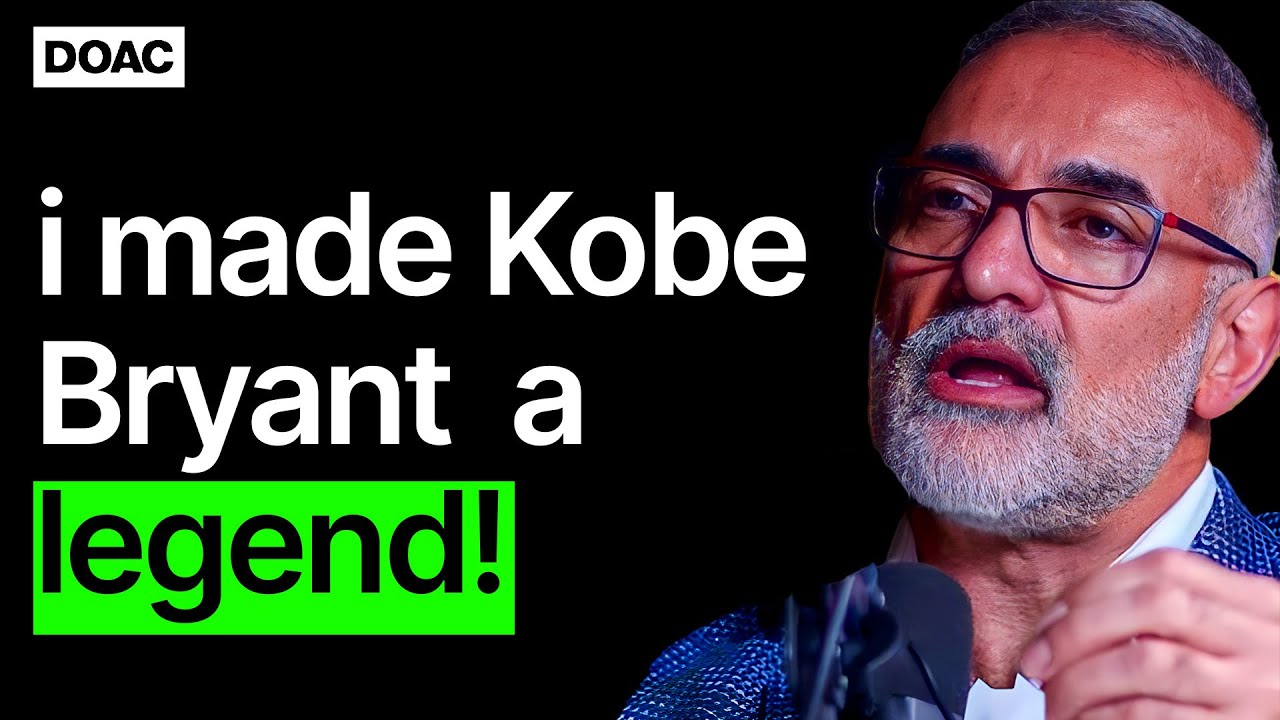
The Man Who Coached Michael Jordan AND Kobe Bryant To WIN!: Tim Grover
嘉宾:Tim
全文文稿 · 按对话顺序保留完整内容,深入理解上下文。
本篇目录1 章节
§01Transcript — part 1§01Transcript — part 1
When your cat is acting weirder, or your dog is being louder, your turtle moves slower. Day or night, if you don't know what's wrong, know where to go. Veg ER for pets, the better, kinder ER for pets.
Kobe Bryant was not interested in winning championships. He was obsessed. Tim Grover was the trainer for Dwyane Wade, Kobe Bryant, and Michael Jordan. His book is *Relentless*.
What is your dark side? After every semester of anatomy class, you have dead bodies. My dad's job was to dispose of those bodies. You have to cut off their legs, you have to cut off their head. I saw him do that when I was four years old. It doesn't get any darker than that.
If I spoke to some of your clients and I asked them, "What was Tim good at for you?" What would they say to me?
Elevating them to another level. Very few people understand what winning does to an individual's mental health. Winning doesn't make you heartless; it teaches you to use your heart less. Every decision I've made, I knew what the cost was going to be. If you think the price of winning is too high, wait until you get the bill from regret.
So, without further ado, I'm Steven Bartlett, and this is The Diary Of A CEO USA edition. I hope nobody's listening, but if you are, then please keep this to yourself.
Tim, I read in your book *Winning: The Unforgiving Race to Greatness*, Chapter 12. I don't usually start with people's books, but in Chapter 12, you talk about this concept of the dark side and the darker side. And the reason I want to go right there is because I actually think it's the start for many people. It is the start. So tell me about your dark side and where and what it came from.
This is a very unique story. Both my parents are of Indian descent. They came over to the States when I was four. My mother came over first; she was a nurse practitioner. My dad was a professor in India. When he came from India to the UK, he was still a professor, but when he came from the UK to the United States, they said that his education would not transfer. He wasn't qualified enough to teach at the university level in the States.
So my dad said, "Okay, well, what job do you have available?" They had a job back then called a "degreaser." A degreaser is an individual—this job does not exist anymore—who, after every quarter or every semester of anatomy class, has cadavers. Dead bodies. My dad's job was to dispose of those bodies.
This is a man who was called a doctor back in the old country. Now, when you dispose of these cadavers, it's not a garbage truck that comes and picks them up. You have to dismantle them. You have to cut off their legs, you have to cut off their arms, you have to cut off their head, and you throw them in a furnace.
I saw him do that when I was four years old. My parents couldn't afford babysitters. My mom worked at night; my dad worked during the day. So when you were off from school, guess what? You can't disturb Mom because she's worked 16 hours that night. You go to work with your dad.
My dad said, "Son, never let your pride get in the way of doing what's necessary and providing for the people you love." It doesn't get any darker than that.
You still feel it today?
Very much. I wouldn't be here if it wasn't for him and the things that he did. Both of them. They never complained and went to work every single day.
As you were telling me that story, what was the emotion?
People talk about sacrifice that others did for them, but very few get to actually witness it and remember it. There are certain memories that people have when you go way back in age and they can't even remember. I have vivid memories of those things and how they not only molded him but how they molded my brother. The effects it had on both of us, positive and negative.
I understand how to use that darkness in the most positive way, just like my dad did. Because to him, that darkness was a new beginning. He didn't look at it as an individual who was highly accomplished back there; he was just grateful and thankful to be in the United States and have a new opportunity for his family.
This is why when we talk about the dark and the darkness and the dark side, people forget this. I always say: When does a new day start? It starts at midnight. Is it dark outside at midnight? Yes. So if a new day and a new beginning starts in the dark every day, that's when your new beginning starts. But so many people are afraid to go to that place.
I tell them: You have to visit that place because if that place comes to visit you, it will never leave. If you go visit the darkness that you've been running from, you'll have the opportunity to leave a better person. You'll have a better understanding of yourself and your purpose. But if you don't take that trip and the darkness comes to visit you, it's a guest that will never leave.
That dark side, you referenced it did good and bad things for you. What are the negatives?
It hardened me. It hardened me to the point where I had a hard time communicating with other individuals. I had a hard time understanding things that were so easy for me to deal with—the hardships, the trials and tribulations. I would see other people complain about things and I'm like, "What are you complaining about?" I just couldn't relate to it. I didn't have much compassion for those individuals.
You talk in the book that often you're visited at night by a presence in the early hours of the morning.
Every night there's an individual that comes to visit you. Everybody has these grandiose dreams and these daydreams about success, money, fame, and power. I always say: Winning never visits you in your daydreams. It sees you in your nightmares. The things that come to visit you in your nightmares, those things are real. Those are the things that you have to deal with. Those are the monsters underneath the bed, the skeletons in the closet.
Those are the things that you've put away, and some of the stuff that you've put away and you don't want to deal with is some of the best part of you. How many times have you heard this? People always say, "Always show up positive. Always bring your positivity." Well, that means you only bring half of you. That means you're not accepting the other half. You've got to bring the light, you've got to bring the dark. You've got to bring the good, you've got to bring the bad.
You have to have conversations with those skeletons in your closet; they know you better than you know yourself. In order to stand out, in order to fight, many times you have to become that monster. But most individuals, when they become that monster, they don't know how to control it and they let the monster control them. So it's a learning process. All those years that you run from that monster underneath your bed, you're actually being taught: Can you control that monster or is that monster going to control you?
Once you recognize that part of that monster, or all of that monster, is you, that's when you can actually start fulfilling your dreams and living the life that you're meant to live.
How did that monster manifest itself in your behavior? You said you struggled to be compassionate or have empathy for struggles. Were there other things where that monster would rear its ugly head or take control of you?
When the monster took over, it wasn't for bad things. It allowed me to deal with how mean kids could be—the bullying in school that every kid goes through, whether it's physical or mental. The monster gave me that strength to not lash out back at those individuals and just say, "Continue, trust yourself, continue on this path, and don't worry about trying to prove those individuals wrong. You and I will prove ourselves right."
When you talk about 2:00 AM realizing you're not alone—and this is what I was trying to gauge when I was listening to your audiobook—I wasn't sure if you were being literal or figurative. If you literally felt the presence of spirits or someone else in your room, or if it was a figurative way to talk about the thoughts in your mind.
It's both. When you want to get out of bed, there are all these individuals lined up next to that bed. There's fear, there's doubt, there's compassion, there's hatred, there's excellence, there's sorrow, there's excuses. And they all have their hands out. Literally, you see them. And then you get to choose every single day who gets a vote. It's your decision.
Most times, many individuals make their decisions with their feelings, when you have to make those decisions with your mind. Every single morning, if you can't get out of your bed and you choose not to win, you listen to your feelings. If you chose to get out of bed and you said, "There's a win for me," that's your mind. Each one of those individuals, you decide who gets a vote. And some days, not all the popular things are going to get a vote. Success may not get a vote, winning may not get a vote. But you've made that decision that now this thing gets a vote, I must be ready to deal with it.
Every single day there's something different. There also has to be something different about yourself. I said this in *Winning*: Different scares people. When you're different, it scares people. When the world is different, it scares people. Everything different scares people, but it attracts the right emotions, it attracts the right feelings, it attracts the right thoughts, and it attracts the right people. Because the people that are willing to not judge you and understand and know that these things are real—they are real—they will tell you, "I understand." With both books that I've written, people were like, "I thought I was the only one."
Because this is not accepted to talk about these things. People put you in this land of "you're crazy." Anytime anybody's told me I'm crazy, I've always thanked them for that because it gave me the ability to see and do things that other people can't do and acknowledge things that other people won't acknowledge.
It seems to be a bit of a paradox that sometimes our dark side—whether it was being bullied in school, being overweight, or some trauma—can be both the driving force of our life and also the cause of so much pain. It can be the thing to put us in pain and then also the thing that drives us out of pain.
100%. For a lot of individuals, the physical pain that they put themselves through is actually their pleasure. My athletes, when they are at the highest level of their training, it is the most uncomfortable state they put themselves through every single day. People just say, "I'm just not going to do that." You see people that run ultra-marathons, people that take these ice baths—it's all out there. Now, that doesn't mean if you do those things, you're going to excel in other aspects of your life, but it does raise your level of understanding that nothing great is going to come without you having to deal with what I call adversity and pain tolerance.
You must be able to deal with that, and the more understanding you have of what's causing you the pain and how you've dealt with it is going to determine how successful you will be in whatever you choose in life. You'll have individuals who come from a broken family, and you could have two children that come from the same broken family. One individual will not live up to their potential and they'll say, "It's because I came from a broken family." And then you have the other individual—same environment, same household, same everything—who will do great things not only for themselves but for humanity and this world. And what's their answer? "Because I came from a broken family." They both understood how to use the pain; one used it to excel, the other used it to deny.
Having done this podcast for a long time, what you've articulated there about the broken home scenario is the thing I've always played around with: a trauma causes an adverse response, typically greatness or despair. I've always tried to figure out what a trauma is going to do, but it's been impossible for me. In your case, it led you to be great in what you do and what you achieved. So tell me about how you went from that traumatic early upbringing to being a "Sports Enhancement Specialist."
Yes, that was my official title when my main job was to train professional athletes. I never wanted to label myself as a "trainer" because I did more than that. I actually came up with that title myself. So, I played college basketball myself. I had these dreams of playing professional basketball, but I wasn't good enough. But I was like, "What can I do to make sure this doesn't happen to other individuals?"
I started to study the body really, really closely, which goes all the way back to when I was four years old. Not only did I have to study the body from an external standpoint, I had to learn it from an internal standpoint. Going through the different injuries that I suffered through my years of working out and playing allowed me to understand what an individual goes through. Not only from a physical standpoint, I understood what was going on in their head. If they hurt their ankle, hip, back—all that stuff—I knew.
So not only was I able to train them from a physical standpoint, I was able to train them from a psychological standpoint. "I know what you're going through. I know the barriers that you have to go through." Because it's so much easier to get an individual back from a physical injury, but it's that mental scar that stays with them. What do you have to do to make them forget about that mental scar? And that's where my niche came in. "Okay, I need you to go out there and play at the highest level and not worry about what happened six months ago, nine months ago, six weeks ago."
So when it became "Sports Enhancement," the sports was the physical, the enhancement part was the mental.
If I spoke to some of your clients that knew you best—Michael Jordan, Kobe, and all these others—and I asked them, "What is Tim good at? What was Tim good at for you?" What would they say to me?
Elevating them to another level holistically. Just being able to, because when somebody comes up to me and they say, "I want to be something," I look at it and say, "Well, somebody's already done that. I need more." You can't come to me and just say "I want to be the world's best tennis player," or "I want to be the world's best basketball player," or "I want to be the world's greatest podcaster." That's already been done. There's another level—you're not thinking big enough. My individuals come to me and say, "Listen, I have these dreams, I have these thoughts," and the first thing I tell them is, "Your dreams and thoughts better be so big that they better scare you."
Why?
Because you're not thinking big enough then. You don't want it. It has to be something that nobody else has thought about before or done before. The process it takes to be number one and stay at number one—you have no idea. You have an idea because you've been there, but everybody wants to sit in your seat until they have to sit in your seat. Very few people understand what winning and success does to an individual's mental health.
Everybody thinks the more you win, the more successful you are, it just makes everything so much easier. They don't understand the pressure that these individuals put on themselves to continue to perform at the highest level, to have their businesses win over and over again. When you reach a million followers on your social media, it's a different level of pressure than an individual who isn't winning all the time or hasn't been successful at the highest level. You're being critiqued about every decision you make, what you wear, what you say, where you go. That's a whole different level of mental health that success brings that a lot of people just don't understand.
Michael Jordan. I watched *The Last Dance* documentary. I saw you in there as well. Really, I've got to be honest, I didn't really know much about MJ before that. And it went from me watching that documentary, getting obsessed with him, to hanging a picture on the wall in my office back in London. But as I read through your story—and a lot of my listeners won't know about this—how on earth did you go from a college graduate that was earning $3 an hour as a trainer in a gym to becoming the trainer for Michael Jordan?
Well, when I started to go to college, I didn't know what I wanted to do. Again, being of Indian descent and having both parents in the medical field, you get to choose two options as a career: one being a doctor, and two being a doctor. That's it. And I told my parents, "I do not want to be a doctor." They said, "Well, what do you want to do?" I said, "I want to train professional athletes." I knew this very early, because when I was a freshman in college, there was a class called kinesiology—movement of the muscles and body. I took it and I said, "You know what? This is for me."
When people kept telling me, "Why are you going to take this class?" everybody said, "Most people that take these courses end up in the health industry, whether it be studying science, working in administration, or being a health educator." I'm like, "No, there's something more out there for me." And then when we'd have our basketball practices in college, I was like, "All we're doing is just running, we're doing stuff without a purpose. This can't be right." We had an individual that would come in and work our team out, and I was just like, "This doesn't feel right."
So I really took study to this, I really wanted to understand this. Later on, I graduated with a master's degree in exercise science. Parents were like, "Well, you got this, you can't stay at home, got to go get a job." I took a job at a local health club. The minimum wage back then was $3.35. I took the job. They did not allow me—I was the most qualified individual they had on their training staff, but they still wouldn't allow me to train because I had to do the six-month probation period.
So I said, "Okay, no problem." What I did was I worked in the exercise rooms, cleaned the equipment, opened up the gyms. Then after six months, they said, "Okay, you have to take this exam, and if you pass the exam, we'll allow you to be a trainer." Well, the funny part is, when I looked at the exam, it was the exam I actually wrote as one of my projects for school, and this health club was using the exam I actually wrote to certify their trainers.
F***ing crazy.
So I looked at this exam, I gave all the answers, they scored it and said, "You got a 100%, you're able to qualify as a trainer." I said, "Where'd you guys get this from?" They said, "We got it from a university." I said, "Which university?" They said, "University of Illinois Chicago." I said, "Yeah, you should really follow up and see who developed that exam." So they came back later and said, "You wrote this?" I said, "Yes, I'm the one that wrote this exam."
So I became the trainer over there and in a very short period of time, I became the highest-grossing trainer they had. But what was great about it is, school taught me *what* to think. All the education, all the books—I knew exactly what to think. But when you start dealing with humans who are able to communicate and have their own thoughts, beliefs, feelings, emotions, and ideas, I was like, "There's a whole part of my education that's missing here. My schooling taught me what to think; now I need to learn *how* to think." And there's a big difference between the two.
Once I started training individuals, understanding how different people adapted to the different ways of communicating, different times of working out, different words, different facial expressions, different levels of silence—that's where I really started to manifest my trade and understand the results with all the different types of individuals. And these weren't just athletes; these were everybody who wanted to just get in shape, lose weight, get stronger, jump higher, run a little faster, play better tennis, whatever it may be. But I'm sitting here and I'm like, "I'm only using maybe 10% of what I've learned in school. There's got to be more."
There was a small article in the local newspaper that said Michael Jordan was tired of taking the physical abuse from the Detroit Pistons and wanted to get stronger. I said, "You know what?" Now, back then, remember, there's no cell phones, no emails, no way of direct messaging anybody. So I said, "I'm going to write letters." There's 15 players on a basketball team; I'm going to write 14 letters. The one person I'm not going to write a letter to is Michael Jordan. He's the best; why would he need to work with an individual that's never worked with a professional athlete?
So I wrote 14 letters explaining my background, what I do, my training philosophy. Back then, you put a stamp on it, you go to the post office, you put them in the mail, and they get delivered to the players' training facility and they get thrown in a locker as fan mail. Whether the player decides to open it up or not, that's up to them. Well, obviously, somebody opened up one of the letters and Michael saw it in somebody else's locker, pulled the letter out, read it, and gave it to the team physician and the athletic trainer during that time and said, "Hey, find out what this is about."
I have to pause you there just to highlight the fact that most people would not send those letters.
I'm not "most." There's nothing about me that qualifies as most, nothing that qualifies me as average. Because, you know what? What's the worst thing that could have possibly happened? I'd be in the exact same situation I was in. I wasn't going to be any worse. If I didn't take that initiative, I didn't take that action, I was in a worse situation.
In hindsight.
Yeah. But it's so interesting because those moments riddle my story, where I sent emails at 18 years old to people saying, "Will you invest in my company?" And those were pivotal moments in my life. And as you say, if I rolled the dice and got a bad hand, I was in the same place. But it was free to roll. In your case, it cost you a couple of stamps to roll. And it baffles my mind that the people, the young people that listen to this podcast, aren't just rolling the f***ing dice every day to see if they can get a Michael Jordan.
The best of the best are always looking for a competitive edge. They're always looking for that 0.001% thing that can make them better. I had a conversation—and this individual I never worked with, but he was at an event that I was speaking at—Michael Phelps. Michael said that he trained every single day. He was at the pinnacle of his career. And he said, "It's not like I can go ahead and I can knock off three seconds." He goes, "I train every single day so I can shave 0.001 seconds." He goes, "That's my ultimate goal. After three, four months of getting ready for my next race or years, I need to shave 0.0001 off my time." And everybody he surrounded himself with, that was their job.
Marginal gains, as we call it. That 1%, that 0.1%. And I heard you talk about this with Kobe in the book, and your other athletes. Kobe was one of those people that you talk about really trying to find that edge as well in his career. I'm really compelled by the concept of marginal gains because I feel like it's been my religion for my life. How important are those marginal gains to the athletes that you've worked with and in the work you do with them still today?
It's everything. And it's in the details. You just described all these little things, and somebody comes in and says, "Oh, it doesn't matter." A great example was like, when we handed you the book, you liked one cover better than the other. "Switch it." It's the little attention to the little things that people think everyone won't notice. You hear this all the time: "Don't sweat the small stuff." The 1 percenters, the 0.01, they sweat *every single detail*. Because the one thing they let slip, somebody is going to use that to their advantage. Somebody is going to make a big deal out of it, and they're going to feel like they left something out.
You know, everyone says "Don't worry about the things that you can't control." Well, these individuals, they want to control everything they can control so the uncontrollable becomes more manageable to them. So if they pay attention to every single detail obsessively, over and over and over again, then when the uncontrollable happens, they can have a better chance of controlling it. There's a big thing that we used to use with Kobe all the time. I used to ask individuals: "If you're interested in taking your business or your basketball game, your football skills, your podcast [to another level]..." and we'd have a room of thousands and thousands of people stand up. Everybody would stand up and give this big rounding clap.
If you're interested in taking it to number one.
If you're interested, yes, to another level. Everybody claps. Then I say, "Sit back down." Then I'd ask them, "If you're *obsessed* with taking your business, your sport, whatever it is, to another level, stand up." And everybody would stand up again. Well, I would say, "Well, which one is it? You can't be interested and you can't be obsessed. 'Interested' is a hobby." Kobe Bryant was not interested in winning championships. He was obsessed. And obsession comes in the small details that nobody pays attention to. And I have a saying: Interested people watch obsessed people change the world.
Kobe was interested in those small details that nobody else was interested in paying attention to. What were those small details for him?
Everyone talks about maximizing their time. Kobe and I were interested in maximizing his focus. When you maximize your focus, it gave us more time. Having everything laid out for him so he wouldn't have to worry about what shoes he had to wear, where the tickets had to go for friends and family. We would come around and in the different arenas, I would walk the floors while he was getting dressed, and I would tell him where the ball doesn't bounce as well. Because on a basketball court, it's made out of wood, and they're portable floors, and everybody knows in certain arenas, there are dead spots. You force the player into that area; if the ball's going to bounce there, it's not going to bounce as high, which gives the team the advantage.
So we would walk around, bounce the ball—dead spot, dead spot, dead spot. So we'd get an advantage of the details that nobody else would pay attention to. If we went into that area, we'd know to stay away from it, or if we know we can't dribble on that particular spot. And there was one time before a game where Kobe was shooting free throws and he was like, "Something isn't right." So he called one of the maintenance guys over, "Are you sure this basket is right?" And the guy said, "Yeah." He said, "Well, I want you to check it for me." He measured it. It was an eighth of an inch off. When you're that obsessed, when you pay that much attention to the details.
You know, it's no different than what you said about the lighting and the microphones and the team. I've done quite a few podcasts, and this is the first time I've seen this many individuals.
It's funny, we were having a conversation yesterday about whether we should hire someone full-time to look at the data and analytics of the episodes when they go out. We know which part people found most interesting because they pull it back and watch it again. We want to be the team that cares enough about *that*, about those tiny details, because that is our religion.
That's where the separation is. The separation is in the details. It's in the details. The separation in the clothes you wear is in the details, the shoes, the car that you drive, the house, your education. It doesn't matter whether you go to the most expensive university or you drop out; it's the details you pay attention to in your studies, in whatever your career choice is. Those are the things that matter. You pay attention to the details in your family, in your kids, what makes your significant other happy. People get comfortable with not having to manage the details.
Having worked with a man like Kobe and seeing what he strived for—his focus on legacy, his obsession with his sport, and his obsession, as many have said, of being better than Michael Jordan—he's no longer with us tragically. But having seen a man striving for that greatness and that legacy, and having seen how that story ended, and now being able to look back on the fullness of his life, what was he missing? The reason I ask this question is because sometimes I reflect on my own striving and think, "Is there something in hindsight, having lived a life where I achieve those things, that I'm going to realize and go, 'You know what? Legacy might not have mattered as much as I thought it did. It might not have mattered as much as relationships or friendships.'"
I always say this: The most driven individuals live a life for many years and certain times without balance. Everybody strives for balance, and in order to be that obsessed with something over and over again—if you say something that was missing but it was actually a gift—it was his lack of balance. You can't be the best at something and try to balance everything else around your life. There is going to be times where things are going to be out of balance. It just is. You don't find balance; you create it. And it's different for every individual. The balance I've created may be completely different than the balance you've created.
And there are certain times in your life that the scales are definitely going to be weighing towards one side more than the other. In the early part of Kobe's career, it was about basketball and winning. Towards the end of his career—and he played for 20 years—it became less about winning, it was still about basketball, and it became more focused on spending time with the family. But you have to surround yourself with people—and this is very important to the listeners—you have to surround yourself with people when your life is unbalanced with individuals that would be selfish for you. They understand your obsession, they understand your drive, they understand your attention to detail.
They become selfish for another individual so that individual can perform and do their task at the highest level. That's how you get closer to balance. You want to get closer to balance? Don't continue to add stuff. Get closer to balance by deleting the unessentials. Delete the unessentials. The most successful people—and the success I'm talking about isn't just from a financial standpoint, whatever success means to you—they've learned how to disconnect. They've learned how to delete the unessentials because you spend so much time being obsessed and paying attention to the details that you don't have time, you don't have focus for the unessentials. The most successful people have the smallest circles.
When people hear that, there will be young kids that listen and they might stop talking to their family, they might stop calling their girlfriend, and they might say, "It's because I just need to be obsessed." And they might compromise things in their life that lead them to despair and unhappiness. Do these individuals you've worked with prioritize happiness as the ultimate goal, or is winning the goal at all costs? And in your view, does it sometimes go too far? Should happiness be the goal?
I can't make that decision for those individuals. My job is—if happiness *could* be winning for them. But you don't find happiness; you create it. You're not going to find winning; you have to create winning habits. I sat here with a lady who became the number one YouTuber in the world, 15 million subscribers, and she was talking about her obsession. She realized she was completely burnt out, miserable, depressed, and eventually, in 2019, she just quit YouTube. And that's what I think sometimes with our darkness: it drags us in a way that is less conscious to a place that might make us unhappy.
It does. Winning does not always equate to happiness. It just doesn't. I have a lot of individuals that have come to me and just said, "This is too intense." Kobe's known for "Mamba Mentality"—that was his thing. First of all, Mamba Mentality is not a mentality, it's a lifestyle. That's the first thing I tell individuals. And once I tell them about the lifestyle, I've seen Mamba Mentality destroy more careers than I've seen it help. Too intense, too hot. People want the flame, but they don't want to touch the fire. Are you willing to put aside the things that aren't as important to you at this particular moment?
And I'm not telling you kids, listen, don't separate yourself from your family. But there's a lot of times that your family doesn't see the same things that you see and the same things that you believe in. They've had a certain way of doing things. My family—very supportive, but to them, success was working for an institution where you get a paycheck every single two weeks, you got health insurance, you got paid vacation, you got a 401(k). That was their definition of success and happiness. To me, none of that would have made me happy. So when you talk about creating happiness, are you creating happiness that you've created or someone else has created for you? Are you writing your story of happiness or did someone else write your story of happiness and hand it to you and say, "Here, this is how you become happy"?
One of the things I think I've struggled with in my life is knowing if something is something I want or if it's scratching an insecurity I have. Insecurity is one of the greatest motivators in the world. Then it can turn into an obsession. So if you were bullied in school, you might want to become famous because that, in your view, is acceptance. So you strive, and then the minute you get a taste of fame, you triple down because people are clapping for you and this is everything that didn't happen when you were a kid. It's filling that void. But is that happiness or am I just using external validation to cover a wound in me? I guess my conclusion has been that you just need to be conscious of that.
When you talk about that insecurity, that darkness, that need for validation—what's [controlling]? Is it controlling you or are you controlling it? There was a point where as obsessed as Michael was with basketball, he never let the sport control him. He was like, "There are certain things within this game, yes, I have to follow these rules, I have to do things, but there are certain things that I still have to be in charge of my life, I still have to be in charge of who I am, I still have to be in charge of my brand."
And then when what happens is when you let external things and you start playing for the wrong reason—a lot of individuals play in sports now, everyone talks about building their brand. If you follow the people who have had the greatest success building their brand, they just outperform individuals. They put out better product. Do your job better than anybody else and your brand will build itself. So when people look for that happiness factor, is your foundation and your fundamental principles so strong that if this thing was to go away, could you still create happiness and success all over again? You look at the most successful people in business and everything else, they've gone to do multiple things that have allowed them to create different levels of happiness within that confined circle.
On that point of balance, was Michael ever direct with you about the sacrifice you would have to make to come on that journey with him?
The first thing he told me was, "You better keep up." And what he meant by that is not as a trainer—keep up in life. Because this ride, we don't know which direction it's going to go in. We don't know if it's going to go up, down, sideways, but be ready for anything this throws at us. Interestingly, that's what you knew he meant. One of the reasons I get along so well with all my clients is because they know I'm just as messed up as they are. And I don't judge them. My daughter always says, "Dad, you have no weird-ar. Nothing to you is weird." And I just, when I see something, I just say, "Interesting." I want to know what that person is doing and why they're doing it, and what's fueling that desire and what are they going to fuel it with.
One of the stories I tell when I first started working with MJ—recording devices back then were called a BetaMax. Videotape you stuck in. So what I would do is I'd have to be at the basketball games very early, make sure everything was prepped and he was ready to go, and we were always the last individuals to leave. I'd rewatch the game. I would count his steps. There was no Fitbit back then, no tracking measurements. Well, in my thought—and this went back to my process of not what to think, *how* to think—how can I prepare him for his next workout in the morning if I don't know how much physical activity and the differences between the right and left side?
So I would literally count: this is how many steps he took left, this is how many steps he took right, how many times he took backward, how many times he landed on his right foot, landed on his left foot. So I'd have all this data so the next morning when I would get up, I'd be able to plan. "Okay, you know what, MJ? This side you used your left leg 60% more than you used your right leg, but you used your right hand more than you used your left. Okay, so this is what we're going to do from a workout standpoint today." There were no books out there that told me this was the right thing to do. I just knew it was right. I just knew it was right.
And now they use this methodology all the time. Was that music to his ears when he knew that his Sports Enhancement Specialist was going to such a degree of detail? Could you—did you know that that was proving to him that you cared and you were as obsessed as he was? Yes. He gave me one of the best compliments that you can ever get at the highest level. When somebody else would say, "Hey, I want to hire Tim," he goes, "I don't pay Tim to train me. I pay him not to train anybody else."
That is a big compliment. He ultimately introduced you to somebody else when he retired—which was Kobe. And I found it really intriguing that when he introduced you to Kobe, he lovingly used the word "asshole." Why did he use the word "asshole"?
As individuals become more successful, everybody around them becomes "yes people." Nobody wanted to say no to Michael Jordan. Well, I was that individual. We had many times we had very heated, short arguments. There were like three words which I won't say because it'll offend a lot of your listeners. But that was the end of the conversation. I said, "MJ, you hired me to do a job at the highest level. You cannot do a job at the highest level without accountability. Once the accountability is broken between us, then it's time for you to find another individual."
So he held me accountable, I held him accountable. And when somebody says "you better keep up," as a person's star starts to grow, the accountability has a tendency to get less because now you don't pay attention to the details as much because you feel like, "I've achieved it, I've gotten there, it's a lot easier." Staying on the top is not the same thing as reaching the top. Many individuals can reach the top, but very few individuals stay at the top because the accountability among their team and among themselves starts to deteriorate once they've reached the top.
And what does that deterioration in accountability look like?
When people perform at the highest level in business, sometimes a boss or the person above them, the CEO, is like, "You know what, man, their numbers are so good, we're going to let them—we're not going to hold them accountable for this, this, and this. They're still performing at a top level." So now you have that little crack. And that little crack gets a little bigger and a little bigger. Michael in *The Last Dance* said, "I never asked any of my teammates to do anything that I didn't do." He didn't have to have anybody else hold him accountable; he was like, "I'm not going to ask you to do anything that I'm not going to do myself."
So as individuals once they've reached that pinnacle and they get their arms out and they start looking down and say "I finally reached the top of this mountain top," those are all the right things to do. Don't exhale. Because the air is so much thinner up on the top than it is on the climb to the top. And if you exhale, the next breath you have to catch will not have the same effect. You'll have to catch multiple breaths over and over and over again. That's why you see some of these individuals that retire from a sport, they come back. Or you see a CEO of a company leave a company, take a year off, and now they become a CEO of another company. They can't exhale.
In Chapter 5 of your book, you speak to some of these things that Michael would do to his teammates. One of them is he would mock his teammates into dedication. You see this in *The Last Dance* where he's cracking jokes at them, but you know that behind the jokes, there's intention. Can you give me a window into what you saw in terms of the way that Michael would treat his teammates in order to get the best out of him that some might consider to be, in the modern day and age where we're very soft, toxic?
It worked for him, and it was the only way he knew how. A lot of people may consider things toxic when they initially start out, but then when you see the end result or when your career's over with or you're with a different organization, you look at it and say, "You know what? I really miss that." I give an example of flowers. When you gift roses, or you're gifted roses, they cut the thorns off because the thorns are prickly. Well, when you cut the thorns off a rose, you decrease its lifespan. So a lot of individuals that have been thorns in your life have actually allowed you to propel to places that you would never be able to propel before, and you don't miss it until those thorns are no longer there.
So when Michael was constantly pushing his players, everybody knew he was not coming down to their level. He didn't expect everybody to come up to his level, but he knew there was another level for each individual. He just wanted you to perform at the highest level and he wanted you to have a taste of winning. And he had to be genuine to who he was. One of the things that I talk about in my other book *Relentless*: you know exactly who you are. He knew who he could communicate with and say certain things, and he knew when not to say certain things and have another individual talk to that person. But when he spoke, everybody listened. As soon as that whistle was blown: silence. And Michael always said, "I practice so hard, and we all need to practice so hard, so the games become easier."
Do you think he used those thorns as a filter to filter out the teammates that he didn't think were good enough?
I won't say they weren't "good enough." It was ones he could trust in certain situations. The thorns were more for trust. "How many times can I keep poking you and see, are you going to come back? What's your adversity tolerance?" Because there's going to be certain situations where, "Can I trust you in that situation?" And if you look throughout his career, there's very few people when the game was on the line that he would trust to pass the ball to. And all those individuals that he did that with, at some point in their career, stood up to him and challenged him.
Isn't that interesting? We trust those most who have a voice and are willing to give it to me despite my success. You look—definitely keep those individuals around. It's too easy, too many times we let people off the hook. I can't let an individual off the hook because it's too easy. Think about the time that you let somebody off the hook. How'd it turn out for you?
Badly. The first example that came to mind was someone who I hired to lead one of our countries for our company, and their behavior was not up to standard. I procrastinated on it for too long, for more than a year, and it cost me every day—a seven-figure cost to our company. Eventually, I had to make the decision that I should have made at the start. For reasons I now clearly understand, I was avoiding the decision and letting the person off the hook.
How many years ago was that?
Four years ago.
If that same situation happened now, how quickly would you respond?
Oh, so fast. And I have, subsequently. I recite that story to the people around me. I go, "Four years ago, this happened, and it's my single biggest regret in business."
Winning doesn't make you heartless; it teaches you to use your heart less. Four years ago, you were using your heart. Now, you use your heart less. And your brain more. Exactly. Mind over feelings.
And when we're faced with those tough decisions, for me, what I learned in hindsight is it felt like difficulty in the moment—that's part of the reason I procrastinated—but in hindsight, it caused so much more difficulty in the long term. So a tough decision today, or you can make the same decision but in a year's time when the cost and the implications are even greater. One of the things you said which I found really thought-provoking in Chapter 12 of your book is: "When someone says showing up is half the battle, you're looking at an individual who is already losing the battle." People say that all the time.
You showed up, I showed up. Were we supposed to not do the podcast and go have a drink? Showing up is *none* of the battle. People want accolades and rewards for doing things that they're supposed to do. People want to get acknowledged for things that you're *supposed* to do. You're supposed to show up, you're supposed to practice, you're supposed to perform, you're supposed to get results. People have a hard time understanding now the difference between feedback and criticism. It's exactly the same thing; it's just how you hear it.
In order to get anywhere in life, you must show up. If you think showing up is winning, you've already lost the battle. People want to get a medal for doing the easy things. People show up every single day and are dealing with circumstances that are beyond your imagination. They still show up. We're sitting in a completely different location of where this podcast was originally supposed to be done at. Showing up and you congratulating yourself for "Hey, showing up is half the battle," you'd have been like, "All right, well, we showed up here, we won." You're like, "All right, no, we actually showed up and we got thrown out. Now we got to go show up somewhere else and make this thing all work again." And people come back and say, "Oh, you know what, you showed up, don't worry about it, you won that battle today." No.
Do you know that story? So we landed in LA and we got to the hotel, and the hotel had offered us a certain room, the penthouse suite, where we felt we could replicate the aesthetic we needed to make the show successful. It needs to feel at home because of the nature of the conversation. It needs to be dark. Details. So we got to the hotel, they're like, "Well, you can have the penthouse suite, there's one day it's booked for, so for three of the episodes, the set will change." I was like, "We don't want the set to change." So they said, "Well, there's a meeting room, we'll give it to you completely free at the back." We can't do it in a meeting room. They showed us six or seven rooms, they took us around every room in the hotel. No.
So although the podcast was two days away and we had 20-odd guests coming, we, as a team—because, again, our religion is to care about the details—looked for somewhere else. We found this place. Insanely expensive place, as you've seen. But we've always believed in those details. We don't have to do that, but we've seen the outcome of that suffering now. And once you've tasted it, you can't unsee it.
You can't unsee it. You just can't. You can't forget what you've seen, you can't unlearn what you've learned. You can learn from it and learn other things on top of it, but you're never going to unlearn those things. And that's when people just don't understand. They can't see and understand your level of craziness, they can't see your level of obsession. And then once those things no longer matter for you, then you know it's time to move on to another endeavor.
When you talked earlier about relationships and the impact that your dark side and obsession and your desire to win had on your romantic relationships, tell me from both a personal perspective as Tim, the impact that your dark side and obsession has had on your relationships and those you've worked with.
From a personal standpoint, I will say this: Winning will cost you everything, but will reward you with so much more. It's going to cost you everything. And every decision I've made, I knew what the consequences were, I knew what the cost was going to be. It may have not been at that particular moment, but I knew down the line, if I go do this decision, if I go work with this individual or I decide to do this now, somewhere down the line, this is what it's going to cost me.
I tell the story in the book where my daughter came up to me when she was like five years old and says, "Daddy, why do you travel so much?" And I said, "Sweetheart, this is how I take care of the family, this is how I provide for you, this is how I take care of Mom, this is how I put a roof over your head, this is how I put food on the table." She goes, "Daddy, if I eat less, will you stay home more?" at age five. I was packing for a trip. Now, if this was a fairy tale, I'd unpack my bag, I'd have grabbed her hand, we'd have went out for ice cream. I kept packing.
Now, I'm not telling anybody out there that's a decision they should make, but that was *my* decision. And then many years later, I sat down my daughter and I said, "Hey, I want to talk to you." I wanted to discuss with her why Dad is the way he is. And before I could even start, she goes, "Dad, I understand. I could see what you provided for Mom and I. I could see the sacrifices you made for us."
Was it important for you to hear that?
Yes, very important. And I just never knew when the right time was. And then one day I just said, "This is the day." She goes, "You taught me how to make the toughest decisions in life. Not only taught me, you showed me. You taught me how to be independent." So sometimes when you think you're making the wrong decision or you have to make the toughest decision because you're thinking about somebody else and the consequences—if you think the price of winning is too high, wait until you get the bill from regret. And that bill from regret is generational.
And there's a lot of people listening to this that that bill has been passed on from generation to generation, and *you* are holding that bill right now and someone in one of your generations has to pay that bill off in order for the generation to move on. And the only way that bill gets paid off is you got to be willing to make the hardest decisions. The other side of that story is I would often fly—my family was in Chicago, I was doing work on the West Coast. So when she had a school play, when she had a volleyball game, I would fly from the West Coast, land in Chicago, watch her perform for 45 minutes to an hour, and get on a plane that same night and be back for my client the next day.
And there was a lot of times where I didn't even get a chance to speak to her; she just knew I was in the audience because I had to—that was the only flight to get back. Those are the parts nobody remembers. Everybody remembers the one event you don't show up for. And I guarantee every individual who's won at multiple things, who's been successful at many things over and over again, at some point in your career, some point in your life, you forgot a very important date, you missed an event—you just did. But nobody wants to talk about it because people are going to judge you on that *one* thing.
Tim, thank you. Honestly, your job is to sit here and ask questions, but my brain has been running for many, many reasons. I feel like I need to go and sit downstairs and just reflect on a lot of things you've said. We have a closing tradition on this podcast where we ask guests to leave a question for the next guest. I don't get to see the question until I open the book.
"What is one mistake you've made that you've been scared to address or reconcile?"
Every mistake I've made, I've reconciled. I've owned up to it. Whether they accept it or not—people have asked me to apologize for things I shouldn't have apologized for. If people had to make a mistake, I would say that would be one of them: a few times I apologized for things I should have not apologized for.
Thank you.
You're welcome.
(Podcast outro music plays until 01:23:50)