
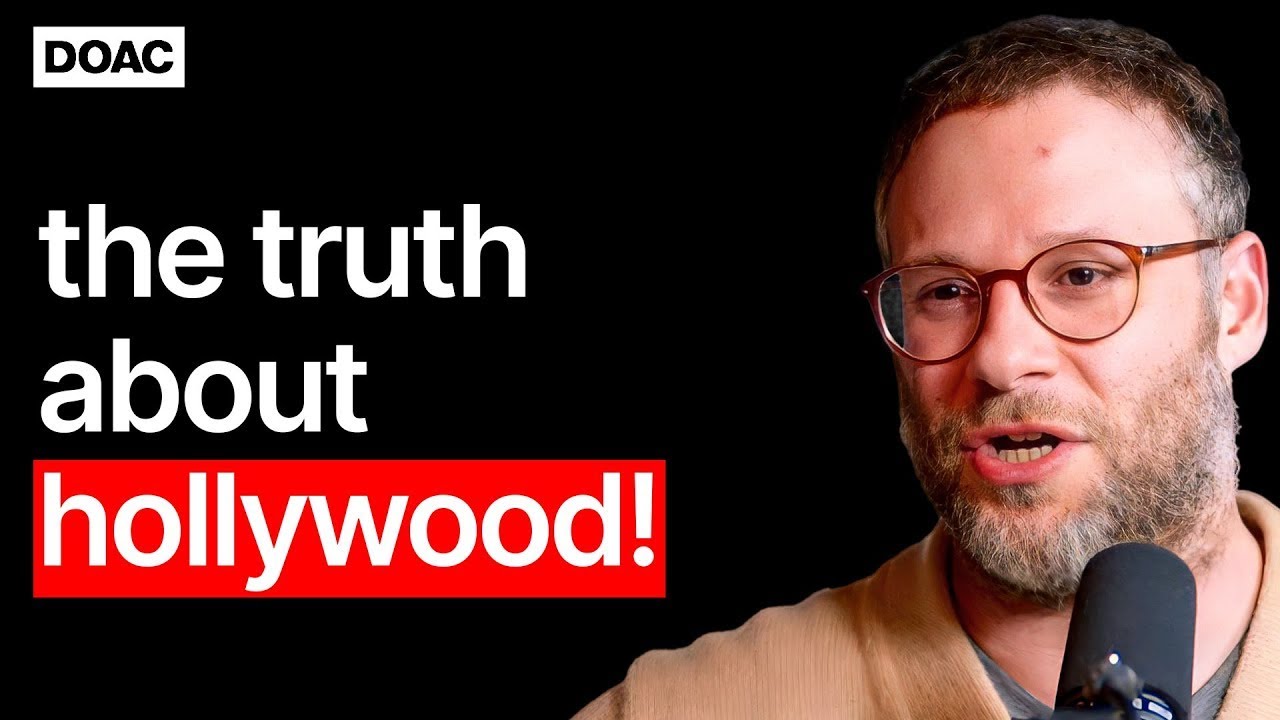
Seth Rogen Opens Up About His Self-Doubt & Struggles That Nobody Sees!
嘉宾:Seth Rogen
全文文稿 · 按对话顺序保留完整内容,深入理解上下文。
§01Transcript — part 1
The thing I think about most, especially when I'm on the go but also when I'm sat here in the Diary of a CEO studio, is the Wi-Fi and internet that we have to work with. In fact, anytime I'm filming away from the studio, one of the first things I do when I arrive is open up an app and do a speed test to see how strong the signal is.
The number of screenshots I've sent to my team about Wi-Fi signals at different locations is actually pretty crazy. It matters that much to me because it's such a competitive advantage to have fast Wi-Fi. On any given day, if I'm recording hours and hours of footage with a podcast guest, I then often have to have my team send that across to our London team who then do the edit.
Fast Wi-Fi and internet is not a "nice to have"; it is absolutely business mission-critical. So, when it came to finding the best provider who could supply internet and Wi-Fi to our new LA studio, which I'm sat in right now, we looked at every single option.
Of all the providers, the one that came back with the steadiest connection as well as being the cheapest was today's sponsor, Spectrum Business. Spectrum Business keeps businesses of all sizes connected with fast, reliable internet, advanced Wi-Fi, phone, TV, and mobile services. Millions of business owners already rely on Spectrum to keep their operations connected. If you want to join them, head to spectrum.com/business to learn more. Restrictions apply. Service not available in all areas.
Hey there, welcome. Seth Rogen: writer, producer, and actor you know from *Pineapple Express*, *Knocked Up*, and *Superbad*. Hollywood is not a fair industry. It is not fair who makes it. Any given phone call is one that is making your life or one that is yet another door slamming in your face.
We had finished *Superbad*, and then we wrote *Pineapple Express*. No one wanted to make it. But if you don't quit, you might make it. People would obviously look at you and assume that you have zero self-doubt because you've been so successful in what you've done.
What's your journey been with self-doubt? I'm at the point in my career where not a lot of people are in a position to yell at me. But I will have a cultural institution tell everyone that I suck. That will add self-doubt. *The Green Hornet* received critical reviews for that.
What's that phase like? Any opening weekend, honestly, and any time I have a thing coming out, it sucks. I think if most critics knew how much it hurt the people that they are writing about, they would second-guess the way they write these things. It's devastating. It’s something that people carry with them literally their entire lives.
I read that you'd said you would find life really hard without marijuana.
I smoke weed all day. I've been very productive in that time. Clearly, that's what I've been missing.
Seth, you've had an incredible, twisting, turning career. I have to say, when I was reading about your earliest years, it was an unexpected one in many respects.
To me, too.
What do I need to know about you, where you came from, and how you were raised to understand the man that you are?
That depends on your appetite, I guess. I don't think anyone *needs* to know anything. But if you're curious, there's a lot. When I look at my life, I started young. That's something that I view as one of the defining traits and characteristics of my life. I've always worked very hard, and I've always had very supportive parents. Those things were instrumental.
Your parents? I was reading about them.
Yeah, they're very strange people.
How so?
Everyone's parents are strange, I would imagine. They're just kind of eccentric. My dad's eccentric; my mother's also kind of eccentric. But again, they were both incredibly supportive. I think because they're eccentric, in many ways, they were much more supportive of my career than my writing partner Evan’s parents, who were much more traditional. I probably benefited from their eccentricities more than anything.
"Eccentric" is a broad word. What exactly do you mean?
My dad—well, my whole family. My grandmother was an immigrant who fled World War I. A lot of Jewish families are defined by the fact that people have been trying to kill Jewish people for a very long time. My family is no different. A lot of the reasons Jews live where they live and are where they are, and not in Eastern Europe somewhere, is because people were trying to kill them.
That also shapes Jewish sensibility to a large degree; it's informed by neurosis and trauma. So, my grandmother is an immigrant, and she met my grandfather, whose parents were immigrants to Winnipeg, which is a very cold, unforgiving part of Canada. They moved to Vancouver and had my mother.
My mother wanted to go to Israel to travel. My dad's from Newark, New Jersey, which is one of the worst parts of America from a crime standpoint, especially in the '70s and '80s. My dad was a socialist and moved to a kibbutz in Israel, where he and my mother met.
My dad has always been incredibly left-wing. My dad really would have stayed living on a commune his whole life if he never met my mother. He also has obsessive-compulsive tendencies and Tourette Syndrome, so he's twitchy. I have it as well to some degree. There's no shortage of strangeness to draw from in my family.
What was his relationship like with money?
Not that relevant. We did not grow up with a lot of money. My mother went to school to be a social worker when I was very young. When I was a kid, she was a cashier at a department store, and my dad worked at a vocational college as an ombudsman.
We grew up in a small apartment. I think some people who don't grow up with a lot of money are taught to really revere money and put a lot of emphasis on it. Other people are taught that it's not that important, and as long as you have enough to do certain things, then that's enough. I was definitely raised more like that.
Is there sometimes a paradox where, when your parents don't value money or struggle with it, you grow up trying to avoid that struggle?
Definitely. I for sure had moments when I was young where I was afraid of being broke, and I'm sure that for sure informed elements of my ambition. I'm very lucky in that it also coincided with a very strong creative drive.
But I definitely remember being very concerned that we didn't have enough money, and my parents not being that concerned, which probably made me *more* concerned. That was when I was very young. As I got older, I saw that we would be fine on the grand scale of things.
In that apartment when you were very young, if I'd asked what you were going to be when you were older, what would you have responded?
I probably would have said I want to write movies or something like that. I probably would've wanted to be a ninja up until a certain age—a Ninja Turtle specifically. Then, when I was probably six or seven years old, the idea of making movies became very fascinating to me.
I was one of those kids with a camera who was running around making movies. I was obsessed with movies, quoting movies, wanting to watch movies. I fell in love with movies at a very young age.
Was there an influence in your household that inspired that?
My parents love movies. They're huge movie fans. Again, even though we did not have a lot of money, we would go to movies all the time. In Vancouver, Tuesday was the cheap movie night. Almost every Tuesday, we as a family would go to whatever new movie had come out that week.
So I saw everything in theaters constantly, and I loved it. My parents had a VCR and would tape movies off of television. Then in high school, me and Evan lived across the street from two video rental stores—a Blockbuster and a Rogers. We would go there every day after school and just walk the aisles for hours and rent movies. Ever since I met my writing partner Evan when I was 12, I've been obsessed with movies.
And stand-up? That came in at 12 years old as well?
Yeah. I loved comedy in general and I loved stand-up comedy. But truthfully, it was kind of a means to an end to me. It was weirdly well-thought-out for a 12-year-old, but I thought if I do stand-up comedy, maybe I can get an agent, and then maybe I can get on a sitcom and be like Jerry Seinfeld, and then maybe I can write movies. That was what I hoped my life would be like.
Remarkable, because most 12-year-olds are not thinking like that. What was your relationship like with school?
For sure, the first movie I wrote was *Superbad* with Evan, and it was very much informed by our high school experience. The educational aspect of school was lost on me. I knew from a very young age that my ultimate life path was not going to follow an academic route.
My parents never put that much emphasis on it. My dad dropped out of college. They saw that I was very inspired to do comedy and movies, and they saw I was willing to work very hard from a very young age. From the time I entered high school, they didn't care that much that I was not doing that well because I was always working really hard on writing movies and doing stand-up.
I loved the culture of school and the things that happened at school. I thought the kids were hilarious. We would go to parties every weekend, try to hook up with girls, and buy beer. I thought it was awesome. I went to a public high school in a big city with 3,000 kids. It provided a lot of adventures, and I loved it. We weren't popular or cool, but we weren't tortured by high school.
At 15 years old, you went to a Canadian comedy festival?
Yeah, I entered a competition and I did pretty well. I was okay, I was pretty good at stand-up comedy.
Do you remember the instance where Jerry Seinfeld showed up?
Yes, I do. I was auditing to get into the Just For Laughs festival in Los Angeles. I showed up, and it was during the day, which is not great for stand-up. I'm 15 years old and I flew in for this. I'm about to go up, and someone comes over and says Jerry Seinfeld is about to show up and he's going to go up instead of you.
I had to go on after Jerry Seinfeld. He goes up and he annihilates. He's as famous as a comedy star as there is alive at that moment. The people felt like they won the lottery. He gets off stage, and they introduce me: "From Vancouver, 15-year-old Seth Rogen." And I bombed horribly. I did not get into the Just For Laughs comedy festival. I told Jerry Seinfeld that story later, and he was completely uninterested. He could have cared less.
It seems like a tough thing for a 15-year-old—a horrific firing line to put yourself in.
I think part of it was informed by my overall naivety, but I was good enough at it that it wasn't a viscerally painful experience. It's worth the stress of it in order to pursue it. But honestly, what was more fun at that time was that me and Evan started to write *Superbad*. I loved sitting with Evan and writing a movie. To me, that was what I really loved doing.
There's this through line in all your creative work about making people laugh. Have you ever figured out why? I've sat here with a lot of comedians, and there always seems to be some instance or some inspiration in their life that made them feel compelled to and energized by the pursuit of making other people laugh and happy.
I think for me, I don't have a "dark origin story." I think for me, it was something I liked, something I was good at, and something I was very encouraged and fostered to do from a very young age. I was lucky enough to find another guy my age who was as good at it as I was.
I think it was things like my parents being big comedy fans, so I saw comedy from a very young age. I'm from Canada, which is a place that acclaims comedy and respects comedy. Culturally, I'm from a place where comedy is a relevant part of the culture. Canadians—some of their biggest exports are comedians and comedy shows.
Also, I'm from Vancouver, where they made movies. You would see movie sets around. I went to a high school where they shot some movies because it was a very cinematic-looking high school. It made it a little more obtainable than if we lived in the middle of nowhere. My path is one of being supported and working hard and being very diligent.
At 16 years old, you get a part in *Freaks and Geeks*. And that brings you to LA with your family. Your entire family came?
My parents. My sister was in college.
I read that they'd lost their jobs at around that time, and that made you the sole breadwinner in the house. Did that feel like pressure?
In a way, it felt like an alleviation of pressure. I remember my dad telling me after three or six months of being on *Freaks and Geeks*, "You've made more money in this time than I've made my entire life put together." So if anything, it was like an amazing alleviation of a weight. There was money all of a sudden. I was more than happy to provide for everybody because I suddenly had access to an amount of money that was absurd compared to the amount of money I grew up with.
Your work ethic seems to be pretty spectacular. One of the quotes I read is: "If there were any kind of dark driving force behind your early ambitions, it would be some sense of financial insecurity."
Yeah, probably. But that's gone. Which is maybe why I don't make as many things as I used to.
That's an interesting journey to go on—being driven by that financial insecurity, developing a strong relationship with work, and then that falling away.
Yeah, and it fell away pretty fast. Once I had some money, it was just bonus money. Part of what had happened is they lost their jobs and we sold our house in Vancouver and everyone moved to LA. It's not like my parents were a leech; they were able to make a baseline level of survivable income. So when I had more money, it just added a cushion of comfort.
Then they moved back to Canada when I was 18, and I was in LA. That's around when I became unemployed for years and years. So I did then start to have financial burden, but it was my own financial burden.
You were unemployed for years and years after *Freaks and Geeks*?
We did *Freaks and Geeks*, then we did a show called *Undeclared* in 2001, and then I basically didn't work for like three years essentially.
Most people quit at that point.
That didn't even occur to me. I had a chip on my shoulder to some degree. I was writing a lot still. That's probably when we wrote *Pineapple Express*. We had finished *Superbad* and no one wanted to make it, but we thought it was good, so we put it on the shelf and said, "Let's write another movie." In general, we were also getting very positive feedback as writers; we just weren't getting hired to do anything and no one would make our movies.
It was this weird mixture of things kind of being encouraging and very frustrating at the same time. Any given phone call is one that is making your life or one that is yet another door slamming in your face that you have to just suck up and keep moving forward. You inherently get very jealous and you start to doubt yourself and if you are good enough. But it's pretty warm in LA usually, so it's easy to just hang out and keep plugging along.
What's your journey been with self-doubt?
I think all creative people have self-doubt. It's impossible to put yourself out there and not worry people won't like what you're doing. That is pretty constant across the board for all creative types who genuinely care about what they do. For me, it comes in waves. You make a thing everyone likes, it gets a little better. You make a thing everyone hates, it gets a little worse.
I'm at the point where not a lot of people are in a position to yell at me in my job, but the *New York Times* will publish an entire article saying I suck at my job. So that's the trade-off. I've worked my way up to not having to deal with that much face-to-face conflict, but I will have a cultural institution tell everyone that I suck. That will add self-doubt.
Has it ever hurt you?
Oh yeah. Criticism hurts everyone very much so. I think if most critics knew how much it hurt the people that made the things that they are writing about, they would second-guess the way they write these things. It's devastating. I know people who never recover from it, honestly. Because it's very personal. It is devastating when you are being institutionally told that your personal expression was bad.
You've had back-to-back successes, so it's hard to find someone who's trending as well as you. The thing you've spoken about in interviews is *The Green Hornet*, where you received some critical reviews. If I was a fly on the wall in your home, what would I see? Do you stay in your bed? What's the human impact?
Life goes on. You could be making another movie as your movie is bombing, which is a funny thing because it's bittersweet—you know that things will be okay. If the fear is the movie bombs and you won't get hired again, well, you've been hired. It's too late.
For *Green Hornet*, the reviews were coming out and it was pretty bad, and people just kind of hated it. But it opened to like 35 million dollars, which was at the time the biggest opening weekend I'd ever been associated with. And so it was a funny thing where it really didn't matter.
But I honestly think things like *The Interview* were more painful as far as people really taking joy and talking shit about it and really kind of questioning the types of people that would want to make a movie like that. That felt far more personal. *Green Hornet* felt like I just had fallen victim to a big fancy thing. *The Interview*, people more treated us like we had creatively failed, which sucked much worse.
On the grand scale of things in life, it's not that bad. And I've gotten much better at dealing with it as well. Now I do not carry it with me nearly as much as I used to.
It is the center of your world, though, because you've poured your creative heart into something.
Oh yeah. It feels like a personal rejection and it doesn't feel like constructive criticism.
What's the human impact there?
Sometimes you go to dinner where you just try to forget about it, sometimes you sit there and watch movies, sometimes you're literally just sitting on the couch pissed and devastated. I used to go to the beach. Any opening weekend, honestly, and any time I have a thing coming out, it sucks because it's just stressful. It's like birth, which is just an inherently painful process. Even though it is bringing something beautiful into the world, it is a painful act.
Originality risks both exceptional success but also potential failure.
Yeah, and the more personal it is, the higher the highs can be if it works and the lower the lows are if it doesn't.
How long is that process of trying to get back on your feet and get it out of your head?
It's different and it rears its head in different ways. I think imposter syndrome or self-doubt is a common theme in creative people's lives. But to me, it's never been that hard to do the creatively risky thing. It's never been that hard for me to convince myself to take the leap and do the thing that is maybe crazy. Even the worst-case scenario is survivable if you just keep going from a creative standpoint.
My biggest fear is to make a thing that's boring or not taking a big swing. The fact that we get to make anything—movies, TV shows—it's like, there are so many people who are trying to do it and we get to do it, so we should go for it. We're spending the money of these giant conglomerate corporations; they're letting us spend millions of dollars to make our crazy things. We should really look back and be like, "Wow, can you believe we did that?"
I get the sense you almost couldn't *not* do it. You're such a lover of what you do at heart. If I told you today that you could no longer make movies or do anything in the entertainment or creative space?
That would be hard. I'd become a ceramicist, which I do spend a lot of time doing. But it would be a real bummer. It is very ingrained in who I am. I have enough money to where if I didn't want to keep working, I could never work again and live the exact life I live now until I die.
It's genuinely because I enjoy it and it's a part of who I am and how I spend my day. People generally seem to enjoy the output. I just love writing. I've been writing screenplays since I was 12 years old. It's so much a part of who I am that I do it all the time. If I'm making a coffee and have five minutes, I'll write for a few minutes.
You have ADHD?
I don't know, maybe. I'm pretty good at focusing, honestly.
I read that you had Tourette's and ADHD.
I do have some Tourette's, which is connected to ADHD.
I don't fully understand Tourette's.
It's kind of connected to like a compulsion disorder where it manifests in physical tics and twitches. The most extreme versions are like people screaming swear words, but it all roots from like a compulsion to do it. It's like scratching an itch. I'm sure you've been sitting across from people who twitch or have a weird eyebrow thing they're doing. I see it so often, and that is a mild case of Tourette Syndrome.
I know the exact feeling those people have when they are doing that. It literally feels like you have an itch on your hand and you're scratching it. You feel like if you don't cock up your eyebrow, you're not scratching that itch. When you do, you're like, "Ah, I did it."
And you have that?
Yeah, at times. For me, it was always pretty mild physically, but I still feel the urge at times.
When your cat is acting weirder, or your dog is being louder, your turtle moves slower. Hello, Ted. Your cat seems thirstier. Whoa, slow down buddy. Or your puppy is acting clumsier. Day or night, if you don't know what's wrong, know where to go. Vedge ER for Pets. This is Kate. Vedge: the better, kinder ER for Pets.
Paying extra for tire care is BS. You know, bad service. So at Midas, we're rolling out our BS-Free tire guarantee. Included with paid installation and tax on every purchase, you'll pay nothing for flat replacements, nada for flat repairs, and zilch for tire rotations every 5,000 miles. That’s zero dollars for all that. So with this limited lifetime tire guarantee, you’ll pay a whole lot of nothing compared to what the other guys charge for tire care. That’s the BS-Free tire guarantee, only at Midas.
"I’m not quite cut out for this world, but weed makes it okay." In a different interview, I read that you'd said you would find life really hard without marijuana.
Yeah, for sure. I smoke weed all day.
All day every day?
Yeah.
Today?
Oh yeah. Every day. I've smoked weed all day every single day since I was 20 years old, maybe, something like that. And I've been very productive in that time.
When you say that you wouldn't be cut out for this world but weed makes it okay, what do you mean?
In the book and in life, I equate it to shoes or glasses. Are shoes like a crutch we use, or are they a thing that we have culturally decided make our lives easier and better? That is exactly how weed is to me. Could I not wear shoes? Probably. Could I not smoke weed? Probably. Would I just much rather smoke weed all day? Yes.
It only makes my journey through this life more comfortable, more palatable, easier to process, easier to manifest the things that I want to do. Exactly how I would be trying to do the same things I do in my life without shoes on or without my glasses on or without a jacket on. That is what it would be like for me to do it without smoking weed all day. It just would be a bit more of a pain in the ass.
For that Seth Rogen that didn't smoke weed all day every day, what do you believe his life would be? How would his life be different?
I would not probably have a weed company. I probably wouldn't have made the movie *Pineapple Express*. I maybe wouldn't have conceived of a lot of the things I've conceived of over the years. Weed has always been like a very powerful social element for me and my friends. We've hung out, a lot of the ideas we've come up with, we've come up with hanging out and smoking weed.
You don't come up with the movie *Sausage Party* not hanging out and smoking weed. So I think the environment it has created amongst me and my collaborators has been very additive for sure to my creative output.
I was looking at the wording: "I’m not quite cut out for this world." I found that really curious.
I don't think any human is. No human is quite cut out for the world, as is exemplified by the fact that we wear underwear, that we need toilet paper, that we have shoes. We are not like these pure beings that just go out into the world and can exist flawlessly. We do dozens of things that are external to make our lives livable. Weed’s actually natural, unlike underwear and shoes and glasses. Everyone has things they use to make their lives livable, and for me, weed is one of those things.
Is there a cost to weed? Has there been a cost in your life to weed?
No. No, there's literally, from my—no. I mean, because weed is illegal stupidly, there has been situations I have found myself in that are not great in the pursuit of getting weed, but I don't blame weed for that. I blame the government for making weed illegal and making me jump through all these hoops to get it.
But in general in my life, no, there has been no downside to weed or my use of weed or my love of weed. Maybe it’s cost me jobs throughout my life. I'm in the Mario Brothers movie coming out soon, I'm in the Ninja Turtles movie that I wrote and produced coming out soon. I'm producing things for giant corporations that do not seem to mind, so I have not seen a definitive impact on my career.
I get work ethic, I get your innate passion which seems to have been there since you were a child. But there's people that have both of those things and they're not Seth Rogen. Is there anything about you in particular—a talent—that makes you good at what you do?
I think because I grew up watching so many movies and having parents that appreciated them, I from a very young age had an inherent understanding of cinematic storytelling. Of what—and that specifically from a writing standpoint, from how the movies were written. That is, for whatever reason, how my brain processed it.
How the characters were introduced, how the conflicts between them were set up, how they played out throughout the movie, how they resolved themselves or didn't resolve themselves throughout the movie, how they manifested in set pieces and sequences that exemplified the conflicts and the themes and the tensions between the characters.
For whatever reason, from a very young age, I was able to understand and write those things. There are things about what we put into *Superbad* as 14-year-olds that are like fundamentally functional and good in a way that is beyond the average writer's ability in a lot of ways.
And that is something that me and Evan really just—we were lucky. We got it. And I think honestly, as an actor, I mostly credit my ability to act as being from a writing through a writing lens. I think as an actor, I understand what the story needs. I understand how that character needs to affect things, what that character needs to do in order for this story to be told effectively.
I don't view my acting as internally as the other actors I work with. I view it much more from like a big picture: "Okay, here's the role this character plays in the story. How do I make that work as well as it possibly could?" And I can do it, so I have some performance ability. I think my understanding of how story works kind of helps compensate for the fact that I'm not the greatest actor and that I am able to work with actors who are much better than I am.
What is the actionable advice that you could give to a young creative to give them a shot? There's a lot of creatives out there that are struggling.
Unfortunately, the only way to mitigate not being successful is to not quit. That's it. If you don't quit, you might make it. And if you quit, you definitely won't.
And honestly, I think after all the years I've seen people make it or not make it, the only common denominator is that. I've seen actors write themselves off, be like "I'm never going to fucking do this," try to get other jobs. One of my dear friends who's an actor—he's a brilliant actor—and his career ebbs and flows, comes and goes. He went and tried to get a job at a car dealership one day. He's like, "I quit acting. No one's going to fucking hire me again."
Now he's like the star of the most successful play on Broadway right now. And it's because he didn't actually quit; he kept going. Hollywood is not a fair industry. It is not fair who makes it. The best people don't make it. It's very luck-oriented; it's very connections-oriented. I'm lucky, and I also worked hard.
But that being said, I've seen people get lucky at random times through random ways. I always think about Ian McKellen. Had you heard of him before he was 65 years old? That guy—I had never heard the words Ian McKellen until he was Magneto in *X-Men*. Then all of a sudden he's in *Lord of the Rings*; he's one of the most famous people on Earth. He got famous when he's like 60. That's what happens to people sometimes. You never know.
And if you like it, then just don't quit. And as long as you have enough to survive, then just keep trying to do it.
But there's got to be something that I can do to increase my luck.
Be really good at it. I think being nice, honestly. Being nice, being the type of person people want to be around, that people like, that people when it comes down to it want to help instead of not help. That is very good. If people don't like being around you, then you will fail because you need other people to help you succeed.
Working hard is something you can control in a very uncontrollable world. I was meeting with someone recently who ascended very high in Hollywood and she was like, "I always fetishized hard work. Like, to me, that was like it. If you weren't working hard, I had no regard for you basically."
And that's a good reminder of those are the people you're up against. I don't consider myself a competitive person, but I knew succeeding in Hollywood was inherently a competitive pursuit. There's only so many jobs and there's way more people trying to get those jobs than there are jobs available. So by the nature of that, I was competing with people for these jobs.
And I knew I had to be able to look at myself and be like, "Am I at least working harder than everyone else who is competing for this job?" I might not be better than them or smarter than them or have as many connections as them or be as good-looking as them, but I can at least work harder than them. And that to me was something that was controllable, and I've never seen someone regret the amount of hard work they put into their pursuit.
You referenced earlier you don't have any kids.
I do not. That has helped me succeed as well. Definitely.
Really?
Oh yeah. There's a whole huge thing I'm not doing, which is raising children. I'm not ignorant to what it's like. I've seen everyone I know has kids. I'm 40. Some of my friends have had kids for decades. Some people want kids; some people don't. I think a lot of people have kids before they even think about it, honestly. You're just told you go through life, you get married, you have kids, it's what happens.
And me and my wife were just neither of us were like that. Honestly, the older we get, the more happy and reaffirmed we are with our choice to not have kids. It was something we talked about more and were like, "Are we sure? Are we sure?" Now if anything the conversation is like, "Honestly, thank God we don't have children."
We get to do whatever we want. We are in the prime of our lives, we are smarter than we've ever been, we understand ourselves more than we ever have, we have the capacity to achieve a level of work and a level of communication and care for one another and a lifestyle we can live with one another that we've never been able to live before, and we can just do that. And we don't have to raise a child, which the world does not need right now.
And I work with a lot of people with kids, and I see definitively that I have more time to both do the things I need to do and the things I enjoy doing than they do. And not to say their kids don't bring them joy, but me and my wife seem to get a lot more active enjoyment out of not having kids than anyone I know seems to get out of having kids.
Speaking of your wonderful wife, in my extensive research I found this photo.
Yes, that's my wife Lauren.
Exceptionally beautiful.
She's lovely.
And I found this one.
Yes, that's Lauren and her mother Adele. That's a great photo. Where'd you get this?
Internet. Adele passed away a few years ago. You've campaigned exceptionally hard for Alzheimer's following Adele's diagnosis. Can you tell me about that journey?
Yeah, definitely. It's funny as a celebrity, I guess you're kind of asked to do a lot of charity things and find like a cause. I think there's pressure to find a cause, and I think a lot of people adopt causes that are not organic to them. Then I met my wife, and I started dating my wife Lauren in 2005.
Very soon after we started dating is when she realized her mother seemed to be showing the first signs of Alzheimer's. I knew nothing about that; it's not in my family. What I didn't understand is it was a disease that had no treatment, no cure. It was only going to steadily get worse until she died from it, which was truly devastating.
It put me and my wife on a pretty intense journey for the next 15 years or so. It really took a lot out of us, and my wife especially felt very out of control and devastated. Our friend suggested we do a comedy show and maybe give the money to an Alzheimer's charity. We did, and it went very well.
My wife started telling her story as a young woman whose mother was in her 50s and diagnosed with Alzheimer's. It was really not a thing anyone was talking about at all, and she found there was an enormous need for people to connect with someone who was going through this because a lot of people were going through it and really no one was talking about it.
We found a need for this organization that we made, HFC, which became an Alzheimer's charity that really was focused on talking to young people, many of whom were caretakers for their parents with Alzheimer's. It's a very stigmatized disease and not a disease very many people are comfortable talking about at all.
You say people don't talk about it enough, and part of that results in people thinking about Alzheimer's as just losing your keys or forgetting a sentence. What is the reality of Alzheimer's as you've observed it?
It's different for everyone, but for my mother-in-law, she forgot how to speak, how to go to the bathroom, how to eat, how to walk, and was essentially someone you would move from the bed to the wheelchair, force-feed essentially, move back to the bed. She was like that for like seven years.
She didn't speak for several years. If you saw her, you wouldn't assume it was dementia/Alzheimer's; you would assume she had some horrific stroke or something like that. It was far more devastating than I understood a cognitive decline could cause. It was far more devastating, and I think people don't understand how dire it is. Or they do understand and they just don't like talking about it because it's really scary.
What toll does that have on the people around her, like yourself and your wife?
It was just devastating for my wife especially. Truly one of the most upsetting things you could imagine is very slowly seeing your mother die over the course of years and years and years. It was very grim. But through the charity, there was a lot of hope that came up at times and a lot of wonderful things that it felt like we were able to do as a result of it. So there were bittersweet moments, but in general, it was terrible.
Has that been one of the hardest times of your last couple of decades?
Oh yeah, for sure. Especially being married to someone who is going through something incredibly traumatic. It's hard for them, and it's hard for you to know how to support them properly and how to navigate their feelings in a productive and loving way. It's obviously much harder for them. Adele passed away in 2020.
What impact does that have on the family?
In some ways, it is a relief of burden, especially when someone was so sick for so long with no hope in sight for any way to get better. And also devastating. It’s something that I'm always having to remind myself of: your wife, her mother died recently. There's a lot going on with that. The active agony of her mother slowly dying was probably worse, but this is also bad in its own way.
You mentioned Americans don't like talking about their mental health. I've never heard you speak about your mental health.
I don't think it's that interesting. That might be why.
Do you ever have anxiety?
Not really. Not more than the average. I think I have anxiety, but I'm also good at analyzing my own feelings and behavior to some degree. I do have anxiety sometimes, but I'm also having to remind myself that I am going through things that are objectively anxiety-inducing to almost anyone.
You just tell yourself, "Yeah, you feel anxious right now because you are dealing with this thing that has a lot of public pressure on it." So I think in general, no, in general, I have pretty good mental health, I think. Ask the people who work with me.
It seems like an unhuman way to live, right? Being in the spotlight and being receptive to so much public feedback. You talked about how shoes are kind of unnatural and roofs are unnatural. There's the way that we all live these days—it seems so far from what it is to be a human. What do we need to do to get back to being a little bit more human?
I don't know if I'm the best person to ask that, but I personally have tried to spend less time on social media. I think that is a good thing; I don't think that contributes to one's humanity necessarily.
What are the things that make *you* feel most human then, and most connected?
Spending time with my loved ones—my wife, my dog, my sister, my family, my parents, my friends. Going to dinner with my friends, going to their houses, hanging out with my friends and their kids. Writing, being creative with my friends, doing things with my friends, making things with people that I respect. The feeling that I'm a part of making something that I am excited about and that I think is really good—those are the moments where I feel like I am personally living up to my potential.
You've done so much in writing and entertainment, then embarked on other pursuits—Point Grey (huge success), Houseplant (massive success). That's in the more entrepreneurial side of your passions. What is it now for you? Having achieved all of this, what makes you fired up and excited about a challenge?
I get excited when—and it's a simple metric, I think—anytime we're making a thing that I know I would be psyched if I saw it or got it. If I'm making a movie and I'm like, "I would love this movie. I would see this movie and be like this is fucking great."
And it's the same thing with Houseplant. If we make a thing and I'm just like, "This is awesome. If I saw this, I would want this." To me, that's exciting because it is a creative expression. Houseplant is all output that is meant to reflect my taste and my sensibilities and those of those who are working on it with me.
When I'm excited about it and when it works is when I really think it is the thing that I wanted it to be. That's the same thing since we've been writing *Superbad*. We were like, "Let's write our favorite movie. Let's write the movie that we want to see and no one else is making." It's the same thing with everything that we've done for the most part, which is like, let's make the thing we want more than anything.
Why not make the thing that you think other people will want?
Because who the fuck knows what other people want? And I think luckily, that's a thing we've been lucky with—either our taste and the public taste has coincided, or the public has been willing to take cues from our taste and bite to what we're putting out there.
Which is just an almost intangible skill to some degree, which is just making things that connect with people in a big way. And that's not even what every creative person is trying to do. I know plenty of filmmakers whose favorite movies are movies that are not trying to connect with giant audiences.
But those are the movies we grew up loving, and to us, that's a fun challenge: how do we put everything that we think is risky and subversive and difficult about this idea into something and then have it connect and have everyone go crazy for it?
Your creative process—what is, from your own observation, the most unusual part of it?
I tend to be able to work on a few different things throughout the day. I'm lucky also because I get to work with the most brilliant people in the world who do what I do. I have a very front-row seat to an incredibly high level of performance on a writing, acting, or directing standpoint.
I am good at switching gears and compartmentalizing. Some writers find switching gears creatively, especially midday, difficult. I can work on five different things throughout the day. I physically write more than I think most people do on a keyboard. I find a lot of writers want to talk about writing; to me, I'm like, "Just write it. Let's just write it."
I try to really just write different versions of things, share a lot of early versions of things with a group of people that I trust. I'm really not precious with that. My personality, I think, in some ways is engineered around writing and making movies because I've been doing it since I was so young. It's become a very fluid part of who I am.
I do also have a schedule sent to me by my assistant at the end of every night that tells me what I'm doing the next day. And I pretty much just do what's on the schedule.
She sends you an email, right?
Yeah, and there'll be giant free blocks of time in there where I will write usually, or me and my partner will organize our own writing time. But yeah, I'm pretty regimented from a schedule standpoint, which does surprise people because people will encounter me and be like, "Let's get together sometime this week," and I'm always like, "I'm like scheduled like a month out pretty rigorously throughout the day."
But if I asked you what your schedule was next week, would you have any idea?
I have no fucking clue. I don't even know what my schedule is Monday. I'm good at dealing with what's right in front of me, honestly. I can't begin to process what's happening next week.
Have you observed a point in your trajectory where you become somewhat so successful or somewhat so famous that happiness begins to decline?
No. It was never like being famous was a goal for me. So I don't have this complicated thing where I was like, "I was trying to become famous and then I got famous and realized being famous sucks." I always thought being famous kind of would suck a little bit.
The idea that it is great in a lot of ways and it does suck in some ways, but that's not honestly a thing that I have a very conflicted relationship with. I've also been pretty famous since I was like 23 years old. It's been a very long time since I got pretty famous. Where I've been at for quite some time has been a pretty good place. I see other famous friends have much rockier roads dealing with it than I do.
And as far as success goes, no, like if anything it's like great. I get to work with the filmmakers that inspired me to make movies in the first place. I get to make a movie out of a thing I've loved since I was a kid. We just sold a show to Apple that I'm writing and directing and starring in with my partner so we can come up with original ideas and do whatever the fuck we want.
What's the cost?
There's no cost. I don't have kids! If I felt guilty that I was not being a good father, that would suck. I do not have that feeling at all.
We have a closing tradition on this podcast where the last guest leaves a question for the next guest, not knowing who they're leaving it for. The question left for you: Looking back on your love life, can you see patterns in it, good or bad, and what was the greatest love of your life? What did it feel like, and how has it affected you up until this present moment?
Lauren. Yeah. I mean, I made a whole movie about how I was not well-liked in high school by women. Lauren, my wife, was the first serious relationship I ever had. I felt deeply in love with her very fast. We essentially moved in together after like a week and almost have not spent any significant time apart since then. We've never broken up, we've never had any serious issue throughout the entire time we've been together, which has been like 17 years or something like that.
If anything, she has really helped me do better work. She's been a real supporter and also she herself is a brilliant writer and director and filmmaker. She's been a very direct voice in improving our work. I think the most tangible example is the movie *Neighbors*. One of the things people really liked about it specifically was the relationship between me and Rose Byrne's character and how we're a couple.
Traditionally in comedy for years, the comedic dynamic of a married couple was they hated each other. That was the joke. They got on each other's nerves, they didn't like spending time together. The woman was usually annoying, the guy was usually cool and laid-back. That was it. That was the comedic dynamic that essentially was like frozen into movies forever.
And Lauren was the one who was like, "What if it's like us? And they fucking like each other. And they both like to smoke weed, and they both do stupid things, and they both go out and party." We put that in the movie and it completely changed the dynamic, and I honestly think it's one of the reasons the movie became so liked and successful.
What's life like without her, though?
Thank God there's not a whole lot of life without her. We hang out a lot. I don't really leave LA to make movies anymore. Honestly, part of the reason is I just like spending time with her and I don't like leaving Los Angeles as a result of it. I used to travel much more to make movies and shoot movies in other cities, and it sucked. Ultimately you're just like, "This isn't worth it. This is my life. I'm living my life not being surrounded by the people I want to be surrounded by so I can go make a movie."
§02Transcript — part 2
Everything every answer you gave came with the second part of the sentence which was "with friends," "with the person I love," "with people." It's quite inspiring and important to hear that you're orientating your life now that you can so that it's surrounded by people.
Yeah, and I think it's always how I came up. My parents had a lot of friends. They always had people living with us in our house that were divorced or down on their luck. I always was in like a community. Then I moved to LA and I fell in with a community. Comedy especially feels more of a team sport than other creative pursuits.
I remember years ago being at that *Vanity Fair* Oscar party. There's one corner of the party where every comedian is. And they're all together in one little lump. And it was so funny. No other genre is like that. They're all spread out talking to people, but if you were a comedian, you were in this one little circle where you kind of felt safe and insulated. I'm friends with everyone I work with, which is great.
What a privilege. You're the first person to open this box. The first person to ever open this box. This is a new tradition we're starting. All the guests that have been on this podcast, all the questions they've written in this box—oh, they're on cards now!
They're called The Diary of a CEO Conversation Cards. I've put 20 in here. All I'm going to ask you to do is to pick one at random and then answer the question.
"What is the greatest gift another human has given you?" Love. Also, I got paid a lot of money to make *Green Hornet*, so that was—no, it's love, though. It's for sure love.
Thank you, Seth. The paperback version of your book is now out.
It's out.
And it's phenomenal. It's hilarious, it's phenomenal. It was fun to write. I mostly didn't want to humiliate myself. That was my goal. I was talking to another friend of mine who's writing a book the other day, and I was just like my whole goal was for the book to come out and for the general consensus to be that I'm not a fucking idiot. Which I did. I feel very secure with that.
Thank you, Seth.
Thank you.
(Music plays)
When your cat is acting weirder, or your dog is being louder, your turtle moves slower. Hello, Ted. Your cat seems thirstier. Whoa, slow down buddy. Or your puppy is acting clumsier. Day or night, if you don't know what's wrong, know where to go. Vedge ER for Pets. This is Kate. Vedge: the better, kinder ER for Pets.