
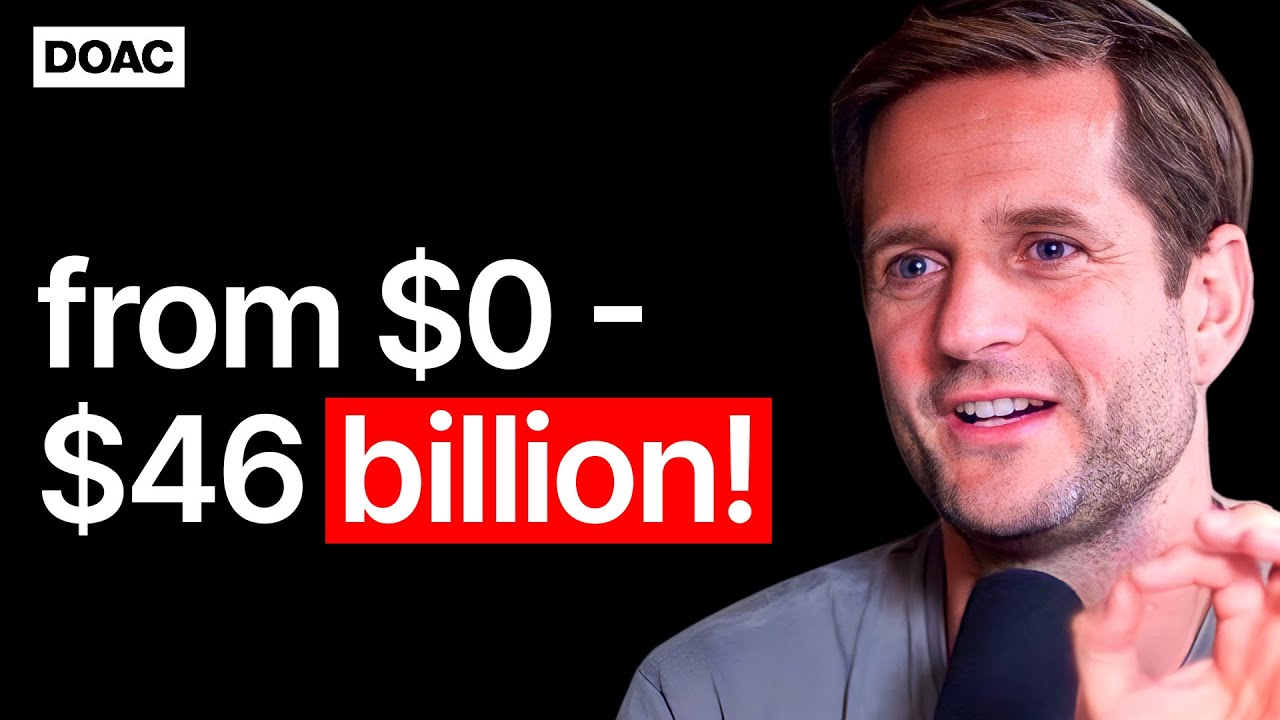
Klarna Founder: From $0 to $46 Billion: Sebastian Siemiatkowski
嘉宾:Sebastian
全文文稿 · 按对话顺序保留完整内容,深入理解上下文。
§01Transcript — part 1
The thing I think about most, especially when I'm on the go but also when I'm sat here in the Diary of a CEO studio, is the Wi-Fi and internet that we have to work with. In fact, anytime I’m filming away from the studio, one of the first things I do when I arrive is open up an app and do a speed test to see how strong the signal is.
The number of screenshots I’ve sent to my team about Wi-Fi signals at different locations is actually pretty crazy. It matters that much to me because it’s such a competitive advantage to have fast Wi-Fi. On any given day, if I’m recording hours and hours of footage with a podcast guest, I often have to have my team send that across to our London team, who then do the edit.
Fast Wi-Fi and internet is not a "nice to have"; it is absolutely business-mission critical. So, when it came to finding the best provider who could supply internet and Wi-Fi to our new LA studio, we looked at every single option.
Of all the providers, the one that came back with the steadiest connection, as well as being the cheapest, was today’s sponsor: Spectrum Business. Spectrum Business keeps businesses of all sizes connected with fast, reliable internet, advanced Wi-Fi, phone, TV, and mobile services.
Millions of business owners already rely on Spectrum to keep their operations connected. So, if you want to join them, head to spectrum.com/business to learn more. Restrictions apply. Service not available in all areas.
Be careful with who you’re listening to. Have they really contributed to success? Have they really built success, or have they simply been in a company that was successful?
Afterwards, I’ve heard from journalists that a ton of emails were coming from banks since they’re threatened by our existence. And so the articles and the writing about us shifted from "they’re here to screw customers over" to "do bad things." And that was tough.
I went home, I had dinner with my wife, and we talked about it. And I was like, "No, this time around, I should probably help him." I decided. And I tried to call him, and he didn't answer. I emailed, he didn't answer. In the morning, my mother called and said he was dead.
Sebastian Siemiatkowski. He’s the CEO and founder of Europe’s most highly valued fintech privately held company. His company is worth $45 billion. Sebastian isn’t a guy that comes from a stable household or a silver spoon. It’s very much the opposite.
The stories you’re going to hear about his home life, his family, and his father might just bring you to tears, because that’s the effect they had on me. He came from incredibly humble beginnings, and he’s built a company in an industry where he was not qualified, where he didn’t have technical expertise, and where he couldn’t code.
He has completely revolutionized an industry. He is humble, he is honest, and he’s willing to tell you the truth. And that’s why it’s such a pleasure to sit here with him today and uncover what it takes and who it took to build such a revolutionary, pioneering business.
Without further ado, I’m Stephen Bartlett, and this is The Diary of a CEO. I hope nobody is listening, but if you are, then please keep this to yourself.
Sebastian, one of the things that I’ve come to learn from speaking to a wide array of guests on this podcast, from sports athletes to really successful CEOs, is how often our childhood and our early years shape our adult foundations.
Whenever I meet someone like you that’s achieved really remarkable things in whatever discipline they’re in, my first question always becomes: what was it that made them remarkably unique in their early years? What was the experience or the cauldron that shaped them into who they are today?
It’s kind of funny you ask that because I don’t necessarily feel that I was remarkable or unique in my early days. A friend of mine, their son turned out to be blind, but he has perfect pitch. He’s now eight years old, and he’s sitting and playing the piano and singing.
That, to me, is remarkable. I was thinking about that, like, "That wasn't me when I was a kid." My parents were from Poland. They moved to Sweden about a year before I was born. I was born in the northern part of Sweden. They were basically immigrants because they didn't see a future in the communist Poland which was the case at that point in time.
They came to Sweden, but obviously, as it was back then, it was very hard to integrate into Swedish society. English wasn't as profound as it is today, and there were a lot of language barriers. At that point in time, there was also a lot of skepticism about people with Polish names. It was hard to get a job if you had a foreign-sounding name.
My parents struggled quite a lot to integrate. My mother was an early retiree, and my father jumped from job to job. He was unemployed for quite a long period of time, drove a cab for some years, and did a lot of different things.
I do think that there's something to the fact that as an immigrant kid with parents that still intellectually had academic backgrounds—they had studied at universities and stuff like that—and never basically were able to live up fully to their potential, I think that kind of creates some kind of feeling like, "That's unfair."
You’re going to try to fix that somehow. I was growing up among Swedish friends who just had better economic standards than we had, and I was obviously longing for what they had. I remember with my mom, there were weeks when we were eating pancakes every day.
I thought that was great, but now I realize it was because there was nothing left. That was the only thing we had: flour and milk and so forth. I do think that setting—and there's obviously some research that suggests that in Silicon Valley, more than 50% of the companies are started by people with immigrant backgrounds—has a lot of intellectual capacity.
At the same time, this drive of almost feeling like it’s unfair. Life isn't necessarily fair, but you feel like, "This is unfair; we should have been able to have something different than this." And maybe also, to some degree, on an emotional level, your parents really sacrificed their lives.
I think it’s hard for people that are not immigrants to understand the consequences of not having the friends from school, not having the understanding of how society works, which school is better, which is worse, how to interact with the government, or how the system works.
That total lack of understanding of a specific society that it means to shift, like my parents did in their late 20s or early 30s, and how difficult that means for your own ability to do something with your life. I think that’s something that’s underestimated.
That feels like a tremendous privilege. I wanted to ask you because I can relate a lot to that. I’m an immigrant myself; I was born in Africa, in Botswana, and my parents came over here. My mom can’t read or write.
Fantastic country, by the way. Beautiful place.
Yeah, beautiful place. But I moved to the southwest of the UK where I was in an all-white school of 1,500 white kids, and it was just me. We were also the poorest people in a middle-class area. So I felt different all the time. Did you feel that way?
Absolutely, very much so. Even the fact that we were Catholics—now I'm not a very religious person today necessarily—but we were Catholics and my parents went to church every Sunday in a very non-religious society like Sweden. That was in itself very odd.
I remember people saying, "Jesus wasn't the son of God" and stuff like that. At that point in time, that was a big deal. And then also the view of Poland back then was that it was this country behind the Iron Curtain that was spewing out toxic waste into the Baltic. There were a lot of Polish jokes and stuff like that.
I took all of this to heart. I wouldn't say I was bullied; that would be taking it too far because I know people that have been bullied for real, and I don't think I was. But there was that sense of being different, of not necessarily having the same prerequisites, but also getting a hard time over these things.
When you were a kid, because I know I did, I developed a very naive thesis as to how I would escape this scenario. And what was that? Money and success. I thought that because it was the pain in my household—the lack of it—that would fix it. Did you develop your own thesis of how to respond?
Yes, very similar to yours. Because also what happened in my life was that my parents divorced when I was about eight years old. They had a lot of conflicts on different topics. As a child, my interpretation of the reason for those conflicts was the lack of money.
That was what they were talking about all the time; you were hearing that. Now, I do today probably have a slightly different view of whether that was the only explanation for their inability to be a couple and be together, but at that point in time, I agree with you. One of my interpretations was: yes, it would be nice to have monetary success in life and that would solve some of these problems.
But I also, at least in my life, there was in addition to that something else which I cannot really explain, which was that I was always intrigued and thought it was interesting to do business. It’s very nerdy and I can't explain it. I remember reading Richard Branson's book when I was like 13 years old.
I thought it was super interesting. Or the founder of IKEA, Ingvar Kamprad, who was a big thing in Sweden, obviously, because he's a Swedish guy. I remember reading these stories and I also remember trying to start businesses very early.
I did a lot of different things. It was everything from gathering some of my friends and we would go to the apartment buildings where we were living—the storey buildings—there was this bus stop where all the people were coming, and we would go there and offer to carry groceries and stuff like that in return for money.
Is there something really intriguing about that? Because as you've highlighted, immigrants tend to be more entrepreneurial generally. In the situation you were brought up in, I made this connection that if I was to have anything or become anything, it would be a direct consequence of my own actions.
Entrepreneurship appealed to me because I knew I wasn't going to do great in the conventional route, but this was this really nice route to potentially huge success, and it was all centered on what I did. It was going to be me.
Hearing about the scenario you were in with your parents and your upbringing, entrepreneurship was something that maybe you could control.
You're right in the sense that, definitely in that environment and growing up in that setting, you know that there's nobody who's going to help you. You're not going to get anything from anyone. It's just going to be: either you do it, or it doesn't happen. Those are the two options.
If I look at my own kids, there's a lot of things that happen in their lives that fit into a third category: "it happens because Dad and Mom helped out." But here it was like: if I want to have an adventure, if I want to go and see the other part of the city, I bike there. I have to go there myself. Nobody's going to drive me.
I do think that there's some lack of healthiness to that as well, where it kind of educates you. I also think on the immigrant side that they are more common among entrepreneurs, but also when I look at when we have problems in neighborhoods with a lot of immigrants, I wish that society would realize that there's going to be a lot of frustration.
People with energy want something different. They want a change. They don't want things to be the way they are. That's kind of where you're coming from. And then it's just society's ability to try to showcase that that energy can be used to become Zlatan Ibrahimović, it can be used to become a music artist, it can be used to become an entrepreneur.
Or, if we fail to offer those opportunities or showcase those alternatives, they may come out as burning cars and doing other things that are less productive. To me, today, I just wish that society would really see it as: how do we help showcase and show that there are these great options for that build-up energy of wanting something to be different?
For that, you need a sort of great empathy and to understand that people are different shapes and sizes. That brings me nicely to the education system and your personal experience with it. Did it serve you well or did it fail you?
I think it did one thing that, to your point, you were describing as well in your own history. One thing that I do worry for today compared to me was that I was in a school with a mix. I would still say 70-80% were Swedish, 20% at that point in time had different immigrant backgrounds.
If they would have been only immigrants, I would not have had anything to compare to. So I do think that the school system at that point in time was less segregated than it is currently, at least in Sweden. In that case, were the teachers that amazing? It was a mix; some were good, some were bad.
I remember I was one of the kids who had it very easy at school. I learned to read quickly. I believe to some degree then I became slightly bored because the Swedish school system at that point in time was very much set up as "everyone equals." So if you were ahead in math or reading, I literally still remember from second grade...
We were having reading, which meant that everyone was reading from a book, and some kids, unfortunately for them, were still struggling to read it. I had already read the whole book. So I was quite bored sitting there listening to the story that I had already read.
And then I started disturbing the lesson. I became a person that was quite problematic for the teacher because I was so under-stimulated. That, I think, is a bit sad. I hope that schooling has become better in actually understanding that all pupils are different and need different support and can get a different challenge.
Those lessons there you learned about that need for challenge—you're now the headmaster of a school that has thousands and thousands of employees in it. That point about making sure that the people that attend your institution are also challenged must still be important to you.
Absolutely. Actually, in a way, especially in Swedish society, the Swedish culture is very much... there's a saying that "alla ska med," which means that everyone should join, everyone should be part of this. And that's a fantastic ambition and vision for a society.
But for a while, that was creating a conflict because Klarna as a company, we have very high aspirations. We want to do something very different. We want to really, as I say, sometimes play in the Champions League. And the problem is that's not true for everyone in the work world.
Some people are fine with playing in the Kids' League. So it took us some time to dare to say that Klarna is not for everyone. That Klarna is actually a company that wants to attract people that want to make a real impact, make a real difference, that want to learn, that want to be challenged.
That took some time, and it might sound odd, but for us at least in the Swedish cultural context, it took some time to get to that where we started saying, "You know what? Klarna isn't for everyone. Not everyone is going to enjoy this environment."
A lot of people would say, "It's amazing to climb Mount Everest. Did you climb Mount Everest? Fantastic." That's one thing, but it's a very different thing how many people are really willing to freeze their fingers off and train for four years.
Then the number of people that check the box and say, "I want to do that," becomes massively smaller. I think the same applies for companies. A lot of people would say, "I want to work for a successful growth company doing things that are really cool, like climbing Mount Everest."
But then the question is: are you willing to do all these things that it means that you need to do in order to be able to accomplish that? So to your point, I think the challenge today, I always tell people when I interview them: just be aware, this is... you're going to be very challenged here. This is not going to be a place where it's just going to go easy.
What's the perfect balance, though, of challenge between being too challenged that they end up burnt out or under-challenged that they lose motivation?
It's super difficult. I think that's why it has to be about encouraging them and seeing each individual by individual where they are. Think about a great personal trainer. When you go to the gym, how do they find the balance of how much to push you and when to hold off a little bit?
My kids have this swim teacher; her name is Petra. I can sometimes just sit and watch her when she's training my kids swimming because she has that perfect balance. She pushes my kids exactly to the point where they are dead scared, almost like they're going to want to give up and get out.
But they're doing it, and then they're proud of what they accomplished. That to me is almost like a piece of magic that a teacher has. The best teachers can spot that in their pupils and really find that perfect balance. But it's very difficult in a company with 4,000 people.
How do you try to put mechanisms in place to ensure that you find that balance and that you really allow people to get to that perfect spot where they develop heavily but at the same time don't bang their heads into the wall and feel like they want to give up?
To your point about it taking you a long amount of time to realize that you wanted to just say to the world and to anyone that was considering joining your company, "We're not for everyone." The pandemic happened, and what I saw was leaders were kind of forced in this wave of virtue signaling to say, "Everyone can work from home forever."
It became like, if you didn't say that, now you're a bit of an asshole company. As I reflect on that, I started to reject that narrative because I think that the culture of the company should be determined by the mission. I actually think that companies should have really clear communication at all stages about who we are and how we work.
Allowing it to be "you decide" is super weak as leadership, but I also think it will have an adverse effect on the ability for the company to achieve its mission, but also the company culture—people knowing what's expected of them. But now it seems to have become really politically acceptable to just say our employees will do whatever they want. How do you feel about all of that?
It's a very complex topic. I'll give you an example. Previously, Klarna was not really following agile work tactics. A few years into Klarna's development, we realized that some aspects of agile, like daily stand-ups and weekly retros, working as small teams on specific topics, were very productive.
So then what we did is we said, "Okay, now all teams within Klarna should do daily stand-ups and weekly retros." I think currently when we look at our data, about 50% of teams are following this. So then the question is: how do you then approach that?
Because you feel yourself very convinced that, for example, the idea of daily stand-ups is helping to be productive. But if you enforce that, if you simply go and say, "Everyone has to do this, period, check the box," the problem is you can do daily stand-ups in very productive ways where you're engaged, the whole team is engaged.
Or you can do daily stand-ups only to check the boxes. There are different ways, and that applies to almost all such rules and concepts within companies. I still don't feel that I've entirely figured this out, but there's a balance in an organization around when are we prescriptive and mandating things and when are we suggesting and highlighting.
In the end, the reason I believe in daily stand-ups so much is because of my own experience of that. But there was also something that I sought up myself; there was a willingness to—I was interested in trying to find out better ways of working. I learned about this, I saw it in practice being done in a good way, and then my conclusion was that this was good.
So if you think about my learning process, my personal learning process in that situation, it was driven by my interest, my passion, and then I accomplished it. That's a very different thing to if my board suddenly would have dialed me up one day and said, "Everyone has to do daily stand-ups, period."
Because it would not have given me the opportunity to learn and reflect on it. That's when, so a lot when I think about learning within an organization, I think about the karate masters and the Japanese. Remember all this karate kid and everything? How they learn in those environments.
It is like, obviously at the beginning, there has to be an interest by the individual itself to try to learn, but then the master doesn't always tell you exactly what to do. They provoke you to try to learn yourselves. There's an excellent example from the Toyota way where some of the masters of Toyota way within Toyota would take a lot of their senior managers and they would draw a circle on the factory floor.
And then the managers would have to stand there and observe the manufacturing of the cars. And then by the end of the day, the totally silent teacher would come and say, "Okay, so tell me, what have you observed?" And then the senior managers would have been standing there the whole day and had to say, "Well, we saw this, we saw that." And then he would look at them and say, "No, another day."
So he provoked them because I think that's the thing. Learning is such a difficult thing because you don't—as much as we think that learning is sitting in a room and listening to somebody—that is a very inefficient way of learning. We learn by doing, by doing things ourselves. That's really the truth.
I think COVID is such a good example of that because we had a lot of experiences that we've never had before, and they taught us a lot about our life, our priorities. A lot of people talk about that today because we were forced to do things differently. Not because we read about COVID and we read about how things can be different.
But because suddenly we had to experience it, and when you experience, that's when you truly—that can impact your behaviors and change your ways. So the kind of—it's a very difficult balance in these companies consistently from a culture perspective.
How do I encourage and push people to go and find out? Try to experience that and learn from it. But not trying to enforce it too much. And that's a balance game. You cannot be entirely without rules because if you join a soccer team, there are some rules. You come into exercise every morning.
If you just don't come to exercise, maybe you have a different philosophy about how you're going to become a great soccer player, but I just don't believe in your philosophy. It's not going to work. So there is obviously some selection criteria where we have to decide: within our ecosystem, these are the rules that will apply.
But once you're beyond that level, then it's more like: how do I intrigue you, how do I challenge you to develop that insight for yourself so that you really come to embrace those ways of working and really make them your own and really expedite them? I haven't solved all of this, to be very honest. I think we have lots to learn still with Klarna.
One more thing on your specific work from home thing. What ends up happening is—and this is not a problem when you're 10-20 people in a startup—but when you start becoming 4,000 people, what ends up happening is you have obviously layers of management.
There is a tendency for people to go and say, "Management team, the top people have to tell us what the rules are." And if you write those rules, the problem is—look at Klarna, we're active in 40 offices across 20 countries. Each one will be in a different phase of COVID or not.
Try to write a rule that is applicable for each team. And then you're going to have individuals; maybe some individuals have immune diseases and are extremely worried about moving into that environment. Maybe you're going to have some people that have religious concerns somehow tied to this. You're going to have a flora because you have so many people.
So what you then sometimes need to do is you need to say, "Look, you will decide for yourselves." And what then ends up happening is the people who are actually doing the work, they usually find that quite attractive, that they can take that decision.
So the managers of those people, they may find it more difficult because to them it's nicer that the top management team has written a policy and they can say, "These are the rules. But why? Why these rules? Because it was said so."
And so then they can hide behind that. And if you don't allow them to hide behind that, they will actually have to motivate: why are we going to do like this? We've decided in this team that we're going to work in office, so we're going to do this. And that forces them to do that, which is good for them; they need to do it.
But there's always a risk when you write too strict rules on the top is that they're being used and then there's just "management said so." And that is just so bad for the culture and everything. You want to provoke an environment where people feel like the rules are there, they were well-intent, they had a good purpose, but they also need to be challenged.
If they on a specific individual or a specific situation do not apply, there needs to be a mechanism where those rules come back and say, "What if we were in this?" And in the end, rules can never be an excuse for not thinking for yourself. That never happens. There's going to be exceptions in a large company.
I have to go back and hear about the start of Klarna. One of the things that really intrigued me and made me feel a lot of respect towards you was that you're not technical as a co-founder.
Unfortunately, no. I would have loved to.
So you built this mega tech company, but you're not technical. I know I tried when I was 18—that was my first failure—but I found that really just horrifying and respectful. So tell me, how did it start and where did you find the courage?
As I said previously, I always had tons of business ideas. I even remember when I was like 13 or something, in Sweden was the first time we had private radio stations, and I thought the one in my home city of Uppsala sucked. So I kind of wrote a business plan for them on how they should change the shows. I actually called them and tried to convince them to change.
At 13? I can imagine they were laughing their guts off. "This 13-year-old is calling us, you should do this programming instead."
Exactly. I bet they're gutted now. For whatever reason, I always had this inclination to wanting to do something. And then I did two years at Stockholm School of Economics, which is one of the top schools in Sweden. Everyone at that point—this is 2000—everyone wanted to work at Goldman Sachs, Morgan Stanley, McKinsey.
That was really the vibe. It's actually interesting; they had this survey where they said at that point in time, 7% wanted to start their own company. Today it's 70%. It just gives you how much of a shift there's been during that period of time. But anyway, in 2002, I was like, "I just gotta do something else."
All my friends had backpacked and stuff like that. So me and what actually became my co-founder, Niklas, we went backpacking, which at that point in time—because we always wanted to do something that was a little bit different—we ended up going around the world without flying.
Oh really? You're a YouTuber?
Yeah, because we had this idea. This was just at the beginning of all these Big Brother and all these docu-documentaries. So we thought that we're going to record the whole thing and we thought we're going to air this as a TV show.
How did you get to Australia without flying?
So you had to take a cargo ship from Singapore to Brisbane. And then we had a cargo ship from Sydney over New Zealand up to Mexico. And then we actually took the QE2, Queen Elizabeth the Second, between New York and Southampton. So those were the expensive parts of the trip.
I mean, we did it on an extremely low budget. I think on average we spent like $10 a day. We're sleeping in the streets. I actually slept on Piccadilly Circus on the street when we were in London that night and when we were passing through London. Then we went to Hyde Park when the sun had risen and slept.
Because you don't sleep really well in Piccadilly Circus at 4:00 AM, I tell you. So you can imagine the vibe there at that point in time. But anyway, so we came back, and then I missed to start my semester. And so instead, I was like on this second sabbatical year that I hadn't expected.
And it was 2003, and I was looking for a job in my home city of Uppsala, and I couldn't get a job. I was actually on welfare for a time because I just couldn't get any job. It was a low economy; it was very hard. Eventually ended up working at this accounts receivables factoring firm, which was the last place in the world I ever thought.
As a sales guy. And I was like, "Okay, but now I'm here, I'm going to do the most out of this." So I started calling and trying to sell these services. And then it was very difficult to sell such services to companies because they're all like, "Yeah, you can save me £400 a year, but I don't really care because we work with this other company for 15 years."
But then I started talking to entrepreneurs. And these entrepreneurs were starting small e-commerce companies because some of them had figured out at that point in time, you could buy Google AdWords super cheap because nobody was buying them. And then you can get some traffic and you can sell some stuff.
So you start talking to them, and they were really keen. "Oh, I can save £400 a year, that's awesome. I'm going to work with you guys." So then I started thinking about payment services and I was asking them, "What are your problems? What are the things that you would like to be solved?" So that was kind of where the idea came from.
But then a year had passed and I want to go back to school. So I came back to the Stockholm School of Economics to start my third year. I left my job, but there was an incubator at the school. So I went to the CEO of the incubator and I said, "Hey, I have this idea, it's kind of payments, offering buy now pay later services, it would look like this."
And she was like, "This is awesome, you have to do this." And when she said so, I was a little bit like, "Now I can't just give up on this." So I was kind of looking around and then I stumbled into one old friend of mine, Victor, who I knew a little bit. He was the only one who was like, "Wow, that's awesome. I'm with you if you do it."
So I was like, "Okay, that's cool, let's do it together." We didn't know each other that well. And then I had Niklas, who was an old friend of mine who I did the trip around the world with. So we kind of joined forces. But then it was still like a huge decision to us, like starting a company.
At that point in time it felt like, "Wow, crazy. Are we giving up on careers?" So it was only when we came to the conclusion where we were like, "Okay, you know what? Let's not think about this as a lifelong decision. Let's think about this as a six-month decision."
We're going to do this for six months, but if we do it for six months, we're going to do all of our energy, all of our time is going to be this for the next six months. So we even had like a rule: we had to eat breakfast in the office, we had to be there, we were counting the hours everyone else was there so it's fair. We were living in the office for the first six months.
But it was when we decided it was going to be a six-month and then we're going to evaluate, then it was kind of easy to take a decision. So we got off, and then what we did, we realized that we couldn't code. We needed a system. So we're like, "How are we going to solve that? Are we going to raise money, try to pay some engineers and hire them?"
Eventually we ended up—the incubator we're in, they had this Christmas drinks thing where they invited some business angels and they invited the companies that were in the incubator to pitch. Niklas did a 30-second pitch. After that, a woman called Jane Walerud approached us.
She was like, "This is awesome, tell me what you're going to do." She told us, "Look, I have these engineers, and they're like the best engineers." Because she had actually done one of the few really successful exits during the .com era where they had sold a company for £150 million.
So she had money from that, and she had the engineering team from that. She said, "I'm going to connect you with those guys." And so we sat down with those engineering guys, and they were much more senior than us; they were like in their 40s and we were 20s.
And there, unfortunately, a misunderstanding arose where our understanding was that these four engineers, they were going to join us full-time and work on this and continue developing the company with us. Their understanding was they were going to give us some source code, some code and a system that works, and then they're off and doing something else.
As it is, and I now try to tell other founders this today: if you find friends and you want to start a company together, don't only talk about all the amazing stuff you're going to do. Also sit down and ask: how many hours per week are you going to spend on this versus because you love exercising and you love hanging out with your friends?
Just so that you're aligned. It can't be too big a misalignment; it can't be one person doing 30 and another doing 80. Make it super concrete exactly what expectations you have on each other because otherwise there's just such a big risk of misalignment and conflict.
So then what we did, we brought those engineers on board and they started coding, and they were excellent. They started coding the system in December; in April, four months later, we launched with the first customer. They put together a lot of the fundamentals that actually still today are part of what Klarna offers as a service.
But then, after that, they were like, "Good luck guys, see you later." And we're like, "No, no, no, that's not what we agreed." And we looked into the contract, and we had given off 37% of the company to them for the technology. And then we had given 10% to Jane as a business angel, but she gave us £60,000.
And then each one of us then had equal, so we had 17% each. So that was kind of the setup after that. And then we had basically given away now all these percentages to these engineers, and they just left us. And so that became a quite tough conflict, obviously.
But legally speaking, they had followed the contract. There was nothing for us to go into contracts and say whatever. We just had—we just hadn't talked about this, and we were under different assumptions of what it meant. The contract was just there; we didn't think about this consequence.
They ended up leaving us, and it was kind of funny because in that room, at one point in time in the boardroom, one person said, "Well, you know what, just so you know Sebastian, you have to calm down on this topic. Klarna is never going to be the size of a company where it's going to need four great engineers like this."
Did you ever resolve that? Did you ever buy them out?
So what ended up happening is, to some degree I think just because they didn't understand the potential of what they had built together with us, they also sold much too early. So as a consequence, I mean they sold at a very early day when maybe the company was $10 million worth or something.
Oh God, that's awful.
Well, it's not awful in the sense because to me it feels a bit fair. They got the upside of what they did. If they would have participated longer and so forth, they would have seen a very different upside and they would have built the company with us.
But this was a challenge for us as a consequence because at least what it allowed us to do is very quickly get a system live and get something going. But then as they left, I needed to figure out: okay, I need to hire engineers. And I have no clue how to code and how do I evaluate a good engineer from a bad engineer? I have no clue.
Architecture, what is that? There was like zero knowledge. And that is one of the biggest challenges I think for a lot of people: managing people that do the same thing that you know yourself is one thing; trying to manage somebody that does something that you have no clue how to do is very, very difficult.
How did you solve that problem of not knowing what "good" looks like?
Well, first and foremost, I think unfortunately in our situation, one of the guys from this engineering team stayed on as an advisor. And we started hiring some engineers, and some were better, some were worse, as you will always have a mix.
We also got a CTO eventually who came in. And the CTO—he as a CTO was an amazing programmer and developer—but he wasn't necessarily the CTO that would hire the right talent, build it. He wasn't business-oriented. He was very much like technically interested and wanted to build really beautiful codebases.
And what was the frustration to me is that for a long period of time—and this was a challenge in Sweden in Stockholm at that point in time—the advisors that we had around us, none of them had built a $45 billion company like we are in today. None of them had that experience.
But they were senior in our opinion compared to myself; they had done great corporate big jobs, we had like advisors and board members that had corporate backgrounds and been in big institutions. And so they were giving us a lot of advice on topics like: is this system that you're building, is it fast enough? Should you be able to build it faster or slower?
And so when they were giving us that advice, it was bad advice. But we were too young and too unexperienced to be able to recognize that. And so unfortunately it took us some time and it created a lot of frustration because I was always sitting there like, "Does it really need to take this long to build something?"
"And is it really unfair of me to expect that the engineers are a little bit interested in the product they're building as well and the business side of it, or are they only always going to be interested in the coding itself and the technical challenge?"
A lot of times they were like, "Oh, we want to build this product. You need to give us more clear specifications." And I was like, "But if I write those specifications, what's left to do? That's part of the creative process to sit together and create." So you know, you get stuck in a lot of these things.
And then eventually, I remember I was very frustrated because one day when Sequoia invested—and that was why Sequoia was so important to us—because in 2009 we got Sequoia to invest in the company. Michael Moritz joined our board, and one of the ambitions we had with that was to get a contact point to somebody that had actually seen large tech companies grow.
And at that point in time, I unfortunately concluded that it was not going to work with our CTO because he didn't have that right mindset for it and he was interested in something very different. He's a great guy in many ways, but he wasn't the person that would be able to allow us to build our engineering organization and bring us to become a true tech company.
And I remember going into the board eventually and saying like—and at that point in time, the representative of the engineers that built the original system who was on my board, he had been telling me over and over again like—I was like, "I'm a little bit worried, should it really be this slow?" and he was like, "Yeah, you know, it's different, it's this and that."
And then eventually I came to him one day and said, "Look, now I've taken a decision. Unfortunately, I have to change CTO." And he was like, "Good decision." And I was like—I almost wanted to smack him in the face. I was like, "For four years you were telling me that this is okay, and now I'm doing this change and you're saying 'good decision'."
You should have said, "You're wrong," that I would have respected him more. So there was in that setting we were coming up for—it really nowadays I appreciate much more like how I have to really look through a person and ask myself, "Is this a believable person? Is there somebody I should really take advice from?"
And I think a lot of entrepreneurs that will listen to this and startup people: be careful with who you're listening to. Have they really contributed to success? Have they really built success, or have they simply been in a company that was successful? Those are very different aspects.
One last piece of very practical advice that we did, which was one of the best things I ever did, was because I was so mixed up like, "Engineering, whatever, what does it mean?" And then I said to my CTO, a very practical thing, I was like, "Hey, can you show me how you fix a bug?"
And so we sat down together by his screen, and he basically took one bug that we had, and he started searching in the code, and then he wrote the fix, and then he wrote a test case for the fix. And just sitting and watching him do that made a huge difference for my understanding of how long it takes.
So I think as much as sometimes you may feel very—whatever you're managing that you don't understand, you may feel like, "Oh my God, it's so difficult," and they talk about all these technical terms and so forth. Sit down next to them. Spend half a day, spend a day, just look at when they're doing it. A designer or whatever it is. Something that you don't know how to do yourself, just sit next to them. See them do it.
The really tricky thing is to know what "good" looks like. When you judge some work, like: what would great look like? And it's when you've established that understanding—whether it's in communications, marketing, whatever—you know what good looks like, then your job becomes so much easier.
But the only way to find that out obviously is introducing external people, talking to people, comparing. We also did that actually with my CTO at that point in time, which was one of the things we actually did that led me to conclude that I had to let him go.
We booked meetings with five other CTOs in five large Swedish companies. Among them were like Ericsson, the more traditional ones, but there was also like a gambling company that was doing fantastic, there was a gaming company, DICE. And we went and had meetings with them.
And in those meetings, I started raising my concerns and stuff like that, and I was listening to the other company CTOs answering to the same discussion, comparing it to the answer of my CTO. And in that conversation, I really saw the difference in how they were attacking these problems and what their philosophy is.
As much as Klarna had a lot of success in Europe, there’s a kind of funny story around this topic because, you know, we were doing really well in Europe and developing our services, but there wasn’t necessarily that much fierce competition. And then as we were moving into the US market, there’s this company in Australia called Afterpay, run by Nick.
And they’re competing head-on with us, right? And they were doing really well; this is back in like 2018. And I was like, "Ah, this is so annoying. They’re coming in here, they’re taking our market share, they’re doing our product, they’re copying us," you know, all this frustration building up.
And the funny thing is I happened at that point in time to be visiting with Mahmoud, who runs Boohoo. So I’m sitting there with Mahmoud and I’m complaining to him and I’m like, "Look, Mahmoud, it’s a little bit like the Olympics when there’s this guy who’s been like—this is his fourth Olympics and everyone knows now finally he’s going to get the gold medal because he’s been training like—and then this young guy comes from nowhere!"
"And like, that’s so unfair! This is my fourth Olympics and this guy comes in!" Mahmoud looks at me and he’s just like, "Sebastian, shut up. Stop whining, stop whining, and like, this is going to make you so much better. You have been not having proper competition. You now have proper competition."
And it is so true. Klarna in the last three years, thanks to the competition with Afterpay in the US, has become such a much better company. It has helped us so much to improve, to get focused.
What was the toughest moment in your Klarna journey?
Similar to there’s been some media scrutiny of us in the UK, we had a similar experience in Sweden but a few years earlier, which was in around 2012 and 13. It started off with this media inquiry about what we were doing because we were, first, just like, "Oh, it's an amazing successful company."
And then people were like, "Ah, but you're actually doing credit, and what does that mean?" And so there started to be quite a lot of like—and it actually started with a mistake that we had done internally, it was an operational mistake we had done a stupid thing and that had resulted into a lot of customer complaints and stuff, which was our own fault.
But that was the beginning of it. And I think through that process when the papers started writing about us in a negative way, I kind of jumped in—and it's kind of funny because at that point in time we had comments fields on the articles. So I would go into the comments field and write my responses in real time.
And then other consumers and readers would answer and then I would answer them. And even the newspaper started writing about like, "Look, Sebastian the CEO is on our forum discussing the topics." So I was very engaged, thinking about like: how do we give... because quickly the media went out of control and there was a lot of bias and inaccurate reporting.
Some were accurate and some was fair, but a lot of it was also just out there. And then obviously the banks, because we are a big threat to the establishment banks. So even afterwards I've heard from journalists that a ton of emails were coming from banks saying like, "Oh, they're bad, they're this, they're that."
Because they simply were threatened by our existence. What was the hardest thing to me point is that that situation itself was fine, but at some point of time, the kind of articles and the writing about us shifted from "they're bad, they've done these mistakes" to "they have bad intent."
"They're here to screw customers over to do bad things," and that was tough. That was really tough because I know that wasn't true. And I know that we have good intentions and we're trying to do that. We have done mistakes and we can fix things. But being judged and questioned on your intentions of what you do—that hurt a lot.
You grew up from a very humble beginning with an immigrant family, as you've said, and because of the success of Klarna, that's now made you very wealthy. What role does that play now in your life?
I think it's an interesting topic and I've been asked sometimes like the classic question: does money make you happy? I understand why some people try to say no it doesn't, because to some degree you're the same person even if you have a different income level and wealth than you used to have.
You still get angry at things and sad at things; still things happen—you lose a relative or something happens in your life. But I've stopped saying that because I actually think that it's a little bit out of touch. I mean, there are elements in my life I don't have to worry about.
I can still remember the feeling of like, I used to go into 7-Eleven and I would be like, "Oh, I would just love to have orange juice but I can't afford it," or "I would just love to have a Snickers." And I remember the day coming into a 7-Eleven like: it doesn't matter, I can buy whatever I like in this store, it will have no impact.
And that is a difference. I don't have to worry. I never worry about finances. It's all taken care of. And that obviously creates a different life. It gives you a different thing. Then I'm not a big—like I don't have ten cars or anything like that. I have a couple of things like I have for example my—I'm very proud that I bought a Steinway piano that is self-playing.
Exactly. Pretend that I have learned to play piano as well. So like I have some luxuries that I've really afforded myself that I think—we have a beautiful house and things like that. But I still think that the key thing is I don't worry about it. And I remember myself worrying about it, right?
I read something which was quite difficult to read actually, which was about your father and his response to your success—not being particularly proud, necessarily, of your success.
Yeah, but that also comes back to alcoholics. So what ended up happening in my life is that my grandpa unfortunately drank himself to death. And then when I was growing up, my father was very conservative and I never saw alcohol in our house. He barely had a glass of wine.
And unfortunately that started changing in my teens. I started discovering bottles of vodka at home and so forth. And then over time there were instances where I would come home and Dad would be quite drunk and act in a very irrational way. He became more aggressive and so forth.
This was at a point in time where I was still out partying and drinking and so forth, and it was interesting because at that point in time—and that just tells you about the problems of alcohol addiction—I never reflected that maybe I have a problem as well. Of course not; it was my father who had an issue.
But he unfortunately found himself in a spiral in his life where—and I think it's almost like people find themselves in a positive spiral and negative spiral. The positive spiral is like, "You know what? I can actually affect my own life and now I'm going to try it a little bit. Ooh, things got better!"
While other people find themselves in a negative spiral where it's like, "I have found myself in this, it's not my fault, it's everything else's fault." And then things get even worse. And they just found themselves in a very negative spiral. Alcohol tends to extrapolate that and make it even stronger that you basically blame everything else and you don't take the responsibility.
Unfortunately, it went as far as he lost his job, he lost his apartment. And I found myself in a very tricky situation because at the same point of time my economic situation was improving heavily, and I was trying to figure out what do I do now? Because he could call me and he would ask for money.
And I would be like, "Of course I want to help my father." And so I would help him, and then if I did that, I didn't hear from him for a couple of days and then he would call me super drunk or text me something very nasty. And so it was very difficult. Then I started seeing counselors and understanding that maybe actually in this situation I needed to put limits.
To say, "Look, I'm not going to do this unless you do this," which was kind of the right way to deal with it but very, very obviously tricky. And unfortunately in my situation it didn't work. So at the end there was a situation where he was about to lose his apartment and he'd had a discussion with me and I was very ambiguous.
Should I help him? Should I not help him? On and on. And then it was an evening in the office and suddenly I see my phone's phone number, he's calling me on the phone, and I was like, "Ah, I don't know yet what the right answer is. Should I help him or not? What should I do? It's difficult."
So I was like, "I'm going to call him later." So I didn't answer the phone. I went home, I had dinner with my wife and we talked about it and I was like, "No, this time around I should probably help him." I decided. And I tried to call him and he didn't answer and I emailed, he didn't answer. And then in the morning my mother called and said he was dead.
So that was a very, very obviously dramatic moment in my life and very difficult from that perspective. He was so smart. He was so thoughtful. He had gone to the places he had worked, he had tried to do things better and so forth, but he had been in normal places where if—I remember him working for the municipality, for example, and he created some Excel systems that would rationalize everybody's work.
And nobody wanted to rationalize their work because that meant that they would have less to do and maybe somebody would have lost their jobs. So he's doing all these things and nobody was showing gratitude to his attempts of trying to fix things and things. Similarities to what I'm doing.
I could see him having those things. But because of his background, because of his situation and to some degree probably because of his addiction, he just found himself in this negative spiral rather than the positive spiral that I found myself in. And it just made him more and more depressed.
And that made him also very difficult for him to relate to me because, in one way I must believe and hope that at some point of time he was proud and happy about how things have evolved in my life. But at the same point of time, it was very clear that he felt frustrated by the fact that what he had gotten and how his life had turned out compared to mine.
But I'm very happy at least that I stopped drinking and I'm a sober alcoholic since nine years now, so yeah.
Amazing. Well done. My last question then—that was incredibly moving for so many reasons and I think it's really also inspiring that you have that sense of empathy to be able to look back on your father and understand that a lot of his circumstances came from his own pain and that was a generational cycle. One that you have the power to stop. And also to—it sounds like you've kind of forgiven him.
Yeah, I have. Because look, I don't think people still fully understand alcoholism. In my opinion, it is a disease. He was sick. He had an addiction. Does that mean that he couldn't cure himself? No, he could cure himself. If he would have found himself on a positive spiral, he might have been able to cure himself.
That doesn't mean he wasn't sick. The father that I had last years was not my true father. Those are not the memories that I have from my youth when he would bring me into the forest outside Uppsala and we would go on long walks together and we would fantasize about being space explorers. There are different memories of my father that was my true father. That was a sick man.
And now you're a father of three beautiful kids. What matters to you in terms of the principles in which you hope to raise them? Much of the circumstances that created you were because you went without and you didn't have things handed to you and you formed that connection that "if I'm going to be, then it's going to be a direct result of my actions." So what's your thinking on them?
It's a topic I tend to talk a lot about with my wife and it's very difficult. I mean, it's a mix. Because first and foremost, obviously my kids are not going to have the same upbringing that I had. There is a massive difference—look at our vacations, look at our summer house. There's no way I'm going to be able to ever recreate any of that.
But I do think also when it comes to being spoiled, to some degree to be entirely fair, like—and I love my mother, she's amazing—but she did spoil me. She had a very hard time say no. And if we were in the grocery store and there was some candy and I would be like, "I want candy!" she tended to give me the candy.
So I'm a pretty spoiled person by my upbringing, even though we didn't have much financial means. Now, she wouldn't buy the candy if there was no money left, but if there was money left, she tended to buy it and then there was no money left for something else. So she had my parents, especially my mom, had a very hard time putting nos to me.
But there is something where I've—and it was funny because now as this—my son was invited to like a birthday party with some of his friends like six years old, and you're standing and talking to the parents. And we have this amazing school. It is a private school but it's not upper-class private school; it's actually a really nice school with a good mix of people from all types of society.
And we're starting then and the other parents are a little bit like complaining about like, "Oh, this could be better." And I stop them a little bit and said, "You know what? I sometimes wonder whether I want my kids to continue going to this very good school, or whether maybe when they're like 12 or 13, I'm going to try to find the worst school in Sweden and put them in there for three years."
Just to create a little bit of resistance. Like to get something like a different perspective on like—be in an environment where it's very difficult. And like I was like, "Because I really want them to get the resistance. I want them to get to know themselves and get to know that they can actually fend for themselves."
"That they can solve these problems for themselves. I don't want them to be without resistance." And I feel like all of our parenting today is about like remove all resistance and I'm like, "No, no, I want some resistance!" And the funny thing is I'm telling this to the other parents and they're all looking at me like, "Is he stupid? Is he wacko? What's wrong with him?"
I remember just to round off: when we did that round the world trip, we had very little money on that trip. And at some point of time we arrived from Singapore to Brisbane. And we were going down to Sydney and we were actually supposed to take the cargo ship the next day to go to US.
But we missed the boat. We came too late, and the cargo ship was not going to wait for two passengers, I promise you. So they just left. And we went to the firm that helped us find these cargo ship trips and they said, "Sorry, next boat is in a month." And we're like, "Okay, but we don't have any budget, no money, and now we're stuck in Australia for a month."
And I remember walking down the street, I think it was Elizabeth Street or something in Sydney. And I remember that like: I have no job, I have no money, I have nowhere to stay, I have only my backpack. And you're like: and we're going to stay for a month. Let's try to start a life.
§02Transcript — part 2
And we had to find a place to live that was affordable and we had to find a job and we actually started working as furniture movers for a company. But the point is that it taught me: I can fend for myself. I'll survive. And it's only dependent on me. And that resistance created a sense of like: I can do this. That's what I hope to give to my children somehow.
But how do you do that if you pass them your wealth?
Well then I'm not sure I'm going to pass them the wealth. So I actually have officially said in some interviews in Sweden that I am—and my wife and me are still not entirely aligned on this topic—but I have actually said I'm not going to give them anything. And I tell them in that—and it was even funny because, you know, in Sweden I'm quite well known, so even the fact that I said so on public TV, then my kids heard from their friends like, "Dad, you said on TV that you're not going to give us anything! That's unfair! We want...!"
But I've been telling them consistently like: when you're 18 years old, you're on your own. And then my wife always comes, "Well, we may buy an apartment for them, right?" and I was like, "I'm not sure, let's see." I just—there is, to your point, I mean—I don't want to—it's a little bit provocative for somebody with money to say I'm not going to give anything.
I don't say I don't believe in welfare. I think sometimes you need to support people in difficult situations and so forth. So I said: I'm not talking about people in general, I'm only talking about my kids. But for my own kids, I am not convinced that giving them all of this is going to make them happier.
I meet a lot of people from family wealth that have inherited wealth that are extremely unhappy with the pressure and the expectations that comes with that. So as much as—and again, I'm not saying that money doesn't make you happy—but there are some aspects of it that are very difficult.
And I think that in general building a person's own self-confidence and belief in their own abilities to actually have a positive impact on their lives—I feel still think that that is the key path to happiness.
I agree. Sebastian, thank you so much for your time and your honesty and your humility. You’re a massive inspiration to me for so many reasons, not least for your business success, but I really do come back to that point about you building such a great tech company without technical expertise.
I hear it all day every day from entrepreneurs; I felt it myself. I think I’ve told myself that there’s certain industries I can’t build in because I lack fundamental expertise there. And I think you kind of buck that trend and prove to me and entrepreneurs listening that you can if you have the drive and determination and that underlying self-belief to get there.
What you’ve done is just absolutely phenomenal. You’re an unbelievably pleasant human being as well and you’re very, very honest. I think that’s a gift that I’m glad you shared with us. Thank you so much for your time and I can’t wait to continue to watch your journey. It’s been a pleasure.
Yeah, it's going to be exciting. Thank you. Thank you so much.