
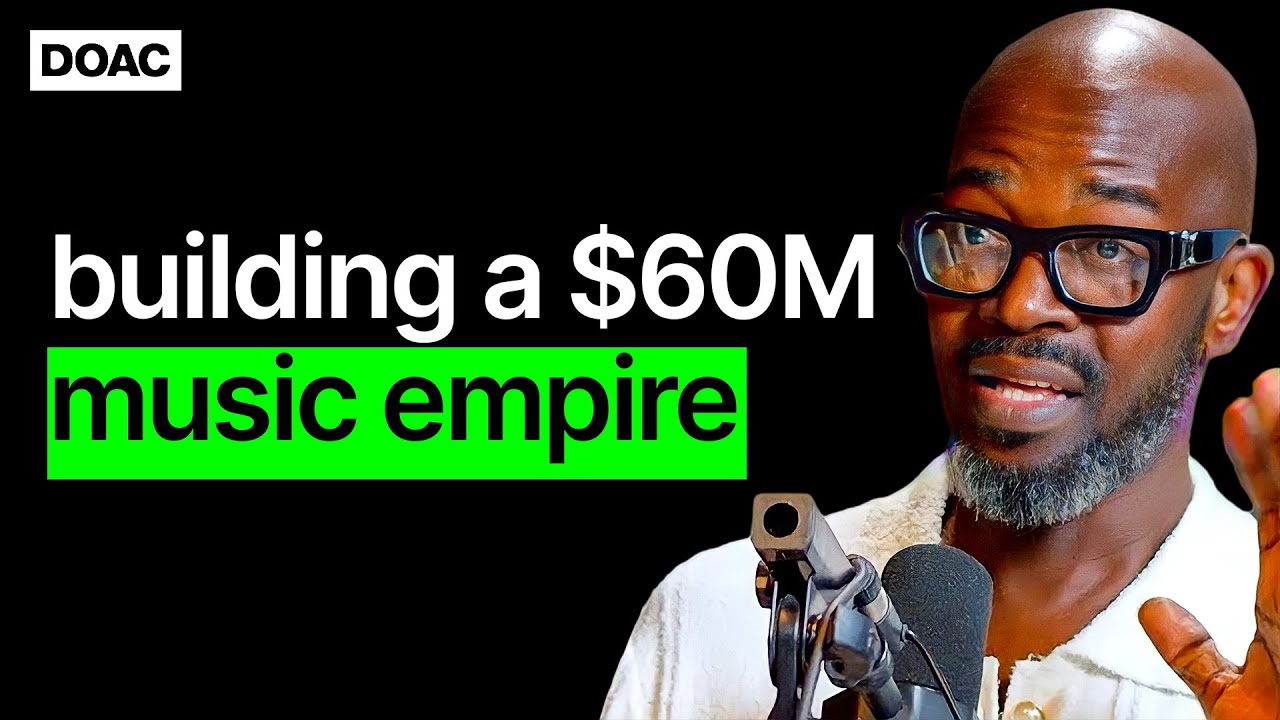
How I Became The Worlds Best DJ With Only One Arm: Black Coffee
嘉宾:Black Coffee
全文文稿 · 按对话顺序保留完整内容,深入理解上下文。
§01Transcript — part 1
When your cat is acting weirder, or your dog is being louder, your turtle moves slower. Hello, Ted. Your cat seems thirstier. Whoa, slow down, buddy. Or your puppy is acting clumsier. Day or night, if you don't know what's wrong, know where to go. Vedge ER for Pets. This is Kate. Vedge, the better, kinder ER for pets.
We just heard this sound and it was a car just rammed through the crowd. I just blacked out.
Make some noise for Black Coffee!
I hardly had a childhood. I was always working, and I used to hate it growing up because I just felt like, when am I going to become a child and play like other kids?
The 10th of February. Tell me about that day.
That was a scary thing for me. When I went to the hospital, no one knew what to do. I would literally close my eyes. I wouldn't know whether it's here, or here, or here, or here.
So you were paralyzed at that point?
Yeah, I stayed for three months in the hospital. In that, it depressed me even more. Music helped me so much. It brought me peace. This is why I share it. It's my way of healing people the same way it healed me. My childhood, where I come from, those things scare me.
Why do those things scare you?
Because it's a story that it was for years hard for me to share. So what happened is...
Without further ado, I'm Stephen Bartlett, and this is The Diary of a CEO. I hope nobody's listening, but if you are, then please keep this to yourself.
So the question I always start this podcast with, because I studied childhood psychology for a little while and it was illuminating to me how much of our early years end up defining and shaping us, into who we become. So that early context, before twelve years old, what did that look like for you?
When I was born, my parents were married. My mom was super young. I was the first one. Two other siblings at the time. My mom married very, extremely young, probably like 22, 23, already with three kids, divorcing.
We were moved to live with our grandmother from the maternal side, and she's the one who raised us. She used to work in a general hospital in a sewing room, but I saw her working extremely hard to go for everything she wanted.
I look back and try to imagine how much money she was earning and look at the achievements, like changing her mud house into a big, designed, respectable house. And she did this bit by bit by bit. As a kid, I was there and I saw it.
Whatever little money she would have, she would buy the bricks, they would wait. She buys sand, it waits. She buys gravel, it waits. Everything was slow. So that's what I learned from her, to be assertive. You wake up, you go work.
Also, the strongest thing that I learned from her is she had cows. And she was the only woman in the area who had cows. She was a single woman, and my job was to every morning go milk the cows before I go to school.
Every afternoon after school, I hardly had a childhood or time to play as a child. I was always working. 5:00, 5:30, from 11 years old, every single day. And that was my environment where I'm like, okay, whatever you need, you just have to work. There's no other way.
For the few years, she would make sure I'm up, she would make sure I'm on time, and eventually it was my thing. She didn't have to wake me up. She didn't have to tell me when to go. If there was a problem with the cows, I knew what was wrong.
If I needed to get medication from the pharmacy, I understood everything eventually. It became my thing. That's my childhood.
Where was your father?
My father remained in Durban and remarried. So he started another family. He worked in a factory for a company called Beacon, they made sweets and chocolates. That's where he worked, and he just didn't have... he was a nice guy, but he wasn't present.
On holidays we'd go see him, he would have nothing to say. He wasn't the guy who's like, "how was your day?" "how's school?" any advice type of thing. It was just the way he was. Yet my grandmother was the one. She was the man and a woman.
She's the one who basically... and I used to hate it growing up because I just felt like, when am I going to become a child and play like other kids? She was super strict, assertive, hardworking. There was hardly time to do all the games like other kids were doing.
So I grew up with that kind of focus, which I hated because I wanted to be a kid. But then it taught me so much about just work, having a work ethic, and that's why I'm able to just pick up and leave wherever I can.
I always reference this conversation I had with the guy that trained Michael Jordan and Kobe Bryant. He told me that these things when we're young, they end up being the consequence of our greatness, of our talent, these hardships we have. But they also always come with a cost.
The lack of play, the lack of a father figure, the situation of you growing up in a house where you didn't have electricity, you're milking cows, your food is cooked by you creating a fire, etc. What is the cost? I can see the lesson and the value it gave you is so clear, but what is the cost?
Oh man, lots. One of them is just being to myself. To a point where I have a very small circle of friends because I was never a social guy.
As a kid, I always had to do all the work alone. Because your friends will sometimes come, but then they realize it's every day. So they're not going to always come. So I was always like a loner growing up.
Then I kind of got comfortable with that, got comfortable with trusting my thoughts and my decisions. Being confident in just myself without needing people. That has affected a lot of personal relationships where if I just feel a little bit uneasy, I will just remove myself.
It's not hard for me because I'm like, what I really know is myself. But it's something I want to start working on because I'm quick to create a comfortable space. I can meet a stranger and I'm quick to just like... but I'm much quicker to move as well.
It's something that I feel is not real, but it's doable because I'm always on the move. But there are things that I'm like, I need to work on.
Typically, I think there's a bit of a stereotype that Black men aren't the best at emotions, and some people point out generational cycles for that. Did you learn how to express your emotions when you were young?
No. I was terrible at it. There was no one. Like I said, my grandmother was quite tough. I look at how I am with my kids, you can see when you've pushed a little bit hard in conversation with someone and you are able to bring them back and explain.
Look, I'm sorry, I was a bit loud there, this is why, so that they understand all the dynamics. And the older generation was the one that will whip you and tell you "it's going to hurt me more than it hurts you" and that's it, you'll get over it.
Because as a child, you have unconditional love for your parent, you will eventually get over it and you're the one coming back making jokes like nothing happened. But I didn't have like a good role model in anything, even this.
I used to avoid, I still do, doing interviews. Because there's just again society pressure that if I'm good at making music, am I good at public speaking? So if I play songs nice, am I now a role model to your children more than you?
But society will say, "oh don't act this way, my kids look up to you," and I'm like, but I'm just a DJ who's living his life. All of a sudden it's like, no, no, you can't tweet like this because it's you.
In the beginning, all I wanted to do was just play music. Like I was that kid, even if I'm not invited at a party, I bring my record box and I wait and I hope they give me a chance.
Why music?
Because it's always been my escape in that house where I used to live and all I did was work. Then in my room, music helped me so much to dream of these moments. If I listen to Michael Jackson, I imagine where he lives, it must be in America, and one day I'll go there.
That's it. It really took me to all these places. So it became my friend. I never had an explanation as to even then what I would do with it. Like when I finished high school, I'm like, I'm going to go to college and study, and my cousins were like, "are you crazy? then what are you going to do?"
I didn't know. "Do you want to be a teacher?" I'm like, "no," but this is what I want to do. As long as I was surrounded by music, that's all I wanted to do, because it just it brought me so much peace, happiness. And this is why I share it.
I share it because of what it does to me. It's my way of healing people the same way it healed me. I don't know if I'm making sense.
You make perfect sense. You know, I sat here with the biggest comedians in this country, and typically with comedians, the stereotype is that the comedian is depressed. And then one of the comedians came here and said to me, "you should never ask a comedian if they're depressed, because it's usually that they were doing comedy because one of their parents were depressed."
So comedy became a way for them to see a smile on their mother's face for the first time, or to see their father smile for the first time. Music and the role it played in your household and just in your environment, outside of yourself, I was wondering as you're saying that, is it also something that created happiness in others when you were young, that you saw like your family or your...
Yeah. Before we moved to my grandmother's place in the Eastern Cape, the structure of my family back then was my entire family lived in one house. My father and his brothers. So there was about four families. And that's where music was like a thing.
One of my uncles, my father's brother, had like small... they call them ghetto blasters. Yeah. So he was the music guy. He loved Reggae, he used to play Reggae a lot. That's where my first love for Reggae came from. Anything as a kid, I used to know different Peter Tosh albums, Bob Marley and the Wailers, and all that kind of music.
Every now and then, then it would be the Pop that was happening at the time, and he would take it out and all of us would be out there and we would dance. That's my earliest childhood memory with music is that. In that big family when it's hot and it's summer and we're just all outside and he plays the music and then we dance.
Anything with music you would find me. That's why I never knew what I would do with it, but I just knew wherever it is... sometimes they will send me to the shops, and in the townships sometimes there will be like a big Coca-Cola truck, maybe they're promoting a new flavor and it's parked and they play music.
They send me to buy bread and I don't come back. Like literally, because I'm just there, I'm just listening to music. I don't leave literally, and I get into trouble.
So wherever there was music, that's how I got into it because my cousin, who's also our neighbor, he and his friend had a mobile sound system. So they were doing weddings, like graduation parties.
During the week he'll have the sound system connected, like a small speaker, and play loud music, and I'd go there. So I'll spend days there, and then I started... they used to use cassettes and you rewind with the pen.
So that's how I started and I would learn and I was curious, and then they would take me to the day parties. Then I'll be the opening DJ. But I was so curious that I developed a style of playing. I was a little bit advanced in understanding tempos of the songs, and so I wouldn't just randomly play.
I would play songs that were close together in tempo and so all of a sudden the mixes were like almost flawless and people were like... then I became their main DJ. By 14, 15, I was like their main DJ and the people booking them will tell them "bring that Black boy." I was super dark as a kid. Bring him.
Then I was more curious, then I started collecting records, then I bought turntables for my own and they bring the system, I plug more things. Then when I finished school and I moved to another city back to Durban where there was more access to things, then I really got into it.
So I was studying Jazz music, but I was a DJ on the side. And sometimes I would bring turntables into the school studio. It was such a fascinating thing for the Jazz students because we were there learning Jazz scales and the theory of music and I'm here with my DJing equipment.
At some point actually while I was a Jazz student and a DJ, I did a Classical play. Like all three same time. Because me and a friend of mine in the hallway at school, because we were in the choir, we were singing one of the songs we sang in high school in a choir and one of the school lecturers heard us.
And she was shocked because we were Jazz students. She was like, "wow you guys, this is Classical music, like you sound so nice." There's a play that's happening at the Playhouse called "The Pirates of Penzance." We were like "cool."
So we went, we auditioned, we got the parts. So we would do Jazz studies, after school we go practice at the Playhouse, and we went to perform. I was opening the show like I was a tenor. Just anything that had to do with music.
So from Jazz when I was young... sorry, Reggae, then I went through different stages, then there was a time where I was like obsessed with fusion, then Gospel music, then Classical music. And I didn't understand what I was being prepared for. All these years I kept being exposed to different types.
And I'm a DJ, so then my taste varies based on understanding these different genres. That's why I was able to in 2010 do a show with a 24-piece orchestra for 8,000 people in a stadium. Because I was exposed to this music and I knew where to bridge the gap.
The 10th of February. Pivotal day in your life. Tell me about that day.
1990. I was talking to someone about it because it's a story that was for years hard for me to share. And I'm in a better space now where I'm able to talk about it.
Strict grandmother, we're at home on the 10th which was like around 8:00 at night, and she was super strict, no one comes out the house that late. We were sitting in the house, I think after dinner, we hear people singing outside.
We all come out, everyone comes out to see what's happening and it was people singing, there were a group of people about to pass our house. We run to the crowd with my cousins. We were not allowed to, but this was nice, so it wasn't a big thing even for her.
But my cousins went back. I didn't. Why? Music. So I followed the crowd. And the reason this was happening is because on the 11th of February, Nelson Mandela was officially coming out of jail after 27 years.
So there was like jubilations around the entire country. This was happening in all the major cities where people were like "we're going to stay up all night until the morning of his release."
So this crowd was going to a stadium which is close to my house. That's where the camping was going to be, the singing until the morning in the stadium. So they went on the streets basically gathering more crowds, and we were now close to the stadium.
And just out of nowhere, we just had this sound and it was a car, just came out of nowhere, lights off, just rammed through the crowd. So I was not in the front, but I was maybe like 20% in, and I just blacked out.
People were screaming, and when I woke up, there was fire. People were angry. So basically this driver switched off the lights to literally just kill people with his car. And so they burnt the car, they burnt the guy too.
They burnt the guy?
Yeah. They pulled him out the car and killed him. Literally. And he stayed there for hours actually without anyone coming for him.
Because I remember this happened around 4:00 in the morning, went to hospital around maybe 30 minutes later, the cars took us to hospital. I came back from the hospital around 7:00, 8:00. He was still there. Like not even covered. His car, he was still lying there on the ground.
That cost his life and someone else's life who was also in the crowd. So by that time, I'm in 7:00 in the morning, I'm back from hospital. The announcement happens, Nelson Mandela is finally out of jail. We're watching this from TV.
I'm sitting on the couch in pain after the accident. And I think what really happened to me, I don't think the car reached to me. I don't think the car touched me. I think the force of the people that were in front because of the impact they pushed so hard.
So what happened is I dislocated my shoulder, but severely. I had no bruises, no cuts, it just came off. Meaning my nerves that connect the arm to the body were snatched.
Being in a small town, when I went to the hospital no one knew what to do. So I'm there, I'm holding my arm like they don't know if it's broken, they don't know what to do with it. So they just gave me a sling and pain tablets and I went back home.
But the pain wouldn't stop, and then the following day then I went to Durban, which is the bigger city, to go to like a bigger hospital where I stayed for three months in the hospital. Even there they didn't know what to do.
One morning they would like, "okay we figured it out," they put a cast. So I'll have a cast for like two weeks. But the damage was here. But I was a kid as well, so I didn't understand.
So the injury is called brachial plexus, which is a damage of nerves, and there's nothing you can do to fix damaged nerves. They can only fix themselves. So over time... so they tried different things.
At some point, I remember I was being taken to like a specialist to see if there was life on my arm because they were thinking of amputating my arm. So they put this device that had electricity to see if I'm going to feel it.
And there was just like probably like 5% of life. And he was like, "no, we don't have to do it. Over time the nerves will grow back." And that's what has happened.
And as a kid, I mean I was 14, it was life-changing. There's things I wasn't able to do, activity-wise, there were just things I couldn't. I was in a music class, so I couldn't participate on the piano lessons. We used to play recorders.
So I went through a phase where it really affected me and just over time I was like actually, I have a life to live.
When you say you went through a phase where it really affected you, what does that mean?
Like "why me?" I mean, when you are born fine all of a sudden, and kids can be mean, so the name-calling comes and... because I also thought it was going to pass and I would as a kid even have dreams.
I wake up, I'm like "oh I had a dream last night my hand was working and I was doing this." And so to me it was like maybe next week, maybe next month, I'm going to be fine again. So I went through a lot of that, and then eventually acceptance. Okay, this is what it is.
I have to live, I have to move on. And I kind of like stopped thinking about it and just focused on what's next. How do I learn to tie my shoes? Or just wake up and do everything without calling for help?
That was the most important thing for me because I didn't want to feel sorry for myself. That's the most important thing where I was like, I need to learn how to not to call anyone for anything. Zero. Then that was a big thing for me.
What condition is your left arm in now as we sit here?
It has gained probably like 40% movement. Let me put it this way, when it happened, I would literally close my eyes and I would know where it was. So it was paralyzed at that point, the whole arm.
I wouldn't know whether it's here, or here, or here, or here. So over time, I've started feeling things. I can differentiate between hot water and cold water.
And every now and then, because that's another thing, I used to do physiotherapy a lot when I was a kid and after school I go and I train and that depressed me even more because I was waiting for results. And I thought I'm training for muscle that wasn't coming.
So I couldn't see anything. And when I stopped, I stopped everything. I stopped thinking about it. I stopped waiting for it to be better. Acceptance. Yeah. So even now it's like, if I woke up and it was fine, do I even need it? That's where I'm at. Like doesn't really matter.
I think my life has turned out exactly how it's supposed to.
This happened to you when you were 14, but you didn't share it with the world until 2017 in a Facebook post?
Yeah. Because as an artist, I just felt like I did not want to be seen as that guy who has a disability. Where it's like "oh," you know like a... I didn't want a pity party. I just wanted to be understood and heard like everyone else.
So my first album came out in 2005. That's it. I just worked on music, released it. I used to DJ the way I do and people would think "this guy he plays with his hand in his pocket, what's with that? it looks cool but what's...?"
I thought you were just the coolest motherfucker ever.
People would like... because the hand thing in the pocket happened when I was a kid, because I used to have the sling and even when I run with other kids and I had to hold this hand because it was just moving everywhere.
And one day I just put it in the pocket and I was like "damn, this is more functional than having a sling." And I never stopped. So it wasn't even a thing that was like so deep. It just happened when I was young, I was like "actually I feel comfortable like this."
And over time it became a thing because also, being the introvert that I am, it helps me in not explaining myself. Because everyone even now, there's these things that I support. You can buy them from a pharmacy. I have them.
So when I'm home, I use that, or when I have people at my house I use it, or when I swim. Even people who know me are like "are you okay? what happened?" These were things I was avoiding, to be having to explain myself all the time.
I'm like, I sit and I look normal like everyone else and there's people, promise you in my life today, who don't know. And it's fine.
Did it make you work harder or have to work harder to get to where you are today?
Definitely. Definitely. Especially as a DJ. Because I just felt like this thing was trying to rob me of this one thing that I really really love, and I will not allow it.
So it made me in that sense, not even in a sense of "who's going to employ me, I'm fucked, my life is a mess." It was like, if there's one thing I'm not going to lose is music. I won't stop, I have to be a DJ. I have to.
And I'm from the cassette era to the vinyl. I mean, how do you take a vinyl out of a vinyl package with one hand? And this used to stress me and when I look at it I'm like, "how will I become a professional DJ?"
And it takes me not, or it took me not thinking. I just did it. I'm like "this is one thing I want to do." So I just went all the way. I'd go to school, I remember there was a time where I'll spend at least two hours every day DJing.
For I didn't play for a club or every day two hours of my time, because I and I used to say this like "I just want to be ready." Like one day when someone says "you a DJ?" I must boldly say "yeah, I am."
I look now when I play sometimes, I'm like "man, you good." Like I look and I'm like "wow." Because I developed a style of playing that is my own, based on understanding myself and what I can do.
I have a friend, we grew up with, he's also a DJ, and when I started back in the day, like really when I was spending time practicing, I used to be really crazy and he says this all the time that they don't even know how crazy you are.
Because now I don't do anything, I just play. Less is more. I'm a more experienced now, but my understanding of it is like on a different level. But I'm in the space where I'm like I don't have to do it because I've been there.
It's like learning the basic course and you go to the advanced course. You go advanced driving, doesn't mean you're going to come on the road and drive like you were on the advanced driving school. It's just understanding and knowing. When I look at this thing...
Most people know American Express for our iconic personal cards. Some know us for our business cards to help entrepreneurs grow. But American Express also offers something built for companies at scale: the American Express Corporate Program. With the Corporate Program, you can apply for employee cards tailored to their needs, issue virtual cards to your team and suppliers, and even automate accounts payable with American Express 1AP.
Along the way, your company can earn rewards or cashback as a statement credit to reinvest where it matters most. And because it's all backed by American Express, you get the service, insights, and flexibility to help keep your business moving forward. The American Express Corporate Program, designed to help companies grow with confidence. Terms apply. Enrollment required and fees may apply, including an auto-renewing monthly platform access fee. Suppliers must be enrolled and located in the United States.
Paying extra for tire care is BS. You know, bad service. So at Midas, we're rolling out our BS-free tire guarantee. Included with paid installation and tax on every purchase, you'll pay nothing for flat replacements, nada for flat repairs, and zilch for tire rotations every 5,000 miles. That's zero dollars for all that. So with this limited lifetime tire guarantee, you'll pay a whole lot of nothing compared to what the other guys charge for tire care. That's the BS-free tire guarantee. Only at Midas.
It's part of me, the deck.
When you were asked, I think you were only in your early 20s, they asked you, you know, I think you'd just... was that around the time you'd done the Red Bull? Your early 20s, they asked you in an interview where you were going to be in two years. Do you remember?
That was a scary thing for me. I remember that, I'll never forget it. I don't think that was me talking. I just... it was Black Coffee. Someone I wasn't yet. Because I was never that guy.
I didn't have... I don't want to insult my schools and say I didn't have the right education, but you know, I look at my kids' schools where they go to, they learn public speaking, they know how to present themselves and they know how to get across a point, a point across.
They know how to speak. And I'm not from there. Everything that I kind of like have, I had to figure it out myself. So doing an interview then, being asked this question at the worst time of my life, and to give that answer, because the question was "where do you see yourself?" and I said...
They said "in two years," and I said "in five years." I just gave myself time. I said "in five years I'm going to be one of the most important producers." I don't know if I said "of the continent" or "the country."
Which actually I'm proud of that because it could have been worse. I could have said "I'm going to be number one, I'm going to be the baddest motherfucker," I would have said something crazy like pompous. My answer was still like very modest and... but I was clear about what I wanted.
But after saying it, I freaked out because then I realized I need to own this. I need to own it and I need to then start working towards it. And yeah, and then in two years later, which was the question, I released my album and I won my first award for Best Album.
Then I was the Best Producer in the genre in the country. But I think I don't know if it's the awards that drive me or just success itself. Because the narratives that "oh he probably like got a Grammy, then he wants something more, he wants more, he wants more."
And I don't think I look at things like that. I think I just know that I can do more than an award, I can do more than an achievement. I'm capable. That's it. That's what I'm fighting for.
And it's the little boy in me who was milking cows, who had no friends, who's like "I can," especially coming from where I come from. And that's it. It's never really about "I'm the smartest one," and "I'm going to be the best one," or "I'm the most gifted one." It's just like, I started with nothing. I'm from like nowhere really, like... and I had nothing to lose. So I threw myself in and I just want to keep going.
When you look back at the... you said that in your early 20s and two years later your album wins that amazing award, your career continues to go to the moon. When you look back in hindsight with wisdom and say "ah," because I think it's always in hindsight you go "that's why I got here." You've talked about the obsessiveness. I get that drive, the hunger. But as it relates to the creativity and the craftsmanship and all the other things, why you? And why not some other young South African DJ from the Eastern Cape?
I think it's just being intentional about what you want. The people I work with from the beginning, there's always just like the goal is similar. We don't try to... I don't think we chase number one. We just want quality.
We strive for quality, we understand the "less is more" concept. I've never, and I've tweeted this once in my country as well, I've never gone for like "I want Song of the Year." Those things scare me. I just want to release music that has the kind of substance that I love.
Why do those things scare you?
Because I just feel like then you have to keep chasing the number one. So if I am this year, then I must be next year, otherwise then there's a dip that's going to come with that if I'm not. So we do what we're comfortable with. Because what we're comfortable with we can do it again and improve it and improve it.
So the goal is always the same, like not to try and go mainstream. It's just be comfortable. You can wake me up tomorrow and be like "can you make a song like 'Drive'?" I'd be like "I can, probably better."
Than "oh I can never make that song again because wow." It's in my space. Everything is in my soundbank. Everything I work with is always around. And also I think now I'm clearer as to who I am as an artist. I'm more of a... I'll say 65% DJ. That's where all my energy is. And then 35% producer.
Having sat here with Diplo and other artists, Jessie J, the boys from One Direction, Liam Payne... what I heard over and over again from them is that with success in music there becomes more authority figures, record labels etc., telling you how you should sound and telling you that if you sound like this then you'll get a number one and it will be mainstream etc. etc. How important over the course of your career as you look back has it been to try and stay true to yourself despite the temptation to fit someone's...
That's an easy part for us because first of all, what am I looking for? Like what I just explained to you as being more DJ than producer. So DJing pays our bills. That's our core business. Therefore that's where we're going to be strongest.
And releasing music is the second part of the business. So it being the second part of the business means it's not the main thing. And so there's no pressure in then following all the trends that come.
And I've been quite fortunate in my career from the beginning, when I released my first album, I released it with a licensing deal. Meaning I did it on my own and I submitted to a label. So no one could say "we don't like number five, take out number seven, don't you want to fix number two?"
It was a done and packaged album. And that's been the nature of my production career where the last album that I did was the first album with a label in the US where there was that authority.
It would mostly come as "we're not sure about this one," but what I did, I separated my African releases from the global releases. Therefore when they're like "we're not sure," I'm like "it's okay, I'll release it in Africa" where I know it will make more sense and also it fits the sound that I'm doing, that I want to do.
I remember one of the songs I released was a song called "Your Eyes" with a South African artist called Shekhinah. Brilliant song and they were like "nah." I released it and immediately after it came out they changed their minds. They were like "okay maybe not, we'll also release the song."
Because we were not following what they want and we were cool with it. Then after I released an EP called "Music is King," which was purely purely for the African market because even now I don't have a label.
So I don't have to have these conversations about what song I want to do and how does it sound. But still when I do, my team knows I want to separate the two. Africa must be on its own.
Because one day I may wake up and be like "I've always been a fan of Salif Keita, I want to do a song with Salif Keita." And when you do a song with Salif Keita, being a Grammy-winning artist, if you put that song on an album, that album might not be nominated on the Dance/Electronic album. Because the language is foreign.
They will take that album and shelve it with the "World Music," that means you're competing against your African brothers and sisters, which is what I really hate.
So my point is, I then separate the two. If I want to do a single with an African artist, I can do that. If I want to do like a Grammy quality kind of work, I can still do it. But I'm fortunate not to have those kind of gatekeepers and authority that tell me no.
And I can understand with the Diplos and them, their structures are different, but we've structured our things well.
How many shows... so you said 60% DJing. How many shows do you do in a busy year?
I don't know, man. Ibiza this summer I think I did 21. Just Ibiza alone.
All Saturdays at Hi, right? I was there for two of them.
Just Saturdays alone in Ibiza, 21 of them, and started then since May. So meaning every weekend, Thursday, Friday, I'm somewhere else, Sunday I'm somewhere else, every weekend.
Thursday, Friday, Saturday, and Sunday. You're going to be flying around...
That's what we do. So before Hi I'm somewhere else, after Hi I'm somewhere else. Like I had a show here on a Sunday yesterday, have a show on Tuesday tomorrow. So sometimes there's Tuesdays, sometimes there's Wednesdays.
But every summer it's like for every Saturday there's a Thursday and a Friday and a Sunday sometimes.
How many shows is that in a year though, if you were to add it up? Is it... because I read that it was more than 150 sometimes.
It is, yeah. Definitely.
That's a lot of shows. I think I did my little tour of this podcast and we did nine and I was fucking knackered. We did nine shows in two months and I was like "I need to wait another year before I do that." Because of the adrenaline and all the feeling and the emotion and the performance and it's late and whatever else. How?
No, I think at this point, this is what we do. You know if you look at... you made a reference about Michael Jordan and Kobe, can you imagine like the hours they spend to get to that level? It becomes second nature.
First thing that comes to mind is that little boy milking cows. I'm like "this is a blessing." So nine shows? You must have made good money for you to complain.
I don't think we made any money, we gave it all to charity. You were like "I'm done, I'm retiring."
But I do wonder because, you know, I hear about the kid that was milking the cows with no electricity back in South Africa and you know, sometimes my fear is that that kid is going to, when that kid becomes an adult, he will make decisions which will compromise other needs because he's so driven to survive.
At some point as you said before we started recording, you've got to step out of survival at some point and go "now we live."
No, definitely. That's why therapy is such an important thing for us. I mean, I've had so many different conversations with South African artists, some I've had conflict with, and when we meet and try to solve the conflict, I'm like "let me tell you what's going to help all of us: it's therapy."
Because how do I go from being that boy, living in the same community where like no one even looked at me? And you fast forward, I'm coming back to that same community in a Lamborghini and everyone wants a picture... it's a mindfuck. Just to me.
So you need to really work on yourself when you cross that line where it's like someone you looked up to as a kid and you thought this guy's so successful and you realize that actually you are the successful one. So how's the shift then even in respecting that person?
One is like "I'm the king now," then another is like "you're still the king, you did this before me, I'm paying so much respects to you." So it's a very thin line between seeing yourself as the king over everyone else or knowing you are and still respecting everyone else.
And that's the balance for me. And it took me such a long time and I'm still battling and I'm working on it and I'm a little bit better now in understanding the difference between Nathi and Black Coffee.
What is the difference between Nathi and Black Coffee? The little boy and yourself as a DJ?
Black Coffee has all the privileges. Right? Like... it's a joke in my house and sometimes when I want to go eat in a restaurant and I think late "damn I need to go," and I tell my sister "please book," and she's like "oh well not now," it used to happen like that, she's like "oh it's fully booked."
And then I'm like "no, but just tell them who's calling." And then she's like "oh yeah, table for two, sorted." Those are the perks of Black Coffee where if Nathi called the restaurant is full. If Black Coffee called there's a seat for you, there's a table for you.
So Nathi's the kid that grew up going through magazines and seeing model girls, thinking "wow if one day I can have a girlfriend like this." That's Nathi. And Nathi never had access to that and never would given where he comes from. But Black Coffee has access to that.
So then sometimes Nathi uses Black Coffee to satisfy Nathi where it's like instead of saying "hi I'm Nathi," it's "oh you Black Coffee" and I'm like "hmm yeah." You understand?
So it's two different things. To a point where even where I live now, it's crazy but that's how it is where I first bought myself a house, this is with my divorce story that's not even final, I moved out of the house.
I'm like "life is going to be so dope now that I'm a single guy and I live in this apartment," and in between tours I go back and like "wow." And then tour's over, I'm back home, I'm sitting, I'm like "is this my life?"
Like just... the house I left I just finished building. Now I live in an apartment like a student. Let me look for a house for myself. Then I looked for a house and I found it. So I have the house but now I'm like "it's a big house but it's lonely because I'm from family, I live alone."
So I'm like "Mom, don't you want to move and come stay with me?" which I think it's a noble thing because my mom had like a heart problem. So she moves and then now I have the warmth of the family. It's nice and I'm like "but is this my life? I live with my mother."
So I mean I can't bring my friends here, can't have a little party because my mom is in the other room. Then it bothers me so much and I remember having a conversation with my friend, I'm like "man I love it but at the same time I even told her I just feel like this can't be it where I'm about to finalize my divorce and I live with my mother."
And the most incredible thing happened. I get a phone call, just that week when it was stressing me so much, I get a phone call, it's a number I don't know, I'm like "yo" and then this guy's like "my name is Michael, I'm your neighbor."
And we have this long conversation on the phone and then he's like "by the way, I'm selling my house and I'm going away, we're moving to another country and just letting you know as a neighbor." And I was like "oh thank you God." Because it was like a solution.
So I bought the neighbor's house. And in my crazy head, the neighbor's house that's where my mom and the children are going to stay. That's a Nathi house. Right? That's where you're going to find me on the floor, on the grass playing with my children. Then next door that's the Black Coffee house.
I want to come to the Black Coffee house.
But the thing is about the Black Coffee house which is what before we started recording you asking me what's on my mind and I was telling you "legacy, legacy, legacy."
I want to build Black Coffee house as a Black Coffee house that would be like a future Black Coffee house. OK, not a current Black Coffee house. No, current, but it will be a future "this is where he used to live."
So I'm very much intentional about the things I collect, the art on the wall... everything that I do, I'm doing to create value in the house. To have Steve come to this house and we take a picture by the pool and it goes to the wall of fame.
Oh nice. Tell me when.
Create this value out of it. Any kind of friends that are known in the world that come to visit, we create all the memorabilia, even the suit I wore at the Grammys, frame it, and so I've kept it and the shoes. That's the whole idea to kind of like build like a legacy project for my kids who are living next door in a normal setting where they're not exposed to... their lives are normal.
You know, like having a day with the kids in the pool and then Drake's walking in.
Or Stephen Bartlett.
That's the difference between Black Coffee and Nathi. I'm just taking it that far where I'm understanding the different dynamics.
When you told me the story of going from a divorce in a house to an apartment penthouse to a house with your mother to then moving next door back in on your own, it sounded to me like someone that was struggling to try and have the best of both worlds continually.
Because in your own words, you were told that the best life was to be married. Tried that. Discovered that for you it wasn't. So you went to the penthouse, which is where... bachelor, single, we're about to... and then you're in the penthouse you go "fuck, I need to be back in the house." Family environment.
And then you get the mother back in and the mom comes in and you go "fuck, I'm out!" You're right. But remember, it's all the search. That's what it is. Searching for happiness. And in the end, I don't think we're going to be able to find and define it.
What is your happiness?
It's going to be... it's not a destination. It's going to be like a series of different things where boxes are ticked.
If all those boxes are ticked though, are you then happy?
You can't tick them all. Because life is so long and we keep discovering things to tick. And they all have different meanings. Which is where the small boy's journey ends. Because if it was the small boy's boxes to tick, by now we'd be done.
There's boxes of an adult, like you're saying you live here and then you extend and then upstairs you keep... then you're going to be like "actually I need to buy another building." That's how it is. But all these things, we're never going to stop.
I often think that... I was thinking there about advice and you know, because a lot of that advice tends to come from our parents. But I often think that when we've come from a place of hardship, and I just think generally, I think this a lot in my own life, there's words that I wish I said or could say now to my parents. Words I wish I could say to my mother, my father. You spoke so lovingly at the beginning of this conversation about the role that your mother played in your life. Is your mother still with us?
§02Transcript — part 2
Yes, she is. Spoke to her on my way here.
Are there any words that you found difficult to say to her?
Not anymore. "I love you" was one of them. Because she... it was never part of our family as an African family to have that kind of warmth and these kind of conversations. Even our hugs are still a little bit awkward, but they're still hugs because their generation didn't do that.
They would show you and you would know your parents love you, in the best way they will do it. And being a parent, I am so much aware of how I want to teach my kids to be able to say it and randomly hug them because I never had that growing up. And then in the end, we are the ones who come back and teach our parents, no matter how awkward it gets. Teach them to say and they learn even though it's not something they know.
We have a closing tradition on this podcast where the last guest asks a question for the next guest. They write it in the book, they don't know who they're writing it for. The question that was written for you, and it's funny that... they've written a question for you but they didn't know who they're writing it for. Which is the most amazing thing ever when you hear this question: What is your favorite sound?
Laughter.
Why?
Because people laugh when they are happy. And going back to what I said in the beginning, I think personally that's what we're searching for as a human race. We're just looking for happiness.
Thank you. Thank you for being so generous with your time. Thank you for giving me some of the best nights of my life. Thank you for coming here inspiring me. Thank you for your vulnerability which I know will help so many people. And thank you just for being a creative inspiration for me. As I said, I'm trying to DJ at the moment, I've got my decks upstairs, so I read that you're looking for young South African talent, so come get me! The South African from Botswana! South of Africa. But yeah, thank you so much. It's been a pleasure.
Thank you, man. Appreciate the invitation. I was nervous about coming here, opening up, but it worked out well. Thank you.
Thanks.
Paying extra for tire care is BS. You know, bad service. So at Midas, we're rolling out our BS-free tire guarantee. Included with paid installation and tax on every purchase, you'll pay nothing for flat replacements, nada for flat repairs, and zilch for tire rotations every 5,000 miles. That's zero dollars for all that. So with this limited lifetime tire guarantee, you'll pay a whole lot of nothing compared to what the other guys charge for tire care. That's the BS-free tire guarantee. Only at Midas.
(Closing music fades out).