
Dame Dash: The Man That DISCOVERED & Built Jay-z & Kanye West!
嘉宾:Dame
全文文稿 · 按对话顺序保留完整内容,深入理解上下文。
§01Transcript — part 1
The thing I think about most, especially when I'm on the go, but also when I'm sat here in the Diary of a CEO studio, is the Wi-Fi and internet that we have to work with. In fact, anytime I'm filming away from the studio, one of the first things I do when I arrive is I open up an app and do a speed test to see how strong the signal is.
The number of screenshots I've sent to my team about Wi-Fi signals at different locations is actually pretty crazy. It matters that much to me because it's such a competitive advantage to have fast Wi-Fi. On any given day, if I'm recording hours and hours of footage with a podcast guest, I then often have to have my team send that across to our London team who then do the edit.
Fast Wi-Fi and internet is not a "nice to have," it is absolutely business mission-critical. So, when it came to finding the best provider who could supply internet and Wi-Fi to our new LA studio, we looked at every single option. Of all the providers, the one that came back with the steadiest connection, as well as being the cheapest, was today's sponsor, Spectrum Business.
Spectrum Business keeps businesses of all sizes connected with fast, reliable internet, advanced Wi-Fi, phone, TV, and mobile services. Millions of business owners already rely on Spectrum to keep their operations connected. So, if you want to join them, head to spectrum.com/business to learn more. That’s spectrum.com/business. Restrictions apply; service not available in all areas.
Kanye West's whole thing is "I don't give a f***." Art is something that you really fight for if you love it, even if your message is misunderstood, like "White Lives Matter." He's an artist that likes war.
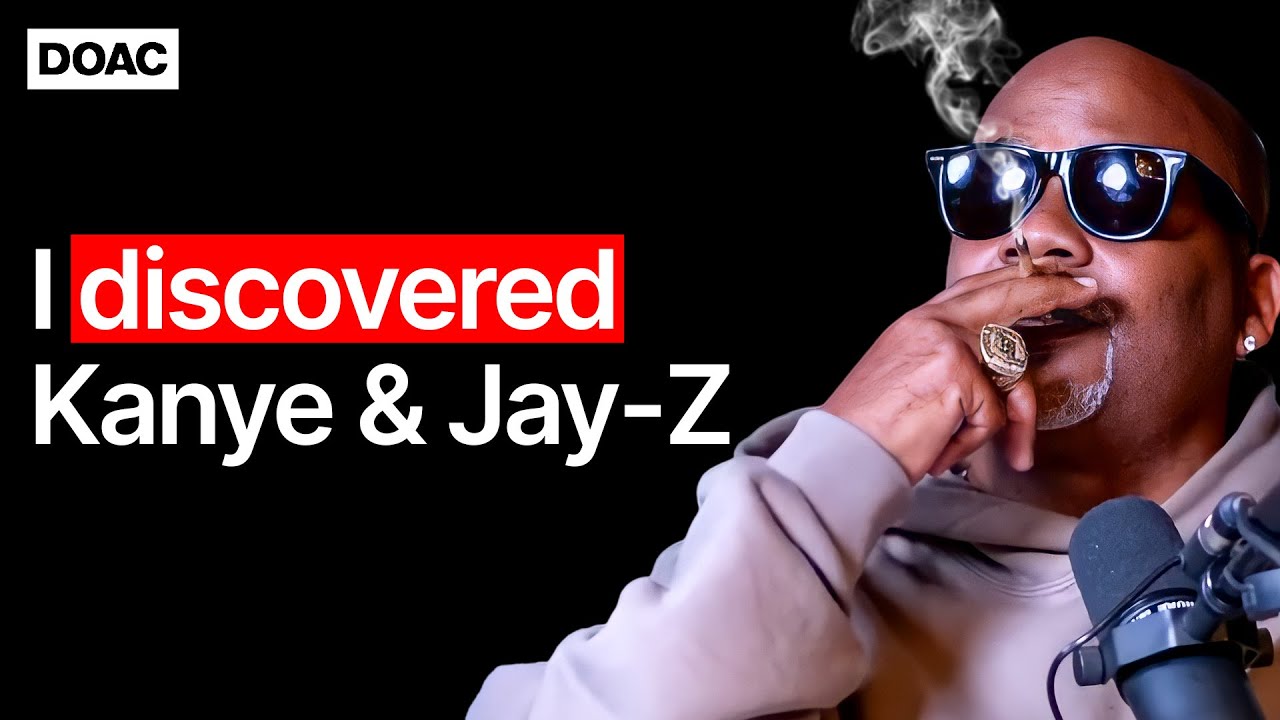
Dame Dash in the building! One of the founders of Roc-A-Fella, Rocawear—he discovered Jay-Z, Kanye West, and so many others. One of the biggest pioneers in hip-hop.
I took Jay-Z and shopped him to every single label and they all said no. I had to do it myself.
I really want to understand why Roc-A-Fella won.
I did partnerships with my artists. I'm going to give you all the rights to my records, my art, and then you're going to give me 10% of my art? That just didn't make sense to me.
That whole stint of your career, the Roc-A-Fella chapter—do you have any regrets surrounding that when you look back?
I wouldn't have been so generous with Jay. It was more friendship for me and money for him. But he did things that I thought he would never do.
What was the hardest moment in your life?
When Aaliyah died. That breaks my heart.
I tried to play out what that would feel like for me.
Don't do it. You don't want to go there. It's a pain that you couldn't understand.
Without further ado, I'm Stephen Bartlett, and this is The Diary of a CEO. I hope nobody's listening, but if you are, then please keep this to yourself.
Dame, I always believe that in order to understand a man, you have to understand their earliest context because, as childhood psychology often asserts, that's really when our character and our shape is formed. So, can you take me back to your earliest context? The context that's most relevant to who you went on to become in your life, back in Harlem on 109th and First Street.
My first real memory of who I am is I remember being four years old and I was in nursery school. A teacher yelled at me or I got in trouble, and I felt embarrassed. I felt uncomfortable. I remember saying to myself as a four-year-old, "I'm never going to feel embarrassed again. Ever." I didn't like the way it felt.
You know how Fred Flintstone used to get yelled at and he started shrinking? I just was like, "I'm never going to put myself in a position to let any adult, teacher, whatever—I'm never going to be embarrassed." I just hated that. I remember not liking that feeling. And I think that was the last time I felt it.
And how did that presumably impact your relationship with authority figures?
It just means I don't care what anybody thinks. So no matter what, regardless of what, you're not going to make me feel as less of who I am. I know who I am. So there was no way that teacher was going to make me feel small just because they were a teacher and I was a student. There was no way they were going to make me feel less of myself.
I was never going to let another person make me feel bad about myself ever again. The last time that happened, I was four years old. But what I saw as I got older was that this is the way people live their lives: fear of what people think of them. And that's the reason why they don't say what they feel. That's the reason why they internalize, and that's the reason why they end up depressed.
So as long as you're expressing yourself, as long as you don't care, as long as you're not hurting anybody, there's no pain to feel. It's almost like at that point I sprayed this thing called "I don't give a f*** what anybody's thinking" spray. I think that's been the most important thing: to not care about the judgment of other people.
What about your parents? Could they tell you what to do?
Of course as a child. But my mom died when I was 16, so I was still a child. At that point, I was making money. The last time anyone could tell me what to do would be the last time someone was paying my bills. So if you're paying my bills, then you could tell me what to do. I've never put myself in a situation as an adult for someone to be able to tell me what to do. They could give me advice. My parents could give me advice.
But at 16 or 17, after my mom died, I was getting more money than my dad. So at that point, it's hard to listen to people that are older than you that haven't gotten to the place you want to go. As a child, you become very arrogant when you can do adult things.
But my mother was the one that taught me to never, ever, ever let someone tell you something that you don't believe without saying how you feel about it. It made it where we might have had almost a somewhat disrespectful relationship because I would talk back. But in school, I would talk back. If I didn't agree with you, I was letting you know. And I'd be like, "My mother taught me that." So I was basically taught to talk back.
You're a father now. When you look back on your own relationship with your parents and how—now that you're a father, you've got kids of your own—how in hindsight did that shape you? The dynamic between your parents, but also their relationship with you? Is there anything you look back and say, "Well, because of that, I became this"?
Everything. I have a tattoo on my arm that says, "Thank you for making me the man I am." So, yeah, I got my sense of humor from my father, and I got my hustle from my mother. Period. You become a combination of the people that influence you the most. That's why it's important to be cognizant of what you do when you realize that people are actually influenced by you.
You never want to do something that you don't want the people you love to do, because they're going to do exactly what you do. So I got a little bit of that. My mom, she was like an entrepreneur. She always made sure I had everything. She sold things—not drugs, but like clothes at flea markets and stuff. She was real innovative about it.
She did this thing once where we went to a flea market and she took a hula hoop and put a curtain on it. We would stand up and it made it into a dressing room. That day she sold all of her jeans. She made $800 that day, I remember, at Aqueduct. So, I've always had that hustle and bustle from my moms. Doing things differently at an early age made me know that's the only way you could do it right. If you don't stand out, then you're just atmosphere in a crowd. But when you do things different, then people are drawn to you.
One of the things I've thought about since growing up is how a lot of the things that I value most as characteristics in myself probably came from what the world would consider to be mistakes that my parents made. So one of them being like, not being around makes you independent. Or maybe being a workaholic makes the kid a workaholic, or maybe not having money gives you drive. When you think about the things that wouldn't be in that parenting handbook of how to raise a child that ultimately served you and made you the man you are today—is there anything there where you go, "A mistake made me brilliant"?
Yeah, every mistake that I had to fix made me brilliant, made me a boss. Because that's a boss's job, to untie knots. Your job as a parent is to make sure your children never have to go through the same problems that you went through. It's to break cycles. But first, you kind of have to understand what that cycle is.
So as an adult that had children, I'm not going to s*** on my dad, but if I were him, I would have been in my life a little more. You can look at it like if your father's an alcoholic, you could either become an alcoholic because of it or just never touch drinks. It depends on how things affect you.
So the way he parented and the way I knew—and I was conscious about the way it made me feel—I knew what not to do to my children. Or what not to, you know, be absent or how—when I should be consistent. The cycle that I've wanted to break was that cycle where your mother tells you not to like your father and your father's telling you certain things about your mother. Those are the people that you love the most, and the only thing you want as a child is for your parents to get together.
So it took me to have five kids to have a good relationship, a functional relationship. It took me five to be 50 to get there. But each one of those children—the other four children—I knew that I was like, "Damn," even though I've been able to make it where they've never had to sell drugs and they've had the best educations and lived that 1% of life. But I wasn't able to break that cycle. The thing that hurt me the most was the separation of my parents and the beef. I wasn't able to break that cycle, so I wasn't going to stop until I did.
It's almost like with every child I became a better parent. But knowing that the breakup of my mother and father affected my mother for the rest of her life, which affected me—I didn't want to ever do that to my children. And then also, being a visiting dad is whack. You want to wake up with your child. You want to watch your child grow and evolve. Buying and providing physical things—a kid doesn't even care about that. That's not currency to a kid. They don't even know about money until you tell them about it. All they care about is your time. And that's the most valuable thing, the love that you can give your child.
So at some point, you might think, "Okay, I'll sacrifice time with my child because I've got to make money to support them," but the kid doesn't care about that. The kid just wants you to be there to support them.
Did you learn about emotions and affection and how to express yourself from your parents? Was that something that you were able to do as a young man well?
Yeah, I mean, I wouldn't put a title on it like, "Oh, this is affection," but I've always been able to express myself in any way. Whether I'm crying or whether I'm cuddling, I don't have any problems about being and showing what I feel in that moment. Unless it's the police.
You were 16 years old when your mother passed away.
Yeah.
How does that change you? From everything I've read about that time in your life, she was everything. And I read that you'd said that was your biggest fear when you were a young man—was losing your mother.
Yeah, it made me a beast. It made me fearless. It's like a gift and a curse of facing your nightmares early because then you have nothing else to be scared of. So when my moms died, again, I didn't really care if I died because I'd be like, "Oh s***, I'd be with my moms." So I had no fear of anything at that point.
And I knew how I would react. You sometimes you don't know how you're going to react in certain situations. So I knew how I could get over it—not get over it, but live with it. And also it makes you appreciate what a real problem is. After my moms died, I was like, "Yo, if nobody's dying, I don't really want to hear about it." It could be fixed. I'm not going to ever be unhappy unless it has something to do with health, death, or freedom.
But other than that, nothing is going to ever make me worry. I'm not going to be like—a lot of people overreact to problems because they never had any. They don't know what a problem is, and then they make something that's light feel like it's the worst thing in the world. And I'm never going to do that because I appreciate when things are good.
In any second, some s*** could happen that's f***ed up. So in between those moments that you can't control, you have to enjoy life to the fullest. 100%. But sometimes you have to actually go through some pain early so you understand how to appreciate life moving forward. Same thing with me losing my girl, losing Aaliyah. That wasn't a pain I thought that I would ever feel. You don't anticipate losing your girl. But once you do, once you get a girl again, you don't let go, and you appreciate love.
S*** has to be taken from you—things that are free you find are priceless when they get taken from you, like freedom and people you love. And then you go, "What was I complaining about?" I was rich, I was wealthy because I had love. And now I don't, and there's no money in the world that could bring it back. Once your health is gone, it doesn't matter—you will spend any amount of money to get your health back if you're sitting in the bed compromised. Once your freedom is taken, you'll spend any amount of money to get out of jail—all of it—because you can't spend none of it while you're in jail other than on commissary. And then again, lose a friend, lose someone you love—you would do anything, you'd spend anything in the world to get that person back. But then you have to actually lose them to realize how much and how lucky you were to have them. So I try to appreciate life in the moment. I do appreciate life in the moment because I'll be like, "What if this was taken from me? Then I'd be sick."
16 years old, losing your mom in that context in Harlem. How do you grieve that? Nobody teaches you how to grieve.
Sell drugs. That's how I grieved. That was like, "Yo, I gotta go get money." At that point in that moment, I thought—because I was younger—that money meant happiness. So I would do anything for it in that moment. I was selling drugs, I was risking my freedom and my life and hurting other people. So that's how I did it. It was just occupying my time and moving forward. Period.
Is that grieving or is that a distraction?
I don't know what you call it at that age. It's just called getting through it. So yeah, it's probably a distraction. But again, what are you going to do at 16? To me, I didn't have the money for a therapist or the hindsight to go get one in that moment. So I just sold drugs.
Is that what you think in hindsight you needed? A therapist?
I didn't need anything. I like where I'm at now. I think every lesson that I've learned to get me to this place has been perfect for me and for the world. The world learns as I learn. That's the guy that I've become. I don't call them losses; I call them learning experiences. But when you do that publicly and you can always land on your feet, the rest of the world learns from that.
Tim Grover, who trained MJ and Kobe, said to me that you'll look into people's early years and you'll find trauma and things that have happened and pain, and it will often be responsible for their—as he called it—their "light side." The thing that makes them great and famous and resilient and successful and win the gold medals. But then that thing is also responsible for their "dark side," which can be the insecurities, it can be the things that are less admired. Do you agree with that? And if so, what is your dark side?
Well, I think it's natural to be worried when things are going good for a second because it's happened where things are going good and I've been devastated. But in that moment, I say it's normal for you to think like that; you've been through it. I think the only dark side is people triggering me. When I feel someone's not doing right by me or by people that I love, I can get triggered pretty—I get triggered. It's hard to control that side.
Why? Why can you get easily triggered?
Probably because there have been things that have been bothering me for a while. You know, when you're in the street, you have to make examples of people. So any kind of weakness means that more people are—it makes you like a magnet for pain. Like people trying to rob you or thinking you're soft or whatever, especially when you run a crew.
So you always have to be the strongest. You have to be willing to do anything that you're sending someone else to do. So in the street, it's swing now, think about it later. It's survival mode. And what happens is, just because you're out of survival mode, your muscles and your natural instincts still do survival mode at times. So I've had to get therapy to be like, "Yo, you're not in the street." To be able to say that: "Yo, you're not in the street, so you don't have to deal with things that way anymore."
But if you've seen in my career, it'd be a lot of yelling because I would rather—when I'm really yelling, it would be me like in the street, I'd have to put my hands on you. So instead of me yelling—I mean, instead of me putting my hands on you and going to jail, I would just yell or snap. So I had to actually—because it's a different game in the street than it is in business. And the rules are different.
Being disrespectful is almost part of traditional corporate business. The s*** that you do every day in corporate business could get you put in a trunk in the street. And if you come from the street and you have to be like, "Ah, that hurt," and you're like, "I can't hurt you, I can't hit you, I can't do nothing, I can't defend myself. I've got to go through a lawyer for this?" It could become traumatizing. And you have to internalize a lot. So disrespect triggers me.
And people trying to control the narrative by tricking you into thinking you're not great when you really are. People have tried to convince me I'm not a superhero, and I know I am. I'm Batman.
Why is that an important belief for you?
Because I'm always fighting for the culture. That's what a superhero does. Or a general. Like in the Roman days, no matter how much money you had, you were not famous unless you fought for your country and won a war for your country, for something you loved.
And for me, I'm a person that loves a lot. Not just country—I love culture, I love art. There's so much for me to fight for. It's like I just can't look the other way for things that affect me and my culture and things and people I love. It's hard. I think a lot of conditioning happens when you see things are wrong and you've got to look the other way for survival. And I've just never been that guy. And I don't come from a family or a bloodline of people that have ever been abused, that have ever been bullied. I come from a bloodline of people that bully the bully, that oppress the oppressor. Like we look for people that think they're tough because we really think they are not, just based on the overcompensation. So it's not in how you project yourself or act; it's really about what you do.
If I'd asked you when you were 16, 17 after your mother passes, what you're going to be when you're older...
I'd just say great. I'm going to be great. I'm going to be Dame Dash. I didn't know what I was going to be; at 16, I just knew I was going to be great.
How could you be so sure?
How could you not be so sure? I'm Dame Dash. My narrative's never been losing. When you start out winning and that's all you know, even when it appears you lose, if you're a winner, you're like, "I just can't see myself losing." No matter what, it's going to end up winning. I'll learn from it, I'll be patient, but I just don't see losing.
You realize that not everybody has that mindset, right?
That's too bad for them. I don't understand why.
Do you understand where you got that mindset from?
I'm from Harlem. It's just a Harlem thing, I think. My family, and just winning. Like being that kid in school that was good at all the sports, that could fight, could dance, funny. I just don't see myself taking an L.
That belief, has that built over time? Got stronger and reinforced by success over and over again, like building this evidence about what you're capable of and who you are? Has it developed or was it just always solid?
I just never thought I wasn't going to win. For someone to ask me and say, "That's crazy that you always think you're going to win," I really think that's crazy that you *don't* think you're always going to win. Like, I don't understand why you'd get into a fight that you think you're going to lose. And life is a fight every day. So why would I get into anything thinking I'm not going to make history?
I'm like a little behind schedule for me right now.
What do you mean by that?
Well, again, in the beginning of my career, everything I did was for money. I was all about the money. And then this thing happened where it just became all about the art, and being able to sustain doing what I want, being happy and being able to create, becoming a starving artist—and just being someone that not exploits artists, but actually *is* the artist.
I was doing it the business way and I was getting where I needed to go as far as touching pop culture, but the people around me were making it where I wasn't happy about it. It didn't feel good. And I just decided to do it the artist way. So back then I didn't know I would be like, "F*** it, I just want to be an artist." I thought if I were just doing things for money, imagine what I'd be in the music business right now if I just was exploiting everyone that's not smart and taking advantage.
Like if I would have taken advantage of Jay-Z, which I probably could have. He didn't know anything about the business. He might try to act like that now, but trust me. So, if I was that person that would do anything—no integrity, no morals or scruples—I'd have billions and billions and billions of dollars. I wouldn't have taught my artists how to leverage their celebrity for their own products; I'd have just leveraged their celebrity for my own.
I teach my artists how to be independent of me. That's why the artists around me end up having more money—usually, it's the businessman who has more money than the artist, right? The artists are the ones that have more money than the businessman. Obviously, I'm not the businessman, or else I'd have the bread. I'm the artist.
It's funny how artists become businessmen—they kick the art at a certain point. Or who's really an artist, or what a real artist is. But to me, a real artist is someone that won't do nothing for money, which is me. I won't do nothing for money. I make money off the things that I love to do, off the art. And I respect the process of art. That's why you see when I came in, I know the process. But not of one art, of a lot. So I know the fashion art, the music art, the comic—even though I don't draw, but all of these different things I learn them to where I could do it independently and I don't have to outsource.
At the cost of the timeline, which could have been faster if you'd chosen to exploit people.
Right. And that's a trade-off that a lot of people wouldn't have taken. They would have taken the money. That's why they're miserable. Now they're on pills, now they're not happy, now they're paying for sex. It's just, I won't do it.
For the first part of your career, you were on the other side, right? You were the businessman. You were working with artists like Jay-Z and Kanye and many, many others. And you weren't in "artist mode" as you kind of see yourself now with the comic books and the movies and the magazines and the music and everything else you're doing. The list was so long that I thought there's no way you can be doing all this.
It's almost, like I said, insanity. It's ridiculousness, the amount of things that inspire me that I think I could actually do better than everyone else.
When you look back though, on that period from being that 16-year-old—you go through school, I heard you got kicked out of school a lot.
I got kicked out of four schools.
I got kicked out of one school and then I dropped out of the next, but you got kicked out of four schools. I can understand why from what you said about that four-year-old kid.
Why would I want somebody that doesn't have as much money as I want to make trying to tell me what to do? And how do you think they felt when I would tell them that? Like, "My car's better than yours, I'm 16. You're the principal." You know what I'm saying?
Didn't you park in the principal's spot one time as well?
That's what got me kicked out of two schools. It's so crazy because there would be kids that did real wild stuff in school that did not get kicked out, but I would always question this entitlement of certain kinds of people. Just because someone gives them authority doesn't mean I'm acknowledging it.
Support for this podcast is brought to you by Walden University. Ever catch yourself thinking, "What if I could go after what I actually want and really make a difference?" You're not alone, and that's exactly why I want to tell you about Walden University. For over 50 years, Walden has helped working adults like you get the 'W' with the knowledge and skills to build the future you want and make a difference where it matters most. If you've been waiting for the right moment, this is it. Head to waldenu.edu and take that first step. Walden University: set a course for change. Certified to operate by SHEV.
This podcast is supported by Midi Health. Are you in midlife? Feeling dismissed, unheard, or just plain tired of the old healthcare system? You're not alone. In fact, even today, 75% of women seeking care for menopause and perimenopause issues are left entirely untreated. But it's time for a change, it's time for Midi. Midi is not just a healthcare provider; it's a women's telehealth clinic founded and supported by world-class leaders in women's health. Their clinicians provide one-on-one, face-to-face consultations where they truly listen to your unique needs. They offer a full range of holistic, data-driven solutions that isn't one-size-fits-all care. This is care uniquely tailored for you. At Midi, you will find that their mission is clear: to help all women thrive in midlife, giving them access to the healthcare they deserve. Because they believe midlife isn't the middle at all—it is the beginning of your second act. Ready to feel your best and write your second act script? Visit joinmidi.com today to book your personalized, insurance-covered virtual visit. That’s joinmidi.com. Midi: the care women deserve.
That journey that led you from there, from being kicked out of that school, to signing Jay-Z, building that career and all of that success around Jay-Z and Kanye—when you look back at "Why you?" Why you versus everyone else? What did you have to spot Jay-Z's talent, to spot Kanye's talent, to build them into stars, to create Roc-A-Fella alongside them? What was it about you in hindsight, the characteristics of you as a person, that made you capable of doing such an endeavor?
I mean, I just wasn't taking no. Like if I believe someone's going to win, I'm 100% sure that they will, and then I fight and make sure that they do.
Did you have history in music before—I mean, you'd been successful...
Before being in the music business? I got in the music business when I was 19. So I went from drug dealing to the music business.
Do you not need any qualifications to become part of the music business?
No, you could be the dumbest motherf***er in the world. That's why so many people are there.
Really?
In the music business, the traditional music business, they are figureheads. If you ask the average president of a label about P&L and quarterly... they won't know s*** about that. They're just there because a white company or another culture can't say that they're running black people with a white face. So you need a figurehead there, someone that will listen to what that person's telling them what to do.
And that's why that industry was no bueno for me. First of all, I never got hired in that industry; I came as a partner. But the funny thing is they couldn't recognize me as a partner because *they* were not. And I couldn't recognize them as generals. It'd be like, "Yo, how you going to talk to... you're a soldier. How could you talk to a general like that without thinking your teeth are going to get cracked?" And they didn't understand that.
Like, you don't understand—I own this s***. You work for somebody. Talk to me like a boss. And it's crazy how you will talk to the people that don't own s*** like the boss. They just couldn't understand what that meant: to own my actual equity, to have ownership, not sell my rights to something and then let somebody else pay me for my work. That does not logically make sense and it never did to me. You know what that means? You have a grown-ass man being proud to say, "I'm signed." Does that actually sound right? "I'm signed to another man."
No, it doesn't.
But they've actually programmed us to believe it is. You're going to give me an advance, I'm going to give you all the rights to my records, my everything that I've done, my art, and then you're going to give me 10% of my art? That's what the music business is, or 8% if you're lucky. That just didn't make sense to me. And I did partnerships with my artists, with the artists I work with in the businesses that I do now, just because I want people to maintain their manhood. Like, don't ever say you "signed" to me. I'm not letting... I don't like the way that sounds. So even the verbiage and the whole thing—just "your masters." All of those things are like trigger words that unconsciously control us.
Can we smoke in here?
If you want to. We’ve got... is there... upstairs? Is that a fire alarm?
Yeah, that’s a smoke alarm. I didn't know.
You're not even from here, man!
I have no idea. Don't even get out of here. You just been out in the hotel, okay?
Is it going to go off? I have no idea what that is. It should be fine. It is what it is. I really want to understand why Roc-A-Fella won and...
Because it was real. It was real, and I wasn't having it. Roc-A-Fella... think about this, this is the record industry: I took Jay-Z and shopped him to every single label and they all said no. I had to do it myself.
Why did they say no?
Either he was too old, he rapped too fast—they just didn't have it. So we were like, "We'll do it ourselves." That's the thing. Remember when I said before, people have been telling me I'm not a superhero and I know I am? So if someone told you that you couldn't sell companies and do the things that you did because to them it's superhero s***, it's a dream that can't come true for them.
You've done things that people want to do. And I guarantee if you came with that idea to certain people, they'd give you 30 reasons why you can't do it. The reason why Roc-A-Fella was good, the reason why I did what I had to do, was because I knew how to have a clear dream without anyone obstructing it. I knew how to visualize winning.
So if somebody told me, "You can't do that because of this," get out of my dream. Because that's not the last thought I'm going to have with my dream, because my mind is powerful. And whatever I see in my mind, I can make happen. So what I'm living in is my dream. I dreamed about coming to London right now in the past. This was a visualization. I didn't know exactly what I'd be doing in London, but I visualized doing a lot of s***, talking to a lot of people.
If you can't visualize winning, then you will not win. And the average person, because we're programmed not to win—99% of us are—we don't think anyone can. So when someone does, it's amazing. But it's just the program. As soon as you're born, I've said this before, you don't know about fear or what to be scared of until someone tells you what to be scared of.
And a lot of what people tell you to be scared of is to actually be successful and dream and be independent and be on your own. What would you—if you were a conniving person that wanted to take over the whole world and you had that kind of power, but you had to program everybody—the first thing I would do would be take everybody's kids as soon as they wake up and program them for eight hours a day on what I want them to do.
"I want you to go to college. I want you to get a job. I want you to work until you're 70. I want you to be unhappy. I want you to have debt. I want you to go get a loan to go to college, and then I want you to work that off." And if you don't—if you don't go to college, then you make your parents' dreams into a nightmare. Most kids only go to college for their parents. And then you pay for that.
When I look at hieroglyphics, I never see "school." I think parents love their children the most. No one's going to love their kids more than the people that made them. Those should be the people teaching them. Why would you put a kid in a room behind a desk when the sun is out for their whole entire childhood?
Not put them in front of water or ocean or anything that inspires them? Dim lights? If you notice, schools, jails, and hospitals all look exactly the same. Why wouldn't it be in something inspiring? Why? Because it's a program to keep us controlled. You have to have order of masses, you have to have them all doing the same thing so you could know what they're doing, you could monetize what they're doing, you know how they're doing it.
At a very early age, I was like, "Yo, all this s*** y'all teaching me—first of all, none of it makes me think I'm number one." It would make me, if I believed what y'all were teaching me, especially back then, that I'm number two. That I could never be a boss. That there could never be a black president. They never teach us how to pass laws and lobby or be politicians, and that's the only way to make change.
So it has to be strategic. When the cycle continues over and over again without change, it's either insanity or it's intentional. Somebody's losing—which is us—but somebody's winning, which is them. And they're controlling the game. So now we have to make our own game which behooves us.
But the patterns that are implemented, like you said, the DNA of who you are starts when you're a child. What happens as soon as you're four, five years old? You get taught what to read, how to read, what to do, and you're also told that the only way you could break a social class is to be an athlete or be an entertainer. And both are provided for you in school.
So you just cash out and don't go to school, get an education, you go and invest all your dreams in being an athlete, which is like lotto. And when it doesn't happen, they build a jail based on those that don't graduate. That's how they build jail cells, which is an independent sector, meaning that the government doesn't own it. And the intention is to keep those beds in those jails filled because you have a government contract. It's nothing but a hotel that you want to keep.
So when you get to that jail, based on the fact that you didn't get your education, they make sure that you come back. No rehabilitation at all. And serve you bad food. No therapy. None of that s***. And it's obvious, if you study people—which people do—that you should do that differently so that there would be a different result.
But because there hasn't been any change made by anyone, the change has to come from us. And that's the reason why Roc-A-Fella was successful: because I wasn't with none of that. Not the education, not the programming that we should be signed—none of that s***. Not them telling me Jay was too old—all of that. Basically, everything I've been told has not behooved me. But everything I do has. So when I don't listen, my family eats. When I do, we don't.
One of the things they don't teach us when we're young is about money, especially if you don't come from it and you haven't got a...
And that's a business—holding money is a business within itself. They don't teach you how to pay taxes. They don't teach you about capital gains. They don't teach you about trust funds. None of that s***. They don't teach you how to *have* money because they don't expect you to get none. Why isn't there a class on how to have money? How to invest it, how to pay your taxes?
I destroyed, by 18 years old... we have this thing called a credit score out here. I think you have the same sort of thing in the US.
I don't have a credit score.
I destroyed mine very early, and then I got these two CCJs, which is a county court judgment which sits on your credit score for six years, when I was 18. Because I was shoplifting pizzas, my parents weren't speaking to me, I was trying to start these businesses.
How do you shoplift a pizza?
You just walk in, you get a bag, dress as smart as you can—so they don't... you're still black, so they're still going to look at you walking in the shop—but you dress as smart as you can, go around the back, put it in the bag, walk out. That's what I was doing, I just didn't have any money. But I destroyed my financial credit before I knew what it was.
But it didn't bother you because you still did what you had to do.
I was convinced I was going to make millions anyway.
So, in the street, there is no credit. There are no contracts. Your word is your contract. Your honor is... and if you come from that—like, that's the way I was introduced to life, was the honor, not the contract. Not the paper, but the heart and the soul. And that's another reason why I was like, "Yo, I can't be a businessman because it means my honor game is out the window."
How did you learn those lessons of business? You start Roc-A-Fella, but you haven't gone to business school.
Selling drugs. You gotta market, you gotta be consistent. You have a color top—no one else could use that color. You protect it, you brand it, your work's gotta be good.
Marketing then?
Well, it wasn't—see, that's the thing about hustling. This is another thing: because it's illegal, you can't do no ads. You just gotta give samples out. And once they're addicted, then you raise the prices.
But the marketing of Roc-A-Fella, that was something... the brand.
We were just active, bro. Innately, I don't know. I look back at tapes that I have of when I was like 19, Roc-A-Fella... and I had merch, but I didn't call it merch back then. The things I was doing I didn't get taught, I didn't have a title for them, but it was just logical to do. If you deal with logic as opposed to waiting for somebody to tell you—I mean, that's the difference between being a soldier and a general. Soldiers wait literally to be told what to do. Generals give orders.
There as well, the naivety seems to be playing in your favor. Because if you'd gone to business school and learned about how to build a record label...
While I was in business school, I'd have been missing building the label. Bro, I paid for my daughter's college, right? But I told her, "You don't have to go to college." She wanted to be a model at the time. Those four years would have been the prime years for her. You understand what I'm saying? Now she graduated and it's like... I would have preferred—because her education cost a quarter million dollars—I would have way preferred to just give her a quarter million dollars as a salary or at least invest a quarter million dollars in a business for her.
I tell my son Lucky, who's in college right now, and I'm telling him, "I just did this with your sister. If I'm paying for college, you're going to listen to your professor, but you're going to have to listen to me too." I have to be able to tell you—now this is my first lesson: tell me what your dreams are. What's your dream? And it's the hardest question for him to answer. They don't teach dreaming in school.
Which is why we make books—I ain't going to be mad about it. I'm part of something called the OSG, and there's 200 principals, and most of these principals are from places where most people are economically challenged. What we do is we discuss curriculum, the things the Board of Education's not doing, we'll do it. They do that on Thursdays, and on Tuesdays I teach the principals an entrepreneurial class, because none of the principals knew how to dream.
And I'm like, "How are y'all teaching your teachers to teach the kids how to dream if y'all don't?" So in order to teach these kids how to be fearless, y'all got to be fearless. And they have been, and they've been that. So I'm not just a person that talks about problems; I'm actively trying to fix them.
That point about dreaming. I've heard you talk about visualization and dreaming and the importance that plays. I also saw you on an interview before—you asked the host, the guy that said he wanted to be an actor—you asked him, remember? I thought that was brilliant; I watched it last night. What's the right type of dream to set?
The one that you love, what inspires you. But don't dream cheap because they don't cost a dollar. You gotta dream big. Why would you dream small? Why wouldn't you have the perfect, best-case scenario? And it has to be a selfish dream, because you can't help nobody unless you could help yourself. Period. Unless you're 100, you can't help someone else be 100.
Have you always had a really crazy dream in your head?
Yeah, I've been living it. Roc-A-Fella was a crazy dream in my head. But so was DD172 and these other art galleries. Everything I'm doing right now, being a director... what I do is, as a creative person, I like looking at my life like a movie, and I like to play different characters. So I got to play the gangster character early—got that out the way. I got to be a music mogul years ago. A fashion designer, a fashion mogul. I started an oil—I sold oil for fun, just to do it. Web 3, Metaverse, the galleries, with Netvibes—that's where I got my land, in Netvibes, because of the utilities that it could do. Just playing these different roles.
Where does focus come into this? Because...
None. I'm insane. I don't have any focus. That's the problem. If there is a problem, that is it. I drive my staff and my crew crazy. Every day there's a new idea, I'm inspired, and I want to make it happen—tangible. And I have the wherewithal to make it happen. I'm a starving artist, but "starving" is relative for me. I'm always going to have a staff that can make my dreams come true. So while I'm in London, trust me, the third edition of the magazine is being... right as we speak right now, I can feel it actually being drawn and written.
What I came to learn probably the hard way about this point of focus is like, I have all these dreams and things I want to do, but they all come at the cost of the things I'm currently doing because there's 24 hours in a day, even my team's time is finite. So if you're well aware that focus is an issue for you, and that you can't do everything, how have you not sort of stopped, ranged yourself in a little bit with all these ideas and projects you have going on? As I said, I read the list and I was like, "Jesus."
Sometimes I have to completely detach. So the last three months, I just left LA. I've been trying to stay away from creative things. I've been hiding my cameras from me. I'm telling you, I'm staying away from people that inspire me. I'm in the house looking at a lake—me and my girl and my baby.
For the last couple of years, maybe I'd say nine to ten, I've just been a creative and I've been creating. And I haven't been outside, I haven't been trying to promote or do any of those things. But I have so many tangible physical assets, goods, that need to be sold right now, that it's time to be great. So I've proven to myself that I can be an artist. Now I need to prove to myself I can make money off being an artist.
Why does that matter?
So I can pay the bills. So I can make more art. To be able to have every single thing physically that everyone that sold out has is important to me so people could know they could do it on their own. So if you see that Dame did it, and I'm like a regular guy to me, besides the superhero s***—but if I could do it, most people believe that they can as well. So it's important to lead by example.
A lot of people give these like "classes" and this, that, and the third. I'd be like, "Yo, just look at what I'm doing." I'm not talking about—like as I'm talking, I don't make a living from talking. I make a living from actually talking about the things I'm doing, but the living comes from the things I'm doing. I have s*** I'm doing. I don't just say I got a movie to show you—right now, three. I got a magazine to show you right now. I got a comic book to show you right now. I got a children's book to show you right now. I got so many different fashion lines. You know, I have an album out right now? Cam'ron—me, Cam'ron, and A-Trak. It's called *U Wasn't There*. It was number one on the rap charts last week. I forgot I put that s*** out.
When is enough, enough? Enough what?
Fun? It's never enough fun. Again, it's not like I got a bunch of bread. If I had crazy bread, then it'd be like, "Oh, you doing..." I'm not doing it for the money. I just do it—every single day there's just new s*** to do.
You said before we started recording, you're busy in your mind almost to the point of insanity. And when I spoke to Roc, who's your fiancé, she said you're crazy, crazy motivated. The most driven, motivated person she's ever encountered in her life—he just never turns off, he doesn't sleep. How sustainable is that?
How sustainable has it been? I'm 51, 52. I'm chilling. I'm just having so much fun. It's not like I don't leave her, though—it's not like I don't leave the house. I'm up working. So it's like, "Oh s***, there's music to make," or, "Oh s***, there's a movie to make." There's just so much to do and I'm having mad fun.
My dream—like literally, like physically—when I go to sleep and dream at night, my life is better than anything I could be dreaming about. And I wake up and I'll be like, "Whew, I'm glad I ain't have to stay in that." Like, am I still in my house? I love... for me not to take advantage of all the opportunity that God has given me based on where I'm from, it would be disrespectful to the opportunities that are presented for me to sleep right now. It would be disrespectful. There's too much—I am very aware that I live a privileged life compared to most people, because I can actually do things based on art all day. So it just would be disrespectful to art.
If I was coming up, right, so say I hadn't done anything in my life and I was a young kid, 18 years old, and I'm saying, "Dame, I've got all of these ideas—you know, I've got this book, a comic book, the TV, the movie, da da da." What advice would you give me in terms of...
I'd say focus.
Interesting.
But the thing about it is, the difference is when I say I have all these ideas, I'm also showing you tangible things. Can you execute? People have ideas all day; not many people can execute. I can. See, that's where there's a gift and a curse, because I *can* finish. Because I actually *can* do it. Because I *will* do it.
That's a curse, isn't it?
Yeah, but I love it.
The reason I'm really obsessing about this topic is I've been talking to my team—some of them are here...
Seems like it must be a similar, relatable problem.
That's exactly why I'm really picking at it because, you know, I...
Don't worry about it. We're told that we can't move in ten different dimensions at one time, but we really can.
But what about twenty?
You could do fifty. But then it comes at the cost of one of those—and that's what I've been contending with is like...
What life doesn't come with a cost? To give you an example, this podcast here, we could start multiple podcasts with loads of different creators... so do it! But even 5% of my time thinking about that problem is taken from like my company...
Let me equate that to you. There are people that can cook very well for their family. But a real chef has to cook a thousand plates every f***ing night. He does not do that on his own; he has other chefs that he teaches. So that's part of being a business person. Like, look at Walt Disney. Like look at Disney—they do a bunch of s*** to insanity, but it gets done.
So that's where the business... see, I'm lucky enough that I can understand my left and right side of the brain, but I kind of understand if you do two things both of them working at the same time, it doesn't work out. Because in—when you're dealing with money, you can't be emotional. But when you're dealing with art, it's pure emotion. So when I'm shooting movies and people try to make me do business, I be mad. Like, get the f***, don't—you can't. It's not going to come from a businessman's place; it's going to come from an emotional place. Identifying when to turn off, turn on—it's tricky.
Have you ever overextended yourself in terms of taking on too much and thought, "F***, I need to..."
Always. You gotta remember, like, I don't have no support. It's all me, financially. So all these things that got made, got made from one pocket—an independent pocket. So it ain't never no money to look at. Like, I'm always racing a storm. When things happen to me in life, it's like, "What's the message here?"
So we had this crib in Florida. First two weeks lightning hit the crib, blew out the f***ing air conditioners. And you can't be in Florida without air conditioning in the summer. And then this hurricane comes through. So the hurricane is on its way. I gotta go to the Black Caucus in Washington, have a commission meeting and do a panel for Congressman Andre Carson in the commission.
And I'm like, "Yo, I'm not going to be able to fly out of Florida," so we go to Hilton Head. We got a crib in Hilton Head and Rocky's parents are from Hilton Head. So we go to Hilton Head, six hours away. The storm comes to Hilton Head. I gotta go to Washington. So while the storm's coming to—it's getting ready to go in the direction, I gotta time it, because we can't fly.
So luckily I'm, you know, because I'm able to move around, I got a sprinter. Gotta drive—I'm like, "Yo, I'm gonna drive there." It's only eight hours away. But the hurricane's coming through, you might catch you. "How many hours I got?" "Three." "Alright, let's go." We here, the wind's catching us, we gotta get—you know what I mean?
But that's what my life is like. I felt no fear, which was crazy. It was like fun. And what was crazy about it, it wasn't a paid gig. If it was a paid gig, I wouldn't have went. But because I made a commitment, because the commission is important to me, and the Congressman threw a commission dinner in the middle of the Black Caucus and, you know, he also had a panel for me to speak on—and before COVID I was supposed to speak on a panel and I missed my flight because of traffic. So I was like, "I can't do that to him again."
So it was like, "Damn, you'll go out in a hurricane for something you believe in and for honor? And for money, I'd have been like, 'F*** the money.'" I know I would have. But my point is, my life is like that. It's like it's always close, and I don't mind it.
One of the things that your fiancé said to my team when we spoke to her was that you value honor and loyalty exceptionally high.
It's everything. I can just tell you, where I'm from, survival is honor. So if you don't play the game right, you end up dead or in jail. Period. And you have to play the game right. Unspoken laws. Just honor. And I just always looked at people that were honorable and how cool it looks to be honorable. How fly it is because honor's not convenient. It's when it's something that's challenging and it's something that you don't want to do, but you do it anyway because of honor.
Give me an example of what you mean by honor. What is that in the streets, what is it in business to you now?
Being a man of your word. So if you agree to something, that's it. Period. See, in the street, if you give your word—for a real street dude—that's it. You gotta—you know what I mean? Like, you can't talk to certain people and say you're going to do something that you're not. They coming looking for you. You said you were going to do it, you got to do it. When I agree to do something, even—I don't even care about the money, it's your word. You lie to me, your ass is out. You're erased to me because that could get you killed. That could get you put in jail. Those are characteristics of people that—unhonorable means you're going to tell on somebody to get yourself out of trouble that doesn't usually deserve it.
I was watching an interview earlier on with Kanye, and he speaks incredibly highly of you every time he's asked. I was actually more compelled by—you know, you're heavily credited for discovering Kanye and seeing something in him again, like Jay-Z, at a time when no one else did. Kanye's become this brand now, and he's stretched across multiple industries in an unbelievable way in culture and art and fashion and all these things. What did you see in him back then that you know to be responsible for the monolith that he is today? What was it about him?
He would listen. Kanye listened. Like if I said, "Yo, have cameras with you," he had cameras with you. When he broke his jaw and I had to send him the equipment, and with that through the wire where his jaw broke... I remember bringing him to London and I'd be like, "Yo, rap." He'd just jump on a table and rap.
When you say I discovered Kanye, yeah. But I gave everyone in Roc-A-Fella the same exact opportunity. I fought—like I fought for Kanye and protected Kanye—I did that for every single artist. He just chose to do and take the opportunity and the protection and run with it until he didn't need it anymore. And no one else did.
What is his brilliance in your assessment?
That he's so confident in his dreams that they happen. Period. But what y'all might not realize about Kanye—and I'll probably leave it at that—is that my personal experience with him, just watching him move around, is that he's completely committed to what he's giving you. Every single second until he passes out, he's working. He doesn't have a personal life that I've seen. Every second's devoted to art. And it's an insanity as well. He said it, he's like, "Yo, I'm Dame Dash with a whole lot of money." And he is. But the thing is, he has a whole lot of money because he talks and works with corporate. But look how it triggers him.
So what it means is, no matter how much money you make, if there's still somebody impeding on your art, you're going to be unhappy. And that's why my advice is always to do it on your own. Just for the happiness value of it. F*** the money. If we all said forget the money, we'd make so much more.
There's a trade-off though, isn't there? And I've experienced that in my life and it's kind of what you were speaking to there...
It's the business side of you that keeps talking because you still love money.
§02Transcript — part 2
Me? I do love money, to be fair.
That's why you're conflicted.
Yeah. And I've taken investment in all the companies I've started... well, not these days, but before.
Sound like you have, yeah. And it sound like it get you uninspired. That's why when you—we spoke offline and you said, "I quit my job," I was like, "Didn't you just say you sold a company? How could you still call it a job?"
Yeah, I saw the job... once it's a job, it's not fun no more.
I don't got a job.
When you look at these people—so in Kanye's case—obviously it's made him a billionaire. The trade-off you're speaking to is that, you know, he's had these frictions with the corporations and stuff like that, but it puts him in a position now where he can, as he is doing, go it alone, be an independent.
All I'm saying is, regardless of what, it ends up in war. So if you get either way—either you're going to have to walk away from your company or go to war. One of the two. Correct?
Yeah, most of the time for a lot of people.
Yeah. Look at Steve Jobs with Apple—he got fired from Apple. Let's talk about you.
Yeah, yeah, yeah. My... I'm doing...
It sound to me like you got—went public and got uninspired.
Yeah. Lost control, felt...
Exactly. You gave away your freedom for money.
Yeah.
Why would you give your freedom... think about this, right? So when slavery became in America illegal, everyone that had slaves were still lawmakers. They still were passing laws. So can you imagine this conversation? "Yo, what are we going to do now? We don't have slaves. Well, we have to make it where they're slaves but they don't know it. How do we do that? Well, let's oppress them and let's make them fight each other. So every time one kills, we get one killed and then one goes to jail, we get two for one. Plus they all have kids, they have kids. So now they don't have parents, they're disenfranchised. So now the kids do the same exact thing because they have nobody to lead them."
It's just the plan. To make us think we're winning when we're losing. But what we really do is we give away our freedom. So what happens is, you commit a crime, you hurt your brother, and now legally you're in chains. You're put in a cage and you're working for slave wages. And now instead of "slave master" or "master," it's "warden" or "CO." Or at least that's what we call them in the states. I don't know what—they just call them a "correction officer," "CO," or "warden," whoever runs the jail.
It's a plan. So they always trick us into giving away our freedom by dangling a bag.
The bag, though, can sometimes be very big.
But the bag doesn't mean... it's man-made. Money is man-made. The value of money is made based on what a man says. But real currency is love, and that's God-made. So why would you listen, just logically, to man telling you that his currency is more powerful than God's currency, which is love? I'm going with God's currency every time, just because it's logical.
And that's another thing: logically, I just believe God has to be a woman. Why? Can you create life? But God creates life. Can a woman create life? So what would be the closest thing to God? The creator of life would be a woman. But of course, a man, because they have muscle, would trick the rest of the world into believing that man would be in—if war and people fighting is the least smart thing in the world to do, and that's what men do all day. It's the most destructive thing to do—it's bad for business, but it's good for someone else's, whoever's selling bullets. You understand what I'm saying?
And men do this all day. So if men been running this s*** for a while, and s*** is f***ed up, I would love to see what life looks like with women running things. I would love that.
That whole stint of your career, the Roc-A-Fella chapter... do you have any regrets surrounding that when you look back and think, "I wish I'd done that differently, I wish someone had told me this thing"?
It's Roc-A-Fella. That s*** is art. Why would I want to mess with that? Look how it's impacted the world. You know what I mean? Like, yeah, there'll be certain things that just because I know better, I'd do different. But who cares, man? That was like a kid.
What are those things, if you were giving me advice?
I wouldn't have been so generous with Jay. It was more friendship for me and money for him. And I always felt that, but I ignored it a little.
Do you regret ignoring that?
I don't regret it. I just—the things that I wouldn't have let certain things happen because I didn't think they could happen. Like, "He would never do that." But he did things that I thought he would never do. So now I would be like, "Oh, he would do that," and I would make sure it didn't happen. So Roc-A-Fella would probably still exist right now.
I made those mistakes too with business partners.
It is what it is. Actually, the life that I got after Roc-A-Fella was so f***ing—it's been so fulfilling and I've had so much fun. I just opened up art galleries all over the world and made music with cool people and I just—I've just been doing cool s*** for the last ten years.
I was compelled by the idea, what you said earlier when you said Roc-A-Fella would still exist.
Yeah.
Why? Why did it... okay, you tell me what was the end of Roc-A-Fella and why it happened.
From what I understand—and again, this is just what I've read—there was a dinner that took place between you and Jay where Jay wanted to sell Roc-A-Fella to Def Jam? No, that's not right. We had a—we met at dinner because I had heard from L.A. Reid that Jay was like, "I'll take the job of president but Damon and Biggs can't be down with Roc-A-Fella."
And L.A. Reid was like, "Yo," and I thought John Meneilly had said this s***. I was like, "Jay could have never said that." And we went and he did me like public place, the whole s***, and told me this s***. And I was just like, "F***ing serious?"
Jay told you that?
He said, "Yeah, I want to be looked at as a businessman and as long as you're around, I can't be looked at as a businessman." But I was like, "What's that got to do with Roc-A-Fella?" So he was like, "Yo, y'all could have Roc-A-Fella, but just give me my *Reasonable Doubt* masters back." I said, "Let me think about it."
And I went and did a screening of *The Woodsman* and I was like, "Yo, come with me to the screening," so he could walk the carpet. He's like, "Nah, you're all dressed up." And I was like, "S***, this n***a never helps." But my point is, regardless of what, Roc-A-Fella still existed. It's just I didn't run it. So why isn't there still a Roc-A-Fella?
Roc-A-Fella was sold, right? In the end?
Jay was—they gave Jay to run Roc-A-Fella. So Kanye was still there, everybody was still there. Why is there no more Roc-A-Fella?
You tell me.
Well, usually when a rapper runs other rappers, it doesn't happen, it doesn't work no more. It just means there was no Roc-A-Fella unless I run it. That's it. So I would have continued to run it. I wouldn't have put—I'd have dealt with it different.
And how, when you're going forward in business...
But I didn't want to run Roc-A-Fella no more. I was done with that. I was at that time, I was already at Rocawear. My office was not—I wasn't f***ing with music no more.
And Rocawear was making a lot of money, right?
Yeah, but it was just more—I was just inspired. I was just sick of being in that building and dealing with dumb s***. I was done with the music business. I wanted to do fashion. I just was done with it. So I looked at it as an out. Out of obligation I would have still ran Roc-A-Fella because I gave my commitment, but because they were acting silly I was like, "Yo, take it. I want to go anyway."
How do you feel towards Jay-Z now?
I don't feel nothing. No bad feelings, no good feelings. No feelings. I'd deal with feelings and they would probably not be so complimentary. He's obviously achieved tremendous success in all he's done in multi-industries and all that kind of thing. What is—what is it about him that you think has put him in that position? His characteristics.
I don't want to talk about Jay. I know what Roc-A-Fella was and how we did business, so it's hard to—I don't even try to figure that s*** out. Period.
You have a really unique perspective in the sense that you, yourself, Kanye, Jay—you got to see the characteristics that made them go on their journeys. And that's really what I was trying to get at: like what are those...
The difference between Jay and Kanye, and I say it: Jay is about the money, period. And Kanye is about the art and the money. But it's the art. Kanye is a real artist. Kanye is in different dimensions; he really focuses on that fashion. I never saw Jay do that ever, not nothing near that. And he really focuses on his creative—like he produces his own beats. And then he's about sonically—he's really into how things are... like I don't even understand what the f*** he's doing when he makes beats. I know what a beat sound like, but then he does some other s*** that makes it where other people respect it. He has—it's an art to what he does.
And Kanye obviously has opinions. He's not trying to fit in. So Kanye's whole thing is, "I don't give a f***." You know, he's an artist that likes war. But most artists... I don't know, I think if you really—it's like art is something that you really fight for if you love it. Even if your message is misunderstood.
Like "White Lives Matter"?
Yeah, I don't understand it.
You don't understand his message there?
No. Kanye holla at me, bro. Explain that one to me. I didn't understand that one either. I did try to read after I saw his post, but I still couldn't quite grasp what he was aiming at. Actually, don't holla at me. I don't want to talk about that. The only reason why I would want to talk to him is so I could know so I could protect him. That's the only reason why. But other than that, it's like, yeah, that one went—that one there. I love Kanye.
Seems to have bothered you.
No. Nothing he does bothers me. I've learned—I know about Kanye. I know that his thing is to trigger. So he's a triggerer. So if I'm not going to be triggered—you know what I'm saying? Like he likes that s***. That ain't me. I mean, you know, it's fun to watch, but certain things I be like...
But like I said, we have a relationship where if I don't agree with him, we have conversations. You feel me? And that might be why sometimes we don't speak for a while. But with everyone that I love, I'm not going to just say things are alright if they're not. I'm going to tell you my perspective on it. And sometimes people don't want to hear that s***. I don't know what's going on, so I can't judge it, but I wouldn't have done that s***. You know what I'm saying? I didn't like it. But I'm telling you right now, I'm not going to disown him. But I didn't like it.
He's like that person in Thanksgiving, that uncle that you... like I have, think about it, like Stacy—I'd have Stacy Dash at my f***ing Thanksgiving table. Imagine what that would be like. S***, the elephant in the room gets addressed. You understand what I'm saying? But that be the reasons why a lot of times it doesn't happen so often because I'm always addressing... not because I'm... I just honestly would like to know. Curiosity.
What did you learn from how Roc-A-Fella came to end about business, life, people?
I didn't look at the music... I didn't look at that as business. That's why I was like, it's not—they not—it's not real business. So you got to think, I'm a real businessman—that means I want to be strategic, I want to make plans. If nobody wants to do that s*** and I'm doing it on my own, it becomes very frustrating.
So I had to fight for Rocawear. I had to do it on my own. Had to fight for Roc-A-Fella. I had to do it on my own. Just too much fighting and then fighting with the people that I'm fighting for, it just was—you know, it's just like, yo, it's a bunch of ungrateful dudes. And I can't have my daughters around these dudes. I have trust issues. Hell yeah, there's no trust issues; I trust no one.
Y'all got... I can get another drink?
Yeah, can we pour another drink? Same?
Yes, please. We can just keep talking, it's okay, isn't it? It's cool, we can just keep talking. Yeah. You said you don't trust anybody. Do you?
Yeah.
Cool.
My girlfriend.
You think if you make her really mad, you think she's going to... you trust that she's going to be fair?
Fair? What do you mean by fair?
If you do something unfair, would her reaction be fair?
Probably not. Next question?
I mean, I trust my girl, but I trust Jack.
Who?
Jack.
Well, how much you trust him? He has your bank account numbers and s***?
I'd give him my bank account numbers.
You would?
Yeah. My assistant Sophie, I trust her as well. My brother runs—is works full-time for my company, Jason. I trust him. He actually manages all my finances, my bank account, all my investment portfolio when I do Shark Tank, Dragons' Den.
We'll see how that works out.
It's going well so far. We don't, you know...
No, I'm just saying this, let me just say this. Of course, I have people around me and everyone has to deal with those things, but the trust thing is I'm cut from a certain kind of cloth. So what may not be honorable to people because they're not from the same experience as me, it may be a different version than what I see.
So I don't trust that people look at things exactly the way I do. Like some people don't think things that are disrespectful are, because they're not a boss. If you're not a person that's actually paid people for service—if you've never done that, which a lot of people have not that judge me, which I don't care—then you can never, ever understand what it is to pay someone and them not do their job. You just never know what that is.
So you don't trust people?
Nah. People don't even trust themselves.
There's no one in your life that you trust? Your fiancé...
No, I mean, there's a level of trust, yeah. Yeah, I mean, I trust her. Yeah, I trust my girl. But people—you know, like family, it's like whatever. If they f*** you over, they do. It is what it is. You know what I mean? Like, that's their burden to bear karmically. But people that I don't have to trust, I don't. Like I trust people like... yeah, but it's never 100... you never know what someone's doing when you're not looking, bro. People are different.
You know, when you're a person that's cutting the checks, it's hard to trust people because they're just showing you what they have to show you to get the money.
You know, I was saying this, I was—being in Florida, you understand real racism. Motherf***ers are racist out there. You know what I mean? Like, broke motherf***ers, too. The crazy s*** about like racism is like, being a wealthy or what could appear to be a wealthy black man with a staff, and you might get someone from another culture and they'll be like, "But you still not white. No matter how much money you got." I be like, "N***a, I don't want to be white." You know what I'm saying? But they still have that chip—like, "But you know, it's that one thing." I'm like, "N***a, I'm not trying to be that, you think that's what it is, I don't."
But what I understood is, I've never had to feel racism because I'm always the person that's hiring and firing people. A racist is never going to act like a racist in front of me. He'll get fired, or worse. You know what I'm saying? But if you're a person that's not in that position, you have to deal with racism. Imagine someone that's racist is your boss. And that's a lot of people.
So the only way to really combat racism is economic empowerment. You have to either own the bricks, you have to be the boss. And then you select the people that you want around you. And if they want to be racist, they better internalize that and go get some therapy because a black man's telling you what to do.
On that point of the people you have around you, how do you pick those people? What are you looking for when you're hiring somebody or you're looking for someone to partner with? What characteristics are you looking for?
They got to be the best at what they do that I need to hire them for, and I prefer a certain kind of discipline. That every hour of the day that you work in that you love what you do. You know, that you respect my time and my money. But you know, it's just really at this point... like when you're looking to invest in somebody, you look at potential. But when I'm hiring somebody now, their potential has to have already realized itself because I'm paying you.
It's like a professional team. So there's favors, there's certain relationships that I have that are completely personal. And I'll work with you because we have a personal relationship. I'll help you. That's personal. But when I'm really paying you, you just got to be the best at what you do. So I'm just going to look at your work. You know what I mean? I just need to see your work. I need to see what you've done before you work with me.
What do you think about pessimism in people you're working with? I've seen from watching your interviews that you seem to have a real problem with people that...
I hate negative people. If you negative, you gotta get away from me. And there are people that come negative because that's just what they've been raised, but they're skilled. And it hasn't worked out because of that. Because it's just like, you just lead with negative first. You know, if I have an idea, the first thing you want to talk about is the problems with it, then we have an issue. There's a time to talk about problems, but not while I'm dreaming.
And hard work. In our culture, there's been a bit of a movement around hard work that, you know, work-life balance and these kind of conversations. What do you think about work-life balance and the importance of hard work in achieving big dreams?
Hard work is everything. And if you look at the people—you know, there's this misconception that black people can only have black people work for them. You know what I mean? Like, in the US more so than here, probably. Yeah. And that's where I'm coming from.
So, you know, what I find is I'm not trying to only hire my culture because I know my culture. I'm trying to take over the whole world. So I'm going to have Benetton in—I have Benetton—it's black, white, Chinese... it's every kind of person in my crew because I want to speak every language.
I don't want to be wrong—I don't want to be good for somebody black. It's time to be good for being the best human. I'm going to everybody. And there's also this thing where it's always like black people should only have education for black people. And I think there should be new education for black and white people. There just needs to be new education, for us to figure out how to come together as a human race. Because it's been strategic that we've for the last hundred years we've been saying the "black" thing. Always. There's always separation which brings fear which is what causes racism.
But I just believe if we're at least the landlords and we can make a curriculum that everyone could f*** with, it's us making it. It's just about us being the ones to make the s***. I believe it would be good for everybody. No fear because, you know, we're not worried about someone else and them taking over what it looks like. We already know what it looks like. You know what I mean?
To be like, "Yo, let's keep everybody happy." As long as this division is, nothing gets done. And again, that's another thing that I feel is strategic. So when I make a movie, I'm not like, "Yo, this movie's for black people." I'm like, "This s*** for everybody." This ain't just good for black people, this is better than everybody's s***. You feel me? I'm not just trying to educate us; I'm trying to educate everybody because if we're the only ones educated, then we really going to have a big fight. Because once we get enlightened and people acting stupid, we ain't going to have it. So we have to evolve everyone. Everyone needs to catch up. We're all human. Forget the past so much, learn from it, but let's talk about how to move forward in the future collectively.
You mentioned at the start of this conversation that you went and had therapy to understand yourself a little bit and to understand your triggers and what was triggering you and where that came from. What age did that happen?
Well, being a child like myself, I was always put in therapy no matter what, but I didn't talk. But as I got older, like when Aaliyah died, I just always was looking at it like I might need a consultant that didn't have a dog in the fight to tell me if my actions were right or wrong or to give me advice—sort of like a consigliere.
But what I understand about therapy is black people don't get it. So the study of therapy doesn't come from our trauma; it comes from other people. So when we finally do get it, it's in the wrong language. So we have to find therapists that actually speak our language, that come from similar traumas and us, and know how to talk to us.
So that's why I have a program called *Healing is Gangsta*. Taj, he's also in the commission, is a therapist that's been through everything if not more, and now is actually a doctor—he has a doctorate—and he's a therapist. That's the person I talk to daily. Like anytime that I'm unsure about how to react to certain things. The times I'm the most unsure is with my children. And that's when I call him.
But then you know, I had to fight to even be able to see my daughters, so I had to go to court-ordered therapy and I learned a lot there about how to raise my daughters. So the difference between 25-year-old Damon and 50-year-old Damon: 25-year-old Damon would have thought—because I had Boogie, I was a single father, no one ever talks about that. Went to court and got him. But I used to bring him in my environment and thought that was fathering. But with a child, you have to go to your child's environment. And I needed therapy to actually show me that: how much better it is for me to become a seven-year-old than for my seven-year-old to have to become a 50-year-old.
To be in a place that they don't care about. See, the things that you care about as an adult, your kids don't care about. Just think about what you cared about at certain ages. So you be like, "Yo, they don't care..." my kids don't care about any famous people. They don't even know them until they get older. They don't care about anything that I had because that's all they know. It's not like a big deal, it's not like a comparison. They're not in another social class below and then they're like, "Oh..." it's just what they know.
They just want your time and they want you to do what they're doing, and they want you to speak in their language. And that's what I've learned. That's why I've made all of these with my girl for my son—she's made children's books and syllabuses from the womb to three years old and all this programming on how to interact with your child. So I'm a way better parent now, which is most important.
What was the hardest moment in your life?
When my moms died, when Aaliyah died. When people die, that's the s*** that's the hardest. But everything else is easy.
When I read about... obviously remember the news, the global news when Aaliyah died. But when I read about it before you came here, now that I'm in a relationship with someone that I love, I tried to play out—well, I played out in my head what that would feel like for me...
Don't do it. Yeah, I just couldn't... don't, you don't want to go there. It's a pain that you couldn't understand. But surviving that pain has made me very cool.
What was that period of your life like?
It was sad. But, you know, things were going on. So it was me organizing myself to still be strong because when people see that you're weak, they attack. And people were actually getting cute. It was me proving to myself that I'm a real general, that I could work with a broken heart.
Is there a cost to that? Always being strong.
Nah. I'm not saying that I didn't feel; I'm just saying I had to learn—I had to lead by example. So in that moment, I was like the way I react to this is how every single person that looks up to me is going to react when they lose someone they love.
And you know, being at the head and you're a lot of different people are depending on your strength—it's a life I've chosen. So when you choose to be a certain way or take a certain role... like I would rather do that than sit around and be sad. I don't want to sit around and be sad.
For me it's like life—I have so much fun that when natural tragedies happen, when things happen that are going to happen to people—just a matter of when—I can't let that f*** up my fun. It's just the test. But you know, it takes reading and therapy to organize, to be able to move at a professional level.
Your five children. If they're to be successful and happy in their lives, what lessons are you imparting on them to set them up for success and happiness?
Thing is, the people that are the hardest to talk to are my children. But I think my daughter Ava, who's been through everything as a youngster, been through the wars and all that—but where she is now, I really feel good about my parenting skills because she knows what happiness is and she's just so—she just loves the family so much.
I don't really think that way with my children. It's just like, I just want them to be happy. And I just feel like it's my job to make sure that they're happy. If they don't find it on their own—even... and the thing about children is after a certain age they ain't children no more. So you can be like, "I got children"—I don't have five kids. I have like three adults, at least two. But they're still my kids. So if they're not happy, then I want to make sure they are. If their dreams... like my job is to make my kids' dreams come true. But they have to know what they are.
Do your kids know what their dreams are?
Nah. It's a conversation I have often with them. And I be having like, "Yo, write it down." They don't even listen to me. I be like, "S***, I get paid to say... they don't listen to you for free." But they're still perfect to me. It's hard because like Baby Dusko, my son, Rocky is instilling everything that I'm instilling. There's no contradictions—like if I say something, she's not saying I'm wrong. So there's no choice that has to be made where both instilling the same thing. So I'm curious to see how that one's going to work out. All my kids are different. All of them.
You visualize for your whole life. I was reading about how when you were building Roc-A-Fella, you would pull up at houses and go and view houses that you knew you couldn't afford because one day you knew you'd be able to afford them. In this thread of visualization...
I still do that. Still pulling up at houses. Yeah, but I can always buy them. I promise you, it's once I go look at a house and I want it, I'll figure it out.
My question is like, what are you visualizing now? You talked about living in that neighborhood where people sold out, but what is Dame's vision?
Right now? As far as business or personal?
Both.
Personal, I'm visualizing like a hundred acres, having a farm and a studio and just frolicking. But having a private jet. Maybe that's in Hawaii. Business, it's turning Dame Dash Studios into what I call like a Disney. You know, I'm visualizing buying schools, going into marketplaces where they might think it's dilapidated and taking a building that's messed up and turning it into something creative and bringing kids in there and teaching them.
There's a couple of laws I'm visualizing passing or getting passed. I'm visualizing what our culture looks like in the Web 3 space, getting past the monkeys, and making it more about creativity and not some static that's not creative that could have racial implications and connotations.
With all these things going on, you still said earlier that you feel like you're behind schedule in your life's roadmap. If you were on schedule, what would that look like? All those things would be true? All of those things would have been realized, all of those dreams?
Yeah. It's crazy because I think what I'm most bothered about is the fashion business for me because I did a lot with Rachel [Roy] and then it's like we flushed that one down the toilet. And I really love fashion, so I think the next thing is I want to get back in fashion. And also my age—like I'm 50 and I've always wondered what I would look like fashion-wise at 50 because styles change and I'm not trendy, I'm more like... I'm classic but not really. And a lot of the people that I've molded or at least that I worked with when they were younger are now doing very well in fashion. So I'm like, I always liked the fashion world. That was always my favorite world. So I got to get back—I think I want to get back into fashion.
We have a closing tradition on this podcast where the last guest asks a question for the next guest. They don't know who they're asking it for, and I don't get to see it until I open the book. The question that's been left for you is: "What are you most missing in your life?" It actually says, "What are you missing most in your life?"
Right now? I'd be missing my children because they're all doing their own thing and I can't ever get them all at one time. You know what I mean? Like I got to get like a day, couple times a year, that all my kids—like I'm always with three at a time or two at a time—I never have them all in the same house. I'm missing that. I'm missing my daughters a lot because I've been on the road. I miss Aaliyah. I'm always curious, like if Aaliyah and Rocky knew each other, what that would look like. Because I see so much of—like Rocky has a lot of similarities to Aaliyah that people would not even understand.
You still miss her.
Yeah. Yeah, she was the coolest. Unless you were able to experience her, it would be hard for you to understand, but she was—she still is—she was magic. But again, the type of magic she is, it was like when I—I never thought I'd see that magic again, but I saw it in Raquel. In a very unsuspecting place, which was odd. But yeah, she was different. And you know, to me, in history, I think she'll go down as probably the coolest woman singer—coolest—of all time. And when she was alive, she was like—had that aura of coolness of being the coolest. And she told me I was the coolest. You feel me? So what does your life look like or how do you feel about yourself when Aaliyah tells you that you're the coolest? And Aaliyah... you understand? What kind of confidence do you have? What kind of validation do you have when you could really be like, "Aaliyah told me I was the coolest person she ever met"? A lot of people have told me that, but Aaliyah told me that.
I'm so inspired. I'm really inspired by so many things you've said, but really the dedication to art and being an artist I think is something that people don't speak about enough because everyone's trying to get the bag and business and build, but the art is obviously where the emotion, the love, and the expression...
The bag has always been a distraction. Money is the devil, bro. It makes you forget everything that makes you happy.
There's no way to get both at the same time?
Yeah, be an artist. I'm doing it. I just told you, it comes with a fight. But like, you're an artist, right?
I DJ, I write books, I have a musical that tours the country. That's my art, that's the piece of me where I go "I ain't doing this for money." And we make money, we give the money to charity. So that's my...
Is that when you're having your most fun?
Yeah, 100%. I mean, this is art for me.
Exactly. So why not make money off what makes you the happiest? Usually because you don't have confidence in the fact that you could. But that's what I decided to do: have complete confidence in my artistry. I just want to make money off me. I'll help people get money, but first and foremost, it gotta be about me.
Dame, thank you. Thank you for your time, thanks for coming here. You're someone that I've admired from afar for many, many years from an art perspective, business perspective, and I've watched your videos and your mindset I think is the thing that I think everybody can take the most from. Because a mindset—and your mindset really is like a fishing rod. It's like a way to maneuver life in order to orient yourself towards success and get outcomes. Dame, thank you.
Paying extra for tire care is BS. You know, bad service. So at Midas, we're rolling out our BS-free tire guarantee. Included with paid installation and tax on every purchase, you'll pay nothing for flat replacements, nada for flat repairs, and zilch for tire rotations every 5,000 miles. That's zero dollars for all that. So with this limited lifetime tire guarantee, you'll pay a whole lot of nothing compared to what the other guys charge for tire care. That's the BS-free tire guarantee, only at Midas.
When your cat is acting weirder, or your dog is being louder, your turtle moves slower... Hello, Ted! Your cat seems thirstier—whoa, slow down, buddy—or your puppy is acting clumsier... Day or night, if you don't know what's wrong, know where to go: Veg ER for pets. This is Case at Veg, the better, kinder ER for pets.