
Will scaling work? [Narration]
精读 · 按主题梳理核心观点、论证与案例。
§01Framing the question: a debate between Believer and Skeptic
This episode narrates an essay built as a formal debate between two invented characters, Believer and Skeptic, and the device matters for how the argument should be read. Patel's framing claim is conditional: if LLMs and their successors keep scaling and keep getting more general as a result, then powerful AI capable of automating most cognitive labor by 2040, or much sooner, is a reasonable expectation; if scaling fails, the path to AGI becomes much longer and harder to see. The essay's job is to test the antecedent rather than assume it.
The subtitle lists the considerations the debate will touch: data bottlenecks, generalization benchmarks, primate evolution, intelligence as compression, and world models. That list is worth keeping in view, because the essay's conclusion is not that one side wins on a single decisive point but that the evidence is uneven across these fronts, and the probabilities at the end reflect that unevenness.
§02The data bottleneck, stated honestly
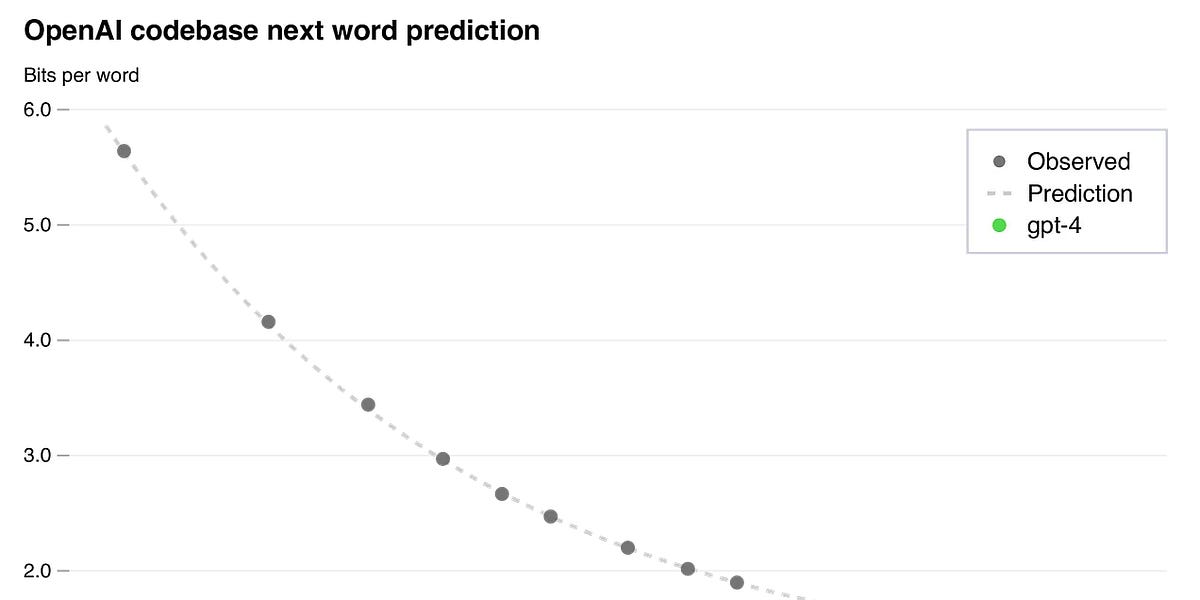
The skeptic opens with the sharpest concrete objection available: high-quality language data runs out next year. Patel then makes the arithmetic do the work. Even taking loose scaling curves seriously implies roughly 1e35 FLOPs for a model reliable and smart enough to write a scientific paper, which is presented as table stakes for automating AI research, and that implies about five orders of magnitude more data than appears to exist.
The rhetorical centerpiece of the section is a warning about how people misread orders of magnitude. Hearing five OOMs short, listeners translate it into needing a couple of twofold efficiency wins. The correction is that five OOMs is a hundred-thousand-fold shortfall, and the available one-off remedies, more efficient algorithms, multimodal data, multiple epochs over the same tokens, curriculum learning, are not exponential in the way the compute trend is. This is the essay at its most useful: it converts a vague worry about data into a quantity that cannot be waved away by a couple of engineering tricks.
5 OOMs off means we have 100,000x less data than we need