
Richard Branson: How A Dyslexic Drop-out Built A Billion Dollar Empire
Guests: Richard Branson
Full transcript · Read the full conversation in order, with its original context.
Contents1 chapter
§01Transcript — part 1§01Transcript — part 1
When your cat is acting weirder, or your dog is being louder, your turtle moves slower. Hello, Ted? Your cat seems thirstier. Whoa, slow down, buddy. Or your puppy is acting clumsier. Day or night, if you don't know what's wrong, know where to go. Veg ER for Pets. This is Kate. Veg, the better, kinder ER for pets.
You do think about, is it selfish? Is it worth it? Is it something...
Sir Richard Branson. Richard Branson is one of the most fun-loving and adventurous billionaires in the world. He's conquered our skies, blasted off into space. The entrepreneur's entrepreneur, the marketer's marketer.
In the school of business, they said focus. By the age of 33, you’ve got 50 different companies. You kind of break that law, it seems.
If we'd stayed still and only focused on one business, we wouldn't have a business today. If you get the little details right, it makes for an exceptional company over an average company. We were the first airline to introduce seatback videos in the world, sleeper seats for business class passengers. We've always been ahead of the pack. The airline’s been bullied by British Airways, famously through the "dirty tricks" campaign. The best always succeeds.
As if all that you had done before wasn't enough, you decided to aim for the stars.
We're going to space. Looking back at this beautiful, beautiful Earth that we live on whilst floating, it was a dream come true. You know, we're still at the early stage of space travel and there are still risks.
One pilot has died after a passenger spaceship crashed.
Everything that we’d built up looked like it was crashing down.
What impact does that have on you and your mission?
You’ve got to continue.
Richard, having spent the last 24 hours reading both your autobiographies but also your new HBO docuseries, it feels very relevant to start where I usually start when I have these conversations, which is: can you tell me the context that I would need to understand about you and your earliest years, your home life before the age of 10, that went on to making you the man that I saw in that docuseries, but the man that we've also observed and been inspired by for many decades?
So, I was brought up in the countryside. I love the country. And I was brought up by a mom and dad who, I suppose, were struggling after the Second World War. A mother who was a fairly extraordinary woman, who was absolutely determined that we'd stand on our own two feet.
She wouldn't let us watch television. She made sure that we were outside doing things or creating things. And I’ve been forever grateful for that approach. On occasion, she would maybe go a little bit far, pushing us out of the car aged five or six and making us find our own way to Granny's house. But anyway, we survived all her approach and hopefully are the stronger for it.
Throughout your docuseries, but also throughout your books and everything that I've heard you talk about, Eve, your mother, she felt like a really extraordinarily principled and strong character. In the docuseries, you actually say that you didn't realize how much she had influenced you on becoming the entrepreneur you are today. What was it that she was doing? Pushing you out of the car at five years old and making you walk home, but what were those principles that underlined her approach?
So, I mean, she was one of the first entrepreneurs around, really. Not a particularly successful one, but she was making table mats and cutting out pretty pictures from books and turning them into pictures that she would then take to Harrods or Harvey Nichols.
Interestingly, and I didn't realize this until I saw it in some letters that she'd written to me, working from a phone box in London. That was her office, just like my office had been later on, working from a phone box at school. But yeah, so she would never stop. She was an idea a minute, always trying to better our lives and always trying to create things that she could be proud of.
When was she most proud of you in terms of what kind of behaviors or achievements would make her most happy when you were young?
She was fairly firm when it came to the need for being courteous from a young age. I remember in church one day, I refused to go and sit next to somebody that she wanted me to sit next to, who was maybe visiting our house.
When I got home, she asked my dad to spank me. That had never happened before. My dad takes me into the next-door room and instructs me to burst into tears. He slaps his hands together very hard six times. I come out rubbing my bum.
Then, of course, she regretted having done it in the first place, but of course, it never happened. But generally speaking, it was unreserved love. But she wanted us to care for other people properly. If we ever said ill about somebody, we’d be sent to the mirror and we’d have to stand there for 10 minutes because she felt it reflected so badly on us that we’d said ill of somebody. Those sort of lessons, I think, were very, very powerful and very good later on in life when I was leading people, always trying to look for the best in everybody.
One of the threads throughout your story, which shocked me, surprised me, and inspired me in many ways throughout the docuseries, was this continual desire to move on to the next thing and make things bigger and to capture another opportunity, which struck me as being at times like a really defining character of you. Even when things seemed to be successful by anyone's estimation, you pushed on again and then you'd push on again and again. Do you have any idea where that instinct or that characteristic came from in you?
I'm sure that came from my mom. I am "Son of Eve," which is my mom's name. But it's also, I think, because I was dyslexic and pretty hopeless at school. I've forever been trying to prove something to myself and prove something, when she was alive, to her and my dad.
I'm inquisitive. I just love learning about new things. Once I've actually absorbed everything there is to know about the thing I've just created, I'm apt to want to move on and learn something about something completely different, particularly if I feel other people are not doing it well. I just love diving in there and trying to shake up an industry that is badly run.
Do you think she and your father, Eve and your father Ted, had high hopes for you?
I think that my mom definitely thought that I would be... she decided that I was going to be Prime Minister of Britain one day. So she definitely had high hopes for me. My dad just wanted us to be happy. He was a very lovable, content, funny, witty individual. Wanted to be an archaeologist but ended up going into the law after the war. He would have been happy as long as we were happy. He didn't really want to push us, but my mom, I think, expected more of us.
You mentioned school a few moments ago. You and I both have a similarity in that we were hopeless in school. You went off to boarding school at seven years old, which in and of itself is a pretty extreme experience for a seven-year-old. You described this as being a little bit too young in your view, and you struggled, in part because of your dyslexia. At the time, did you know what dyslexia was or what it meant?
No, I had no idea what dyslexia was. I just assumed that I must be a little bit thick. I mean, I could just about add up and subtract, but when it got to more complicated stuff like algebra and geometry and the likes, I couldn't understand the reason for it. I wasn't interested in it.
I couldn't understand why we were having to learn French when nobody seemed to ever actually speak it when they left school, or Latin. And so, I suppose in my head, I rebelled against being taught things that I couldn't see the relevance of. And actually, that was a good thing because it ended with me rebelling from actually staying at school and leaving school at 15 and creating a magazine to try to address some of the issues in the world.
Your dyslexia—you've often highlighted that in many respects it's been a superpower. It’s given you skills that have led to your success. What is that? What are those skills and what is the advantage, in your view, of this dyslexia and how that's changed how you function and operate?
I think that, first of all, I'd like to say I'm proud of being a dyslexic thinker. I'm delighted that dyslexic thinking is now becoming almost part of the vocabulary. I'm pleased to talk to many dyslexic kids over the years to try to make them realize that you should not be worried about it.
Look at the areas that you enjoy and concentrate on those. The areas that you're not great at, you'll either catch up later on in life, or if you're going to start a business, you can delegate and find other people who can deal with those. So I think dyslexic people really excel at the things that interest them. I know a lot of business people, for instance, who were dyslexics who have gone on to do incredible things.
Your headmaster—I read the very slightly humorous, slightly shocking story of when you were at boarding school. You had a little bit of a romantic run-in with his daughter Charlotte, got expelled, staged a fake suicide, got un-expelled. And then you, as you referenced a second ago, had this idea for the *Student* magazine. I read that there was an ultimatum given to you by your headmaster where he said, "Richard, I know you're starting this magazine. You've either got to leave school and start the magazine or stay in school and focus on your formal education." At that point, you made the decision to jump ship.
Yeah, I mean, I don't think the headmaster was very foresighted. I think if a kid at school wants to start a national magazine for young people, what a great education. They should have welcomed us to stay at school and do it from the school. But the headmaster wasn't going to allow me to do that. And thank God, because getting out into the real world, I achieved a lot more than I would have done if he'd been pleasant and said, "Run the magazine from school."
There was a lot going on in the world. There was the Vietnamese War, there was the Biafran War, there were the Provos in Holland, there was the education system that needed students to rebel against. And so it was an exciting time in the '60s to leave school, go to London, and try to start a magazine.
I watched your docuseries yesterday in that theater that we were all in, including yourself. One of the lines really struck me. When they showed the small room that you were building this magazine in—I know sometimes it was the postbox, but sometimes there was a small room at a later date—a line was said, which was: "This was my education."
For young people who are considering taking a leap when they have very little responsibility or very little to lose, throwing themselves in that kind of situation where they'll fail their way to an education struck me as being so important and so underrated. When you don't have kids or you don't have a house or a mortgage, it seems like that's exactly what you did. You used failure and risk as a way to self-educate.
Yeah, I mean, it's difficult for me to recommend it to everybody listening to this program because not everyone's going to be successful. Obviously, you and I have been fortunate that we have had success doing it that way. Some people—and I'm going to put my conservative hat on knowing that the parents may be listening as well—some people will benefit from having an education degree or whatever to fall back on if they find that they just can't make a go of it in business.
But anyway, for the two of us, being out in the real world, I mean, I learned so much. It's held me in such good stead throughout my life. In running a magazine, of course, you're going out interviewing people, you're learning every time you interview somebody. I think being a journalist or being an editor, it's not so different from being an entrepreneur. You're out all the time meeting new people in different sectors, just learning, learning, learning.
Through the magazine, a lot of people would write with problems—young people would write with problems. So we ended up setting up a Student Advisory Center where we would give people advice on venereal disease, or the gay population, or contraceptive advice, abortion advice, psychiatric advice. Just meeting all these people with all these different problems, suicidal mental problems, really opened my mind. It was just a fascinating, fascinating education.
Throughout my life since then, I've spent a lot of my life trying to address some of these issues, first of all in a wider sense in London and now more on a global scale. But that education was so important. For instance, I remember when I was 15 in London, somebody who was gay came to me saying that they wanted help. I thought very naively that when they said they wanted help, that they didn't want to be gay.
Of course, within a month or two, I realized that people are born gay and they don't have a choice in the matter. What they desperately needed in those days was to meet other gay people. Because if they came from some remote place in the UK where gay people weren't accepted, they would come to London desperately seeking love or seeking friendship. Just little things like that I learned from just being out there, listening and doing.
That magazine was the first big notable thing that you'd done in business. Throughout your story, I was told by other people: "Richard Branson's an amazing delegator." You mentioned it earlier on, your delegation skills. To understand how to delegate to someone else, you first, as you've said, need to understand your strengths and weaknesses and also their strengths and weaknesses. So what are your strengths in your own words? What is the bit of the puzzle that you are good at?
I think I'm good with people. I think I can trust people. I think I can surround myself with really good people. I think I'm able to delegate, not to second-guess them all the time, to praise, not criticize. And I think I'm quite good at, if I create something, making sure it's the best in its area, so that the people who are working for Virgin are really proud of what they're doing.
It's really important that if somebody's in a pub and they work for Virgin, and somebody says "What do you do?", that they're proud of the fact that they work for Virgin and they're happy to say it. There are some companies that if people work for, they won't really want to be able to say that they work for such and such a company.
Yes, I think my people skills are the most important skill. I think just giving things a try. "Screw it, let's do it," obviously is a phrase I coined years ago, and I've used that phrase many a time. Somebody comes with an idea and I like them and just say, "Let's give it a go." Sometimes we fall flat on our face, sometimes it succeeds.
And conversely then, what are the weaknesses that you've kind of observed in yourself or the things that you tend to delegate to other people? I actually read something, which was a quote of yours, that said: "I once took an IQ test at eight years old, I don't think I filled in anything. Going forward 30 or so years, I was running Europe's largest private group of companies, but I didn't know the difference between gross and net profit, but it didn't matter."
Yes, I was in a board meeting when I was about 50 years old and the director said... and I think I said, "Is that good news or bad news?" And one of the directors said, "Come outside, Richard, a minute." So we came outside and he said, "You don't know the difference between net and gross, do you?" So I said, "No."
He said, "I thought not." Anyway, he brought a sheet of paper. He brings out this sheet of paper and he has some color pens and he colors it in blue and then he puts a fishing net in it, and he puts a little fish in the fishing net and he says, "So the fish that are in the net, that's your profit at the end of the year, and the rest of the ocean, that's your gross turnover."
And I went, "I've got it." And ever since then, I've been name-dropping net and gross to people who obviously know full well what it is. But the point of the story is it really doesn't matter. I mean, it's a good idea, most likely, if your chief accountant knows, but for somebody who's running a company, what matters is: can you create the best company in its sector?
If you're going to create an airline, is it going to be palpably better than the rival airline? If you create a cruise company, is it going to be palpably better than the other cruise companies? If you're going to create a train company, is it going to be palpably better than what's gone before? And if it is, then at the end of the year, it's likely that more money will come in than goes out and then somebody else can add up the figures.
So I think to run a business, yes, it helps to add up, it helps to subtract, it helps to multiply. I don't even think you need to worry about division. That's it. So if you can do those three things, you can run a business. If you can't do those three things, I wouldn't worry too much. Find somebody else who can and just go out and create something that's going to make a positive difference to other people's lives.
That student magazine kind of pivoted at the end into a mail-order music business, which is a big part of the docuseries that we watched yesterday. But then it became so many more things. And the interesting thing is kind of how you swung from one of these business ideas to the next because you'd seen a product or service that you thought could be done better or there was an opportunity there. In the school of entrepreneurship, we always talk about the importance of focus. Now when I look at your story, from 15 years old starting that magazine to starting a mail-order business, around I think 22 years old when Virgin was kind of conceptualized and launched, and then by the age of 33, you've got 50 different companies involving everything from filmmaking to conditioner cleaning and generating more than $10 million in sales. I go, "This is not what they told me about the need for focus in the school of business." They said focus. You kind of break that law, it seems, of focus.
So, I've never really thought of myself as a business person. Obviously, on paper, I am an entrepreneur or business person. I've never really been interested in the bottom line, despite what the docuseries seems to portray. I really have been interested in creating things I can be proud of. And a lot of those things come out of personal frustration. I must have been frustrated quite a lot when I was young because I've ended up trying a lot of things.
And I just found it great fun investing in people I met. Somebody will come along and the music business may have been struggling at one stage of my career with the advent of the iPod. A couple of guys come along and say, "You should do mobile phones. This would replace the music business." And they were great people and so we thought, "Screw it, let's do it. Let's go into the mobile phone business."
And so if we'd stayed still and only done, only focused on one business—maybe let's say the record business, or let's say record stores, which was one of our earlier things—we most likely wouldn't have a business today because the mega stores and record stores no longer exist because the iPod and free music really put them out of business.
So by actually going against the rules of what you learn in business school, we are still going strong 55 years later. And diversification actually saved us. I mean, like during COVID, Virgin Atlantic and our very badly hit companies were saved by being able to sell Virgin Galactic shares. So diversification is far more exciting, you learn a hell of a lot more, and it can be useful in times of crisis.
It's clear that only a great delegator would be able to diversify without spreading themselves too thinly, per se. Your headmaster said something to you that my best friend George Way said to me when I was 18 years old after I dropped out of university. He said, "You're either going to be a millionaire or in prison." Now, when I read that this morning when I was doing research on your headmaster, it stopped me in my breakfast halfway through my chew and I thought, "Gosh." Now, I know why he said that to me, because he knew there was a certain level of desperation in me and there was a certain craftiness, which could either take me... could either be used for good or evil. When you did the student magazine, that prophecy appeared to come true one day when the police raided your magazine and arrested you. Your mother then puts her house on the line to get you out of jail, and you choose to expand your way out of the problem, which for you meant, as it said in the docuseries, opening 30 record stores that year to be able to pay your mother back. Have you always chosen to expand your way out of problems?
Yes, I think the answer is yes. I spent one night in prison. In those days, you had to pay tax on records if you shipped them to Europe. Sadly, with Brexit, people are going to have to do that again. And I stumbled into the fact that if you drove across the Channel and drove back again, you had a piece of paper which said you'd exported the records and therefore you didn't have to pay the tax.
But anyway, so we got a bad rap on the knuckles. I spent a night in prison and swore never, ever, ever to spend a second night in prison in my life. And yes, we expanded fast in order to pay off the fine. We just needed the turnover. And it was actually a really wonderful booster to all the team at Virgin. Fortunately, we managed within three years to pay it off. But I mean, sometimes we're expanding just for the sheer pleasure of learning about something new and then maybe occasionally like on that occasion we're expanding to get ourselves out of trouble.
From my perspective, one of the most terrifying decisions you ever made was to go into the airline industry. Warren Buffett's fairly famous for saying that he has once considered employing someone to sit in his office and every time he feels like investing in an airline to talk him out of it because it's such an absurd, terrifying business to get into. You were running a very successful record label and record store business by then. You had many, many companies, many investments, and you decided to take this huge bet to start an airline. Could you tell me in your own words why?
It really was out of frustration of flying on other people's airlines, having bad experiences, and feeling that we could do it better, we could make it more fun. In those days, if you flew on, say, British Airways, it was a monopoly. They maybe got a lump of chicken dumped in your lap, there was no entertainment, the cabin crew certainly didn't enjoy working for the company, and you really felt like you were just being herded from A to B in a cattle truck.
And so I was flying all over the world to visit our record companies because we had record companies in most countries around the world and just felt we could do it better. Somebody came along to us with the idea of a business airline only. I didn't think that would be very exciting to run. But I thought a really, really good quality airline for everybody, including business people, would be something special to run.
And so ended up ringing up Boeing and having a wonderful discussion with a wonderful guy called RJ Wilson and ended up being able to lease a secondhand 747 from him. And because I do like to protect the downside, which is obviously important in business, I did a deal with him whereby I could hand the plane back at the end of 12 months if my instinct was not right. But fortunately, at the end of 12 months, people loved flying on Virgin Atlantic and we ended up getting a second and a third plane from Boeing.
And that was 38 years ago. Virgin Atlantic has been roughly the same age as my daughter. The airline’s been bullied by British Airways, famously through the "dirty tricks" campaign. It was a really tough time. We took BA to court and we won the biggest libel damages in history.
She's had to go through the crashes like the 9/11 disaster, the 2008 disaster, the COVID disaster. And I'm sure that it's cost us more money than we've ever made from it, but it's been the flagship for Virgin. It's enabled us to launch other companies in different countries around the world on the back of the strong brand and the strong reputation it's had. And she's a daughter that I will zealously protect as long as I can.
When you look back at why that business survived considering the fierce competition, considering what British Airways did and what they were ultimately found guilty of in court with their "dirty tricks" campaign—the bit that really stuck out to me yesterday was hearing that they had a staff member hack into your customer database to kind of spy on what you were doing. That went to court, you won the battle, and that acted as a real booster I think for Virgin because it kind of staged you as this sort of David versus Goliath situation where you were the underdog. But as you look back on that journey, many people have fallen in that industry. It’s a graveyard, as you say in the documentary. Why did Virgin win? What was it? Was it brand? Was it customer experience? Was it just grit?
I think a lot comes back to staff. We've always had a great team of people working at Virgin. They're really proud of the company. We've done things, we've always been ahead of the pack in new innovations. So seatback videos, for instance—we were the first airline to introduce seatback videos in the world. sleeper seats for business class passengers, stand-up bars and lounges and so on. Collecting money at the door for charity—Virgin was the first to do that and now pretty well every airline and most airports are doing it as well, loose change.
So I think every little detail the team have got right at Virgin. And if you get the little details right, then collectively it makes for an exceptional company over an average company. If I'm on a Virgin plane, I'll have my notebook, I'll take notes, I'll listen to the staff, listen to the customers, and then act on it when I get to the far end and then be back in touch with the people who gave me the idea to thank them and tell them what we've done. I think a good leader has to be a good listener. And that's I think one of the most important attributes of a good leader.
I grabbed my phone halfway through watching the docuseries yesterday when you mentioned the seatback videos because in the same breath you mentioned how every accountant would tell you not to do many of the things that you've chosen to do. But also the banks wouldn't even lend you the money to do the seatback videos. They'd give you the money for like $2 billion to do the planes, but they wouldn't give you the $10 million to do the seatback videos. You've mentioned instinct as well a few times. As a CEO over the years, I've had this battle between instinct and the CFO. You seem to tend not to consult finance people and accounts people when you have these ideas. How have you found that battle between the two, between your instinct and your vision and the money people going, "This won't work, this doesn't make sense"?
I suspect that you're the entrepreneur and they're the CFO because you're the entrepreneur and they're the CFO. So I think you've just got to believe in your instinct and go with it. If you create something—I mean, we're just opening a new hotel in New York—if it's the best hotel in New York, even if it's gone over budget in the building of it, which it will have done, the best always succeeds.
We famously during COVID launched a new cruise line, Virgin Voyages. It is so much better than any other cruise line out there. We've had two years where we've had to mothball the ships, but we've stuck with it because we know that the quality is such that people will seek it out and the feedback's been spectacular.
Each ship has 78 different nationalities working on it, 1,200 people, and they're just the best. It's adults only and it's a lot of fun. But there were moments during COVID that we did think we definitely chose the wrong business to launch.
"Virgin at its absolute best"—what does that mean? What is Virgin at its best?
Virgin at its best is when you launch a new company and you know that because people have experienced previous Virgin companies, that they will give it a try. You don't really have to even advertise. They know that when they went on a Virgin train, when we ran the network, that it was really good quality. When they went on a Virgin plane, it was great quality. When they went into a Virgin Health Club, it was good quality and so on.
So that gives us a big advantage with a brand that people have tried, they've loved, and so when we launch something new like a cruise line, they will give it a go and we make sure that we don't let them down. And then having them try the cruise line, if we decide to do a new venture, it's that much easier for us to launch off the back of the cruise line.
You are so synonymous with the Virgin brand. I don't think I know a person who is as synonymous with their brand as an individual. So when you think of Virgin, you think of Richard Branson. When you think of Richard Branson, you think of Virgin. And in 1985, you started doing some pretty extreme adventures around the world which become kind of pay into the brand and give the brand extra meaning. Things like crossing the Atlantic by boat, which sunk. It seems like a lot of the trips you took either collapsed, like fell out the sky into the sea, or the boat sank. You set so many records through that period. I was reading about you going 250 miles per hour in a hot air balloon across the Pacific from Japan to the Arctic in Canada, again breaking existing records at the time. This became a real hallmark of the Richard Branson and Virgin brand, these extreme adventures. Was that intentional? When you did that first one, did you... was it because of a marketing thing or was it because of the fun of doing it for yourself?
It started out as a mixture of the two but more... we had one plane and somebody said, "Why don't we try to bring the Blue Riband back to Britain for the fastest boat across the Atlantic? We can build this boat."
But it ended up being much more than just a marketing adventure. It became a real adventure. I mean, it was tremendously exciting and I was in my very early 30s and it was tough but it was great fun. There were lots of moments of drama, which there always are when you're trying something that's never really been tried before, including, as you pointed out, we sank before we got the whole way across.
But anyway, it makes for a good documentary series and it makes for a good book. And it did put Virgin on the map. It made Virgin a much more sexy brand, a more adventurous brand than, say, British Airways, our rival, and other brands.
I mean, Virgin Atlantic cheekily took a full-page ad when we sank in the Atlantic. The only thing that was sticking out of the Atlantic of the boat was the brand Virgin. And the ad just had the picture of the boat sticking out of the water and the ad said, "Next time, Richard, take the plane."
And of course, there were people who said, "Gosh, you've sunk. You end up in the Atlantic. No one's going to want to fly on an airline where..." But of course, it was quite the reverse. It helped put a tiny little airline on the map more effectively than anything else we could do and much more cheaply.
In the moment, competition is the archenemy, causing you a ton of nuisance. But as you look back on the competition you've had throughout the different industries you've been in, has the competition actually made you stronger and better at what you've done?
Yes, and I think the reverse is also true, that these big public companies or big government-run companies like British Airways have been made the better by having Virgin Atlantic innovating and them having to catch us up over the years. I think British Airways is a better company today than it was 38 years ago when we started. So competition's good for all of us, big and small. And the only role that governments need to play is intervening when there's unfair competition. And that's one of the most important roles a government can play is making sure that they set laws that encourage competition and don't stifle competition. And we've had... anyway, there've been books written about companies that have tried to stifle Virgin in the past, but somehow we came through.
There's this term now called "personal branding," which has become very popular predominantly because of social media and everybody having a channel and they can build followers and they can try and tell the world who their company is using social media. But you were kind of the first CEO personal brand to many people because everything you did added value to the brand. And it wasn't just what Virgin said. I think when I look at your story, it teaches me that the brand is what the people do and what the founder does becomes the brand more so than ever. And I think that's often what we lose sight of in some of the best brands in the world, like the Red Bulls of the world, who have figured out that the things you do say so much more about the brand than what you say.
In the early '90s, you got into a bit of a struggle because of the broader economy, and you ended up selling your record business. From all accounts and from speaking to some of your current team, they said that this was a very difficult moment for you, that it was "crushing," I think the quote that I was told. Is that accurate? And why was it crushing?
Oh look, I think if you think of the things that you create like children, which I do, and I'd think of it like that because it is just a bunch of people—your business is yourself and a group of people—if you sell it, it's like selling a group of children. And that's tough all round.
I needed a war chest to combat British Airways and the "dirty tricks" that they'd launched at Virgin. And so the war chest that I thought I could best tap into was Virgin Records. The good thing was that the staff at Virgin Records still had a job but working for another company, and the staff at Virgin Atlantic were safe because we had the financial clout to deal with our competitor. So there are obviously times in life where you have to make tough decisions like that and move on.
Do you have any regrets about how that happened, about that phase?
I always think that if anybody asked me if I ever have any regrets about anything, I would be a very sad person to answer positively because I've had the most extraordinary life. It's been full of interesting twists and turns. And I honestly really can't think of anything I regret in the past.
I think I would be a sad person if I had regrets. It's just been rich with adventure and people. And I'm not somebody who looks back, by and large. I mean, obviously, an interview like this I will, and I suppose I've reached an age where it's important to write books and it's important to do documentaries because it's important not to waste your life and it's important to share what you've learned.
How did you feel yesterday watching the docuseries on your life? I was sat just behind you, so I'd look at the screen and then I'd look at your reaction and I'd see you laughing sometimes.
I was emotionally drained, to be honest. After the after-party, I just could not really get my words out for the first half hour. I found it fairly exhausting. It's incredible, a really good documentary maker, and Chris Smith is one of the best in the world. Prides himself on his independence, which I respect completely, and so we didn't have input into it.
Obviously, therefore, not everything one's going to agree with, and not everything in my brain would be exactly as it was, but 95%, 96% was as I see it. But just what is incredible was the archive footage they managed to find, considering we'd had my main house burned down, my main house blown down in a hurricane twice. The fact that anything survived to be able to make such a really full, quite exciting, I think, documentary series was... I have to take my hat off to them.
And then in the last episode of the docuseries, I saw you once again in typical Richard Branson style set yourself a new frontier, which was space. As if all that you had done before wasn't enough, you decided to aim for the stars. Why?
I remember many, many years ago when President Gorbachev was leader of Russia and he was trying to bring Perestroika to the West and trying to put out peace signs. He invited me to come to Russia to be the first person to go up in a Russian spaceship. But it would have meant a big check—$60 million—it would have meant a year learning Russian and being in Russia. And I just didn't have the time at the time and already the spare money to do something like that.
But it did just get me thinking: that's an inordinate amount of money to charge for somebody to go to space. For that kind of money, why couldn't I just build a spaceship? And so we registered Virgin Galactic Airways and I went around the world trying to see if we could find somebody to build us a spaceship. And then just found this genius, Burt Rutan.
To me, I've always dreamt of going to space one day. I think 50% of the people listening to this program will have dreamt or will dream of going to space. 50% will think, "Why on earth would you want to do that?" But it was the most extraordinary day of my life, my trip to space. And looking back at this beautiful, beautiful Earth that we live on from space whilst floating with a lovely group of people—just an extraordinary experience. To pinch oneself moment to be doing it in a spaceship that we built was a dream come true.
In that documentary, we're also reminded of the cost of all of these endeavors. At a moment where there's a shot of you taking a phone call at your house, learning that in the lead-up to Virgin Galactic's going to space for the first time, an astronaut had died in one of the tests. It's a very emotional scene, but it is a reminder of the cost of these great endeavors to humanity. That day, when you received that phone call and then you rushed yourself to the site, what's on your mind?
It's happened to me twice in my life. I was once in a cinema in Europe with my kids and my phone just kept vibrating and I ignored it and ignored it, and then on the sort of third or fourth time, I decided to walk out of the cinema and check it. One of our trains had come off the track and straight away I knew that I just had to get to the scene of the accident. There were no flights that night, so we had to drive through the night and then got there at early in the morning the next day.
One lady had died and I went to the morgue to meet the relatives and we had a hug and... fortunately, it turned out it wasn't actually a Virgin fault, but you're still obviously responsible for the fact that it was on a Virgin train. And then you've got to, as owner, talk to the press.
But I think the fact that you make an effort and get there quickly is very important. And the same when we lost a test spaceship, I knew straight away based on my previous experience with the train that I needed to be there as fast as possible.
Is there a conversation about discontinuing Virgin Galactic at that moment after losing that life?
Yeah, there was. I sat down with George Whitesides and just asked ourselves questions: "Is it worth it? Is it worth continuing? What would happen if we had a second accident? We would never be forgiven, our reputations would be destroyed."
But then we spoke with all the engineers and we spoke with many of the people who'd signed up to go to space and we spoke with the family of the pilot who we'd lost, and with one voice they said, "You've just got to continue." And we did. And we're still at the early stage of space travel, there are still risks. We think that we're through all the big risks, we've got a... we can automatically switch off an engine if anything's wrong and we've got astronauts actually flying our craft. But it is the early stages, but I think everybody involved are doing it with their eyes open.
One of the most beautiful, heart-wrenching scenes from the docuseries is in 2021 when you are months away from your first space flight on your own spacecraft, and tragically she passes away from COVID before she has the chance to embark on that space journey with you, which she was planning to do. That phase of your life when you lose your mother, when you lose Eve—what impact does that have on you and your mission?
I mean, first of all, she'd lived a long life and an extraordinary life. I was very fortunate, our family was very fortunate to have had her around so long. And the absolute last thing that she would have wanted was for the mission or any missions to be held up as a result of her death.
If there's a star up there, she'll be on it and I'm sure that she was there in spirit when I went to space. She definitely would have been smiling down at us with my dad Ted. And so I think when we lose loved ones, you live on through your parents and your children live on through you and your grandchildren live on through your children. And that's the sort of wonder of life.
And when you came down from that space flight, you wrote a letter to your mom. You said, "Dear Mom, you always told me to reach for the stars while I took my own winding road, but I always knew when to follow your lead. You always pushed us to our limits, you were always a dreamer, you urged me to strive for every opportunity I saw, you told me to chase my wildest fantasies, to live life to the full—how you lived, how you loved, and how you are missed."
Yeah, I mean, she... I think hopefully when people read the book, they'll think about their own moms and dads and how lucky we are to have moms and dads who sacrifice so much for us as we grow up. And then obviously later on in life, one can give back in looking after them as they get a little bit older.
The docuseries was a bit of a punch in the face from the start because of that opening scene about your family where you're sat there ahead of your journey to space trying to say some words to Holly, Sam, and Joan, your wonderful wife and your kids, just in case you never make it back from space. This is something that you've done time and time again before you embarked on these journeys. Really, really difficult to watch, and took me by surprise because it was so early on in the film. Why is it so hard to get those words out? Otherwise, you seem like such a composed individual, but when it came to those words, you know, multiple takes, you got up, you walked away, you came back.
So first of all, I do... I cry at happy films, I cry at sad films. My kids bring a box of tissues when we go to the cinema, or used to. So I am... even now just talking to you I can feel tears in my eyes. So it's not surprising for me to suddenly not be able to get through my sentence sometimes.
But obviously look, if you are speaking as if you have died to your kids and your grandkids, a lot of emotions go through your head at the time of speaking. I suspect even the emotions of "My god, should I be... is it worth it?" A lot of this documentary series is asking the question "Is it selfish? Is it worth it? Is it something that one should be doing?"
I remember I was just taking off to go across the Pacific in a hot air balloon and walking into this truck and Joan Turketel from ITN was just finishing editing my obituary in case I didn't come back. She said, "Richard, do you want to sit and watch the obituary?" And I said, "Well, why not?" And I sat and watched the obituary and again had a couple of tears in my eyes at the end of it.
But I do think that in life, one advantage of doing these adventures is actually you do confront the ultimate inevitability that you're not going to be here forever and so you do think about, "Have I left everything in order? What am I going to say to my children? What am I going to say to my grandchildren?" A lot of people don't have that opportunity because they die suddenly. So I have written quite a few letters over the years thinking that I just may not come back from this adventure or that adventure.
The documentary also shone a light on Joan, who has clearly been this huge rock in your life over the years. She is a strong, tenacious, honest, very to-the-point, wonderful woman. What does she mean to you, and what has she meant to you over the last 40-50 years?
Well, I was lucky enough to meet her 45 years ago in a recording studio called The Manor. Walked into the kitchen and just looked across the room and she was the most gorgeous creature I'd ever seen in my life. And it was instantaneous love from me to her, but it took me a while the other way around.
But she's just a fantastic down-to-earth Glaswegian, doesn't suffer fools gladly, complete opposite to me. Doesn't play tennis, doesn't run, doesn't ski, doesn't climb mountains, doesn't go adventuring. But she's the most fantastic mother for Holly and Sam and the grandkids. And she knows what matters in life. In the end, I suppose what matters is the love you can give to your children, the food on the table, but above everything, just unreserved love to everybody around her. And everything else is sort of icing on the cake.
You're a man synonymous with living a life worth living. One of the quotes from the film was about not living a life that is full of risk is not living at all, words to that effect. If I was Sam or Holly, your kids, and I asked you, "Dad, what is a life worth living?", what would you say to me?
I think just to first of all fulfill their own dreams. Not to have their father or mother push them into things they don't want to do. So I was lucky—my daughter wanted to be a doctor and she did the medical... she became a doctor. She now helps us with our foundation. My son wanted to make films and he's a musician basically, which is his main love, and he does a little bit of both of those things. They're both fantastic parents and they find the time for the grandkids. So I think just to follow whatever dream it is that you have as best you can. And yeah, we've been lucky that our kids have I think found their path in life.
We have a closing tradition on this podcast where the last guest asks a question for the next guest, not knowing who they are asking it for. The question that has been left for you is: where were you when you felt most vulnerable, and why?
I think I felt most vulnerable relatively recently during the... about six weeks into COVID, when everything that we'd built up looked like it was crashing down. And interestingly, when the British press, rather than being supportive, really turned on us.
But fortunately, my kids and grandkids, everybody arrived at around about that same time. And the team just got down and worked really hard day and night to make sure we kept as many jobs safe as possible. And I think pretty well every Virgin company got through it and pretty well every employee's job got protected. But that was maybe the toughest time in my life for suddenly it just looked like your reputation and everything else was going out of the window. COVID was tough for so many people and we felt it too.
Holly and several members of your team reference that as being your toughest moment. But the word "tough" is just a word. If I zoomed in and if I was there and I was you, what would I have seen and what would I have felt?
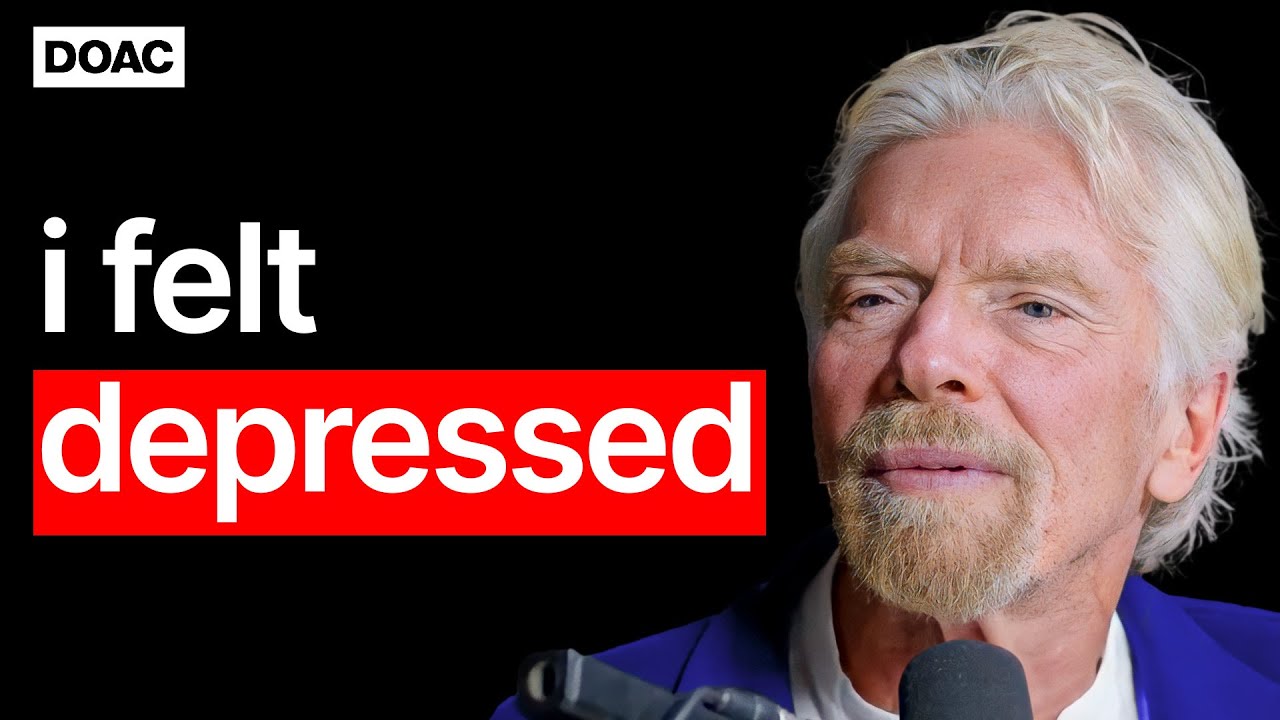
Well, I think that I've never understood depression, and I think I understood where people get depression from after that experience. And it was good to have gone through it myself a bit. I mean, it didn't last too long because I've been brought up by parents who'd been through the Second World War and you couldn't waste your time getting depressed—there were much far worse things than being depressed. But anyway, it taught me to understand it, which I think will hopefully make me better understand other people's depression in the years to come.
What were the symptoms of that?
It's very difficult to pinpoint the symptoms, but you just feel very sorry for yourself for a day or two and then you just have to snap out of it and get... my mom would have, if she'd been alive—well, she was, but if I'd talked to her about it, she would have told me to pull myself together and just get back to work. And I think within two or three days, her words would have been ringing in my head and I would have overcome it. And I did overcome it, but it just gave me a little taste of it anyway.
Richard, Sir Richard Branson, thank you so much for your time. To me, when I started this podcast, you were *the* name. You were the name that if one day I could speak to on this podcast, I think we might as well pack it up and finish because to me, as an entrepreneur my whole life, you've always been the North Star of entrepreneurs. You've represented and embodied what it is to be an entrepreneur that's striving forward to create better in everything you do.
I had the pleasure of researching your story again now at 30 years old, and it's been a tremendous source of inspiration for me. To meet you today, to get to come and watch your docuseries, is one of the highlights of my entire entrepreneurial career and life, and definitely this podcast. So thank you so much for that because I'm not sure you'll ever really appreciate how much of an impact you have on people like me.
So I want to make sure that while I have you here, I have a chance to tell you and to thank you for that because you've definitely changed my life and I know I'm not the only person. So thank you. Your book is amazing. The docuseries was so captivating. I stayed up till about 3:00 AM last night making sure I watched all of it and then watched the last episode again this morning. And I implore everybody to go and check it out now on HBO. But yeah, most important thing is I just wanted to say thank you.
Well, thank you back and yeah, many, many congratulations on all you've achieved and all you—you being a young bastard—all you will achieve in the years to come. Thank you, Richard.