
Tony Bellew: Nothing Made Me Happy Until I Found This
Guests: Tony
Full transcript · Read the full conversation in order, with its original context.
Contents1 chapter
§01Transcript — part 1§01Transcript — part 1
No two companies are alike. That's why the American Express Corporate Program can help you customize rewards, reporting, and billing options, all designed for your business. Build your program with American Express at americanexpress.com/corporate. Terms apply.
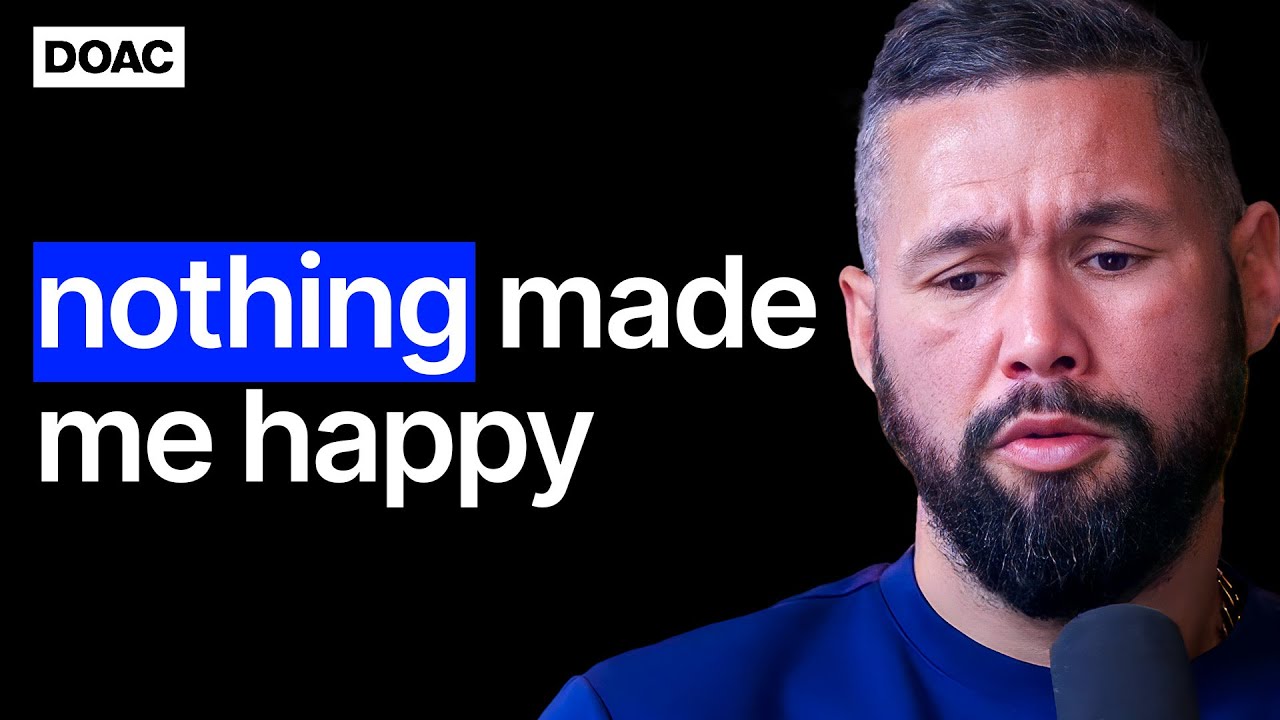
Every night I cry myself to sleep. Like nothing made me happy. Nothing.
Tony Bellew! What a fighter!
I believe I was put on this earth to fight. It was my father who taught me how to punch. And at 12 or 13 years old, that’s a powerful tool to show a kid.
Finding out that your brother was gay being a pivotal moment. Why?
In the mid-90s, it wasn't cool to be gay and black. That’s when I’d say the fighting takes shape. I used to brutalize my body, cannibalize my own body. There’s fight nights that I’ve had that I can’t remember anything.
That shield you put up to help you to survive, I’m guessing it’s not serving you.
No. One of the things I will never forget is the raw emotion that came out of you after you won that fight.
You know, people look at you and think you’re a success story. They look at the money you’ve got, they look at the setup you’ve got, but ultimately, are you happy?
Are you happy?
So without further ado, I am Stephen Bartlett, and this is The Diary of a CEO. I hope nobody is listening, but if you are, then please keep this to yourself.
Tony, from reading your book and a lot of things you've said over the years, one of the things that really stood out to me—because it’s been front of mind as a few guests have said this to me over the last couple of weeks—is "I was a product of my environment." And your early environment was Wavertree in Liverpool. Take me back to that environment and tell me what it was about that environment that shaped who you went on to be and who you are today.
I am a product of my environment. And the way I get to that is because it's no coincidence I'm a fighter. I was just—I believe I was put on this earth to fight. It's something that I enjoy, something that I like, it's something that I'm not afraid of. Fighting never scared me, it never bothered me. I think that's a bit weird, to be honest, but it's just me. I can't change who I am.
The environment I was raised in definitely helped produce that. From being a kid, at the age of 10, my old man leaves home. He's gone. At that age, my little brother is about six or seven. My two elder brothers, one had moved out and the other one was on the verge of finishing school. The elder one who finishes school then goes on to further education, he goes to university. So we kept moving on over a few years.
Once I hit 13 or 14, it's quite apparent my younger brother's gay. And then that’s when I’d say the fighting takes shape and things take shape.
You said your dad left home when you were 10. How come?
He couldn’t keep his dick in his pants, to be honest. That’s the long and short of it. He got caught. Fantastic father, but he was carrying on and broke my mom’s heart and was gone. A product of most men, to be honest, but that was the reason my dad was gone. He was carrying on, he had an affair with some scumbag of a woman who knew he was married with four kids. He just let the thing in his pants rule his head. It’s a thing that he regrets every single day for the rest of his life, which he constantly tells me, but these are the mistakes men make.
What impact did that have on your mother at the time?
It was heartbreaking. Absolutely heartbreaking. As a kid growing up, it's not nice watching your mother cry herself to sleep at night. The other things that go on in life... it's heartbreaking. Very, very tough. And you only understand how tough it is when you look back as an older man, as a grown man. You realize how tough and hard it really is.
Getting to see the impact of infidelity in your own home, has it impacted what you are like as a man with your wife?
That's deep. I've never been asked questions like this, but it's all good. Yes, it does add a life where I try my best to learn from others' mistakes and not just my own. So, I would never, ever in a million years have an affair. It ain't happening. Just not going on. Not a chance. Things sit with me and I try my best to learn from other people's mistakes. But yeah, growing up in that period of time and that part of my life was very, very difficult.
You just have to learn to adapt. So at that stage, your home is broken and my friends then become my family. My closest friends, the five or six of us that all go to school together, they become my best friends and they become my brothers from there on in. You learn to cope with life and do things. Just because my dad done what he done, he didn't detract anything from as a father. He was a brilliant father. He's been my greatest supporter since the day I was born. I'm his shining light. He believes in me like no one else could ever believe in me. He adores me. I know he does, and I adore him. I would do anything for my father. But yeah, them years when he's gone, very, very difficult. Especially when he goes to prison as well, so that was hard as well.
You mentioned finding out that your brother was gay being a pivotal moment. Why?
We always had a conscious thought that he was, because my brother's gay, he's not like a hideaway person. You hear my brother before you see him. He's out there, he really is. So we knew it quite early on. But as time goes on and you see the environment that he's raised up in, he's constantly around women and yeah, he just adapts. We see where it's going.
As a family, we understand and know we get him. I love him, he's my little brother. But then for the outside world, it doesn't go down well. In the mid-90s, it wasn't cool to be gay and black. Like, my brother's darker than me. So he's the same shade as you, our Liam. And that just didn't go down well. He was picked on in school regularly. In the junior school, it's not too bad, it's okay because it's kind of just looked at as being loud and out there. But when you start getting towards senior school level, it's like, "Oh okay, he's gay." And then that comes with problems and headaches.
When you're raised in Wavertree, being a kid growing up, I think I seen one gay man, one gay black man. His name was Skipy. No one would mess with him because he was like 6'3" and his name was Skipy and he would mess around and no one would just leave him alone because anyone who did try and mess with him, he was going to smack them. But my little brother wasn't that way inclined at that age. He's not smacking no one. He'd just take a slap or whatever, so I couldn't allow that to happen. So anyone who would step to him, I would step to them. And it would always be me winning every single time.
So you found yourself defending him a lot from bullies?
Lots of times. I mean, the amount of times I'd have to go up to the school. I remember being a kid, taking my mom's car. She was away, she was on holiday. I got a phone call saying your brother's been threatened to be beat up after school. At this time, I think I was 16. Took my mom's car, which I shouldn't have done. Went and got my little brother and I remember I smacked someone at the school. Whoever was waiting for him, I gave them a good beating. Driving back home, I then crashed my mom's car.
Really?
Yeah. Crashed my mom's car into a taxi and then set off running for a couple of weeks.
For a couple of weeks?
Yeah, I was gone for a couple of weeks back in the day. So you could just go missing in them days. And yeah, my mom's car was classed as being stolen and stuff like that. So yeah, lots of crazy things I've done and experienced in my life. But yeah, this is the first time I've actually spoken about that side. So you're a first, well done. You've dragged something new up.
I'm just so genuinely curious because much of the reasoning behind my questioning is to really try and understand how someone came to be who they are today. All of these threads through your life—the absence of your father which creates this void where you almost become the man of the house, and then you've got this thing you need to defend in your brother.
Even the race thing I find really interesting because your mother is a black woman. And growing up in that environment where there wasn't a huge amount of black people, did you find yourself almost identifying with that community while also not being considered part of it by some?
Yeah, of course. So you're not black enough for the black people and you're not white enough for the white people. So yeah, I've got that since I was a kid. But it doesn't bother me in the slightest. It did growing up, because you try to think "who do I relate to, what do I relate to?" I relate to just being a decent person. I try and do the right thing. I've done enough bad things in my life to know that I'm a good person, if that makes sense. So yeah, race, color, creed, it doesn't really bother me. You're either good or you're bad.
But yeah, it's not hard. I've always wondered what it must have been like for my mother growing up, because that must have been very difficult, especially for her. I know it was difficult for my mother and father to be together when they first get together because my father's coming into a period of time where the Toxteth riots are happening. For a white man with a black woman and black kids and stuff, he's had his fights regarding that as well. But for my mother, it must have been horrific at times. Must have really been hard. But she's strong. She's a strong woman and she can get through anything.
I saw that a lot. My mom—obviously my dad's white, my mom's from Nigeria. My mom, we moved to Cornwall, right? Where everyone's white. When I'm like one or two years old, my mom just constantly struggled with it. Her car being burned by people locally, shops being broken into and everything. She really built a huge amount of anger and resentment towards people which I'm really happy I didn't carry with me. But you know, at that age, even I heard racism. A lot of racism on the playground and stuff like that. Being someone who wouldn't necessarily be a target of that racism but could identify with the community because your mother's black, was that ever a thing where people would have the guts to be racist around you but because they wouldn't think you'd be offended by it?
Did your mom give you advice on how to get through that?
Never. I mean, I got in probably the only significant fights I ever got in were with someone calling me the N-word in school. I was the only black kid in school, like there was in Cornwall in 1992. Those were the only fights I ever got into and I didn't really know what it meant. I didn't even know I was black until someone called me the N-word. You know what I mean? So, did you get some advice on that?
No, I wasn't given advice. I just found myself—I used to build a bit of a protective wall around myself. So I would let people know I was half black within literally the first couple of minutes of meeting them. So that way it would shield them from saying anything, because if someone says a racist comment in front of me, I'm going to smack you. Or I'm going to do something. I'm going to smack you, I'm going to give you a piece of my mind, I'm going to do something.
So I'd find myself meeting people and I'd be like, "Yes, I'm mixed race, my mom's black, my dad's white." And some of them used to look at me as if to say "why is he telling us that?" And I think because I just don't want to hear the comments that I'm used to hearing of this word, that word. I'd heard them all my life. And people would make smart-ass jokes and degrade black people. I've heard every single word and phrase you can possibly imagine. And I would only hear them because they were undertone racism. It would be said because they thought I was white.
And that was the most frustrating part. So then I felt myself letting people know "look, I'm not white." I'm not black and I'm not white, but I'm just me. But yeah, I'd let people know what I was pretty much straight away because if I hear that undertone or I hear that slight comment or dig, I'm going to respond. Unless it's a woman. A couple of times I've had to let that go when it's been women who have made undertone comments.
Only once, I think, I took it up with a woman because I was working in the sports center for Liverpool City Council and a woman said the N-word. And I was furious and I just had to give her a piece of my mind. I called her every slut and sweat you can go on. And yeah, I actually lost my job for that. She just denied she said it. But I was like, you know I'm such a quiet—not quiet, but I'm such a—I treat people, everyone with respect. Everyone I meet, it doesn't matter whether you can be anything in life. I'm no better than anyone. Whether it's a binman on the street, whether I was a lifeguard, whether it's someone who's begging on the street. I am no better than them, but believe you me they're no better than me. Shouldn't disrespect anyone. So yeah, I gave her a piece of my mind, lost my job and that was the end of that. But you learn to deal with moments like that. And as I say, in the environment I'm raised in, I've kind of found a way of shielding myself, protecting myself, and then also my actions now speak louder than my words because of what I've done with my career.
When I sat here with Eddie Hearn, it became really apparent that many of the successful people I meet start with this kind of innate desire to please a parent. Eddie's one of them, right? He kind of lived in Barry Hearn's shadow. But he was someone when I was reading your story, I saw the same thing. You had this real strong desire to impress your father. And I'm wondering why?
Because he's my dad. And I adore my dad, I love him. Not everyone has that though, because not everyone has a father and I'm very fortunate that I do. Yeah, he might not have been living at home from the age of 10 but he's still my father and he still loves me and adores me. I know he does. My dad would do anything for his kids. He would literally die for all of his children. And that was passed over to me. I think that's why I adore my kids so much. But I always wanted to impress him.
Why?
He's my dad. So yeah, he's my dad, I want to impress him. A part of me wants to impress him and a part of me wants to do more than he's done. Do better. I want to impress him but I also want to go further than where he's gone. And yeah, I was lucky enough, fortunate enough to be able to do it. Especially when it comes—I mean, my dad was a hard man. My dad can fight. Really, really fight. But he tried the boxing, didn't stick at it, didn't go right. And it didn't go right not because he's not hard enough or tough enough, just because he mentally can't stick with it. He can't take someone jabbing the face off him because he goes nuts. He attacked someone with a stool in his second fight.
He's got a wicked temper. You would never know that as us as his children, but I've seen it literally because I've worked on nightclub doors with him. I've strapped up a bulletproof vest at the age of 19 with him and we've been working side by side working on nightclubs. So as a young kid, I just wanted to be like him. When I realized what my dad was, he owned a nightclub security company. He ran them doors brilliantly. The nightlife in our city was fantastic. We had the best club in the city, people still talk about it today. It was called Society and the policy was three-to-one with women to men. You can possibly imagine the trouble that would cause from the outside in.
We created an environment and a place that was unbelievable. And I've watched my dad go through so many problems and fights and things like that. Whether he's been threatened to be shot, his house blown up, ran over, shot, stabbed, every possible thing you can imagine. Jailed twice. So yeah, I just wanted to impress him. So the first step was working on the door with him. Well no, the first step was going into the boxing gym. That was the first step. Once I found out he couldn't progress any further with his boxing, I thought "okay, I'll show you I can. I'll have a go." And it started off as just a bit of a macho thing. I'll show you this, I'll show you that.
Ultimately, I didn't really want to box. I wanted to play football. I adored Everton Football Club and I wanted to be a professional footballer. But that's just a pipe dream. But at the ages of 12 to 16, you think you can do it. And I was a big believer in my own beliefs. So I thought if I work hard enough I can do it. I've always synchronized working hard with getting to the end goal. I'll get there no matter how hard it is or how big the task looks. If I work hard enough I'll get there. But that just wasn't the case with football, unlucky for me.
But with boxing, I always watched it with my dad from afar. I wasn't its biggest fan, but I studied and watched because I was intrigued by it. And then upon finding out my dad couldn't stick it and do it, I thought "okay, I'll have a go at this." And I was just insanely good at punching people. And that was from an early age, I knew just straight away. He took me on pads, I kickboxed at first. Got to a good level at that, good standard. And then knocked a couple of opponents out with punches in the face. When I was only a kid at this age, that shouldn't happen. Dropped one and flattened the other one. Got disqualified for both contests because it was supposed to be semi-contact. You're supposed to tap each other for a point and then point for you, go away, let's fight again. Point for you and you get to like 11 points and you've won.
And upon knocking people out with punches it was like, "Oh, you can't do this." And at this stage, it was my father who taught me how to punch. He showed me the correct way of how to turn your fist over, how to exchange your body weight from the end of your foot to the end of your fist. And at 12-13 years old, that's a powerful tool to show a kid. But I seen how proud he was the minute I knocked them kids out in the kickboxing, even though I got disqualified and I lost. I knocked these kids out with punches and he was extremely proud. And I was like, "Oh this is the way forward." And even though I didn't know that then, mentally and subconsciously I've took that on board, seen how much he's praised me, seen how much he's given me for doing it, and I've thought that's the way. So I keep flitting and messing around with that thought and then ultimately I end up in a boxing gym basically trying to impress my dad. I'm not going to lie, that was the first reason for going into a boxing gym, an amateur boxing gym and doing it.
Your dad had gone to jail twice, you said. The first time was before you were born?
Yeah, first time before I was born. And then the second time when you were roughly around... I think I was 14 or 15. Somewhere there or thereabouts. I'd have to go back in the years but around roughly that age.
What's that like when you find out that your father, someone you admire so much, is going to this place called jail where he's going to be locked up?
That's tough. When I'd found out what he done, I agreed with everything he done. At this age now, it's right. So someone stole his money. My dad at this stage, he owns a pub. He's running a security firm, he's got a pub on the side, he's got his other job with the probation. He's got so many things going on. And this pub, I think the guy stole £10,000 out the safe. The manager he was employing to manage took £10,000 out the safe and went running with his money. So my father picked him up, took him, kidnapped him, whatever they done. And phoned his home and demanded his money back. That was told no. So he makes another phone call, leaves a voicemail—unbelievable—leaves a voicemail of what will happen if he doesn't get his £10,000. And that voicemail sends him to prison.
So yeah, if someone stole £10,000 from me, I'm not leaving a voicemail like, but you know, no one's taking my kids' money. So I know I get these traits from him. No one can steal from you and take your child's money because I don't look at my money as being my money anymore. I look at it as the kids'. And I'm pretty sure that's how he looked at it as his. So yeah, he done what he done and then he goes off and I go and visit him. And then that's when I think another pivotal moment in my life. Going to visit my dad in the big house is very, very tough but sticks with me once again.
It's a part of my life where I think to myself "wow, I can never come here." He tells me one of the most important phrases he ever told me in life. I'm sitting with him and I'm on a visit. His partner who takes me up to the visit, takes me there. And he says to me, "You see a lot of people glorify jail. You see lads in there like 'I've done jail, I've done this, I've done that.'" My father was the only person I seen say what he said to me and I've never seen it said since. I've got friends who are in jail, I've grown up with lads from jail and stuff like that. And he says to me, "Son, don't ever come here." I said, "I'm not going to." He said, "Because you see this place? It's the house of failure. Everyone in here has failed. There's no winners in here, there's no great people in here. If you're in here, you've failed."
And it sat with me forever. Just... it's always sat with me. So there's various things that I've done that I'm not proud of, there's various things that if I would have been caught for I would have been in jail, but I didn't. And at the same time, I'm very grateful for the words that he said to me because they stuck with me forever. I actually have got friends doing life. I've seen friends, you know, being in jail for long periods of time. I visited a friend most recently and we speak to him and I told him the phrase my dad said. And this friend of mine has done a long time in jail, he's done nearly 16 years. He's getting out soon and that's what he said to me. He said, "Your dad was spot on." And he's sitting there... that's what he said to me. He said, "Your dad is spot on, he couldn't be any more truthful and couldn't be phrased any better. If you're in jail, you've failed." So no one should glorify jail, no one should put a badge of honor on it. There's nothing glorious about sitting in a prison cell. Nothing at all. But I'm not stupid enough to think that that couldn't have been me. Could have been me. With the cards I'm dealt, it could have been very, very easily been me. I'm just very fortunate that it didn't happen to me.
When your amateur boxing career starts, are you still being tempted by those kind of temptations? You talk a little bit about that in the book, street life.
Yeah, definitely. Because there's no other way to earn. I've got no qualifications, I've been expelled from school for fighting, right? Yeah, for fighting, for smashing someone's face in but while he was stabbing me in the head with a compass. So yeah, it's... but this is the life that you just, it's looked at as normal. I know when you look back now it's frightening to think that if someone stabbed my son in the head with a compass, wow, it's truly frightening. But it didn't deter me or bother me at all. Crazy. Like I walked up to him and watched him hold the compass and I knew I only had fists but it didn't intimidate me, didn't scare me and yeah.
When you get expelled from school at 15, what do you think you're going to become in your life? What was the hope?
Locked up. You thought that was how it was going to play out for you. Yeah, because I know I wanted nice things. At the age of 15, 16 I always knew I wanted nicer things and I just at that stage, especially being expelled from school, I had no idea how I was going to get them.
Why did you want nice things?
You just want nice things. So the nice things that I looked at was like as a kid—the only reason I wear this—so I got a gold chain, I bought this chain. Now the only reason I have this is because I wanted that as a child and I've never grown up. It's the one thing I wanted, I thought "right, if I can get that, I've cracked it." I don't wear a chain out on my top and show this and that, that’s not me now. But as a kid growing up, I thought that was going to be me. The chain out and the cross and the diamonds. You know, you've grown up in similar environments and that's what you want.
But I get it because in my mind, I think I've got the things I wanted. But I've worked hard and I've done it the right way. I did have it in me where I was thinking "I'll do it the wrong way as well." And that—that's once again where I touch upon being a product of your environment because everybody else is doing it. Anybody else who had nice things where I'm from, everyone was selling drugs. There's no other way to get nice things. No one where I'm from—I didn't ever see a doctor where I'm from. I didn't see a solicitor where I've lived. The first time I found out what a solicitor was, it was because a lorry crashed into our bus on our way to school and my mother took me to meet him. That's the only way I found out what a solicitor was.
Isn't that so crazy? It tells you so much about what's wrong with society, right?
Why Litherland High School?
Litherland school in Liverpool? I know where it is but I didn't live anywhere near there. I went to a place called Childwall Comp. I went undercover in Litherland as a teacher for a TV show. Did you really?
So Litherland school, that's a predominantly white area. Yeah, it's the north end. Is it a rough area? Because it felt rough. It's not rough. Is it not? Litherland's actually nice. Really? It's a nice part of Liverpool. You would say Litherland's really nice. They're really, really strong... they were like the lowest ranked on Ofsted or whatever. But I remember a kid there in the school, Ste, I went to his house, bear in mind he thinks I'm a teacher, and he goes "I think I want to be a millionaire when I grow up, but there's just no millionaires around here. I've never met any." And he goes "it's hard to be something that you can't see." And I always remember him saying that.
And again that speaks to much of the problem in society where those kids don't have role models to—so they can only aspire to—and it's a big part of the show we did—the networks of people getting young kids from schools to deal drugs. What ends up happening is these adults from out-of-town message these kids from Liverpool on Instagram and say "listen, you can make some like 50 quid today if you just move these drugs for me." And then they end up going through that path.
The cycle of deprivation. Yeah, and that's how it starts. But you also have to understand that in them areas, like I've just touched on, no one was coming from my area and was going to be like—it's only since I've grown up and I've realized so three of us got expelled from school. There was me, Tinker and Walker. Three of us were permanently expelled. Now them three people—me, Tinker and Walker—Tinker is one of the lead professors in Leeds University, expelled the same as me. Walks is one of the best journalists in the whole of the country for sports. This boy knows everything about football, boxing. The only reason he knows everything about boxing is because the dope didn't like the fact that I knew more about boxing than him, so he started studying boxing, which is insane.
And then there's me. And we're—we were best friends who grew up together. Then there was Neil, there was Danzy, he was a footballer, he was set out from the start, he was amazing. He was always going to be a footballer, he was just unbelievably gifted. So between the four of us there, growing up within two miles of each other, no one from them areas I'd ever seen before or heard of before me had ever become a professor, an amazing journalist, a professional footballer and then a professional fighter world champion. And we were four lads who all went to school together, the closest of friends. And that's just four out of about eight of us. The others have good jobs and stuff like that and they've cracked on with just finding out—figuring out the way in life.
But yeah, that wasn't available to us as kids because as I say, if I could tell you what that professor was doing now as 15, you wouldn't believe me. If I could tell you what the 16-year-old was doing and what was going on as the journalist, you wouldn't believe me. It's only the footballer out of us that I could say he was the goal we all aspired to be as kids because he was so driven. Neil was just, he'd work so hard when every spare minute he got he was kicking a ball against the wall. He was training, he was working, he was playing for Liverpool, he was just unbelievably gifted. But worked so hard with the talent that he had whereas others didn't.
And as I say for me growing up, it was like everyone who had nice things was selling drugs. And that's all you could really see. Because if I'd have seen a footballer from where I'm from, if I'd have seen a professional world champion boxer or I'd have seen a really educated young man living where I was, then I might have thought I can do that. But you don't—you just don't see it. So I go to schools to these sometimes now and I try to talk to these kids and explain to them. I don't feel comfortable going to places—so I got invited to Oxford and Cambridge and I didn't go. I said no. I just said I don't feel—what am I going to say to people who have got brains the size of theirs? And they were like "they understand it's not about the brains, it's what you've tapped into up here yourself to make work for you." I said "yeah but I can't, I'm not comfortable going so I'm not going."
But I can walk into any school where I'm from and have a chat to them kids because I am them kids. I've been where they've been, I can relate to them and I just need to get across to them. So I do that now with the program that I do with the Weapons Down Gloves Up. A certain amount of it is in the book. But ultimately it's just hard to get across to the kids in the areas that I'm from. It really is because there is no way out. And I understand there's no way out because I was there. I was where you once was with no way out, with no hope, no job, expelled from school and you just think "what am I going to do?"
When your cat is acting weirder, or your dog is being louder, your turtle moves slower, hello Ted, your cat seems thirstier, whoa slow down buddy, or your puppy is acting clumsier. Day or night, if you don't know what's wrong, know where to go. Veg ER for pets, this is case Veg. The better, kinder ER for pets.
We talked a little bit about your father there. The other man in your life that you referred to as being a father figure is in chapter two, which is Jimmy.
Yes. What a guy.
Who is—I believe your amateur coach?
Yes, he was.
You know, it’s so blatantly obvious from reading chapter two that he had a profound influence on you.
Definitely. In the short space on time I was around him and with him, I just—I got him. And the very first time I met him I thought "this is never going to work." The very first time I met him he basically just shrugged me off and thought "I'm not going to..." He obviously seen a talent. So I walked into—before I actually had an amateur bout I walked into the Rotunda ABC and I started punching a bag. This had been the second gym I'd tried out. So I went in this gym and punched the bag and he comes over and says "have you ever boxed before?" I said "no, I've never boxed." He said "don't tell lies." He said "how many bouts have you had?" I said "I've never had a bout in my life." He said "kids who have never had a bout don't hit a bag like you. How many bouts have you had?" I said "I've had no bouts." I said "but when can I have a bout?" To that smart-ass comment from me, he replied "you don't tell me, boy, when you're going to box. I tell you." He said "about 12 to 18 months." And I was like "okay yeah." Walked out the gym and never came back.
I then went straight to a place called Stockbridge ABC, met a guy called Mark Kenny. Six weeks later I have my first amateur bout. And all hell breaks loose and I just think then I'm the Wavertree's version of Mike Tyson. I'm smashing people. You have to understand when you first have amateur bouts, very, very rarely you'll see a stoppage. My first three amateur fights all ended in knockout wins. And you just don't see that. Usually a lot of amateur fighters lose the first fight through nerves and anxiety and just being petrified. It's normal. I've only ever been nervous for two fights in my whole entire life: the very first ever amateur fight I had and then Goodison Park.
So I've never been nervous for any other fight. Fighting doesn't bother me. I enjoy it, like I said before. So it gets to a point I get disqualified, my temper flares in one in the last bout I had at Stockbridge ABC. Guy spits in my face, I butt him as hard as I can in the middle of the face. Referee throws me out. I then go back to Rotunda. This time I've now had four bouts. I go back to Rotunda with my tail between my legs, I go back to Jimmy Albertina after him telling me it's going to be 12-18 months. This guy now knows who I am. He's seen me box, he's seen me fight and he's identified me as a talent. I didn't know that, I'm only told that later on in life because he would never ever give me an ounce of credit. He never once praised me, not to my face anyway. It was only upon him dying that I found out that he thought I was going to be a champion.
So which is crazy to think that he could see that because I couldn't see it at that stage. But being with him and spending time with him, he made me believe in him so much. And a part of it was because he pushed me to levels of work rate that I'd never seen before, that I never thought I was capable of. How hard we worked in that gym under his tutelage was as hard as any day I've had as a professional. It was really tough. He would demand only the best from you. And I don't know how he seen the things he seen, but he did. The guy was a genius. He was unbelievable. So yeah, losing him was the first real loss I've ever had in my life. I'd lost at this stage, I think I'd lost my uncle at that stage, which was a bit heartbreaking. He was my dad's previous partner in the business and losing my uncle Jimmy was hard, but I could deal with it. He had a progression, he got cancer and he slowly, slowly died and went away. So that was a bit hard to lose him. But the first real tragic loss I had was Jimmy. That was hard. Grief is the worst feeling in the world. It's the worst thing ever.
Do you remember where you were when you got that call?
Yeah, Paul Smith phoned me. I was just sitting there and he and he was sobbing on the phone. I said "whoa, whoa, what's wrong? Where are you?" And he was just can't—he was crying on the phone, I couldn't understand what he was saying. And then I got the last words, he said "Jimmy's dead." I said "don't be stupid, I was with him two days ago." Because Jimmy had a quadruple bypass. He gets the quadruple bypass and he just comes back too soon. He started training again and he had a bevy and liked pizza and food. Jimmy was just a proper man's man. And yeah, he came back too soon.
So when Paul phones me and tells me that Jimmy's gone, I just couldn't believe it. I remember just breaking down crying, taking another car again with no license and driving straight to the gym. The top Jimmy gave me, I remember sitting at the gym just crying and crying, thinking "what are we going to do?" And as selfish as I am, thinking "what's going to happen to my career?" Because at that stage then, being with Jimmy, I then knew I was going to be a fighter forever. Once—once I'd had two or three bouts. I won my first national championships and Jimmy was in my corner. I fight in the Under-10 Novice finals, I fight against a guy with a surname Muhammad. He wins the semi-final 10-0. I go in and knock him unconscious six seconds in the final to win my first ever national title, an Under-10 Novice title. Cleaned him out in six seconds. Still a record to this day.
At that point then, I'm going to make—I'm going to make it as a fighter after that national final victory. And I remember running back to the corner to Jimmy and jumping on the ropes and saying "I am the fucking best fighter you lot will ever see here!" I was in Nottingham Sports Centre in Leeds, telling everyone "I am the king of the world! I am the best ever!" Now this is just so embarrassing when I look back. This is a guy who was in his 10th amateur fight and I was telling people I'm going to be a world champion. And they—they must have been like "what's going on?" Gets—jump down from the guy I've just rendered unconscious and he's still asleep. I've jumped down off his corner of the ropes after screaming my head off. I walk back to my corner and I says to Jimmy, "Jimmy, how good was that? It was amazing wasn't it?" And he just looked at me and went "fucking shit."
I thought I just knocked someone out in six seconds and his response was "fucking shit." Low and behold, he turns away to the other coach and just goes and just does a face with a little thumbs up. I didn't see that once again, you'd have to look back on the video and see him do it. He never gave me praise. But then from what he told other people... like Jimmy, when Jimmy died, he got carried by six of us. Past champions, present champions Paul Smith and Mick, and future champions who he regarded as the future of the gym: myself and Paul. And I was the future one. Bear in mind I'd only been around him at this stage for two years and he already predicted I was going to be a future champion. So for them to just predict that and see it, unbelievable. He'll stick with me forever. I have his name tattooed on my arm. All my tattoos mean something. Miss him every single day. Not many days go by where I don't think of him. I'm close with his family and I love his lovely wife Bernie and his kids, Michael and James. Lovely family. They've now got kids and Jimmy's affected so many people's lives, massive, massive part of mine. I will never ever forget him and I will never let his name go. Whenever I—whenever I am, I will always take his name with me.
And then you go on and do exactly that, what Jimmy predicted you would do.
Yeah, which is crazy to think I'd be winning an ABA title. Well I win three of them. I don't know if he predicted three, but I win three ABA titles. I box for my country, I go all around the world. I have amazing success as an amateur. Bear in mind that I've not got the style to be a good amateur boxer. My style was to render people unconscious. I've never got in a boxing ring and wanted to beat someone on points, ever. Well, that's a lie. One time I did. I got in the ring against a guy called Danny Price. And I really liked Danny, I didn't want to hurt him. It's the only time I ever got into a fight and didn't want to hurt someone.
And yeah, amateur boxing is about skill and class and it's a proper sport. Professional boxing is a brutal, horrible business. It's not a sport. It's literally a way of life. You don't live professional boxing the way it needs to be lived, you will get found out every single time and it will leave you in a bad way. Amateur boxing was a beautiful sport. I was part of a team, I was in Rotunda ABC. I had great amazing teammates, I had amazing coaches. Understand that these coaches in these amateur gyms, they aren't there for money because there's no money in it for them. They're there for the love of the sport and to help kids. That gym has saved more lives than anywhere I've ever been in my life. Every boxing gym does, amateur gym. And people use this and they use the phrase "oh this and that saved life," it literally does. It saved mine. It saved numerous lads I know in that gym's lives. There's numerous lads there who have been to jail, numerous lads who have been there who have been shot, stabbed, I've shot and stabbed people. And that boxing gym has kept them on the straight and narrow. Like there was—there's so many wars that have gone on in and around that gym, but when you went in that gym, that was the safest place in the world because no one would come in that gym and do anything to anyone because that was the safety net when you went in a boxing gym. And that was because of the respect they had for someone like Jimmy. And that's what he demands. That's what saves areas. It's literally you policing your own neighborhood. Something that has completely gone in today's environment. No one cares no more. There is no hierarchy within a criminal environment, there is no hierarchy on the street no more because every kid is out for himself, they do not care. That boxing gym demands respect and no matter who you are or what you've got, you give that respect to that boxing gym. So Jimmy was a massive, massive part of that. And yeah, we were very fortunate, all of us, to have him. Without him, mate, it would have changed so many fighters' lives in that place and in that community as well. I don't—it's not an understatement when I say save lives, he literally did.
You said that the coaches aren't there to make money, but a lot of the fighters don't ever make good money unless they get up near the top of the sport, right? And I was actually really surprised to hear in one of the conversations you had where you said you hadn't even become a millionaire until pretty late into your career.
Yeah, I didn't become a millionaire until I beat some fellow up called David Haye.
When you think about what you're doing for a living, you're smashing your head up, you're smashing other people's faces up. And it wasn't until you fought David Haye, which was in 2017, right? Correct. Where you became a millionaire. I remember that fight so clearly. I remember every round and the twists and turns and the emotion surrounding it all. That was madness.
Madness, crazy. I basically been fighting as a professional all my life at that stage. As well as being fighting as a boxer all my life. And bear in mind, when I go into the ring against David Haye, I'm British, Commonwealth, European, World Champion. I've achieved everything I possibly can within boxing. I'm still not a millionaire. I'm topping bills, I've fought at the Everton Football Stadium, Goodison Park. I've defended my world title at the Echo Arena. I've sold out multiple venues at this point. I've fought on Sky Box Office multiple times at this stage.
And it wasn't because you were spunking your money at all. You were blowing your money.
No, I'm very wise with my money. At this stage, after I've won the world title and just before I fight David Haye, I don't own my house outright. I've got property, one property that I rent out, my first house. After that, I've got the second property that I've got a mortgage on. That's all I have to my name at that stage in life.
Why? How does that happen?
Because that's boxing for you. Really that's boxing for you. That's professional fighting. Unless you turn professional with a gold medal, there ain't no money at the start. And you've got to bank on how good do you really believe you are? How much do you really believe in yourself? Because you've got to back yourself all the way. So you know, after five professional fights, my hand, my left hand, knuckle here, snaps in half. In the fifth fight of my career. So I get an operation on off the best surgeon in the world, his name's Mike Hayton. And I didn't even have enough money to pay for the operation. Because I fought in the December, I snapped my hand in half, this snaps in half. And then I spend all of the £6,000 that I've just earned to give the kids the best Christmas they can possibly have. On January the 11th, I'm skint, I haven't got a single penny in the bank. I've got a mortgage to pay, I've got kids to provide for. But everyone thinks from the outside I'm this top budding professional and I've got loads of money because I've got a new car and whatever have you at this stage. I'm still living in my terraced house in Old Swan in Liverpool, but from the outside looking in it's like he's on TV, he's fighting. If I'd have said to people I earn £6,000 a fight, of X amount I lose to the promoter, X amount I lose to the manager, X amount I lose to the trainer. I'm breaking even. I'm lucky if I'm getting out with four grand, three and a half. I'm lucky after I've paid the cut man and all the expenses in training. Very lucky if you get out with that. You definitely don't clear it because don't forget, she wants her cut as well—the Queen, HMRC. So you know, very, very tough. So then you have to do extracurricular activities to try and earn some more money and provide put food on the table for your kids. So it's very, very—I know what it's like to be skint. I know what it's like to not have a penny. I've felt financial pressure. It's a frightening, frightening thing and I understand why people do the things they do. No one can tell me nothing about being skint or whatever. People say to me now "you wouldn't know what it's like to be skint." Yes, I would. And I know what it's like to be skint with two kids as well. So it's petrifying.
So you figure a way out and you get through it. As I say, all them achievements that I've done and had, it was all to maintain that dream of one day becoming a world champion. The frightening part is, imagine getting to that point in your life, becoming world champion and all that, and then thinking... my wife then says to me—and she's not my wife at the time, she's still my bird, well she'll always be my bird—and saying to her, she comes down, I win the world title at Goodison Park on a Bank Holiday Sunday, 29th of May 2016. That belt I win from Goodison, that's the belt I win.
So 29th of May 2016, I've completed the game. I've completed the story. I'm someone in life who has—I've seen through my life-long dream. My dream in life was to fight at Goodison Park. You know, that was the best I was ever going to achieve. The WBC title at Goodison Park. I've lived, I've seen my dream through. But I wake up on Monday... well that's a lie, I didn't wake up, I didn't sleep. So I go down the kitchen on Monday morning, Bank Holiday Monday, and my missus comes down and she says to me "that's it, now you've done it. It's time to stop." And I'm like "yeah, I've achieved everything I set out to do and yeah, it's gone well." I said "but girl, we're so financially far from security that I've got to keep going." At this stage she now understands because she used to think boxing was a game. She used to think like as an amateur she didn't even recognize it was—she was like "you've got head guards on, it's not even boxing, it's just it's basically it's a game of tick." And I was like "fuck's sake, girl, if you only knew. Let me put a head guard on you and give you a jab, you'll soon have a fucking different opinion." But she's soon learned. She soon learned how I used to brutalize my body, cannibalize my own body. There'd be times when I'd come home from training and not even remember where I've been. Concussion that I'd have. There's fight nights that I've had that I can't remember anything. I've turned up to arenas, had a 12-round fight, come home and not even known I've had a fight. I've lost weeks at a time with my mind because I've been dieting so hard my body's just gone into complete overdrive. I've drove home from Sheffield multiple occasions and not remembered a single thing of how I've got home and drove, I've been on autopilot. And that's just training camp, that's life.
So she started to understand how dangerous and real it was as time went on. So once I've won the world title she's like "you need to stop now, it's time to just be a dad." And I'm like "no, it's not. I've got to financially secure us." So then I made the audacious thing to target a man with a pound sign on his head, and the man who had that pound sign on his head was David Haye. The way I looked at David—I knew David from way back from sparring many years ago and he paid me. If you've ever seen the program Red Dwarf, remember H? Well David had a pound sign on his head like H had in Red Dwarf to me. But no one else could see it, it was just me. Added to the fact I knew I could beat him. I always knew.
Why?
Because I sparred him 10-15 years previously. After I won that first ABA title I'm talking to you about, David hired me as a sparring partner for one day. And I'd never ever been—it's still to this day it's the hardest I've ever been hit. He hit me so hard with 16-ounce gloves on the head guard. It made my back leg kick out like a donkey out of nowhere. And it always stuck with me but I took it. I didn't go down, I should have gone down, I still don't know to this day how I didn't, but I took it. Said to him "good shot," and I always remember the look in his face of "how the fuck are you still standing?" And that look and then me being able to go at him and put it on him stuck with me forever. And then me dropping him later on in the sparring session let me know... even though he said he should have given me a thousand pound—David, you'll always owe me that thousand pound. If you dropped David you got a thousand pound in cash off Adam Booth, the coach at the time. I didn't get it because they said it was his leg... he had a hamstring problem, that's why he went down. Absolute bollocks. I put him down on one knee. He still owes me a grand. But yeah, I knew him... I actually knew after that sparring session "I'm going to fight this man later in my career." I told David Price on the day—me and David Price sparred that day. He was getting ready to fight Mark Hobson. And I said to David Price after that sparring session "I'm going to fight him one day." David Price has done him as well, didn't he? Yeah. And David said... David said "what are you on about, Pricey?" he said to me. I said "I'm telling you, one day I'm going to fight that man." And I chased him my whole career. I knew one day I'd get to him, one day our paths would cross. I just—don't ask me why I know that, I don't know how I know it, it just... I just knew one day I'd fight him.
So that conversation at the kitchen table with Rachel, you telling her at that point after you've won that title that David Haye's next and that'll make money?
No, I didn't tell her he was next. I told her my career is now all about money. It's no longer about my selfish needs and wanting to become world champion. She knows I can be the most selfish bastard in the world and I've done it numerous times to her in life. I've just fucked off. Listen, when my brother died, I left and I fucked off to training camp. I'm the most selfish bastard you could meet. It's disgusting when I look back at it but that's me. So I'm not that anymore, I've changed... I'm a different person than I was then. I change all the time. And I'd like to think I'm not changing, I'm evolving. I'm getting better. I'm learning from my mistakes. But back in the day when I was fighting, I would just pack up and leave. So you know, I went through the worst time of my whole entire life at that stage and I just packed up and fucked off. When we lost Rachel's brother Ashley, that was the worst time of my whole entire life.
This was after you'd beaten David.
That was after the first time I beat him but yeah, I can just pack up and just go. And then that was because, you know why? Because I've got a job to do. And when I was fighting, it was a job. And it was only until I achieved my goals of becoming world champion that I then... it was a dream before I was world champion. I was chasing a dream and a goal. When that goal was achieved, I actually thought "I'm not... I'll leave boxing alone" or I didn't think I'd give it 100%. When I became financially secure, I then realized it wasn't the dream, it wasn't the money that I was chasing. I need something to drive me in life. I've only realized that since I retired.
Do you remember that feeling of looking at your bank account after that first David Haye fight and thinking "I am a multi-millionaire now"? And how—what was the feeling?
Eddie Hearn phoned me. I've been waiting for about eight weeks. Might have been longer, might have been 12 weeks for the Box Office money to come through. But at this stage, I already know in my mind... I've now completely relaxed. I've beat David, I've had the crazy result. I've now crossed over as well. I'm now a public figure. Like as a world champion, yeah, I was known. I'd even done a Rocky movie for fuck's sake before this. So my fame had crossed over to a different kind of setup, group of people. I'd crossed over to your average person, so your grandmothers knew me at this stage. Things like that, that's when fame really kicks in. But after beating David, it's now gone to another level because David's a crossover star. David's a great-looking kid, he's fucking David Haye, he takes his top off, he looks a million dollars, he's David, isn't he? He's just the king of the world. When I beat him, it goes absolutely insane. And I'm living now in a different world but I ain't got the money to be living the way I'd like to live right now. I've got enough in my account, the business is going well. At this stage in time now, after beating David, I've got enough to start buying properties and building up our property portfolio for the family and the kids, something I'd always planned on doing. But when Eddie phones me at three months later and he goes "Tomorrow, I'm just giving you a call. The Box Office money's landed." He said "And tomorrow you're going to look in your bank and you're a multi-millionaire. Congratulations. If anyone deserves it, it's you."
Me and Eddie have a backstory and it's mad to think that I was on... I could have walked away from Eddie. I didn't have no—I've never had a contract with Eddie Hearn, ever. I'm probably one of the highest profile fighters he's had who's made him the most money, who's never had a signed contract with him, ever. And we dealt on a handshake. Bear in mind I was a world champion with no deal in place. I was top property after Goodison Park victory, the way I done it and the way I executed it was perfect. I then defend my world title and I smash some guy called BJ Flores like no one's ever done him before, I get rid of him. And then I get a phone call offering me £1.6 million to fight David Haye on BT Box Office. And I say no.
And Eddie tells me on the phone and says "I can't offer you that money, you've got to take it." And I said "I'm not going to take it." I said "We shook hands and we're going to see this through." He says to me "Tone, I can't give you that money. I ain't got that kind of money to give you right now." I said "I know he wants to fight me now. He's going to deal with you." Because David didn't want to deal with Eddie, he didn't like Eddie. And yeah, so loyalty means just as much to me as well. But getting to that stage of my life was very, very difficult. I can't explain to you how hard it was and believing in yourself, backing yourself. When that phone call came in and at this stage I've got a few hundred grand, I've got a right few hundred grand, it's cleared, I've paid my taxes, I've done stuff like that. But at the time it's in a company. So I'm not really—it's all good, you can be a multi-millionaire but it's stuck in a company. Mate, you ain't a millionaire. Until you've got that money personally and the tax is paid and it's in your bank, which is very, very hard to do. That's when you're a multi-millionaire. So I had to wait a long time to get to that stage. But thankfully enough, I did. I carried on believing in myself and I showed that I can be loyal even when tested at the most difficult of times because you can imagine when I'm got that phone call that night and this man's offered me £1.6 million and says to me "I know you don't trust where this money's coming from, but I can have it at your front door tomorrow." That's what this man says to me, "I can have it at your front door." And believe you me, this man could. Have £1.6 million in a suitcase at my front door the next day. And I say no to it. And at this time I've got a wife who's listening to this phone call with me and she's saying "You better have a fucking good plan or you're going out this door." Because at this stage now I've got three kids and I've just knocked back £1.6 million and I'm basically worth 480 grand and that's in a company, by the way as well. And he's offered me £1.6 million, it just quadruples my net worth. And I knock it back. To this day I still can't believe I had the audacity to do it, but my handshake means something.
So we do, we agree a deal. When the money comes in the bank, I'm not going to lie, it was... what's it called when something is... anticlimax? Yeah, did I seen it? And I had to actually go to a cash machine, to—I had online access and I could have done it that way but I didn't. I wanted to go into a cash machine and put the digits in. Look at the numbers. So yeah, I wanted to see the actual digits, the zeros on the thing and see what it looked like. And it was over... what's the word I'm looking for... it just didn't... no. That's when I realized it wasn't about money. I just thought "this isn't—this isn't all it's made out to be." I didn't change nothing—nothing's changed me as a person, nothing's changed in my life. I've still got three hungry kids, I've still got a wife I adore. Yeah, nothing really changes.
You know how it feels. Yeah, I know. I remember the—I had the same anticlimax feeling I've talked about on this podcast a million times. If this wasn't it, Ste, this is what we thought we were aiming for and if this isn't it, then what the fuck is it? And why was I doing all this stuff, you know? Why was I working hard and being obsessed?
It makes me question why do I keep doing what I—why do I want to keep earning? I think now I want to keep earning for the sake of... I'm trying to pass it on. I tell myself that as well but I don't think the insecure kid never dies in you. I think the kid—I still know he's telling me now. I say to myself now "well I just need to get to nine figures in my bank account." And I go "why?" Like, who do I need to show off to? I don't need to show off. But it's still in me. And then I have—I never really talk about this but I have these little moments where I start looking at Lamborghinis again just out of the blue, like four times a year. And then sometimes it overflows and I'll send it to like my manager there, I'll go "what do you think if I bought this Range Rover—this Rolls Royce?" Or I send it to my girlfriend and I go "hi babe, what do you think?" She'll go "what are you fucking on about? Sorry." Like I just—it'll be like I woke up again, like the kid took over the control room for a bit.
I've—someone sent me a book on—I've actually downloaded it, I've got it on the audio book and I haven't done it. Is it The Chimp Paradox? He sat here, Steve Peters, the author. I haven't read this and I haven't done it, but people have said to me "you should really read it." Yeah, you should. And what you're saying to me kind of... it's the inner chimp, is it? We all have an inner chimp. Yeah, so the chimp brain which is the kind of irrational, impulsive ego, it's where your anger and all of those things exist. Okay. I've—I've got it on the Audible because I don't really read the books no more, I actually looking at them, I just listen to them. It's changed a lot of people's lives. Has it? I absorb it better.
Yeah, I only listen to audiobooks as well in—other than—I actually downloaded your audiobook for £9.99 and then I was going between both of them. So I was going like I'd read this and I'd be like chapter two and then I'd... Did you understand it okay? Yeah, yeah, yeah, you narrated the whole thing, yeah. I always think I try and slow down. If I'm talking to another Scouser, it's out of control. No, it's always better when the—when the author narrates it as well. But you should read that book Chimp Paradox. If there's one book which honestly helps you understand yourself and you go "I wish someone would have fucking told me this 20 years ago about my own brain," it's that. With your relationships, why sometimes you—you argue with your wife, how to get control of those emotional moments. It's all about your chimp taking over the brain. And Steve Peters, who's the author of the book, who is like this brain scientist who traveled all the way down from somewhere at the top of the country just to sit here and tell me about the chimp thing. Genius.
Honestly, that book—my business partner's an alcoholic and was—had suicidal ideation and didn't know what was out of control with him. And he cites reading that book as the thing that made him change his life. Sobriety. It's mad the way you've just brought that up because of the way you explain things. Yeah, it's honestly really—and I actually was reading the second—so the author of The Chimp Paradox wrote a like second part to it. And I was reading it last week in Bali because I was having a bit of—me and my missus were arguing about something a little bit. And so I went to the page about emotional control just to understand why we have these arguments where we just repeat ourselves on cycles. And it basically explains in there that the chimp part of your brain, which is the front of your brain, it will continue to do that until it feels heard. So I put the—closed the book, went back downstairs to my missus and I went—I said to her, I said "Just want to make sure that you—I understand I completely heard what you're saying and I..." And I repeated back to her what she said. She completely just stopped. Because the minute the chimp part of your brain feels like it's understood, then it—it's completely pacified. But until then, it will just... you know when your missus is like "ra ra ra ra ra"? Yeah, I know that one. So it—it's how to navigate life yourself and those around you. And it's all the chimp part of our brain causes us a lot of problems. But I've got to read this fucking book. Yeah, no, for sure. I've just done the biggest plug in the world for it. That is brilliant.
One of the moments that you talked earlier about you becoming—you kind of crossed over after that David Haye fight. One of the things I will never forget is the raw emotion that came out of you after you won that fight. The first one or the second one? The second one, I believe, because of Ashley's passing. Yes, that broke me to the core. Still does. Think about him every single day. But yeah, that shit's horrible.
He was—he was like a brother to you and he... Yeah, he's Rachel's brother. So he's basically my brother. All Rachel's brothers are my brothers, my brothers are her brothers. I've known Rachel since she was nine years old. So Ashley's 18 months younger than her so I've known Ashley since bloody hell, that makes him seven when the first time I met him. Yeah, that was not nice, mate. And listen, don't get me wrong, it affects her sisters and her brothers and her mother and her father far more than it could possibly affect me. The part that affects me the most, that I've—I've tried my best to come to terms with losing Ash, the part that gets me the most is how I see her, my wife. It just—it just kills her to the core. Like you've got to understand that them two growing up 18 months apart, they grow up basically like twins. So she adores him, he adored her, they fight, they argue constantly as siblings. And then one day he's here and the next day he's just gone.
And he'd gone on holiday?
Yeah, he'd gone to be his—his best friend's best man. He was just... basically he went to a wedding abroad in the most unruly country in the world, Mexico, and just doesn't come home. So yeah, petrifying, mate. I still remember the day getting the phone call and shit like that. Yeah, horrible, horrible time. But there's not much I can say that—that hasn't already been said. It's just the worst time of my life, I—it's something that I'll never truly understand. Never. That life could be so unfair. Yeah, just a kid who's innocent, a lovely, lovely lad. Do you know what? If—if—if that—if what had happened to him would have happened to me, I could half say well he's seen his life-long dream go through, he's—he's lived his life then and he's done some bad shit too, so I can kind of accept it if it was myself. I just can't accept such a kid like that who's just such a nice... fuck's sake, just loved life, was happy, was always smiling, always telling jokes, the life of the party. Yeah, it's completely unfair. That's why I have the color red and the AA Angel... people think I'm some kind of baseball fan, I couldn't give a shit about baseball. But and as people will know, the red A on my arm is for Ashley and it's in red because he was a mad Liverpool fan and followed them everywhere. So people would think I absolutely hate red. But I don't now, I actually wear it with a bit of pride. So yeah, just so many things. Like the kid looked up to me as well. So yeah, hard, hard time, mate. Losing him was the hardest thing that's ever happened to me in my life. Bear in mind I've lost two grandparents, seen people dying, lots of crazy scenarios, situations. Yeah, but nothing's ever affected me like that. That was worse than Jimmy. That was just fucking—just here one minute and gone the next. Yeah, gone. So what can you do?
You said that nearly impacted your relationship with Rachel as well?
Yeah, definitely. Definitely. Without a shadow of a doubt. I mean, I'd hope it bring us closer but I—I just don't think my wife will ever get over it. Well I know she won't. I know she won't. It's a little brother. And especially when you haven't been given the answers that we should have been given and there's—there is answers out there, there's people that could give us the answers but they—they won't. So yeah, very, very hard. I—as I say my heart breaks for my wife and her sisters and her brother and her mother and father especially. A child—a parent should never bury a child in any way, shape or form. That is the most harrowing, frightening thing you could possibly imagine, losing one of your children. How they got through it and how they get through it... I'll never know. So yeah, very hard.
I always think of the selfish things I've done once again. Just fucking off to camp after he died and just because I had to honor that rematch. I gave my word I'd fight him again and I shouldn't have... it's a regret but I found a way to get through it. I navigate through it and got the job done.
You regret giving him your word that you'd fight him or going...?
No, going through with it. I should never have done it. Selfish when I look back. But that's me. I gave my word. And and when you give someone your word you've got to—you've got to honor it.
When you say "fucking off to camp," is that like a form of escapism where you like the fucking off to camp becomes this distraction where you don't have to face the pain?
Yeah, the pain and the truth. And bear in mind I'm definitely facing the pain because I just cry myself to sleep every night that I'm in Sheffield. Every night, I cry myself to sleep. But I know my wife's at home crying herself to sleep as well, and my kids are with her. Oh yeah, I do that for three months. So I go to camp for 12 weeks at a time, 14 weeks for that one because I knew I had to lose X amount of weight. Yeah, that'd be it. And you're alone in a hotel room crying? Yeah, Holiday Inn Express in Sheffield. Me, the microwave and my iPad. And me just sobbing. Yeah. I used to go the pictures once a week as well on my own and just sit there. Times I've cried in that pictures on my own and I've just had a cap on, me hood over, and just cried watching films. Because I just—it's mad because I can deal with losing Ashley, I can't deal with seeing my wife in pain that I can't change. That's the worst part. She's still in pain and she'll—like she wouldn't speak to anyone about it. She'll—she'll just bottle it up. I don't—one day she could come to terms with it but she can't, I know she can't. It's—it's the worst feeling in the world, man, it's helpless. So yeah, it's tough. It's tough.
In one of your interviews when you were talking about this, you—you reference that phase of your life I think as being you feeling like you were depressed. Is—is that accurate? You felt depressed through that?
If that's what depression feels—I—I don't want to tap on that kind of word because I feel people use it today to their benefit. I feel people abuse it. I feel like it's used today as a fucking traction part to—to gain traction or to—people actually earn from saying they're depressed. But if that's what depression was, yeah. Crying yourself to sleep and not being able to solve a problem for the life of you, you don't know how to solve it. And like nothing made me happy. Nothing. Like nothing, not—the only time I was ever happy is when I seen her smile. When I seen her smile, and that was very briefly in that period of time. Like even now to this day I can look at her, I know she's thinking about her brother. Even now we've been past four—five years in August. Yeah, four-five years in August and I know she's thinking about him. I just know. But I can't change that. And that's the—the saddest part because as—as a husband I should be able to do something about that but I can't. You know, that's the one thing... if you're a husband, you're a partner, I should be able to be there for her, I'm the comfort blanket but I can't, I can't change it. So yeah, that's hard. It's tough.
You said you'd never spoken to anyone about it, but have you spoken to anybody about it?
No. I went on SAS and that's where I found out I was fucked up. So going on that show highlighted... like I've never seen it back so I don't know what I've done, what I've said, some of the things, conversations we had. I don't know but at that point I knew I had a problem because I went on that show thinking I've completed life. I've—I've seen through my life-long dream, I've done this and I've done that. I've got what I set out to get, I've—fucking hell, I'm financially secure, my career is over, I'm retired. I'm supposed to just enjoy getting fat now and enjoy playing golf. And it was on that show that I realized that I'm not. I'm carrying the burden of what's gone on and I'm—I'm just constantly wanting to make my wife happy. I'm trying to make sense of how I can fix my wife's situation. That—that's what I found out on that show because I was just broken down gradually. And to be fair, Ant Middleton, it was his process that made me realize that. It also made me realize what's important in life. Fucking nothing is as important as what's in the four walls of my house. Nothing matters. Nothing genuinely matters. I've got some great friends and I love them like brothers, I really do, but I'm sorry to say it doesn't matter. What matters is my missus and my kids. The—no one in this world actually needs me or depends on me to the amount that they need me. I put them kids on this planet, I've got to look after them, I've got to give them the best I possibly can. She's my wife, I've got to be the best I can possibly be for her. Nothing else really matters. Not much. And being on that show made me realize that. My phone is just a fucking distraction. I don't need to spend all day on my phone. I spend too much time on it as it is, but I'm trying to implement things now when I go home, that phone doesn't need to be there. Like I—I'm trying my best to just not to leave the phone alone in the house. It's very hard to do by the way, I'm sure you'll know as well, but I'm trying to implement things differently in my life and—and that show helped me see that. Definitely did.
At the start of this conversation you said when you were talking about your brother that you'd—to survive you'd put this kind of protective wall around yourself. And often when I sit here with—Patrice Evra is a good example—he grew up on the streets of France and he put this protective wall around him, his brother's a drug dealer and they're overdosing dying in the house, etc. So he puts this shield around him to try and survive. And then it's not until his later years at like 30, 40 years old after he's retired in his afterlife, as you call it in chapter 11 of your book... that he realized that protective shield is actually—it's protected him from his early years but now it's costing him as an adult. It's meaning that he's not able to properly connect on an emotional level, he's running from his pain, he's defensive, he's got a lot of anger. And so he goes on the journey, thanks to his partner when she turns to him one day and goes "you're not okay." And he goes—gets angry, "what do you mean I'm not okay?" She said it again, "you're not okay, what's wrong?" And then in that moment at 40 years old he just lets it down and he says everything from my head teacher abused me, sexually abused me at school, all of these things that happened in his childhood. But I was wondering when you said that at the start of the conversation, that that shield you put up to help you to survive after you finished boxing, I'm guessing it's not serving you?
No. Well, it makes sense what Patrice Evra... I always say I'm happy and stuff like that. He's actually fucking not. I get it, I understand this side and I understand but then I feel like I've—I've given enough. There's certain parts I'll never give up. I—I just won't because I wouldn't—I can give so much, I can't give everything. So I hope—and that could be pain, that could be torment, that could be shit that's gone on in my earlier life. I don't know but there's—I won't give everything. You say that on the show, you say—you actually say you'd never write a book. And you said I'll never see a—I'll never see a psychologist and I'll never write a book because I don't want to go back there. Yeah. It's not that—and I don't want to paint it out to be any worse than any other kid because it's not. Don't get me wrong, there's obviously some shit there, but yeah, I just... what's the point? I can't change the past.
So you—you won't speak about it? Is that what you're saying?
There's nothing to really speak about. I just—it just is what it is, it's been and gone, I can't change it. So there's—there is no point discussing it. Like I went to New York on the weekend and I just before as I got to the airport, I hit a shitload of shit. Just get to the airport, I'm always early, I'm never late for anything. I arrive at the airport, they said I need the test. So I said "okay, well no one told me I need a test." So "okay, what do I do, what do I do?" Goes downstairs to the first floor. They've now—I'm now half an hour away and I'm not checked in yet from my flight. And I'm at the front of the queue sitting there waiting for the thing. Goes downstairs, gets the test done. Okay. Now we've hit another problem, there's a different name on your ticket than there is on your passport. I said "okay, well sound. I'm not in control of any of this." Young man comes over to me from Virgin and he says "right, you've got—you've got to be at your plane in 10 minutes and the gate is 15 minutes away." I said "okay, sound." He says to me "can I just say something?" He said "we get through this checkout bit and where you put all your shit in the bag and stuff." He said "I've never seen anyone so calm, you're going to miss a flight." I said "you want me to tell you something, kid?" I said "why am I going to get stressed out about things I can't change? I have no—I can't do anything to change—if I start shouting and screaming and blaming the people who are involved in this, it's not going to change the situation. So why would I get worked up about it?" And he said "wow, that was amazing. I've never seen anyone say that. I wish you could tell everyone who comes on Virgin Airlines that problem." And I was like "it's just a part of my life that I'm in now." So I don't see the point in going backwards and talking about old stuff when I can only change what's in front of me and I can only change what's on my path. By going back, I'm only just going to lift the can of more pain and hurt or shit that I've done that's wrong. And I—and to be fair, I think about enough of the wrong things I've done or enough of the bad things that have happened to me anyway. So I don't see what talking about them would solve if I can just keep moving on and keep moving forward. I—I remain in a happy place. I try to remain in a happy place as much as I can. But life's difficult, you know. People look at you and think you're a success story. They look at the money you've got, they look at the—the scenario and the setup you've got, but ultimately, are you happy? And that's all that matters. I don't care if you've got a pound in your bank or you've got a hundred million in your bank. Are you happy? And that's all that matters. So all is I'm trying to search for every day is that feeling of happy. Yes, I understand there is a need for money, I'd be a fool if I said I don't work for money. Of course I do, I've got to get what I'm worth. But at the same time, I'm a happy.
Are you happy?
Yes, with the life I've created, yes. Do I feel it's complete? No. Do I have unhappy days? Absolutely yes. Am I happy every single morning when I wake up? No. Not at all. I don't believe anybody is. And if you are, show me your fucking recipe, please, because I'll drink it up. But no, I'm not forever happy. But if I look at my life and what I've generated and what I've created, yes, I'm happy. I'm happier with that. But I'm still striving, I'm still pushing towards goals. Whether that be work goals, whether that be... I always want to be better. And that—that's the problem with me.
You said it's not complete. No. What would be required to complete it?
I don't know. That's the—that's the frightening part. So I can keep chasing money, I can keep chasing deals, I can keep putting things in place, I can keep looking at that Rolls Royce that I could probably buy but I can't justify because as I said to you before, I look at it as the kids' money and I ain't spending their money on keeping a Rolls Royce so that just ain't in the plan. I don't know. I don't know what's going to make me happy. I'll try and just keep getting better at whatever I'm doing. Try and keep a working relationship and a—and a lifestyle relationship, both of them working in tandem so I can remain happy but keep also enough time to spend with my kids and family. Because ultimately I've got to work, I need something to focus on. I was retired for two years and basically not heard of—or no one seen me for 12 months. I just enjoyed getting fat. And yeah, just being one of the lads with my mates and then I soon realized, "Shit, I need something to focus on."
Why?
Because life just—I can't just be at home, be a dad and be a husband and just sit there and get fat. I mean, what kind of example am I setting to my kids?
Is there a part of it that your life was so full of adrenaline and that's super addictive, that buzz? And then I mean, fighters talk about this a lot, and we—Fury's talked about this a lot, and then that struggle of just going back to—you said it in there, you're not very good at normal life.
No. I'm not good at that. I can definitely... yeah, I'm not good at just being a... I couldn't be a 9-to-5 dad. Like that in itself is a fucking great strength. That is an enormous amount of strength that you give them a pat on the back. Everyone out there doing 9-to-5. I've done it, I've tried it. I've worked in Next, I've worked in a pillow factory, I've worked as a lifeguard, I've worked nightclub security, daytime security, I've worked as a laborer. I've done some mad stuff. I've done every possible thing you can imagine. I understand it. I've sat in an office, I worked as a trainee accountant, tried my best with that. It's hard. 9-to-5 jobs are hard. Anything worth doing is hard. Anything to be the best at something is very hard.
This thing that you said you think you're kind of looking for to complete you, as you said... does it scare you that it might not even exist?
It doesn't exist, and that's the frightening part. I know it doesn't exist. But I also understand and know that no one can feel absolutely complete. Because otherwise, we wouldn't be doing the things we're doing. It's—it's just... the complete person doesn't exist. That's a—that's bullshit, it's a lie, it's a fairy tale. So you show me a complete—if you can show me a fully complete happy person, I'll show you a unicorn. It's just—it doesn't exist. But I—I'm still chasing it. Well, I'd like to think so.
Quick one: we bring in eight people a month to watch these conversations live here in the studio when we're here in the UK and when we're in LA. If you want to be one of those people, all you've got to do is hit subscribe.
Tony, we have a closing tradition on this podcast where the last guest writes a question for the next guest. Wow. Yeah. And I don't read it until I open this book. So... "If money were no issue and completely unlimited, what would that enable for you?" And then they've done a second part to the question: "How would you put it to use to further your vision?" So if money were no issue.
Money was no issue. I created—I'm already trying to create things for my kids that I pass on. So I've always thought about when I die. So leaving, making sure they're safe.
Would you give them all the money though?
Phff, that's a fucking big question. Would I give them all the money?
Yeah, your kids. If I was a billionaire. Yeah. Not all of it. Are you not a bit scared? Because you come from—the place you come from is what made you who you are today.
Yes, I understand that. Even though my eldest son wants it to be the same, which it can never be. He would never understand. He likes to think he can because he was born where he was born and where he's served the first few years of his life. He's seen us have difficult times. He remembers sharing a bedroom with his brothers. He remembers... I can't even say that... No, he's always had the best. My kids always had the best even when I didn't have it, they had it. So yeah. If that—if that was entailed, if money was no object...
If I sent you a billion right now—not that I have it, but if I did—I sent you a billion, what changes? Does it scare you a little bit the thought of getting a billion?
No. No, money doesn't—money doesn't mean much to me anymore. It's—it's like fame. Fame is just an expectation. Fame is just an intrusion of privacy. That's all it is. It—it doesn't mean anything. I tell people all the time, social media is the biggest problem we're dealing with because it's showing everyone the destination and no one the journey. Everyone just sees where—no one sees where you came from, no one sees the—the struggle. Everyone just sees this point up here and this point down here. No one sees that uphill struggle, the fight to get where you need to get, the hours of determination, of work, of graft, of all the stuff you put in. No one sees that journey. And if I—if I could have that money and show that, it would be more in showing people the journey. That's what I would use that money for: show people the journey. Show—show everyone that they're capable of everything I've done. I tell this to people all the time, I am no one special.
Guy just stopped me outside. He gave me—shook hands with me. He said "can I show you something?" right outside when I just pulled up outside here. I said "of course you can, man," I said "stop believing I'm someone special." He said to me "no, look at this." He just showed me a picture on his social media. I've no idea what the guy's name was but he says "look at that." He said "there's hope for all fat kids." And it was a picture of me after I'd just beat up David Haye and it was a picture on his Instagram that was posted months ago but he showed me. And I said "thank you so much for your support, I appreciate that." Now if that can't show you everything can be achieved, then nothing can. That's all I am, a fat kid from Liverpool who never gave in, who never gave up, and always believed in himself. If I can do it, so can everyone else watching this.
Thank you, Tony. Really.
An absolute pleasure.
Honestly, really remarkably inspiring. And the thing that I think the mark you left on me as I watched your journey play out is that it's possible to be a really good, honest, legit person who is exactly who you think they are when you see them on screen. Who's willing to pour their heart out, who doesn't need to engage in these like shit-talking games that like David Haye was doing, who can be so real and connect with so many people because of their like just their realness and their honesty. While also being this—this unbelievable champion that was considered an underdog for so many years and did it all. So thank you so much and it was a pleasure reading this as well because your book is as real as you are. And it's—as you say from the guy outside, it's an inspiration to so many young men that need that, so...
Thank you very much, honestly. Just try and be authentic and be yourself. It's all we can really be. I mean, there's no point in pretending to be anyone else or trying to be something that you're not because ultimately in the end your colors will come shining through and they will see who you are. So thank you very much. It's been an absolute episode and a half coming here and seeing your environment and finding out about you as well. You've done amazing. To come from the background you've come from and to do what you want, you should be very proud of yourself.
Oh, thanks man. Means a lot coming from you. Thank you.
Pleasure. Thanks.
Most people know American Express for our iconic personal cards. Some know us for our business cards to help entrepreneurs grow. But American Express also offers something built for companies at scale: the American Express Corporate Program. With a Corporate Program, you can apply for employee cards tailored to their needs, issue virtual cards to your team and suppliers, and even automate accounts payable with American Express 1AP. Along the way, your company can earn rewards or cashback as a statement credit to reinvest where it matters most. And because it's all backed by American Express, you get the service, insights, and flexibility to help keep your business moving forward. The American Express Corporate Program, designed to help companies grow with confidence. Terms apply. Enrollment required and fees may apply, including an auto-renewing monthly platform access fee. Suppliers must be enrolled and located in the United States.