
Stephen Fry: “Lost, alone and I wanted to take my life”
Guests: Stephen Fry
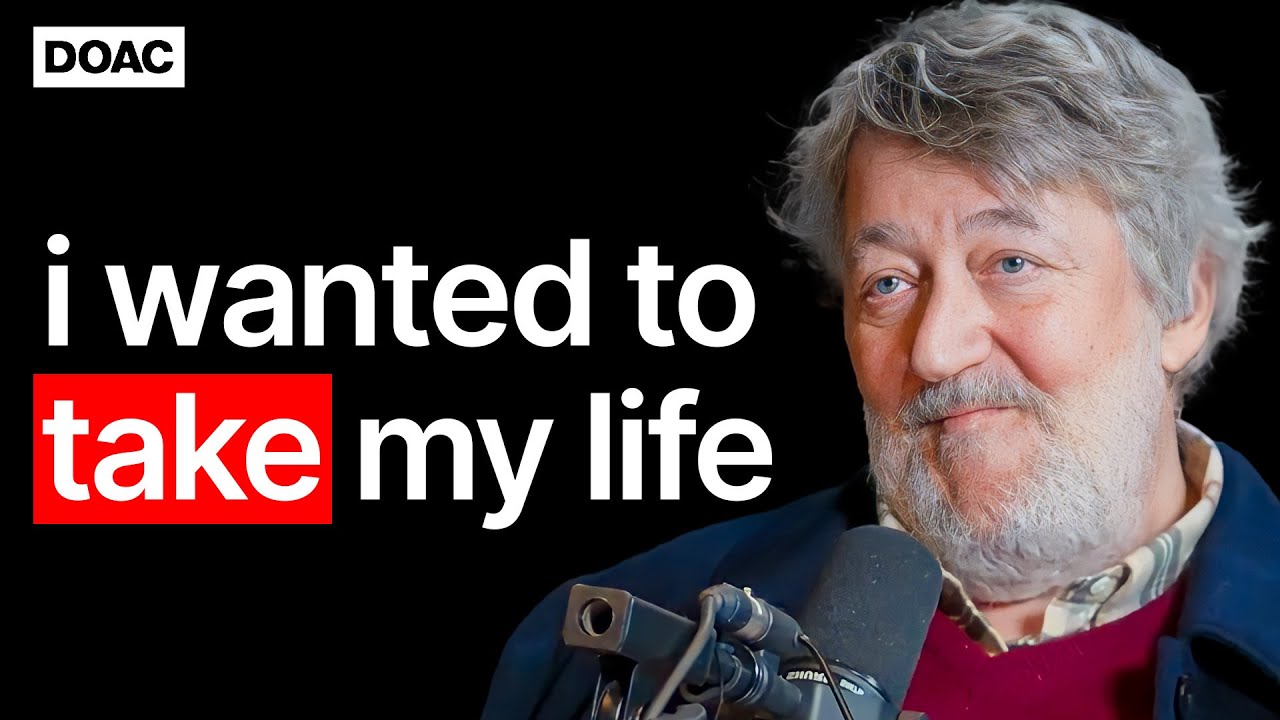
Full transcript · Read the full conversation in order, with its original context.
Contents1 chapter
§01Transcript — part 1§01Transcript — part 1
The thing I think about most, especially when I'm on the go but also when I'm sat here in the Diary of a CEO studio, is the Wi-Fi and internet that we have to work with. In fact, any time I'm filming away from the studio, one of the first things I do when I arrive is open up an app and do a speed test to see how strong the signal is.
The number of screenshots I've sent to my team about Wi-Fi signals at different locations is actually pretty crazy. It matters that much to me because it's such a competitive advantage to have fast Wi-Fi. On any given day, if I'm recording hours and hours of footage with a podcast guest, I then often have to have my team send that across to our London team who then do the edit.
Fast Wi-Fi and internet is not a nice to have; it is absolutely business mission critical. So when it came to finding the best provider who could supply internet and Wi-Fi to our new LA studio, we looked at every single option. Of all the providers, the one that came back with the steadiest connection as well as being the cheapest was today's sponsor, Spectrum Business.
Spectrum Business keeps businesses of all sizes connected with fast, reliable internet, advanced Wi-Fi, phone, TV, and mobile services. Millions of business owners already rely on Spectrum to keep their operations connected. So if you want to join them, head to spectrum.com/business to learn more. Restrictions apply. Service not available in all areas.
I was lost in the drift and really what I first wanted to do was to take my life. He's a comedian, an actor, and a national treasure. He's a director, a writer. I'll probably miss things out. He is a master of language.
I was a deeply difficult child. My parents sent me to a psychiatrist when I was 14. I started doing weird things. I was sent to prison. So the best I could do after a disastrous childhood, I decided, was now concentrate on getting into Cambridge. That changed everything.
I want to please people, and if I don't please them, I get upset. I've done it wrong. Age 37, you star in a play. The play gets some pretty harsh reviews. I was lost in the drift and really what I first wanted to do was to take my life.
That started my journey into my mental health. When you were 55, it was your third suicide attempt. That's right. Can you take me back to that moment?
I'm so fascinated by people's foundations, their earliest years, their context, because it seems so apparent that that ends up shaping who we are and who we become and our orientation in life. As I read through your story in your earliest years, it was an unthinkable rollercoaster ride of twists and turns. But what do I need to know about Stephen Fry's earliest years to understand the man that sits in front of me?
Well, to use the language of the time, I was a disruptive, deeply difficult, screwed-up child. That's kind of the language they used then. I think, to give myself some credit, I would probably in later years have been diagnosed as having Attention Deficit Hyperactivity Disorder. I was extremely difficult to keep still and I found it hard to focus.
I was, as vain as it may sound, intellectually advanced for my age. I was very quick with language and with speech, and just seeing things and remembering things in particular. So I never had to revise, and in that sense, had a lot of spare time. But on the other hand, socially and where it matters to a child, I never fitted in or felt fitted in because I was bad at all the things that are valued when you're a child.
I couldn't catch a ball. I did the uncoordinated hand-clapping method of trying to catch, which is always mocked. The cry of "unco" would follow me, short for uncoordinated, and worse words we certainly don't use now to describe a dyspraxic figure in terms of physicality. I was growing too fast and too tall and very thin. I wasn't musically gifted, and I couldn't draw.
All I had was my passion for language and I loved it and I played with it. I told stories and tried to make myself less unpopular. It was a boarding school. I was sent away at the age of seven in Britain, which is not a huge country. It's about as far as you can be from home. My parents were in Norfolk on the East Coast and I was sent to Gloucestershire on the West to a prep school from the age of seven.
To some people, it sounds a bit cruel and weird to send a seven-year-old boy 200 miles from home. But you have to remember two things. One, that was what happened as far as I was concerned. My father had gone to a similar school. My mother had boarded since she was four because she was a Jewish refugee in England and her father wanted to hide her away from the impending Nazi invasion.
My brother had gone at that age, and by definition, everyone at the school was in the same boat. So you just thought that's what happened. If you take a child and put them in a cupboard between half-past two and three in the afternoon and shout at them through the keyhole every day, they'll just think that's what happens. Anything you do to a child regularly is the normal world until they see other children having a different experience.
I was so class-locked without really noticing it. I grew up in the countryside in a large house. Not Downton Abbey, but we had gardeners and people coming in to clean. Staff, whatever word you want to use. It was deep in the countryside, and the other boys that I knew went away to school. Even the girls I knew went away.
The parents you met said, "When are you going off to prep school then, Stephen?" I'd say, "When I'm seven," and they'd say, "There you go." That was it. I didn't know any other children. It sounds monstrous, but that's just the way things were. You stuck to your own. It wasn't outright snobbery, it just was the world into which I was born.
Through most of my prep school time, age seven to thirteen, I was very disruptive. I passed exams very easily. I tried as hard as I could to get out of any form of physical activity. I gave myself asthma attacks in order to be put off games because I just hated them, particularly rugby in the muddy cold, running and the collision of bodies and bones. It was just so vile.
I wanted to sit and read a book by the side of the field. Humor particularly then, as I moved to thirteen and went to the big school, the public school as it's known, though of course they're private. That was scary because it's 600 boys rather than the prep school's ninety. It's much less of a little nest.
I was thirteen, and as you know too well, chemicals start to boil and bubble inside you and things begin to happen in your mind and soul. I was not prepared for the astonishing cataclysm, the catastrophe, the glorious catastrophe of love. It had never occurred to me that it would be what it was, which is silly because we grow up hearing nothing but love songs.
The Beatles go on about "Love Me Do" and "Please Please Me" and "Money Can't Buy Me Love." Everything's a love song. Suddenly, when you fall in love, all those lyrics make sense and you realize there's nothing else in the world and nothing else is even slightly as important. Of course, I was in love with another boy and I was aware that that was probably not the right thing.
It threw me out of everything. I just stopped being able even to pretend to be a normal, well-behaved schoolboy. I started doing weird things like climbing the roofs of all the buildings, the big chapels and churches and classrooms. So that was the first school from which I was expelled. I'm going to compress the story because it gets kind of long. I was then expelled from another one and then kind of another one.
Then I left and went to London. I left home, went to London, and the major problem there was I was in a pub. It was getting a bit chilly. I saw a coat I liked the look of, half-inched it, stole it, and left the pub and then discovered there was a wallet in it and two credit cards.
So I went absolutely nuts around Britain with these credit cards, staying in grand hotels and buying things and traveling. In those days, they didn't even have magnetic strips on the back of credit cards. You just had to roll them on a piece of carbon to take an imprint, so it was very easy to use them fraudulently as long as you looked vaguely convincing.
I was aware because my father had once lost his Barclaycard that it was the bank that paid, not the poor fellow whose cards I'd stolen. So I didn't feel guilty in that rather pathetic way we do when we try to square our dishonesty. Eventually, I ended up in Swindon of all unlikely towns. I think I was going to meet a school friend and the idea was we were going to go to the Reading Festival.
I stayed in the hotel in Swindon and that's when I got back to my room and there were a couple of men in the room. I thought it was rather weird. Being used to hotels by this time, I assumed they were like cleaning or maintenance people. I said, "No, it's alright, don't need anything." They then said my name, only not my name, the name of the fellow whose credit cards I had stolen.
They said, "Mr. Smith?" and I went, "Yes." They said, "Wiltshire CID," and held up their IDs. Suddenly I realized the jig was up. I was sent to prison on remand. I was sent to a young person's institution on remand while they waited. There were seven counties, I think, that had paperwork because I had traveled in with these cards that had to be caught up with.
You were 18?
17 just turning 18. That's right.
As I read through those first 18 years of your life, I saw someone with clearly huge intellectual potential but also someone who was rebelling against society, had an addiction to stealing things. Is that because it comes back to that feeling of being an outsider and kind of rebelling against the society that you weren't able to fit into?
I think that's exactly right. My parents did send me to a psychiatrist when I was 14 or 15. He was, oddly enough, a Member of Parliament and a junior health minister as well as a psychiatrist. A very grand Harley Street office with one of those enormous Montblanc fountain pens the size of a small submarine. He was slightly annoyed my parents weren't in the diplomatic service because the way I behaved was very typical of people from unsettled families.
Later I found out, when I was doing a documentary about mental health and I went all the way back to my school and spoke to my old schoolmaster, he had a copy of a letter from that psychiatrist in which the psychiatrist had written "Bipolar?". I knew nothing about it at the time. I was 15. So there was clearly some mental kink. 100 years earlier it would have been called a moral kink.
It's that whole mixture. My love of literature and stories and wanting to be involved in the world of ideas desperately to learn more and to share ideas. A cheap wish watching Parkinson every Saturday night to be famous, but not sure how that could happen. It seemed absurd. And a deep, deep feeling like hot lead leaking in the stomach whenever I contemplated my sexuality.
I read and read and read around it. You go to a library. In those days, of course, there was no worldwide web, so you used what was known as the bibliography at the back of a book, which would recommend other books that were sources. So I would build a web of connections. I read a biography of Oscar Wilde and that led me to biographies of other figures in his circle.
I saw there was this extraordinary tradition of literary, artistic people who were queer as we'd say now. Of course, the ones I was reading about were born mostly into an elite part of the society that allowed them to go and live in North Africa or Italy or Greece or somewhere where it wasn't quite so dark and oppressive. But the average person who was born queer had a miserable outcome. It was illegal and the police would treat you dreadfully.
I saw ahead of me a life of shame and secrecy and abstinence and sorrow. There was no possible way the world would be open and free for me. The best I could do after a disastrous childhood, I decided in prison, was now concentrate on getting into Cambridge, become an academic, forget anything about the world because the world wasn't for me.
That would be enough. It would also repay my parents for the extraordinary stress and distress I'd given them. So when I was put on probation finally at the end of the prison thing, I was just put on two years probation. Went home, told my parents I would look after myself entirely, got jobs, got myself a moped, went into Norwich, did a course, and amazingly got a scholarship to Cambridge.
So that changed everything.
It is the most remarkable turn I think I've ever seen in someone's life. I've never seen someone who has a series of criminal engagements, gets expelled from school multiple times. I read at 17 there was a suicide attempt after an argument with your father, which led you to be in hospital as well. You end up in jail and then from jail you go to Cambridge. It doesn't seem like the normal path.
It doesn't seem normal. While I was at Cambridge for the first year, I was on probation still. I remember saying to one of my tutors or supervisors, "Oh look at the date, I'm no longer on probation." And he said, "You weren't on probation," thinking I meant some sort of academic probation, you know, that I hadn't done good enough essays. He said, "You're not on probation." I said, "Well, actually I am." He said, "What the hell? Why didn't you tell us?" I said, "Well, why didn't you ask me?" They never asked.
But it is extraordinary how everything turned because in the first week I met Emma Thompson who was an undergraduate reading the same subject, English. I then saw her in a play and I was just knocked out. I had considered maybe I should do some acting at Cambridge. I started doing that and really enjoyed it. I wrote a play called *Latin*, it was a comedy.
That went to Edinburgh and it won a prize. Emma came to see it and brought someone along to watch it that she thought might enjoy it. I didn't remember this experience, but that person was Hugh Laurie. He apparently came and watched the play and said hello briefly. Then at the end of my second year, I was approached by Emma who said, "I'm going to come round and introduce you to Hugh." I said, "I haven't met him," and she said, "Yes, you have."
Anyway, she took me over to his college and knocked on the door. The door opened. He was sitting on the bed with a guitar on his lap. He said, "Hello," and I said, "Hello." His girlfriend was there making a cup of tea. He said, "I'm just writing a song," and he started to play a bit of the verse of the song. I said, "It's fabulous."
I sat down next to him and we started to work on the lyrics of it. I added some ideas and then we built it up into three or four verses and the chorus and the song was finished. Then he picked up a piece of paper and we started to write a sketch. Emma and Katie were just staring at us saying, "What's happened?" We barely didn't ask each other our names, we just immediately just fitted.
I describe it like falling in love, but a platonic comedy love. We just seemed to gel straight away. It was most extraordinary. So from that moment on, we started writing stuff together for our show. I was thinking that either I was going to stay at Cambridge to be an academic or maybe I was going to go to a drama school afterwards and join the Royal Shakespeare Society and bellow speeches. And now there was this strange possibility of using comedy as a way of going forward.
Why acting? I sat here with Maisie Williams, the young Game of Thrones actress. I found this book called *The Body Keeps the Score* and it talks about six ways that we can help our mental health, like yoga and these kinds of things. But one of them is acting. It talks about the separation from identity and how that can be liberating and wonderful. When I heard you describe your first acting experiences, you used words like blissful and amazing, as if you had found your place in the world.
It's true. It is also the acknowledgment, the love or the sense of attention you get from an audience. It's not that you want to be praised exactly, it's just you want to experience that moment and keep experiencing it. It's not "Oh look, you must write marvelous things about me." That's all embarrassing. But the moment you're on stage and you feel that people are looking at you and not admiring you, Stephen, but that they have you have won them over.
They are following the story of the character you are and they are sucked up into it and you've made it. It's a wonderful feeling. But something even more primal than that, because I can remember when I was very young, five maybe and my brother was seven, going to a pantomime in Norfolk. The usual thing happened, Buttons comes out and goes, "Hello boys and girls, who'd like to come up on stage with me now and sing a song?"
My brother dived under the seat and made noises like a piece of dust so that no one would notice him. Like most children, he was damned if he was going to get up and make an exhibition of himself in public. But I stood on my tiptoes with my arm up so high that I nearly split the membranes of my underarm, you know, going "Me, me, me!"
We both had the same parents, we both had the same DNA more or less. And yet, he would rather have cut his arm off than go on stage and I would have cut my arm off in order to go on stage. That's just something that was built in. That was when I was too young to be self-conscious, to have those kind of issues of self-worth. Much of what you say about the mental health aspect is true.
Even when you're in a very long-running play, when you're in the wings for the first night, you know, you are trembling, you are white, your heart rate is really up. But the weird thing is, six months later if it's a long run, you're standing in the wings, you're talking to the stage management people. Your heart rate is as high on that night as it would have been on the first night. It's just you've got used to it.
The comparison is with an RAF pilot. Every day they're flying up like that. They love it. I mean it's frightening and they hate to see their companions killed and so on, but the awful thing is when it stops. Suddenly the war's over. Every single day you were in a Spitfire, you were facing death, you were doing such amazing things and now there's nothing.
Similarly, in a long play, of course it's nothing like being in the Air Force, but nonetheless, it does cause the similar kind of shakes in your body and the excitement. Then that's the end of the run. Stop. And it does explain I think a lot of the substance abuse, the addictions and the kind of unhappinesses and breakdowns and short-term marriages and relationships that are also common in the acting world. I don't think anybody would say that as a group, actors exhibit mental health of a happier and better kind than other groups of people.
It's so interesting, that sort of anticlimax. I've referred to that before as like Gold Medal Depression.
We tend to set ourselves goals of, "Oh if only I could live in that kind of a village in the South of England, quite near a station and nice little house but not too expensive." Then you get it. Suburban life, hooray. "Oh, maybe that car, that new one there, that Tesla or whatever, if I get that, then I'll be happy." You don't literally say "then I'll be happy," but there's a kind of sense of "that's all I really want."
Each of these goals is met and it isn't it. As the line of T.S. Eliot, "That's not it. That's not it at all." And we go through life thinking "That's not it. That's not it at all." There is something in all of us, a hole, a need for connection and love and truth and a sense of something beautiful beyond. If you're religious you call it heaven, and if you're a humanist you call it a full and achieved life of friendship and elements of sacrifice.
But if you mislabel it and think that it's connected with money or cars or mortgages or jobs or status, you're never happy because of your status. Happiness comes from somewhere else. Of course, I yet to meet anyone who can tell you where it comes from regularly, where it can be tapped like some resource. We know there's fake happiness from a drug or something like that.
And there's the happiness of sitting around a table with friends, those beautiful fleeting moments with friends and family where it's all working and people aren't shouting at each other and you can just look at each other. I was at a memorial service for a very dear friend, the composer Leslie Bricusse, who wrote "Feeling Good" and "Pure Imagination" for Willy Wonka and "Goldfinger."
I remember I had this diary entry when I was just getting to know him where there was a party, I think it was his birthday. It was full of people, some of whom super famous. But I remember just catching sight of him and thinking he looked so like a Persian cat just looking from one friend to another with this huge smile on his face, just being happy to have his friends around him.
It's a simple thing and yet it's the best thing. We chase things that give us less time to see our friends. We chase work targets and we chase journeys and holidays and things with individuals. I think we grow away from it. I think the older you get, the less you appreciate friendship, which is really sad. When you're in your 20s, you tend to do things as a group. You go on holidays as a group because you haven't yet got married and partnered off.
I'm convinced one of the jobs of getting older is not to become gnarled, like a tree. When a tree is young you can bend it, a green stick as they call it, you can bend it and shape it. Once it gets old and it starts getting that bark and if you try to bend it, it would snap. And we become a bit like that.
Coming back to the first point you said there about the goals we should be striving for. How does someone listening to this now, what kind of goals do you think would protect them against that Gold Medal Depression?
It's an interesting point and of course, I obviously understand that there are people who need to meet goals in order to pay debts and that there are certain amounts of money they have to have to pay for their heating and their mortgage. But in terms of one's own personal sense of fulfillment and self-worth and achievement, I'm more and more convinced that it comes from how you treat people and how they treat you back.
How you try to be a better person. I know it sounds really silly. I'm not a religious figure at all, but I'm very interested in religions. I can understand how in some cases religions help cement a sense of community. Where I don't like it is where it's exclusive, where you have to buy into a certain set of ideas and so-called truths.
It's really about when you're falling asleep at night. Can I fall asleep at night and feel I've been a reasonably okay person that day? Is this someone I have to apologize to next morning? Did I was I short and sharp with someone? Was I a bit mean? Was I lazy? Did I lie because I wanted my own way there?
I do have a very loud voice in my head. Philosophers call it a deontic or deontological voice, this sense of obligation that is a peculiarity it seems of our species. As far as we know, an Amazonian tree frog perched on a branch with its big grin isn't thinking, "Oh God, I was a terrible Amazonian tree frog yesterday. I really let myself down. I was mean, I was unkind."
What we admire about animals is they spend 100 percent of every day being themselves. And we as humans are fully aware that we don't. We are not fully ourselves. We lie, we hide behind, we pretend, we fail, and we judge ourselves. Now that peculiarity of humanity, people have tried to explain it in different ways.
Obviously, the Genesis myth is that we ate a fruit. It gave us the knowledge of good and evil and the sense of shame of our physical selves. All those things that separate us from animals. Because humans, since we were cognitively conscious, have been aware that we're animals because we can see that we defecate and eat and sleep and mate just like other animals.
But we can also see that we have these other things that animals don't. Who gave them to us? Where did they come from? Are they a curse or a blessing? Do they make us mini gods or do they make us the playthings of gods? "As flies to wanton boys, are we to the gods; they kill us for their sport," as Webster put it.
Those oldest questions still really obsess us, particularly now of course, because in the age of AI we are able to be gods ourselves. We are making sentient beings and we will have to decide whether like the Greek gods we give them fire or deny them fire. And maybe they'll kill us. But will they have what we have, this sense of "I try to be good"?
I try my best, I fail.
It's right. And we all like that but we don't pay much attention to that and yet it's the most extraordinary thing about us. I have that loud voice and I've always had it. When my grandfather died and I first learned to play with myself, I was terrified that he was watching me because he'd died. I thought, "I can't do this because my grandad is watching me and that's just awful."
In a sense, there you have it in one image. That's what humanity's been cursed with since our birth. The big daddy in the sky is watching you and making you self-conscious and you're holding back from your true nature because "I can't do that in front of God." Somehow we have to square that and give ourselves permission to be who we were born to be.
But accept also that we will feel that we let ourselves down and that we're guilty of this and guilty of that. It's very tempting to be more like someone like Samuel Beckett and the absurdists and just say there is no meaning to any of this. Life is absurd and meaningless.
I know very well that in philosophy there are very, very few professional philosophers who believe in free will. But we all live as if free will exists and we all have to live as if we are accountable for our actions, otherwise society falls apart. But if deep down we know that really there is no free will.
A psychopath is not just a murderer, but it's a murderer who is cunning and who plans coldly their killing. They choose to kill. But no one on this earth has ever chosen to be a psychopath. It's a condition. You don't It's like saying "Oh, he's an asthmatic, we must lock him up." Well, you don't choose to be asthmatic, you don't choose to be psychopathic.
How possible do you think it is to really change who we are? Past the age of 18, the imprints have been made into our character, our identity, our sense of being. How possible is it to change who we are? And are we anybody? Or are we just a byproduct of our DNA and our experiences?
That's such a good point. I mean we are in that sense we are a story and a story is a mixture of different elements and a story is a myth. I'm sure you've read Yuval Noah Harari, that wonderful chapter where he sort of proves that Peugeot doesn't exist. It's a myth. It has a symbol, it has people working for it but there is no such thing as Peugeot. There's a Peugeot car but that's not Peugeot.
Similarly, there is us. Now if I cut my toe off I'm still Stephen. If I cut my head off I'm dead so obviously, you know, I'm the remains of Stephen. But if I start cutting more and more bits, when do I stop being myself? It's such an extraordinary idea. We're aware of our own self. Unless we have particular problems on the neurodiversity scale, for example, we also fully understand other people's selves and that they have a self.
What that self is, how it can be in any way quantified. It can't be removed from the body as far as we know. You can in a metaphysical way reach yourself into other people's selves even after you're dead. Shakespeare does that every day to different people reading his sonnets or Jimmy Hendrix or John Lennon does. I'm reached by David Bowie when I turn on "Starman". I feel his self is connecting with me.
That's what art does and in that sense you are immortal. Indeed that was Shakespeare's obsession. "So long as men can breathe or eyes can see, so long lives this, and this gives life to thee." He was aware that there is a way that we communicate beyond language. The actual sound in the throat of words being said vibrating the ear is one way for language to get into us.
Their self is as real without a body as the self of someone who has a body. In that sense, there is an immortality but it's held together by communal memory and by means of communication like print. And if they die then the selves of the past die as well, don't they?
Since you were a young man, at the core of you, what do you think has actually changed between the age of 25 and today?
I think I'm much calmer. I think I'm more accepting of things. I feel less need to prove myself. I of course have found a kind of permanent love. I got married nearly eight years ago and that that has changed things. Especially talking about that child early on who knew he was gay and saw ahead of him only a life of exile and shame.
The prospect that I could ever actually be married and live happily and for it to be of no big deal to anybody. So that that's made a big difference. And I'm ambitious only for an if there's an exciting project like this film I told you I'm learning Polish at the moment. I'm very excited and ambitious about the film not because I want it to win awards but because I really am I haven't done anything quite like it for a very long time.
I don't need to connect to people in the way I used to. I used to be really shy enough to need cocaine to stay up at night and to go to parties. There was quite a few years of that. 15 years of that. I mean I look back at it and I think I cannot believe I was such an ass. But on the other hand, there are friendships I made that I don't regret and things I discovered and learned about myself.
I realize that I am a very, very quiet domestic soul. I don't like going out, I don't like parties. I said to my husband a couple of years ago, "I don't think I've ever met a person or read about a person that I hate as much as I hate parties." He said, "That's a bit strong. Do you hate parties more than you hate Hitler?" I said, "Well, close."
I do go to parties, but I don't standing up talking to people with a drink in my hand is just my idea of agony because I tell you another secret which you may have uncovered, but it's an embarrassing one, is that I have a condition called prosopagnosia. It means face blindness. It means I will see you in the street two days time and I will blank you because I won't recognize you, I'm afraid.
And it's absolutely heart and gut-wrenching because you are convinced that people think you're looking down at them, you don't care about them, you haven't bothered to remember them because they're unimportant to you. And it really isn't that. I remember names all the time. Most people the other way round, they remember faces but not names.
I have a little card in my wallet that says "Prosopagnosia Society" and I give it to people and I say "Oh God I'm so sorry but look believe me." I did an event for Mind last night and there were some wonderful people in it. I was thinking in the cab on the way home, "If I see any one of those people, we had this wonderful conversation, the chances of my recognizing their faces are so low."
It's awful. And you teach yourself various things like the color of what someone's wearing on a particular day or if they have a earring or some sort of jewelry or something external to the face.
When your cat is acting weirder or your dog is being louder, your turtle moves slower. Hello, Ted. Your cat seems thirstier. Whoa, slow down buddy. Or your puppy is acting clumsier. Day or night, if you don't know what's wrong, know where to go. VEG ER for pets. VEG, the better, kinder ER for pets.
No two companies are alike. That's why the American Express Corporate Program can help you customize rewards, reporting, and billing options all designed for your business. Build your program with American Express at americanexpress.com/corporate. Terms apply.
Age 37, you star in a play which again called *Cell Mates* I believe. The play gets some pretty harsh reviews to say the least from a lot of the big newspapers. And that's another real low moment in your life. Can you take me back to that moment?
Yeah, it was pretty grim. I mean we'd done previews of it in Guildford and Richmond I think before coming into the West End. I was with Rik Mayall whom I loved and a sweet funny man, he was brilliant and charming as always. It was written by Simon Gray, the British playwright, and he also directed it. And I was playing George Blake, the spy, the British spy who was sent to Wormwood Scrubs and then amazingly escaped.
I was never comfortable in the play and I was beginning to feel lost and adrift and deeply unhappy and I couldn't understand why because the play wasn't that much of a disaster. I mean it had good audiences and they applauded at the end. Some people said, "Yeah, I don't think it's his best play," but it wasn't an absolute catastrophe.
At this point, context, you're well established.
Yes, things like *Blackadder* and *Jeeves and Wooster* and *Fry and Laurie* had happened and my books had been selling. So I was in the public eye, well known. Anyway, there was a Saturday night. I guess the press night had been on Friday or something like that. We then had a Saturday night and then on Sunday there were the Sunday papers, of which I saw some, some of which were deeply unkind to me.
That did make a difference. I've said I didn't go just because I didn't like the reviews. It wasn't entirely that. That would have been a bit weak and certainly was a weak thing to have done anyway, but it was a whole concatenation of something wrong in my head. I just suddenly saw myself as in the wrong place doing the wrong things and I wanted to get away from everything I knew.
Really what I first wanted to do was to take my life and I did run the car engine in the lock-up garage of the flat where I was in London and then realized it was a catalytic converter and it wasn't really going to do much harm to me and there was stuff of it and I was just coughing a bit.
That's quite a significant decision to make following reviews.
I know. I just wanted out really. That's it. I just wherever I was I wanted to be somewhere else. If it was nowhere, that would be a first, that would be the most perfect place to be. I just didn't see the point. As anybody listening who's had the misfortune and the terror of considering taking their life, suicidal ideation as it's known in the trade, they will probably concur with me that there comes a moment where you just start saying to yourself "What's the point?"
Anyway, so I got in the car and drove to the South Coast to Folkestone and got on a ferry to Zeebrugge in Belgium and then ended up in Bruges. Like Colin Farrell and Brendan. I then wandered a little further East into Holland and then into Germany and Hannover and Hamburg.
And you didn't tell anybody you were going?
No. And this was '93. There was no worldwide web as such. It was just beginning to happen. But there were these things called commercial online servers like CompuServe and America Online. I had been connected to those for some time and I'd taken my computer with me I guess. So I was in a hotel in Hamburg and then I got a message from my friend Hugh who said, "Old fellow, you must come home. Be in touch at least."
So I sent him an email on this CompuServe thing and I agreed that it was nonsense. I had this in my head, this idea that I would go up from Hamburg and up Schleswig-Holstein which is the border with Denmark and go up into Denmark. Somehow in the North of Denmark, I would sit on a rock in a thick white pullover with a pipe clenched between my teeth writing impossible poetry and teaching English to Danes and be forgotten.
Total fantasy. But no, Hugh said "Come on, it's fine, come home. We really want to see you. Everyone wants to." And so I drove back overnight to Amsterdam and my father had got a flight to Schiphol and we met in a hotel in Schiphol and then got a flight, little airplane back to Southend.
What did you say to your father that day in Amsterdam?
I said, "You've spent your life getting me out of terrible and embarrassing holes and this is probably the worst of them." And he said "No it isn't, it's fine. It's all okay." And he was just wonderful.
I watched a news report of your absence. BBC News reporting that you had basically gone missing. With a big picture of you on the screen and saying you had vanished.
I never saw any of that. I did see a photograph someone sent me years later of police on the roof of my house in Norfolk which was slightly disturbing. It was a strange event, but in some ways, it was a cleansing or a necessary step I suppose because as a result of it, I went to see psychiatrists and started to try and work out why my mind was taking me into such impossible dark places.
Why should I have come to such a crisis just because someone didn't like my performance in that play? It's not really good enough and I'm not that hypersensitive. So that started what I suppose we have to call my journey into my mental health. A few years later, I made a program with the BBC, two episodes I think it was, called *The Secret Life of the Manic Depressive*.
In which I tried to explore this darkness that can enshroud a mind so completely. But also that it's part of an illness that I hadn't really understood. I'd heard the phrase manic depression and I'd never really heard the word manic. Manic depression is two illnesses: depression, which is a dark depressed lowered state, and mania is an elevated state of energy and full of bounce and vigor and a desire to communicate with people.
And depression is the exact opposite. You just want to lie in bed and pull the duvet over your head and never speak to anybody. Whereas when you're in a manic state, you're always on the phone boring people. So there are two poles, and hence it's also known bipolar. I wanted to find out more about it and that's where I went back to school and discovered that the psychiatrist when I was a boy had written "Bipolar?".
I also discovered something quite extraordinary because I asked everyone I spoke to, I did a little button with my finger I said "I'm drawing a button on this table with my finger. If you press this button, you will never get a depressed episode again, but nor will you get a manic episode. Do you want to press the button?"
And almost none of them wanted to press the button. It reminded me of a thing that W.H. Auden the poet had written, "Don't take my devils away, or my angels will fly away too." It's a fear that we have inside us that even an illness like manic depression and how serious it can be is part of us and gives us a secret power.
It's dangerous because it is highly the word doctors use is morbidity. In other words, people especially if it's undiagnosed, if you start finding that you're crashing in moods and becoming miserable or you're absolutely wild and full of crazy plans and buying things. If you don't know that it's actually an illness, then you just mask it with alcohol and narcotics of one kind or another.
They mask it pretty successfully but they have their own problems to say the least and people can then slide down and leave their families and they end up on the streets. Then there's a lot of discovery for them to know that they first have to get off the substances that have been masking the problem and then to face the problem. And it's a really, as we know now, a huge endemic problem it seems in our culture and country.
Post-diagnosis of manic depression, what were you advised to do and what did you do to make life better with the understanding now and the awareness that you had this condition?
Well, firstly I went on a sort of exploratory journey of medication. My psychiatrist tried me on a number of things. Sodium valproate, which has since become somewhat of a disgraced pharmaceutical, and then Lithium. I was on Lithium for quite a number of years. And then slowly I became aware of some of the kind of folk wisdom that has been around in our species for a very long time.
There are certain kinds of people who if they hear someone's depressed say, "Well go and walk it off." Just go for a nice walk. And you think, "Hang on, this is an illness, just saying go and walk it off." And yet, once you've confronted it and once you've understood what it is a chronic condition, a bit like asthma or diabetes, you then do discover that there are therapies in life like exercise, gardening, making music, knitting.
It is like a folk wisdom of taking yourself out of yourself and also believing in a future. The first thing I did I think that was a breakthrough for me was that I lost some weight. I was really pretty pretty big back then and I managed to lose about four stone. It's not that losing four stone is in itself a vast achievement, but it tells me that I can control some part of myself.
My physical body is not a rogue that will look just do whatever it wants to do. I can say, "No, I'm going to make you a bit sleeker." If I can do that with my body, maybe I can do things with my mind. So yes, I started walking every morning, you know, when I was in London going round Regent's Park and listen to audiobooks.
Choice of all kinds of books, Dostoevsky or Agatha Christie. It wasn't about high literature necessarily, it was about just having a story in my head and walking and walking and looking and saying, "Wow I did seven miles this morning, that's amazing." You feel you're doing something. So it's really been a slow process of allowing myself I suppose to be who I am and not to fight for my place at the table.
You've got almost 13 million followers on Twitter. What's your relationship been with social media?
Up and down. Twitter really is a cesspool at the best of times, just negativity and abuse and trolls. It can be supportive too. I've learned how to use it in a way that is not likely ever to upset me anymore. There was a time when I was fully engaged with it. In the early days, it was like a lovely swimming hole in a glade in a lovely wood somewhere where people of good will would swim about.
Then suddenly you notice oh there's a turd floating. What the hell's that doing there? Then suddenly there'd be a bit of broken glass when you put your foot down or an old rusty pram or something and you realize that it had become as you say a kind of cesspool. It's immensely useful to have that many followers because it means I can satisfy a few publicity requirements with one stroke of the pen as it were.
I'm slightly worried that I may have to leave it if Elon Musk takes over. I'm not sure that I want to be involved in his Twitter, it doesn't sound like a nice happy place. I mean I'll consider I might just simply stop using it in any other way except to post things for charities or work. But rather than engaging in people, I just I'm not sure I'll want to see some of the tweets that float up from the kind of people that Musk encourages.
Do you know what I wanted to do in a sort of way is go on one of those doesn't Piers Morgan do something is it GB News he does? I've sort of wanted to go on and say, "Hello how are you you old [censored]? It's [censored] great to see you." And him to go, "Sorry you can't say that." "Oh I thought this was the home of free speech. Isn't it? I thought this was the [censored] home of counting free speech. But it isn't."
Free speech is negotiable. There are bits that you can't say and bits that you can. Because that's the point. I mean free speech is of course important but it's not the end point. The end point is human beings living together in peace and harmony and happiness as much as possible without war and violence and envy and resentment and bitterness or starvation and poverty.
And it's probable that that endpoint is better arrived at if we live in a society where you're free to speak and share ideas and think freely. But for some people free speech has become the endpoint. "I want to live in a society where I can say anything. Doesn't matter if people are starving and that the gap between rich and poor is wider than it's ever been."
I just don't think that's what John Stuart Mill and all the original figures who wrote on liberty and free speech, I don't think that's quite what they meant. So I'm worried that there will be a rise in the kinds of anti, racist and transphobic and indeed anti-feminist nasty on the other side and Musk will go "Yeah that's that's what we call free speech."
I've made the decision that I just don't I don't tweet so I just post the podcast when it comes out and that's it.
I think the what what I think of is like if at school you're captain of the chess club and you put the team up on the notice board and you pin it up on the notice board and you then go away. What you don't do is put the notice up and then hide behind a pillar and listen to how people respond to it. "Oh I see the chess oh what's he put that up for he's a wanker isn't he." I mean just put your notice up and walk away.
With this journey of mental health, I know you're the president of Mind, which is a phenomenal charity. One of the things that I think about a lot is how the battles we fight for our entire lives, there's almost sometimes a frustration around our inability to cure ourselves of those things. Even in my own life, I've come to realize that a lot of my like real deep battles maybe they'll never come a day where they're cured. My traumas, these the way that I react to certain things my triggers maybe they'll never be cured.
Yes, Fred's right. No, I think it is in that sense what doctors call chronic like asthma. You never stop being an asthmatic. And the day could come when you least expect it where suddenly you just get this enormous attack and you can barely breathe and it might have been 10 years since you last had such a one. It's a bit like that.
You are living with it and coping with it and managing it and most of the time one manages it but sometimes you hear the you know the hoof beats back in the in your brain of of the coming storm and you do everything you can to avoid it. And tell friends now. I mean that's it's so much easier said than done.
I have a theory I call it my genital wart theory. We all say how important friends are. "Gosh we need friends friends are the people you can say anything to aren't they?" But actually they're not. If you had a genital wart, you wouldn't show it to your best friend. You'd show it to a stranger, a doctor.
If that's true of some little physical part of yourself, it's also true of the mental part of yourself. Although you have family and friends who are supposed to be there for you, it's actually very difficult even though you know it's the right thing to do to share with them what you're thinking. It's very hard.
They'd be upset nearly always when you have a crisis if it gets as far as suicide obviously even more so but any they say "Why didn't you come and tell me? They're actually angry with you. You know I'm there for you. Why didn't you come?" Well because I was a genital wart in my mind as it were and you just feel and you have to try and overcome that.
It's like the weather. The weather is real you know. You can't ever say "So I'm going out it's not really snowing and it's not a blizzard outside I'm going to wear a t-shirt." You have to accept that the weather is real. But you also have to accept that you didn't cause it.
Nor do you have to sort of welter in the problem of thinking "Well that's it it's snowing now going to snow for the rest of my life it's always going to be cold." It will actually pass again nothing to do with you you can't make it pass and it's those are the storms in your head. The mistake is not to think it's real. Oh I'm just imagining it. No it's really raining in your head it is.
Oh what did I do to make it do this? You didn't make it rain. It's not your fault. And "Oh it'll never go now." It will. The sun will come out you don't know when it's not under your control. Those are three things they're not absolutely hooray but they're just enough if you cling on to them to make you realize sort of what's going on.
And what is the mind's you talked about the hooves of the horse coming. Is there is there words associated with those moments?
That is often the one, "What is the point?" and it's also just a it's like I mean all of us who who've had it. It is like something being sucked out of your sort of energy sucked out of and and that you feel drained and you're convinced your face has gone white and sometimes you look in the mirror and it has gone white. There has been a physical response to it.
People who love you and know you well see it in your eyes straight away. So my husband will say, "Whoa what's the matter?" And I'll go, "I don't know I don't know I'm just going to go and lie down I just don't know." And he will have seen it instantly and I look in the mirror myself in the mirror and think "What what is he seeing?"
It is a common thing and I noticed this during the documentary. If you take a magazine and you cover half your face and look at your right eye and then cover the other half and look at your left eye. It's amazing how I found people with who've had mental health histories that have not been happy have a often have a more extreme difference in their left and right eye.
Then if you look at my left and right eye one is rather cold and calculating and one is warmer and friendlier. That's usual with people I think. I don't know any empirical science behind it but I did notice that almost everybody I interviewed had an extreme version of that.
There are signs and signals that come. I get itchy under the chin when I'm going to have an asthma attack for example. But with with mania which is often worse. With mania you want to concentrate you want new projects you've got amazing ideas in your head you're risk taking and entrepreneurial and grandiose.
I interviewed someone in America. She said "It's a terrible thing to say," she said "but I was always happier when he was depressed than when he was manic. When he's depressed he's just you know lying curled up in a ball." But when someone's manic they are just out of control they are so embarrassed they will do such weird things.
She said he had a car, a nice car, it was like a one of the original Mustangs or something and he took it apart piece by piece on a large piece of cloth in his garage. And each piece he you know with the pencil or marker he did a little mark for where that piece goes and he wrote what the name of the piece was.
So the whole thing and he started chroming all the bright work and making it all perfect and the all the engine parts were out. And then he had a change of state. And it moved away from this optimistic bright mania and he just kicked the cloth and all the pieces and everything just piled into a heap of junk and the car couldn't be rescued.
I had a manic episode right in the middle of someone's memorial that was quite extraordinary and it frightened me because the power of it was so intense. And I ran home and I called my doctor, my psychiatrist Billy. I said "Billy I'm I have to tell you I've had visions and I feel the closest I can describe it is like Joan of Arc I feel irradiated by some extraordinary power and light."
He came round and he said "This is a very dangerous thing." He could see me. I had I'd started cooking and I'd started tidying. I'd done three different jobs. And the cooking thing I'd done a plate with quails eggs halved so elegantly around the edge of the plate it was so beautiful everything's amazing. I said "I don't know why you've come Billy I have never been happier and more in charge of myself." He said "No you are not well. You are really not well."
You've accomplished so many unbelievable things in your career in spite of all of these struggles that we've talked about. Why and how? Why why you? Why why you?
I think the first reason and it would be the same if you spoke to a certain kind of musician is because I write. And I have always written. Since I was a little boy I used to write stories. And when I then was at Cambridge and there was this thing of comedy it was natural as with Hugh and on my own to write monologues and sketches to perform.
But the writing was at the bottom of it all. And if you look at musicians the reason we venerate Bowie and Elton John and you know Leonard Cohen whoever everybody is they write their music. Doesn't matter how fantastic their voices are. The pantheon of great artists are those who create their own work by they write it.
They write the songs they last forever if you write the song Paul McCartney or whatever you know. I mean you just think even something like when you see that postcode lottery and there's who's that knocking at my door and you think That's Paul McCartney when he wrote that cannot have been thinking but he wrote and every day he writes to this day.
And I love acting and I love presenting and reading audiobooks and things like that immense fun but the real work is always sitting in front of the blinking cursor and and and writing things. And everything else is gravy and fantastic gravy at that. Not because it's easier and you know I'm not sort of saying acting is easier it's just for some reason in my head the protestant work ethic the Jewish work ethic call it what you like is the one that says you know sitting alone concentrating until bubbles of blood fall come out of your ears that's work.
Do you think we're all artists?
This is a really good question and I always used to say no. I was very friendly in their heyday well I still am with for example Damien Hirst. I'd sometimes say I want to be an artist and he'd say "You are an artist anybody can be an artist." I said no they can't. He said "What do you mean?" I said and I would say "I'm an I'm an entertainer. I'm frankly a bit bourgeois I want to please people."
For me the aim is to see delight in the face whereas for you it's to make something that matters to you and if it disgusts people or horrifies them you can you're often full of glee. It's not you deliberately make them to hate it there are enough people who love it to make you extremely rich. At the time he was only slightly rich but now of course he's worth a huge amount.
And that's what a real artist is. My other artist friends Maggie Hambling who's a wonderful painter in Suffolk. There's a toughness about her a refusal to compromise an absolute what central is her and her work and that's true of artists. Artists are bloody minded they bite the hand that feeds them. I'm pretty easy going.
But I don't have the artistic drive to make it something out of me. There's a fantastic confidence and supreme almost contempt for society that artists have. And that's why they're so unpopular with the Daily Mails and the bourgeois people because they don't please they don't provide what is comfortable or easy and what people would like or pretty.
It's always "Oh it's disgusting a throwing a pot of paint into the public's face." That was said 150 years ago. It's always been thus and artists are special I think. I mean I like makers or craftsmen artisans you know that who make beautiful things whether it's shoes or you know Tom Daley knitting a nice pullover whatever it might be is a beautiful thing to see but art is to me at least art is special to me and it has a special place and does special things.
Usually very simple and that's the that's the genius of an artist. We die. We the flesh this case we have dies and rots. And we know this. And mostly we don't particularly like to be reminded of it. Artists find it the most fascinating thing in the world. So even if it's Van Gogh showing the petals falling off the sunflower there's death in there.
As for Francis Bacon and indeed Damien Hirst and and almost all painters they paint death. They paint the truth about what we are becoming and painting is sometimes the last bastion against death. I'm going to make something permanent because everything else dies. That's again to Shakespeare's sonnets you know. "This will last, everything else will die but this poem will stay here."
I made something permanent against death, decay, entropy, all the horrors of of the universe that drag us down. You know, my nipples are dropping two inches every year as gravity takes hold and it will for all of us and and art keeps them propped up if you like.
I've been going back and forth about this point about art because I've realized as probably as I've got older that expression in some artistic form whether it's knitting that jumper like Tom Daley does is so great for our mind.
Yes I think it's true yeah there are qualities and degrees.
I mean there are people who've tried to define I mean an artisan a craftsman can make the same thing again and again identically and it's genius. They're making four chairs each chair is the is the same. An artist never does the same thing again. They might have a theme that they do. Everyone is different everyone is is a variation on a theme whereas an artisan is happy to make things that are perfect and the same each time a craftsman and but they're both good for the mind.
In fact probably being a craftsman is better for the mind. I remember Rowan Atkinson said to me once years ago he's a very wise man indeed and thinks a lot very very thoughtful. And he said and I'm sure he wasn't the first to say it and there are many different names for this. He said "But it only ever works on stage if you are relaxed. But it only ever works on stage if you are concentrating."
If you concentrate without being relaxed you're just stiff and you're trying too hard. If you relax without concentrating you're all over the place. But when both happen at once you are master of time and space and you are in control you're concentrating on every detail and every second of the audience's response and your timing is perfect and yet you are relaxed enough to allow them to enjoy it without feeling any strain.
A sportsman call that being in the zone and it's immensely important to get that blend. And one of the ways to create it is I think not to do art because that's just too frightening but to do crafts. And that can include painting. It can be painting by numbers it can be just a general sketch where you're not trying to make it art but once your tongue is stuck out and you've got that concentrated but relaxed on you.
It can as I say it could be knitting carpet making it can be anything you choose but some a jigsaw even but something where you've made a change to what was there before you brought materials together that weren't there before and you've done it in a way that has just given you a the you've listened to the radio or or the television's on in the corner or you've got a playlist going and it's it's a magical thing.
That flow state you described.
Yeah and and and if if anyone's thinking of how they might do that. One of my favorite films is a film called *Running on Empty*, a Sidney Lumet film with River Phoenix and Judd Hirsch and various others in it. It's about this family that are on the run because they attacked a weapons laboratory during the Vietnam War and unfortunately there was a security guard in there who got killed although they didn't they tried to do it when it was empty.
So they've been on the lam from the FBI for like 15 20 years that's the backstory. Anyway it means that they they don't have much and they're constantly having to go on the move when the FBI might be close. River Phoenix's character is a musical genius as it happens not irrelevant to this story but he meets this girl and they start to fall for each other.
At one point they're walking along the beach and he's picking things up and says "Oh this might do." She says "What's that?" And he says "In our family for Christmas or birthdays we're only allowed to give something we found or made." And I I almost wept at how beautiful an idea that was. I know it's so obvious we live in a ridiculous crass commercial world where we score everything by its monetary value.
But to say we're only allowed to give each other things we found or made. And so he'd found this stone and this piece of wood or whatever driftwood or whatever it was and he was going to make something out of it and his parents would be thrilled to have it because you've given them time and concentration but you've also had the pleasure yourself of doing the making.
So maybe someone listening will say to their family "Hey Christmas is coming up we're only allowed to give each other things we found and made." And especially at a time of of financial crisis who wants to go into this slightly sick making nonsense of just going into shops and spending vast sums of money that you know on shiny things and when you might just find a piece of driftwood or something that looks like a hedgehog and turn it into a pipe holder or a soap dish.
It sounds so cheesy but no it's beautiful it's a really really beautiful idea and it's very much aligned to the relationship I have with my partner to be honest. We you know I'm sure everybody knows I have the means to buy whatever but I can't think of a recent Valentine's Day birthday she just had my birthday where anything has exceeded the 100 pounds because it's all like scrapbooks and really sentimental personal stuff and thankfully I'm with someone who wants that and would actually be probably disgusted if I got them a shiny thing.
If your best life was a recipe constituting of a bunch of different ingredients, what do you think you need or is missing from that list of ingredients for you to have the dish of a good life?
Wow that's an amazing thought. I mean there is a part of me that obviously feels I say obviously that feels in another world if I'd timed things right I might have had children. And that's an experience that enormous number of my fellow humans undergo and it clearly gives pleasure. I have many godchildren and now nieces and nephews and great-nieces and great-nephews.
But I'll never experience the a child growing up and and and that I mean it's slight sadness. It's um it allows me fantastic ironic sarcastic in fact conversations with people sometimes where someone goes "Oh this nonsense about global warming and la di da I mean you know."
And I'll go "No I'm with you I don't have children either so I don't care what happens to the world." And they'll go "Well no I've got kids." I said "Oh do you hate them then? You hate your children so you don't want them to have a nice world. Oh I don't understand I mean yeah that's fine." And they'll go "Oh look don't be stupid." And I'll go "Well I still That's very silly of me."
But it um yeah I mean that's probably the biggest hole in my in my life experience. I've been fortunate enough to have done so many things and to experience so much and met so many people I've been thrilled to meet and had opportunities that are just unbelievable really. And of course I've had opportunities I suppose to have had children I mean you know I could have sorted something out I could and you know Elliott and I could you know we we talked about it a bit but we never we never talked about it to the extent of "Right so we're going to a clinic tomorrow to talk this through to some expert."
We never quite got that far. It was always just "Yeah that would be nice wouldn't it." And uh so that's probably the I mean otherwise of course there are there are regrets in life because um as you get to I'm now from the 25th of August nearly your birthday onwards I was my birthday's 24th of August so from that day onwards I was closer to 70 than 60 because it was my 65th birthday on the 24th of August.
So as you move towards the the sere the yellow leaf as Shakespeare put it. Oh God so embarrassed. Shakespeare calling saying could you stop quoting me. Oh it's my sister I don't It might be important could Jo yes sorry I'm still at the oh god am I late? Sorry. Yes you're quite right. The driver's worried about getting me back in time I understand.
Thank you darling bless you. We're having such a good time I had no idea how the time was passing. Jo loves you Bartlett you're the Bartlett pair the juicy Bartlett pair. Please please apologize for me interrupting. I know you're having a nice time but I felt I should do my duty. You bet. I really appreciate it. Thanks. And I'll I'll text them in the in the cab on the way there. Gosh I'm sorry. No worries at all.
No no. Listen Stephen thank you thank you so much for your your time. We do have a quick closing tradition just where the last guest asks a question for the next guest. What is it that motivated you once you already had it?
Oh do you mean once you've reached a goal why do you keep at it? You got to the point in your life where you'd achieved so much most people would be satisfied with retirement and wrapping it all in. What then became your motivation in your life? Honest pleasure. The fact that I still enjoyed it so much.
That when I met new people who wanted me to do a new thing like this this dinosaur program I'm doing *Dinos*, yeah. Living you know doing this new technology being with the dinosaurs so exciting. It was just a whole new thing for me and and I'd never done anything like it. And so I just said yes and even though it meant like am I going to get a week to be in that studio and do this and enough stuff and prepare for it and so on.
It turned out to be a a wonderful program and unique kind of technology demonstrating these dinos. So so that is an example. It's just and similarly doing this Apple TV show which I'm doing now in America called *The Morning Show* which which is good fun. And you know it just occasionally it's it's the thrill of the variation you know.
So it's the variation between doing a documentary and then suddenly having to spend four or five months just working on a book and then and then doing some slutty piece of TV or film with big stars in it feeling like "Ooh I'm in Hollywood you know." It's not that I'm calling *The Morning Show* slutty because that's the least slutty thing I've ever done.
I've actually had the privilege of seeing all of the above other than your upcoming movie which which hasn't been shot yet but when I saw *Dinos* it was um it brought me right back to my childhood and watching *Jurassic Park* with awe and as if I was stepping back in time to a to a place in our history. Thank you so much for your time Stephen I really appreciate it you're someone that I've A real pleasure. And do I have to leave a question for your next guest? If you could that would be amazing. Could you give you the book *The Diary of a CEO*. Thank you Stephen.
When your cat is acting weirder or your dog is being louder, your turtle moves slower. Hello, Ted. Your cat seems thirstier. Whoa, slow down buddy. Or your puppy is acting clumsier. Day or night, if you don't know what's wrong, know where to go. VEG ER for pets. VEG, the better, kinder ER for pets.
When your cat is acting weirder or your dog is being louder, your turtle moves slower. Hello, Ted. Your cat seems thirstier. Whoa, slow down buddy. Or your puppy is acting clumsier. Day or night, if you don't know what's wrong, know where to go. VEG ER for pets. VEG, the better, kinder ER for pets.
When your cat is acting weirder or your dog is being louder, your turtle moves slower. Hello, Ted. Your cat seems thirstier. Whoa, slow down buddy. Or your puppy is acting clumsier. Day or night, if you don't know what's wrong, know where to go. VEG ER for pets. VEG, the better, kinder ER for pets.