
Romesh Ranganathan: There's A Dark Voice In My Head That I've Learnt To Control
Guests: Romesh Ranganathan
Full transcript · Read the full conversation in order, with its original context.
Contents1 chapter
§01Transcript — part 1§01Transcript — part 1
Time is precious, and so are our pets. That’s why time with our pets is extra precious. That’s why we started Dutch. Dutch provides 24/7 access to licensed vets with unlimited virtual visits and follow-ups for up to five pets. You can message a vet at any time and schedule a video visit the same day. Our vets can even prescribe medication for many ailments, and shipping is always free. With Dutch, you’ll get more time with your pets and year-round peace of mind. Go to dutch.com to get vet care that is always there for just $92 a year.
I was thinking about taking my own life regularly, and I’d fantasize about it.
Please welcome Romesh Ranganathan! He’s one of the most popular stand-ups around. I think that all comedians are wired slightly differently. Something happened to them that has made them an outsider in some way. What is that for you? We lived in a nice house, we had a nice car. All the stereotypical things you mark success with. Then, in a period of six months, it was a complete 180.
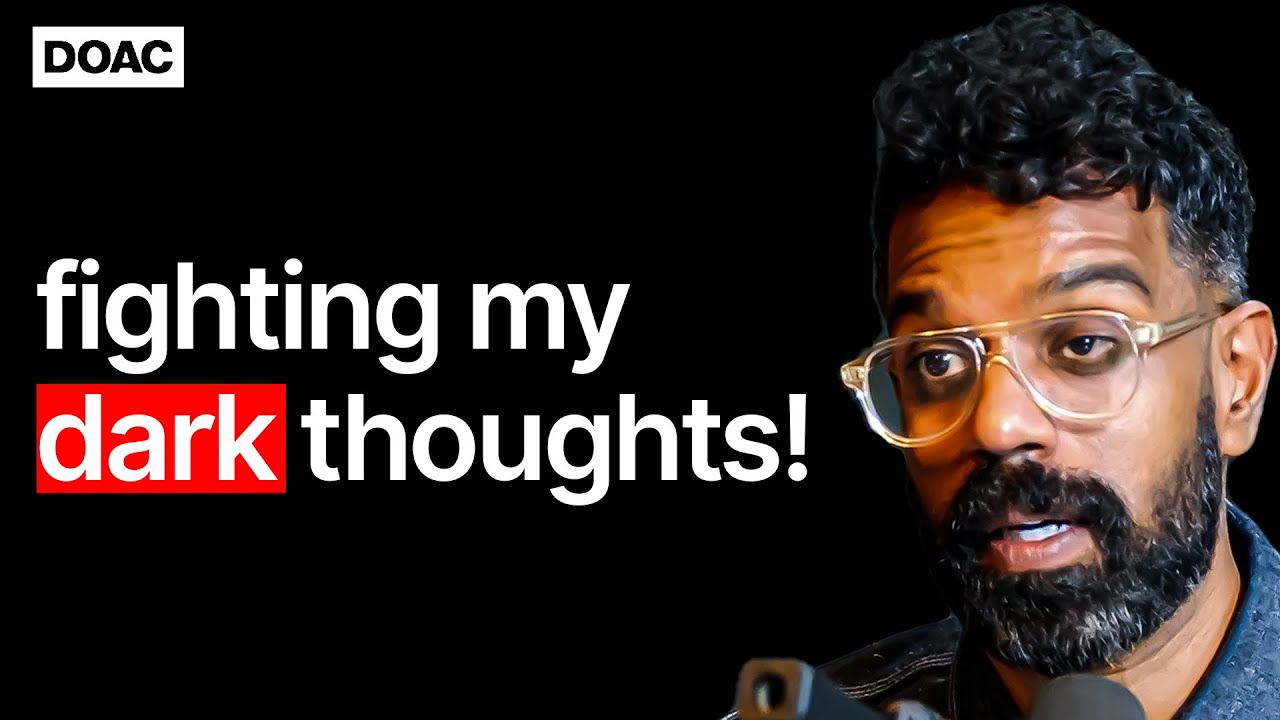
I’m addicted to doing stand-up, and it makes me better at everything. But I’ve got this inner voice that is horrific. It will say, "You’re not a very good dad, you’re not a very good husband." I had a run of about six panel shows, and I was in a really bad place. I turned up to each one of them with the steadfast belief that I was shit at this.
What happens when it does go horrifically on stage?
It’s horrible. That silence never gets easier, man. But you learn more from those gigs. I just need to do the best I possibly can at this gig. I’m not in control of anything that happens after that. Don’t think about this goal down the line that you’re trying to get to. Do this thing brilliantly. If you love what you do and you do that, you’re on a good path.
This is such a great point. What an absolute stitch-up! Are you joking? We’re having such a nice time.
I’m so fascinated by comedians because I find it to be an art form that is both genius and terrifying. So for someone to want to pursue that career, I’m always intrigued by why. Can you give me the context from your earliest years that might have influenced you taking that path, even before you were ten?
Well, I did stand-up comedy when I was eight for the first time. The truth is, I fell into stand-up by accident. When I was a kid, my mum and dad used to take us to this video store, and they’d say you can choose something each and we’d all watch it together. My mum always used to pick Pink Panther; she loved Inspector Clouseau and Peter Sellers.
Then I discovered Eddie Murphy. I remember getting out *Beverly Hills Cop*. I watched it and just thought, "This guy is so incredible." Then I started watching everything: *Golden Child*, *Trading Places*, all of that. As a kid, I was too young to be watching that stuff, but my mum and dad had no idea about age ratings, so they were fine with it.
Then I discovered *Raw*, which was his second special. I remember watching that. I’d watched a lot of British stand-up on TV as a kid and loved it. But there was something about watching a guy with just a microphone walking out in that leather suit—not that I’d ever wear one—but he walks out like it’s a rock gig.
This massive crowd goes nuts to watch a show of somebody just talking. I found the "lo-fi-ness" of it unbelievable. The idea of, "I’m going to say things I think or my take on stuff, and that’s the show." There are no effects; it is just literally a stream of consciousness. I found it incredible.
Then my family took me to a Pontins holiday camp for a week. They had a talent competition. All I used to do then was read joke books, like *3001 Jokes* or joke books for kids. I think I was just really into comedy. I loved the idea of making people laugh. I was obsessed with it. So, I entered the talent competition as a stand-up. It was horrendous, but I won. I beat a kid playing a kazoo and another kid doing a dance thing. I smashed it.
Even then, I loved stand-up. Но the idea that I would do that for a career, coming from an Asian background—my parents were very much like, "We’ve come over to this country for you to follow a path and be successful." The idea of stand-up as a career was just never in the cards.
That stereotype of immigrant Asian parents trying to make you a doctor or a lawyer—did you witness that firsthand? Did they have that conversation with you, or was it just an expectation in the background?
They didn’t explicitly say, "You’re going to be a doctor." My dad was pretty laid-back, to be honest. My mum was a bit more dead-set on what we were going to do. My parents left Sri Lanka for my dad to finish his studies. It was an economic reason, but also there was trouble in Sri Lanka. My family is originally Tamil, and there was a lot of conflict between the Sinhalese and the government—a civil war was affecting a lot of my family members.
There was a lot of push and pull involved in them coming here. They never sat me down for a formal talk, but every time I made a decision or talked about A-levels, I was conscious that they were really worried about what I was going to do. For example, not going to university was not an option for me, really, unless I decided to rebel. They just assumed I was going to educate myself to a high level and follow a path to being a "successful" whatever.
When I was reading through your story, I could really relate because it seemed like your childhood had very distinct, opposing chapters. I came to this country from Botswana. The first chapter was great, though I don’t remember it well because I was under ten. My siblings remember the presents and things being normal. The second chapter, which I remember vividly, is when chaos ensued. What was that first chapter like for you?
It was very similar to what you’re talking about. I remember being very comfortable. My dad wore a suit to work. We had a nice car. We never really wanted for anything. We lived in a nice house. My parents had a big social circle. All those external signifiers of success were happening. My recollection was honestly of being spoiled. My parents bought us loads of stuff; we’d go out to eat a lot. My dad was doing really well.
I don’t have vivid memories of specific events, but I have a general memory that if I asked for something for Christmas, it was pretty likely I was going to get it for those first eight years. It was super comfortable. And then, over a period of about six months, everything got completely turned upside down. It was a complete 180.
What was the catalyst for that 180?
Unbeknownst to me, my dad was not doing great at work. He was starting to mess around—he was a bit of a loose cannon. I think it had got to his head a little bit. He drank a lot, he was a bit of a womanizer. That was starting to get noticed at his work. Then he had ideas of going off and doing other things. He ended up getting fired from his job.
Then he started trying to do these kind of import-export deals which, at the time, we thought were his new path, but as it turns out, they were illegal. The first sign I had was my mum saying we’re going to have to move out of this house because it’s being repossessed. My parents couldn’t keep up with their mortgage repayments.
We ended up moving to this house on a council estate that my dad had got off a friend or was renting off a friend. We were there for a little bit, and while we were at that house, my mum found out that my dad had been regularly sleeping with and had started a relationship with another woman. He was intending on leaving us to go and start a life with her.
That threw my mum’s world upside down. The trigger for everything going really mad was that we hadn’t seen my dad for a couple of days. My mum said—I can’t remember how old I was, maybe 11 or 12—"I’m going to take you to this woman’s house, and I need you to go to the door and ask where your dad is because I haven't heard from him."
We went to the house, I went to the door and asked, "Where’s my dad?" and she said, "Your dad was arrested two days ago." It turned out they had been in the middle of some sort of deal and were the target of a police investigation in Leicester. The police stormed in and arrested them. My dad ended up being sentenced to two years in prison.
Then everything went to chaos. My dad was in prison, and we ended up being housed in a bed and breakfast by the council because they didn’t have enough housing. So, my mum, my brother, and I were staying in one room in this bed and breakfast in Crawley. My mum, who hadn't been working, got herself a job as a cleaner. We were going to school from there. Everything just completely flipped. It was a total 180.
At the start of that 180, your dad was an accountant, right? And then within 12 to 18 months, he’s in prison?
Yeah, the house got repossessed, we found out about the affair, and then the prison sentence.
And at the start of that, you were in private school?
Yeah, I had a scholarship. I was at school, and what I didn’t realize was that my parents were struggling to pay. My dad had lost his job and was struggling to pay the fees. The first I realized was when accountants from the school were turning up to my lessons with an invoice to pass on to my parents because they were in such arrears. One day I came home and my dad said, "You’re not going back tomorrow." He was getting freaked out because he couldn't see a way of paying the money anymore. Two days later, I was enrolled at the local state school.
Did you say goodbye to anybody?
No. There was a mate of mine I’m still in touch with now who I let know what was going on, but nobody else. One day I was there, one day I wasn't. When I look back on my own life, it’s taken me 30 years to realize the underlying shame. I was trying to understand if there was that same feeling for you.
To give you an idea, I started at this state school and I really enjoyed it. I had a slightly opposite experience to you. When I was at the private school, I was one of the only Asian kids there and I got a fair bit of racism. At the state school, there were more kids of color. I still got into my fair share of scrapes with racists, but I was really enjoying my time at school because it was a respite from being at home.
At home, everything had gone to shit, and my mum was really sad. School felt normal. I didn’t tell anybody at school what was going on at home. For all they knew, everything was totally chill. To give you an example, my dad went to prison on the 26th of March. Мой birthday is the 27th of March. My mates organized a little get-together to watch films. I didn’t tell them. I didn’t want to pollute my school experience with that.
I had really embarrassing experiences. We moved out of the bed and breakfast into a flat that didn’t have a phone. There was a payphone downstairs. I didn’t want my friends to know it was a payphone, so I had to make them promise they were going to call me at exactly a certain time, and then I’d stand by the payphone so that nobody from the other flats answered it. It was so stupid, but I just didn't want anyone to know.
There’s a cost to that, though, living with that sense of embarrassment.
There is a stress at trying to live a double life like that. Things that would normally be okay, you suddenly panic over. For example, there was a girl I liked, and we were living on this council estate. We had been put in a house, but we couldn't afford carpet. So we just had the wooden floors. It looked strange. We were walking around the estate, and this girl said, "Do you mind if I come in and use the toilet?"
I nearly had a panic attack. I thought, "What do I do here?" I can’t say no. I started thinking of excuses like, "My mum doesn’t like girls using the toilet in my house." In the end, I said—I think I said—"We’re between carpets."
You know how it works! You get the carpets taken out, you wait a couple of weeks for the floors to settle, and then you get the new carpets. That is actually really quick thinking!
But yeah, all that kind of stuff is just so stressful, man.
You described yourself as a lazy kid. You’re not now.
I still think I’m quite lazy. All of my school reports said, "Romesh is wasting his ability," or "Romesh doesn’t apply himself." That was true before everything, but it was definitely true after. For a while, I went through a phase of just having given up. My world had been turned upside down so completely I couldn't really see the point. Initially, it didn’t give me that "list of targets" motivation; I just thought, "I don't give a shit anymore."
I’d watched a man work really hard, then end up in prison and split with my mum. I went through a phase of thinking we were just cursed. So many bad things happened in quick succession that I thought happiness would always elude me. My parents are Hindu; they talk about God a lot, and I genuinely thought, "Maybe God just doesn’t like us, man." It pushed me the other way; I stopped working, I started bunking off.
What was your opinion of yourself during that time?
That’s a great question because, to be honest, what my opinion of myself is *now* is something I really struggle with. I think, when I’ve come to reflect on it, I don't know what I would have ended up like if we had stayed comfortable. If that hadn't happened, I wouldn’t be a comedian now. I wouldn't be the person I am. So much of me has been defined by that period.
But what I would say is, my opinion of myself was and continues to be something I really struggle with in terms of it being absolutely at rock bottom. I have a prick living in my head that talks to me all the time. To this day, I have to contend with this inner voice that is horrific. It’s like a horrible person in my head that, regardless of whatever external evidence there is, I will always have this inner belief that I’m sort of a bit shitty.
It says, "You can’t do this," or "You’re not good at this," or "You’re getting away with this." Imposter syndrome is an oversimplified way of describing it, but it’s something I’ve dealt with for as long as I can remember.
It breaks my heart to hear that. I think people don’t understand the privilege they have if they don’t have that voice in their head.
It’s such a difficult thing because if you don't have it, you don't understand why somebody would. You look at a successful comedian and go, "What are you talking about? Snap out of it." And it’s not that I’m unhappy with my lot; it’s nothing external. I just have that. People that get it, get it.
It’s something that I’ve kind of got involved with as much as I possibly can—to encourage those kind of mental health conversations. When I was at uni, I went to see a therapist. They had these free sessions for students. I remember telling my mum about it, and she freaked out. She said, "What do you mean you’re going to a therapist? Is there something wrong with your head?" To her mind, does that mean you’re mad? She didn’t have that understanding of it then.
At the moment, I’ve got coping mechanisms and I’m on top of it, but I’m always this close. If I don’t exercise for a bit, or I don’t hydrate properly, or I don’t get enough sleep, I’m back. I just go dark in my head. You start getting down on yourself, and you have to be on top of all of those things.
What does the voice say?
It will say you’re not a very good dad, you’re not a very good husband. If I come to do this podcast, it will go, "Why are you bothering to do this? You have nothing interesting to say. You’re going to try and get away with this. At some point, somebody is going to tap you on the shoulder and go, 'We all know. If you leave quietly, we won’t say anything.'"
I remember doing a run of about six panel shows over two weeks. I was in a really bad place. I turned up to each one of them with the steadfast belief that I was shit at this. To be a comedian, you have to be loose and relaxed. You can’t be in a "flow state" if you’ve got a voice in your head going, "You’re crap at this."
When you went to see that therapist in school, why did you go?
There was a very specific trigger. I had saved up to get this hi-fi, a really cool bit of stereo equipment. I was too scared to take it to uni because I thought someone would nick it, so I left it in my bedroom at home. My mum and dad had a lodger from Sri Lanka they were helping out. When I came back, I found they had moved that piece of stereo equipment because he needed to put some stuff somewhere.
My reaction to something quite nothing was so extreme. I felt like my mum and dad were trying to move me out or they didn’t care about my stuff. I got really pissed off about it. Later that evening, I realized that was a massive overreaction and recognized that I wasn't in a good head space. For me to have reacted like that was a sign that I needed to speak to somebody.
Until I started this podcast, I had absolutely no idea—I couldn't comprehend—that there are people that have a voice in their head that is somewhat against them at times. Have you ever developed a perspective on where that voice comes from?
I don't know. I’m being super pseudo-psychologist here, but I sort of think that when everything was against us during those formative years, you then start to see that as your default. Then if something goes right, that is "against type." You’re *supposed* to have shit happen to you. That gets hard-wired into you. Even if you have positive things, you kind of don't accept them.
I also think of times when I was a kid and did things I would consider to be selfish. I have a vivid memory of being horrible to my brother. The voice goes to me, "That’s you at your core. When you’re being nice, that is conditioning." I allow my brain to go down those thought pathways.
I sat with Gabor Maté, who is a leading therapist on childhood trauma. He talks about how we are narcissists as young children. We think everything is about us. So even though his mother was giving him away during the Holocaust to save him, he internalized it as an act of abandonment, which meant he wasn’t good enough.
The other conversation I reflect on is Steve Peters, who wrote *The Chimp Paradox*. He says under the age of ten, you can develop "Goblins"—things we can never really shake because the neural pathways in our brain are changed for good. After ten, they are "Gremlins," which we *can* overcome.
I do sort of agree with that. I discovered this David Foster Wallace commencement speech where he says we’re all hard-wired to believe we are the center of the universe. When you’re going to work and somebody cuts you off, you think, "Why is this happening to *me*?" As soon as you flip the switch and go, "This isn't happening to me; this person has their own thing," your ability to chill out is miraculous.
The belief that bad things happen *to me*—what am I talking about? Do you think you’re that important that Destiny has time to go, "Nah, bad shit for Romesh today"? You absolute God-complex-having twat! That’s the truth of it. It’s not Destiny. Nobody’s got anything against you.
You said you’d learned coping mechanisms. What are they?
One of them is perspective. Another one is completely surrendering yourself to the moment that you’re in. A lot of your worries are things that are not happening to you at that time. I found that if I just go, "I’m just going to come here and enjoy this podcast and be in the chat with you," the way you experience things completely changes.
All of these things you’re catastrophizing are fine. If I’m crap on a panel show, I don’t get booked for that show again. So what? Who gives a shit? That’s fine. And the other thing is to just actively be aware when I’m getting like that. I go, "I’ve gone dark." I don’t need to block those thoughts, but they are irrational and I just know what’s happening. I need to get my nutrition in order, get to the gym, get a good night's sleep, and do a bit of "headspace" to get back on an even keel.
What period of your life was the most difficult in terms of mental health?
I would say my late teens into my early twenties was really challenging. I’ve got loads of memories of reacting really badly to things irrationally. I remember I didn’t do very well in my A-levels because I was just pissing about. When the results came, I just thought, "This is the end, I can’t carry on with my life."
I was thinking about taking my own life regularly. I did think about it a lot. And I’d fantasize about it. I’d think about how I was going to do it, how easy it would be, and the repercussions after I’m gone. I’d spend time thinking about it. That was the toughest time. As I got older, I still had the same issues, but I started to be able to deal with them more effectively.
You know there’s a stereotype about comedians and not being happy. Jimmy Carr told me I should ask comedians not "Are they depressed?" but "Who in their family was depressed?" What’s your observation on that stereotype?
I don’t know if I think all comedians are depressed. But I do think that all comedians are wired slightly differently—certainly all the really good ones. Something’s happened to them that has changed the wiring and made them an outsider in some way. It might be depression, but it might be a change in circumstances, a bereavement, a class shift, their parents splitting up.
Whenever I talk to comedians who I really like, after a while of talking to them you go, "I’ve spotted it. There it is." They’ve all got a little bit of different wiring.
What is that different wiring for you?
I think the speed in which everything changed, my life experiences, as well as the fact that I was drawn to comedy anyway. All of my family are pretty comedians—the love language at my house is taking the piss out of each other. My mum and dad and my brother and I just rinse each other all the time.
Having seen the normal trajectory for my dad go so spectacularly wrong allowed me to accept taking a different path. Had that not happened, I probably would have gone, "I need to get a regular job and follow the milestones of success that everybody attributes." This thing allowed me to go, "You know what? I’m just going to do the thing I really want to do and see what happens."
Initially, that was teaching. I didn't do teaching because I wanted respect; I did it because I loved the idea of teaching children. Then I moved into comedy and I’ve attached less weight to financial remuneration or having the nice house. I just want to be driven by wanting to do this thing. Because if you chase the financial thing, it can still go horrifically wrong, so why am I doing that?
That first time a gig went well—how did you feel on stage and the minute you walked off?
I can tell you a really specific gig, man. I was starting to do well at these pub gigs. For that level, I was starting to feel like I was starting to get alright at this. What I’d never done is I’d never "turned" a room. However the gig was going, I would go on and follow suit. If it was a good gig, I’d have a good gig. If it was tough, I’d have a tough gig.
The first time I absolutely buzzed my tits off is when it was a tough gig. I was on second. The host had struggled, the first act had struggled, and then they got me on. They were quiet. But by the end of the gig, I was having a great one. To have taken a room from being quiet to being a great gig—I lost my mind. The adrenaline was just insane.
You have to hide that, right? You don't want to walk off just going, "Yeah, man! Absolutely smash time!" So I had to swallow that down and just go, "I’ve got to leave quickly so I can scream in the car." But I felt incredible. As the gig was turning, I didn't want to dip out of it, because as soon as you go, "This is going well," you’re out of the moment. I just had to keep doing the gig.
What happens when it does go horrifically wrong on stage?
It just depends. The truth is your mindset changes. When I started doing stand-up, if I did badly, it’s probably because I was shit. Whereas now, I feel like I’m alright at stand-up. Now, the gigs that go badly—you need those gigs. It’s like going to the gym. If I’m trying to write a new tour, I’ve got to write new material.
I go on with ten minutes of new material and try it out. If it goes for nothing, I’m disappointed because none of the stuff worked, but it doesn’t make me think I’m a shit comedian. These people are going to leave thinking Romesh was crap tonight, and I can’t do anything about that. But you’re going, "This is part of the process." You learn more from those gigs.
Don’t get me wrong, it’s still horrific. Saying something and then looking out at silence—that never gets easier. But you’ve got to take risks in the small rooms so that when you do the big rooms, it’s better. You want to do stuff that’s on the edge, and the risk is you might tuck into a big plate of shit. But when you’re in the big room on your tour, you go, "I wish I’d taken more risks back then."
There's something surprising about someone who has that tricky internal monologue putting themselves in such a high-risk situation.
The honest truth is I would have that voice regardless of what I did. So I might as well do something I really love. I am absolutely addicted to doing stand-up. It makes me better at everything. If I’m doing a travel show, I’m funnier on the travel show if I’m regularly gigging. If I’m not gigging, I’ll be worse on that travel show, worse on a panel show, worse talking to you now. You’re just exercising that muscle.
So you went and became a teacher for a while, and at some point, you made the decision to reach out and swing onto that next branch. I’m trying to understand that pivotal moment. Comedians don’t get paid a huge amount of money when they start. You had a kid on the way?
Logically, it was foolish. There’s no getting around that. I started teaching and I was really loving it. I just wanted to do stand-up as a hobby. Loads of teachers have hobbies; how many teachers are in bands? So I just thought, this is going to be my thing. I just started doing gigs.
It started to go really well. And then somebody said to me, "You know you could definitely do this for a job." I hadn't thought—well, that’s a lie. It had occurred to me, but there are so many people trying to do stand-up. What are the chances? It was actually at a competition called *So You Think You’re Funny* in Edinburgh.
I got to the final, and one of the judges came up and said, "The reason that we put you through is because as soon as you walked on, we go, 'This guy is going to be a comedian.' You definitely can do this for a living." That’s when I was like, "Oh, okay."
Then my gigging had a bit more purpose. Before, I was just trying to get good at this. Now I was thinking, maybe I could do this for a job. Then I got an agent. The agent said to me, "If you really want to give this a go, you’re going to have to leave teaching." So I talked to my wife about it, and I decided to leave at Christmas.
Didn’t you get caught by the school?
Basically, I was Head of Sixth Form—actually, I was Junior Head of Sixth Form. I don't know why I had to make that clarification. Literally nobody cares! Anyway, I got asked to do this show at the Edinburgh Fringe every night. It was a big opportunity. But I was supposed to be back for A-level results day.
I got in touch with them and I said, "My wife’s poorly, and so I can’t make it back." I feel embarrassed saying that now. They went, "Okay." I came back to school the first day of September and nobody in the office was talking to me. It was a proper frosty atmosphere. I opened my computer and it said, "Could you come to HR?"
I went to HR, and the lady said to me, "So you couldn’t come back because your wife was poorly?" and I said, "Yeah." As soon as she said that, I thought, "This is over." Then she just opened this drawer and pulled out this folder. It had reviews, me appearing on lineups—it was a comprehensive dossier of what I’d been up to at the Edinburgh Fringe Festival.
She was like, "What do you want to do?" She says, "You can’t work with that team anymore because they don’t want to work with you because they feel so pissed off with you for what you’ve done." She said we can move you to another head of year team. I knew I was going to leave to do comedy anyway, so I said, "I’ll just become a maths teacher," and I took a step down for the remainder.
When I left, the thing that turned things upside down again was that three days before I was due to leave teaching, my dad passed away suddenly of a heart attack. After my dad passed away, we had to sort out my mum’s finances. It turned out my dad’s finances were a house of cards. He’d got this pub he’d been borrowing money from the house to finance. It was a nightmare. The start of my comedy career was pretty tough.
How did you process the loss of your father?
It was really difficult because I was really close to my dad. My relationship, as you can imagine, was very troubled because I’d seen this guy want to leave us and he’d been sleeping around a lot with a lot of different women. I’d seen my mum cry herself to sleep every night, and that was all because of my dad.
That was really difficult. I’d had loads of arguments with him. He tried to be a parent again, and I resisted because I felt like, "You didn’t want to be a parent, how can you come back in and start telling me what to do?" But then as we got later on in his life, we got really close again. I’m absolutely delighted that when my dad passed away, I had a really good relationship with him.
But it was hard. My dad was the person that I was most like in my family. My mum and my brother are very similar, and I’m very similar to how my dad was. The thing that I feel really sad about for him is that when he passed away, he hadn’t really got himself into a comfortable position. Everything had gone wrong and he was trying to work his way back up. My recollection of my dad right up to the day he died was working his ass off and chasing his tail.
If my dad was still around, I’d be broke because he would have burnt through all of my money that I’d made from comedy! My dad was so irresponsible with money. But yeah, there’s a bit of sadness there.
If you could have gone back to Romesh when your father was alive in his last five years, would you have acted differently? I’m in a position where my parents are still around, and I spend time often forecasting the things I’m going to regret.
No, is the honest answer. I think you always are going to feel like, "I should have said I love you more." But when I was 18, I’d come back from uni, and I’d been out with some mates getting drunk. I walked in pretty inconsiderate and drunk, and my mum and dad were sitting in front of the TV. My dad said, "How can you come back at this time?" and I said to him, "How can you even talk to me about what I should be doing in this house?"
Then I just launched into a monologue about how he had no right to tell me anything that I did in my life. How he wanted to walk away, how can you come back in here and tell me that I should be doing whatever after what you’ve done to Mum, after what you’ve done to me and my brother? I just went into this rant and he sat there and he took it from me. You don’t talk to your parents like that, but he sat there like he took every word from me.
I stormed out of the house. My mum watched me have this conversation. I never spoke to my dad about that conversation again. My dad never asked for an apology, I never apologized. We never spoke about it again. If my relationship with my father hadn't improved after this point, it would be something that—it kills me that I said that to him. I don't disagree with anything I said, but it does kill me that I said that to him.
But when it was his 60th birthday, my dad’s got loads of brothers and a sister, and a load of them came over from Canada and Australia to see him. I wrote in his card: "Thank you for being a great dad and somebody I look up to." My dad opened the card and he read the card and he went really quiet. He just said to me, "Do you honestly mean that?" He just didn’t believe that that was my view of him.
Then I realized up to that point my dad had just thought we weren’t cool because of what had happened in the past. He said, "Do you honestly mean that?" I said, "Yeah, of course I do." And then I felt—I feel like now, my dad knew what I thought about him. What I think of my dad is that he was a deeply, deeply flawed human being that had a lot of great things about him.
When things started to go wrong, I was quite materialistic. "Can I have this? Why can’t I have that anymore?" I remember wanting the new Public Enemy album; it was like £8.99 on cassette. My dad said, "Yeah, I’ll get it for you." Then on the day, he just didn’t have a tenner. He didn’t have any money. And I flipped out! "You promised me!" But at that time, everything was going tits up, and this album was some sort of security. He couldn’t in the circumstances. What I *should* have done was gone, "Okay cool, I’d love to get it when we can."
But as a kid, you sometimes interpret that as "You don’t love me."
100%. And it’s something I’m really conscious of with my kids now. You sort of go, "I don’t want them to get the message that I don’t love them," so then you run the risk of buying them everything. "I love you, have it! I love you, have it! Playstation? Yes, I love you!" And then you go, "Hold on a minute, this ain’t good." These kids need to hear "No."
What about your mum? She seems to have been this real warrior throughout all of this turmoil. She just said that the center of her universe was you two as brothers, and she would have done anything for you, including becoming a cleaner. She seems to be a real hero.
She’s amazing. You think about—she came over from Sri Lanka, she was 19 or 20 when she came over. She grew up in a tiny village. She gets thrown into this new country, she tries to make her way, her husband is immersed in the country much more than she is because she’s a stay-at-home wife and mother.
Then her life gets thrown upside down, and she goes through a position where she has to single-handedly raise her two sons because her husband has dipped out. And on top of that, she’s got to deal with the heartbreak of what her husband has done as well as go, "I’ve got to brush my shoulders off and support these kids." It’s amazing.
She’s like a hero of mine. I’m delighted that my mum’s period of life now, after what she went through, is being on TV, being comfortable, having her house paid off, drives a nice car. Great. Wicked. This is amazing. Don’t get me wrong, I do sometimes have a go at her and go, "You don't need that, Mum. Chill out."
She does things that annoy me. For example, she crashed her car, she wasn't happy with the courtesy car they were offering, so she then said to me, "Romesh, you need to give the guy that works at the insurance company two tickets to your tour because he upgraded my car." She does stuff like that! But she’s incredible. I owe a lot to her.
Does she know that?
I have said that to her. What I would say is that sits in direct contradiction to how many times I phone her. I tell her I love her, but I don’t get in touch enough. I don’t see her as much as she’d like. So, yeah, I probably should sort that out. But she knows what I think of her, definitely.
When did you "make it"? I hear about this figure in your life called Sean Walsh and the impact he had in believing in you and being very patient with you.
Basically, what happened was he saw me at a gig in Brighton and he liked the set. Then he was going on tour, and he asked me to support him on tour. At that stage, I was so broke that sometimes I didn't know if I had enough money for petrol to go and get him and take him to gigs. I was really running on fumes financially.
That money from those gigs was basically keeping our bills paid. Then during that time, I couldn't pay the road tax on my car. I said to Lisa, my wife, "When this money comes in, I’ll pay the road tax." Anyway, we came home from the shops and the car was gone. They had impounded it for not having road tax.
I phoned up and I said, "How do I get my car back?" and they said, "It’s a £450 fine and it’s £150 for every day that we have the car." So I said, "Enjoy the car," and then put the phone down! I said to Lisa, "I’m really sorry we don’t have a car anymore." Then I told Sean about it and he straight away goes, "I’ll give you the money to get the car. I’ll just lend it to you. I know you’re good for it. I know you’ll start making money from comedy." I never took him up on it, but saying that was huge.
Anyway, when we were on tour, he started doing this show called *Stand Up for the Week*. He said to me, "Can you write some stuff for the show?" What he started doing was asking me, "What do you think about this story?" He was trying to test the waters. Then he goes to me, "Can you send me some stuff you’ve written?" I sent it and he goes, "This is all shit."
He goes, "Try again next week." I did it again and he goes, "Some of this is good, most of it is shit." Then I did that for a couple more times and he goes, "Right, I’ll get you into the writers' room." Then I became a writer on *Stand Up for the Week*. Then he did a show called *Sean Walsh World* and he got me in as a writer on that.
Then they did a press launch for the show and they were doing a comedy gig as part of the launch. Sean got me on that comedy gig. I did the gig, and the guys that produce *Live at the Apollo* were there. Two days later they phone me and ask me to be on *Live at the Apollo*.
At that time, the money that you get for doing *Live at the Apollo* basically would pay my bills for six months. I didn't have an agent at the time, so they had to phone me directly. We were dropping the kids off at nursery and I got the phone call. "Romesh, this is the guy from Live at the Apollo, just wondering if you wanted to be on the next series." I just went, "Hold on a sec... Lisa! I’m doing Live at the Apollo, man!" And straight away I go, "I can do comedy for another few months."
I heard your dad always used to say to you when you were younger about you doing *Live at the Apollo*.
When I started gigging, my dad was running a pub at the time. He said, "Just run a gig here." I started running a gig there. When I did my first gig there, he’d go to me, "I don’t understand why you’re not on *Live at the Apollo*." I said, "Dad, I’ve got like four minutes of gear. If it was that easy, everyone would be doing it."
He always thought I was going to make it. He had no doubts. But then he would come and see me at gigs and he’d go, "The first guy was a lot better than you tonight. You did fine, don’t get me wrong, but that first guy was great. That’s who everybody’s going to remember." So he was like, he would give me honest and heartfelt criticism, but within the context of the fact that "You are going to make it."
Was it bittersweet when you did *Live at the Apollo*?
A little bit. My dad never saw me really—I mean, my dad died before I became a full-time comedian. He’s not seen any of it. He used to come to all those shitty gigs. He never saw me do any TV—no, he did see me do one terrible bit of TV. I did *Soccer AM*. That was my one thing that he saw me do and it went terribly.
Your run from that point has been incredible. To be one of those standout comedians that everybody knows is really incredible.
I just feel really lucky. I just feel like so much of that is outside of your control. That’s why I don’t want to accept that comment. There’s so much luck to this. I think comedy is a meritocracy up to a point, but then you just get lucky.
Do you work hard now?
Well, I work a lot. I just like everything I do—it’s like fun. I love doing stand-up, I love travel shows. The only struggle is that I’m away a lot. I’m saying to my family, "I’ll see you in a week." That bit I’ve actually had to take action on really. But I don't feel like I work hard; I really love what I do so much. Sometimes if I’m working on a script at three in the morning because I’ve got to meet a deadline, I do think, "This is bullshit, I *am* working hard now."
When you’ve come from where you come from, is there not this kind of overarching force that’s like, "Fuck, I could lose this at any minute"?
100%. My dad was going alright and then it all went wrong. I was a teacher, I took a gamble on comedy, and then we were broke. I’ve had two examples of everything going. Definitely, there is part of me—I don’t consciously think that—but I think part of how much you’re willing to hustle comes from feeling insecure.
But now what I would say to you is sitting here now, if it all went—if I stopped being on TV now or the phone stopped ringing, I’d be cool. I will always do stand-up. If TV stops, I’ll be fine. You’ll see me down the park and you’ll go, "That guy looks like that guy that used to host *League of Their Own*."
Are you happy?
I know that I’ve talked a lot about my inner voice and how I’ve struggled with that. But I am happy, yeah. I do consider myself to be happy. I’ve got a great situation at home, I’ve got a beautiful family, I’m happy with being able to do nice things. My mum’s in a good position, my brother’s in a good position.
Do I have dark moments where I descend into troubled times? Yeah, 100%. But that’s not—happiness isn't buzzing off your tits the whole time. I think it’s like the stock exchange; you’re going to have ups and downs, but generally speaking, you’re on a decent trajectory.
If one of your boys—Alex, Charlie, Theo—comes to you and says, "Dad, right, I’m going out into the world. What wisdom do I need to know, Dad, to make it in life, to be happy and to get to where I want to go?"
Well, you asked me about me being lazy. And I still believe I am lazy. And the way that I have managed to life-hack that is to do things that I really do enjoy. So, I think for them: choose something that you really feel passionate about that you really love.
And for me personally, don’t think about this external goal down the line that you’re trying to get to. Do *this* thing brilliantly. Do each single thing you come to do, do that to the best of your ability. When I do a gig, it doesn't help me to think about what this gig could lead to. I just need to be great at *this* gig.
I’m not in control of anything that happens after that. So every single step of the way, you try and do that the best that you possibly can. If you love what you do and you do that, I just think you’re on a good path.
It reminds me so much of what Sir David Brailsford said to me about the British cycling team. He said one of the first things he did was get them to stop thinking about the podium. Because of all the emotional impact that has when you’re racing, when you’re thinking about the medals. It is not conducive to being productive and focused. His whole thing was, "Can we find a way to be 1% better today?" That’s controllable.
I have no plan. I just think—it’s like you know when people go, and lots of people I know that are really successful do this, where they go, "I want to get a BAFTA by whenever." To my mind, I just think there are so many variables outside of your control to getting a BAFTA. Why would you give yourself a target that’s so outside of your—so many things could happen that have nothing to do with your ability. What I *can* go is, "I want this show to be really good. I want this show to make me laugh. I want to create something I’m proud of." I can do that. That’s inside the realm of possibility.
We have a closing tradition on this podcast where the last guest asks a question for the next guest not knowing who they are asking it for. And the question that’s been left for you is: "How will we make progress in solving the crisis of meaning today?"
What an absolute stitch-up! Are you joking?
Basically, the guy was talking about how life expectancy for the last two years has begun to drop. And what he pointed out was that it’s to do with a broader epidemic of meaninglessness in people’s lives, where they’re turning to opioids, suicide. So he’s saying, "How will we make progress in solving this crisis of meaning where people’s lives don't feel meaningful?"
Well, I don't know. Но what I would say is, one of the things that I noticed during the pandemic was when people’s jobs were taken away or they couldn’t do their jobs and people weren’t able to socialize, people’s identities completely disappeared. They just didn’t know what they were.
I think if you can get people to allow themselves to engage with things that are outside of this "I’m doing this for this," if you can get people to engage in things that are for their own enrichment outside of a job, then I think you—that’s a way of equipping people sort of more effectively to find that. I completely agree—realizing that we can all be artists, it’s not just a job title.
I reflect on the huge impact it’s had on me learning to DJ in the middle of the pandemic.
Really? How are you getting on?
I’m not going to sell out any festivals just yet. I did my first gig the other day. I’m shit, but I’m at the top end of shit.
Well, I do a hip-hop show on Radio 2. But I don't DJ on the show, I just talk. So they gave me a challenge. They knew I was into DJing, so they gave me this piece of paper on the show saying, "Romesh, by the end of this series, we want you to do a 20-minute mix for the show."
Anyway, I went off and did the 20-minute mix. I submitted the mix. They played it. I’ve not been asked to do another one. That perceived start of a series of Romesh mixes has evaporated after they heard that first mix.
Did you not ask for feedback?
No! I don’t want feedback! If they don't ask you for another one, I don’t need that feedback. I know what the feedback is: Practice.
Romesh, thank you so much for your time today. Huge honor to speak to you. Your story has been incredibly inspiring.
No, thanks for having me, man. I was really enjoying it up until that last question.
Well, you can stitch someone up now! Let’s do this. Thank you, man.
Great shots start with confidence. Bushnell Golf delivers the most accurate distances available, so you never second-guess the number. From GPS devices to laser rangefinders, every product is built for precision, ease of use, and reliability anywhere you play. It’s innovation trusted by the PGA Tour and backed by decades of leadership in golf technology. Play with certainty. Bushnell Golf. Trust the number. Visit bushnellgolf.com.