
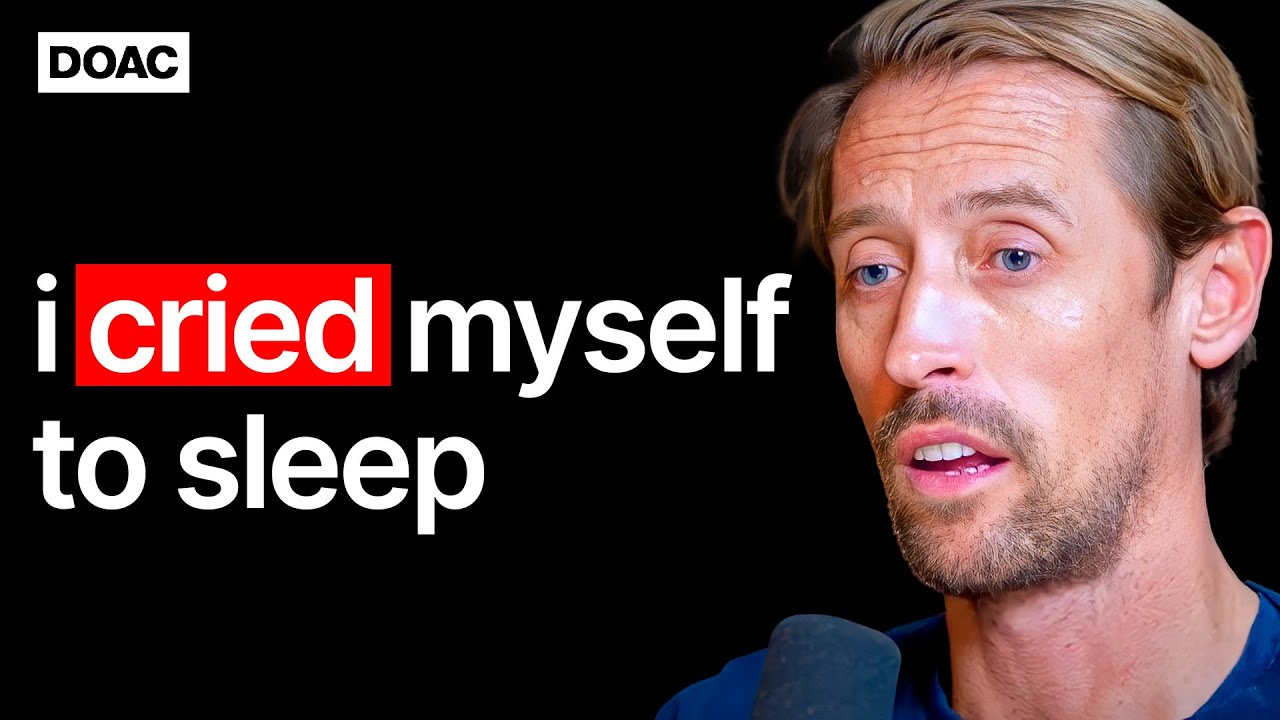
Peter Crouch Opens Up About His Dark Times & Crying Himself To Sleep
Guests: Peter Crouch
Full transcript · Read the full conversation in order, with its original context.
Contents1 chapter
§01Transcript — part 1§01Transcript — part 1
When your cat is acting weirder, or your dog is being louder, your turtle moves slower. Hello, Ted? Your cat seems thirstier. Whoa, slow down buddy. Or your puppy is acting clumsier. Day or night, if you don't know what's wrong, know where to go. Veg ER for pets. This is Kate. Veg, the better, kinder ER for pets.
I've seen things that I've never seen before. The proudest moment of my life has been taken away because of that. People that know me would say I'm a nice guy. On the pitch, I had to be a different person if I wanted to succeed. The top-level players that I played with—Lampard, John Terry, Steven Gerrard—I think looked like they didn't enjoy it. They are constantly battling for the next thing.
Were they intense?
So intense. It's a big reason why I am the person I am. I played for England in an era where it felt like there was a huge pressure. We had an opportunity to win World Cups, and because we didn't, it was heaped on players. I’ve got my mom, my dad, and friends in the crowd, and then you come on and get booed by 70,000. It's hard to come back from that.
My mom was crying. My dad had to have a fight. I was thinking about giving up football. I don't think I was seen as what an England striker should look like. I was so scared. I just wanted to hide away.
In that phase, you were turning to drink more than you should have been?
I needed to at that time. You're not seen as people. It's like, you're well-paid so you have to endure this abuse. You put yourself in a position to be shot at. But like what I've seen with Harry Maguire, the criticism goes beyond criticism. It's gone too far. I was so proud to represent my country, but...
Peter, where do I need to start in your story to really understand you? What are the most pertinent, relevant things that someone listening to this needs to know about you to understand you?
Well, right at the start, I suppose. Everything comes from your childhood. I am who I am and shaped by my parents and my friends. People see me now and obviously, I had a huge determination to be a footballer. Then people see me now as a footballer who has a laugh, and that is my persona. But that stems from my childhood really, and being a little bit different, looking a little bit different, and having a defense mechanism.
That humor that you see, which is me now, was a little bit of a defense mechanism. When someone came at me, I'd always be funnier than they would be. That stops whoever's saying it in their tracks. Being so tall at such a young age was difficult at times, but that kind of defense mechanism was, "I'll laugh at myself before you can laugh at me." That stood me in good stead, and even now, that's the way I get through things.
When was the first time that you realized that you were different? I remember coming to the UK from Botswana in Africa, and I was the only Black kid in an all-white school. There’s some day—I think I remember specifically a comment that a kid made to me on the playground which really put into perspective that I was actually different from them. It was something about my hair. Can you recall a time where you realized that you being taller made you different?
Well, I think it's only because of people with experience, like older people, that notice anything like that. As kids, we just grow up and everyone's the same, aren't they? Then it's older kids. I was always the tallest in my class, but my mom and dad never made a big deal of it to me. Then when we started to play football and I started to be good at football, you would hear things on the sideline like, "Yeah, but he's a couple of years older," or "He's good but he's too old."
You're only judged by your height at that age. So I would hear things from the parents and then I'd hear little remarks, people laughing, little japes and jibing. People saying "you're skinny" or "you're lanky" is seen as a describing word. But that's how it was for me. But I love it. It feels to me like it's part of me. It's me now. I've always been taller than everyone else. It wasn't as if I just shot up and was different; I was just always ahead of everyone else.
Richard Osman, who came on the podcast, was the first person who stunned me into silence because I have to be completely honest, I didn't realize that "heightism"—abusing people for being tall—was such a consequential thing for those people.
I was one of the people who didn't realize that someone who's lived their life being very, very tall will be told about it everywhere they go, every second, and how that can impact someone and how they feel. Honestly, I remember doing that podcast and sitting here thinking, "Of course. If I had a third arm and everyone said it everywhere I go, it would make me subconscious about it."
Exactly right. And it's because there's bigger problems everywhere. But my thing that was different was my height. I recently did a joke of all the questions that I was permanently asked. I had a series of cards in my inside pocket to answer every single question that I knew people were going to ask me. It was "What's the weather like up there?", "Do you play basketball?", "How tall are you?", "Do you sleep in a grow bag?", "Is the weather different up there?"
Five questions, but I had all the answers in my inside pocket. So before they even opened their mouth, I could give them a card. It was just something funny that changed the subject. But it's amazing how many times—I think it's less so now because people know who I am—but before I became well-known, those questions were just constant.
What impact does that have on a young man?
On an impressionable young teenager, it had a big impact. Me now, it's water off a duck's back; it doesn't matter to me. But as a young lad, it was a little bit different. I remember my dad getting really angry about it. As a teenager, you're going through things and you're not comfortable within your own skin, are you? So I was the same as everyone else, but I found it difficult at times. Especially football terraces as I got older and I was playing professionally. All of a sudden it was like, dealing with the odd person in the street saying "Aren't you tall?" is one thing, and another thing dealing with 30,000 people screaming obscenities at you, taking the piss out of the way you look, laughing at you. That was difficult.
When you say difficult, what do you mean in a practical sense? I read that at 14 and 15 years old you were crying yourself to sleep sometimes because of this and having conversations with your dad about it.
Yeah, I think there were times where I thought to myself, "Is it worth it? Why am I putting myself through this?" It's all I've ever loved, it's all I've ever wanted to do, but if people are going to laugh at me and take the piss out of me, what is the point? Do I want it that much? I was lucky I had a good support network around me. My dad was great with me and he was harsh with me at times as well, but he was also really good at pulling me back up and giving myself more confidence.
Listen, I don't look like your average footballer and I've known that since I was 10 or 11 years old. When I watch football on the TV, I don't see anyone that represented me, really. The odd Tore Andre Flo was potentially one who had good technique. There were a couple of players but not many. So I thought to myself, "Maybe I'm just not right. Maybe I don't look right. I shouldn't be a player." I had all these things going on in your mind. But ultimately, I had the determination and I had the ability and I suppose the thick skin, which you have to have to go past it.
You said there were thoughts in your head of maybe I should quit. Were those real considerations you had?
Oh, without doubt. I used to think to myself "Is it worth it?" I always remember the game, it was West Brom away where I came on and I missed a chance. Nobody knew who I was. I was probably the same height as I am now and probably about nine and a half stone. I was much skinnier than I am now, believe it or not. And I'm trying to be a Premier League player. People just thought it was absolutely ridiculous. At times I thought it myself. I know I've got ability, but I'm looking at these big, strong, developed men and I can't compete with this.
I always remember coming on and people actually laughing at me. Then there was another game away at Gillingham where I just got absolutely abused to the point where people were shouting "freak" and "does the circus know you're here?" These were the things that people were saying. My dad was in the crowd. I always remember it; I was walking out at halftime and my dad was rolling down the aisle in the Gillingham end having a fight with someone. I thought, "Oh my god, this is my first season in professional football, my dad's having a fight, I'm getting absolutely abused, my mom's crying. What am I doing? Why am I putting myself through this?"
How do you feel about those people that are shouting "freak" at you when you come on the pitch and upsetting your family? How do you think about them and that culture now?
You know what? It'd be easy for me to sit here and go, "Oh, you know, brain dead, they're this, they're that." But growing up in a football culture, I've been there myself on a football terrace where you hear things. My dad used to cover my ears and stuff. It's like almost normal. I know it's wrong, and obviously, there's a line. We've seen it recently with racism, and there's certain things that go well over the line. But being tall wasn't considered over the line. So it was something that I just decided was the way football is.
Can we change that? Can I change that? I don't think so. So I just got on with it. How do I think about them now? I think it was reckless. I think if I sat down a Gillingham fan that was abusing me that day and I said to you, "Do you know what? You really made my mom cry, my dad had to have a fight, I was thinking about giving up football," I think he'd say, "Oh god, I'm sorry." I don't think in that moment he saw us as people. You're a footballer on the pitch and you're not seen as a person. It's such tribalism that you're just going to have to endure it because you're well-paid.
Did that put a chip on your shoulder? You know when you hear those things and you're running onto the pitch, do you think to yourself, "I'm going to show these people"? Does it give you doubt or did it give you an extra bit of confidence?
It's a little bit of both. When I was starting, I didn't know whether I was going to play for England or I was going to be a non-league player, and either of them would have been fine. I wasn't on the map to go and play for England. I wasn't Steven Gerrard or Michael Owen or Wayne Rooney. I had a different path. I wasn't ready for the Premier League until I was 22 or 23. There were times where I doubted myself. But then I scored my first goal and things just changed. It was against Gillingham again, believe it or not. I chested the ball down and volleyed this ball into the net. I knew then that I'd have a career in football. I didn't know I'd play for Liverpool or England, but I knew then I'd have a career in football, and that was where my confidence grew.
Your dad, I heard he was quite tough at times. What does that mean in real terms? [14:31] **Peter Crouch:** I think at times he probably went a little bit too far, but I wouldn't be sat here having played for England or achieving the things that I've done without him being hard on me. Would I go to the lengths that he did? Maybe not.
Just certain things. I think the harshest one was when he left me at a ball court at Tottenham. I jumped out of a tackle, and his thing was, look, I came from a nice background and a lot of the kids were playing football to survive. So I had to toughen up. Was I going into a tackle like my life depended on it, like the kids from the estate round Edmonton or East London? Probably not at that time. So when I got up after training, my dad had gone.
He left me and I had to get home. Bear in mind, I grew up in Ealing. Getting home from White Hart Lane was an overground to Seven Sisters, then the tube to Oxford Circus, Oxford Circus to Ealing Broadway, and then walk home from there. I was probably 13 or 14, but I hadn't been on a tube on my own before. So it was a tough lesson.
Did he tell you he was going?
No, I went up there and he was gone.
And did you not think to give him a call?
Well, I didn't have a mobile! It was a different time.
And when did you find out it was because you weren't tackling people?
Well, I thought it might be! It wasn't that I didn't tackle; I remember jumping out of one particular tackle and I thought, "My dad's gonna kill me for that." I never jumped out of a tackle again. It is a harsh lesson, but I'm not going to sit here and say it wasn't the right lesson. I think it might have been a tad harsh. Would I do that to my son? I'm not sure. Probably not. I think potentially I'm too easy on my kids a bit.
It's a tough lesson to learn, but if you want to be a top elite footballer, you need to want it as much as the next person. I did want it, but I hadn't had to fight as much as these kids. These kids are my friends now. I have some good lads that came from tough upbringings that went on to be really good players. Ledley King, Steven Mills, James Carter—these boys that I met in the ball court. They were tough lads from Bow in East London, an estate where Ashley Cole grew up. I ended up playing in the ball court where they grew up, and that's a different kind of environment to where I was playing. But I think when you can hold your own in there, you can fly into tackles. I basically changed my whole personality when I played football.
When you got home from that little football game where you jumped out of the tackle, did your dad have a conversation with you about why he left?
Yeah, he told me why. There's a few things that should remain private between me and my dad, but let's just say I was told in no uncertain terms to not jump out of a tackle again.
And your mom? What was her broader influence on you?
She was very much like me. I think most of my traits probably come from my mom. Obviously, the love of football came from my dad, but my mom was very good with me. I thank her every day; she'd take me to matches. I remember seeing her as the only mom on the side with the brolly when it was lashing down. She was incredible taking me to places. She was like my shoulder to cry on, she was the person that I would confide in. They're both very, very good and a big reason why I'm the person I am.
One of the things I read about in your book was how you could see how attitude played such an important role in who would make it. Getting from the estate to the semi-pro level and then getting to the Premier League is a long journey, and there's only a few seats at that top table. When you think about why some of your peers made it and didn't make it, what's your answer to that?
Every footballer that's played for England or played within the Premier League, they've all got a story. Every single one will tell you a story about the player that was better than them that no one knows. There's so many of them out there, and it's sad. For whatever reason—injury, lots of temptation as a young footballer especially when you're that good. If you're earning money, you don't know how to handle that money, friends, parties, distractions of all different kinds. Attitude, will, determination, dedication—there's so many factors alongside ability and luck.
But I sometimes think we don't look at the positive side. A lot of the time we look at the negative side of football. But I think sometimes when you see the kids that have come from absolutely nothing, some of these kids who are now playing for England, and they make mistakes in the public eye. High-profile mistakes. Everyone goes, "Ah, it’s footballers, that's what they're like." But if you'd have seen what they've come from to playing in a Champions League final, I think that's a success story. Some of these players who have come basically with no mom and dad, someone has picked them up, they’ve not had any boots, been thrown on a football pitch, and has ended up playing in a Champions League final. I think sometimes we should consider that a success.
We don't really have a lot of empathy, do we, when it comes to footballers?
No, because it's a highly paid profession, and sometimes there's a stigma on why these players are getting paid so well. I get that; there's a lot of money in football and could it be spent elsewhere on people in the NHS or people who are doing probably much more harder jobs than a footballer. But it is what it is, you can't change it. I do think there is that stigma associated with footballers.
I sat with Tim Grover, who was the guy that trained Michael Jordan and Kobe. He also trains some Premier League football players now. One of the things he told me was how he's seen the pressure of being a high-level Premier League football player completely destroy some players. As a fan, we're all tweeting, commenting, shouting in our little mob mentality. But then we don't really think that all of that pressure, especially on an 18-year-old kid that's come from the estate, how they can be going home and how it can severely impact their performance.
I've seen a similar thing in my view with the mob attacking someone like Harry Maguire. Rashford had it a lot last year as well. What's your take on all of that? Have you seen that yourself in the dressing room?
Yeah, I've seen it. I played for England in an era where it felt like there was a huge pressure. It was the "Golden Generation," the players were the best we've ever had since '66. We had an opportunity to win World Cups, and because we didn't, it felt like it was heaped on certain players. But when you're talking about Rashford and Maguire, I think we're all entitled to criticize players, but what I've seen with certainly Harry Maguire, I feel like it goes really too far.
It's harsh. I'm just thinking of his family because I've been in that position. I've been booed for England. I remember playing at Old Trafford in a game and coming on, and it's the proudest moment you'll ever have in your life, and your home fans are booing you. I've been in that situation. It feels like Harry Maguire's going through what seems to be a prolonged period of this. Regardless of form, some of the social media stuff I see, the ridiculing... I think he's having a difficult time as a player, but I think some of the criticism goes beyond criticism. It becomes too harsh in my opinion.
Having been in a situation where you've been booed by the fans of the club you're playing for, what does that do to you? Was it for England you came on?
Yeah, that was devastating. I'm playing for England and there might be an element of the fact that I was a Liverpool player, I'm at Old Trafford, obviously a lot of Man United fans. But it was during the course of when I wasn't scoring for Liverpool and I was having a real tough time anyway. I had 18 games where I didn't score for Liverpool. And the fact that it goes back to—I felt like with England I had to be superhuman. Because I looked different, I wasn't seen as what an England striker should look like. And I think that was genuinely a thing.
You know, I'm so proud to represent my country, but I've got my sister, my mom, my dad, all friends in the crowd. Everyone's excited, they're all talking to me before the game about me potentially coming on and making an appearance and getting a cap, and then you come on and get booed by 70,000 of your own fans. So what I'm saying is, don't ever feel sorry for footballers, don't, you don't have to, we expect that. But my family, like my mom, was in bits. The proudest moment of my life has been taken away because of that. We put ourselves in the position; I'm not going to sit here and cry about it, but it's just disappointing for my family more than anything.
What happens when the whistle blows and the game ends on days like that? You go back and see your family. Is there a bit of an awkwardness to it?
A bit of embarrassment. You want to be the one who comes down with the champagne in your hand, everyone claps you in, and your family gives you a big hug. Most of the lads did that. They've got a shirt, they've got a cap. I come down to the players' lounge after and I'm a bit sheepish, like "Sorry about that, mom." It's like you're apologizing for doing the thing that you've worked so hard to do your whole life.
So that is difficult, dealing with the family side of it. Because I know what I've done; I've put myself in a position to be shot at. I'm sure you feel the same, doing this podcast, whatever you do, you put yourself in a position to be shot at. But your mom hasn't. She doesn't need to hear that.
How do you deal with it? Do you just part the guard and pretend it's not happening?
My friends know not to send me articles. Just assume I've seen it. I don't need my best mate going, "Have you seen this?"
This is something that happened early on in my career and I was like, "Nah, stop all that." I don't read the news, I don't watch Match of the Day if I haven't scored. That's the way I deal with it. That doesn't exist. And when I do something good, I might listen to the praise. Be very selective in what you watch or listen to.
Was there a moment in your career where you said, "I'm not going to read the newspapers anymore, I'm not going to watch the telly"? Was it that Liverpool phase?
Oh god, yeah. That Liverpool phase was like radio silence. I was gone. But everyone's—the problem with now, I could stop buying a newspaper, I can stop watching telly, I can do other things. But nobody can live without their phone now. This is the problem for young footballers that I worry about. You've got to worry about it because no one can put their phone down. Any footballer's the same, especially a young player. You pick up your phone—"Right, I've got what's on the diary, I've got a text message"—then you find yourself on Instagram, on Twitter. You can't get away from it. No matter what the players tell you, whether they say "Oh, I don't listen to it," they do. They do. You can't get away from what it is now with the phones. With me to get through that, I didn't watch. I was getting ridiculed. That time where I didn't score for Liverpool was such a hard time for me. I just wanted to hide away in a dark room until I scored, basically. So I don't know what I would do if I was hiding away in a dark room with a mobile phone. You might as well just go out and face it all because it's a lot harsher on the phone.
Paying extra for tire care is BS. You know, bad service. So at Midas, we’re rolling out our BS-free tire guarantee, included with paid installation and tax on every purchase. You’ll pay nothing for flat replacements, nada for flat repairs, and zilch for tire rotations every 5,000 miles. That’s zero dollars for all that. So with this limited lifetime tire guarantee, you’ll pay a whole lot of nothing compared to what the other guys charge for tire care. That’s the BS-free tire guarantee. Only at Midas.
If I was in your household at that time—signed for Liverpool and then you go 18 appearances without scoring—what would I have actually seen?
Someone who's depressed, I suppose. Outwardly not; I've never been that person to wallow in it. I've always been a bubbly character, always see the positive in everything. But at that time, it felt like I was getting ridiculed and it was really tough. I had to fight my way through it. But what was so amazing was the Liverpool fans stuck with me. That's something that I'll never forget.
I swear to you, any club in the world, having just won the Champions League in one of the best finals you've ever seen in Istanbul in 2005, they sign me, I turn up and I don't score for 18 games. I don't think there's a club, a top club in the world, that tolerates that as a fanbase, apart from Liverpool fans. They stuck by me. It was like a siege mentality; it was like everyone else is attacking him, but he's one of ours and we're with him. It felt like every time I played, they were willingly scoring for me. And when I eventually did, you can see the footage of it—the camera shaking, it's like we've won a European Cup final. People wanted me to score that much. And I'm thankful to this day that they did stick by me because I managed to turn it around after that and it was a special moment at a special club.
I was reading in that phase you were turning to drink more than you should have been a little bit after games and stuff.
Yeah, because my dad, to be fair to him, would say to me—I'd be like, "No, I'm not going out," and he'd be like, "You're going out." He'd make me go out after games. I'd be like, "God, I don't want to, people are laughing at me." But he'd drag me out, we'd have a few beers. It wasn't as if I was drinking at home on my own; it wasn't like a dark kind of thing. He was dragging me out and he was making me have a few drinks.
Then I realized actually no one really cares. They might have a laugh at you on a Saturday, but they're going back to their own lives. I feel like everyone's laughing at me at all times. You build these things up in your head and they're never as bad as you think they are. So his way of dealing with it with me was to take me out for a beer. And yeah, I probably did drink a little bit more than I should do as a Premier League player, but I needed to at that time.
You bounced between six clubs before the age of 25. That's a lot of moving.
It's a lot of moving around, yeah. But I class that as—if I'm at Liverpool or Man United or Chelsea, Bayern Munich, Real Madrid, you don't have to move anywhere if you're playing, do you? The course of my career was very different to anyone else's course of my career. Those moves that I had where QPR was a chance to showcase my talent, I did very well, the club went into administration, I went to Portsmouth, they bought me for like a record fee. I then did really, really well in the Championship and got a move to Aston Villa in the Premier League. I felt like my dream had arrived.
And then it didn't quite work out. I wasn't ready for the Premier League. I always remember my debut was against Newcastle and Alan Shearer was up the other end of the pitch and I was at this end. I thought, "If that's what I need to be a Premier League player, I'm not one." Because he was so good and I just thought, "Maybe I'm a Championship player." So I ended up having to move again to Southampton to get games, and then things took off. So all my moves were for a reason from a club point of view, for a financial thing for the club, or for me having to go out and get football or for me to progress as a player. I would have loved nothing more than to stay at one club for my whole life, but that wasn't my journey.
You moved from Liverpool to Spurs. How would you summarize your time at Spurs?
I absolutely loved it because I started at Spurs as a youngster and I played in that ball court at White Hart Lane and I tried to play in the youth team and I was in the reserves. Me and Ledley King came through together. Ledley stayed there and I went throughout this whole journey of Liverpool, England, QPR, Portsmouth, Southampton, on loan at Norwich, on loan at Dulwich Hamlet, and I came back to Tottenham and Ledley was in the same place I left him! Which was amazing. I never got to play in the first team for Tottenham coming through. I had so many players ahead of me, I wasn't ready. So to come back for 10 million pounds and I'd already played in a Champions League final, I'd played in a World Cup... to come back, it felt like unfinished business. So then when I scored some important goals for Spurs and we got into the Champions League for the first time and we had good success, that felt like almost like a homecoming.
That ended a little bit too abruptly for your liking?
A bit, yeah. I liked it at Spurs. It was funny because it was deadline day and Harry Redknapp was talking about bringing Emmanuel Adebayor in. I went to work—call it work for now—and I left Abbey and the kids and I said, "I'll see you this afternoon." Then the afternoon never came, I never came home, and I just gave her a call and said, "We live in Stoke now." It's the life of a footballer. I was happy, I had a two-year contract left at Tottenham, but a bid came in of 10 million pounds for a 30-year-old. I could understand from a club perspective that they wanted to accept the offer. I spoke to Harry and he said they wanted to bring Adebayor in, but Daniel Levy wanted to accept this bid. Obviously, I wasn't happy about it; I was happy where I was. But certain bits and pieces happened and I said to Abbey, "We're on the move."
How does Daniel... he's a figure that's talked about a lot as being quite a tough guy.
Well listen, this is Diary of a CEO, right? If I was running a football club, I'd probably have him in charge. Really. He's a harsh businessman, right, but he's looking after a billion-pound asset. He's not necessarily the owner, but he's running it like it's his own. I think I understand that. Like the bid of 10 million came in for me—I'm an asset to the business. If you look at it purely from a business perspective, I'm a depreciating asset at 30 years old. Wilson Palacios was another 6 million to go—so 16 million they're getting for us. It's good business potentially. But you know, I'm not stupid either, so I had two years left on my deal and...
You must have had him bent over.
Well, if you think about it, he's getting 16 million, right? I know what he's getting! I'm entitled to see some of that if you want me to leave. And listen, I didn't get that much obviously, but I did okay and it worked out for both of us. But I don't think there's many people that come out of an incident like that with Daniel Levy and come out smiling. Because he is harsh. I had my run-in with him and there were times where I said, "No, it's okay, I'm happy, I'll see you in the morning. I'm happy at Tottenham." You've got to be prepared to hang up the phone and say that. Then he kept coming back and telling me that I wouldn't get a squad number, I'd be training with the kids, trying to make my life difficult. And I was like, "No problem."
What was that initial conversation? He calls you in and says you're off? I'm interested in the world of football because in the world I'm from, in business, there's a high degree of empathy. It's very conversational, there's performance reviews. But we don't have an impending deadline day, either.
But I think it would be different if you did have a deadline day. People would get stuff done on that day! So that rushes people obviously. But you're definitely seen—there's this whole thing about how a player should show loyalty, but it works both ways. A club at times, if you aren't performing or you're having issues or problems off the field, sometimes that side of it doesn't get shown as well, where the club will quite happily get rid of you. So it works both ways. But unfortunately, the business that they're in is buying and selling players and winning football matches, and it is a ruthless industry. But I went into that realizing that very quickly to be honest. I went into that with open eyes.
Do you regret leaving Liverpool?
Yeah, I do a bit. I had a great time at Portsmouth though, so some of those memories will stay with me forever. But leaving Liverpool is a difficult thing to do. I was playing for England at the time and I was loving playing for England, I was playing well, and I just thought, we sign Fernando Torres and I'm pragmatic, I understand my role. He was better than me. Right, so what do I do now? He's always going to play, formed a great partnership with Steven Gerrard, he's on absolute fire. I still believe in myself, I still believe I can play for England, I'm still a very good player, I'm just not on Torres' level. I'd left and then he was sold quite quickly to Chelsea. And I saw players obviously that were playing—Andy Carroll, Voronin, Ngog—players that I basically felt that I could have played. Having said that, I never look back. People say to me now, "Do you miss football?" No, I don't miss football. That was a time that I had that was the best.
You mentioned Gerrard there. Lampard, Beckham, Gerrard, Carragher... what was it that made those individuals great in your view? What did you see?
I saw something in those players that was slightly different to me. Like, I enjoyed what I was doing. I looked at the top, top-level players that I played with and they never looked like they enjoyed it. Ever. Gerrard, Carragher, I'd class in that, John Terry, Lampard—it was always the next game. And I think that's the top-level mentality you need to have. For me at times, I'd go, "We won this lads, let's enjoy this one a little bit," because we had a massive game on Tuesday. They would already be thinking about that. It's always about the next one. And I admire that in people. I had a steely mentality, but I also thought, "What we doing it for?" Yeah, of course it's about winning trophies, but also it's about this moment. We've just won a huge game in the last minute, let's celebrate this moment and deal with tomorrow tomorrow. Whereas sometimes the top-level players—like Steven Gerrard, prime example of that—just the constant... there was no enjoyment. Obviously there was enjoyment at times, but it felt like it was just the next game was more important than enjoying this one.
Were they intense?
So intense, yeah. But I think that's what separates people. I think you've got to want to sacrifice everything, and I did when I was younger and I did throughout my career. But what I'm saying is that's that 0.5%, that 1% difference of just already thinking about the next game. The consistent winners are the ones that I think looked like they don't enjoy it, and because they are constantly battling for the next thing.
I read that you said some players couldn't deal with the intensity of a Steven Gerrard and a Carragher, and that you also were much more orientated to try and please them than the manager, which I think was Rafa at the time. You were more concerned with pleasing Carragher and Gerrard than the manager. Why is that? What were they doing?
They're local boys, right? They're legends at the club. When I think of Liverpool, I think of Steven Gerrard and Jamie Carragher. Rafa Benitez, I suppose, was a top manager and he signed me, but Steven Gerrard and Jamie are absolute legends of the club and quite ruthless and quite harsh in their appraisal of some players. So I found myself constantly seeking their approval. My training was—I always remember the first training session when Steven wrapped a ball into my feet and I miscontrolled one. It's like a one look would be, "You don't do that here. You're at Liverpool. One bad touch isn't tolerated here." It's only a look, but it was enough to make me not do that again. Those kinds of standards are different.
Would they go after individuals in the changing room?
Oh yeah, yeah. I mean, it's their club. I think some people didn't understand that level of passion that they had for the club. Every person is different; in a place of work, there's no two characters the same. So you need to know what makes people tick. Some people couldn't understand the level of passion that they had for the club, of standards that they had. If you want to play for Liverpool, you have to have a certain way about you and a certain standard, and if you fall below that standard, then players like Steven and Jamie would tell you very quickly. In front of everyone. I've seen players be signed and be written off in one training session. 15 million pound players coming in and like, "He's shit." You wouldn't get many chances. But then I've also seen players be written off and then come back.
What do you think of Liverpool right now?
I like Nunez. I think it's going to take him time to settle in, but as a club, what Jurgen Klopp's done there—I look at young kids now who just expect Liverpool to win the Champions League or win the leagues. It was 30-odd years before that; it was a long time. Jurgen Klopp's just changed the DNA back into where they were in the '80s. What he's done for that football club has been nothing short of incredible.
Jurgen, Rafa... how many managers did you work under in your time?
Loads over the years. Probably more than ten.
For you, from working with more than ten footballing managers, what made a really good manager?
I think there's lots of ways to manage. You try and use a little bit of the good stuff out of everyone. Rafa was very tactical. Harry Redknapp was a great people person; he understood people and what they wanted. Sven-Goran Eriksson was the same, so relaxed. In a pressured environment when you were going into a World Cup, Sven had that aura of calmness around you which you needed. So great managers that I've had along the way, but very, very different qualities in all of them.
What about the opposite? What were the instances where you thought, "That's not good management"?
Well, it was certain things like—with Rafa, I thought there was a tendency to be too intricate, to be too methodical, too precise at times. If you could mix a little bit of Rafa and a bit of Harry together, you'd have the perfect manager. Because with Rafa it was like we're playing Wolves at home and we've got Steven Gerrard, Xabi Alonso, Fernando Torres, we've got the best back four in the league... just go out and beat them. I don't think you have to play with a couple of holding midfield players. We're at Anfield, let's go and express ourselves. That was my only criticism—I think there were too many times where we were thinking about the opposition instead of being Liverpool and going out and battering them.
Who was the best manager you played for?
There's so many reasons for each manager. Harry Redknapp was—I don't think I'd be sitting here without him, just because he understood football, he understood a player, and he understood how to get the best out of you. I was struggling at Southampton and I thought, "Maybe I'm just a Championship player." Harry comes in and it just changes like that. He says, "You and Kevin Phillips will be my front two for the rest of the season, you'll score enough goals for us to stay up." Just that confidence, that belief. I went out and scored 16 goals after Christmas and was on absolute fire, got in the England squad and moved to Liverpool at the end of the year. So that little spell of six months was crucial to my development as a player and as a person.
It's crazy how much someone believing in you can have such a huge impact.
Yeah, if you're getting told that you're no good, you have to be a real strong character to be able to cope with that. And when someone comes in and goes, "Actually, no, you're doing great stuff," it lifts you. That's the way I would manage. I think now players are a bit more—you have to be a bit more of an arm-around-the-shoulder guy than a "crack the whip" kind of manager.
When I've sat here with Patrice Evra, Gary Neville, Rio Ferdinand, they all say the same thing about Sir Alex Ferguson. They say he was almost like a unique-shaped jigsaw piece for each person. For Nani, he was one Sir Alex Ferguson, and for Gary Neville, he was a different shape because he understood everybody and which buttons to press. Great management is being like a bit of a shapeshifter depending on who you're dealing with.
I think that is exactly right. You can't treat everyone the same way. Everyone is different, everyone's a different character. For instance, you talk about Sir Alex Ferguson—not many people could handle Eric Cantona. Alex Ferguson got the best out of Cantona because he treated him differently to how he would treat Gary Neville. It's not rocket science, but it's a quality that not many people have. Being able to adapt. Some managers are just like, "This is my management style, everyone has to fall in line with it." I don't think as a manager that is the best way to go about things; it's about adapting to people that you might need to speak to on a regular basis.
Reminds me of watching that Netflix documentary about Michael Jordan called *The Last Dance*. Phenomenal documentary.
Phenomenal, yeah.
Dennis Rodman, he was a character where he would go on benders for a couple of days and the manager goes, "Listen, that's Dennis." But they won everything.
Exactly! But that's what I'm saying—could you imagine a football team? Dennis Rodman was a huge part defensively of that setup with the Bulls. And if you didn't have him, letting him go to Vegas for a couple of weeks... at least you get Dennis back for those games at the end that are important. That was in his makeup, that was in his DNA. Is it better for you to let him go to a rival or do you accept that and win the titles they did?
All the great managers seemed to have instances where they were okay to make an exception. I guess the risk is, what message does that send to the other players?
Well yeah, I totally agree with you. I don't know if the boys told this story last time, but the story of Ryan Giggs when he turned up for a team event and he's got no tie on, and Eric Cantona walks in with no tie and a pair of trainers. And Alex Ferguson has obviously caned Ryan Giggs and told him to go home and get a tie, "Who do you think you are?" Eric walks in, sits down, doesn't say a word. Really? Yeah. Because it's Eric Cantona. Ryan Giggs was just as capable of winning a football match as Eric Cantona. But where this does fall down is when those players stop performing. I've seen players get treated differently and that's fine, until they're not Eric Cantona.
Which kind of makes me think about Ronaldo and what happened the other week with him storming down the tunnel. As someone that's been inside the changing room and probably seen moments where a certain player was being disruptive, what was your read on that situation?
In all honesty, it's nothing new. I think because it's Ronaldo, it's a huge story. But I've seen it over the course of my career—players who aren't playing, "throwing the toys out the pram," being disruptive. As players, it's constantly happening, so you don't worry. I've seen it many times. I've seen it with a particular player; we're playing in a preseason match, he just walked off the pitch while we're playing. This is absolutely ridiculous; he's literally walked off, we're down to ten men. My take on the Ronaldo situation is I think it's disrespectful to the players that are playing still. I think it's something that he probably regrets and I think it's something that the manager dealt with well.
Good managers can keep the respect. Now if he doesn't deal with that properly...
Without doubt. Players are on every little moment. If you don't know the answer to a particular question, lie and lie well, because players will, if they sense an element of you being unsure about a situation, they'll pounce on it. If you're a manager and you don't have control of the dressing room at all times, it's hard to come back from that. You need to command respect. Managing players that aren't playing with those egos is a tough thing to do. And when you've got someone of the stature of Ronaldo, managing him not playing in the dressing room is a difficult thing to do.
Put yourself in Ten Hag's shoes. It's a situation where the club have, I believe, told him he has to stay because they want to play him. Now he's not playing and the window's shut. How do you deal with that problem? It's going to be a huge issue. But I felt he dealt with it well. You don't want Ronaldo training with the kids away from the first team; you want him in and around it because he'll be an asset potentially at the end of games or to start some games.
I'm really compelled by that point you made about how as a manager, if you don't know the answer to maybe a strategic thing, you're better off lying than losing the control of the room.
Well like, say if in your industry, if an employee of yours asks you "What should we do here?", I think it's better to have an answer than to say you don't know. Right? Even if you don't know. Because it's giving them confidence. You say, "We're looking into that, we've worked on that." Just make it... the moment you say you don't know, I think there's an element of, "He hasn't got a clue." Basically, yeah. I think it was Guardiola who said it—if someone asks you a question, you have an answer for them. You need to be seen as a level above the players. You need to have more intricate details on the opposition, you need to know about football more than the players do so they have that respect for you.
Was there ever times—you talked about "losing the dressing room"—is that an actual thing that happens that you've observed?
Yeah, I think you can see it. I have seen it in certain dressing rooms where a manager has lost it a little bit. We had a situation at Stoke where we had probably the best dressing room I've ever been a part of, and then we added some more talented players rather than hardworking, honest players, if you like. And for a spell, we had a really good mix of that real quality and that kind of determination and spirit. And then it went too far the other way. It was almost too much quality and not enough effort, determination, team spirit, ethic, standards. They slipped. And I've seen things that I've never seen before.
I talked about the player walking off the pitch; that happened in that season. And it culminated in relegation. So when you talk about "lost the dressing room," I class myself in that scenario because I was an older player then and maybe I let things go a bit as well. Not my standards personally, but I let people get away with things when I was an older player. I should have been the Steven Gerrard in the situation; I should have been a player that flagged it up maybe. That rankles with me, like I let things go. I knew we were in big trouble.
When you say you saw things you hadn't seen before, it kind of reminded me of what I remember Rio saying when he moved to QPR from Manchester United. He saw just a completely different dressing room culture.
Exactly right. I'm friends with Rio, I speak to him about that time. It feels similar in some ways. You have too many doing what they want. Just being late, little things like that. Being late on the training pitch, being late for games, not wearing the right suit or not wearing the right tracksuit to games, wearing whatever they want, wearing caps when you're not supposed to. Just little things like that made us become lax. And we might go a goal down or two goals down and you can see players waving their arms around and not tracking back. I remember asking a particular player, "You stopped trying? You stopped working?" and he said, "Yeah, I did, yeah." I said, "What?" He said, "I did, yeah." I said, "Why?" He said, "We were three down." I couldn't believe it. 30,000 people in a stadium that have paid to watch us play and you've given up! It's horrible those games, but at least you've got to run round. That's when I knew we were in big trouble.
Does that not start with a manager? He lets one thing slide, lets two things slide...
Yeah, that was exactly what happened. There were certain things that were let go and then you feel like you can get away with more and more and more. There was a certain thing where you'd have to run after a game if you didn't play. So at that time, I was 37 years old. Sometimes I was on the bench and I'd be out there running. And there was a younger player not out after the game doing this fitness work. I came in, I'm like, "What's going on? Why am I 37 and I'm out here running after a game and this 25-year-old is not? He didn't want to." These are the standards I'm talking about. You've been asked to do it, you don't pick and choose whether you do it or not. But that was allowed to happen. Then it happened again. This particular player said, "Right, because he hasn't run after the game, we're all in on Sunday." The whole team came in on Sunday and the particular player didn't turn up for training! So we're all in because of him and he doesn't turn up. Just standards slipping and everyone knows where it ends—it ends badly.
When did you decide that your football career was over? Tell me about that decision.
I was lucky I got the opportunity to get out of that dressing room that I was in at Stoke, which was difficult, and I got the opportunity to play for the exact opposite at Burnley. I finished in the Premier League. I knew that I was done that season because I was on the bench a lot and there was players playing ahead of me that I knew should have been ahead of me. I thought to myself, "I am just a Plan B now. I'm coming on at the end of games." I still felt fit, I still felt I could have an impact, but I knew inside my own head.
So I told my family, I told Abbey. We all went to the game—it was against Arsenal at Burnley. No one else knew, but I knew it was my last game of football. All the family came on and we walked round the pitch at the end. I've got a picture at home on the wall of me and the three kids we had at the time—got four now, believe it or not—but the three of us on the pitch and a lovely picture of me walking out. It's my last game of professional football. I knew it, no one else did. But yeah, lovely picture, lovely moment, and then it just sort of comes flooding in that it's over. 20 years I played. I retired at 38. 22 years every day of my life doing something that you loved. I look back on it with such fond memories. I was so lucky to have played in an era that was full of great players. I cherish the moments that I had.
And your dad was there that day?
My dad was there that day, yeah. He was the one, I don't think he missed a game. And he was part of my superstition, bizarrely. If I didn't see him before a game, I'd feel unnerved. He was with me every step of the way. He would watch me even the warm-up; he'd be the first in the stadium. I would walk out before the warm-up and I'd see him, 6'5", I'd always be able to see him. He'd give me a little wave and he'd watch how I warmed up. After the game, he'd even say, "I knew you'd have a good game in the warm-up" because he'd always watch.
Yeah, you know what? We had sort of a retirement video, and Abbey got together a load of ex-players and managers that I'd played with, which was nice. But I don't think I've ever sat down and discussed at length my career. Life's too busy, isn't it? I've got match balls, England caps on the wall, only in one particular room—I'm only allowed like a little dungeon! But I've got them there on the wall and I look back and I look at some pictures on there and I look at the moments and I think, "They were some great times."
But like I say, life moves quick and I love what I'm doing now. I've gone straight into doing other things, and I was very conscious of that. I planned a little bit of that. While I was still playing, I did the podcast and I did the first book that I did. And I did my coaching badges as well. I didn't know what I wanted to go into, but I was so scared of waking up on that Monday. Every player that I've ever played with just says to me, "When you retire, you're forgotten like that. It's difficult, it's hard to get your head round it, keep playing as long as you can." I was so worried about it, I just thought, "Right, I need to do everything now before I retire." I think it was the best thing I ever did was to do things while I was still playing. The book and the podcast just went bang, and that just propelled me into a world in the media, really.
Was there ever a moment after you'd retired where you had a bit of a down day? You spend those 20 years where everything's sorted for you, your schedule is sorted, you know where you're going to be. Then suddenly the structure's gone.
I don't think I've had that, you know. I feel really lucky because I know so many players that have really struggled since they retired. What I don't like is not having that structure. For instance, I knew exactly where I'm going to be on September the 16th, on February the 12th. I know where I'm going to be training. Now, I couldn't tell you what I'm doing next week. Things come up, things change. I don't like that. I like—I've been institutionalized, if you like. I like being told, "On a Monday we do this." For 20 years I didn't have to grow up. Now I do.
They used to take our passports off us! They didn't trust us enough to get ourselves to the airport. Everything's done for you so you can purely concentrate on football. I quite liked that in a weird way, because you solely focus on one thing, whereas now there's lots of different things that I do and lots of choice, lots of decisions to make. It's like being an adult; it's not great.
It reminds me of Raphael Rowe. He's the guy who was imprisoned when he was younger for a crime he didn't commit. He was telling me that when he came out, he went to a supermarket and there's like seven types of beans. And he stood in the supermarket going, "What the fuck do I do?" He was never used to making decisions.
So true, though! With football, you are told where to be, what to do at all times until you're on the football pitch. But even some degree there as well, the manager's telling you what to do. I quite liked it in some ways, but obviously, the freedom is great in other ways. Like I have Christmas now, I can spend time with the kids. If I choose to have a week off during the winter, I can have that. Are you a workaholic? I think I've got a good work ethic, definitely. Without doubt, I enjoy it. I enjoy getting up and having a purpose.
Do you feel like you're out of balance, though?
Yeah, I'm finding the balance really tough. Really tough. I speak to Abbey about this as well. I struggle—I'll have one week where I'm constantly on the go, and then one week a little bit quieter. I sort of sold her the dream of retirement as being retirement and it hasn't quite worked out that way because I love doing what I'm doing.
What did you sell her?
Well, I sold her like we'd be in the gym every day, little juices and nixes, we'd be on dog walks, I said we'd just—Rome! Quality time together. And yeah, it's not quite worked out that way. But she knows I'm passionate about what I do. I love what I do now. I'm still involved in football which I love. I do the podcast that I absolutely love doing, and various other bits and pieces come up. I'm in a fortunate position and I do it purely for enjoyment. The main focus was the same as my football career—to do something that you enjoy, and I'm lucky in the fact that I can still do that.
Is your main dispute in your relationship—because this is the answer for mine—this issue of quality time? It's like doing all this stuff and then being there to be able to give this person quality time that they want where you just go for the walk and you just do nothing.
Do you find that hard? She's the same, you know. I think it'd be easy to say that there's a misconception of footballers' wives that they just relax all day. She's so driven. She drives me, to be honest. I run all my decisions past her. She's on it. So that's good in the fact that if we go for a walk together, we'll have some quality time together, but we both won't switch off together. We're still bouncing ideas off each other and I'm glad that I can have someone like that.
So your podcast—absolute smash hit. A lot of ex-players, ex-athletes have started podcasts. I can't think of any that have risen to the heights that yours has. It's really been a bit of a cult phenomenon. It is like a couple of lads in a pub chatting.
Yeah, and I suppose that is our thing. I think it was a reflection of me, it's what I like to do. I suppose we could now, because things have gone well, upgrade our setup a little bit. But it feels like we need to stay where we are. We love being in the pub, we like having a bit of a drink while we do it. It feels, certainly during lockdown, we have lots of comments from listeners and people writing in and they feel like they're in there with us. This is a different kind of podcast—more serious, more enlightening maybe—but I try and take people inside the world of what it's like being a footballer and it's a mad funny world. I love doing it. It's genuinely the most fun. When I say to Abbey "I'm going to work," she's like, "Are you joking?" I'm leaving her with the four children and I'm going to a pub in town to record with lads that I get on really, really well with and just talking football. For a lot of people certainly in my world, that is the ideal job.
The podcast offers people that kind of connection and community. But at the same time, it's not just banter. I remember seeing the episode with Prince William where you talked about mental health. How the fuck did you get Prince William's team to have a pint with you on the podcast?
There are points in this podcast—obviously now I know what a podcast is, but I was just talking literally as I would talk to my mates. We built up a big following and then people started calling us about coming on. That was a call we had from the Palace. I promise you. At one point we had Elton John had called and Prince William had called.
With Prince William, we made it happen. We ended up going to Kensington Palace, which was an amazing day out. We had a beer over the road before we went in. Then Prince William—I talk about the Samrat, the Indian restaurant that I used to go to with my mates as a kid. When Prince William brought in the delivery and put it down, I was thinking, "If my mates from the Samrat could see me now!" It was just so surreal. But like you say, we got to talk about a range of topics. Certainly in football, there's a stigma of "you have to man up." I think that this is why the target audience for Prince William and his "Heads Up" charity for mental health is targeting the right people—the people that don't speak out.
I'd done something with him called a "Royal Team Talk" on BBC and we talked about mental health and stories in football. That's the first time I shared my issues. I'd never talked about anything; I was one of those people that kept everything inside. But since these kinds of things that I've done, since that podcast, I have started doing more stuff. I have started reaching out to my friends and you realize actually that people aren't always alright.
I think the quote from that podcast with Prince William was, you'd gone into the dressing room, you'd shared how you were feeling with your teammates and instantly you kind of felt lighter because of it. You felt better for opening up.
Yeah, that's something that I definitely found. We opened up—it was me, Thierry Henry, Danny Rose who was quite open with his mental health problems, Gareth Southgate, and Prince William. When you actually get a group of lads there talking, Prince William wasn't Prince William, Thierry Henry wasn't Thierry Henry, it was just a group of blokes talking.
Prince William's talking about bereavement and you think, "My god, like, you don't..." It's like that's not real, it's like a not-real life. But you think, actually when he's sitting there, he's just a lad, he's lost his mom. You're not seeing her as Princess Diana and you're not seeing him as the future King of England; you're seeing him as a man who's struggling who's lost his mom. I think sometimes when you read things and you look at things, like I say, it's that thing of playing football and not realizing that they're actually on a human level just a fella that's lost his mom and has struggled with that over time.
And you were referring to the stuff you've talked about today?
Yeah, me personally, I opened up about looking different a bit and getting heckled and being that impressionable teenager. Bizarrely, that's become my superpower now. It's become me. I'm recognizable. I think people understand all my insecurities have been what has probably made me successful in the stuff that I've gone on to do.
When you do look back at your success, what are the key things that in hindsight you go, "That's why I was successful"?
I had ability. I felt like I was a good player and I worked on that. If I was going to be tall, I wasn't going to be this big target you can lump the ball up to; I wanted to have technical ability, so I worked on that, I constantly worked on that. Then I had to work on my heading because I was incredibly tall but I didn't have to jump as a young lad. Then you get to play professional football and you realize that people are going to jump, they're going to beat you in the air, and it looks ridiculous if you're 6'7" and you're losing headers. So I had to work on my heading. And obviously it's determination, it's the will to succeed, it's the desire, it's the ability to deal with knock-backs.
Knock-backs... did you ever have experience with, especially through the period with Liverpool where you went 18 games without scoring, did you ever experience anxiety?
Yeah, I'd say so. I'm not an expert on this field. I wouldn't say I'm an anxious person, like I say I'm a glass-half-full kind of person. But I would say, of course, like in football terms, of course I was anxious. I was snatching at chances. And was I anxious off the field? Yeah. Couldn't switch off from it, couldn't stop thinking about it, couldn't sleep.
Couldn't sleep?
Yeah, I wouldn't have been able to sleep, certainly after games. Physically impossible at times.
Where are you now in terms of your mental well-being?
Good, good. I just need to get the balance right between this new field that I'm in, if you like, and family life. Working enough to satisfy that hunger to keep going and not miss what is important, which is my kids. I want to see them grow up and I want to be at the forefront of that.
That's my biggest problem. I always hear this voice which is like, "When is enough enough?"
"When is enough enough?" It's a difficult one. I think it's for me about enjoying it, and if it stops being fun, then I think that's the time to call it quits.
Crouchfest. 19th of November?
19th of November. People buy tickets and not have a clue what they're letting themselves in for! And it is one of the best things that we've ever done. Last time we had Liam Gallagher on, we had Katherine Jenkins singing the Champions League anthem, we had the fella that wrote the Champions League anthem spoke to us, Tom Grennan. We had people dressed as referees, fancy dress... it was absolute carnage. And yeah, now we're at Wembley Arena!
Wembley Arena? Jesus Christ.
Yeah, so I mean we've probably bitten off more than we can chew, I'm not going to lie to you! But yeah, great guests and looking forward to it so much.
What are you promising for this Crouchfest?
Well that's the thing, we don't promise anything. We literally don't say a word to anyone. It's so much fun. If the last one was half as good, it'll be a great event.
What is your goal now? What is next for you? You’ve got all these things going on—the media stuff, presenting on BT, the podcast, this amazing book you've just written, *How to Be an Ex-Footballer*.
Yeah, I like I say, I'm finding my feet. I have no clue where I was going to go. When you say "What is your goal?", I don't want to come on here, *Diary of a CEO*, right, and everyone's got a goal, everyone's got a purpose... I have to be honest with you, I don't have a goal. I don't want to be doing this in five years or that in five years. My goal was achieved—all I wanted to be was a football player. Now everything that's happening to me are things that I'm enjoying, but there's no particular goal.
I think you'd be surprised how common that is. I've said on this podcast a million times that I've never written a business plan in my life. It's really about doing my best today and doing that every day and kind of being open to the things that come along.
Well, I feel like it's also now a mindset in some way. I did the book, I did the podcast and things took off, and then opportunities come off the back of that. As long as those things are going well, the opportunities will continue to come. And then you might find that you enjoy something else or a different avenue. That is where I'm going. I'm on a journey that I have no clue where it's going, but I'm enjoying it and long may it last.
At the start you mentioned that the way you were treated when you were younger, looking a bit different, meant that you used self-disparagement—criticizing yourself, making a joke out of yourself first—as a defense mechanism. Much of the reason why people love your books and your podcast is because they are really, really funny. I find it interesting that the thing that people criticized you for created a quality in you which seems to be critical now to your success. Is that an accurate assessment?
It's spot on. My humor and being able to laugh at myself was a self-defense mechanism where people were trying to take the mick out of me. I would take the mick out of myself in a better way than they were about to do. That makes me self-deprecating, and I think that is very uncommon for a footballer. It was groundbreaking, and I don't think it should be, but let's be honest, I think it probably was a bit. Not many players that play for England let their guard down at any point or want to criticize themselves or have a laugh at themselves. And that has set me apart from other players.
That is not me being contrived or trying to force an agenda; I think anyone who has played with me over the course of 20 years will say this is the person that they knew in the dressing room. I'm able to showcase that a little bit more by being less guarded because I haven't got a football club telling me to not talk too much or "you're a footballer, shut up." Now I can do whatever I like.
100% they are enjoying it. It seems to be the case from the people I’ve sat here with that those that are themselves are living the most sustainable and fulfilling lives. It's fucking difficult not being yourself for a long period of time.
Yeah, well you can't get tripped up if you're being yourself. The guard never slips, does it?
But it feels like a risk to some people.
Yeah, it's only a risk if no one likes you!
We have a closing tradition on this podcast where the last guest asks a question for the next guest not knowing who they're going to ask it for. And the question that's been left for you is: "What moment has caused you to be the most afraid in your life?"
I've been in situations where... none of this matters, does it? I was thinking about football terms, but none of that matters. Your family's the most important thing, and when you have a scare personally or one of your close people—your wife or your kids—has an issue, that is when you're the most scared that you'll ever be. We realized actually none of it matters. I had my family and we were fortunate obviously to be in a nice house, and I just thought, "We are incredibly lucky even if we don't have anything, we've got each other." That was the most scared when you have a scare with someone close to you, which we have had, and you get through that. That's the most scared I've been.
That’s exactly what came to mind for me. It was when my mom called me and told me she had cancer. It transpired it was a cyst, it was fine. But that period of several days believing my mom’s going to die when I’m 10... everything pales in comparison and you realize that fuck all matters as you said.
Yeah, like it's so weird, I went to like football then, like straight away. Then you actually think, "Hold on a minute, that doesn't matter, does it?" The most scared I've been is when you have a scare in the family. Without doubt.
Peter, thank you. Thank you for so many reasons. Thank you for inspiring me in this podcast. What you have is something that's so authentic and brilliant, and that's the impossible thing to create. To find an authentic formula that's resonant with the audience that you have and give so much to them, it's a lot. And it's not fucking easy. Watching what you've done since, I think is even tougher. Your book is amazing, Crouchfest is obviously going to be amazing. It's fun to watch you guys' journey and to not know where it's going to go. It's perfectly authentically brilliant.
No, my pleasure. Thanks for having me. I really appreciate it.
Why are you laughing?
I'm just laughing because I like smiling! I've genuinely enjoyed it and it's nice to see a professional setup.
Thank you so much. Thank you, mate.
Paying extra for tire care is BS. You know, bad service. So at Midas, we’re rolling out our BS-free tire guarantee, included with paid installation and tax on every purchase. You’ll pay nothing for flat replacements, nada for flat repairs, and zilch for tire rotations every 5,000 miles. That’s zero dollars for all that. So with this limited lifetime tire guarantee, you’ll pay a whole lot of nothing compared to what the other guys charge for tire care. That’s the BS-free tire guarantee. Only at Midas.
When your cat is acting weirder, or your dog is being louder, your turtle moves slower. Hello, Ted? Your cat seems thirstier. Whoa, slow down buddy. Or your puppy is acting clumsier. Day or night, if you don't know what's wrong, know where to go. Veg ER for pets. This is Kate. Veg, the better, kinder ER for pets.