
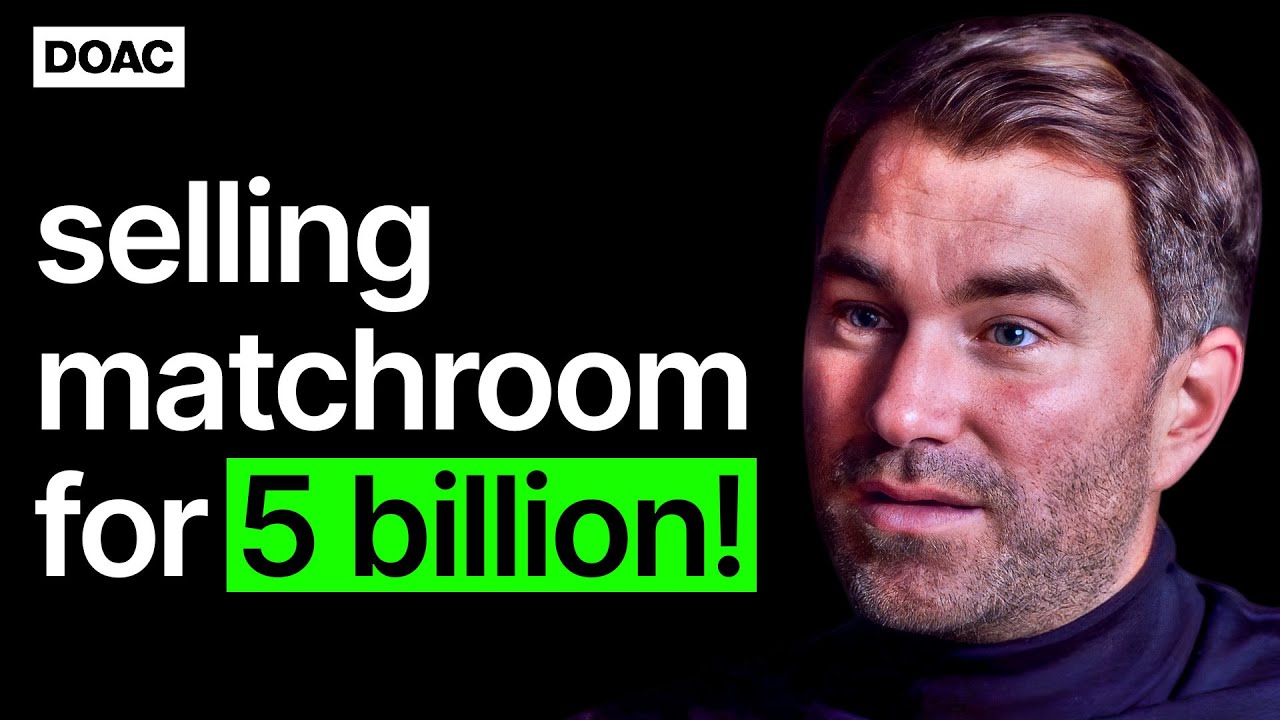
Eddie Hearn on Selling Matchroom For 5 Billion
Guests: Eddie Hearn
Full transcript · Read the full conversation in order, with its original context.
Contents1 chapter
§01Transcript — part 1§01Transcript — part 1
When your cat is acting weirder, or your dog is being louder, your turtle moves slower. Hello, Ted? Your cat seems thirstier. Whoa, slow down buddy. Or your puppy is acting clumsier. Day or night, if you don’t know what’s wrong, know where to go. Veg ER for Pets. This is Kate. Veg, the better, kinder ER for pets.
Oh my god, Eddie Hearn. What a guy. There’s very few people—no, I’m going to change that. I’ve never met someone as neurotically obsessed with success and with winning and with accomplishing things, and with living a life in constant forward motion as my next guest, Eddie Hearn.
And it’s remarkable because when you unpack the reasons for that obsession and that dedication to being more and achieving more, there’s quite a fragile, vulnerable, insecure story. That’s something I’ve noticed with a lot of my guests. And it often makes me think that the most successful amongst us aren’t necessarily choosing to be.
Something’s happened to them that’s left them with no choice. Eddie Hearn is one of the most notorious sports promoters in the world. He’s the king of boxing in this country. He is known for his "No Context Hearn" Twitter page, which I’m sure a lot of you have seen. But what I wanted to do when I sat down with Eddie Hearn was to get underneath.
To get underneath the external, sort of braggadocious, loud promoter side of him and to find out, even in the case of someone like Eddie who is loud, who is successful, who is ambitious, who is a promoter, are the same things true for him that are true for you? The insecurities, the vulnerabilities, the mental health issues.
And how much does he really understand himself? My conversation with Eddie Hearn was incredibly enlightening, but it also wasn’t that surprising. So without further ado, I’m Steven Bartlett, and this is The Diary of a CEO. I hope nobody is listening, but if you are, then please keep this to yourself.
You’ve done a ton of interviews, especially over the last couple of weeks, and there’s this really consistent theme that I felt in all of the interviews I watched. I watched you at Cambridge, the High Performance Podcast, loads of them. And then before we came and started filming today, I had a chat with Frank and he fully grassed on you.
No, what he said to me, which was also consistent with these interviews, is that you are relentless. And he was telling me he’s had some—I probably shouldn’t say this—but he was telling me he’s started having this—is it a night owl or nightness? Because Eddie would text me in the middle of the night. And he went, "I’ll tell you one thing about Eddie, he is relentless."
You’re what, 41? 41 years old. What’s made you that relentless at 41 years old to the point where you’re pestering your colleagues at 3:00 AM in the morning?
I don’t know, really. I think when I did the book, it was like quite a good sort of counseling session with myself because I wasn’t really great at school. I wasn’t particularly a hard worker at school. I loved the pound note, always.
And when I wrote the book, it just—I started writing about my childhood and what it was like growing up and how I was molded. And I think a lot of it comes down to the fact that I love to win. And I’m a—
Why did you love to win?
I don’t know, because with my dad, that’s what we did. So when we played cricket, when we played football, when we played table tennis, when we sparred with each other, it was like—for me growing up, you weren’t—you know, I would come back from a match, say I played cricket, and he would go to me, and actually my mom was the same, and he would say to me, "How many runs did you get today, son?"
And I would say, "Oh, four." "Ah, useless. Come on. Next time, knock in a fifty." Right? It was never, "Oh well, well done son, you know, you took part. That’s what really matters." They taught me taking part is completely and utterly irrelevant. You win.
And ultimately, sport is how I was brought up. I was brought up on the foundations of sport, the lessons of sport, the winning, the losing, you know, the highs, the lows. But always taught that winning was everything. So I’m a failed athlete. You know, I think any kid growing up would love to be a sportsman.
I played cricket at a very good level, but I was never good enough at anything. So this is the next best thing. But I think if you’re not trying to win in life, and win—winning means something different to everybody. Success means something different to everybody. Some people view success as being able to get their pay packet on a weekend.
You know, being able to spend time with their family and have enough food on the—you know, make enough money to have food on the table and make sure everything is okay at home and be happy. You know, and have a happy life with no stress or no drama. That’s success to a lot of people.
But people’s interpretation of success is very different. And for me, I still don’t know why I do this. But like you say, I love it, I guess. That’s what it comes down to, a passion for what you do. And I don’t know what the passion is. Is it the passion that I love the sport of boxing? Is it the passion that I want to succeed against, you know, and be bigger than my dad? I think that’s a big part of it as well. Or is it just that I love to win, or is it that I’m a bit sick in the head? Maybe all of them.
The "sick in the head" point. I want to play with that idea a little bit. I write—I wrote in my book actually, we have the same publisher—I wrote in my book that the thing that invalidates you when you’re younger becomes the thing you seek validation from when you’re older.
And what I meant by that is like, in my childhood, because we didn’t have money and I was this Black kid in a school of 1,500 white kids, everything that we didn’t have became the things that I chased when I was older, or the thing that made me feel somewhat invalid sometimes when I was a kid, like you were saying about your dad saying, "Oh, you lost today," became the thing that I would seek validation from as an adult. And I wondered if that resonated with you at all.
Well, I had a different background. I mean, my dad was poor, became rich, and then I was born. So I’ve said before, it’s not like when you talk about generational wealth, we didn’t have generational wealth. I had a dad who was from Dagenham, was from a council estate. His dad was a bus driver.
And then I grew up in this sort of nouveau world where this bloke had made his money and he was—you know, I take the mickey out of him, I suppose he was a bit of a chav. You know, he was like from Dagenham and all of a sudden he’d got Ferraris and big cars. And we used to have a white limo and a black limo that would drive like the snooker players around and the fighters around.
And I was horrible. I was obnoxious. Imagine like a 14, 15-year-old kid hanging around with Eubank and Naz and then you’re in the limo with your mates going up to London or to Romford for a night out. I mean, oh, I look back and just cringe. But mine was different.
And I guess when it comes down to it, and again, from the book and speaking and speaking to people like Frank Lampard—he went to my school, he was in the year above me. At my school, I was Barry Hearn’s son. And Frank Lampard was Frank Lampard’s son. You know, his dad played for West Ham, he was—and it’s a different kind of drive if you can make it flow in the right way.
You know, when you’re talking about sort of mindset and hustle where all of a sudden, I think so many people with successful parents end up just doing okay, you know? But how do you go beyond that? How do you outperform everything that he done? And I will—and I feel like I’ve done that in many ways, but I will never be able to outperform the fact that he came from nothing.
My friend—my friend is in a very similar position. If I said my friend’s name, you’d know the guy. His dad is a multi-billionaire. I know you know him because I’ve seen you with him before actually in New York. But his dad is a multi-billionaire and he grew up living in the shadow. And his dad was the same. And I had a conversation with him and he said, "I was always trying to be better than my dad." He is now a billionaire himself of his own doing. But it’s just—it’s fascinating. And his dad sounds very similar to what your dad sounds like, where his dad was tough on him. Tough on him in—
I think they’re tough on you because they don’t want you to be that spoiled kid. I mean, you always want to spoil your kids, you know, you want to give them the great—even now, you know, I’ve got two daughters, I love to spoil them. I work hard so I can give them a great life. But I just want them to understand manners, respect, and discipline.
These are the three most important things. And he would make sure that I would understand that, even by having me working, giving me a clout every now and then, trying to keep—because it must have been frustrating for him because I was probably all the things that he resented when he was growing up. You know, the rich kid with parents who have got a big house and cars. And I would have hated me at school, you know? But he would have looked at me and that’s why he was so disciplined with me.
And I was in his slipstream growing up. So I would sit—we’re here now, that was my house over there. So he would get home from work if he was in the country. He would always go out and give me a game of football or cricket, and then he would go in the office all night on the phone. And I would have dinner and I would just sit in the office, you know? I might have a ball just throwing it up in the air, but I would subconsciously listen to the arguments and him losing his temper and just listen—not because I wanted to learn, just because I was there.
And you’re talking there about the sacrifice of his success, which is—one of them, as you’ve highlighted, is less time with your family. You are relentless; everybody says that. What is the cost of being a relentless person?
You have to be incredibly selfish. You have to—for me, family is the most important thing, but I have to be brutally honest and say I don’t let even family get in the way of things that I have to do.
You know, and that can make you an asshole and it can make you sound terrible, but I just don’t know any way around it. There is no way you can be the perfect husband or the perfect father and run a successful business or be a relentless operator. It’s impossible because I know because I try to balance both.
But when you’re flying back from America from a show and you land at 7:00 in the morning and then you go to Manchester for a press conference and then you come home and you just make it to pick them up from school and then you get back and they say, "Dad, Dad, let’s go over the park!" And you’re just absolutely on empty and your phone is going and you’re trying to do another deal.
And you’re pushing the swing and you’re going like this trying to send a message at the same time. It’s impossible. You know, listen, I know because sometimes my eldest daughter is old enough to say, "Dad, please get off the phone." And that kills me because that’s—that’s bad to hear. And I’m like, "Okay, okay." But then 30 seconds later, I’m back just having a look down because it’s a lifestyle.
You know, and it’s impossible to be great at anything without making sacrifices. You know, it doesn’t matter if you’re a fighter, if you’re a sportsman, you speak to all successful people—you can’t be everything. It’s impossible. You know, and but what you don’t want to do is you don’t want to disregard your obligations, your family obligations, because they are extremely important. But you also need a wife or a partner who is understanding enough to say, "This is what I know what he’s like. He won’t stop."
And that’s why when Frank talks about the 3:00 AM, 4:00 AM, that’s because a lot of the time I’m sort of making up for the hour or two that I’ve lost out playing with the kids. So I’ll put them to sleep, they’ll go to sleep at 9:00, 9:30, chill out with the wife for an hour, she’ll go to sleep, and then I’m up. And now with the growth in America, it means that at 4:00 PM, 5:00 PM, the West Coast wakes up. So I can’t go to bed—I can’t disappear when it gets to 11:00 AM or midday on the West Coast because they want to speak to me and we want to do business.
I am much earlier in my career, maybe I don’t know, 15 years earlier in my career. And I’ve struggled with romantic love for the very same reason that for the last decade, I’ve like slept in the office multiple weekends, I’ve been obsessed. I would basically sacrifice everything. And then there became this moment in my life where I think it was maybe the day that someone tried to buy the company and I thought about what I’d spend it on.
And I remember going home—and I swear on my mother’s life—I went on Rightmove and Auto Trader at the same time. I had two tabs open. And I’m like—
Before you could say Tinder!
No, no, no, no. No, that always follows the Lamborghini. So I was looking at this Lamborghini and this mansion in the countryside and then I thought, if I buy these things, I’m trading like this purpose I have, this job, this for this Lamborghini and this mansion. And it felt really, really empty.
And then I thought, but Steve, you know, when you were 18 and you were broke and you had no money, 18-year-old Steve said, wrote in your diary—and this is why it’s called The Diary of a CEO—that you wanted the sports car, the million before you were 25. This is what we did it for. And then it threw my head into this like confusion. I was like, if it’s not that, if that’s going to make me feel empty—they call it like gold medal depression where Michael Phelps won all the medals and then got depressed—then what’s it all for? And then I thought, and then also, when does it all end?
Like when does it end?
Well, it doesn’t end because and actually, you’re always searching. This is a problem and something you have to be careful of because when you are trying to succeed and when you’re trying to become great, actually the great people, they never feel content with achievement. And I’m very much like that. Frank Lampard again, going back to him, he said that when he won the Champions League—he’d always dreamed of winning the Champions League—and he stood there with the trophy and he felt nothing.
I mean, he felt happy, but definitely not content, definitely not "I’ve cracked it." That might go back to the sickness that we talked about earlier. And when we talk about sickness, I mean not probably medically sick, but sick in the head a little bit to a point where I get it all the time. You know, we say that, you know, we wanted to do—when AJ turned pro, we wanted him to be the world heavyweight champion. He won that. Great. We were in the ring after, jumping up and down. As soon as we got out the ring—
The moment?
Yeah, and then it’s like, okay, well we want to do something else. You know, we got the Klitschko fight. Okay, you go through it, 90,000 at Wembley, you stand there, everyone that was at the event tells you it’s the greatest sporting occasion they’ve ever been to.
How’d you feel?
At the time, amazing. In the ring, amazing.
Day after?
Not even the day after. It’s—I never go out really and I never drink really after a show because that’s probably—depressed is the wrong word, but you—I go back, you know, finish the media obligations, 2:00, 3:00 in the morning, go back to the hotel and that is when I’ll sit there, get into bed, and then obviously you can’t sleep because the buzz and the adrenaline.
And that’s when you just feel a little bit low and empty is that okay, it’s over. Same with what you talk about with Phelps, is the highs versus the lows. You can’t just experience the highs and then be happy with the lows. So you want more and more and more and more. And I’m my own biggest critic and I’m also very pessimistic, which is strange to a lot of people. But I kind of use it to play tricks on myself to keep myself driven.
So when I do something or when I plan something, I always say to myself, "There’s going to be problems. It’s—I think it’s going to go wrong. I doubt this will happen." You know, I don’t know why I do it, but it just helps me to battle away to overcome everything to get to the place. And then when I achieve something which others might think is great, I say to myself, "That’s nothing. You got a long way to go." Because I’m scared of sitting back, you know, with the cigar on the beach and going, "I’ve cracked it. You can’t touch me."
You know, and we got to a position with UK boxing where we are virtually untouchable. But I just don’t want to be that guy who takes the foot off the gas. I want to bang every single nail in the coffin and then move on to another market and another market and another market. But you do get—the worry with that mindset is you may look back when you’re 80 or 90 and go, "Wow, you know, look at everything you’ve done. You never really enjoyed it, did you?" I mean, I love what I do, but you probably should savor it a little bit more than you do. But again, it goes back to that mindset of being so driven. You want the next—it’s a drug. Success is a drug. But you got to be careful that it doesn’t turn you into an asshole at the same time. Because how many successful people do you know? Absolute assholes. Horrible, rude, no manners, obnoxious.
What’s it done to—do you ever find moments where you think, "Fuck, I was just an asshole then"?
I think that it’s just time for people. You end up being—it’s not that you turn into that if you—if you’re not one, but when you become busy, it’s a bit like, you know when people say that go, "Oh, he’s changed." Of course he’s changed. His life’s changed. You know, his responsibilities changed, his business’s changed. You can’t expect him to stay the same person.
And you know when you have a group of friends when you all come out of school and sort of you go from there and you’re talking every day and the ones that sort of grow, the friendships are still as strong, but you just don’t talk to each other every week, every day, because you got your own lives, you got your own vision, you got your own plans.
But you still go for lunch and you get on better than ever. And it’s the ones that say, "Oh he’s not—oh he don’t talk to us anymore." "I ain’t got time, mate." But this goes back to the sacrifices. You know, if I fall out with friends because of what I’m trying to achieve in my own personal life and my business, so be it.
I know again that sounds, you know—and it’s not about being a bad friend or a bad person, but you—you can’t—you can’t worry about other people. As long as you’re a good person, as long as you do the right thing. The fact that you don’t have time at the moment, but that’s when people might perceive you to be an asshole, you know?
You talked a little bit about there about being 80 years old and looking back on your life. I’m going to just play a little—a little game with you. So we’ve got to imagine—imagine that what day of the week—I think it’s Tuesday today, Tuesday. So Friday you find out that Friday’s your last day on Earth. My question is, and really put yourself there, right? So Friday’s your last day on Earth. All the fights coming up, AJ, Fury, all of it falls away. What do you immediately regret?
That’s actually something that I’ve thought about quite a lot. And the reason was is about four months ago, my granddad passed away. He was 93. Great life, you know. And when I went to see him in his last couple of days, you know, and he obviously didn’t look great. And I looked at him and I thought, "Wow, life’s crazy, isn’t it?" I said, "Everything that you’ve done in your life and now you’re laying here about to leave."
So when you get experiences like that, it just—you have to be reminded sometimes that this is a game. Life is a game. We’re only on borrowed time, right? And you can never take yourself too seriously. I think that’s one thing I do well is I love to have a laugh and I don’t take myself too seriously. In answer to your question, since that moment, I’ve been thinking a lot about if I, you know, if I went now, do you look back and say, "I couldn’t have done any more. I had a great time"? And I think the answer is yes.
I mean we could all—we can all do better. But my dad is an inspiration in that respect because he’s the kind of person that couldn’t have squeezed one more drop out of his life, right? So I’m quite envious of that. He’s 73 and who knows how long he’s going to last. But I do feel like it’s very important that when you get to whatever stage when God says that’s enough for you, that you are able to look back and say, "I couldn’t have done any more." And and that scares me a little bit because—
I want to know exactly what. When you think about "more," you’re saying "I could have done more." You find out that this Friday’s your last day, what are the things where you think, "Do you know what?" Because I think that the—that moment, like the deathbed moment, puts everything in perspective.
It does, but I think in that moment, your emotions are very different to when you’re well and fit and on the hustle and just, you know. So you don’t get a chance to reflect on that kind of moment until you’re there. And the obvious reflection at that point is, "I wish I would have spent more time with my family." You know? "I wish I would have been less focused probably on work."
But I’m not a believer in, you know, the thoughts then are not the thoughts now. And you have to act on the moment. You can’t live your life saying, "Well blimey, when I’m on my deathbed," you might look back and because I don’t think you can plan like that. You have to do what’s in your heart, you have to do what feels right.
And what feels right for me right now is this. What might feel right then is, "Ah, do you know what? Should have probably missed a few trips really and just done the school run a little bit more." And I know that, you know? You have to—you really have to understand where you are in life. This is great for your mental health as well and your sanity. You got to be honest with yourself and you got to understand the situation. I know exactly where I’m at, what I’m thinking, what I’m doing, the sacrifices I’m making, what I could do better at, what I—you know, but I’m okay with it. You know? You can’t get the perfect balance, but as long as you understand what is going on and you’re not deluded, you’re not stubborn. "Ah, don’t worry about—" you know, I know. I know I need to do more at home. I know I need to do more school runs. I know I need to be less short with the wife sometimes.
But can you—there’s a couple of points here that I think are super interesting. So that deathbed moment, what I think it’s doing, and I’ve never been there, you’ve not been there, but what I think it’s doing is it’s telling you what actually mattered because to some degree. I think that it’s like with that hindsight you can say, "Fuck, that person criticizing my hair or my car or this—none of that fucking ever mattered. All of that was trivial. The things that mattered were," as you say, like your kids. So I think that’s what that moment’s doing.
But that comes over time. How old are you now?
27, 28.
Okay, you’re a baby. Right? When I was 27, what people thought of me really mattered. You know? I mean listen, I’ve been working out for 35 years just to stay fat. You know? The barnet’s going a little bit. I could not give a monkeys now. At your age, oh mate, I was, you know, I might have been jack-the-lad, I might have been turning up but—deep down, you know, it only take one of the boys to say, "Tell you what, Ed, you’re putting on a bit of timber there," or, "Look, look, your barnet’s creeping back." "What? What do you mean? What do you mean?" Now I go, "Yeah mate, I know. Listen, sign of the times, isn’t it?" So being comfortable with yourself is the best feeling in life. You know, it’s the best feeling in life. And I think when I was growing up at school, I wasn’t subconsciously. I think I had a massive chip on my shoulder and that’s why I was a bit—a bit of a knob, to be—to be quite honest. But when you get comfortable with yourself, it’s a beautiful thing in life. It really is. You know when you wake up in the morning and—you’ve always got to try for me and look good and feel good and be the best version of yourself you can be, but you do get to a stage, and that’s actually when you become really powerful and effective. You know, it’s the same kind of thing. You know when you’re young and you’re courting or you’re looking for a young lady to show you some interest. You know when you try really hard and you’re sort of on edge and you bit, "Oh, don’t really like my hair," or, "Oh my god," you know? You know the ones that walk into the bar and just go, "Ah mate, you know, look, I know I’m not the best, but I—" you know, they’re the ones that everybody gravitates to. Anyone with a smile on their face is always—creates so much more energy and flow than the people that don’t. And that’s about being comfortable in yourself. So I think that it’s very difficult with everything you’ve achieved at your age to just know where you’re going or what you’re doing. I’m done. Do you know what I mean? I’m married, I got two kids, I got a bus—I’m struggling to balance everything, you know? But I’m here, you know? I’m not going to roll back the years and do this and do that and I know exactly what I’m doing. I know exactly where I’m at, I know exactly what I’m focusing on and that life starts to become a lot easier then. At your age, you know, I went to—I left college after my A-levels. I went to work for five years in sports management companies, in event management companies. I was a sports agent on the PGA Tour in America. I’d no idea where I was going. I mean, I knew I just wanted to be successful, I wanted to earn money, you know, but the mindset—or the changing mindset—over the years is unbelievable. I always say to people, you know, what matters to you now, you will look back on when you get to my age and go, "I can’t believe I even used to worry about stuff like that." And and that—that’s important because I feel like people that are very successful, you know, you did it at a very young age. Very impressive because I think it takes time. You know, when I did the Cambridge talk the other day, you know, you’re sitting down with all these young—I mean, I’m—I’m street smart and I can sell, right? These people are like—
Boffins.
Yeah, boffins. But I’m jealous of boffins. I used to take the mickey out of boffins. I’m jealous of boffins now. I find intellectual people fascinating. I love talking to them and just trying to learn and absorb. And I’m sitting in this room of people and they’re listening to me and I’m thinking, you know, firstly, you must be listening to me thinking, "This bloke, who is he? What is he, a used car dealer?" Or something like that. And then but I’m looking around and I’m saying to you, "What do you want to do?" "Pfft, er," you know, "What is success to you?" They’ve not got a clue. And it’s not because they’re at Oxford and they’re deluded, it’s because that’s just—it’s very difficult at that age to understand. I don’t believe anyone at 40 looks back at what they were thinking at 20 and said, "Yeah, I had this plan and I’m there now and this is what I always wanted to do." So it takes time to develop a passion for something. And that—that is the—that’s a keyword, "passion." Because we talk about being relentless and we talk about this work ethic. You can only have it if you love what you do and if you have a passion for what you do. I don’t think you can trick yourself. You can, but you can’t be as good, you know?
You know you said earlier that you you feel like you’re self-aware of like the lack of balance in your life because you’ve got this real relentless streak, you’ve got this family, and you’re self-aware of it. Do you think as much as you’re aware of it, do you think deep inside you you really have a choice? Or do you think you’re being somewhat dragged by your own ambition? Because this is what I find fascinating about successful people, is it tends to be the case that like me, I’m aware I need to see my niece more, but I just sometimes don’t feel like I’m fully in control.
Well, I do it because it’s what I want to do, ultimately. I mean, I do have an obligation, you know? I do have responsibilities. I’m talking about in the workplace. You know, we got a fantastic team here but ultimately, when we’re announcing a show, when we’re doing a press conference, when we’re—they want me. They want their flesh. So they roll me out and I’m just like—I’m like a traveling salesman. "Right Eddie, we’re announcing this show today, off you go." "Right, here we go, blah blah blah," back in the car, "Here we go," you know. So but I do it because I enjoy it, because I love it, because I have an obligation to do it for the business that my father created. And I’ve—my responsibility now is to take that to the next level. You know, he built this from the foundations from nothing. I’m not going to let it just fizzle out as he goes into his 80s. I want to take it to the next level. But the difference is, is I don’t have to do this. You know? I’m not looking at this saying, "It’s my way out." "Oh, just if I just make some money I can," you know, "I could buy the Lamborghini," I could have done that at 21.
But imagine the Eddie that doesn’t do this. Imagine what—how he feels.
Oh, but the same thing. That was me at school. You know, that was the kid telling the teachers, "I don’t even have to do that, you know, I want—" and that—ugh! Can’t stand that. That runs shivers down me.
Give me some advice on—because you’ve got—you’re married, and I’m genuinely—
Are you on dating apps or anything?
Genuinely. No, no. No, it sounds crazy but I’m like, you’ve managed to crack—it seems like, because you’re married—managed to crack the balance of being relentless on one end but then managing to find a person or to at least keep them happy to some degree. I’ve not—I’ve not spoke to—yeah, I’ve not spoken to her. But I genuinely, I’ve started to think over the last couple of years, I’m like, how am I going to find someone that understands that I want to send text messages at 4:00 AM in the morning and that I sometimes don’t want to talk to them and that when I’m sat next to them I’ll be quiet for seven hours because I’ve just got an email that I’m thinking about? And so I’m like, is it—you have to find the right person? Is it something you say to them?
I think they need to know you. They need to know what drives you. I mean if you had a conversation with my wife and you said, "What—what is he like?" You know, she’d just go, "Well he’s just in his own world, isn’t he?" I mean the amount of times, you know that moment where you get home and they go, "Right, I need to talk to you." And you go into the kitchen and they go, "Right now, er Isabella, you know, I spoke to her teacher today and—" and what—I’m gone. Right, so I’m—I’m going and I’m thinking that contract’s got to be in at 9:00 PM, you know, blah blah blah. And she goes to me, "What did I say?" And I go, "The school. What? Isabella." And she just—she—but it’s not like—and she’ll go, "Listen, we have blazing rows. You’re a—you know, you’re so selfish, all you care about is work," you know? But again, it just gets to a point where you just have to understand life. You just—nothing’s perfect. You know, you got two people that love each other. I’ve known her since, you know, my 20s. I’ve—I’ve changed—we’ve both changed a lot over the years, but we’ve changed together and we’ve grown together. And this is what I do. You know, and I would have had that conversation with her at some point many years ago to the point saying, "Look, nothing is going to get in my way. I—and I don’t mean to sound horrible. And I love you and, you know, I want to spend the rest of my life with you, but you have to understand me. You have to understand that this is extremely important to me." Don’t—don’t say this is the *most* important thing to me because that’ll get you bang in trouble, but you know, this is extremely important to me. And I think because she’s been around my family, because she knows how important it is to us, she kind of just gets it, you know? And there’ll be times where she’ll say, "Did I hear you on the phone last night at 5:00 in the morning?" I say, "Yeah, you know, we was doing the Canelo deal or AJ deal or—" and she would just look at me and go—but over time, you know, I think the most—the most difficult thing is the early stages of dating because it’s very difficult for a woman—they want your attention. You know? People—people sometimes think that women want, er, you know, money and, you know, the nice house and of course everybody does. But they don’t really. They want your attention and they want your company and they want your time. And they’re three things that are very difficult to do when you live that kind of lifestyle. So you do have to, you know, we’ll do—I’ll—I’ll race back from somewhere and I’ll say, "Right, you know, tonight let’s go out for dinner." And I’ll be knackered. I don’t, you know, hopefully she don’t listen to this—I *really* don’t want to go for dinner tonight. But you have to do it. And that’s what my dad has kind of always taught me is, son you got to do—you got to—my—big—we’re big family people. My mom is a—from the East End, she’s old school. As far as they’re concerned, the man goes out and puts the bread on the table and the wife looks after the man. Old, old, old world. That don’t exist anymore, but every morning or every night, my mom will iron my dad a shirt and she will put it on his—on the door for him in the morning.
If your—if your wife, right, say I—say I—we brought her in this room, we sat her down with God and we said, "Listen, you can decide what happens next with Eddie and his career. Right? So you can—we can bring it to an end and he’ll spend more time with you or whatever." What do you reckon she would do? If she could make the decision on you, your relentlessness, and your career, how do you honestly think she would make that decision?
I think—I think she—because she knows how important it is to me, I think she would say, "No, he—he—he needs to do it. He has to do it." But I think the—I think the hope is that there is an end place or an end goal. For me—
Does that exist?
Yeah, but for me, I don’t—whether in 20 years’ time we—we play this back, I don’t think I want to be 70, you know, maybe even 60, 70, 80 doing this, dealing with problems and listen, maybe I won’t even make it that long. But for me, I definitely have the mindset of, not "I want to get in and get out," but I—I *do* want to get that moment where I do sit on the beach with a cigar—don’t even smoke cigars but, you know, and a whiskey—don’t even like whiskey but, you know, I can imagine the picture at least—and go, "Do you know what? We done it. We done well."
But walking away is the thing that at the moment would kill me, you know, to be able to—imagine when you wrap up shop and, you know, this might be—I mean for us, we’ve gone from being a family business, you know, to having four employees to now all of a sudden having hundreds of employees in in multiple offices around the world. We’re being approached by for for investment, for takeover, for IPOs. And now we’re sort of at that stage of growth where, I don’t know, I just see—I see a faster exit strategy than my dad. At least that’s what I’m selling to her. You know, just give me a few more years, just give me a few more years. But I do want to go and enjoy because I can’t say I’m not enjoying myself because I love what I do, but I do want that moment to just, you know, but it’s the walking away. You know, how do you just one day turn around and you might sell the business or, you know, you might float and you take a more of a backseat role? That’s difficult because we make our own decisions. We’re a hands-on business. That’s what we love. We’ve turned down investment and opportunities for years because we don’t want to—I don’t want a board of directors. We make the decisions and we do what we want to do because we love what we would—we do. But when you see such growth and you see such interest and you see the opportunity for, you know, a much vaster wealth, being quite honest—do you want it? And if you want it, what’s the exit strategy? Because at the moment, the exit strategy for our family is from the day you start working to the day you die, you work your nuts off every single day. I mean, it’s not particularly advanced, is it? That strategy. But that’s just what we’ve always done.
Mental health, big topic. Especially over the last 10 years. I think if you go back—well, 10 years ago—and you said the word mental health, people think people are crazy, right? They think like, "Ugh, you know, run away from that person." But now it’s become like the opposite. It’s like, "Oh, someone’s got—you know," it’s become something of where you’d give someone affection and you take care of them because the stigma’s somewhat changed. We know the stats around male mental health. Have you ever suffered from any sort of mental health predicaments?
I don’t think so, no. I mean, I think again, depression’s one of those things a bit like yoga and breathing and stuff we were talking about earlier. If you would have said to me 10 years ago—listen, maybe even five or six years ago—so-and-so’s suffering from depression, if if your perception of that person is, well, he’s young, he’s good-looking, he’s healthy, he’s rich, he’s successful, how can he be struggling from depression? What a load of rubbish.
And actually, it takes the older generation even longer. I mean, I think my dad’s only just accepted now that it exists with people because his mentality is, "What? Dust yourself down! What’s the matter with you?" And it’s that—you know, that’s wrong because it is real, you know? And it does exist. Um, I don’t, you know—have I had days where I’ve been feeling incredibly down? Yeah. But surely that’s normal, you know?
I don’t—I don’t see myself suffering from that. And I think—I think mental health problems and depression, I think it comes from overthinking. You know, my—my brother-in-law is hilarious. He just—I’ve never known anyone who just overthinks and worries about stuff. You know, you’ll be able to have a conversation, he’ll go, "I’ve just been thinking about that, you know, and and if that happens, I was thinking, you know, next year you could be there and that and then from there—" it’s like, "Whoa, whoa, whoa! What are you doing?"
Just when you’re struggling mentally, focus on the short term. Focus on day by day. I think sometimes people look at—and this is the same for business—when you have a project or a long-term plan, there are so many short-term obstacles and goals to overcome to get there. That’s why how many times you spoke to some, "Got this idea, you know, I’m going to be doing this and that and blah blah blah." And then a month later, you’ve not even heard about it. "Oh, well what happened was we launched and then, you know, the council came in or the regulation board came in and and this other company tried to do this and that and it just—" it’s like, no, because you didn’t focus on the short-term goals. All you were worried about was the house and the Lamborghini and you weren’t prepared to tick the boxes to get there.
So sometimes when I’m a little bit off or, you know, it might be traveling a lot and the equilibrium has gone and it’s like, okay, so I’m just going to write down what I’m going to do today. And it can be really menial stuff. Could be walk the dog. You know, could be finalize a contract. Could be go to the gym. Could be go and get some food, you know, from M&S or whatever. Just to focus yourself a little bit. Just to say and I would tick every one off. Really? Yeah. And I would say at the end of the day, I would look at it and I would go, "Done." And that’s the momentum back. That’s where you get the feeling of accomplishment even on tiny things to say, "Okay, I’m moving in the right direction." For me, that is a big help for me is short-term focus. Because once you start worrying about what’s going to happen next week or next month or next year—
You can’t control it.
No, and you’re going to start driving yourself crazy. You’ve just got to say, "Okay, I—this is what I need to do today." And tomorrow, I need to do the same thing. And then before you know it, you’ll start making positive changes, you’ll start achieving because you know what you’ve—you know what you’ve set, the targets you’ve set yourself, you are achieving.
You’re a bit of a philosopher, I don’t know if you realize, because um there’s a great famous philosopher that says, "Depression is too much of the past and anxiety is too much—thinking too much about the future." And he says the cure is more "now." And that’s pretty much what you’ve described.
No, but that—that is true because you can’t worry about things that—that may or may not happen and you can’t change things that have already happened. What you can do is change what is happening today. And it’s simple to do that. Again, in in the book I ran a marathon, one marathon, right? Because my dad ran loads and he took the mickey out of me and I had to do it. And it’s the same kind of thing. You start the marathon, you think 26 miles. If you start thinking about running 26 miles, I mean I was—it did give me anxiety attacks to start with. I was thinking, "That’s just ridiculous. I’ve never done more than 10k." And then you train and you train and you train and you build and then every mile marker is an obstacle. You start off, you think, "26 miles, blimey," and then you go one, two, three, four, five and you’re you’re okay and then and then you’re at 12, 13, you think, "I’ve done half." And then you get to 18, 19, you think, "I can’t do it anymore," and you think, "Just get to 20. Get to 20, 21." And when you see that 20-mile marker, you know? And then you get to 20 and you go, "Do you know what? I’ve still got six miles, I can’t do it," and you go 21, 22, 23 and then when it’s all over, you can look back. But if you start worrying about the future, you’re going to gas out. You’re not going to make it.
Do you feel that anxiety sometimes in those big moments where you’ve got, you know, some things coming up and you just can’t stop thinking about it? In my business, it was actually the first, you know—I heard this term mental health and I think at the start, I thought, "Nah, it’s not real." And then a couple of years in, I started hearing, you know, friends of mine and stuff going through really bad things and I’m like, "I think it’s real." And then I got to this point where I was almost scared to admit that it would be real because I I almost felt like if I admitted it was real then I’m like welcoming the possibility into myself of like labeling myself something. And then there was one moment where I had this really big decision to make in New York and I’m laying in the hot tub in Manchester and I just got really anxious. And I was anxious for about four days up until the point of the decision and then I thought, "That’s probably the closest I’ve come to some kind of mental health predicament, is that real anxious feeling that I couldn’t shake."
I think social media is horrendous as well. Like I’ve made the decision in the last couple of years, years specifically, to start ignoring and blocking out a lot of—
You’re a celebrity now.
Yeah, well—but when I was coming through, when I was overturning the system, the support was unreal and I was really feeding off that. I mean anyone that says, you know, they’re not affected by criticism or they’re not worried about—I mean that’s a load of rubbish. Of course you don’t like people criticizing you. And by the way, you love people patting you on the back and championing you. Of course, that’s—that’s natural.
What things get to you though?
Stuff that people—like the personal stuff, couldn’t give—couldn’t give a monkeys about. It’s more about the—it’s more about people when you’re putting the work in something and you’re so passionate about something and you’re actually working for the good of—it might be the sport or whatever. It’s the people that just, you know, presume—see you completely differently. So that’s the frustration.
But over the last couple of years, I just started thinking to myself, "What are you—" I was having a conversation with my old man. My old man’s on Twitter, right? And he phoned me up and he goes, "I was having an argument with this geezer on Twitter, right, and he was going on about the snooker in the format and I said to him—" I’m like, "Whoa, whoa, whoa, whoa, whoa!" I said, "Are you serious?" I said, "Who is—one, who is this bloke?" I said, "You imagine someone stopping you on the street and having a—having a pop at you about the snooker format?"
But it also, it’s the platform that made us what we are. It got us to the top, you know, the interaction with the fans and the understanding of their mindset. So we can’t just—no, but it’s become a toxic place. It really has. You know, and I worry—I worry for my kids. You know, sometimes one of them will be on TikTok and she’ll put a dance out and someone will come back and say, you know, I don’t know, "You’re ugly, you look—you’re stupid," you know. And it’s like, we never had that in our day. I mean we never even had a phone. You know, someone didn’t like you they might say something in the playground but that’s about it.
So we live in a world of criticism and I think it’s and negativity. But that’s what I said to my old man, I said, "You imagine like these people, they’re doing it all day." I’ll put a post out, you—it’s the same ones all the time. And I look think—you know, and even um to the point where someone posted my phone number on Twitter, right? And I’ve had my phone number for 25 years. Same one, right? And someone posted it and went, "Give it—this is Eddie Hearn’s number! Give him a call and, you know, tell him what you think about the pay-per-view price," or whatever it is. And my phone was going mental—it was like every literally all day it was just private number, private number, private number and I thought, "You know what? You got to change your number." And then I thought, "I can’t be bothered." So I started answering a few, right? And to this day, this was a few years ago, it’s stay—people still do it.
You’ve got the same number?
Yeah, I can’t be bothered to change it, right? So this guy—private number, private number, private number. And it’s all day, right? So I pick it up and I go, "Hello mate." And he goes, "Oh, bloody hell! Eddie!" And I go, "Yeah, how you doing mate?" And he goes, "Uh, um, uh, when are you going to stop ripping us off on the pay-per-views?" or something like that, right? And I go—and and I I and I went to him, "Mate, let’s have a serious conversation. What are you doing?" And he goes, "What do you mean, what am I—" I said, "Have you got a job?" And he’s like, "Uh, yeah, I mean—" I said, "You haven’t, have you?" And he’s like, "What? Uh, not at the moment." I said, "What are you doing? I said, how many times have you phoned me today?" "Oh," uh, I mean the answer was like 40, right? I said, "You got to focus," I said, "all the energy you’re putting into phoning me because you think it’s banter or it’s some kind of an accomplishment if I pick up the phone. I said, put it into something worthwhile. I said because you really wasting your life."
And he just went quiet and he’s like, "Oh, come on Eddie, what about a few quid off the pay-per-view?" And I’m like, "No, no mate, I’m serious. Like I want to help, you know, you’ve got to—you’ve got to change." You know? And then he just hung up. And I thought, "Shit, I hope he’s alright." But it’s like—but it’s true, isn’t it? What are you doing? What are you doing? I mean alright, once might be quite funny, you know, I pick it up and you give me a bit—but like all day every day. You know, because I’d hate to be one of those people that just wakes up every morning with no fire in the belly, with no passion, with nothing. And there are, by the way, that’s 95% of the population. Many people, that’s why it’s so important to me here to create an environment at Matchroom for the—for the team where you enjoy being there. You know, we got—we get food together, we got a gym, we got a pool, we got—we’re all traveling away to events, we’ll have a night out, we’ll do that because you can’t be in a job or a life where you’re just flat. How am I going to get the best out of you if you don’t love what you do? And it’s very difficult to have that same passion when it’s not *your* business, you know? So motivation’s important.
You know Frank said to me, he said, he said, "Eddie’s—Eddie’s a businessman. That’s where you came from. Your dad’s a businessman too." And with this new age of social media and all the interviews you do on YouTube—and you are relentless with the interviews as well, by the way—you go and I when I was—when I saw you in New York on that rooftop with like the nice garden stuff, yeah. You were back-to-back-to-back doing those interviews with all these bloggers for three hours. That’s helped grow the business. It’s why most people know Matchroom of this especially of this generation. But it’s made you a celebrity. And Frank said to me, he said, "I don’t think he’s enjoying this celebrity thing, you know." And I think a lot of people would be really, really surprised to hear that because, you know, people would—they think that you’d love it. They think you love the attention. I mean promoters are in the business of attention, right? But from a personal perspective, apparently you don’t like it. You don’t like the celebrity.
I didn’t set out to be a celebrity. You know, I set out to be a businessman. I set out to continue the success that that my dad built. But I do recognize that if I am well-known, if I am a showman, if I am a celebrity, it will help me push my events. It will help me push the profile of fighters. You know, you get to a stage now where the industry haters might say, "Oh, well, it’s ridiculous, he’s doing all these interviews, you know, he’s more popular than most of his fighters." You know, "More well-known" is the wrong word, "popular" is the wrong word. Well-known than than some of his fighters.
But that’s me, you know, and I look at the success of the UFC. I look at the growth of of that business and Dana White. And every major fight sport product has that lead guy. In WWE it’s Vince McMahon. You know, in MMA it’s Dana White and in boxing I guess it’s me or, you know, I want it to be me. So there’s a method to the madness. And but you know, the book—the book was something that I wanted to do because I just thought it was funny that I would ever write a book, right? If you knew me at school and you knew me at—it was more like Hodder put it to me during—before lockdown. And when lockdown come, I panicked. And I was like, "Oh!" And next, you know, talk about being at home with your kids—now I am at home with my kids and I’ve got no events. And oh! So I was just like for those first two weeks I was just like, "Right, we launched a fitness show with Sky that people could do at home, Fighting Fit." You know, I was said to the guys here, "Get me that book deal. I’ll write it now. Let’s do the book now." And I wrote it in lockdown, you know, and and I was just Zooms, more Zooms, more interviews because I was just I was just scared of not having that drive every single day of, you know, going out there and and and I did enjoy lockdown.
You really do sound like an illness, you know?
It is an illness. It is an illness, let’s be honest. We’re all sick, aren’t we? I mean like you can’t do—you can’t wake up in the night every night and start writing emails, doing contracts, texting people, and then wake up at 7:00 and do the school run and then drive to work and do it all over again every single day, unless you’re a little bit ill in the head.
You—you can’t actually be still. Like so when you talked earlier about that cigar moment in the future, sitting on that beach, I didn’t believe you for a second.
Yeah, you’re probably right. But I just I’d like to think that at least what I’m telling the missus that one day we’ll be—we’ll chill out, you know what I mean?
Could you imagine laying on a beach with a cigar like this? No emails, no nothing. Just no fights coming up, nothing. Just meditating.
No, but I think it all depends where you get to. You know, it’s like when you’re building your stack at poker. You know, the problem with gambling is you never know when to walk away. Right? And we’re not gambling anymore because we’re very good at what we do. But life is always a gamble. So when you build your stack, it’s that moment when you say to the cashier, "Can I get a rack, please?" And you put it in your rack, and you go up to the cashier’s desk and you say, "Cash that in for me." And they go *clack-clack-clack* and you walk away and you go, "Yeah." And then you get sit down and you go and have a nice beer and you go—
But that moment sucks. You said that moment sucks.
The moment—the moment—that moment doesn’t suck. But then after, again, it’s the thrill, isn’t it? I like to win. I like to be people. So the thing that would hurt me more is if I turned around tomorrow and went, "I couldn’t have done any more in boxing. I’m out. Bye." What would hurt me more is sitting on the beach *not* not, you know, enjoying myself, going, "Now I’m gone, all those people that I was fighting against for all those years to become number one, they’re got—the back, you know, they’re back."
And that’s what—my dad walked away from boxing because it is the most aggravating business and intense business. And that’s what I’m saying about it all throughout the night because everyone’s trying to fuck you non-stop. Right? So you have to sleep with one eye open. And I think he got to a stage where he went, "I don’t want to do this anymore. I’m going to go and do darts where everyone’s going to love me." Do you know what I mean? And I’m jealous of him for that because I saw growing up this guy that was so intense and who had a bad temper and, you know, and then all of a sudden boxing went, he was just chilled out, "Wow, I can’t believe what’s happened to my life."
So you know, I I hate to let people win and if I left, ultimately they would win. But I guess the only time you can walk away is when you’re content. And will the contentment ever come? At the moment, like you say, possibly not. But who knows? You know, who knows where we can build to, where we can get to, where it might be that moment. And again, you have to always leave the option open because as I said, your thoughts at 20 are totally different to your thoughts at 30 and 40 and 50. I may get to 50 and we may be, you know, have had another great 10 years and I might go, "Fire’s not there anymore. I’m done." Or I might be saying, "Right, now I want to take over music. Now I want to take over football. Now I want to—" you know. So it’s difficult to say.
And with the family businesses, they’re a very special thing. And in the world—the world we live in today, with these big global corporations and the public market’s growing, it’s very rare for a family business to withstand the temptation of acquisitions or going public or whatever. What—who continue—you don’t have a son, right? And um I’m wondering who continues the family business if you were to go down that route? Is it your daughters?
No, well that’s a good point because that is—look, the conversation, you know, ever since I started to understand business more, for me that that is a natural progression of a family business to go: family business, you know, investment or acquisition or IPO, and that’s what you do. Because how do you—go—I I have I have aspirations for this business to grow globally and to be staging events in every major territory in the world. You know, to do that does require huge investment, it does require, you know, management. It—and we can do it, but that’s not our specialty. Our specialty is creating great live events for our broadcasters and fans. Okay?
So my dad has always said to me, "I would never, ever, ever take investment for the business, float the business, or sell the business." And I’ve always over the years gone, "Yeah, but, you know, it’s got—we got to get to a—" and actually the son thing’s quite interesting. You know, I’ve been blessed with two amazing daughters, of course every man would quite like a son, didn’t work out, it’s what God gave me. But there is—it’s an interesting point because my end goal, if I had a son—and listen, I’m only 41, who knows—but I think it would be more, you know, here we go again down the line kind of thing. With me, I would quite like to end the journey with my dad. Do you know what I mean? To say, look at what we, you know, not "It’s gone," but look at where we started, look at where we finished.
Because it’s very difficult and I take the interest from, you know, hedge funds and, you know, investment funds with unbelievable amount of compliment to say, "Wow," you know, and the calls are coming in non-stop because they appreciate the model of growth where when we talk about one sport, one promoter, one belt, you know, that mindset, it’s a carbon copy of the UFC. You know, the UFC sold for 4.6 billion. There is no reason why boxing with so much more history, with so much more credibility with fans and broadcasters, can’t replicate that model and actually be even more valuable than the UFC business. And I’m really the only chance it has to do it. It’s not going to be Bob Arum, it’s not going to be Don King, it’s not going to be Frank Warren. It’s going to be me.
So all of a sudden, I’ve been giving interviews like that, and then the calls are coming. "Right, we want, you know," and it’s like, guys, we’re not—we don’t need it. We’re not—if I wanted to go and get funding, if I wanted to go and float, I’d do it tomorrow. But it’s a big—it’s a big, you know, headbutting system with me and the—me and my dad. And, you know, he’s starting to look and I’m just saying we can’t just be blind to it. It’s a natural progression for any business in terms of growth to to look at these models.
But is that why you’re doing the business? Because, you know, this bit—the happiness you’ve got from this business, I think—I would guess—and I run a—I ran a public business until recently. Um, much of it has come—
Aggravation.
Oh! No, no. Loads of bullshit you don’t necessarily want, right? Quarterly reporting, you got to hit the numbers. If you don’t, then you got to do something short-term that’s not necessarily in the long-term interest of the business, right? So I I almost quite jealous of the setup you have, the control you have. You have it in your family and you’re happy. But but you’re someone that almost needs forward momentum to continue to be—to be happy.
It’s just growth, isn’t it? You know, you know that as a family business, you know we we, you know, you can see in our financial results. We’re fantastic, you know, we’re we’re a huge family business in terms of the numbers that we’re delivering year on year. Yeah, it’s huge. But at the same time, you’re almost capped by the growth and by the numbers within the current—within that setup. Yeah. Okay. So when you start, you turn a break-even business into a five million EBITDA company and then before you know it, the aim is 10 and 15 and now we’re 30 and, you know, but how do you get to four billion?
Why does four billion matter?
That’s just the UFC number, you know? So but because why it matters is it was never on the agenda. It was never possible. It could never be done. And I guess it goes back to the competition with my dad where I’m saying, you know, I believe, you know, when you talk about P/E ratios and the value of a business, yeah, we know what we’re worth now, but I do believe we have the potential to be worth those kind of numbers.
And that would be your success in some respects.
It’s a game. It’s a game, Stevie. It’s I don’t know. It’s not like I don’t—I don’t think that deeply to—I just see it as a game.
But when you start thinking deeply, it does make you question and say, "Yeah, that’s a good point, why does—"
I don’t know. I just—I live in the moment I live in now. I just feel that every day we’re trying to expand, we’re trying to push the boundaries, we’re trying to do more. So would I like this business to, you know, sell or have a value of four—fucking right.
Why?
Because it’s ridiculous. We’re just a couple of people. Like he’s out of Dagenham, I’m his son.
Great story.
Yeah, but it it’s just it’s us against the world. Because the money would do to be honest, nothing, you know?
No, but no—the money wouldn’t change my lifestyle at all. I’m not—I got a couple of nice cars, right? I got a nice house. I don’t want a yacht. I don’t want a jet. I don’t want—I mean well, I mean we’ll talk about it, but you know, I I don’t want for anything. I’m not—at the age now, maybe when I was in my 20s, yeah, wow, yeah, get a private jet and a yacht. You just rent it if you need it. So it’s just it’s just the fact that what we’ve done.
I think—I think legacy is—I was talking to Freddie Flintoff on my pod yesterday and I said about legacy. He went, "I think legacy’s a load of bollocks." I actually I disagree a little bit because you know when you go back to that moment where you’re on your deathbed and it might be today or and when you’ve achieved something like that, you just you just start laughing. And you go, "I can’t believe we done it. I can’t believe we done it." And that would be the better kind of memories or the achievement to me, you know? Can you believe we done it?
But you’ve got to enjoy it at the same time. But you know, I don’t know. It’s you can you can debate this all all day long because you sit back on the deathbed and you say, "Yeah, but was I really happy?" Well of course, because this is bringing us happiness. This is—I know that every day I come in here and I’m smiling and I’m up for it and I’m passionate and I’m full of energy and I got a drive and a fire in my belly. That’s good enough for me. My dad comes in here every day, he’s been coming here, you know, into this off—into this business for 50—45 years and he’s got the same passion, the same energy that he did when he first started the company. That’s got to tell you something.
And this is almost somewhat of a contradiction, because he’s coming in here every day, you’re both really, really happy, you come in here with a fire in your belly, but then there’s this other part of you that’s like, "But we need the end place."
He doesn’t. He doesn’t. He he—he doesn’t want any of that, you know? He’s going, "No, son, we got the most amazing business. You know, we’re forecasted to just for continued growth for the next five, 10 years. We got broadcast contracts locked in. We we’re untouchable." And I’m like, "Yeah, but how do we go, you know?" I want offices, you know? We have offices in in England, in New York, in Milan, in Madrid. I want offices in Sydney, in Toronto, in Mumbai, in Beijing. That’s what I want.
Why?
Because we’re not supposed to have it. We were never supposed to be this business. I was never supposed to be this kid.
So if it sounds like you’re proving something to someone.
Yeah, maybe. Maybe.
Probably to him.
That’s what it comes down to. Like—
Which comes back to your childhood.
Probably.
And if you prove that to him, right, you have all these offices around the world, you sell for five billion, will that make you happy?
Probably not. But I don’t know. I I don’t think that selling for five billion and making a load of money will make me happy, but it will make me happy to be able to say, "I can’t believe we’ve done it, you know, I can’t believe what we’ve achieved."
And then you’ll need the next thing.
Pos—possibly. Or that might be the the cigar on the beach moment.
I wrote I wrote this one sentence in my book where I started to understand the moment I described at the start where someone made me an offer for my business and I looked at it when I was 23 and I thought, "Oh my god, 25 million quid, oh fucking hell." And then what I learned in that moment is my whole life became so confused and I almost fell into like—I’d call it chaos.
And so in my book I write that we live our lives thinking that we’re striving for stability, which would be completed goals, the cigar, um thinking that stability is stability and that we’re trying to escape chaos. But what I came to learn was in fact um our stability *is* chaos. It’s the having unanswered goals and it’s the problems and it’s the forward motion. So our chaos is stability and our stability, the cigar moment, would actually feel like chaos. Yeah, it would feel like some kind of exit.
If—if it wasn’t time. If it wasn’t time, and we don’t know when it’ll be time. But what you just said there’s very true because like any athlete, that moment when they’re in the chaos is where they feel most at peace with themselves. You speak to any fighter and you say, "Where where would you rather be more than anywhere in the world?" and they’ll say, "In the ring."
And that’s the same for us. So it’s not like I want aggravation, but stick me in it, put me in front of problems and and tell me I can’t do something, that’s where I’m in my moment. Am I in my moment where I’m sitting at home, you know, watching TV? No. I’m at my best when I’m doing those 100, 200 interviews or I’ve got problems or a fight’s fallen through and, you know, all of a sudden the shit’s hit the fan. That’s when I’m at my best.
And that’s when I do feel calm in a way, you know? At first when you have problems, you know, it might be a panic, but for me, "Okay, this is what we do. We go to work now." You know? And that’s the same for an athlete or a fighter. That’s when they feel calm when you might be watching going, "Oh! Oh!" because that’s not your—your calm, that’s not your—your moment. It’s their moment. I’m fine. You know, when AJ fights, he ain’t nervous. I’m fucking shitting myself because I can’t control it. It’s not me, it’s not what I do. But that’s what *he* does. You know, when when a fight’s fallen through or it looks like a massive show’s about to be cancelled and other people in here might be going, "Oh, oh, do you think it’ll be alright? Do you think we’ll do it? Oh, ugh," and I just lock the door and say, "Right, leave me alone," and I go to work. That’s my—that’s no problem for me.
You know, but but you only become exceptional at things and used to things when you become familiar with them. And when you put yourself in the same position time and time again. You talk about Frank, you know, we always laugh about him giving his press conferences, you know? Because I when I did my first ever press conference, which was Audley Harrison against David Haye, I couldn’t stop shaking. You wouldn’t have known it at the time, but I put my hands on the table like this and I and I could I could feel them, you know, I could see them going. So I just when I spoke, I just put them underneath my legs like this and just leant forward and and you would never have known.
And when I done the next one, a little bit less. And the next one, and then within five or six I never needed notes, I just speak, you know, for for hours. And with Frank, you know, he done one recently and I could see him shaking, you know, I was just taking the piss out of him and I just said, "Just keep doing it, keep doing it. Repetition, repetition." Keep putting yourself in situations. Steve Davis, who’s my godfather, I said to him once, "How do you," you know, when you talk about sort of sports where millimeters make a difference, nothing more than snooker, I said, "How do you not get nervous, you know, you’re about you go down to pot the black ball and just one little one little jolt and it’s all over." And he said, "I have no nerve endings." He said, "Because I’ve been put in the position time and time again. In the end, it’s just second nature." It’s just like riding a bike. And and that’s the same with business. You have to keep putting yourself in the position time and time again and you’ll keep improving.
Listen, thank you for your time today. You’ve given me so much—
No problem, enjoyed it. It’s another it’s another counseling session. You know, I’m going to leave here now and go away and have a—have a deep think and, you know.
I I think the best thing—you can talk about mindset and mentality and for hours and hours and hours—just keep it simple. Don’t overcomplicate things. Don’t overthink things. Be happy, keep smiling. That’s difficult when you want something so bad and you’re you’re chasing it, but if you start to really overanalyze, that’s when you know things start creeping in. Just keep it simple.
And um you know, I say sometimes if things get tough or, you know, we’ve got problems and I say to my old man, "Oh fuck," he said, "Don’t worry," he said, "Just wake up an hour earlier tomorrow and go to bed an hour later." And I’m thinking, that’s so that’s so—and he is the most simple mindset, but it works for him because you and the best thing you can do is be honest with yourself as well. Just try to understand—take a step back and just think about what is happening in the world and your world right now. And if you can understand it, you can deal with it and you can solve it. But just think simple.
Thank you.
Cheers, thank you.
This is a message from sponsor Intuit TurboTax. You’ve sent so many emails to your tax pro and nothing. It feels like you’re chasing updates. But now your taxes are done for you by a TurboTax expert so you actually know what’s happening. You can match with an expert and just hand off all your tax stuff to them right in the app. So instead of guessing, you can feel confident your TurboTax expert’s on it. Now this is taxes. Intuit TurboTax. Visit turbotax.com to learn more. Only available with TurboTax Experts. Real-time updates only in iOS mobile app.
When your cat is acting weirder, or your dog is being louder, your turtle moves slower. Hello, Ted? Your cat seems thirstier. Whoa, slow down buddy. Or your puppy is acting clumsier. Day or night, if you don’t know what’s wrong, know where to go. Veg ER for Pets. This is Kate. Veg, the better, kinder ER for pets.