
David Harewood: The Chilling Story Of How A Hollywood Star Lost His Mind
Guests: David
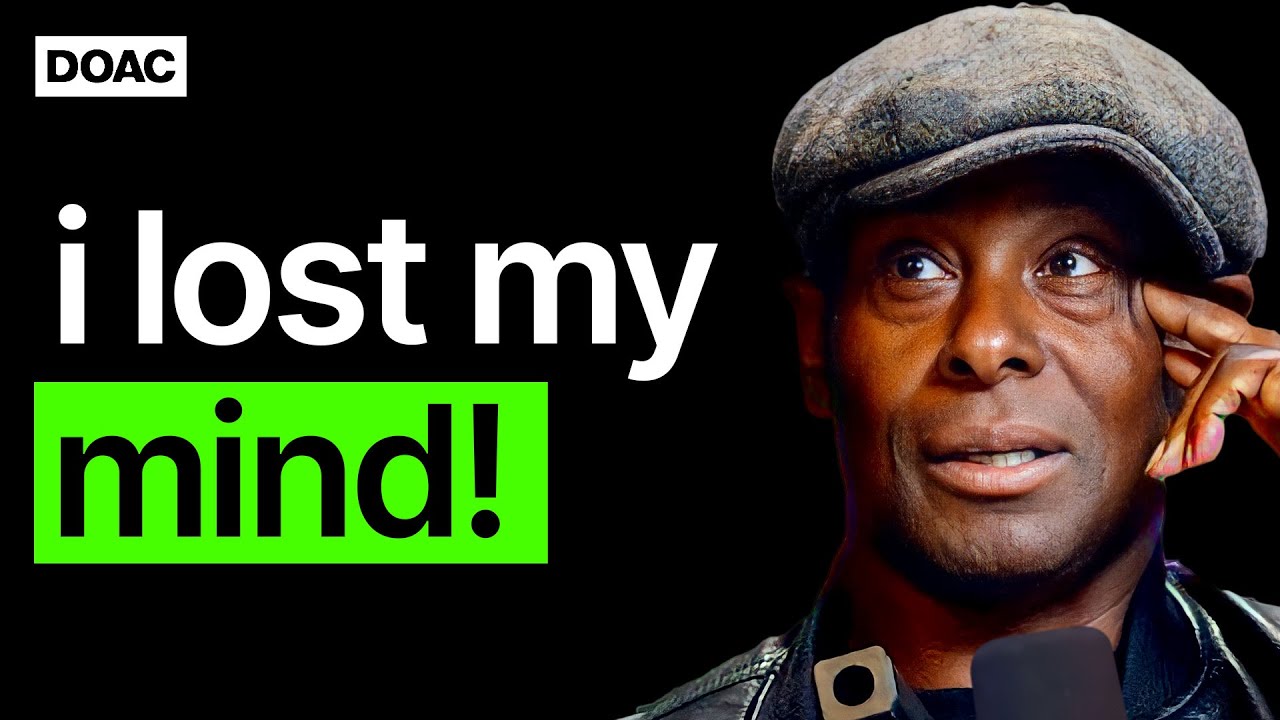
Full transcript · Read the full conversation in order, with its original context.
Contents1 chapter
§01Transcript — part 1§01Transcript — part 1
When your cat is acting weirder, or your dog is being louder, your turtle moves slower. Hello, Ted? Your cat seems thirstier. Whoa, slow down, buddy. Or your puppy is acting clumsier. Day or night, if you don't know what's wrong, know where to go. VEG ER for Pets. This is Kate. VEG, the better, kinder ER for pets.
I did everything that voice told me to do that night. Had that voice told me to jump off Thames Bridge, I would have done it.
Please welcome David Harewood. Propelled to superstardom in hit US drama Homeland. One of our most influential voices on race and mental health. I remember reading about a moment where you come home and you find your father's typewriter with one word written on it.
It just said "illness." I didn't quite know what it was, but I knew something was off. I hadn't seen Dad for a while. Then one morning I got up and my mom said, "Don't go into the kitchen. Go straight to school out the front door." That night, that's when my mom told me that Dad had been... David Harewood was the first black actor to play this part. The hostility that I was met with as a young black actor was ferocious. Newspapers, reviews just dismissing me. "He looks more like Mike Tyson than Romeo. What's he doing on the stage?" So I really did feel like I was an anomaly.
The whole thing—the stress, the smoke, the overthinking—just ended up making me spiral. That's what led to me just falling into psychosis. I was lying in bed and I just heard this voice in my head. He said he was Martin Luther King. "Even though I'm speaking to you from beyond the grave, I need you to close the gap between good and evil. So you're going to sacrifice yourself tonight and you're going to be an angel." That was the night I was eventually sectioned. I just remember lots of flashing lights and then being in the back of a police wagon. If that would have continued, I'm not even sure I would have been here today.
Without further ado, I'm Steven Bartlett, and this is the Diary of a CEO. I hope nobody's listening, but if you are, then please keep this to yourself.
David, what do I have to understand about your very earliest years to understand the man you are, this perspective you have, and the work you do today? What is the most important context?
That's an interesting question. What do you need to know about me then? That I was probably naive, open, innocent, and probably more conflicted than I thought I was. I was a vessel, and into that vessel was just being poured so much false information, wrong information, that at some point it had to smash, break.
I grew up at a time when there weren't many black people on television, when there weren't many black images on television or anywhere. I think that seriously put me at a disadvantage, but I grew up with a false sense of myself. That false picture has only recently emerged. Does that make sense?
Not entirely, unless I get further context. What was the picture of yourself you grew up with?
I would say I think I was just way too naive and way too... it's hard. That's a really interesting question. I hadn't really thought about that. But I think it's only in recent years, and having asked myself some of the questions that I've been asking myself over these last couple of years, that I've really started to get a real grip of the person that I am.
So who did you think you were when you were younger? What did you think of the world and yourself when you were younger that was so naive and ill-informed?
I didn't really think it was important. I didn't think my color was important. That's why I say I was naive. I didn't think my color was that important. I had no concept of myself as a young black man. And that's why I say I grew up at a time when there weren't any images of myself, so I couldn't really structure my identity around a solid identity.
My mother was always trying to steer me into a more Afrocentric mindset. I go back to Birmingham where I'm from, and I look at how many of us are in interracial relationships of that generation. We were constantly told to assimilate. It was all about assimilate, assimilate, assimilate. I heard the phrase one time, "You're not black, you're normal." Which is so bizarre. It's such a strange thing to say. So your identity as a black person was sort of ironed out. You're just British, you're English. When I came out of drama school and the world said to me, "You're black," it was a real wake-up call for me and seriously contributed to what happened two years after I left.
Going back to your mother and your father, how was their relationship and your early experience with them shaped the man that you are today? Who were they as people?
Wonderful people. My mother was extremely strong. My dad was a kind of quiet, silent type, really. Very proud. Didn't really speak much, didn't really... he wasn't particularly involved in our education, wasn't particularly involved in shaping who we were. He was very much hands-off. He was a long-distance lorry driver, so he was away a lot. And when he came back, he would sit and watch the telly in peace. I used to try to talk to him when I was a kid, but he was a very difficult man to open up.
Whereas my mother was always talking and sort of cajoling and very welcoming of friends. She was just a really wonderful character and still is. Very funny. But she tells me now stories that she used to, some of the fights that she had, some of the battles that she had. When I was writing my book, as I said, we were the only black family on that street, and she was constantly in conflict with neighbors, with racists. And she didn't back down. She was very, very sharp and fearless.
Sounds like my mother. Fearless. Your father, you write a lot about how hardworking he was. The lack of affection you've described there, the lack of openness—as you look back now, was there a cost to that to him and to the family, to you?
I think so. I think the fact that he didn't... it's difficult because it feels as if I'm criticizing him, and I don't really want to do that. But I think it was a loving home. There was a lot of laughter in the house. He loved all the British sitcoms and stuff of the time. One of my favorite sounds was the sound of him laughing. I loved hearing him laugh, hearing my mom laugh. The house seemed full of laughter when I was growing up.
So there was a lot of humor in the house, but there wasn't necessarily a lot of tenderness. And I kiss my kids every morning when they go to school. I don't know why, but I don't know why, it's just important to me. Maybe it's just become a habit, but I want them to know how much I love them, and I want them to know how much respect I have for them and how proud I am of them. It's important for me to do that. And maybe it's because my dad didn't do that. Not because he purposely didn't do it, I just don't think he thought it was that important, maybe.
Do you think he knew how to do that?
I don't know if he did. I don't know if he did. But I think that's true of a lot of men of that generation. Showing emotion wasn't very easy for them. And also, I think it's really interesting. A friend of mine tells me this story... it's very particular to the 60s and 70s, which is why I'm interested in this period of late 50s, 60s, 70s England. Because I don't think people understand the level of racism that was present in this country.
I just got goosebumps then because they don't understand it.
They don't understand it. And the idea of being othered, that you would leave your house and literally take your life into your hands. I remember randomly getting off a bus and instantly being chased by a group of skinheads. You would just automatically find yourself running. Now, to have come here from the Caribbean with ideas of streets paved with gold, England being the mother country, to have come here with that idea and to be met with that amount of hostility, to be met with that amount of abuse, that amount of rejection, I think it seriously damaged not just my father, but many people who came here in that generation, that Windrush generation.
Because it's fascinating to me how many Caribbean parents do not want to talk about that period. Just do not want to go there. Because I think it was horrific and I think it damaged him. I haven't really thought about that before, but I do think that that was a tough period for a lot of us. And whereas in America, movies have been made, plays have been written about that generation, about that period, we've not really looked at it.
I have to be completely honest. I was born in 1992, came to the UK when I was two years old from Botswana. I always saw my mom have this combative attitude towards people and this general belief that other people were racist. And I never understood it. I just thought she viewed the world as being racist. And as I've done this podcast and specifically spoken to people from the 50s, 60s, 70s, 80s, and early 90s, my mind has been blown because I didn't get it.
Of course. And it's interesting as I listen to the wonderful Chris Kamara and the world that he was talking about. I know that. I remember it. Growing up in those... I was born just after Chris, five years after Chris, but he's such a legend for me. Why him, Cyrille Regis, they are legends because as kids, I watched them playing football knowing full well that 50% of the crowd were giving him so much abuse regularly. And yet he was able to play football, smile, score goals, play aggressively. I was in awe of those guys because I just thought I would be scared.
As a kid, I was scared. And that's one of the things I've touched upon in my book, is owning up to that idea that I was terrified growing up in those days because you just never knew where a brick would come from, where a car would suddenly... you'd be walking down a street, whistling yourself, having a great day, next thing I know, "n****r!" from a car. "C**n!" from a car. Monkey noises would just come from nowhere. And you would just tense up. So I grew up in that environment and so I'm well aware of it, which probably goes back to that your first question about what you need to know about me. That's the environment I grew up in. So I was trying to form a sense of myself. It's constantly being... growing up at a period where you're othered, where you're in fear and not understanding who you are was destabilizing, I think. And I'm in a sense lucky that my house fell down when it did and I was able to put it back together again.
Where a brick would come from? You talk about a story being, I think, five years old where a brick comes through the window of your family home. Tell me about that.
Well, I wrote about it in the book and how Saturday mornings was always cartoon morning. Saturday morning cartoons back in the day, again you're too young to know, but it was always Tom and Jerry and Pepe Le Pew. It was great. They were just on constantly. So you would sort of run down and watch telly. And my mom's famous for her breakfasts, English breakfast: bacon, eggs, toast, chips, all the English which we used to love. And I remember my mom calling us down for breakfast and running downstairs and then hearing this "smash!" And we ran into the lounge and there was an English breakfast covered in glass because a brick had come through the window and just... there was glass all over our big kitchen table. And we just all sort of stood there in shock. And Mom said, "Go back to bed." We just traipsed back up to bed. But that was the sort of... you don't know where it came from, but we were targets.
Your mom's reaction there when I read about this seemed uncomfortably calm.
Well, what are you going to do? And she wasn't always calm. And there was times when she did, you know, grab people by the collars and have people up the wall. She was fearless. "Don't you ever call my son that name again!" She was fearless. But at the same time, you're powerless in that setting because you don't know who threw that brick. And you're almost... I think back to it now and think she used to walk me to school and be waiting at the school gate to walk me home. And for me, that was great to see my mom's face at the end of school. But I realized later maybe why she did that. Because when you did go home on your own years later, it was a bit of a minefield. You had to be careful. You were a target.
People don't understand that. Especially people that haven't experienced racist abuse. The idea of leaving the school gates and the journey home being anxious and looking over your shoulder.
Anxious. That's a good word. Which I didn't realize at the time, but I think was a huge amount of anxiety. And then the amazing thing about it is you might go a week without it, you might go two weeks without it, you might go three weeks without it and then you relax and think you're normal and then "bang!" A casual Wednesday afternoon, middle of the day, "n****r!" And suddenly you're right back to being scared.
I don't really think... I think my whole sense of self... you do your best to normalize that stuff and think, "I'm not going to let it affect me." And I always had this... my mother's words ringing in my head, "Don't let it affect you. Hold your head up. Be strong." So you keep thinking, "No, no, I'm going to... I'm not going to let this affect me."
Is that good advice?
Yes, but it doesn't always work. It doesn't always work. And it crystallized for me when rather foolishly, I was a Leeds United fan. Always used to watch Leeds United, they were the champions back then. And they came to Birmingham one year to play Birmingham City. And like a jackass, I thought, "Oh, I'm going to go and sit in the Leeds end." And back in the day, at halftime, you could literally walk into the ground. So I thought, I think I was about 12, maybe about 9, 10 or something like that. At halftime, I thought, "I'm going to go and sit with the Leeds fans." The idea of it now! But I walked into the Leeds end and at first, it was just a couple of monkey noises. And then it became like a chorus of monkey noises. And then it became a chorus of "C**n! N****r!" And then it seemed like thousands of people were screaming abuse at me. And I heard these words, my mother's words: "Hold your head up. Don't be scared." So I thought, "I'm going to go and take my seat." And I kept walking down the touchline, but it got so loud that in the end, I thought, "I don't want to sit with these people."
So I turned around and walked away, and I remember them cheering. But I remember I was really shaken. And I remember to this day this groundsman or steward, a staff member of staff, as I walked out the ground he shouted, "You alright, kid?" And I just went, "Yeah, nice one," and just walked home. But I was really shaken by it because I'd done exactly what my mother told me to, but it didn't work.
In your early teens, after that, your father's mental health began to deteriorate. Were there any events that led up to that? I remember reading about a moment where you come home, the lights are on, and you find your father's typewriter with one word written on the typewriter.
Yeah. It just said "illness." My dad was a prolific sort of organizer. And he started this huge darts league and was always on a typewriter writing out the results and writing out who's played who and who had won and who was going through to the next round and who needed a trophy and where they were going to play and what times they played. He loved the darts. But he just took too much on. And he was constantly sort of working at this organizing this whole thing and organizing the trophies at the end of the season, organizing the meeting, organizing the... he was just always... and I think he was just doing it all on his own.
I just think he just took on too much. And I didn't necessarily always see it coming because I was quite young, but it happened very, very quickly. And I always used to hear my dad go to work in the mornings, used to hear his keys jingle-jangle down the stairs. That was sort of my alarm to get up for school, hearing my dad come downstairs. And for a couple of days, I didn't hear it. And I kept hearing arguments in my mom and dad's bedroom. And I thought, "This is... something's not right." I hadn't seen Dad for a while. I hadn't heard the jingle-jangle down the stairs. Something's off.
I didn't quite know what it was, but I knew something was off. And then one morning I got up and my mom said, "Don't go into the kitchen. Get changed in the bedroom and go straight to school out the front door." And I did. And then that night, that's when my mom told me that Dad had been sectioned. So it had happened really quickly, and they sort of kept me away from it. But unbeknownst to me, my brothers were holding my dad down in the kitchen because he sort of lost it.
How do they explain being sectioned to you when you're in your early teens? Because I would have no idea what that meant.
They didn't really. It was just, "Dad's not well. Father's not well, he's been taken to hospital." And you know, there's always that gag at school that the men in the white coats will take you away. "Your dad's crazy," you know, "he's going to be taken away." And that's what happened. My dad was taken away. I didn't see it, but I knew he'd been sectioned. And when I was sectioned, I suddenly realized especially when I was writing the book, I thought, "That's what happened to him." And now it's only once I'd written my book and really understood what that was like having your liberty taken away from you. Because I think that and being locked in prison is about the only time when your liberty is taken away from you.
It was only then that I started asking myself... started looking at my dad's life in sort of retrospect and thinking, because he hated it. My dad hated it and was never the same again when he was released. He was never the same again. And I think he had a really bad time in there. A really, really difficult and bad time, which I don't think he ever forgave my mother for.
Understanding what you understand now about the nature of mental health and what causes it and your own experiences with mental health, when you look at how your father became to be sectioned, have you got any suspicions about why that happened beyond that he took on too much at the darts?
I do think that there was a lot of resentment and anger built up in him. And you got to wonder why. And this is I only found this out again once I started writing my book and started looking at mental health and the numbers of black people are over-represented in the mental health system in this country. And what I realized is it was a Jamaican psychologist who actually performed this study and he realized that black people... there's way less mental health in Africa amongst black community. There is mental health problems, but way less psychosis. But there's more when they are transmitted to a Western culture. So there's more mental health episodes of mental health in England amongst the black community and in America amongst the black community.
And I think there's something about... I call it in my... and this is one of the things that my therapist talks about, when you're in a white space. And that's not a derogatory term, but England is essentially a white space. And I'm sure you've been in rooms where you're the only person of color. The higher up the ladder you get, what they call "tall poppy syndrome," where the higher up the ladder you get, the less of your own people you see. And I think my dad had found it very difficult coming from the Caribbean and coming to England and dealing with a completely different mindset. I think he'd found that difficult and resentment had built up.
A friend of mine used to tell me that his dad used to work on an assembly line. In the 70s, when Jim Davidson was doing his "Chalky" routine. And he was the only black person on the assembly line. Every Monday morning after "New Faces" or whatever it was that Jim was on, doing his Chalky thing, every Monday morning he would be "Chalky." And his dad would laugh and take it. And throughout the week, they'd be calling him Chalky, Chalky, Chalky. "Hey, it's Chalky!" His dad would laugh. And then on Friday night, his dad would get drunk and beat the f*** out of him and his mother. And I think that was just a buildup of resentment of having to live in this place where, yeah, everyone's calling me this name, everyone thinks it's funny, and I'm laughing, but there's a buildup of resentment that he then takes out on his family. Now, I'm not saying my dad had that level of resentment, but I think there was just something about being here that he started to find difficult to live with, cope with mentally.
When I read through your book and also a lot of the stories you've told me today, I mean, I remember one particular story where you've got a girlfriend in school and then you come in school the next day, her father has said that she can't be with you because you're black. This constant, constant rejection. Social rejection. You use that word earlier, the word rejection, and it feels so apt because that's really what I think on a psychological level is going on. Even going to the football and then being rejected socially from that crowd and it's constant throughout your story. Labeling theory says that when you tell somebody they are something, they eventually become it. The famous prison study where they said "you're the guards, you're the prisoners," they had to stop the study because the guards were so harsh on the prisoners. Labeling theory says exactly that. Your teacher says "you're a D and you're going to be a failure," the chances are that will actually lower your performance, your self-belief. How do you stop that happening when society has rejected you for years and years and years growing up, at the most formative time?
I think I was lucky because I do think that I lived amongst a lot of people who didn't define you that way. So I was very, very lucky for that. But I think that house had to come down, which is why I think my breakdown was all about... the more I learn about it, the more I realize that that image of that young boy had to start again. I had to rebuild my image of self. And that's what I've sort of... it's interesting because even though it happened 30 years ago, I'm only now just dealing with it because I only found the records, only did that documentary. All this is recent. And I think if I'd talked to you last year, I'd probably be in tears by now because so much of this is recent for me and having to deal with a lot of the... I just spent the last 30 years in this sort of cocoon not really dealing with a lot of this stuff.
And it's only since reading my medical records and doing that documentary and uncovering all that trauma. As I say, the first thing I read when I opened my medical records from 30 years ago, which were the medical records that the BBC found in the bowels of the Whittington Psychiatric Hospital—I had no idea they were going to give them to me, I had no idea they even found them—the first thing I read was "Patient believes he has merged hearts with a young black boy." And I just thought, "What is that?" And I just looked through the medical records and it's all to do with my race and my identity. All of it. I was just confused. I'd sort of lost touch with my identity.
Going off to drama school and playing Romeo and Pushkin and doing Molière and Dostoevsky, doing all these European romantic playwrights and Shakespeare and all these different characters and thinking my color doesn't matter, I can do all these wonderful things. And then I came out of drama school and every newspaper article was all about my color. Every job I went through was all about my color. I could go for these jobs and not these jobs. And it just... it was like I hadn't dealt with it. Hadn't dealt with my core identity as a young black man. And it all started to just... I started to overthink it.
What was your core identity that you hadn't dealt with as a black man?
I think just understanding myself in the world and knowing... having confidence in myself. There were too many questions about my identity. I think one of the things I did when I saw a therapist after my documentary was I sought out a black therapist, a black male therapist. And that has been really strikingly revealing to me. Because some of the questions that I had, he would kind of say, "Well, why you think? Why do you think like that?" And he would question why I think like that. And I found it remarkable how he was able to make me understand that a lot of the things that my... a lot of my fears, a lot of my insecurities are only natural potentially because I have grown up predominantly in a white environment and maybe I didn't... maybe I wasn't comfortable with myself. I'm much more comfortable with myself now.
What were those fears and insecurities?
You know, there's that image of the strong black man. Great at dancing, great at sex, great at chatting women up, great at this, great at that. And I felt maybe that I didn't always live up to that. And if you have that idea that you can only be one way as a black man, which the world is telling you that—you can only be this way—then you sort of don't feel like you measure up. And actually, I've learned, yeah, you can be vulnerable. That's okay. You can be sensitive. That's okay. You can be... it's okay to be not be, you know, Darkus McFly, you know, who just beats down all the girls, dances fantastically, does all... you know, he's the alpha black. It's okay not to be the alpha black guy. It's okay. And that's taken me a while to sort of understand about myself. I think Jay-Z... it was interesting, I think there's that thing about Jay-Z talks about the gold, silver, bronze black man. The gold: born in the ghetto, black wife, black friends. Silver: born in the ghetto, black wife, went to university. Bronze: born in the ghetto, white wife. You sort of get less and less... it's almost like you get less and less black the more you take on.
And then you see the effects of that in schools where you have teachers who'll tell me that you'll get a really intelligent black kid, but just to fit in with his peer groups, he won't work as hard because he fears the more intelligent he is, the less black he is. The brighter he is, the less black he's seen. I hate that.
Isn't that funny? Being rejected by the white community but also the black community.
Well, that's exactly what I had. When I came out of RADA, I had tough... I had this when I was starting to be an actor, black people were like, "You're going to be a what? That's too white. You're too white, man." And then I went to RADA and kind of did all these Shakespeare, all these plays, and then I came out speaking like this, and everybody went, "You're way too white." So you're getting rejected by the press and critics because you're black, and then you're also being rejected by the black community because you don't look or you don't sound like, you know, man from the ends. You don't sound like that. You don't talk like that. So I really did feel like I was an anomaly.
The American Express Corporate Program is more than a card, it's a complete solution. Apply for the right card for your employees, from everyday spenders to frequent travelers. Issue virtual cards to suppliers or project teams for added security and flexibility. Simplify accounts payable with American Express 1AP, helping your company automate supplier payments. The American Express Corporate Card program grows with you. Terms apply. Enrollment required and fees may apply, including an auto-renewing monthly platform access fee. Suppliers must be enrolled and located in the United States.
Support for this podcast is brought to you by Walden University. Ever catch yourself thinking, "What if I could go after what I actually want and really make a difference?" You're not alone. And that's exactly why I want to tell you about Walden University. For over 50 years, Walden has helped working adults like you get the 'W' with the knowledge and skills to build the future you want and make a difference where it matters most. If you've been waiting for the right moment, this is it. Head to WaldenU.edu and take that first step. Walden University, set a course for change. Certified to operate by SHEV.
At age 23, around the time you were sectioned. In hindsight, knowing now what you know about why you were sectioned, what was going on in your life, your mind, your environment, the press, professionally, personally—what would you have had to change, avoid, do differently before then to have avoided that happening?
That's a million-dollar question. It really is a million-dollar question. And I'm not sure there was anything I could have done. I think that... I think it had to come down. I'm a great believer that in trauma, there's a lesson. That there was something in that for me of value. I don't think any... I don't think... I mean, I was very lucky that I came out of it. But I do believe, and as I have got older in my life and having written the book and having had so many people tell me since writing that book, so many people say, "Thank you. I'm not crazy. Thank you, you've really articulated everything that goes on in my... some of the frustrations that come."
So I've only given voice to things that a lot of people experience, I just took it to an extreme, I think. And I think it's probably as an artist, as an actor, it's benefited some of my work. It's enabled me to take things perhaps a step further than maybe what some people can take things. I think it's given me a perspective. I think there was something of value in it for me. I don't think... I think it had to happen. I don't think I could have done anything to have stopped it. Which is both scary and worrying.
What do you remember about that time? Because it seems to be quite a blur when you recount the events. It's almost like you have these abstract memories of different moments.
Well, it's interesting because I do believe I started this process thinking that it was going to be fun. Because it's like manic depression. Psychosis is often preceded by a mania, a heightened adrenaline rush, dopamine. Your dopamine levels in your brain are heightened. And it's quite exciting. Because you're not getting sleep, it's often drug-induced, and you are really sort of operating at this quite high level. And I remember doing some pretty extraordinary things. I remember brief moments of real sort of mental acuity and dare I say, there was almost moments of fun. But it's usually preceded by a crash. So I sort of went into this thinking, "I'm going to remember all the fun things I did." Some of the extraordinary things I did. And they were some really wild things. I was experimenting with a sense of what was real and what wasn't real. Thinking I could do anything and it was bizarrely exciting.
Give me an example of something that you recount that is...
Well, it's interesting because one of the consultants that was in the documentary tells me that... because she asked me for an example. And I said I was walking down the street one morning, I hadn't slept all night. And there was a guy across the road and he had this huge Doberman. Huge, kind of massive, muscular. And I'm normally quite afraid of dogs. And I just walked up to this guy, I said, "What's that dog's name?" And he jabbered something. And I looked at this dog and I screamed the dog's name and I looked at this dog quite aggressively and right in its face. And the dog just literally lay on the floor and started whelping on its back, just freaked out. And the consultant said to me that often dogs can pick up some energies, disturbed energies. And I'd obviously really... this guy was really freaked out. He said, "What did you do?" The dog was literally whelping and moaning on the floor. And I just fixed this dog with no fear and screamed its name right in its face, just freaked the dog out.
That night you were sectioned, I read that you hailed a taxi and it was ultimately the exchange with the taxi driver that led...
I mean, this was an extraordinary... and again, it was the voice of Martin Luther King that was in my head. You hear voices in... when you're... one of the aspects of psychosis, which is what I suffered from, you can hear voices, have illusions, allusions, delusions that seem incredibly real to you. And I was lying in bed and I just heard this voice in my head: "Wake up! Wake up!" "Where's that come from?" I sat up in bed, looking around the room thinking, "Where's that come from?" And this voice was in my head. It sounds totally bizarre, but this voice was in my head.
And he went on to say, "Look, I don't want to tell you who I am right now because you're going to be really scared. But you have to go to Camden. You have to walk into this store. Don't be surprised if it's open at 3:00 in the morning, don't be surprised it's open. Whatever you do, do not turn around." And it was all these things I had to do. "Whatever you do, don't do this. Whatever you do, don't do that. But then go to... go into this store, walk to the back of the store, there's going to be one suit hanging up on a rack in the back of the store. You need to put this suit on and then you turn around, don't be surprised to find out that it's 2:00 in the afternoon." He said, "I'm going to close the space-time continuum and we are going to close the gap between good and evil." This whole thing.
And it ended up being Martin Luther King. He said he was Martin Luther King. And he said, "When you played Martin Luther King as a kid," because I played Martin Luther King as a kid, it was my first acting thing that I'd ever done. He said, "When you played me as a child, I entered your heart. And when I was... even though I'm speaking to you from beyond the grave, I need you and two or three other people in the world to activate something and close the gap between good and evil." He said, "So you're going to sacrifice yourself tonight and you're going to be an angel." And this voice was, I swear to you, was like real in my head.
And I'm sobbing in my bedroom listening to this voice. He said, "So tonight's the night." And that was the night I was eventually sectioned. But I got up, got my clothes on, and walked all the way to Camden. Obviously, the shop was closed. It's 3:00 in the morning, you know, I'm out of my nut. So and then I was exhausted and I thought I've got to go home. And flagged a cab down and I didn't have any money.
And I don't remember... I just remember this driver looking around and then the driver pulling over and then lots of flashing lights, obviously the police. And then being in the back of a police wagon and then sitting in a cell. And all this was just... I was in and out of what seemed like a dream for me. I didn't... I was in and out of... I remember being in this cell and then going to Magistrate's Court in the morning and not remembering my name. Didn't remember my name at all. Didn't know who I was. Couldn't remember who I was. And the duty solicitor sort of talking about my mom and then he said, "My dad's name was Romeo." And I went, "Romeo? Hang on a minute. I've played Romeo. Romeo, Romeo, Romeo, Romeo. David, David Harewood!" That's... I used my career to get back to who I was.
Then left, went to court, and had no idea what was happening in this court. I mean, I was... the judge was speaking at me and I was just a mess. And I walked out of court and again, lucky, but some woman who'd been in the court walked out and said to me, "Are you okay?" And I said, "I don't think so. I don't know who I am." She said, "Where do you live?" and I said, "I can't remember." She said, "What's your nearest tube station?" and I said, "Highbury & Islington." And she flagged a cab down, gave the driver 10 pounds and said, "Take him to Highbury & Islington." And I got out at Highbury & Islington, walked home, and my friends were waiting for me. Because they'd been looking for me all night, couldn't find me.
And that's the day that they knew something was... even though they'd been sitting with me and visiting me for the last couple of weeks because they knew something was off. They knew I wasn't well. And that's the weird thing about mental health, or particularly psychosis: you see somebody acting very strangely. Somebody that you love—it could be your son, your husband, your mom—they just suddenly start acting out of character, becoming obsessed with something. It's like they suddenly change. And you know something's wrong, but you sort of desperately hope that they sort of come back. And that's sometimes, you know, they don't, and you have to make that call to have them sectioned. And luckily for me, my friends had been there. Because if they weren't there, I think I would have been in real trouble. Like, I would have been in real trouble. If that would have continued, I'm not even sure I would have been here today.
How long did that process last before you were sectioned? Of the slow, sort of gradual deterioration?
Well, I think it was happening for a while because I remember working and not feeling great. So I'd say at least two or three months there was a slow progression of not sleeping, overthinking, trying to hide that, drinking to self-medicate. I knew I wasn't well, but I thought I could handle it.
I'm trying to understand how much of that you believe to be a physiological, biological situation, or maybe predisposed by biology, versus circumstance, experience, and the things that you'd been through.
I think, and again speaking to the consultant who was working on my documentary, it's a combination of both things. Your propensity, the chances of you having a breakdown are sort of reliant on levels of stress, lack of sleep, what's called ACEs, which are these fundamental—like people who experience trauma in life. I mean, for me, I think it was my parents' divorce and not dealing with that. Not dealing with that at the time. So much of it has just been squashed. Not dealing with some of the trauma that was in my life. And I think a lot of it was coming out slowly coming out then in that one slow progression of being deeply unhappy.
Why? Why were you deeply unhappy?
As I say, I came out of drama school and the hostility that I was met with as a young black actor was ferocious. Newspapers, reviews just dismissing me, completely dismissing me. And I'd sort of left drama school with a bit of heat. People were really excited to see what was going to do. The school was very, very excited to, you know... everybody was talking about this young kid coming out of drama school, "He's going to be, whoo!" you know. And I just got slaughtered. Slaughtered. All about race.
I played Sloane in "Entertaining Mr. Sloane," who is quite a devious bisexual character, actually also a murderer. And there was one reviewer, a black reviewer who said who was outraged that I'd taken the part because I was letting the side down. And he said that people should go and demonstrate their disapproval of Mr. Harewood's choice of employment. And I read it, I was like, "Wow." Put that down. And I noticed that night, as Sloane has this really kind of tough monologue where he talks about abusing somebody, and in the middle of this monologue, I saw people get up and walk out. And I noticed that they were black.
And then the next night, more black people started walking out. And it was always in the middle of that monologue, black people would get up and walk out. And it was really tough to deal with. It was really tough to try and ignore, and they were sort of [making sounds of disapproval] as they walked out. And sort of, it was really disturbing me because I had to get on with the play. And that was only the second act, there's another three. So the whole way through that play, I was sort of coping with "Why do they walk out?"
"Get on with the play" seems to be quite an apt metaphor for that period of your life.
Yeah, and I wasn't really dealing with it, dealing with the fundamentals. So I think that's when the drinking started. To be able to get through the play, I started drinking. To be able to... I started self-medicating. So I was drinking a lot before, during, after the show. Smoking after the show. And the whole thing—the stress, the smoke, the overthinking, lack of sleep—just ended up making me spiral.
How long from being sectioned to getting back to acting? How long was that sort of recovery process?
It was much quicker than I realized, actually, which surprised me. I thought it was going to be months, but it was... I was sectioned for about five days initially. And then again in Birmingham for another five days. And then the recovery was just about convincing my mother that I was okay. Because she was convinced that it was acting. It was acting that sent me crazy, and then I was never going to act again. And then I was never going to go back to London again, I was never going to be allowed to act again.
So she tried to watch me like a hawk for about a month, maybe a month, six weeks. And eventually she allowed me to travel back down to London and get on with my career.
I sat here with Maisie Williams, the young Game of Thrones actress. And she talked to me about how acting was a form of escapism in her life because her home had such little joy. That acting became this place, almost this therapeutic place where she could, I guess in some respects, abandon that identity. I remember reading from this Swedish philosopher who said that if we try and abandon ourselves, we'll ultimately despair at the fact that we've abandoned our identity. If we try and abandon ourselves and we're unsuccessful, we'll despair at being unsuccessful in our attempts to become other than we are. And he concludes that the only true way to be happy is to accept that which you are and to not abandon yourself. That kind of felt almost quite true when I think about what acting is in many respects. For Maisie, it was this attempt to abandon the self and actually to not confront the issues. And then she ultimately had to at some point confront those issues and what had gone on in her family home. Does any of that ring true, specifically this idea of the role acting played in identity for you?
Acting is the only space I feel 100% confident in.
Why?
Because everyone knows their lines. Everyone knows where they're going to go. Everyone knows the movement. Everyone knows the play. On stage, I just feel... that's probably where I'm at my happiest.
Why?
It's... I can't explain it. I just become... you become somebody else. That's the true nature of art, I think. It's like somebody who paints, I think. You know, they want to create something and they're free to create. Van Gogh could be in torture, he could be tortured, but he can still produce an amazing piece of art.
You said there that "I'm happiest when acting because I become someone else." So what does that say about oneself?
Well, myself I'm full of insecurities, there's doubt, there's decisions to make, there's which is why life I think is so unique. I don't know what you're going to say next. None of us know. That's what's so beautiful about it and so fantastic about it. But on stage, it's a controlled environment. So for those two hours, I can be King Lear, I can be Othello, and I completely put myself into that. And it's... that I feel... it's like I'm at... I guess you could say... I mean, footballers say that. You know, on the pitch, no problems. George Best: on the pitch, a genius. Off it, an alcoholic. Somebody who can't cope. Maradona: on the pitch, a genius. Off the pitch, something else. You can't cope with life. Life is uncontrollable. Life is full of contradictions, full of difference, full of failures and success. It's very difficult to distill. Whereas on stage, I know... I can play that. And I can put myself into that and pour myself into that character, and I feel great. It's the most freeing place for me, it's the most freeing thing I could ever experience. And that's why I love it so much.
That's what Maisie said. She said for her, actually, it was the only place she experienced joy.
Yeah, I can completely understand that.
But what is that saying about the nature of our life in terms of... why can't life be joyous, as equally joyous? What would we have to do to make our acting life, when we're King Lear...
Well, that's the secret, I guess. And that's the secret of sort of finding a place where you can be—and I'm sort of on the way—where you can experience joy. And I think that's a lifelong struggle. But you have to work at it.
2017 to 2019 was the first time you really opened up about your experiences to the press.
That was the shock of it. I tweeted, 2017 randomly tweeted, as somebody who's had a breakdown, "Just want to say, look, have a great—" It was World Mental Health Day. As somebody who's had a breakdown, "Just want to say look after yourself today, get some help if you can." Got on the plane, flew to America, got off the plane—50,000 retweets! Calls from ITV, calls from the BBC, calls from the Guardian, calls from the Independent. "Oh my god, you've had a breakdown!" And I'd completely forgot I hadn't gone public with it. I've told everybody! It's been a bit of an anecdote for me. A bit of a late-night drunken anecdote for me that I'd had a breakdown and spent time in a mental institution. But it's only since doing that that I've really looked at it and really understood it. That moment of oversharing has led to all of this. Led to my first book, it's going to lead to my second book, it's led to this reckoning, which would not have happened had I not sent that tweet.
2019 you produced the documentary. Everybody talks about that documentary. Really incredibly powerful and just artistically brilliant in so many ways. So many people talk about it. I even had members of my team put in big brackets, "It is so good," when they were referring to a documentary. They don't usually do that. It was really profound and important in so many ways. How did that change your life?
Again, because... and this is really odd, but I'd seen that documentary almost a thousand times because I'd watched it nearly every day a year before it went out. The night it went out, I was absolutely terrified. As soon as I saw adverts for it, I panicked. I nearly called the BBC and said, "I don't want it going out. Just take it off, take it off!" I was really scared and stressed. And that was really unusual for me because I'd seen it and I was happy with it. But going public with it was a whole another thing. And I was really scared, really anxious.
And the whole house, I think the whole house picked up on it. Because my kids went to bed early, my wife went to bed early. And she was like... she was worried that, you know, the kids might get ribbed at school or "your dad's this" or "dad's that." And I hadn't even thought about that. I suddenly thought, "F***, I'm letting people in here." And I was really scared. And I remember that night I had a therapy session online with my therapist. And when we finished, it was kind of dark, and I thought, "Well, it's got half an hour left to go. I'm not even going to watch it. I'm just going to go to bed."
And I was just about to go to sleep and every single device in my house was [vibrating]. Everything was just buzzing. And then the house phone went. And I jumped out of bed to... I didn't want to wake the house. And it was my mom. And the first thing she said was, "Brilliant." And that really calmed me down. She said, "I've just watched it." She said, "Brilliant. Well done, son." Huge sigh of relief. And then started looking at all these messages and emails, and they were all really emotional and moving.
Went to bed and got up in the morning, went to take my dog for a walk like I normally do, and I could not walk 10 feet without complete strangers coming up to me in tears. I swear to God. Going, "Just want to say, Mr. Harewood, thank you." And normally, when you're an actor, people leave you alone. You know what it's like when you're on the telly, people kind of go, "Oh, that's that guy off the telly." But suddenly it was "Mr. Harewood." Not "the guy from Homeland" but "the guy from Supergirl" or "the guy from"—it was Mr. Harewood. "Excuse me, Mr. Harewood, just want to say thank you so much." Tears strolling down their face. "My dad had a breakdown and we never talked about it and just want to say the fact that you..."
We all suddenly started talking about it and talking about dad and I'm blubbing, they're crying. Then I go, "Thank you very much," walk up, somebody else. "Excuse me, Mr. Harewood, just want to say..." and I suddenly realized how common it is. And how everybody was touched by it because you just don't talk about it. There's a shame attached to—particularly psychosis and particularly to being taken away. There's a shame attached to it. For some reason, maybe because I'm an actor, I have no shame. So me, a recognizable, successful actor talking about it, allowed them to talk about it. Got a call from MIND saying phones were ringing off the hook, people were talking about psychosis because they didn't know... now they understand what happened to their son. Now they understand what's happening to their [relative] who's only just been sectioned that morning.
And on this book tour, I constantly do signings and nearly every single time I sign, I go to one of these book tours, there's somebody who comes up to buy the book for it to get signed and they're crying. And they go, "I've just come out of a mental institution. I just want to say seeing you gives me hope that I can get better." Or there's a mother who says, "My son's just been sectioned," crying her eyes out. "My son's just been sectioned and he was at drama school, he was at school at university." Because it happens normally when kids go to university or when they go away from home. And they might smoke, they might drink, they might find themselves in a strange environment. That's when it happens. And the amount of times I've had to get up and just hug a stranger and just say, "They'll get better."
I sometimes sit here with people and there's a moment where they let the wall down. And the wall can be a number of things. Sometimes it's sexuality, sometimes it's something that they've been holding inside of them. You know, they might have told friends, but letting the world in and then feeling that feedback that, you know, people weren't attacking them, they didn't lose their job—that sometimes can be a quite liberating thing. From then on, once we've let the wall down, whatever it is, and really let people in and see our deepest insecurities or our fears, life can feel different. We can be more open and honest and vulnerable.
I can't say that happened because I then had three years of dealing with it. Because I thought, "Oh, okay, I've let the world in," and as you say, "Where's that moment of relief?" And it was torture. Because I couldn't cope with all these people coming up and saying, "Thank you so much." Normally, as I said, you've got that shield as a recognizable face where people don't bother you on the train. People don't bother you in the street. But they were. And they were coming with these really emotional stories.
Some people's parents died being restrained. Now, I talk about seven policemen jumping on me and giving me what's called an emergency tranquilization. I talk about that in my book. How I survived that, I don't know. Because countless people have died like that. Black people. Being restrained by police. The criminalization of that—the criminalization particularly of black people in that period of illness, of psychosis, is... look at the people in America. People shot because they're acting strange. They're in a moment of medical crisis, but they happen to be naked running down the street screaming. You will get shot. People don't understand it. People have been arrested.
One guy I met knew he was having a breakdown, went to the hospital—they refused to treat him. Went to another hospital—they refused to treat him. Started banging on the door, they called the police. He got arrested, he got sent to prison, and it was only in prison that he got treated. And so this whole book has really opened up how particularly people of color are criminalized at a moment of crisis by being arrested and then being treated.
Like for me, it was only when I showed the book to my consultant, she said, "Do you realize you were given three times the legal doses of tranquilizers?" And I said, "Why is that?" She said, "Well, it was..." And then I again, once the book got out, I had somebody contact me saying, "This is standard practice." Because most people are afraid of big black men. So most times a large black man is sectioned, you will get knocked the f*** out. For no medical reason other than "We're scared of this big guy, let's just up the dose here." And that's all it was.
So it just all this stuff was coming at me and I couldn't really process it. And I remember going into my therapist and just crying my eyes out and saying, "It's too much. It's too much, I can't cope." And funny enough, my medical records that I find in the documentary, I hadn't opened those notes for two years since I got them, since filming it. But before I wrote the book, I knew where they were. They were in my flat in Vancouver. I knew exactly where they were. And once I decided to write the book, I remember flying back to shoot the next season of Supergirl and we flew into quarantine because it was a couple of years ago, so you had 14 days on your own. And the first thing I did, walk in the flat, got my medical records out, and I read them cover to cover. And that was really tough. Because you're reading your disturbed self. Everything that I'd said, done, was recorded. So I'm reading all the stuff I did and getting flashes of moments that I thought, "F***, that's where that memory comes from." Taking a piss in the middle of an office and just the most weird stuff that I did and said.
Is it scary to know that you're capable of getting to that place?
Yes and no. And you know, again I think of myself thinking about the acting side of it. You know, I've always had this ability to—not method—but I really throw myself into a character. And I love that. And I think maybe there's part of me that having pushed myself... having let myself go... not many people go there. I literally went crazy. Crossed the line into unacceptable behavior, where your behavior is deemed "we have to take you away." Unsafe for yourself and for others. Sectioned. I've crossed that line. So for me now, I think in acting, anything up to that line is fair game. Fair game. And I love it, and that's why I will push myself. And I look for characters who are like that or who do push. That's what makes acting so great for me and so exciting, because I can behave like somebody else.
But even reading about psychosis as someone that's never been through it, it makes me realize that it's completely possible for me to find myself in that situation.
Absolutely anybody.
And that's what... because you know, when I grew up with mental health, I thought it was something that happens to other people. And then you get a flavor of it yourself and you go, "F***, we all have mental health." And reading the stories of psychosis and how a very normal young man can quite quickly—apparently quickly...
Very quickly.
...fall into that situation, in some respects makes me realize that we are very highly strung individuals.
The brain... you know how incredible that is? It's an incredible muscle. Thousands of firings every day just going off in our brains. Some of them misfire, and some of them very quickly can lead to you taking your own life. And I know how... having been there... I'm just lucky that—I think my doctor said it—that "We're lucky David is essentially a clown." Because my psychosis played out in all sorts of silly ways. But I did everything that voice told me to do that night. Had that voice told me to jump off Thames Bridge, I would have done it. I would have done it. I've met people who the voice told them to throw themselves in front of... as that young girl in the documentary said, throw yourself in front of the next white van. And she did. And it hit her. It is a very powerful thing, and it can happen to anybody.
Where do you find yourself today? You're three or four years on now from that documentary coming out, and you've been on that journey as you describe it of rebuilding the house.
I think I've come through... I think I was really in pain. I didn't realize it at the time, but I think I was really, especially when the documentary went out, I was very, very vulnerable. And it really was painful. It was uncomfortable. And I would get very emotional. I'd be in Tesco's and somebody would come up to me as I bought my sausages and say, "Saw your documentary," and I would just go. They'd go, I'd go. Being reminded of it... it was they would make me cry because they'd tell me about their uncle and they'd start going... it's just something about the helplessness of seeing a loved one acting very out of character and some of them don't recover because you don't understand it. So I used to find it very emotional.
And I think I've moved through that period of vulnerability into a period of healing. And I think I'm in that healing period now. As I said to you, if we'd have done this podcast last year, I don't think I'd have got through it like this. And every now and then it comes... I find a rising emotional level as I'm talking about it now because I know it sounds very weird. I feel like everyone must be sitting there thinking, "God, he's nuts." But I've sort of dealt with that.
Was there ever any regrets about doing that documentary?
Yes.
Really?
Yes. Which all disappeared the morning after it went out. The regrets were all the night before. And then maybe afterwards there was like, "Maybe I've said too much." Maybe people don't now see... since then I've done a lot more documentaries. More documentaries than I have dramas. And I've been back in England now for a year, and in America I was playing leading characters—three-dimensional, authoritative characters—and I haven't had a single offer of anything like that since coming back. And that's been really worrying. I suddenly thought, "Well, maybe I over-disclosed, or maybe I'm not... maybe I've crossed a line." But I don't care anymore. And I've sort of gone, "Well, I'm embracing who I am now."
You have a suspicion that's to do with the disclosure?
I worried that. That was what I'm saying. There was a fear of that. I don't think that's the case. But you know, those are insecurities and fears. Maybe I've said too much, maybe people feel now... or one reviewer said, "All we see him now is in documentaries." I said, "The only reason you see me in that is because I'm not going to play some shit role. I want complexity, I want a challenge." So I'm finding that in the world of documentaries and I really enjoy doing that.
Your career as an actor—and now as an entrepreneur in many other things, and a director—unbelievably successful against many, many odds. Why you? You have the talent, you were a class clown back in school, you're a funny guy, but that's not enough. I know lots of funny people; they're not actors.
I don't think that's for me to say.
But this is why it's such a tough question. Because I really think that when you look at your peers—that's how I've tried to figure myself out—is "What makes me different from these other my peers in my industry?" and I go, "Oh, that's the thing I'm particularly good at, that bit there."
That's interesting that. Because you know, and again maybe I'm oversharing, but my therapist and I talk. When I first started to ask him about this not living up to this ideal blackness, he said, "Well, one of the reasons why you have been so successful is because you are this... you can go over here, you can be over there, you're formless." And in the... I love that Bruce Lee always says, "Be like water." You pour water into a cup, it's a cup. You pour water into a bottle, it's a bottle. You pour water into a teacup, it's a teacup. I haven't tried to be one thing. And I think some actors come out and think, "I'm going to be like this. And I'm going to be like that." And I haven't.
I changed my voice because I didn't want to play Brummies all my life. So I learned the RP. I can do street—if I wanted to do street, I can do street—which used to always piss me off when I was a younger, because people go, "Oh, he's a bit too RADA." It's a character! I play characters. But because you're black, maybe black actors don't play characters, they just play black people. I play characters. And I think that USP that I've had, that I like playing characters, has enabled me to change. And it's also what's constrained me because as I said to you when I came out of drama school, you weren't an actor, you were a black actor. These days you're allowed to be an actor. John Boyega is an actor. Daniel Kaluuya is an actor. He's not a black actor. When I came out, I was a black actor. And I found it so constricting. I'm more than this. I can play anything. And that's what I think is my... of my generation, that's probably one of the things that perhaps gave me my unique USP.
It's funny the things that often give us our USPs are also entirely linked to the things that give us our difficulties and our struggles. Because what I heard from all of that is that your versatility as an actor came from the versatility that you had to demonstrate in your real life as well.
100%. And I think that my experience—particularly getting out of a mental institution, acting my way out of a mental institution—it's all been good training. And I think crossing that line has given me that USP.
That kid that came out of RADA, if you could have a chat with him if he was sat here, the sentences that you would say to him...
I would 100% tell him, and I tell this to all young actors, to all young people: be prepared for the tough times. People think it's going to be... life is going to be rosy and people think it's going to be easy. And yeah, things are great now, but be prepared for when things get a bit rocky because they will get rocky. Tough times... you know yourself in business. It's not all about winning. Sometimes you learn your best lessons in failures. So I would just... and I talk about this with my therapist that I didn't take care of my younger self. I didn't take care of him. So now I try and take care of my younger self. And I always try and tell people, look after yourself. Really look after yourself.
What does that mean to you, "look after yourself"?
Control what I can control. And don't... if I don't get a job, I don't get a job. I can't... there's nothing I can do about that. I can control how I feel about it and just think it wasn't for me. And right now, as I said to you, there's thousands of things that are going my way, and thousands of calls that are coming. Acting maybe not, but that's okay. It'll come around, maybe it'll come around. I can't control that. I can control what I can control, so I've just got to keep myself sharp, look after myself. Don't allow... I could easily allow myself to get down now because I've not been working. But I'm as busy as I've ever been outside of that: creating this company, looking to create other work, doing documentaries, meeting people. It's a very exciting time for me. And I wouldn't have had this time had I been starring in some show. So there's benefits to having time on your hands.
When you said about controlling what you can control, it made me realize that this word popped into my head. I almost imagined myself stood at a crossroads and one path was like "control what I can control" and that says "left, acceptance." And then on the other hand, the right turning is the resentment that you said your father had, which is that slowly, slowly, slow insidious buildup of resentment towards the world. And it's a choice.
You can't go that way. And I'm determined not to go that way. It's keep it open, keep attracting good vibes. And at the moment, that's where it's leading, and it's a very exciting time. I've only been back a year as well, so who knows what's going to happen.
We have a closing tradition on this podcast where the previous guest asks a question for the next guest. Before I ask you the question, I actually was really intrigued because I know you've just started a production company. What was the thinking behind that and how's that going?
It's very exciting. And you know, I think over the last couple of years I've seen how some people... I've been involved in projects and they haven't exactly been run very well. And I think, "Well, I... you know, I've now got the experience to know I can do that job. I know I'm bringing my A-game, but if the people above me aren't bringing their A-game, it's going to make it tough." So I'd like to bring excellence to everything that I do. That's what I think I do: I bring excellence to everything I do. So I want to put some excellence out there.
And what do you want to make? What kind of things?
Documentaries, dramas, give myself some good roles. Why not, you know? But ask questions of the audience. Work in a different way. Create work that isn't being written yet. Why wait for somebody else to write it? Create it yourself. I'm 57 years old.
You look about 35.
Thank you. And you say to yourself, "Well, why hasn't that role come along yet?" Create it yourself. And that's one thing the younger generation are doing brilliantly: starting their production companies, you know, valuing themselves. And I think that's something that I really want to do. Put myself at the top. Be the boss man, like you.
It comes with its costs, but that's a conversation for another time. The question that was left for you: "What is a personal legacy you want to leave for yourself / children?"
I would say crack open the universe. Inspire those around you. Be an inspirational figure in what you do. Be an example in what you do. And let me give you an example of that. I've just been casting this film as a director. Two leading roles, two black people. All these young black kids came in the door, young black actors. And the first thing they said was, "Oh my god, man, I used to watch you when I was at school. Thank you so much for..." I had no idea... I mean, I was feeling probably feeling really depressed that morning, but even without me knowing, just being there, just by doing what I did, I inspired that kid to think about even becoming an actor. Just even think about it.
So I would say that inspire people by your actions. Crack open the universe because we're still living in an age where we're the first. I was the first black actor for Othello, this was the first black person to... we're still living in that age. So I think there's a whole legacy to leave, a whole legacy to open up. Be an example, not just to your generation but to future generations.
Well, David, I have to say you're certainly that. You're certainly an example, you're certainly that inspiration and that role model to so many people. So if that is your objective, then I think you've already achieved it in a tremendous way. No doubt you've got so much more to do. And I have a sneaking suspicion based on your tenacity and your which has been present since you were a very young man, that you'll find a way to crack open the universe in any way that you desire. I have absolutely no doubt about that, in fact.
Thank you. I hope to do that. That's my plan.
Thank you for inspiring me as well. I don't act, but watching a black man rise so high and achieve so much is incredibly inspiring for me. And my role models are varied across industries and you're certainly one of them, so thank you.
But you know, right back at you. Because you inspire, you likewise in yourself inspire people and you know I was listening to as I say listening to your Chris Kamara piece, which was beautiful by the way.
Oh thank you, very difficult.
And hearing how he's inspired people. You know, a lot of the people who go through that, they don't think it. They can't possibly imagine the world but you even just by being yourself you inspire people. So it's right back at you.
Well thank you, David. Means a ton coming from you and I'm sure this conversation's going to continue off-air in various forms. So thank you.
Thank you. Huge inspiration.
Paying extra for tire care is BS. You know, bad service. So at Midas, we're rolling out our BS-free tire guarantee. Included with paid installation and tax on every purchase, you'll pay nothing for flat replacements, nada for flat repairs, and zilch for tire rotations every 5,000 miles. That's zero dollars for all that. So with this limited lifetime tire guarantee, you'll pay a whole lot of nothing compared to what the other guys charge for tire care. That's the BS-free tire guarantee, only at Midas.