
Piers Morgan: Dealing With Repeat Failure, Death Threats & Regrets
Guests: Piers
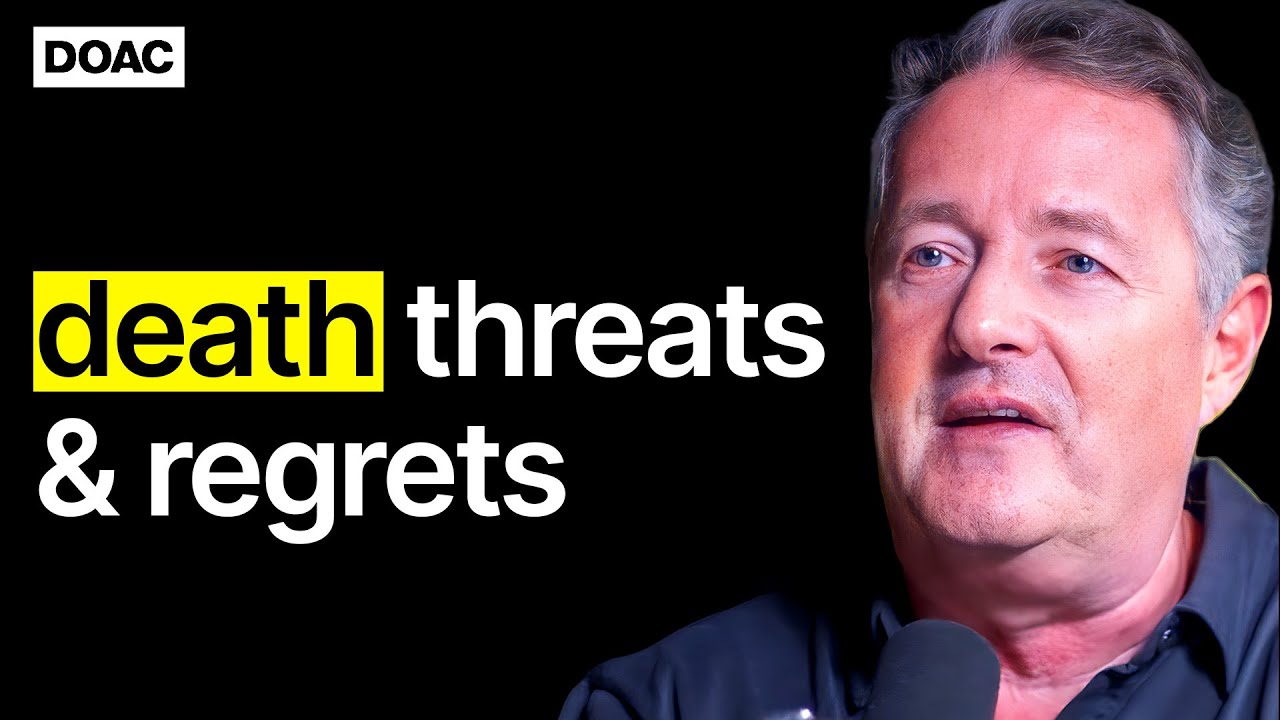
Full transcript · Read the full conversation in order, with its original context.
§01Transcript — part 1
The thing I think about most, especially when I'm on the go but also when I'm sat here in The Diary Of A CEO studio, is the Wi-Fi and internet that we have to work with. In fact, anytime I'm filming away from the studio, one of the first things I do when I arrive is open up an app and do a speed test to see how strong the signal is.
The number of screenshots I've sent to my team about Wi-Fi signals at different locations is actually pretty crazy. It matters that much to me because it's such a competitive advantage to have fast Wi-Fi. On any given day, if I'm recording hours and hours of footage with a podcast guest, I then often have to have my team send that across to our London team who then do the edit.
Fast Wi-Fi and internet is not a "nice to have," it is absolutely business mission-critical. So, when it came to finding the best provider who could supply internet and Wi-Fi to our new LA studio, we looked at every single option.
Of all the providers, the one that came back with the steadiest connection, as well as being the cheapest, was today's sponsor: Spectrum Business. Spectrum Business keeps businesses of all sizes connected with fast, reliable internet, advanced Wi-Fi, phone, TV, and mobile services.
Millions of business owners already rely on Spectrum to keep their operations connected. So, if you want to join them, head to [spectrum.com/business](http://spectrum.com/business) to learn more. That's [spectrum.com/business](http://spectrum.com/business). Restrictions apply. Service not available in all areas.
Opinions to me are the spice of life. If you don't have an opinion, there's something wrong with you. I'm Piers Morgan Uncensored. Show some damn respect!
Why do you want to deport me? Am I allowed to respond yet? I’m a news junkie, and it started when I was six or seven. As I got through my teens, I became very opinionated.
I read a report last year that said 33 million people in Britain are mentally ill. No, they’re not. It’s crap. We’re spending too much time encouraging a kind of wallowing in self-pity.
People will misunderstand the use of the word. But hang on, the risk I see is being the judge of whether someone’s feelings are worthy of the emotion.
I’m done with this. I left on a point of principle. The principle was: I’m entitled to my opinion. Why should my sons be exposed to death threats simply for being my children?
Cancel culture is a virus as deadly over time as a coronavirus. The public wants someone to cancel cancel culture. I want to stimulate debate and to get to some kind of truth.
Have you ever regretted anything you’ve said?
So, without further ado, I'm Stephen Bartlett, and this is The Diary Of A CEO: USA Edition. I hope nobody is listening, but if you are, then please keep this to yourself.
Piers.
Stephen. This is quite interesting. You’re usually on the—I already feel uncomfortable. I’ve watched your stuff. You’re forensic. You go deep. I’m like, I don’t really know why I’m doing it, other than at least one of my sons is a massive fan of yours and said, "Dad, you’ve got to do this podcast. Everyone listens to this podcast." So, whatever you’re doing, it’s working. So I’m here.
You make great kids. Well, thank you for being here. The thing I was thinking as I was sat upstairs, "Where do I start with this conversation?" Honestly, the center point of my curiosity is how you came to be the person you are today.
I look through your story, especially your early years—the loss of your father, certain experiences you had when you were younger. You’re a self-aware guy; you’re an honest man. What are the factors at that pre-teen age that went into making Piers Morgan the man that we all know as this media anomaly?
I'm a junkie. I'm a news junkie. And it started when I was six or seven, which is just weird. I’ve had four kids myself; the idea of being six or seven and being addicted to what’s happening in the world, to news, to newspapers... I used to sit and read the Daily Mail.
My parents used to get the Mail. I used to read it from cover to cover when I was six or seven. So from a very early age, I had that kind of fascination and curiosity about what was happening. I wanted to know what was happening and what to think about it.
As I got through my teens, I became very opinionated. I used to regularly get thrown out of my local pub on a Saturday night for getting drunk and disorderly. By "disorderly," they meant just too opinionated and too loud. I’d argue with people, and then it would get out of hand, and I’d be thrown out. I always got myself back in, though.
Why? Why would you argue with people?
Because I used to feel strongly about stuff. People see me hyperventilating about vegan sausage rolls and think, "How can any sensible human being in the world get so enraged by a vegan sausage roll?" I don’t know, except that when I was young, I used to get enraged by all sorts of things.
Now, not to the point where I’d hit people or it manifested itself in any sort of violence, but I would be passionate about arguing. Most of my family are the same. My grandmother was very opinionated, my mum’s very opinionated, my siblings... I’m probably the quietest one of the four of us when we go out.
So, opinions to me are the spice of life. If you don't have an opinion, there's something wrong with you, to me. You’ve got to care about what’s happening in the world and you’ve got to work out what you think about it.
I particularly think it’s important now when there’s so much opinion flying around that people go to the right people so that they hear the right kind of stuff. There is so much nonsense being spewed into the sort of Twitter-sphere and so on, and Facebook. That’s why I think your show is so successful—your podcast—because people appreciate the more reasonable take that you have on things and the way you try to get to the truth about people and about things.
So, there’s on one hand loving to have a discussion and to have your opinion be heard and to convey information. Then there’s this other part which I tried to understand, which was you repeatedly said, even at 16 and 17 years old, that you liked being the center of attention.
I'm like, where does that come from? Because that feels like more of a psychological thing. A lot of people don’t like being the center.
I just wanted to be famous. I used to practice my autograph when I was a kid regularly. I wanted to be famous. I used to collect autographs. I was a massive cricket fan in particular. Me and my brother used to go and stand outside pavilions at professional games and wait for players to come out and get Ian Botham’s autograph, Viv Richards’ autograph.
I used to practice mine. Then I began writing to world leaders. I’ve got all these letters from Margaret Thatcher and Ted Heath when he was Prime Minister, and world leaders around the world. I’ve got letters from Sir Donald Bradman, the greatest cricketer that ever lived. I used to just write to him, and he used to write back.
I used to spend my entire time in weird correspondence with the world’s most famous people and quietly thinking to myself, "I’d love to be one of these people." It must be great—center of attention, everyone looking at you, talking about you, good, bad, and ugly.
So yeah, there are bits of paper at home that my mum’s kept with just endless "Best wishes, Piers Morgan," "Best wishes." It sounds ludicrous and extremely vain and presumptuous of me, but now I’m at the stage where, ironically, if in the old days I had this level of recognition, I’d be signing autographs all the time. But nobody wants autographs anymore. Everyone wants a selfie. When I finally got there, actually, autographs had gone out of fashion. It’s now selfie time.
You’re very honest about that. A lot of people wouldn’t say—I think 99% of my guests would not have the whatever to say, "I wanted to be famous."
No, and by the way, most of them are lying. Right? So, I like to think that whether you love me or hate me, I do have a kind of brutal honesty about what I’ve set out to achieve, what I have achieved, what I’ve failed at. I don’t try and sugarcoat things. Nor do I try to pretend I’m something I’m not.
You don’t have to like me to respect the fact, I think, that I speak my mind. I give honest opinions about stuff. They’re not always opinions people agree with, but I don’t want them to. I don’t want people to agree with me necessarily. I want to stimulate debate and to get—if we hopefully get—to some kind of truth, which is the most important thing in a world where truth is so difficult to find.
I also wanted to be famous. I’ve only really realized this in hindsight. I definitely wanted to be famous, not for the wrong reasons, but I think the reason I wanted to be famous is because it was the antithesis—it was the opposite—of what I was sometimes when I was younger.
When you’re a kid trying to fit in on the playground, the only Black kid in an all-white school, people calling me the N-word, relaxing my hair to try and be white like my friends were... I think I thought of fame as acceptance on a mass scale and admiration. So I thought, "That’s what I wanted."
When I read about you going to that comprehensive school, you were also subjected to quite a rough treatment.
Yeah, well, my full name is Piers Stefan Pugh-Morgan. It's a double-barreled surname. Imagine having that name when you go to a local comp. On day one, I had the local skinhead who had a Mohican come up and smack me in the face. That carried on for quite a while.
It carried on—people doing that kind of thing—until my brother Jeremy, who’s now a British Army Colonel, joined the school. He was like the old thing of Mike Tyson: "Everyone’s got a plan until they get punched in the face." Everyone had a plan about me until my brother joined and punched them in the face.
I realized then that force sometimes is not a bad thing. When you’re subjected to bullies, actually, there’s only one language most of them understand. I feel that as I did about the playground at the time, and I feel that about Vladimir Putin now with what’s going on in Ukraine. It’s the same principle. When someone’s bullying, you either show them fear and weakness, or you stand up to them.
Did you like school, even though you were bullied?
I loved it. I loved it. I went to a prep school until I was 13. So I had a lot of privilege at the prep school—played sport every day, great academic levels and so on. I then went to the local comprehensive, which was a great school, a very successful comprehensive.
But suddenly you were playing sport once a week. I realized then the massive gulf between facilities and resource at a comprehensive compared to a fee-paying prep school, and how that seemed so unfair to me.
But I also discovered that people had chips on their shoulders in both environments. You got the snobs at the prep school, and you got the yobs at the comprehensive. Most people were fine at both, but you got those two types of people who would have chips on their shoulders. In the snobs' case, looking down on people. In the yobs' case, hating people who had more privilege than them.
I think I came out of that environment—both environments—with quite a healthy—you either have a chip on both shoulders, or you have no chip at all. I think my ability to be exactly the same whether I’m sitting with Nelson Mandela and the Queen or my old village mates comes entirely from that dual-pronged education I had, where I saw great privilege and no privilege and had to work out a way of thriving in both environments. I think that was good for me, actually.
If I removed that experience of that comprehensive school, especially before your brother arrived and saved you from the bullying per se, what would I remove from adult Piers Morgan?
I think resilience and mental strength. These are two things I’m extremely hot about. I think this generation in particular has lost the ability to look at mental strength and resilience and triumph over adversity and being tough in difficult times as badges of honor.
They’ve almost become badges of shame, where people feel like it’s wrong to have a stiff upper lip, to be strong-minded, to be resilient, to be tough under pressure. I looked yesterday—I was watching the golf, The Masters. Tiger Woods. Look at Tiger Woods’ story. I mean, unbelievable.
At 21, he’s the greatest golfer that’s ever lived, destroying everybody. He has it all. He wins 14 majors. Then he has one of the greatest falls in the history of sport. It all involved, you know, Vegas mayhem and so on. His world collapses. Then he has horrific injuries. He becomes number 1,100 in the world. He’s finished.
There’s a whole mashup of clips of people saying he’s washed up, he’s finished, he’ll never win again, whatever. There’s also a video of him watching that mashup just after he wins the 2019 Masters, which no one said he could do again.
And again, now he has a horrific car crash a year ago. And yet here he is, competing in The Masters. He’s made the cut again. The guy is a freak of nature, but he’s a freak of mental strength.
I look at him and I see Rocky Balboa in mentality. And I look at many other sports stars at the moment who think it’s fine to quit, to give up, to walk away, to complain all the time, to moan about their lot in life. And I think, how have we come to this? How, even in high-level sport, has quitting now become something to celebrate?
Now, it’s a contentious issue, and people say you’re mocking mental health when you do this. But I don’t think so. I actually think we treat the whole mental health debate the wrong way. I think we should separate mental health from mental illness.
I don’t think mental health is an issue to even be debated, particularly. We all have mental health. But if you have a mental illness, you need help, you need treatment. Right now, people are, it seems to me, looking at normal life stuff as some form of mental illness.
Anxiety is exploding. People saying they’re mentally sick—the incidence of that is exploding. How can that be happening when it’s all we talk about 24/7? I think we’re going about it the wrong way.
I think what we’re losing in this debate is a celebration of resilience and mental strength. I really believe that. I think schools should have more people in there teaching kids how to be tougher about how to deal with normal life stuff.
And I’m not talking about people who have clinical depression or suicidal tendencies or any of those things. Those are serious mental illnesses. I’m talking about people who are thinking that normal stuff that’s happening in my life, which we all have to go through—grief when you lose a loved one, trouble at work, trouble with relationships, whatever it may be—you’ve got to learn to be more resilient about these things because that is life.
Life, as Rocky Balboa said, is not a bed of roses. Life is tough. It’s not about how many times, as Rocky said to his son in the famous scene in the sixth of the franchise, that scene in the street with the spoiled, entitled son whining away about everything.
Rocky turns on him finally and says, "Look, it’s not how many times you can hit. It’s how many times you can get hit, get knocked down, and get back up and keep moving forward. That is what life’s about." And I don’t think we spend enough time helping people to be mentally strong and resilient. We’re spending too much time encouraging a kind of wallowing in self-pity and weakness. And it is—I'm afraid—it's not working. Demonstrably not working.
I remember when you did an interview with a famous world leader—I think he was a terrorist—and you said to him about his daughter, "What if your daughter had dated a Jewish person?"
President Ahmadinejad of Iran.
Yeah. So I’ll use that same technique. If one of your children comes to you and they express some kind of symptom, which could either be a lack of mental resilience or it could be—
But they do.
Yeah. And how do you know the difference, though?
Well, you don’t. But I talk to them. And I talk—I try and with all my kids, they’re all very different, but they’ve all come to me at certain stages with issues that they want help with. And I always try and drill into them perspective.
The great thing you get as you get older—and I’m 57 now—you learn about life, good, bad, and ugly. You learn from mistakes, you learn from stuff that’s gone bad in your life. You learn that actually, you either give up or you keep pounding.
As I keep always saying to them: keep pounding. Because keep pounding, it’ll be fine. And it invariably is fine. So they start to realize over time that I’m right. That actually, just keep going. Don’t give up. Whatever it is—if it’s a work issue, if it’s an exam issue, if it’s a relationship issue, whatever it is.
I have these conversations all the time with my kids. They’re the people I spend most time talking to. And I try—and they all need different advice and different help in different ways. But what I try and do is perspective all the time.
And based on my own experience, it’s like, "I’ve been there. I’ve been in this position. It feels like the worst thing in the world." You know, you lose a girlfriend that you love, you lose a job that you love, you crash your car, you lose a family member that you love—whatever it may be.
There are all sorts of things that will come and test you, especially as you get older. You lose your first friend who dies when you’re young. I can remember losing one of my closest friends before he was even 30. Devastating. Absolutely devastating.
But when it happens again and again with people that you care about, you realize that that’s life. Life is what it is. You have one life, and people die. People you love die, and people you care about die. And you’ve got to learn to ride that wave of grief. And it’s not mental illness. It’s not anxiety. It’s actually just something we all have to deal with.
But too much, I think, too many young people today feel unnaturally anxious about these things, as they did about the pandemic or about the war in Ukraine. Interesting conversation I had with Dr. Phil out here in America, actually, about this, who said when he was young—he gave the analogy—when he was young, if someone was eaten by a crocodile on a golf course in Florida, very unlikely that anyone would know that outside of the immediate area.
There were very few—one or two main television news bulletins a day. There were very few national newspapers, most were state or county newspapers. And so it might get reported in the local paper; that would be it. But certainly, nobody outside of Florida would likely ever hear about that.
The difference now is young people will see the video of the person being eaten by the crocodile within 20 minutes of it happening, quite likely. Someone will have got it on a camera, on their phone. So they’re being exposed all the time to a sensory overload of quite grim stuff.
Ukraine is a very good example of the first time, really, we’ve had a war of this kind where we’re all watching it in real-time unfurl on social media. We’re seeing all the videos, we’re seeing the horror in real first-hand exposure. And that has to have an effect on your senses. It has to increase your anxiety levels.
I get all that. My grandmother was 19 in World War II when it started, 25 when it ended. She didn’t see all this stuff. You just didn’t get exposed to it. But if she had been, it would have probably had a devastating effect on her.
So I think that I have sympathy with this generation. I think in many ways, they’re a great generation. They’re better informed than any previous generation. I think that these networks like Instagram, Facebook, Twitter and so on, they’ve certainly given people an amazing connection with each other.
But they’ve also got this terrible FOMO (Fear Of Missing Out) which has been created, which I see first-hand with my kids. When they’re somewhere and all their mates are somewhere else, all they’re seeing is all the fun going on on Instagram, and it makes them a bit anxious. I never had that. I didn’t know what my friends were doing in my next village.
So things have changed. Technology’s changed. It’s good in one way; it can be bad in other ways. And we’ve got to work out a way to help young people. But ultimately, I come back to: I don’t want to be unsympathetic, certainly. I want to help. But I do think we’re going about it the wrong way.
I think we’re encouraging a wallowing. We’re celebrating self-pity. We’re celebrating victimhood in a way that everybody now is like—you see stuff on Twitter like, "I've just failed my driving test for the fourth time, but I'm so proud of myself for the journey I've gone on." What are you talking about? What do you mean you’re proud of yourself? You just failed your driving test for the fourth time! Nothing to be proud of.
I get that part. The bit that I still struggle to get on board with is having sat here with even—I know you know Roman Kemp and his father.
Love Roman Kemp. I’m very aware of that.
Having sat here with Roman Kemp and hearing the story of what he went through with his friend who was on his radio station with him, killed himself out of the blue. And never spoke to anyone.
And Roman said, "If I’d lined up 20 of my friends and said, 'Which one is suicidal?', he would have been named last in my estimation." So when I reflect on that and I look at male suicides in particular, and a lot of what the mental health organizations say the causes of that are, one of them is that men just don’t talk about how they’re feeling. And then that results in alcoholism and these other—
But I do talk about it! And I do encourage people to talk.
So this is what I’m saying. So when someone says the use of the word "wallowing," that sounds very similar—
Depends what the wallowing is. If they’re wallowing in—but you know when you use those words... You know, because you’re a smart man and you write. You know that people will misunderstand the use of the word. And there’s harm in that.
But that’s them misunderstanding what I mean by it. It’s a bit like the debate about obesity. We’re now at the ludicrous stage of this debate where you’re not allowed to call people fat. You’re not allowed to. It’s offensive.
So we now have a situation where you see a 310-pound model on the cover of Cosmopolitan who’s 5'2". She’s dangerously, morbidly obese. But the cover picture and the interview, six pages inside, never mentions that. It celebrates her "body positive" image. There’s nothing body positive about being morbidly obese. She’s going to die if she is enabled in this way going forward.
I’m not afraid to say that. And a society that doesn’t go there and pretends that this is all perfectly acceptable is doing that woman an incredible disservice. So when you say, "Well, you can’t use the word 'wallowing'..."
I didn’t say that.
But you were implying it.
I'm saying there's a danger.
Yeah, because I would say to you, a lot of people do wallow. I see them.
What’s the difference between wallowing and coming to a friend and saying, "I’m feeling really..." or even tweeting it, saying, "I’m feeling like there’s something wrong with me"? What’s the difference between wallowing and that?
Well, there’s a line. I don’t know that I know exactly what the line is, but I do know when friends or family members come to me. Either they come to me with something where I think, "Yeah, they’ve got a valid reason to feel this way."
Or sometimes you’ve just got to go, "Come on, get over it." And then they might laugh and have a drink and they get over it. By the way, you’re not allowed to say that anymore. There’ll be people watching this, your younger audience, who’ll be going, "Oh my God, did he just tell people to get over it? He’s talking about people with mental illness." No, I’m not. No, I’m not.
Be very careful that you listen to what I’m saying. I distinguish between people who I believe have mental illness and people who I believe are genuinely wallowing because society has decided that it wants to celebrate people who have something wrong with them more than it celebrates now people who are successful and tough achievers and talk about having grit and stiff upper lip and all these things.
That’s all become sticks to beat people with. I have it used against me. "How dare you talk about a stiff upper lip!" Well, why shouldn’t I? Why shouldn’t I? I have a stiff upper lip. I’ve been through a lot of crap in my life. And I’ve decided that that’s the way I deal with it. You may not like it, and maybe you like to deal with it by going, "Woe is me."
One of my favorite poems is a D.H. Lawrence poem called "Self-Pity." It’s only three or four lines. And it says: "I never saw a wild thing sorry for itself. A bird will fall frozen dead from a bough without ever having felt sorry for itself." Something like that. It’s a brilliant poem. That’s it; it’s only about four lines.
And I get that point: that in the jungle, in the world of animals, self-pity doesn’t exist. Wallowing in your own woe doesn’t exist. You’ve got to get on with it.
One of my favorite conversations ever was with Sir Roger Bannister, who sadly died, but he was the first man to break the four-minute mile. And he—I asked him... he used to live in the square I live in in London, and he came to one of the 200th anniversaries of the square.
And I had a chat with him, and I said, "Did you ever have any... when you won this amazing—nearly killed him, he nearly collapsed at the line—did you have any sort of motivational quote that drove you?" And he said, "Funny enough," he said, "I have one. It was an anonymous proverb from the African bush."
And it was: "When a lion wakes up in the morning, it knows one thing: it has to run faster than the slowest gazelle, or it won’t eat. And when a gazelle wakes up in the morning, it knows it has to run faster than the slowest lion, or it’s going to get killed. So whatever you are in the African bush, one thing’s for sure: when the sun comes up, you better start running." And that motivated him.
And it’s a great quote. And I think it’s a great quote for all your viewers and listeners of this podcast to take away from this interview. If you take one thing away: get running. Get moving. Be positive. Don’t let normal life stuff drag you down. Because if it does, it will dominate your life.
And you’ll become one of those sort of miserable, self-obsessed people in the wrong way, where all you’re thinking about is you and your problems and your woes. It’s like, there are a lot of people a lot worse off than you. When I see some of the crap I’m watching at the moment on social media of people feeling sorry for themselves, when you see what’s happening in Ukraine, it actually makes me puke. It’s like, watch what’s happening to the people of Ukraine and get a perspective about your life. And I’m sorry if that sounds tough, but I’m not sorry, actually.
I completely get the point about mental resilience, and I think there's so much of what you say that I really agree with, especially about a younger generation. I've said on this podcast many times: I am scared of over-labeling things—things that might just be a bad mood or whatever—with something else which is much more medically concerning.
When I asked that question, then you said, "It depends what it is," in terms of a friend coming to you. The problem is, you’ll know that these things are so subjective. So when people could genuinely be suicidal—genuinely be suicidal, not faking or looking for attention—over losing a cryptocurrency investment. I read an article about that the other day. Guy’s crypto investment goes down, kills himself.
So I find the risk I see is being the judge of whether someone’s feelings are worthy of the emotion. That’s the risk. It’s like, you know—
I think there are millions of people out there prepared to do what you’re talking about. I am a very rare voice in the public platform arena who’s prepared to give a slightly different perspective on this stuff. And to me, there’s room for both of us.
You don’t need any more people who are going to give 24/7 coverage to mental health as an issue on the assumption we’re all slightly mentally ill. I just don’t buy it. I read a report last year that said 33 million people in Britain are mentally ill. No, they’re not. It’s crap. Absolute crap.
And when a society pretends that is the case, because a lot of people are identifying as mentally ill when actually they just have anxiety about exams or relationships or whatever it may be, when we do that, it means the people who really need help are not getting it. It means they’re slipping through the cracks, in my opinion.
And that’s the problem with it. And it’s not about being callous or insensitive. I think my kids would tell you I spend hours and hours sometimes talking through problems with them. But always I come back to, "Look, life’s tough and you’ve got to keep pounding." That’s my mantra. Because it’s one I’ve applied to myself. And my family have had a lot of stuff to deal with, and they’ve kept pounding.
Because what’s the alternative, really? The alternative is you give up. And that to me is not an option. Not an option that would bring me any pleasure. Couldn’t look in the mirror having just given up all the time.
When your cat is acting weird-er, or your dog is being loud-er, your turtle moves slow-er... Hello, Ted. Your cat seems thirsti-er... Whoa, slow down, buddy! Or your puppy is acting clumsi-er. Day or night, if you don’t know what’s wrong, know where to go. VEG: ER for Pets. This is Kate. VEG: the better, kinder ER for pets.
Why would that bring anyone pleasure? One of the things that I love about your—well, I was really compelled by your story as I read through your early professional career—was clearly, for some reason which I couldn’t figure out from just reading, you got ahead quite quickly.
Kelvin [MacKenzie] gave you a shot at The Sun. Rupert Murdoch gave you a shot at News of the World when you were 28. He made you the editor of the largest newspaper in the Western Hemisphere, if I’m not correct, at 28 years old. So when I was reading that, I thought, I’ve got to ask him: why? What was it about you?
Well, I think that I remember Alex Ferguson saying—and I know you’re a big United fan and my sympathies are with you at this difficult time—but I remember him saying that he loved youth because there was a fearlessness of youth.
I think I was quite fearless in my 20s, certainly. Before you get responsibility, before you get married, have kids and so on, and you’ve got other people you’re responsible for, there’s a fearlessness that comes with youth. And I think I had that, certainly.
It was instilled by—the confidence came from my family. Very strong women in particular in my family: my mum, my grandmother, tremendously strong people who had come through a lot of adversity and never wallowed in self-pity—to quote that awful phrase I know drives you mad. But they never did.
And that was just not allowed. And it was always like, "Just get on with it. Dust yourself down, get on with it." And I liked that, to be honest. I thrived under that mantra.
And I remember Kelvin MacKenzie, who was a mercurial genius in many ways—brutal but brilliant, hilarious and barbaric. I mean, he was like everything. But The Sun had an amazing power and voice when he was in charge of it.
And he said the most annoying thing about me was that he could give me the most savage bollocking where literally his neck veins would start to explode, and within an hour I’d bounce back into his office, bouncing with excitement because I’d had a scoop for him.
And I was completely unfazed by the bollocking. It had motivated me to go and prove him wrong and get a good story. I think that’s how people should be in life. I think it’s a shame that in the workplace now, you’re not allowed to raise your voice.
You’re not allowed to. It’s bullying. Everyone’s a victim of bullying. You can’t have any banter anymore. Can’t have any fun. All the joy’s been sucked out of life by this woke brigade of, in my view, awful people who just think that life should be humorless, banterless. Everything is bullying. Every criticism is bullying. Everything is terrible. People are awful. You can’t have fun. You can’t do anything. I don’t buy it. It’s not what most people are like. Most people aren’t like that. They don’t actually believe half the crap they’re coming out with. They don’t. It’s not how anybody wants to lead their lives. We know from the pandemic what it’s like when our freedom—our basic freedom—gets taken away. Why, when we’re coming out of a pandemic, would we then want to lead a joyless existence?
How do we fix this? Because I agree with you.
I think common sense has to come into play. I think the problem with the woke cancel culture, as I put it, is that if you go and study—I wrote a whole book about this last year. It was a massive bestseller. People understood it, right?
So, I think you know where I come from. Probably politically we’re not that far apart from each other, I guess, from what I know about you. But I went and studied the origin of the word "woke" and what it meant. By that definition, I’m woke. I believe in promoting campaigns against racial and social injustice. I’ve done it all my career as a newspaper editor and as a television broadcaster.
I’ve done that. It doesn’t cut the ice, though, with the modern woke brigade because they’ve stolen wokery and they’ve now used it as a new form of fascism where they want to dictate to people how they lead their lives.
What they can find funny. What movies are acceptable and not acceptable. What television shows they can enjoy. What haircuts they can have that aren’t "inappropriate" or "cultural inappropriation." You can’t celebrate any other culture anymore; it’s all inappropriate. Every joke is inappropriate. Every comedian has to be canceled.
People can’t host the Oscars if they told an inappropriate joke ten years before. Yet Roman Polanski was given an Oscar after he raped a child. I mean, the sort of warped morality of all this is absolutely extraordinary to me.
But at its center—a woman came up to me in Kensington a few months ago, after the Markle debacle, as I call it. And she said, "Mr. Morgan, I’m an 80-year-old Australian woman, but don’t hold either of those things against me." And we had a laugh in the street.
And she said, "The trouble with these wokies is they want to suck all the joy out of life." And I thought, what a brilliant way of describing it. And they’ve literally become the very fascists that they profess to hate most.
And we have to counter it. And so my ambition with my new show, for example, is to cancel cancel culture. To go back to what a democracy should be, to what society should be when it’s supposedly democratic, where you and I can have a spirited debate about something and agree to disagree and go and have a beer.
Or maybe we reach points of consensus. This is what used to happen. I’ve had ferocious arguments with my friends and family my entire life. The idea I would disown them, as you see happening all the time now with people falling out with friends and family because they’re so blindly self-righteous about their own opinion that they can’t tolerate another opinion...
The idea we have university campuses where only one certain type of voice is tolerated... at a university! A place you’re supposed to learn all sorts of disparate views, hear all different voices and make your own mind up. Now, no. Unless they’re woke speakers, no one else is allowed.
If you’re a conservative—which, by the way, many millions of people are in this country, in America, in Australia—if you’re a conservative, you are the enemy to be crushed and destroyed and deplatformed. Really? How did we get there? How could any student have their mind developed or evolved in an environment that cancels anybody for deviating from a woke agenda?
It’s madness. And when I look at what’s happening with the transgender debate... I support transgender rights to fairness and equality. I always have, publicly, in columns, on television, on Twitter. I’ve been very clear: I want transgender people to have equality and fairness.
Right to the point where trans-activism leads to an erosion of women’s rights, as we’re seeing all over the place, not least in the world of sport. If anybody genuinely wants to sit here and say to me that what’s going on in women’s sport with transgender athletes is fair or equal, I’d love to listen to it, because it’s bullshit.
We all know it’s unfair. And what’s being caught in the crosshairs of this is many trans people who don’t want to get involved in this debate and just want to be able to go about their lives and try and have a life of fairness and equality. They’re getting subjected to mockery and ridicule because it’s so ridiculous what’s going on with trans sport.
And so I say to people, "Yeah, you can say to me you’re bigoted and you’re transphobic, but I’m not." I’m actually just a voice of common sense. When you see even J.K. Rowling canceled because she believes in the biology of sex, it’s just madness. Sex is not something you can just pretend, like gender, can be anything you make up on the spur of the moment. It can’t be.
You’ve seen how this has got progressively more—let's say—the world has got progressively more woke.
No, the world has moved from being woke... right, okay... by the original... I think that most people in the 60s, 70s, and 80s wanted to see better racial equality and social equality. Most people. That was what the original definition of woke was.
The modern-day woke is nothing to do with that. The modern-day woke is a form of fascism. You will abide by our rules, or you get destroyed. That’s the difference, to me.
So the world has got more of this modern-day wokery, right? And I've seen it on social media. The way that algorithms work as well: they show you more of the same, they keep reinforcing you. Then because you build an audience of the same people, they clap more when you say a certain thing. It's kind of reinforcing you; you preach to your choir.
The analogy I would use... you go back 2,000 years, we lived in tribes. Right, I've read your book. Yeah, right. And I told this story: you never used to come out of your tribe. Everyone in the tribe would look the same, same attitudes, eat the same food, drink the same drink, same sense of humor, because you never moved out of this group of people.
And then people began to move out of their tribes and meet other tribes who dressed differently, thought differently, laughed at different things, maybe spoke differently. And both tribes in that moment decided the only answer to this was to kill each other. Well, that’s where we’ve gone back to.
Are you optimistic that—
Not really, no.
This is interesting. So your antidote for this new wokery is to lead and to create a counter-narrative, which is what you’re doing with your new show Piers Morgan Uncensored. It’s what you did with your book as well. Are you optimistic, deeply, that that will win?
Well, let me ask you a question. So I’m described as highly controversial, right? I’ve been called all sorts of names. People say that what I say—the things I say—are outrageous. When you read my book, how many times did you stop and think, "That’s outrageous"?
No, I didn't really disagree with anything.
Right. So that’s my point. I don’t think I’m the controversial one. I think I come at this from a reasonably common-sense perspective. In your book, I didn’t disagree with you at all, because you were talking about things like popularism and liberalism and how it’s changed. I completely agree.
I think I used to identify as being on the left. Now I don’t, because the—the anti-left—
Because they’re nuts, a lot of them.
Yeah, a lot of it is absolutely nuts. I also don’t really identify with being on the right either, because they’re nuts as well.
I agree. You get nuts on both sides. And we’re moving to the extremities.
But I’ll get canceled from both sides because I don’t wear the football kit of either.
I’m the same. Yeah. So I want to bring back a more consensus-related society where you reach points of agreement through debate. And you don’t try and shame or cancel each other for having different opinions. Because that’s at the core of this.
They call themselves liberals. They’re not liberal. Liberalism isn’t about an inability to tolerate other opinions. It’s the opposite! Right? You’re supposed to tolerate and respect other opinions and agree to disagree.
We’ve lost this in society because a small group of people, but very vocal and very angry about everything all the time, they are driving an agenda which, if we go down that road, will be the end of a democratic society as we know it. So I see myself, humbly, as trying to defend democracy.
Humbly.
No, no, humility is not something that comes naturally to me. But genuinely trying to defend what democracy really is, and trying to educate these wokies about what real liberalism is. What democracy actually means. What free speech means.
Free speech is not about you in an echo chamber all agreeing with each other. As Churchill said, free speech is about listening to views you don’t agree with, but allowing people to have different views.
You know, it’s funny. I went around the world when I was running my marketing business, before I resigned, and I used to have one slide on my presentation deck that had your face on it. And do you know who else’s face was on that same slide deck?
I went all over the world with this presentation, met with Apple, Amazon. I had Piers Morgan, Katie Hopkins, Kanye West, and Donald Trump. And I used to tell people that there’s a very important thing to learn from these four people.
Because whether you like them or not, in marketing, the least profitable outcome is indifference, when you don’t care either way. And people have an opinion. And it’s funny because I was talking to the girls on my team here yesterday, and they don’t always agree with you, but they’re always listening.
And sometimes, on the COVID issues or this issue, they’ll be behind you, and then they’ll be against you. But do you realize strategically the art of being the center of conversations? And what are the principles—if it’s a brand trying to be relevant or the center of attention, or if it’s a person in their personal brand—for you, what are the principles for one to replicate what you’ve done with that?
Confidence in yourself. Self-belief. I think the one thing I have is a lot of self-belief. I’m firmly—I remember a friend of mine, Kevin Pietersen, the cricketer. His big mantra with himself when he played cricket for England was "back yourself." Back yourself, whoever you’re facing.
He was one of the few players in history to demolish Shane Warne at his peak in the 2005 Ashes series because he backed himself. But it’s risky. As I’ve seen from your career. It’s risky, but as Wayne Gretzky, the greatest ice hockey player in history, said brilliantly, "You’ll miss 100% of the shots you don’t take."
You’ve got to take risks in life. You’ve got to learn from failure. Mars, the confectioners, used to celebrate chocolate bars that didn’t work more than they did chocolate bars that worked. They worked on the assumption that most of their bars would work. They tested them, tested them, tested them, they knew what they were doing, so most of their new bars would work.
But if they occasionally had a failure out of nowhere that stunned everyone, they would celebrate that because they reckon they learn more from the failure than they did from the endless success. And I agree. I’ve learned more from failures than success.
Success is easy. When you’re successful, everyone wants to have a piece of the pie. And I’ve had great success and I’ve had wonderfully, cataclysmic moments of "boing." And when you get the "boing," the old cliché "you find out who your friends are" is completely true. You find out who your friends are. You find out who actually cares about you, who’s prepared to stand up for you.
I remember after my dramatic departure from Good Morning Britain, Sharon Osbourne tweeting that I was entitled to my opinion. She knew by doing that, there could be massive repercussions for her, given how incendiary the whole debate was.
It cost her her job. Scandalously. Scandalously. She was described as a "racist sympathizer" on her show The Talk. But when she asked them to describe what racist things I’d said, they weren’t able to do so because, guess what? I’d said nothing racist.
Nothing I thought about Meghan Markle was driven by anything to do with her race or skin color. Why would it be? I just thought she was a disingenuous piece of work smearing the royal family. I’m entitled to that opinion. You may not agree with it; I think most people who watched the interview probably ended up agreeing with me.
It doesn’t really matter whether you agree or not. But the idea that Sharon Osbourne was destroyed at the altar of cancel culture because she had the audacity to say I was entitled to an opinion... not that she even agreed with my opinion, just that I was entitled to one.
That in that moment said to me how ridiculous this culture has got. Ridiculous. And I’m delighted that Sharon is now going to be back on TalkTV in the UK, in the show after mine, on a show called The Talk. She’s going to be "uncancelled" by us because she should never have been canceled in the first place.
And when people say cancel culture doesn’t exist, look at what happened to Sharon. Look at the effect it had on her and her family. Devastating. She couldn’t get a job in America where she’d worked for 40 years. So it’s going on. And I want to cancel that culture. I think it’s wrong.
So that led to—that was the first point, which was confidence and backing yourself.
Yes. I think the other thing: you’ve got to have a bit of bravado, a bit of chutzpah. You’ve got to have an ability to know how to stir things up and wind people up. I like to annoy all the right people who are so permanently offended by everything they’re easy to wind up.
Do I enjoy that? Yes! I love sometimes just putting a tweet out. I mean, the vegan sausage roll debate was one of the funniest things ever. I had the flu on holiday in Italy. I was in bed sweating with a raging fever, and I saw Greggs saying, "The wait is over! Finally, it’s here: the vegan sausage roll."
I said, "What on earth are you talking about? Who’s been waiting for a vegan sausage roll?" Apart from anything else, I agree with the French, where it’s illegal to market vegetarian or vegan products using meat language. A sausage roll is meat.
If vegans want to eat their gruel, fine. Go and have a joyless existence munching your lentils. Don’t take my language. Don’t pretend your sausage roll is a real sausage roll. They’re not. And they’re tasteless and they’ve got more calories than a McDonald’s cheeseburger.
So my point is, do I care? Look, I don’t care as much as I do about Ukraine, but in the moment, it really annoyed me that there was a presumption we’d all been waiting for a vegan sausage roll.
And I was also annoyed that you were seeing stories of vegans charging into steak restaurants and playing music of cows being killed. It’s like, shut up and go away. I don’t come into your gruel restaurants ever and shout about what you do to the bee community in California when you eat your almonds and almond milk.
Billions of bees exterminated every year in a six-week cull in California so vegans can eat almonds and eat avocados.
But do you care about vegan sausage rolls?
I care about the hypocrisy that surrounds the debate, actually. Anyway, I did a tweet saying, "This is ridiculous." And everyone went nuts. I wasn’t allowed to think that this was ridiculous. I had to agree that vegan sausage rolls were fantastic. Everyone goes bonkers.
Greggs loved it because they sell I think about a billion dollars' worth more of their products that year. In fact, the CEO thanked me personally at the end of the year results. So they cleaned up. In fact, I’m thinking about going to a business where all I do is take big checks from companies to attack their products. Probably make a fortune.
But the whole thing just showed me that everyone was allowed to love vegan sausage rolls, but if you deviated from that and said you hated them, you had to be destroyed. This wasn’t acceptable. The woke brigade had decided vegan sausage rolls were untouchable.
You had to support them. You had to think they were great. This was brilliant. Even though they’re bad for you—literally worse for you than a McDonald’s cheeseburger in terms of salt and calorie intake—and even though the whole thing was predicated on this utter hypocrisy around vegan food that somehow they’re leaving the little animals alone when they exterminate the little guys, the bees.
And I feel sorry for the bees. No one ever hears vegans talk about bees, do they? It’s always the big animals. They care about cows, not the little guys. I’m a little guy. I’m the Robin Hood of this debate. I look after the little guys against the Sheriffs of Nottingham.
Sure. When I think about that... so you play the game... you know, I know from what you’ve said here, you know part of it is a game. And it’s a very profitable game.
It’s all fun, right? To a point. But there’s also a serious point behind it, which is actually the vegan food business is a massively burgeoning business and that’s fine. People want to eat that; that’s fine.
But I do agree with the French: that actually you shouldn’t be allowed to pretend what you’re doing is meat-related because it’s not. So there’s a genuine point there which I do feel quite strongly about. The French have made it illegal: you can’t use meat language to sell vegan products. I think we should go the same way. You have your world, and we’ll have ours.
You know your career’s been pretty filled with these moments of like, where you are the center, the orbit of sort of debate and controversy. When you go for a period and people aren’t tweeting at you abuse and stuff and they’re not kicking off, do you feel a little bit like, "Fuck, what’s happened? I've made a mistake"?
Well, I remember Donald Trump telling me when he got to the White House, he put four TVs in his bedroom. And he used to wake up in the morning at five o’clock because he doesn’t sleep. And he’d look at the TVs. And if he didn’t like what was on the screen, or if it wasn’t about him, he’d just pull his phone out and tweet something.
And next thing, they’d all change in real-time. "Breaking news! President Trump says blah blah blah." And I kind of related to that. It’s like, if I wake up in the morning and I’m not trending, it’s like, there’s a problem and I have to deal with it.
So yeah, look, I’m in the opinion business. It’s very lucrative for me. I make a lot of money out of it. I get a lot of notoriety and fame out of it. People love me or hate me, but you know, that’s part of being in the opinion business.
§02Transcript — part 2
If you don’t want to be loved and hated, then you don’t express opinions about anything. And that way to me madness lies. You know, I’d much rather be—it’s like the old, again, Churchill. You know, he said, "If you’ve got enemies, it means at some stage in your life you stood up for something that you believe in." Good. That’s good.
When you’ve had those—you called them cataclysmic events in your life where... and when—
Well, other people see them as cataclysmic. I’ve never really seen it that way myself. Like when I got fired from The Mirror, for example, after 10 years. Other people were far more agitated about that and thought it was far more cataclysmic than I did.
The Mirror, Good Morning Britain... and this was the other thing about your story which I found really—I wanted to ask you about. You have these moments, these ups and then these downs, and then these ups and then these downs.
And your Twitter bio I think is probably quite an apt summary of maybe your views on this, which is: I can’t remember it exactly, but "one day you’re the cock of the walk..."
"...the next a feather duster."
Yeah. So then I read that, you know, after like The Mirror situation, you slept a lot.
Yeah.
And then also it seems like after every firing or push—getting pushed out, whatever—you go and get pissed.
Yeah.
So tell me...
Well, again, Churchill, who I love, as you may have gathered. Again, Churchill, who’s now being reviled by the woke brigade. Of course! Because he saved the world from Nazi Germany, so of course he has to be destroyed.
But Churchill, you know, he also said that the best definition of success is going from failure to failure with no discernible loss of enthusiasm. Now, I think I’ve had a lot of success and occasional failure.
But I don’t look upon any of the downs in the same way that other people do about my career. I’m very relaxed about my level of success and failure. I think it’s all been grease to the mill. Normally I’ve left somewhere in explosive circumstances and it’s led to something better. Invariably.
So I’m very optimistic about it. My glass is always half full. I think that one chapter ending is another chapter about to start. You just have to make sure you get something good.
If I spoke to your wife, or maybe even your kids, and I said, "How does Piers’ emotional state change after in one of these moments of cataclysmic failure, getting kicked out, fired?"
They’d say what I’m saying. All of them.
They—"He doesn’t change at all."
Barely at all. Barely at all. No, I don’t. I don’t. I’m probably if anything more relaxed, that’s all. Because when you’re in one of these cauldron jobs, editing a daily newspaper or doing a morning TV show, you know, and you’ve got the adrenaline whirring and your caffeine’d up and so on, it makes you slightly wired to be around.
When you’re not doing that, you’re more relaxed. I’m probably just calmer, a bit more relaxed. And then that gets a bit boring and I want to get back in the game again.
Okay, so in that gap between one job and the next—and you’ve had many of those gaps—what’s going on in your life? And how are you not—because it must be very easy for you to just rush into something else the next day. But the gap between you leaving Good Morning Britain and then...
I always advise people: when you lose a big job, take your time. Just go and clear your head. You’ll get offered loads of things, but don’t react to it. Let the dust settle.
You know, when I left Good Morning Britain, it was a massive global firestorm. And I just took my time. I had loads of people offering me stuff every day. All sorts of jobs from around the world—could have taken any one of them.
But actually I thought, "I’m just going to take my time. Just chill, watch some football, watch some cricket, see some friends, get fit." Unfortunately, I then got COVID and that was the end of the fitness campaign for a few months.
But the principle is clear: your head. You get these moments a few times in your life where you get a chance to reset, recalibrate, clear your head. And then work out what you really want to do next, because it won’t be the same thing three or four months down the line as it feels in the moment.
Most people’s tendency is when they leave a big job in dramatic circumstances: "I’ve got to do the same thing somewhere else. Prove my point." I don’t feel I need to prove anything to anybody. You know, I was a talent show judge for six years. Loved it. Number one show on British TV and American TV for six years. Great. Then I left.
I just couldn’t think of any more things to say about piano-playing pigs. Was time to move on. You know, I did Larry King’s job at CNN after him for nearly four years. I did 1,200 shows on primetime CNN around the world. People call it a failure. It’s like, well, that’s 1,200 more than any other British person I’ve seen do a primetime talk show in America.
So it’s all—it’s all relative, isn’t it? About what your perception of failure is. I had a great time at CNN and actually I wanted to come home. I then did breakfast TV, which I never thought I’d ever want to do or even enjoy. Loved it! And we absolutely crushed it. We took the ratings from a 14% share to a 36% share. They’ve now gone back to 18%.
So people can do the math. You know, I think it was a massive success. And yet I still meet some people who go, "Oh yeah, it all went wrong for you, didn’t it?" I said, "Not really, no. No, it was a brilliant success: Good Morning Britain."
We became the number one breakfast show in the country on my last day. I left on a point of principle, and the principle was: I’m entitled to my opinion. You may not like it, but I’m entitled to my opinion.
And in each case where I’ve had a career-ending kind of moment, it’s really been where the bosses have lost their bottle with me. So I need—I've now gravitated back to my first big boss in media, Rupert Murdoch, who’s got balls of steel. And he’s not going to take a phone call from Meghan Markle demanding my head on a plate.
Meghan Markle, right? Not going to go into the issues of that, really not that personally interested in it. But what I was—I did want to ask you is I saw when you spoke at Oxford, you were talking about Jeremy Clarkson, getting in a fistfight with him, going down the pub making up after. And there you said, "I do like to fall out with someone and then make up again."
Yeah.
What would it take for you and Meghan Markle to make up?
If she could—if she did an interview like this for me. It’d be very interesting. You know, it’s like Meghan Markle to me has lost all sense of reality about life. She needs to sit with someone like me, not an Oprah Winfrey enabling interview fueling your victimhood.
She needs someone to give her some perspective. I talked earlier about perspective, where I say, you know, "Are you aware that when you preach to us about climate change and the environment and carbon footprint from Elton John’s private plane, it doesn’t sit very well? Are you aware that when you tweet as they did on the day of her half-a-million-dollar baby shower in New York with all her celebrity friends, that when you tweet from your Twitter account about poverty, it doesn’t sit very well?"
"Are you aware that when you preach about equality from your 11-million-dollar California mansion, it doesn’t sit very well? Are you aware that when you rip our beloved prince away from the bosom of his family and take him to America and woke him into submission, it doesn’t sit very well with the British people? Are you aware that when you make very serious allegations of racism and callous disregard for suicidal thoughts, you actually have to produce some evidence to support it?"
"Otherwise, everyone at the palace and the Royal Family get smeared by association with those comments." Is she aware of any of those things? I don’t know! But I’d love to ask those questions. She didn’t get asked them by Oprah. Oprah just went, "What? What? What?" repeatedly. Just believed everything she said.
We now know at least 17 statements that Meghan Markle made in that interview were false. So, am I still supposed to believe her? Is it a job-ending moment if I don’t believe her?
So, I think she’s a piece of work. I think that I was one of many people that she used along her path up the slippery ladder. That’s fine; I don’t care, I only met her once. But the way she treated me on a very small level is not dissimilar to the way she disowned her father, the guy that brought her up on his own for six or seven years.
You know, he got disowned. Lives 70 miles away, she never sees him. He’s never met his son-in-law. I mean, crazy stuff. Right? She had one member of her entire family at the wedding. Where her family should have been on either side was Oprah Winfrey and George Clooney. It’s like, do me a favor!
So I see right through it. People still want to believe her; that’s fine. People love Meghan Markle, think what’s happened to Harry is great. That’s fine too. I just don’t agree. And I’m afraid you have to respect my right to have that opinion.
I’m getting about as bored with it as you are, to be honest with you. So I don’t want to be defined by Meghan Markle, even though she was personally responsible for me losing a job I loved. You know, she was the one who wrote to the boss of ITV on the Monday night that led to me leaving the next day, talking about being "we’re both women and we’re both mothers, you’ve got to get rid of him."
Do people think that’s right? Is it right that a person like Meghan Markle from her California mansion should lever a British television broadcaster out of a job he’s enjoying, that viewers are enjoying him doing in that way? I don’t think so.
Is it right that my right to free speech was so impinged that I had to leave a job if I didn’t apologize for disbelieving someone who said false things? I don’t think so. I thought the whole thing was ridiculous. As did Ofcom, the government regulator months later, who ruled in my favor.
So, I thought the whole thing frankly was preposterous. But in answer to your original question: let’s do an interview, Meghan. Let me put all these questions to you and answer some difficult questions. Because I don’t wish them harm, I don’t wish them to be unhappy, but I hate what they’ve done between them to the Royal Family and the monarchy. I think it’s been incredibly damaging.
Do you ever—do you ever get concerned that on a real human level, that some of the words you say—say for Meghan or Sam Smith or on Good Morning Britain, or even around... I know was it Tessa who was the front cover of the magazine?
Yeah, the Cosmo cover girl.
Do you ever—has it ever crossed your mind that the words or tweets might actually hurt someone?
Do you think it’s crossed—well, has it crossed Meghan Markle’s mind what she did to me?
You know like on the suicide—Meghan mentioned suicide.
I didn’t cost her a job.
You know where she was saying she was suicidal... again, I don’t want to go back to the point of mental health, but do you ever reflect, like, is this going to hurt this person on a—
She said that two people at the palace, when she told them she had suicidal thoughts, said she couldn’t get help because it would be damaging to the brand. I don’t believe that. And no evidence has been brought forward to support it.
Those are extremely incendiary allegations. In my view, weaponizing mental health and suicide to portray yourself as a victim. If Meghan Markle has proof that two senior members of the royal household refused to let her get help for suicidal thoughts, I want to know who they were, when they said it, and they should’t have those jobs.
But we are now a year and a bit later: no evidence. Similarly with her racism claims: one of them we knew immediately was untrue. It’s completely untrue that her son was prevented from being a prince because of his skin color. Demonstrably untrue. Factually wrong.
And the other claim was that "a member of the Royal Family expressed concern about Archie’s skin color." Who was it, and what did they say, and what was the context in which they said it? Because the damage that she caused by calling the Royal Family a bunch of racists is incalculable, as we saw on the recent tour of the Caribbean with William and Kate.
So, I don’t think it’s harsh to want some evidence to support such incendiary claims. And when it comes to "Do I use tough language?", yes, sometimes I think I do. But I don’t regret doing that because I think they’ve been using pretty despicable language themselves.
Have you ever regretted anything you’ve said in terms of—
Sometimes you think, "Oh..." Sometimes, look, I encourage all my kids to be free-thinkers. And sometimes they’ll be on to me. You know, like, "Dad, you went too far. You shouldn’t say that." And we’ll have a spirited debate about it. And sometimes they change my mind about stuff.
Tell me one example.
I just—I knew you’d ask! I try to think. They have happened. I mean, they’ll be saying now... like my middle son Stanley is an actor and photographer. He loves your podcast.
He’s my favorite son.
Yeah, exactly. He’s on mine, all right? I have all my sons are the same, and my daughter. But he would say now, "Dad, stop talking about Meghan Markle."
Yeah.
"Just don’t bother. Don’t..." And he’s right. There comes a point: what’s the point? The problem is they make themselves newsworthy all the time, and my job is to talk about the news. And obviously I have a vested interest in the Markle debacle because it cost me my job. So I still feel that I have a sort of involvement in that story.
But he would certainly be saying now, "Dad, move on to other stuff. You know, just do something else in this interview that’s more interesting than Megan bloody Markle." And he’s right, actually. So that would be an example. I’ve had that conversation with him, and my other sons.
But we argue. We have a WhatsApp group, me and my sons. If people read that, I mean, they’d laugh because they hammer me, my kids, about all sorts of stuff. Sometimes we agree; a lot of the time we don’t agree. And we have really vociferous arguments, but then we all go and have dinner and have fun together. And that’s the way it should be. I want my kids to be independent-minded. I want them to challenge me. I want to challenge them. And sometimes it gets really heated.
You know as a dad, when you’re leading such a "crusade," as I’m sure you’d call it, about free thinking and free speech and these kinds of things, surely there’s some kind of consequence for your kids, right? Because you’re put—not—I mean, fame in itself creates a consequence for children.
Well, they get picked on because they’re my dad—but I always say to them, "You also get lots of benefits because you’re my sons and my children." All of you, right? We go and have a wonderful time. We get treated like royalty in restaurants. We have lovely holidays. I’ve got a lovely place in Beverly Hills; they come and see—all this is because of my fame, for want of a better word, and success amid the failures.
And I say you’ve got to take life in totality. There’ll be some annoying bits of being my children, and there’ll be some very good benefits of being my children. You know, I got Cristiano Ronaldo when I interviewed him to do a video to my sons, naming them all!
And they were like, "Oh my God!" But they wouldn’t get that if I wasn’t who I am. So they have a wonderful moment, and then they might get trolls, as in one case happened, making death threats to my oldest son on his Instagram.
And I did take that to the police, because why should my sons be exposed to death threats from some disgusting troll? And it’s interesting: the process, it’s been over a year now, and it still hasn’t come to court.
It was a clear and demonstrable death threat, specific to my son and me and to his mum, my ex-wife. And it’s like, how can this be allowed to happen? And we’re still a year, a year and a half later, and still no action against the perpetrator.
I’m hoping there will be; it’s going through the process. But it shows you the frailty and weakness of social media that someone can make a specific death threat and nothing gets done for so long. So that’s a downside of being my—you know, when the Good Morning Britain thing blew up, all my sons were being abused on social media in the most horrific manner by a targeted mob of people, normally who have the "be kind" hashtag in their bio, while spewing vile abuse at my kids simply for being my children. They didn’t even agree with me about a lot of it.
Outside of losing people, when does Piers Morgan cry?
Not often. I mean, really, the last time I cried was my grandmother’s funeral, 2013. Before that... I remember welling up at a movie. I think it was a movie that ends in a horrible fashion with a young son being shot dead. Can’t remember which one it was. Tom Hanks maybe, Paul Newman... something like that.
Can’t remember the movie, but I was at the cinema and I was watching it, and it reminded me of my sons. And when the kid gets killed in the kind of horrible denouement of this movie, I did actually well up. And I was surprised, I don’t normally.
I don’t well up at most things because I think also as a newspaper editor for 10 years, you get quite immune to shocking things, even if they’re real in your world. You get immune to it. You get used to dealing with—you know, you’ve had to cover stories like the Dunblane massacre, or 9/11, or Diana’s death, or whatever it may be.
These things are huge emotional things for the country, for the world. And over time you learn to be able to handle that and do your job. So you become quite tough, quite thick-skinned on the outside. Doesn’t mean you don’t feel things inside; you do.
That’s what I’m curious about, because reading through what you’ve been through in your career, the ups and the downs, I was like, "If I was this man, I would have suffered with anxiety pretty badly, I think."
I don’t get anxiety.
Do you ever get anxious?
No. Never. Not really, no. I don’t get nervous, I don’t get anxious. I’m very self-confident. I think I’m pretty self-aware, which I think is really important. I’m very aware of who I am, what I am, how I operate.
I’m also aware over time that things that seem terrible in the moment very rarely are. Everything is survivable apart from death or some sort of terrible illness that you can’t get rid of.
You know, the most frustrated I probably ever been was I got long COVID last year after I got the Delta variant. So I had a week of very high fever and stuff, then got six, seven months of long COVID. No smell, no taste, endless fatigue, no energy, which for me was like the worst thing.
I’ve broken an ankle or something before, and I didn’t mind that too much. It was annoying physically, I couldn’t do golf and stuff like that, but I was able to function as myself. But when you lose energy, it’s a really interesting thing. I found that really debilitating and, in a way, quite depressing as the months went on.
Because no doctor could tell you what the cure is. And I have great sympathy with all the millions of people out there with a form of long COVID. It’s a very brutal virus, even if you’ve been—as I was—fully vaccinated, it can cause you a lot of problems.
But as I sat there, month after month after month, with the energy not coming back and no taste—couldn’t drink my favorite fine wine, only drink terrible wine because the sharp tastes I could actually just about make out. So you’re down to your Liebfraumilch, really awful Pinot Grigio as opposed to my normal, you know, Château Latour. It was a difficult moment.
Stop wallowing, Piers!
These are first-world problems and I am wallowing! But it made me realize that if you’ve got good health, you’ve got a wealth, really. Far better than any actual physical wealth.
That really, if you’ve got your health, make the most of it. I got a lot of sympathy for people who have debilitating illnesses, either mental or physical. That’s why I always try and the debate about mental health to park the two things.
You know, I know people who’ve got clinical depression. It’s an awful thing, and they need constant help and constant medical attention and treatment and drugs and so on. I’ve got great sympathy for people in that position.
In a way, when I had the long COVID, it felt like—I guess—this sort of brain fog that comes with it, which anyone who’s had it will know what I’m talking about. And if you don’t, you just wonder what the fuss is all about. But you get this kind of brain fog that sits in your head.
And I’d imagine that it’s on a much worse level for people with clinical depression. I can kind of understand a bit more now about what that must feel like. But that’s not the same as feeling anxious about normal life stuff. It’s the levels of anxiety have completely got out of control. So I don’t get anxious about things. I don’t get nervous about stuff. I get excited! I get that kind of adrenaline excitement.
Nervous excitement. Piers Morgan Uncensored: tell me then. How are you finding your excitement in doing this, having literally had such a long career? What is it about this new show that’s exciting you?
It’s brand new. It’s starting from scratch. I had lots of offers to do established shows, established networks around the world. And I thought, "You know what? I like this idea." I like going back to work for Rupert Murdoch, who’s been a great mentor for me in my life. He’s 91. I had dinner with him here in LA a couple of nights ago, and just his brain at 91 is just staggering.
And his extraordinary drive to always be thinking of a next thing. He’d just been down to SpaceX and was so enthused by what Elon Musk is doing with that. He never looks back; he just always looks forward. It’s very contagious.
And he believes completely in free speech. And it’s made him a very polarizing figure himself, as it has with me. But he believes completely in that. And I find that intoxicating. So going back to where it started with the person who gave me my first really big media job, with a global platform...
No one’s really tried doing a daily show that airs in the UK, the US, and Australia—three different continents at the same time. And my gut feeling is the world’s a small place with debate now.
We’ve got to a place now where, because of social media, whether you’re in Sydney, London, New York, you’re all having the same arguments. Everyone’s talking about the Will Smith slap, or Ukraine and Zelenskyy and Putin, or Trump, whatever it may be.
It’s the same conversation to the same people being held around the world. And I think what people want to know is not what’s happening, because they’re seeing that all the time. They’re getting an overload of information. They want to know what to think about it.
And I’m in the opinion business. I’m going to tell people what I think about stuff. I don’t expect you to agree with me, but I do want to challenge what you may be thinking yourself. I want to be firm about what I believe about situations.
And if you want to persuade me I’m wrong, come on! I’m going to have people from the left, from the right. I don’t want to be a partisan show. I don’t park myself into the right or left at all.
I think I’m a voice for common sense, as I see it. I don’t actually think I’m that controversial in terms of my opinions. I think anyone who read my book knows that. I think I’m pretty much on the side of the 80% majority in most places.
But it’s going to be a challenge. And you know, I’m hoping it will work. I’ll give it everything I’ve got. And it’s a big, big challenge—probably the biggest I’ve ever had. But I find that exciting. I love starting from scratch. Brand new studio we built in Ealing out of rubble, literally out of concrete slabs. We built this amazing high-tech studio.
I’ve just been on a global tour to Australia, to America, and it was so exciting, the energy that I was getting everywhere about this. A lot of support from this massive company to make it work. But ultimately it’s the Wayne Gretzky thing: maybe I’ll miss. We’ll see.
But it won’t be through lack of trying, and it won’t be through lack of confidence, and it won’t be through lack of self-belief that I have that this is the right show for the right moment. The public wants someone to cancel cancel culture. And because of what happened with Good Morning Britain, I became, for better or for worse, a very public defender of free speech and the right to have an opinion.
And that will be the core of my show. And we’ve got to get back to that. I think it’s a war, and I think cancel culture is a virus as deadly over time as a coronavirus. It really is. The damage it can do to society, I think, is extremely serious. And it’s getting worse, not better. And I want to cancel it. And what could be a better legacy than the man who canceled cancel culture?
Piers, thank you. You know, as you can tell, there's much we agree on on this, some things we don't agree on as well. I followed Trump not because I agree with everything he says, but because I don't want to be trapped in an echo chamber of people that are just telling me things that I already believe. And there's this quote I read one day which really resonated with me: "If your friends have the same opinion of you, they're probably not your opinions."
But I would say my own kids are like that. They don't agree with a lot of the things, they agree with a lot of the things as well. But they also understand the perils of this culture that we’re going down, this slippery path. And they understand actually how important this debate is to get back to where we used to be with debate.
It is. We have a closing tradition on this podcast always where the previous guest writes a question for the next guest. They don’t know who they’re writing it for, and you won’t either. But the question that’s been written for you is... okay, interesting... so I never get to read it. I only read it as I open the book. What advice would you give to your five-year-old self?
Just live exactly the dream you’re currently dreaming. Good, bad, and ugly, warts and all. Find something you’re passionate about. At five, I was passionate about news. I don’t know why, I can’t explain it, but I was. And so I pursued a path of wanting to be in the news business. And it’s been the greatest journey I could ever have imagined, good and bad. I wouldn’t change any of it. Nothing. So my advice to five-year-old Piers would be, "Yep, go for it."
There you have it. Thank you, Piers.
Thank you. Really enjoyed it.
Appreciate it.
(Closing music begins).
The thing I think about most, especially when I'm on the go but also when I'm sat here in The Diary Of A CEO studio, is the Wi-Fi and internet that we have to work with. In fact, anytime I'm filming away from the studio, one of the first things I do when I arrive is open up an app and do a speed test to see how strong the signal is.
The number of screenshots I've sent to my team about Wi-Fi signals at different locations is actually pretty crazy. It matters that much to me because it's such a competitive advantage to have fast Wi-Fi. On any given day, if I'm recording hours and hours of footage with a podcast guest, I then often have to have my team send that across to our London team who then do the edit.
Fast Wi-Fi and internet is not a "nice to have," it is absolutely business mission-critical. So, when it came to finding the best provider who could supply internet and Wi-Fi to our new LA studio, we looked at every single option.
Of all the providers, the one that came back with the steadiest connection, as well as being the cheapest, was today's sponsor: Spectrum Business. Spectrum Business keeps businesses of all sizes connected with fast, reliable internet, advanced Wi-Fi, phone, TV, and mobile services.
Millions of business owners already rely on Spectrum to keep their operations connected. So, if you want to join them, head to [spectrum.com/business](http://spectrum.com/business) to learn more. That's [spectrum.com/business](http://spectrum.com/business). Restrictions apply. Service not available in all areas.
When your cat is acting weird-er... Or your dog is being loud-er... Your turtle moves slow-er... Hello, Ted. Your cat seems thirsti-er... Whoa, slow down, buddy! Or your puppy is acting clumsi-er. Day or night, if you don’t know what’s wrong, know where to go. VEG: ER for Pets. This is Kate. VEG: the better, kinder ER for pets. (Music fades).