
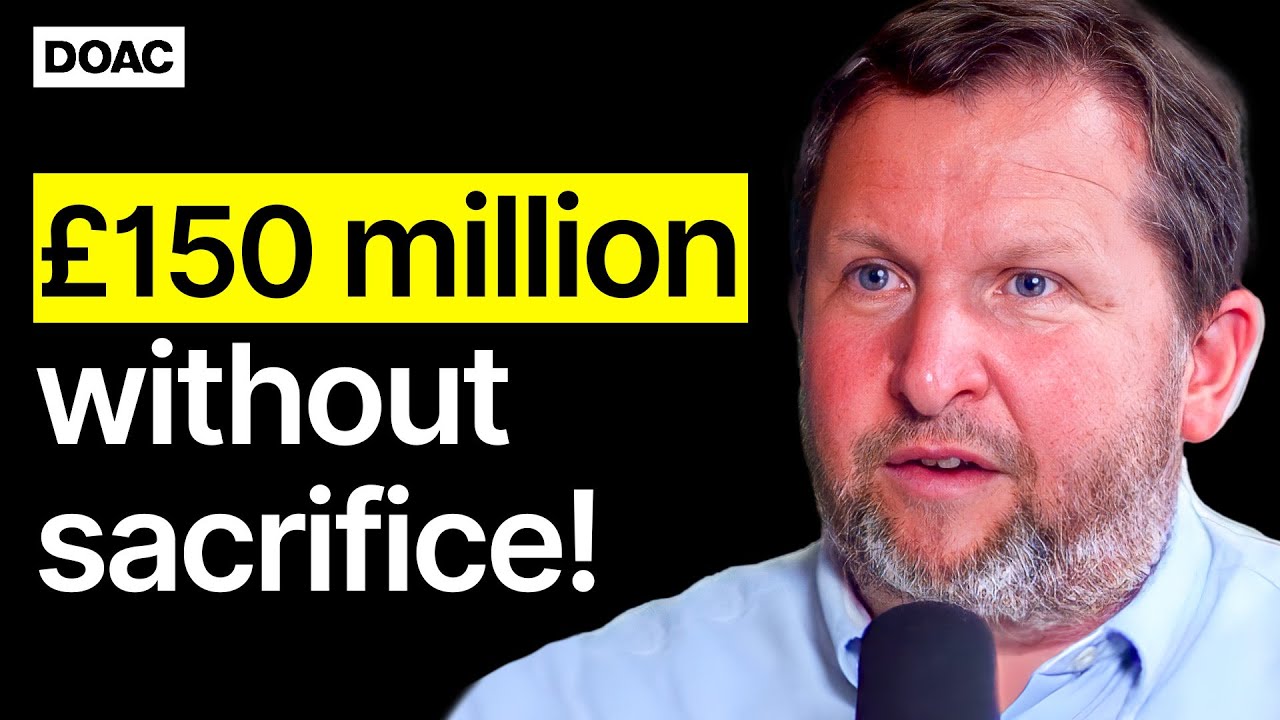
Moonpig Founder: How I Built A $150 Million Business WITHOUT Sacrifice: Nick Jenkins
Guests: Nick Jenkins
Full transcript · Read the full conversation in order, with its original context.
Contents1 chapter
§01Transcript — part 1§01Transcript — part 1
Corporate credit cards, cash flow management, centralizing spend, help with catching fraud—a powerful corporate card program needs to do a lot. So, it should be designed to help work with your business. That's why with the American Express Corporate Program, you can customize key elements to match your company's needs. Explore and apply from a variety of card types based on employee roles, select liability and billing options that fit your needs, add spending controls to support compliance, and decide whether earning rewards or cash back in the form of a statement credit delivers more value for your business. Learn more and start customizing your corporate program at americanexpress.com/corporate. Terms apply.
Nick Jenkins, former CEO and founder of Moonpig, a company now worth $1.6 billion. My first proper business was Moonpig, which, although it's been a success, of course, it went through various ups and downs. Like all overnight successes, it took 11 years. I've got to confess, I probably slightly stumbled on it. I look at it now and think, "Wow, that accidentally was a really good business model." Unfortunately, we too often measure the things that are easiest to measure, and the easiest thing to measure is how wealthy someone is. I'm reluctant to create this illusion that if you work incredibly hard, you can make a lot of money and that will make you successful. You have to be a successful human being. The most exciting times I ever had in my business were when my back was absolutely against the wall thinking, "This is going down." Bizarrely, I found that quite invigorating. At one point, my shareholders all said, "Look Nick, this is never going to work. It’s never going to make money." By the time I'd got to the end of it, I was pretty much down to zero.
Nick's achievements are miraculous. He's incredibly inspiring, and he created a business that's touched many of our lives. But the thing that I found even more intriguing about Nick was he bucks most of the typical entrepreneurship and success narratives. I think we're all sold the belief and the story that in order to be successful in business or any discipline in life, you have to undergo tremendous sacrifice. You have to work yourself into the ground. Nick and his story and his philosophy disprove all of that. He's got another way of doing it.
If listening to this episode does anything outside of just inspiring the hell out of you and giving you very practical business information, it will definitely prove, in my view, that there is no such thing as a born entrepreneur. And also, once you become an entrepreneur, the path to success isn't the same for everybody. A lot of what you've been told is a lie. Without further ado, I'm Stephen Bartlett, and this is The Diary of a CEO. I hope nobody's listening, but if you are, then please keep this to yourself.
Nick, I'm super intrigued when I meet entrepreneurs because there's a huge sort of narrative and a debate that's happened in the entrepreneurial community about whether entrepreneurs are made, whether they're born, or whether it's something that can be taught. From listening to you describe your early years, your school years, and your upbringing, I wondered what your opinion on that was and also whether you think you were a born entrepreneur.
I think there are some traits that are common to all entrepreneurs. One of those is decisiveness. You’ve got to be able to take decisions. When I worked in Russia for a bit, then went and did an MBA, there were lots of people on that course who were brighter than me. They would come up with a beautiful PowerPoint presentation of five different choices of strategic options, but actually, sometimes you've just got to say, "I haven't got the perfect knowledge, let's go with that one" and take a decision.
So, I think decisiveness is a very—and an attitude to risk is the other thing. I think I always took the view that I started with nothing, I could end up with nothing. I wasn't that worried about failing, and that's quite important. So, I think those sort of things are innate. You can teach someone like that to be a better entrepreneur. To some extent, I went off and did the business school because I had nothing else to do, to be honest, at the time. I came back from Russia and I had a spare year and I thought, "I couldn't think of a good, cunning business plan, so I'll do an MBA while I'm coming up with a cunning plan." That probably made my first business a bit better because it gave me more of a rounded idea of business and so on. So, I think you can improve on that, but if you're risk-averse, you're not going to do it.
Where does decisiveness and that risk appetite come from, do you think, in people? Where does the alternative come from? Where does the fear and the lack of willingness to make a decision come from in people? Or in you, where did that decisiveness come from?
I don't know. You have some people who are physically courageous. They will leap in—rugby players will leap in and do things—and other people who are not. Then you have some people who are intellectually courageous who will just—they're just not afraid of saying, "Let's do it." I'm not sure, but I think it comes from not having a fear of failure. We're all going to make mistakes and things will go wrong, but if you're frightened of ever making a mistake, then you won't do it. Much the same as if you ski and you're frightened of falling over, you're never going to be a great skier because you are going to fall over.
It’s also you were just talking there about almost that mental assessment you made on what failure meant. Because you were like, "Well, if I go to zero, that’s okay. That doesn't mean death."
No, it doesn't. It wouldn't be great, but it's survival. Of all the friends I've seen who've gone through that—and I’ve had a lot of friends who've gone through business failures—the ones I admire the most are the ones who—it's the way they've dealt with that. Some of them have thought, "Well, I can't change that, so all I can do is change the way I approach the next step and move on." If you just dwell on failure—"What does that mean? How does that reflect on me?"—then you’d never move on. So, I think it's our own attitude to failure that's quite important.
What was your underlying drive to even start a business versus just going and getting a job at, I don't know, Pizza Hut or something?
I suppose I probably looked at that and thought, "If that goes well, I'll probably make more money per hour than if I go and work at Pizza Hut." There's an element of wanting to—maybe there's an element of laziness that comes into this—wanting to take that shortcut and think, "Actually, if I start my own business and that goes well, obviously it’s better than an hourly paid job." One of my great philosophies on business is just keep everything as simple as you can possibly make it until you have to make it more complicated. People often start way too complicated and over-engineer things.
If you’ve read that book *The Lean Startup*, it kind of talks to some of those values about just trying to find the simplest way to test your hypothesis as cheaply as you can without losing years of your life.
And there's nothing quite like not actually having any money to do that. When Moonpig was starting, we raised money on a very bitty basis. There was never—it was like a well that occasionally we'd pour something in it and you'd usually hear it hitting the bottom, but it never actually filled the well up. So we never really had much money to experiment with, so we had to be very lean with what we did. I think perhaps the one useful thing, the only textbook that I ever went back to from my MBA years was a statistics textbook because what I wanted to work out is the least money I could spend to get a statistically significant answer to how much a cost-to-customer acquisition is for a particular channel.
Why spend £25,000 finding out that a particular channel doesn't work for you when you can get the answer for £2,500? I see this all the time. You get people who say, "We're going to spend a million pounds on our..." When you've got too much money, you just think, "Let's throw some money at this and see what works." Well, why waste it when you can get the answer for two and a half grand? And then I always look at that and I don't think I've wasted two and a half grand. I've spent two and a half grand—some of that will have been, let's say I was aiming for a £10 cost of customer acquisition and actually it was £20—well then £1,250 of that was spent on acquiring customers at the right price, and £1,250 was spent on finding out that I should never do that again. That's the way I would look at that. But if I'd spent £25,000 on it, then it would have been a waste. Also, the more you spend money to find out the answers to things, and when you've got those answers and you're then putting that in your business plan to raise money, I'm always more impressed when people say, "Right, I want to raise money for marketing. This is what we've done so far, this is what it cost us so far, so if we scale this up, that's what we can do," as opposed to just saying, "Please give us lots of money to spend on marketing, we don't know what we're going to do yet."
Yeah, I had this conversation actually with my gym owner the other day. I didn't even know that he was aware of who I was, but I was leaving the gym and he goes, "Can I just have two minutes?" Pulls me into the back room and he tells me about this idea. To be fair, I can't say the idea because he thinks—and we're going to talk about this topic as well—he thinks that if you tell the idea, then I'm going to run off with it. We'll talk about that straight after. But so it's this idea for rolling out gyms in the country. He said, "I need to raise investment to put 10 of them in." I was like, "Your idea is totally contingent on this central hypothesis—I'm just going to say it, he doesn't listen to this podcast—that people that drive long haul want to work out in service stations. You don't need to put 10 in to figure out if that hypothesis is correct. You could get a shipping container in the car park, keep it there for free, and if anyone picks up the dumbbells, that’s an indication that your hypothesis is correct. And then introduce another variable, which is cost. So then charge them to pick up the dumbbells. And if you come back to me in six months' time and say, 'Steve, they picked up the dumbbells, they worked out, and they gave me £10 a month,' then all you need is capital and we'll go make 10 of them."
We're on the same page. Prove what you can prove on the least amount of money first. Evidence is always so important, and people miss that.
But let's talk about that topic then. This idea really shows me that the entrepreneur is somewhat naive when an entrepreneur comes up to you—I'm sure you get this all the time—they pitch you an idea and then they say, well, they sound cagey to tell you the full thing because they think you're going to run off and do it.
I would always say to them, "Look, the day you go live with that, the moment you start advertising that idea, you're lifting your skirts to the whole world." So you're going to have to go live with this at some point, otherwise you're not going to sell anything. And if you don't sell anything, you're not going to raise any money from anybody. So at some point, you have to tell people what you're doing. With Moonpig, there was no way that I could protect that idea. The only way you can protect it is be the best and be the biggest. Amen. I mean, we had probably 20 competitors that followed after Moonpig during our time there, and they would pop up and they'd flare up and then they'd die off again. And even now, Moonpig is 65% of the market.
When you started Moonpig, was there anyone else doing personalized gifting cards online?
Yeah, funnily enough, there was. There was a very—I came up with a business plan and I developed it, and then I looked—the first thing I always do is I look around, not just at what direct competitors I've got, but how are people trying to solve that problem in other ways. Because if you're trying to solve a problem, clearly that problem exists already and people are trying to solve it in one way or another. And I did come across a company that was doing personalized greeting cards. I approached them and said, "I've got a choice. I can either—I’ve come up with this plan—I can either do it myself or I can invest in your business." And anyway, the terms he offered were ridiculous. And also, the other problem was I could see that we were going to fall out over the content of the cards because I just didn't think he had a very good eye for cards. Anyway, that business never turned over more than £300,000 a year, and then it died about two years later. Moonpig went, so I went off and did my own thing. And what it taught me, actually looking back at it, is that it was all about the content. It was about the quality of the cards, the quality of the design of the cards. Because actually, the customer doesn't really care how the card was produced. They don't care about the technology at all. What they want is the end product, and we had the best end product.
That's so interesting because a lot of entrepreneurs are put off from starting an idea because when they Google their idea that they have, they find 10 other people that are already doing it. I really wanted to touch on this point because I think it's quite liberating for entrepreneurs listening. When I started my business—in fact, every business I've ever started that's been successful had a major incumbent already. And we became the biggest and it's for exactly what you described. It's those—there's probably a thousand small details that go into making a successful business. Let's just say there's a thousand. You're basically going to war on a thousand details. And if you can be better in just certain ways—and sometimes you only need to be better in a few simple ways—it can work.
I agree. If you look at the example of bread, people have been eating bread for thousands of years. We know people like bread. We know what people are prepared to pay for bread. That's half of your market research done already. You don't have to say, "We've got this thing called bread. Do you like it? You can cut it in slices and put ham in the middle and call it a sandwich." All that's been done for you. So then you've then got to work out, "Right, well I know there's a market for this. So how do I just make it a little bit better? Do I make it add seeds to it? Do I put cumin in it? Or do I have a shop that is in a location that isn't well served?" So you only have to tweak an idea that's already there. So your chance of success, your chance of succeeding, your chance of surviving is considerably greater because you've answered most of the questions already before you've even invested any money. The chance of that becoming a guy in Shoreditch who's just invented a stuff called bread—it's amazing, never had it before. So you don't get that, and I think that's an important thing for entrepreneurs to think about is that you don't have to be unique. You've just got to be better in some respect. And people tie themselves in knots trying to think or trying to invent things. I think it's a really hard—it's the hardest possible way of making money.
I read a report about the fact that most people who've made money have made money doing something they were previously employed to do. Because they've spent 20 years learning how to do something. They know all the contacts and then they start up their own business. It's logical. And often when I'm looking at investing in people, I think, "Well, you know this industry really, really well. You're very convincing and you know all the pitfalls in advance." So of course you're more likely to succeed.
But they also know—because they know the pitfalls, they know where the opportunity to create a better product would be as well.
Yeah. So often I will come up with a business idea and look at it, and it's only after I've gone through this sort of fourth iteration of the business plan that I think, "Aha, and that is why no one has done this before."
If you'd known how hard it would be to start a business and to make it successful, do you think you would have started? Because here I'm asking—I want to know a little bit about the importance of delusion.
Funny that, there's something I've always believed that an element of self-delusion is very, very important. I think that's one of the reasons why—actually when I finished my MBA, I did have the opportunity to go and join a VC firm. I thought, "If I go and work for a VC firm for three or four years, I'll get more experience before I start my own business." Anyway, I went for a job interview, shock horror, they turned me down. So I had to go and start my own business. And I realize now that if I had gone through several years of investing in other people's businesses, I probably would have developed that kind of hard skin of "This is actually incredibly hard, this is why this won't work." And I see that a lot now in me now that I look as an investor. I look at a lot of things and I'm less wide-eyed than I was when I started Moonpig. I can see the reasons why something won't work and you can become too cynical about it. Whereas when I started Moonpig, if I'd known all of the problems that I was going to come up against, I may not have started. And believe me, there were plenty of times in the middle of that where I would have happily given it up. I mean, people often say, "Was there a difficult period?" and I say, "There was just one, but it lasted from 2000 to 2005."
Talk to me about the detail of that difficult period.
Well, as you know better than anybody, starting a business is one thing and coming up with a product that people might want is one thing. Getting customers is probably the single most difficult thing about setting up any online business. And I think most people underestimate that. We tried all sorts of permutations and bear in mind, this was 2000, so this was well before social media. So a lot of stuff was very manual. I—you will laugh at this—but when I was doing affiliate deals, I would phone up a company and say, "We'll put an advert on your thing and if you send any traffic to us, we'll give you a bit of commission on this and I'll send you a spreadsheet every week to tell you how much I owe you." Literally, it was that manual. I would write up a contract for each separate contract for each individual company. I had a big filing cabinet of them. That sounds very dinosaur-ish, but that's how it was.
And now it's much, much easier. But we were struggling to find ways that we could throw money at driving traffic because everything that we threw money at was too expensive. And the only thing that was really working in all of this was the viral effect that we knew that—we got very, very good at measuring everything. And we could see that if we brought 100 customers in, those 100 customers—we knew exactly how many of them would buy cards, we knew how many of them wouldn't come back again, but of the ones that bought cards, we knew that they would attract about for every customer that we had, they'd attract a third of a customer just because they—I send you a birthday card, you think it's funny, you look on the back of it, Moonpig.com. And so that viral effect was the thing that kept us going for five years.
And it was only really because I understood the statistics behind that and I could understand the model and think, "Right, although everything appears to be failing, although this online campaign doesn't—appears to be too expensive, that appears to be too expensive and we can't—I couldn't tell you if someone given me £10 million, I couldn't have told you what we could have thrown it at to make it work." I could see that just the customers alone were driving the sales growth and if only we could survive that long that we would make it through. But I was the only person who believed that. All of my shareholders—at one point, my shareholders all said, "Look Nick, it's not going to work. This is never going to work. It’s never going to make money. And you know, we're not going to put any more money in and we really recommend that you don't put any more money in too because when this all goes wrong, you're going to have to have some money to pay the rent." And it was that bad.
How much had you bet on this personally?
Well, I put in—I'd gone off and worked in Russia for a while and I'd probably made about a million and by the time—I put about £150,000 into Moonpig at the beginning to get the idea off the ground. By the time I'd got to the end of it, I was pretty much down to zero. I think I'd taken all the equity out of the flat which previously had no mortgage. I'd taken all my savings and all of that. So I'd pretty much got down to zero. So at the point when people are trying to discourage you to—I was pretty much already at zero anyway. So, and then that's when it finally started to turn and—but I could see, I could see the stats, I could see where it was going. It's just that, you after four years of three or four different business plans and you go, "I know the last business plan wasn't accurate, but this one, this one's better. Oh, and I know the previous two weren't that accurate, but this one, this one, this one works." It's tough. That's delusion.
Did you ever genuinely consider quitting?
No, because I could see where the numbers were going. And I did have a firm belief that the repeat rate was there, the viral effect was there, and I could see how we went through a year we spent no money on marketing whatsoever, no money on customer acquisition, and our sales grew by 30%. So that's—now I appreciate, having invested in lots of other e-commerce businesses, I appreciate how unusual that is. It was my first business, so I didn't know quite how unusual it was. But I knew that actually, look, it's not as if—there are so many businesses I see now that the moment you turn the marketing tap off, it just goes to zero. And all you—and that's one of the things I'm always really wary of when I'm investing is when is—I say, "Well, what's going to happen when you turn that money—turn that tap off?" Because when we did turn that tap off, it just kept on growing. And that's what I see as the real quality of a business is when you're adding layer upon layer of customers. Now, not all businesses are as good at repeat business as Moonpig was, but that was the thing that I recognized that kept me going through all of that and stopped me from throwing the towel in.
And that's thankfully because you had a great product underpinning the business.
Yeah, I think the main focus was: Do people like what we're selling? And we knew that. We knew it was a very, very popular product. We could see that in the viral effect with people—not only did people who bought it like it, but the people who received it liked it. So the main focus was always on creating a really good product. And then of course on top of that, you've then got to make sure that you've got your production right so that your gross margins are right and tweaking all of those little knobs within that engine. And the key thing also is just understanding every metric. And we looked at it—it's like a luge run that you're polishing every day. Looking at is there anywhere where anyone's getting stuck along this journey and are they not understanding what we're—the button that they're supposed to press next? Are they getting confused? In which case, polish that one out. So that was a constant process. That time when we weren't spending any money on customer acquisition, we were spending all of our money on customer retention and just polishing that luge run of the customer coming in through the front door and going into the shopping basket.
When you reflect on that and the fact that Moonpig ultimately succeeded in a market where many others failed—you talked about the guy whose business you tried to buy—and you say, "What was it about what we did that made us succeed? Or what was it about me, Nick, that made this business succeed?" What is your answer?
Well, I think I probably did have a good understanding of what people wanted in a card. And the—if you get down to the simplest version of that is that a card is about showing someone that you've—you want to show them that it's relevant, you've thought about them. So you've chosen something which is relevant to them that they're interested in or that's a something you both find funny. And you can weave their name into that as well to show that you've made an effort. And then the double whammy—I would always personalize a Moonpig card, have it sent back to me, and write on the inside. So that's like a double personalization and it basically is about showing you've really thought about them. And that's—and it's amusing as well. And the great thing—quirky British sense of humor that we love slightly mildly offending each other and then we stick the cards up on our fridge finding it funny. So if you focus on that, focus on the product, everything else follows in behind that. Focus on the product and then make it very, very efficient, and everything else should follow. Whereas if you don't focus on the product and you're just constantly selling something that people don't really want, it's incredibly hard work.
On the product, a lot of people have this idea, I think, when they start businesses that you have to have your hypothesis, your idea of what this business is going to become, the product you're going to sell, perfectly nailed before you launch. And then, you know, I made the mistake of when I started my business kind of being too romantic about that initial idea. So I was trying to force the idea into the world as opposed to listening. If we go back before you started Moonpig, what was your hypothesis? Like what—in terms of personalization, how did you arrive at a card?
It was very simple, actually. I sat down and I thought through different ideas and I realized, "Right, this internet thing is going to happen." So I don't know much about it, but no one else knows anything about it either. But I did at least understand how to build a team. So I'd spent 10 years in Russia building a team of people and building a successful business. And I went through this thing of what things could I do, how could I use the internet to make a business? And digital products were all being given away for free. So everyone had this idea that if you could download it, it ought to be free. Well, that's a hard one to make money in.
The advertising business back in those days was incredibly tough because there wasn't much of a market, not much spend was going online. And you were spending more money to get people to come to your site to look at the adverts than people are going to pay you for the adverts. That was tough too. Then I looked at physical goods, and if you take say a digital camera—one of those things I looked at—if I took my sort of Satsuma Fujitsu 32DD B, I figure that somebody at some point would write an algorithm that would merely compare the price of my Fujitsu 32DD with someone else's and they'd buy the cheapest one. And that ultimately would end up squeezing all the margin out of that game. So you'd end up with a lot of physical stock, stuff sitting in warehouses and minimal margins.
So I looked at what are the things that I can—what are the things that I can sell on the internet where I can actually improve the product and make it better? And personalization is one of those things. It's very difficult to do personalization in-store because it takes up floor space and equipment and so on. And I thought of a number of different things including personalized CDs—well I'm really, really glad I didn't do that one—and cards occurred to me because I used to—I used to Tip-Ex my cards and Tip-Ex out the caption and write something a bit funnier and more relevant, and ruder and more relevant on the front. And equally, journalist friends of mine would whenever anyone left the office, they'd be given a spoof magazine front cover, which would take a day and a half of graphic design time to put together.
And I figured, "Well look, we've got digital printing was beginning to develop at the time and you've got the internet and it made it possible to combine those two, to make it possible for someone to order a single personalized greeting card, which has hands down got to be better than the unpersonalized thing." And then I could charge more for the product online than for the product in the shop. But more to the point, there's no stock. So all we've got is a pile of cardboard in the corner of the room and a pile of envelopes. That's the only stock, which I think represented about a quarter of a percent of turnover. So compared to the digital camera business where you might have a whole load of digital cameras on the water coming in from wherever you buy them from, loaded in the warehouse and so on, it's—it was a very efficient business model. I mean, I've got to confess, I probably slightly stumbled on it rather than it being—I look at it now and think, "Wow, that accidentally was a really good business model." You get paid up front, you pay suppliers in 60 days, there's no stock. It was great. But fundamentally, it was a better product and on day one, right from the very beginning, my business plan I came up with when I was doing my MBA was, "I want to make it possible for a customer to buy a single personalized birthday card which technology had suddenly made possible, whereas previously that would have been £200 worth of graphic design time, a bit of litho printing—just not possible." But core to that is that the person who's receiving it's got to think that's a really cool card.
And there was a point where you made the decision to sort of step back from operations?
I've always tried to—my general approach to this is—try to focus on the things that only you can do. And when you really narrow it down and as you become a bigger company, you realize that actually there really does narrow it down a lot because I always tried to hire people, replace the things that I was doing with people who could do it better than I could do it. And then once they're doing it better than I could do it, you think, "Gosh, well I'm not going to interfere with that anymore, so leave them to it." And then it eventually then comes down to a role—my role eventually then became that of executive chairman. So I brought in a CEO and I became executive chairman. And I suppose then my role was that strategic role of making sure that we're pointing in the right direction and also that we take those big decisions.
What were you bad at? Or not good—not as good as someone else at?
I think I'm a—I'm good at short-term detail. I can sprint on real fine detail. So I can—I can sit on a spreadsheet for six hours overnight and come up with a beautiful bit of financial modeling. But I've got a million and one things going on and so—so I don't know that I'm necessarily a complete finisher. And there are people who are good at that. So interestingly, when I'm looking at hiring people, I will often—although academic results aren't everything—that you always need someone who has got straight As at A-level because they're very good at understanding the question and delivering it, delivering the answer. So they understand what's expected of them and they deliver it in a very predictable way. Whereas CEOs can often be quite maverick and you ask them one question and they will answer something else completely different but much more interesting. And that's fine, you can afford to have one or two of those mavericks, but somebody in the company has to be a good completer-finisher. They understand the question and they deliver it.
Have you—this is interesting. So there's certain people in my previous business where I knew they were like useless at organization and process and they were just dreadful—they were like unreliable—but they had one skill which was genius. And so it would almost be like making an exception for them within the company where, okay, they might take a long time to reply to emails and stuff like that, but that one point of creative genius that they brought to the company was worth it. Did you ever have that?
Very definitely. You've got some people—I think creative genius always comes at a price. And it becomes because someone has focused on one thing at the expense of something else generally. And so you just have to work with it. And say, "Right, okay, well let's recognize this person doesn't do that." And actually those skills can easily be dealt with by somebody else. Get them a good PA, someone who can organize—get a good completer-finisher behind them who picks up after them and then they will come up with the ideas that nobody else would have come up with. I think that works.
When your cat is acting weirder, or your dog is being louder, your turtle moves slower...
Hello?
Your cat seems thirstier—
Whoa, slow down buddy.
Or your puppy is acting clumsier. Day or night, if you don't know what's wrong, know where to go. VEG ER for pets. This is Katie. VEG, the better, kinder ER for pets. Control, compliance, confidence. That's what the American Express corporate program helps deliver. Customize rewards, centralize company spending, and count on world-class customer care. With corporate cards from American Express, your company can be covered. Explore more at americanexpress.com/corporate. Terms apply.
You were talking about that struggle you had for the first five years at Moonpig. I've heard you talk in some interviews about year three, four, five being particularly hard. But what was the personal sacrifice of that? I'm thinking now about how easy it was to maintain relationships and friendships when in your head you probably have those red numbers from the management accounts sort of etched into your mind at all times.
To be honest, never really got in the way. A lot of people confuse running your own business with working all the hours that God sends. I never did. If something needed to be done, I could—and only I could do it—then I would do it. There were times—there's the odd time when I remember once when our entire printing team were off ill, I came back from a business trip from Australia to discover that we were three days behind on our printing schedule and I simply—I simply got in the printing room. I was the only other person qualified to use the printer. So I just sat in the printing room and I worked 24 hours a day for three days, I think, just to get it all done. So yes, there were times, but I had a great social life.
I've always been a great believer also that I like to manage a business during reasonable hours. I don't think it's important that people need to sacrifice themselves on the altar of my business. And I don't like them doing that. One, because it makes me feel guilty about skiving off. If you've got all of your people in the office and they're working 24 hours a day and you're sort of taking half the day off to go and do something fun, you feel awful. So I try to make sure the same standards apply and that people should work a proper day's work in the hours that they would like to work within reason. But I do expect them to go off and do something different and recharge their batteries in the evening and the weekends because otherwise you just run out of steam. Particularly it was a creative business, and we're trying to make people laugh. If you're exhausted and miserable, that's tough.
It goes against a lot of the sort of typical narrative, doesn't it, in entrepreneurship, like the "hustle porn" star entrepreneur who just doesn't sleep and caffeine and they're crying in the street and eating ramen noodles and stuff like that. What does that narrative make you think?
Well, I think that's true if you start a business with—a lot of people start a business with nothing and a lot of businesses fail. And as those businesses are failing, clearly obviously you're down to your last pennies and that's tough. And so I think that the thing that they're describing is that—is the last sort of death throes of a business. And I've seen lots of businesses that I've invested in go through the same thing where there is no money left, you can't pay salaries, and the founders are down to living in the office under their desk and eating noodles. So that happens, but it isn't an essential part of the journey. It’s generally the death throes and occasionally you survive. Had I not had that last bit of cash that I put in, I may well have been one of those cases.
What about focus? A lot of entrepreneurs have—I get a lot of messages from entrepreneurs that have multiple businesses, three or four startups they're doing at the same time.
Well, I wouldn't invest in anybody that had multiple startups because if I'd had three businesses going at the same time as Moonpig and Moonpig was going badly, you focus on the one that's going well because it makes you feel better. True. And then the person—then they turn around to the investors who put money into the third one and they say, "Yeah, and I've given up with that one, I'm off to..." So there is no way. When I invest in a business, I would make sure that there is a clause that says that the founder shareholders have to be 100% focused on that. They're not allowed to have more than a 5% stake in another unlimited company. I'm pretty strict about that. I just think it's laughable. Absolutely laughable that people come along and they go, "Yeah, I've got three ideas and I'd like you to invest in this one, but I've got those just in case that one doesn't work."
For me, I tend to think all three will fail because you're giving like 33% of your time and energy to—and all your competitors are giving 101% and a lot of them might be sleeping under the desk. So if you're giving 33%, it's already hard enough to succeed giving 100%. So you're really setting yourself up to failure. But I think there's this weird thing where entrepreneurs find it impressive to list multiple businesses that they're doing. And I swear, if I hear an entrepreneur come to me with an idea and they've also got another thing they're doing, I am immediately deeply unimpressed by them because I think they've got this focus problem. And maybe they sat down and tried to think of a business idea. And for me, when business ideas don't come from some type of inspiration, when they're literally just contrived from "I'm going to try to think of a business idea," I think that they're typically more difficult. I think some form of inspiration, even if it's a small thing of inspiration, is integral to success and creating something unique.
I get just as irritated by that. There are times when you have to push on through that barrier. And if you've got three things going and one of them is an easier journey, that's where you're going to focus yourself when in fact that is the absolute time that you need to be completely focused on crashing through that wall that you've come up against. And that's where the best inspiration I ever had. And sometimes actually looking back, the most exciting times I ever had in my business were when my back was absolutely against the wall thinking, "This is going down, this is going down." And bizarrely I found that quite invigorating. When everything is going incredibly well, there were times when I'd think, "Everything's going very well, everyone's doing their job, frankly I could be here or not be here, it doesn't make much difference."
In terms of skills as well, as an entrepreneur, I heard you talk about public speaking being integral to—you did public speaking at university.
I did a lot of public speaking at university and a lot of debating. And the skill I think that's important is the ability to be able to persuade people of your ideas. Not necessarily public speaking, but in every meeting that you go to, you need to be able to look people in the eye and convince them that your idea is right. And that could be in a sales role, it could be sitting around a table with a bunch of developers and one of them saying, "I think this is the right way forward." If you can't articulate yourself properly, then you're never going to be listened to. And that's a skill I think is being recognized in schools. I do a lot in education now, so I see now more and more they recognize that that's a skill that is really important, that people should be able to look someone in the eye and be able to explain themselves very coherently.
I tend to actually believe—I’d go one step further and think I can't think of a more important skill in life and business than—I call it—I refer to it as sales because we think of sales as trying to get cash out of someone else's pocket by giving them something. But I think of it as like meeting a girl in a nightclub, trying to communicate your idea to your team, investors, employees. Every person you encounter, I think is—to some degree you're trying to sell something and it's usually yourself. But and those that are—you think about how that compounds over 70 years of your life, being good or bad at that one skill. Will anything change the trajectory of your life more than being a good sales person? And that comes as you say from being able to articulate yourself and speak.
Yeah, and just think coherently and put down a logical argument that people think, "Yes, okay, I get that, I understand it."
How does one get better at that?
I think a lot of that's practice. And I think people make this binary thing between public speaking—standing on a stage and speaking to a crowd of people—versus not doing anything at all. And actually in between, there's a whole load of stuff which is working within a team and being able to—and that's where most people come up against it is that they'll be sitting in a meeting with four or five other people and they've got something they want to say and if they're too nervous about saying something, they just don't say anything at all and then their ideas are never listened to. And then they're devalued in that context. And similarly, may not necessarily be spoken word, you've also got to be able to write well and convincingly. Then there's another side of it which is the numeracy side. And I find that the most convincing thing is when I—I love a good spreadsheet—but when you can express ideas in numbers and you say, "Look, this is the model that works," and you can prove it in numbers, it is a very convincing thing, particularly for an investor. You think, "Right, if we do this, this is the evidence we've got, that's what will happen." That's very convincing. So there's also being numerate and being able to explain things in numbers.
It’s so true, yeah. You can be like orally persuasive which is anecdotal persuasion I guess, and then you can be persuasive with numbers which is or graphics, and that's the other thing. I do see the quality of decks in the last 15 years has dramatically improved and in that they're much, much more engaging and there's some real creative genius behind some of this stuff. Occasionally they don't talk about the numbers, which is quite important. Beautiful, beautiful presentation and big sort of you go through the DocSend and oh fantastic, looks lovely, beautiful graphics, and then you think you have kind of missed out the point about how you're going to make any money. But so there's a lot more—so again, but that comes down to how you persuade people and how you present ideas. Not all of us understand things by listening, some people understand by seeing. I see patterns in numbers, but not everyone does. And I realize that now that just because I happen to see something one way, doesn't mean to say that everybody else sees it in that way. And you have to understand how people communicate.
On that point about persuasion and communication, one of the most amazing things that happened to me inadvertently was I started doing a podcast. I never intended the consequence of me being forced to speak on stage because I was running around the world talking about marketing and being forced to write out on—I do quotes on Instagram, write these quotes every single day at 7 p.m. on Instagram—and then write this podcast, I used to write it just on my own—was that I A) was able to develop my ideas better. So if you ask me any question on marketing, well I've already written it out, I've written an essay on it because I had to do a blog, because I had to do my personal brand. Or if you ask me something else about my life, I've already spent a thousand hours talking on this podcast about it. Was I became much—I’d say 10x—better at communicating, and the impact that had on my life was just profound. So my conclusive point here is I really think for young people, if you're out there, there are ways to force yourself to accelerate that learning. One of them is like keep a blog, start a podcast even if no one's listening to it. People will start podcasts because they're trying to make money or because they want to be famous or have loads of followers. But I think the more beneficial thing is the skill, the skills you'll learn from doing it. And oh my God, sales is just everything to me.
You're right. When you have to write a blog, actually write the words down, it really forces you to think about how to express things coherently in a way that verbally you can get away with a lot less discipline.
Dragons' Den, something we share in common. Yes, indeed. I've just started on the show. It was a—yeah, I mean the first pitch, everything, walking in behind the set. I first watched it when I was 12 years old. It was so surreal. How was your experience on Dragons' Den? And what advice would you have for me?
So I loved the experience. Partly because it's very forgiving television to make in the sense that you arrive on set—apart from the fact that there are seven cameras, which was distracting for about the first hour or two—other than that, it's people walking through the door and they're saying, "This is who I am, this is my business." And it's one of those things that I think if you're thinking about that as a potential career, it's about as realistic as you can get while still being entertaining. These are real businesses that people have spent sometimes several years developing and put their life and soul into it. It's not some concocted thing that, you know, "Here's a hundred pounds, go and see how much cheese you can sell on the market" type thing that you see in *The Apprentice*. These are real businesses. And I think it's been very inspiring. I've seen a real shift in the time that I've been around in people's attitudes to becoming an entrepreneur. I think there's also been a shift in attitude generally. And a lot of young people aspire to the idea that actually when you're young and you've got nothing to lose, you can afford to make more mistakes. So you can just go straight into it after school, start something, and crash and burn, start again.
And you can do it all from your phone as well. You can set up a shop using Shopify on your phone in a couple of minutes and sell—you can even drop ship things, so you don't need a warehouse or anything like that. So it's incredibly accessible now. More young people want to be entrepreneurs than ever before.
I'm really looking forward to seeing this new series because I think you will add a different dimension to it in terms of thinking, particularly the way that businesses are now, you know, the way that particularly tech businesses and the way that they're funded is very different from 20 years ago.
One of the things I didn't expect as well was how useful the other Dragons are when it comes to analyzing the business. Because they all come from different disciplines. So Deborah is going to help me with the numbers over here, and Peter's got his background in tech and logistics and all the amazing things he does, and Touker's going to be able to really sort of interrogate the supply chain, and Sara understands the craft industry and business generally. So it was—it's really a—so sometimes you just got to let them interrogate the business from all of their angles.
I learned a very, very important lesson from Deborah about the food business and going to supermarkets. She was interrogating somebody and talking about their gross margin, and she said, "Well, of course, as soon as your sales go up, your gross margin will go down." I was thinking, "What are you talking about?" And then I asked her about this afterwards and she said, "The problem is that supermarkets love to have young pioneer brands in, and they will allow you to be on their shelves because they've got this pyramid of products and they'll allow you—these little innovative little firms to be—to add interest to their shelves. The moment that it looks interesting and you want to sell more of it, the supermarket goes, 'Aha, now let's talk about the price.' Because they know how to make that stuff even better than you do. They know how to squeeze you down to a barely acceptable margin, and so your margin, which looked okay at the beginning, they'll say, 'Well, you can sell a lot more, but we're going to have to have it at a different price.'" And that was a lesson I learned from Deborah. So sitting back and listening sometimes, and you know, like Touker's knowledge of supply chain and in textiles in particular is quite fascinating.
Jumping back to your business then, Moonpig. So eventually you sell the business. Fully or in part?
Well, I sold most of it in 2011 and I rolled over into the venture capital investment in the new company. We basically merged two companies, we merged PhotoBox and Moonpig together with a lot of venture capital money. And so I reinvested in that, and then we sold it all out in 2016.
So there's a couple of things here. That was the first point where you became really rich?
Well, funnily enough, Moonpig started making a lot of money before we sold. So we were probably making about £10 million a year in dividends. Because it was making money faster than we could spend it on advertising, so we just paid it out as dividends. I think we paid out about £30 million in dividends before we sold. So by the time I'd sold, actually, it wasn't as if it was transformational because I hadn't spent the money, I still got all the money that I'd taken out as dividends.
So when you sell, how does that feel?
Well, it was funny. I was interviewed afterwards on Sky and they said, "Well, what are you going to buy? What are you going to do now?" And I said, "What did you do immediately afterwards?" And I thought, "Well, I cycled home and I made a peanut butter and jam sandwich." Because there was a—it was a bit of a weird anti-climax selling. I don't know how it was for you, but I went into a large room and I had to sign about 200 documents on my own and then I sort of done it now. And they go, "Great, well money will be in the bank later on." Off back on the bike, cycle home. That was it. There was no sort of trumpets, you know, no signing anything, shaking hands. It was quite a non-event really.
So the money arrives the same day or you've sold?
Well, not all of it, because it was done in stages, but most of it arrived on the same day, yeah.
And so you sold the company over a hundred million at the time, rolled shares into the holding company as well to keep a sort of vested interest in the business. Was there a bit of a loss of orientation? Like what do I do now with my life?
Yes, though at the same time, I think I'd got to a point where I'd delegated everything within the company and I had been largely focused on the sale process for a year or so. So after that sale process was over, you think, "Well now the day-to-day running of this business has been left to the team. They're all doing a fantastic job, they're all bright and they're probably better than I am." So me sticking around in that company—if I'd decided to carry on running the business for profit, I could have done—but I felt as though I'd run my course. I felt as though I'd added everything I could add to that business. And there were lots of other things I wanted to do in life. In a way, it was a challenge to sort of create an identity outside of that. Because for a long time, I'd been "Mr. Russia." I'd gone to Russia and everyone knew me as the person who went to Russia and did things in Russia. And then I did—as I started Moonpig, I fell into obscurity again. People think, "Oh poor Nick, he does something with greeting cards." And I'd go home at Christmas back to Shropshire and my parents' friends would say, "So you do something with greeting cards. Is that something you do from your spare room?" Having run quite a big business in Russia and then of course it started—it turned into something serious. So it was an interesting challenge, which is how do you sort of reinvent yourself after that? And I actually stopped and I went into the charity sector full-time. And I became a CEO of a children's charity for a year full-time, and then I became a trustee of that for another four years.
Why?
Well, partly because I think I'd sort of satisfied everything that I needed to—I didn't want any more stuff. So I wasn't—it was going to be hard to get motivated just by making more money. So I wanted to make sure that whatever I did after that was useful, was socially useful in some respect. But for that, you've got to kind of do the work, you've got to understand how to make a difference. And that first year really made me realize how complicated it is and how difficult it is to make a real difference in the world. So it was fascinating, and I wouldn't have been able to do that if I hadn't sold the company. I wouldn't have had the freedom to go off and do that.
Isn't that interesting that people typically—this is a super generalization and it's not necessarily the truth—but it appears that we all start quite selfish in life. It's like, "Let me get rich and free first." And then you see that transition when people do make money is the joy comes from philanthropy and helping others.
I think so, but I think, you know, in that very privileged position of having seen what it's like afterwards. Because of course for most people they want more things. I think money—a lack of financial problems can bring you happiness. Not having financial problems. Financial problems bring you misery. When you're beyond financial problems, you're neutral. And then there's and then there's financial freedom, which is "I'm now free, I don't have to do the 9-to-5 job, I have the option if I want to to do other things." Beyond that, I'd say it's pretty diminishing marginal returns. I think for some people the more money they make, it's about—it's not about the money itself, it's more about their position in a high—if you're very competitive and there's a hierarchy of people and there's someone up there who's made, you've got Jeff Bezos up there. And they see themselves on that trajectory, they'll never quite be happy until they're up there. And they'll never get there. So I realized very early on that if I wanted to avoid getting into that sort of competitive mindset of thinking that I have to be somewhere on that trajectory. I've kind of satisfied what I need in terms of stuff, housing and whatever. And then thereafter it's about being free to explore other things.
One of the things that I noticed about you that's very different to the other successful people that I've talked to is there seems to be a lot of like neurotic obsession with people's businesses and hobbies. I remember sitting with Eddie Hearn here and him telling me how relentless he is. His book is called *Relentless*. To the point where he will sacrifice his family for the business and he'll tell them. He'll have the conversation with his wife and say, "My business is everything. If I don't make the date, if I don't make this, then it is what it is. I am obsessed." You don't seem to be like that. And that makes one would therefore assume that the problem that sometimes comes with being like that, which is a severe cost to relationships, would not be present in you.
I think you can be driven by two things. You can be driven by demons or driven by passion. And it's much better to be driven by passion than demons. Some people are. Some people were offended at the age of 11 by a comment that somebody made to them that they'll never amount to anything and they have struggled ever since to prove to that person. A teacher said something bad to them and then finally they go back sort of 35 years later, they go back to school and they find this old teacher who says, "Well I always thought you'd make something of yourself," and they think, "Fuck, I was hoping this was going to be more gratifying." It was—the teacher might just say, "I just felt you needed a bit of a kick to get yourself off your..." and it worked, didn't it? So some people are driven by—and the people who are driven by demons are often—it doesn't make them happy. It's like an itch they're scratching and it just makes it worse.
Eddie Hearn is basically like that. He was quite honest about that. His dad basically, he was always trying to live up to his dad's expectations of him. And I remember saying to him, "What's the goal then Eddie?" "Well, we're going to sell it for five billion." "And then what?" And then he's like, "Well, then I'll have my cigar and I'll go to the beach." "Do you actually think you'd go to the beach with a cigar? You just told me you're obsessive and relentless." He goes, "Probably not. Probably not."
And actually the difficult thing is then what do you do afterwards? I think because I think it's one thing that a lot of people think about starting a business is about you start a business and then you're working towards an exit and happiness comes at exit. It doesn't. Happiness comes from the process of building a business and working with people and pulling together bright people, watching the work and creating this thing. I love the learning process. I think that's perhaps one of the other things that I learned out of all of this is that I really, really enjoy learning. And it doesn't matter how much money you've got, you can't learn Japanese any quicker. Well, you can learn it a little bit quicker if you've got some really good—but basically you've got to put the work in. Doesn't matter how rich you are, you can't buy that. You've actually got to put the work in.
That drives you. So do you think you're a balanced person? A lot of the entrepreneurs that I meet, the reason why they're successful is because of, as you said, demons or something and then that costs them somewhere else. You seem to be, as was the case with the CEO of Deliveroo who sat here a couple of weeks ago, a fairly balanced person. So I'm assuming then you have really well-balanced relationships.
I think so. I've got great friends and great relationships and a lovely family. But that's partly comes down to standing back at it and thinking what is success. And I look at success as that more rounded thing, what makes you a successful human being. And if you look at that, then you're constantly measuring yourself by, "Well, actually what do my friends think of me? Do they think I'm a good person? Am I a good person? Do I think I'm a good person? Am I going to look back on my life and be embarrassed at the way that I've trodden on people on the way up and in which case don't tread on people on the way up." So it depends on what you regard as success, what you define as success in the beginning. I think unfortunately we too often measure the things that are easiest to measure, and the easiest thing to measure is how wealthy someone is. So when I go back to talk at schools about—or my old school about—and you're invited along presumably because everyone's heard of a business that you've created. I'm reluctant to create this illusion that if you work incredibly hard you can make a lot of money and that will make you successful. You have to be a successful human being.
What is a successful human being?
Well, I think it's all of the things: one, you've got to be a good citizen, you've got to make your fair contribution, you've got to make a good contribution to society. Now, if you're good at business, you are of course helping to pay a lot of the bills, which is a great thing if you pay your taxes properly. But equally it's about the way that you treat your employees, it's about the way that you treat the people around you, and all of those things I think are the things that you look back on your own life and you think, "Did I lead a good life? Was I was I a good person? Or do I regret look back and think, 'Ooh, I was a bit harsh.'"
As you look ahead, you know, the next chapter of your life, you talked there about how the journey is actually where all the fun and fulfillment lives. And you kind of like because I think we all kind of mentally map out what the next phase of our life will look like. We don't necessarily know the detail or have a business plan, but we understand the fundamentals of that phase. What are you hoping will be part of that phase at the stage of life you're at where money isn't—money isn't going to mean that you can or can't eat? What are you trying to put into that chapter of your life?
Well, the other thing I've realized, and I listened to something Bill Gates said, which is that if Bill Gates had become a doctor, he could have affected quite a few people's lives. But by going into business, he affected millions of people's lives. And he was very good at making money. So I don't see anything wrong with pursuing—I mean now, I'm actively pursuing the businesses that I'm involved with and I would love to make more money, but then that gives me the freedom to do something useful with that money. It adds a whole other dimension to why you're doing it. I'm not chasing it because I need another Lamborghini because I've got a very old battered Discovery and a Lamborghini is just not what—I was going to say, I can't imagine you in a Lamborghini. No, no. I'm just very, very tired old Discovery which I'm driving into the ground before I buy an electric car. But there's got to be a reason for doing it.
And the reason for creating companies partly because it is good fun. I mean I thoroughly enjoy you have an idea and you're creating something. And seeing your idea come play out and you think, "Yeah, I was right. That hypothesis was right." So we pull together some good people and it starts to work and then 10 years later, absolutely that worked and we've got a whole load of people in employment, they're enjoying themselves and—the great thing also is when you step back from that and you think that thing—Moonpig has a life its own. I was in the car the other day and there was a Moonpig advert came on the radio and I thought, "I've been out of that for a long time now, haven't worked there for 10 years, and yet that sort of carried on without me."
There's a huge sense of pride in that when you see that.
Yeah, and actually when you sell a business, it's also a sense of pride that it worked for them as well. I think the very best deals are deals where both parties came away happy.
Will you ever be a CEO again?
I don't know that I will because I enjoy the freedom to do different things. And there are pluses and minuses to having this plural life. I've realized that doing 10% of 10 things is twice as much work as doing 100% of one thing. Partly from a very simple perspective is the—I mean necessarily now post-COVID, but before that, the actually simply the getting from one place to the other, you know, and that gets in the way of things. But also it's the constant juggling in your head and then suddenly you think, "Oh I haven't focused on that for a bit." It’s more work. So I would like to be more focused. I want to get interested at a level where I feel as though I'm able to make a positive difference to it and that means a smaller number of things.
I had a job when I was at university, the most boring job ever. It was transcribing license details. It was working for a Ford dealership, transcribing license details from one ledger to another. And I'd get to about 10 o'clock in the morning, physically—it was so boring, it was physically painful—and I would think surely it must be 5 o'clock. It's not, it's still 10 o'clock in the morning. It was horrible, absolutely horrible. And the one thing I look back at my life, perhaps one of the greatest things is I've never—I've always got to 5 o'clock wishing it was 2 o'clock. And that's, I think, a sign that you're not bored. There's stuff I'd like to be doing. I wake up on a Monday morning and think, "Fantastic, I can get stuck in and I can do stuff." And so that idea of there not being enough hours to do—to get the stuff done is a sign that it's enjoyable.
The ones that don't like what they do... because I've worked jobs that suck, call center night shifts, just pick up the phone, book the hotel for them because they couldn't figure out how to use the computer for Dorothy and she doesn't know where she wants to stay, she just wants to stay in Manchester, doesn't know Manchester... night shifts of doing stuff like that. And I've had worse jobs as well where I would have had to open the Yellow Pages and just call someone and try and sell them something, which was awful. But what liberates people from that place? I mean, I would maybe guess that it's information and maybe skills. So maybe they could—
The other thing is when you've got one of those jobs, take the view: Look, I've got an opportunity to learn how this works. If I learn how this works, take it seriously and do it well, then I might know what it takes to become a supervisor. If I become a supervisor, I might have then what it takes to go one notch higher and suddenly I'm actually then managing people and that's a little bit more interesting than what I was doing. So to some extent, you have the control to be able to decide how much time and effort and enthusiasm you put into it. And there are some jobs that will not be that interesting but then say to yourself, "Right, what can I learn about doing this that's going to enable me just to do my boss's job?" And actually what your employers will be looking for is someone who's applied, who's interested. And they'll look amongst the 10 people who are doing that job and think, "Nine out of 10 of those people are just doing this because they want to pay the bills. This one is genuinely trying to work out how to do the job better."
I've got one last question for you. I've never asked this question before but it feels like I should. You're several years ahead of me in business, right? So you've experienced a lot more than me, you've had a child, you've gone through Dragons' Den, you've been through that experience as well and had a taste of all of that attention and press and all that stuff. What would be the one piece of advice you'd give to me? I've just left my company, just sold my shares a little bit.
As you go through life, you can get to a point where you think, "Right, I've had a huge success." And I look at Moonpig and think, "Will I ever have a success as big as Moonpig?" I don't know. I don't know, but I've got to be okay with that. And in order to be happy, I have to be okay with the idea that I may never better that. Because if you're always constantly thinking, "Right, I've done that, I therefore have to do that," it can be a recipe for misery. I look at pop stars who have a huge career and then they're kind of done by 25 and actually you know they're not going to quite come back and then a couple of years later you sort of see them. And so I look at it and I think, well, I don't have to better what I did in terms of—I'm not going to judge myself by having a business that was worth more than Moonpig. Because actually that's setting myself an almost impossible task. What I'm going to do is make sure that whatever I do, I feel as though it was useful. And some of those might not be as obvious or as prominent as setting up Moonpig. Because sometimes you catch a wave. I look at Moonpig and I think, "Did I just catch a wave? I was in the right place at the right time. I had a good idea and I managed it well." But actually I just caught that wave perfectly. And sometimes that can be hard to recreate. So I think being—managing your own expectations is an important part of human happiness and thinking, "Okay, I may never better that, but actually I'm going to do something different now and that will be just as interesting and just as rewarding as what I did before."
Do you ever regret—with my company, I think I left in 2019 when the valuation was maybe 200 million. I think now it's like 500 and it's probably going to go to a billion, I reckon. Do you ever regret—Moonpig is now worth what, 1.something billion?
1.6. Well, for a long time I—so eight years after I sold the business, and when I sold the business it was making about £11-£12 million profit—proper profit, like money you could spend. And eight years later, it was making about £18 million. So I think, yeah, it was an improvement on where it was, but it wasn't so spectacular that it was—so they're happy with their deal and I'm happy that I've got the chance to go off and do something else. And then I looked at floating and think, of course the thing about floating is that nobody knew we were going to have COVID and that obviously massively boosted the business and I think probably has permanently put more people online. So that was a fairly unpredictable part of it. Then there's the other question which is if I had stayed in running that business, would it have done as well as it has? And I don't know that it would have done, to be honest, if I'm really honest. Because the guys who came after me—a guy called Stan Laurent who came into PhotoBox after me, who was awesome, I mean brilliant, and then Nickyl Raithatha who's running it now is—has taken it to another level. So I'm not sure that I would have done—had I stayed in, I—there's no guarantee that it would have done what it did. In fact, I'm not sure it would have done. So no, and actually I've had some really interesting things. So if you're asking me the question, would I rather have had sort of 36% of 1.6 billion? Yes. What I'm questioning is whether we would have got there if I'd remained at the helm.
Well listen Nick, thank you so much for your time. It's been an incredibly interesting diverse conversation and thank you as well for—you sent a text message I think to our mutual friend before I went on the show just giving me a piece of advice. And he passed that over to me and I kept that in my mind. Your story is super inspiring and as a British success story and someone that's so—I'm so fascinated by you because you're so unorthodox in so many ways and you also don't bullshit. So a lot of people—it’s tempting to portray yourself—even with the last example there, you basically said you're unsure whether the business would have performed better or worse without you. I think that takes great humility and self-awareness to admit that. And that's the reason why I started this podcast, because to share some of that honesty with the world. So thank you for coming on, thank you for being an inspiration to me. Thank you for being one of my favorite ever Dragons as well, you were just very real and funny. It was a real pleasure meeting you in person. Hopefully we'll get you back again to talk more about your charity in particular, which I wish we had more time to talk about because that was super inspiring to read about as well. But yeah, thank you. Thanks Nick.
Great.
Day or night, if you don't know what's wrong, know where to go. VEG ER for pets. This is Katie. VEG, the better, kinder ER for pets. Corporate credit cards, cash flow management, centralizing spend, help with catching fraud—a powerful corporate card program needs to do a lot. So, it should be designed to help work with your business. That's why with the American Express Corporate Program, you can customize key elements to match your company's needs. Explore and apply from a variety of card types based on employee roles, select liability and billing options that fit your needs, add spending controls to support compliance, and decide whether earning rewards or cash back in the form of a statement credit delivers more value for your business. Learn more and start customizing your corporate program at americanexpress.com/corporate. Terms apply.