
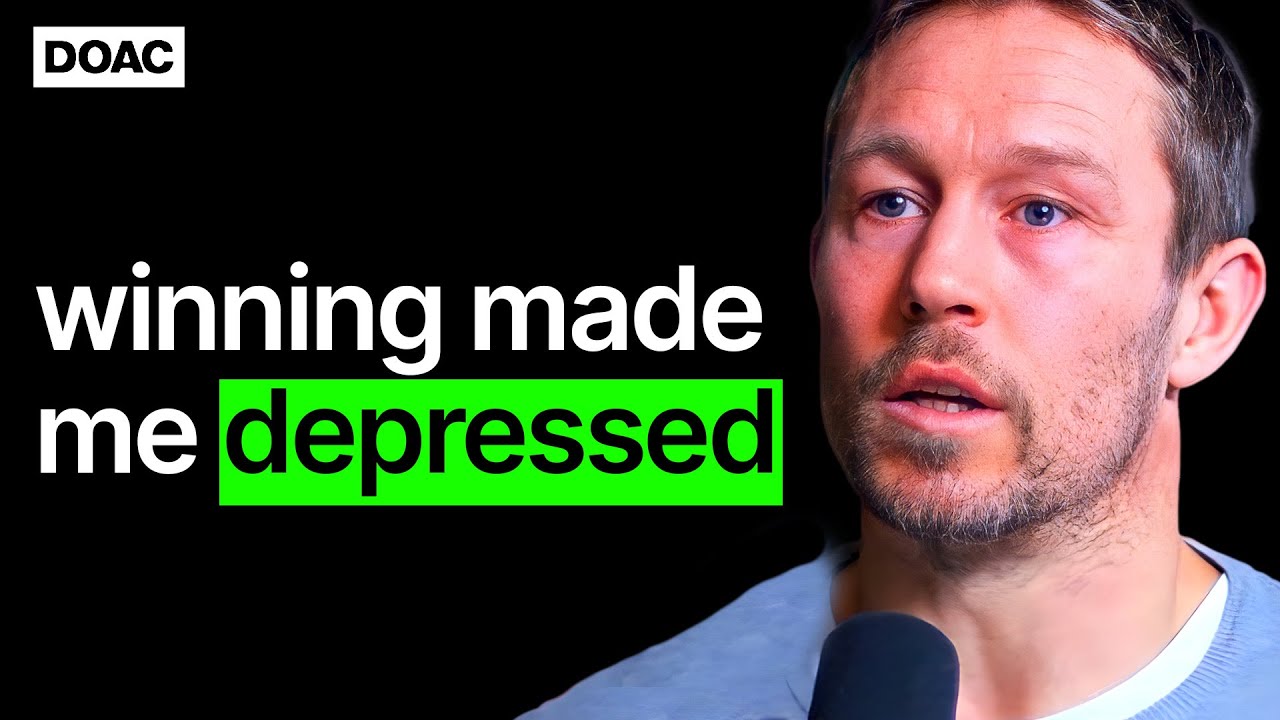
Jonny Wilkinson: Winning The World Cup Led To My Darkest Days
Guests: Jonny
Full transcript · Read the full conversation in order, with its original context.
§01Transcript — part 1
The thing I think about most, especially when I'm on the go but also when I'm sat here in the Diary of a CEO studio, is the Wi-Fi and internet that we have to work with. In fact, anytime I'm filming away from the studio, one of the first things I do when I arrive is open up an app and do a speed test to see how strong the signal is.
The number of screenshots I've sent to my team about Wi-Fi signals at different locations is actually pretty crazy. It matters that much to me because it's such a competitive advantage to have fast Wi-Fi. On any given day, if I'm recording hours and hours of footage with a podcast guest, I then often have to have my team send that across to our London team who then do the edit.
Fast Wi-Fi and internet is not a nice-to-have; it is absolutely business-mission critical. So, when it came to finding the best provider who could supply internet and Wi-Fi to our new LA studio, we looked at every single option.
Of all the providers, the one that came back with the steadiest connection, as well as being the cheapest, was today's sponsor, Spectrum Business. Spectrum Business keeps businesses of all sizes connected with fast, reliable internet, advanced Wi-Fi, phone, TV, and mobile services.
Millions of business owners already rely on Spectrum to keep their operations connected. So, if you want to join them, head to spectrum.com/business to learn more. Restrictions apply. Service not available in all areas.
I had to achieve. I had to be perfect. I guess, ultimately, I had to take on the suffering. For me, it was do or die on the field. Therefore, where other people called it quits and threw in the towel, I didn't have the choice.
Was your mental health better or worse after that moment?
When I was on the field in the zone, I was operating at a level I couldn't even understand. Waking up the next morning leaves you in the cold light of day. I thought there was going to be joy here. I was convinced. There isn't. I spent my life being very fit but not really that healthy.
Health is about what fitness can come out of. Unless you look after health, it's dangerous. People say, "I wish I'd made more of my life, I wish I'd enjoyed every moment," but that starts with health. Working on someone else really doesn't work for anyone, but working on yourself tends to work for everyone.
So, without further ado, I am Stephen Bartlett, and this is the Diary of a CEO. I hope nobody's listening, but if you are, then please keep this to yourself.
Jonny, you went on to become one of the real greats in rugby. I remember watching you in my living room as a very young kid on the screen in awe, not just in that 2003 moment, but long before then. When I sit here with guests who are athletes or successful entrepreneurs, they can sometimes give me a fairly accurate description of what happened in the earlier phases of life that would mold them to become that champion or that CEO they later were.
You're someone who is incredibly self-aware, so I was very much looking forward to asking you the same question: when you reflect on the early stages of your life, what were the defining, molding experiences, for better or for worse, that you would point at and say that's probably why, or at least that led in part to who you became later in life?
I think the best way of answering that would be to say that in my younger days, very young, without any kind of triggering events—certainly not that I can remember or have ever come into contact with—I had enormous passion and some kind of adeptness for ball skills.
If I had a ball in my hand, things just made sense. I could work out in my head some sort of target, some sort of goal, something to do with that ball, and I could work it out. That was part of the intelligence I had; I could bring those things about relatively effortlessly. I had a real passion for exploring that. It still is the case with me; I still find myself playing basketball often on my own because it's my relationship with that inner capacity I have that interests me.
It's not to show what I can do, but it's that sense of being at home. That's where a huge amount of the revelations that I have in life come from, from that kind of relationship. However, there was also another relationship which, again without the triggering event, I grew up with an immense sense of doom and fear about everything.
I had this incredible passion and inclination towards expressing myself with balls and skills and in competition as well. But the competition side was a need; that wasn't a desire. Achievement and all that stuff was obsessive but from a negative perspective because I had this sense of doom surrounding everything.
That was my disconnect. I saw other people handling situations that seemed so simple to them but for me were insurmountable. And yet, when they looked at me with regard to a ball in my hand, what they thought was impossible, for me was relatively straightforward.
I think those two sides of my path meant that I had this constant drive to just find myself in a garden with a ball in my hand at all hours of the day and night. It’s all I talked about, all I spoke about, all I did. On the other hand, I had this ever-present fear that I built this defense mechanism, coping strategy, but ultimately an identity around how to somehow survive that fear.
The mechanism I put in place was that I had to achieve, I had to be perfect, and I had to, I guess, ultimately take on the suffering and live that kind of martyr, savior, stroke warrior archetype. As such, I found myself really, really uncomfortable when things were seemingly going well. I found that horrendously difficult to handle.
As a result, I would revert to that defense mechanism of creating problems if there weren't any. I was constantly looking in a state of survival for where the next problem was because I was convinced with this ever-present sense of fear that there was a threat and it was there.
Those two paths essentially weaved in and out of each other throughout my entire life. There was no doubt that my ability on the field at times to be in that zone was where I felt my genius. But at the same time, the other strength I had was that for me it was do or die on the field. Therefore, where other people called it quits and threw in the towel, I didn't have the choice. The fear didn't just drop off and let me sit down for a bit, so I could go and go and go.
When you talked about your childhood there, you said despite there being no traumatic event that had created this perspective you had about this fear, but also this sense of real peace and homeliness you described when you have a ball. Your dad, Phil Wilkinson, was a rugby player and a cricketer?
Yeah, rugby and cricket. Those two things.
What was his influence on you? Because when I read that he was also a sports player in his own right, that's kind of typically the story you expect to hear. I've sat here with Eddie Hearn, whose dad worked in the same business; I've sat with CEOs whose dads worked in the same business.
The interesting thing I connected—and I'm not making any assumptions here—is that in the case of Eddie Hearn and Umar Kamani, they describe a very similar thing: a real sense of an innate feeling of pressure to succeed, and they also at times couldn't necessarily tell you where it comes from. Did either of your parents play a role in that perceived sense of pressure to succeed?
No. Like I said, I'm heavily into the introspective side of all this, and part of that search now for potential is where that's moved. It used to be grabbing the external and trying to expand physically—how many more people can know my name, everything that could expand my reach and presence on a physical level. Now that no longer interests me; it's how to allow my presence in that non-physical space.
My journey of looking into that has meant I've questioned everything. My upbringing was fantastic in terms of that. I had every opportunity to go and do what I wanted to do. I have my brother there as well, and my parents were all sporty, but there was just something in me which had latched on.
This is something I feel maybe I brought with me into this world from a karmic positioning whereby I was always going to grab things that way. I was susceptible to understanding things a certain way. But for me, I pushed my parents hard. I can't imagine it was easy for them, or my brother too, in the way that I challenged them. I didn't give up, and a lot of that was irrational stuff that came from the need.
For them, it was baffling. But they had their lives, and I appreciate that it is always the case that people are always doing their best. That's what I remember about our family the most—that everyone's always doing their best. I look at everyone now and realize that people are where they're supposed to be and just giving it their all. What's been so powerful for me is just being able to switch that interest in what "giving my best" means. It is more of an unlocking and letting go and shedding than a "what more can I grab." Where that path turned around is perhaps where I felt the true understanding of what this journey's been about.
You said something there which some people might skip over: you said it might have been something you inherited karmically. That reminded me of something I'd heard you say previously about being able to inherit generational messages. Do you believe in that? Do you believe that we're passing messages from one generation to another within ourselves and that is shaping our lives?
Yeah, I believe that the role of karma is basically a memory. It's the way we've remembered things. Whilst for me, for example, when I'm stuck in that really physical identification of "this is who I am" as in "I'm Jonny," then I do have a start to my story and an end.
But as I've been exploring and letting go a bit more of that kind of physical identity of right now, I just tend to feel that it opens up a different understanding of memory. If we're a process of that evolution, then the cells in our body have a memory that goes back a long, long way.
That's impossible to separate where we come from from parents, and where they come from from their parents, and so on. Everything is all interconnected, but we put a stop and a start on it. It seems one of the things I find so interesting is that I'm very interested in the science side of it too, looking at the desire of science to find what it is that we're made of, and yet they keep coming up with "it's nothing."
Then they go to "well, what is it we're living in?" and they keep finding out that it's unending. And yet who we are, we seem to manage to say despite the fact it's made of nothing and it's unending, we've found a way of saying "but we're made of this, we start here and we stop there." It just doesn't make sense to me anymore. Whereas before, you live in those boundaries; what you see inherits those boundaries. As I've released those, you start to not so much question but just allow for different understandings to take hold.
One of those is that it's fascinating to look at—I've got a young child—how children enter and they're all so different. How are they so different? And then you say, "Well, it might be to do with how the parents have behaved during the months preceding the birth," and yes, but even then, why are the parents behaving that way? It goes on and on. It just goes back to the same way that I still believe that we're all doing our best, but there's a part which we bring with us into this space.
I feel like there is nature and there is that nurture side, but that nurture's been going on forever. It's important that we have a bias and a stance because without it, I don't think you can have this physical experience unless there's something holding you in it. I think that's the point: to find out what that is and engage with it, embrace it, and enjoy it.
And what is holding you within this physical experience? What is your stance?
It’s so interesting, that question. At the beginning, I'd have said, "Oh, this what I'm telling you about my fear," and then I'm talking about my need to survive and then unlocking that and going beyond it. You think you understand it and then you get challenged again. "Oh, where did that come from? Oh, I think I understand that now and I feel so much better," then challenged again.
Where do these challenges keep coming from? I think that's the part of me understanding what my stance is; it’s an ongoing process of just enjoying challenge and embracing it. I use the kind of expression when I talk to some of the guys I train with when they're doing their kicking with the rugby, that it's all about finding that absolute peace and inner environment that allows you to go and explore this opportunity you've got ahead of you.
Every time you find you can't find that state, it's because you're holding onto something. It's never because you don't know something or because you haven't learned something; it's because you're holding onto something you don't need. You have sessions where at the end of it, people are feeling like, "I feel amazing," and you're thinking, "Yeah great, just wait until tomorrow."
Because this idea is "tomorrow I'll still feel amazing," but then the next day you ask, "How do you feel?" "I don't know, I just feel a bit like this." Why? It’s because each of those sessions that we're doing is like a light that shines into your garage where you think you've cleared out all the bags in your garage that you don't need anymore. Then you think it's all clear, and then a slightly brighter light comes in the next day and you're like, "Oh, there's loads of stuff over there, I didn't see that, I better go and clear that."
Now, the more you clear, the more space you find in there. But to think you're going to get to the end of that, for me, to think I'm going to sort of find out why I'm here—what I think I'm going to find out is that it's my choice to be here. That's the beautiful part: the proactive reason for being here. As we said in the question, what's holding you here? I think now probably the way I really see that is: what's my calling? What's my purpose? When that's fulfilled, that'll be an interesting moment, but I don't see that being anytime soon.
It's a really interesting reframing of the situation because you're right: we spend our lives looking for some kind of external given reason for our own existence, but flipping that and saying, "Well, yeah, I'm choosing to be here, and I'm choosing to be here because of the purpose that I've decided on," is a really powerful thing.
In my DMs and messages I get from kids, it's this kind of outside external search for this Easter egg that they were born to find called their passion and their purpose. When they can't find this singular Easter egg somewhere, they fall into such tremendous frustration and feelings of inadequacy. One of the things you touched on there was the feeling of peace, and also just before that, you talked about letting go of something because we're holding onto something.
That thing often is identity and expectation. Something I've definitely done in my life is held too much onto a sense of identity, and that's really caused me lots of problems. As I read through your story starting from your very early days in Newcastle to later, it became apparent that you were holding more and more onto this expectation and identity which you had earned from your accomplishment, and that was having a detrimental impact on your peace. Talk to me about identity and the journey you've been on there.
I think for me, the overriding understanding—and it comes from a lot of the way I dealt with my immature days—was trying to understand that fear and what was going to help me transcend it. That understanding was "I'll solve it." And when I solve it, this fear machine will suddenly turn into a joy machine. My suffering is going to result in joy.
Interestingly enough, by feeding that fear with all the reassurance—whether it be hours and hours and hours upon hours of kicking or training—it’s telling me, giving me the greatest guarantee I could possibly hope for, which was no guarantee at all. It never did anything, it never satisfied itself. But that was the best I could do to try and reassure the fear of that moment: "Look, I can do it, you don't have to worry, I can do it."
But of course, as soon as I stop doing it, the fear comes back and says, "Can you really do it? You better do another one." So trying to solve it by feeding reassurance to a fear machine—the fear machine just becomes a bigger fear machine that needs more reassurance to get the same hit.
Trying to get that same hit just meant more and more reassurance, so I was building greater habits and needs to keep suffering so I could keep solving. So you lock yourself into that cycle. That cycle, when you're locked into it compared to when you're not, that's the only difference between why you speak about expectation and fear of failure and pressure. It's just because you're in the cycle. It's not a reality to life; it's the reality to the cycle.
Certainly to my cycle. When I'm outside of that when I'm feeling good—for example, in the middle of the game where you're in the zone—if you could articulate anything in that sort of mind space, what's the pressure like in there? What are you talking about? How can there be a pressure to "now"? When you're in the now, there's no consequences to the now because it's now. There's no "then" or "before" or "after," so you can't have consequences; you can't have pressure.
It's now. So deeply understanding that versus the cycle, I guess, was where I realized what I was trying to do with all this identity was answer something. Answer a problem. The identity was creating the problem, and the identity was about solving the problem. I had to keep the problem to keep the identity, and I had to keep trying to solve it to keep the identity as well. It was never going to go anywhere.
I think my big issue with all that was I was trying to answer something. I was trying to find, as we said before, in a world made of nothing, a universe made of nothing that is ever ongoing, I was trying to find that answer. And that answer for me from an identity perspective was about working stuff out logically.
And yet all my peace and my joy came from when my mind was being inspired by my heart. I spent most of my time trying to almost inform my heart through my head. That was what I was trying to do. I wasn't listening to that one moment where I felt beautiful and then learning from that; I was learning from the 99% where I was feeling so stressed and suffering, and I was using that as my guide. I was using my head as my guide.
Undeniably, the change in me has been to let go of the need to find an answer, to have that trust in that there is not going to be an answer. There is going to be an ever-expanding beautiful journey which, when you remove the answer, is no longer a journey because it's not going anywhere; it's an adventure.
And then that's what the "now" feels like to me. I think for me that identity was a massive relative existence on a social level: how did I measure up? How did I compare? All of that to do with trying to answer that problem—basically, to have this fear that I'm somehow not worthy or deserving of having what I want, how I want it. Therefore, I've got to manipulate it by looking for what's going to get in the way of it and how can I control that to see if I can get some of it anyway.
Instead of that feeling when you're in the now which is: this universe is working for me. We're friends. We're not trying to enter into some kind of tricky, shady deal where both try to con each other. It's like: no, no, we're in this together.
It’s not some zero-sum game where one of you can win and the other loses.
Yeah, for me that was always the case. That’s why you could never rest easy, because something went well—that was the time to be like, "Oh you know, this is where life might have lost out because I'm doing well, so life's now going to have to—how's life going to come back and get me because I've just tricked life? I've gotten something out of it and it's now like it's going to want repayment for this."
And you're going to get injured or something.
You're going to get injured or and I guess in a way when you pride yourself on that perfectionism and the achievements—which achievements basically also comes down to how other people see you, feel about you, what they think of you—when you enter into that kind of space, humiliation is perhaps the biggest fall. That's the one when you pride yourself so much on being perfect, the thing that scares the hell out of you.
From a physical perspective, it's living and dying; on an identity level, it's humiliation. And that was at the base of a lot of the training: it would be so humiliating for me. The more well-known you become, the greater the opportunity of humiliation. When you're the unknown, it doesn't matter too much; when you're playing down at the park and you miss one, no one's watching, you're like, "Oh, I can handle that." But 80,000 people, millions on TV, when everyone knows you and they're all thinking, "Don't worry, he's got this," that's the moment.
Your battle with fear, perfectionism, whatever you want to call it, ultimately led to an obsession on the training ground. You described that obsession on the training ground as actually a distraction from the fear that really never worked in terms of filling the void. I sat here while you were saying that and I said: if Jonny at 16, 17, 18, or before, had the mindset you have now, would he ever have become the player he went on to become?
Like if a 16-year-old who is very similar to Jonny is listening to this right now and he takes on all the advice that you're giving about being present and removing the fear and living without expectation and living in the now, would that increase or reduce his chances of becoming a World Cup champion?
It's a good one. In some ways, I'd have answered that quite simply by saying it was when I was at my best that I was already doing this. So at 17, 18, when I was on the field in the zone, I was operating at a level I couldn't even understand. And that's because I was having the mindset that I'm talking about now.
So I was already having it, and it was in those moments that I really shone. So it's not like I never had it; it's just that when I did have it in those years, I knew I was onto something. It's just the relationship I had was that in order to get in the zone, I need to suffer like mad. The more I started succeeding and feeling a bit of the zone, the more I said I better suffer some more.
More suffering, more zone. But of course, you just overload the suffering and you've got no room left for anything. Now, I think working with guys now is the best way to answer this: I'm kind of answering that question by working with people in that younger space. One thing that's actually impossible to do anyway, but it's also not the right idea, is to remove too much of someone's suffering because you remove growth.
When I say suffering, probably "challenge" is a better word. Obviously, we don't want anyone to suffer, but if you remove too much of the challenge, you remove the opportunity for growth. So in a way, I was going to have challenge then in whatever form, and I needed challenge.
Just like saying if you keep winning all the time, you just see a plateau in your performance. So I didn't want people to agree with me all the time; I didn't want to be written about in the paper as being the best all the time. As much as, ask me before the game, I'd have said, "Please just let me know everything's perfect," but actually looking back, those challenges, those moments of conflict, it's what asks you to step up and go again.
So I needed the challenge, I needed all that suffering, but it's just where it crosses the line and becomes counter-intuitive and counter-productive. There needs to be an understanding of how to relate to the challenge so that you don't face the same one over and over again. I think that's what I would have been interested to see: if you'd have gained some ground on that challenge then, what other challenge would have come? Not that that would have been it, but it would have been a different route to see.
But it's largely irrelevant. It's not something I ever think about because what I've been through and what I've experienced in that way doesn't make me anything. The past doesn't make the now; the now is the now. Who I am is how I relate to that now.
If I'm carrying around this big idea of how I got here and what I've understood, I'm just separating myself from the now. That's so big. If I come into the now saying, "Here I'm bringing a past in, can I get in the door?" the now's saying, "No, no, that key doesn't fit." You can't bring the past in here. You have to choose: you're going to live disconnected from the now and you can have your past, or if you're going to allow that and have a different relationship with that, then you can have more of me. You can have more of the now.
I think that the same goes with the future: the more you carry your past, the more you're carrying your future at the same time. But that same principle applies: if you really want the now, it's a case of well you've got to align with it and ask the now, "What's the now trying to do?" Nothing. "What are you trying to do?" Something. Okay, well there's the disconnect.
I think that's been huge in those moments on the field when I'm in the zone; your identity's gone. There's no "it's me doing this, it's me trying to do this"—there's just doing. This happened with the 2003 drop goal. It's the one moment that I can say genuinely it was happening without me involved. I was able to embrace it and enjoy it and experience it, but there was no me trying to do it. It happened whilst I was in it, but it wasn't me doing it.
Is that a flow state in that moment?
Whatever flow state means to anyone, it's basically that kind of understanding that there was for me what felt like a very, very immediate relationship between what I was desiring and intending on the inside and the manifestation of it was almost instantaneous. As opposed to the way people look at it, which is "I've got my goals and over time they're going to come together to form this." It was almost instantaneous in that respect. That's where that sense of past and future disappeared because inside and outside lost their separation.
Was your mental health better or worse after that moment?
I think it was a sort of catalyst for maybe a deepening or intensifying or an acceleration of what was already in place, definitely. But it wasn't a brand new thing; it was just a bit of a deeper experience of the game. For better or for worse, depending on how you look at the challenge.
For example, the emptiness was just a bit more severe because winning the World Cup was the main goal. Winning the game and the Grand Slam or getting selected for this or that were huge goals, and the little parts of emptiness afterwards that came were a bit less because one, it wasn't the main goal, and two, because it wasn't the main goal, the main goal was still in place which meant you were still moving towards something.
I think because the main goal was so important but also afterwards there wasn't that clarity of where I go next, that was a bit of a deeper drop into that space of "What's this all about?"
And how does that feel in detail, that "deeper drop"?
Just a sense of confusion and sort of bewilderment with the idea that there was a promise here. There was a promise, albeit one that I've made to myself, but it's such a deep, such a strong one and a well-defined one that said: it's going to happen. I've worked hard for this. I've done all I was asked. I've done all I asked myself to do.
Again, I keep—I can't abide by the idea that there is this somehow this external—I used to use the blame and sort of offset that responsibility and hand it over to something on the outside to say, "Yeah that's why I'm feeling this way." But now it all comes from me on the inside. But even so, that promise felt strong, it felt real, and you feel a bit sort of cheated but also confused because there is no one to blame. There is nothing to grab. There's nothing tangible that stood there saying, "Well, I got you there, didn't I?" It's like "where now? what now?" and then there's also a little bit of that extra confusion to say, "Well, what's the point of the next one?"
The promise was that you'd receive some kind of euphoric joy and fulfillment?
Yeah definitely. It is the Hollywood ending. But of course, Hollywood films have that privilege of the credits coming up and leaves you with your imagination, and your imagination always just—not in detail, but you just think, "Wow, how great for them."
But of course, should that camera carry on for even another hour, you get something in there. That's all it took after the World Cup Final. We went to a private party and you're sort of thinking, "Oh we'll go there and have a chance to chat, it's going to be great." And when you get there it's: who are these people? This isn't private. Why are they letting you in? I can't even get here to see, there's no space.
It's already in, it's going. I think waking up the next morning's a big one. That night's sleep leaves you in the cold light of day when it's all, you know, you're looking sort of at the room and the hotel and it's just as is. And it's not shining. I've said this before in a few times when I've spoken: there aren't people waiting outside the door willing to hoist you on their shoulders and carry you down to breakfast where you've got your own special table.
It just is. But it's so powerfully beautiful in that way, in the way that it allows you to at some point understand that there's also a really great reason for why you feel that way. It's a pointer to "there's a disconnect here." It's nothing to do with what's going on on the outside; it's just there's a misunderstanding here and an opportunity.
But that opportunity, as you said, "how do you move on to the next one?", it involves some vulnerability because you can't walk in the shoes of the same identity but head in that other direction. The identity is the direction you're heading in. You need a new identity, a more spacious one, a more open one. But that's vulnerability. To do that, you have to shed those solid lines you've drawn up which have kept you safe and given you your standoutness to others. They can see you because you've drawn yourself in solid lines and you can say "this is who I am" and you can talk about yourself in that way and it feels like that's purpose and that's meaning and worth.
But it's asking you to let that go. And that's humiliation as we're talking about; it's a humbling journey. And it's vulnerability. I wasn't ready for it at that time, definitely not. What also didn't help was the game after that I first played after that for my club was two weeks later. And in that game, I crossed the line on a neck injury. It had been building for a long, long time over years, and in that game it properly went and I spent the next couple of months without being able to move my arm and then surgery and all this talk about "you may never come back."
And of course, you've gone from "this is what I do, this is who I am" to "I don't really know what's going on anymore," and now I can't even do what I do so I can't even be those solid lines. I can't present anymore. Now I'm watching other people do it. So it's an amazing coming together of circumstance to really point you and say, "Hey, what do you think? Should we have a look at something else?" And it's like, "Nah."
So I was on the exercise bike the day after my neck operation with a neck brace on. My brother came in and saw me—we were living together—saw me and sort of said, "What are you doing?" And it's the need: I've got to get back to where I was. This is such a powerful thought: that we want growth, you want progress, you want to advance and to explore and find new things, and yet the way I was going to do that was going back.
That's how I was going to find new stuff. I have to get back to who I was and how I was. And yet deep inside me what I wanted was, and what I began my journey was, "I want to find out what I'm capable of." And what I was actually saying in this moment was "I want to go back to what I've had, to where I've been." That was a big, big moment. I just wasn't quite ready to listen to it. And as soon as you do get back, which I did for a little bit before getting injured again and again and again—which was the stress of all that need and obsession—it's enough. Because just enough of the old habits and the triggers come in with people around you saying, "Oh you're doing great, so good to have you back," and it's "I'm back!" But of course, it's just enough to hold you off making that step in the other direction.
I resonate so much with that. My moment of being injured and being tried to be back on the bike was when I resigned from my company. I looked at it and fell into the belief that if I spent the rest of my life living out these labels that I've earned through my accomplishments—"Social Media CEO" or "Entrepreneur" or whatever—I would likely end up abandoning my true self and probably end up in some kind of midlife crisis.
So at that point, as I write about my book, my objective became: okay, if I had no labels, who would I be? And trying to really live a life free from a confining identity and be free to be the full expression of myself is the journey I find myself in now. Is that what you mean when you say you were trying to get to the point of understanding all you can be? Is that what you're describing there?
Yeah, I think what comes to mind when you're saying that for me—and it's also another way of looking at the identity thing I think you were speaking about—is that the more I've released those boundaries of identity, the more creative I've become. And there's nothing more creative than being in that zone, as I was saying, when those boundaries are gone. You're so creative that you suddenly see things and you put—you join dots together in ways that you can't imagine they could ever have been, and yet it's so easy and so effortless.
Creativity is an effortless capacity that we have. It's not one that needs "trying" to be involved. When you're becoming creative, you don't try to be creative. That's the whole point of not being creative: is you allow and you explore. What comes out is surely more of what's really who we are.
The thing for me in that was that as a child I had that; I had that creative ability. What I did was I embraced and I celebrated my creativity. As I got older, what I did was I held onto my creation. That was another way of saying identity. So as I began to attach myself to what it was I was creating instead of exploring the creativity and the process, there I formed the identity because it was: "look at what I create."
You can't have an identity as a creator because then it's still: "Look at what I create, I'm a creator." But to have no identity, I think, in that respect, to be nothing on the inside, as they say, is to be everything on the outside. Allows you to create and therefore such a real interesting marker for me is: how creative do I feel right now? And to set the environmental conditions internally for creativity: effortlessness, relaxation, excitement, passion, and ultimately on the spiritual level, worthiness.
I think that when I say about for me, that's been where it's changed because you can't be fully creative and insist upon the creation, how it's going to turn out. Needing that guarantee—that's control. "I'm going to be so creative as long as it turns out like this." You're not going to allow it to go anywhere new; you're not creating anything. You're almost—you've got a blueprint, you're organizing.
I didn't, after a while I think, realize I didn't want to organize and manage my talent; I wanted to celebrate it and, like you said, "be all you can be." I want to see where it can go. And "all I can be" means going beyond identity. "The best I can be" means within my identity. "The best ever" is within a very small identity. You want to be the best ever, that's a very small identity.
And you went through those three phases, right? The first phase was you wanted to be the best ever. Then you wanted to be the second one was you wanted to be the best you can be. And the third is you want to be "all you can be," which is where you find yourself now.
Yeah. It just determines the strength of the idea or opinion behind it. "I want to be the best ever" is a very strong idea.
It's a zero-sum game, right? It depends on comparison.
Yeah, massively. Massive comparison, massive competition, massive measuring up, massive dependence upon other people's views. "How do you know you're the best ever?" Because someone says I do. Right, I'm going to work on you. I'm not going to work on myself; I'm going to work on your opinion.
The second one, "the best I can be," is an idea still. What's my best? Oh, well I was good then, so it needs to be that bit but a bit more. Okay, it's still a strong idea, you're still limiting yourself. "All I can be" is looking at the "I," not looking at the rugby player. Because the "best I can be" is: okay, I'm going to be the best father, I'm going to be the best player. These are all great pursuits, but they still don't match up to: what about just this being? How much can I be in terms of how can I explore my being? The "best I can be" still just shifts over to doing. The "best ever" is all about doing. It's all about physicality. "Best I can be" a bit less. "All I can be" drops the physical, and that's where creativity comes in. Being creative physically means moving stuff around, being creative which is effort, but being really creative means you can sit and just be.
And that's where I think all the opportunity is.
There'll be people listening to this that are, you know, they left university, they went to school, and now they're a lawyer and they've been a lawyer for 15 years. Or they might be a dentist, now they've been a dentist for 20 years. A lot of the time when I speak to these people, there's this other voice inside them that's been suppressed over time, which is probably "all they can be."
They've got really consumed in this identity which their parents wanted them to adopt of being a doctor or a lawyer or whatever it might be. When I speak to these people, they are seemingly trapped by something. That force that's trapping them seems to be so much stronger than the other voice which they sometimes can even point to as being a more fulfilling life, which is I guess "all they can be."
They want to go and be an artist. They speak to me before my show, they show me their Instagram, and they're the most unbelievable artist I've ever seen in my life, and their face lights up when they talk about that thing. But when I ask them what they do, they say, "Yeah, I work in the city, I work in finance for like KPMG or something," and you can see the dread in their face. How does someone start the journey—and I think you alluded to vulnerability there—but how does someone start the journey of going from that place of confinement and identity and "I am this thing that I've earned through my achievements" to being all they can be in a practical way? How does that journey begin?
I think that voice, that inner calling, as you just said, is passion and excitement versus the duty and the need and the fulfilling the roles of society. Therefore, for me, the way that works is that you add to the passion and excitement constantly and allow that to look after your deepest intention. Which is always: "I want to spend all my time fully present, which means doing what I love doing, being who I feel I'm meant to be," as much as that will keep evolving and changing.
So therefore, it comes down to following your highest passion and excitement in every moment. People might argue straight away: "Well, how can I do that if I've got to be at work at 7:00 in the morning and I've got to do this and I've got to go and traipse across town to get here?" Yes, but within the boundaries of what you have to do, what's your highest excitement? Follow that.
"I've got to drive across here and it's going to take me two hours," but then when you're in the car, tune into: what's my highest passion and excitement? "I love this podcast." Okay, go, that's it. "Oh, I really want to listen—I've got my hands free, I'm going to phone so-and-so because I just thought of them and I really want to chat to them."
Follow that intuitive, instinctive, impulsive side that comes from what you want. When that gains momentum, I think the way it works is that the universe responds by providing more and more opportunities to do more and more of what you like so that your highest and passion excitement—the environment allows for you to really do more and more of what you really love doing. But you've got to start the ball rolling by saying: right, within this moment right now, how can I—what's my highest passion and excitement? How can I bring more of me into this as opposed to allow this to take away more of me?
I think that is a journey that just looks after itself. On a physical level, it's the "do what you—the little things you can do, set goals and allow them to focus on what you can do and allow it to expand and grow into the most amazing things." It's the same way of just doing that on an internal level: follow your highest—it might be physical, it might just be things I love thinking about.
Even if it comes down to being stuck in a lift and you're going to be there for maybe a while. Okay, but people talk about going to a happy place. But that's "what's my highest passion and excitement? Oh, what would I love to be doing now? Paint it, picture it, think of it, dream it, feel it." All those kind of things, all these things are amazing things to be doing. If you're following your highest passion, if you're enjoying and embracing this moment—I spoke to someone recently who was saying that to know you're on track for your future manifestations of your dreams, the indicator is often: how deeply are you embracing and enjoying this moment now? Once you find yourself loving this moment, it's amazing how much things just fall into place for you.
And I think that's the key: to be able to say, whatever it is, whatever you can do, do it and bring it to this. I think that voice that says, "Oh, I can't do this, I can't do that, it's not possible, I shouldn't do this, or it's not right," is another way of saying "I can't be me."
It's so interesting because when you were saying that, I was thinking about the former version of myself at 18 living in Manchester in Moss Side where I had nothing. I was shoplifting food to feed myself. But in that moment, although I was working in call centers at night shifts, I was so unbelievably excited by life because I was also designing my future business in my lunchtime and my breaks.
I've said this for years, and I don't think people believed me, but I've said: I was as happy then as I am now. That kid was so optimistic and so happy, even though he had no money and he was working night shifts in a call center. It resonated with so much of what you were saying then: I was still pursuing my highest passion despite the fact that I was working in this call center. I was still occupying all of my time and my thoughts that I could with that future. And that's what I believe manifested me being here. Because I could have made the decision that this was my destination and my forever, and I'd probably still be there now in Moss Side.
Yeah, I definitely agree. The idea about following your highest passion—there is a passion, I think, deep down for expressing who you are. There's no doubt for me that rugby for that period of my life was what I was meant to do. That's how I was supposed to play out; that was what I was supposed to be at that time. But then your passion changes slightly. To be able to leave the rugby and follow that passion—often I think people say, "You know, it's really difficult to find my next passion."
But I think having that ability to leave behind what's been is what allows passion for what can be. Like we were saying before about finishing your rugby and then thinking "I'll go straight into coaching" because it's close enough and people will still know me and I'll still—but actually to have that period of not just after an end of a career but daily, to have that quiet period every day where you just sit. Not with ideas—"I'm going to think about this" or "I need to plan this" or "I need to work out what my passion is"—but just sit and just disconnect from that pull of the external.
Eyes closed and just watch. But of course, straight away comes in: "Am I doing this right? What should be happening? Should I be feeling something? I haven't had any ideas, it's been two weeks." Just do it in the name of moving to your potential. Because we're so willing to give to our limits. Look at how many years we spend suffering and telling ourselves certain things that have come from old ideas that no longer serve us, and we're willing to give all our time to those. But people are still like, "Oh it's too hard to find 10 minutes to sit on an evening." What am I going to do?
When actually, you know, you have that moment where you sat watching something on the TV and it's not really interesting and you kind of like—that's time there. But once that ball gets rolling, when your passion centers around something and everything comes out of that same passion so it's all aligned, it's all kind of focused energy—that's going to manifest. There's no doubt. No way you get to where you are now without there being that drive. I had that in the rugby, and a lot of it was conflict and it stressed the hell out of me, but it was so damn strong that it had to win. Because I wouldn't let it not win. I just didn't do it in a way that was enjoyable.
And now I think when you release the conflict, you get even more flow. You get an effortless version of what I've done through efforting. I've efforted heavily. I heard that word recently, I really like it: I much prefer it than "tried" or "given so much," but I've really made it an effort version of how to get to the top. What that means is when I look back, it's like, "How was it? Oh, I never smelled the roses." That's what most people say.
Yeah, because there's another way to do it. Maybe that's how this has come out for you versus the first—I don't know. Like these projects for me, next things I'm doing seem to just kind of—"Oh yeah, there it is, that's interesting." Whereas before it was: "God, I've got to get out there, don't you dare!" whatever it is. I think that just comes from at some point just saying: well, okay, this is what I've got. Acceptance. And then: what do I want to do right now? What's my next step responsibility? And you can't get to that passion without the acceptance.
Acceptance is "This is what I've got, this is where I'm meant to be, this is how things are." Once you come to ease with that, then suddenly there is the "Oh I can start to feel what it is I want to do next." But while there's that resistance to this—"it shouldn't be this way" and "should I be doing this?" or "I'm elsewhere, future, past"—passion and excitement are kind of like: well while you're trying to survive, we're not relevant to you. Someone in survival isn't really interested in passion and excitement.
I was in survival most of my career, hence why I keep saying about my career: the passion and excitement died away, not because I lost—I fell out of love with rugby at all. Not at all. Just purely that I was in survival mode more and more and more, and the more I went into it, the less relevant creativity, growth, love, connection with teammates, excitement, passion, joy—it's just not relevant to that.
You nailed it when you described me as well with that when you said the drive that I had that was really strong was actually upon reflection just deep insecurity.
Still a big drive though. Hard to shake. When you think about winning the World Cup and you said that was the goal—was that really *your* goal?
Yeah, it's interesting. Having that insecurity is often for me just comes down to the opposite of trust: it's distrust in yourself or whatever. But when there's a different trust about it, that acceptance I was speaking about is all-encompassing. When you accept now, it is a full acceptance of all that's been. "Now" is—if you accept this, then everything from a physical perspective that's brought to here is also sort of accepted.
Therefore for me, it was my goal because deep down my inner calling was "I want to be free, I want to be happy." I want this, and so according to the energy I was in, these were the cooperative components: win a World Cup. Why? So you can see that that's not quite where you need to be going. All right, have some injuries. Why? So you can go through your own learning at the speed that you're choosing. You can't go any faster than you're ready for, and you can't go any slower. It is simply as it is.
As you explore, I think it kind of as you start to expand, it—the expansion takes place I think quicker once you get going. I think more revelations come and it kind of opens up harder or faster. But the point for me being that that trust is just—it may have taken 40 years to get to this point from a—but from an experiential level, I don't feel 40 years has gone into this. It's been instantaneous because it's just memory. It's not 40 years.
I kind of love the idea of people confusing the past with memory. When it's memory and you start to realize it's memory and then you start to realize that you have a say in the emotional involvement in that memory, you can release it from those memories. That you can play with your past. Whereas people have a fixed idea of past and yet they want a different future.
It's like a railroad track that has a certain piece that's slightly curved, and the train is going along and reaches back from the previous piece and sticks it in front. "Because these are my understandings about how life is, this is how it's going to be." And so you end up just going round and round and round in circles. Instead of the classic cycle breaker, which is that random different piece, and sometimes it's a big shock or a trauma for people where you kind of get a piece that's like completely different direction. Suddenly you head off into the unknown and people have those amazing experiences.
But sometimes it's just a piece which is slightly less curved. And that's what those moments were for me: that different understanding of "Hold on, I thought there was going to be joy here, I was convinced there isn't." Suddenly that cycle break in your thinking just enough to change the piece a bit and you head here, and you widen your circle and eventually you start to be in control a little bit more of how you're going to see each event so you can start to best you can shape those pieces to send you into the unknown.
Which is where I didn't want to go before. That the unknown was the threat, the unknown was the potential slip-up we're talking about, was that kind of shady space where you're not in control anymore. Whereas now the unknown is like "well if you want potential, you want to see what life is, it's unknown." The more unknown you see yourself, the more you align with life. The less ideas I have, the more unknown I am, the more I align with life, the more that I start to get that more instantaneous response we're talking about instead of it taking 40 years.
This vulnerability is an interesting word because it assumes it makes you feel a certain way. But this truth and this openness that you speak in which kind of marks the way you speak now—this kind of "I'm willing to tell you all about myself in terms of how I feel and what I'm thinking"—and I'm willing—it’s an assumption—"I don't care as much about what you think of me based on what I'm sharing now," whether it's about your mental health or about how you're feeling, which again are things that men don't typically do, especially leaders in sport. What impact has stepping into your truth and being open and free from caring too much about what others might think of you because you're so open about your mental health and other things? What impact has that had on your life?
I think it's the openness is not a conscious decision. I'm not coming in saying "I'm now going to be so open about it" the same way that I might have been unconsciously closed before. Not speaking about stuff, not because I'm sitting there thinking "I'm not talking about this" but because that feeling says "this is where I want to stay within the boundaries of this on the conversation." Now the boundaries are wider, not because it's not a now narrow boundary of "all I ever talk about is how my suffering is."
But you talk about I guess what's relevant to the moment, to the conversation, and it's inspired rather than pre-planned. I like I said to you before, I think I used to be a big one for preparation. So coming into this, you know, I dread to think what I'd have been like when I was 21, but I'd have been out there with my agent or with my dad or my mom or something and been waiting to come in and be like, "Yeah," and they'd be like, "It's going to go fine don't worry, it's going to go fine." You'd be like, "Yeah it is, just make sure you—I'm going to talk about that and I might talk about that story if he asks me about that."
It's planned on the basis "I'm trying to achieve an outcome from this." Which again is that whole kind of: what I create, what I actually create defines who I am. So what I'm going to create from this will define who I am, so I need to make sure it's how I want it to be. All based on this idea of who I am. But without that idea, I think I speak according to the situation, not according to my identity. And I listen according to what's maybe more of what's really being meant than what's being said.
Again, it's this different more less solid idea of who you are that just suddenly opens up the understanding of what really listening is and being there is. I mean "being there" for someone is such an amazing phrase when you really look at it. To "be there" for someone, it means fully being. Now if people are saying, "But how—what's the best thing to do if someone's struggling?" is like, "Well just be there for them." Okay, but you mean like just physically stand there and be loving and—but if all of this is an effort, is designed to get an outcome—but if to get an outcome for someone else, you must have to know what's right for them.
And now you're deciding and limiting them. But if you want to be all you can be, you can allow others to be all they can be. You can allow a situation to be all it can be. And I think that kind of for me has been one of the biggest openings. An example I'd say was I spoke to a young football player a while back, maybe sort of 15, 16 years old, and someone had said "Would you mind just having a chat?"
And I said "Yeah of course, I'd love to," you know, you get that inspirational sort of feel immediately that "Yeah, this is one of those cooperative manifested moments of there's something that I've called for and this has been offered and I think I'm going to explore this because it feels right that it's in my path." And we had a chat and midway through the chat it came to me in quite a sort of emotionally sort of intense way: I suddenly realized that I wasn't talking to this person as if I was 40, they were 15. As if they were a young soccer player, I was an ex-rugby player.
I suddenly realized that I was exchanging on a level here where it was energy form to energy form. Not age relevant at all, not even defined, simply that I was performing a role of serving and being served at the same time according to allowing and letting it be. Whereas before it would have been: okay right, before the call you kind of put on your mentor shirt, "going to be a mentor now," and you better talk like this and give it the whole kind of "well I guess if you're going to play sport..." and all this kind of stuff.
But instead you phone up and suddenly I realized I'd lost that idea of the difference between people. People talk about it from age, gender, all these kind of things, religion, race, everything, and you sort of think we're all trying to do that by listening to the right thing to do and what people should say and how you should speak. But all the answers are in your own journey to releasing all your sort of self-discriminations and judgments that then it just becomes so easy and obvious but so joyful and such a true exchange according to what's really being asked for. Rather than two people playing a game on the surface of playing our roles and seeing what we can get from each other.
It's two people sharing what's really being asked for. I sort of feel like, if you like for me from that perspective, that's the first time I've kind of understood what it is to really care for someone. It's to completely let go of your own ideas of them, and in order to do that you have to let go of yours about you. I think that's the selfless side of it. It's funny that expression, "selfless": you remove yourself and you can be selfless. Just being able to sit there and listen and be fascinated by someone has been a really big moment in that.
And that kind of—yeah that's been a nice change. That moment for me was one where I suddenly realized, you know, that I've been playing a game for so long according again to that identity: what I need from this, how it's going to look. I'm using people—I don't mean necessarily on that whole kind of exploitative, I guess in a way it is, but you're kind of using them to get them to feel a certain way about you.
You're using them to say what you need them to say for you to fill that space, and once that goes, relationships I think take on a whole new level.
Interesting. You're essentially using them to confirm the identity. "To fill the hole. Yeah. Makes me feel like I'm your mentor."
Yeah exactly, to confirm. Yeah so I need and at the end of it I need you—I need that kind of like, "Thanks so much for your time. I can't believe you're doing this." And I need that backup call that comes when the person who introduced says, "Oh they're over the moon, they're so chuffed you spoke to them, you've changed their life forever." You need that because that's what I'm—because without that, am I doing a good job? But once that goes is to be like: but I'm doing what I was supposed to be doing.
When I look over your story, one of the threads that goes through it up until today—because I read that you were thinking of or in the process of starting a Mental Health Foundation—is the story of mental health. Something that has become a greater discussed topic in our generation specifically around because there's a lot of men that are arriving at the unfortunate decision that the only way out is to end their lives.
And it's the biggest single killer of men under the age of 45 in our country. Your mental health journey twists and turns it seems. I remember vividly reading that you were in your hotel room in your playing days looking at the TV and it’s basically just lights because your head is overthinking at an unbelievable rate, and it sounds somewhat—and I'm not familiar with the medical definition of a panic attack or anxiety—but it sounds somewhat like that. Have you ever experienced depression in your life, about a period where—and again I'm not a doctor—but where you feel a sustained low that would be clinically described as depression?
Yeah, they'll always go together. For me they do, because you have that sense of panic and anxiety which for me has always been around sort of finding these insurmountable issues throughout my life. What seems to be insurmountable—which is basically saying according to how I've positioned my view of life, this is now insurmountable. According to my belief system, this means this is an issue and we can't pass each other.
And the fear then kicks in, the lack of control, the panic kicks in which, again that hysterical nature of it tells me that it's not rational to the moment. You talk about there's no threat here, but if I'm having that threat I know it's coming from something deeper. But the fact that it's insurmountable or it appears so, and the fact that before I wouldn't have seen changing your energy, otherwise known as changing your identity I guess in a way or removing your identity, I wouldn't have seen that as an opportunity. Therefore you're stuck in that insurmountable space, and that's where the depression kicks in.
"What's the point? What's the point, this is me now, I can't live with, I can't live without this, I'm stuck." The needle is right in the middle, and every time I try and move it one way to get some clarity, once it goes that way I panic because it has to come back, I don't want it to go that way. So I bring it to the middle, then I try and move it the other way and it's like I don't want it to go that way.
And it's this classic two voices you mentioned, which is this call for happiness and this call for joy and freedom and all the stuff which just blossoms out over and over again in ways that beyond belief. But another voice that says "I don't want that." "I want it so much and I don't want it at the same time." And the "don't want it" voice is the identity: "This is who I am, I think I am, and I want to save this whilst having that." Those are the two voices.
And when you're locked into that "I want to save this," "I want that" becomes "I can never have it. This is all I've got and right now if this is me, what's the point?" But understanding for me that those two voices are what I'm working with, not external truths. You know, external situations and they're not "this is the way the world is and unfortunately therefore this is the way it is." That's the voice that comes from old ideas.
And understanding you're working with old ideas, and old ideas represent that energy state or shape it. That when you start to realize, "Well hold on, on an energy level, if I just trust, I keep working with my energy and I trust as long as it takes, I'm going to work on it." That's it. Without this idea that how and when it should sort itself out.
"Well, I heard that person talking about getting some revelations and I haven't had any yet, but I should have had some after two weeks. Oh, it hasn't been, I'm not getting any, I can't even—" No, just leave it open-ended. If people go to the gym sometimes when they don't really want to, it's kind of like "well why not just sit quietly for 10 minutes when you don't really want to?" But just do it anyway. Just do it and just say "Okay, I'll see." It's a bit like looking in the mirror when you go to the gym; day after day after day you don't see it. Someone else says, "Hi yeah, what's been happening there?" you're kind of like, "I've been going to the gym," and they’re like, "All right, I haven't really seen it." It's the same with sitting quietly; feels like nothing's happening but it is.
Patrice Evra sat here, Manchester United football legend, and he said that one of the questions that really changed his life was one day when his girlfriend turned to him and said, "Patrice, are you happy?" When he was asked that question—and I remember when I was asked that question because my girlfriend at the time asked me in my car back to my house after work and she turned to me and said "Are you happy?" and it made me feel uncomfortable.
And Patrice described a similar thing: he kind of snapped back at her "Of course I'm happy," but then she persisted. And this kind of was a real turning point in his life where he eventually admitted to being molested when he was in school, something he'd never told anybody and hadn't ever confronted. And that set him off on the journey of understanding himself in truth and finding a way to not be this tough guy anymore and to be compassionate and loving and to be all he could be. Are you happy?
It's a—I was just thinking then whilst you were—I presumed you were going to ask that. I think happiness when you're asked it that way is a bit of a destination.
Yes or no, isn't it?
It's like a yes or no. It's kind of like, "You know what, I'd like to see it maybe in terms of: am I grateful to be alive?" And I think, yeah, am I full of gratitude? is my way of looking at it. Am I in touch with that sense of just being so pleased that I'm having this opportunity of life?
And yeah, definitely. And I wonder sometimes even in my darkest moments if you kind of go, you know, "This is part of that journey as well." And in a way when I look back, so much more difficult at the time, I mean almost impossible, but when I look back, am I pleased and grateful for that? It's like: yes I am, because it always turns out that it's the answer to a deeper connection.
And I feel like: yes, am I happy? I'm grateful to be alive. And I don't want to change a thing. And I think that's kind of for me—would I change anything? I don't want to, and I think that's a sign. I feel like as was underneath so much of the rugby stuff, the achievement stuff, the savior stuff, the warrior stuff, the martyr stuff, it was always a case of: "I'm not enough so I need to earn it from other people, from outcomes, from life or whatever." And I think that question "Are you happy?" is like: do you realize you're enough? Do you feel that you're worthy and deserving of being here? And I think that's the connection to everything.
And I think maybe that's the answer—all this energy change stuff we're talking about or old ideas or it really comes down to recognizing that: are you aware of just how worthy you are that this whole universe is answering to you with these experiences? You know, whatever's happened this morning and whatever's happened on my journey here and meeting you, it's all been put in my path for me the same way it is for everyone.
I heard another expression a while back saying that we're so important that without you the universe couldn't be all that it could be; it would just be some of what it could be and therefore it couldn't exist. That's how important we all are. We're here because we're supposed to be here.
And what's great is that finding out your passion, your joy, your true meaning is not something you need to worry about—just something you need to allow out and know that all these events are pointing you, I think, pointing us all towards all we can be if we're willing to listen. But when we answer them, try and stop them, we're basically saying "No, no, I've found who I'm supposed to be and therefore I don't need this."
But when I think we're sort of willing to look at what we've been given and say "Well, I must need this," and maybe there's something asking for this deep that knows way more than I do. So, you know, I'll step out the way for a bit and have a good old listen.
Shelley, your wife—what role has she played? And just having a partner through this journey, what role has that played in you discovering and going on the journey of becoming all you can be?
I think it must be the same for all people. I did hear Eckhart Tolle say that relationships were the spiritual work for the West. You know, maybe it used to be sitting on hillsides, but people sort of think "I can't do that because I've got my responsibilities," but this *is* the work. Relationships are massive like that. And she's perfect in every way because she's perfect as she is, but also because she's exactly what I need.
And that means when I get challenged, I'm kind of like, "This is what I need." And it's when someone sort of provides that opportunity for you to sort of be more of you on every level, I think that's kind of gold dust. Therefore, I turn up and I don't expect or think she should be any certain way. I need her to be exactly as she wants to be and is because it's right for me, and hopefully I'm being the same for her.
It's funny how we're both kind of growing in our own ways and our own directions I think because of each other. And now, you know, we've got someone else on that journey with us in our little world and exactly the same relationship. I think the best thing is that neither of us are trying to lead a change in the other; we're both trying to sort of uncover more about ourselves, and that's doing everything in the work and the relationship. As you said before: working on someone else really doesn't work for anyone, but working on yourself tends to work for everyone.
And I know you have a kombucha-style drink, right?
So it's a living drink, fermented, so probiotic. It's called Number 1 Living. And it's yeah, it's kombucha. We've got water kefirs, more fermented drinks, all kinds of stuff on the market around.
I was curious about that because I'd seen this shift in your perspective of diet and nutrition throughout your life, and I wondered if there was any advice based on the journey you've been on. When I was a young man, I was very much just smashing protein shakes to try and build my muscles and I'm really focusing on trying to have a really good-looking body. Whereas what you've said is that health is much more important. When I read that you'd made this distinction between health and fitness, I kind of looked at it and thought to myself: what does he mean? Because I thought health and fitness were almost a similar thing.
Yeah, I think for a start my brother's a fitness conditioner—we played together professionally up in the North—and then his side's always been the fitness conditioning side. So we have a really close relationship on that, and he's exploring loads of this stuff. My wife was training to become a nutritionist, so she was exploring all kinds of things in the natural sort of healing side of nutrition but also in nutrition as a whole.
And I was looking massively into the mental, emotional side of it. So we all kind of cross paths, my wife and I especially on kombucha and different kefirs. We start making them at home, going blackberry picking, putting them in. A real kind of shift compared to being in a changing room and unwrapping these kind of foil-covered laboratory-based bars that have been constructed.
And I think that was the difference for me: that I spent my life being very fit but not really that healthy. Fitness is an interesting one; I think everyone kind of realizes this to a degree, that when aspirationally you really push yourself down a specific route physically to adapt to be able to do a certain thing very, very sort of fully, you distance yourself slightly from the whole.
It's a bit like a mountain: as you climb to the top, it gets a bit more isolated up there. And I think health is about what fitness can come out of, and unless you look after health, it's dangerous. It's a dangerous balance I think to take. You have to look after health and then explore what your fitness can be rather than go after fitness thinking it's going to lead to health. It doesn't.
I work on this with my brother as well in the stuff we do with regard to the Foundation; we speak about stuff, and one of the areas we talk about is life fitness. Which is another way of talking about health, which is about that effortless flowing capacity to be so graceful in what you need to do every day and not—you know, talking about that aspirational side, you might see "look, I can bench press this and I can lift this, look at the state of me, look I've got no body fat and this," but it's kind of like: "Okay well, let's see you getting in and out of your car."
"Okay, now what we're talking about here is a life fitness which has some balance in it." Now don't get me wrong, I was one of those guys that was rugby-wise—I couldn't bend down. The idea that I would sort of have to look under the sofa for something, I'd be like, "Nah, I'm going to have to lie flat." It took me about three minutes to get down and five to get back up. But there's a real grace to that balance.
You talk about strong men and maybe a story of the past, but where strong men were told "If you carry on like this, you know, this effort to become the world's strongest man, your life expectancy is probably not going to be much more than 45," and people are "Yeah okay, I'll take that." Because of the ambition, the drive behind what's behind that, which is absolutely up to absolutely everyone. But for me, having finished rugby, I think I understood just how far I'd adventured from health.
And the living drink side with the Number 1 Living stuff we do is around the connected nature of—we're more bacteria than we are cells. And yet we also live in a world where there's a great deal of sterility at the moment, so bacteria kind of disappearing. We're not getting outside so much, digging our hands in the dirt. On top of that, there's antibiotics have found their way into all kinds of different foods. And so, you know, we're finding ourselves short of these things.
And what they're finding out is that bacteria has a role in connecting the body in ways we don't even know; it's that incredible. And we're made of mostly of it. And the balance between all these kind of bacteria and even viruses and all kinds of things that are going on in us is imperative to our intelligence and how we operate. So that's been effort behind that, but also trying to help a shift back towards health so that we have this kind of genius way of living our life so that we can involve ourselves fully in every moment rather than have that kind of "Oh, I've got to do that, but it's fine because I'll go into the gym after."
But you know, washing the dishes is a good one I use as a metaphor or an idea. I once got asked by a triathlete—I was speaking to a triathlete and I said, "You know, but you love doing your triathlon but you don't like washing the dishes, but what's the deal with when you wash the dishes, what are you trying to do?" "I'm just trying to wash the dishes." "Well, what are you trying to do when you're doing a triathlon?" "Well, I've got a goal and I'm working, moving my body to get through that to achieve a certain goal."
"What are you doing when you're washing the dishes? Well, there's a goal and I'm working my body through it to get to a goal." It's the same thing, but there's an understanding of "This I like and this I don't. This I'm willing to do, this I'm unwilling to do. This I'm willing to be joyful about and this therefore I've decided already it's not." But to bring that kind of whole engagement to every moment is health.
When you have certain things which are great and others which aren't, that involvement and out involvement or lack of involvement is for me is what fitness was. You know, as a rugby player: training brilliantly, gym, matches—great. Going for walks—yeah not bad. Sitting around, sitting quietly—no chance. You know, getting in and out of the car like I said—terrible. No way. All these kind of things and yet people say "I wish I'd made more of my life, I wish I'd enjoyed every moment," but that starts with health: health of physical, mental, emotional.
And exploring that, and that first of all comes with exploring the body. A classic would be: we sit now maybe sometimes for so long that we become very good at sitting. Aspirationally, we've become great sitters the same way we've become great rugby players or whatever it is. So our bodies are starting to shape towards that and they're forgetting everything we knew before. And now you find sometimes the best feeling you can get is by just stretching your arms back and going "Oh that felt nice, I'd forgotten how nice that was."
Like yoga, yeah exactly. And the danger is that we end up in a few years where we've lost it. And it's to remind yourself that: is health. Whereas if you're doing one thing the whole time without reminding yourself of everything you can do, everything you can as we've been speaking about identity-wise, you become so obsessed with being this kind of person you forget that you're everything. "Yeah, but I'm being this something." Yeah, but you've got to keep reminding yourself that you're everything, otherwise you're going to lose your grounding and you're going to get lost in the small and lose your—you're going to get lost in the wave and you're going to lose sort of your homeliness in the deep sea where it's all peace and you're every wave.
But as it is, we're in that individual thing and health and fitness is part of that movement and health is about how what you eat, what you drink, how you eat, how you drink, how you breathe, how you move, sleep, recovery, restfulness, peace—it's an endless journey. I think people think that health and what have you is about not being overweight, trying not to perish of anything before your time, and maybe hang on to being able to do some stuff when you're still reasonably young. Health is an endless journey of just unending discovery. Or if it's related to fitness, it's looking good for others and feeling attractive and having to eat stuff that you don't like, taste horrible, and wishing you could have this and getting to bed after as long as it's not too late after you finish your Netflix series or what have you.
Jonny, a truly remarkable conversation and it really highlights to me—I was thinking then "this guy should have a podcast" and then I reminded myself that you've just launched your podcast which is called *I Am*. And I also now understand why it's called *I Am* just from this conversation. But I was, you know, it's funny because I listened to some of your podcast episodes before you sat down and you're interviewing people.
I don't know why I'm saying this to you, but when I was listening to it, I just thought I'd say—but I feel compelled to say this: I wanted you to talk more. Because of everything I've discovered from this conversation today, and you're someone that's gone on a very introspective journey who has managed to pull up those pieces of the train track and send them in an uncertain direction which most people haven't, and you're discovering a lot on that journey which I think is so unbelievably valuable.
So when I listen to your podcast *I Am*, I just wanted more of Jonny. But it's a really, really brilliant podcast for all—I mean I don't even need to explain why having listened to this conversation today. But yeah, I just I've absolutely loved this conversation and you talk about a lot of the things that I as a very kind of introspective person talk about. People think we're weird, right? Yeah, you do get that sometimes.
I think the best thing to be seen at the moment with the way that society leans, I think it's quite powerful to be seen as illogical in your responses. Because everything's leaning towards stress and winning and conquering and achieving and reactivity and our stress has become a marker in workplaces: the more stressed you are, the more important you must be. And it's almost like worn as a badge, "check me out, I'm pushing it." Yeah, I might not be sort of my future life is uncertain because I'm really willing to sort of give so much to this.
Whereas to be seen as illogical and a bit irrational in that area is quite a strong place to be right now because of where we are. So you know when you're kind of—I've said this before: we used to have games, rugby games where we'd lose, and I'd be sat there head down in the change room trying to run this kind of thought through my head of like "Oh how you know the world's against me, it never works out and oh I've got to come back stronger and you know what a wasted opportunity I'll never get this back and I'm a what a failure" etc. etc. "What's this going to mean for me?"
And then you'd see someone looking in the mirror putting their tie on, who's already had a shower, already out there, tie on and they're sort of like, "Where we off to tonight lads?" And of course society's voice or the changing room's voice or the team's voice is "How dare you? How dare you be thinking about how good life can be? How dare you respond according to your dreams and the life you wish to live? Come and react according to the life that we want you to live. Come and react according to the life that you should be living, one where you sit here and show how much you care and how disappointed you are."
Whereas in fact, now when I look back, I'm kind of like I wish I'd been looking in that mirror with that guy. I wish I'd been out there earlier saying, "Yeah, well you know what, I gave everything, the learning's taking place, I don't need to sit here and torture myself with this. The learning's taken place because I've got some great contrast: I wanted this, I got this, it's only refined my view immediately of what I want now even more, and it's given me some understandings of of what's working and what's not. The fact that I'm going to think about them isn't going to change those, I've got them."
The question is, as we said, the marker of whether they're on their way depends on how much I'm enjoying this moment. And what do I want to be doing now? I want to be out with the guys, or I want to be at home with my family. But instead I'm going to sit in the changing room, I'm going to be last to leave, and I'm not even going to go in the shower until the groundsman's turned the lights off in the clubhouse. I'm going to be last out to show you guys that I care and I'm hurting the most. And it didn't mean a thing, you know, as far as I'm concerned. It was part of a lesson I had to learn, but being seen as irrational in that way, as long as it's according to life you wish to live and it's not about not caring—totally different things. It's a beautiful space to be in, I think.
And you know, what a beautiful place to end. I again, this is why I'm so excited that you're now a podcaster as well, and I'm really excited to watch that journey play out and to see where that that journey leads you because you never know with podcasting. As I didn't, I didn't know I'd be sat here doing this now, but for many of the reasons you've described about that kind of manifestation and just kind of asking myself to figure out who I could become and all that I am, that's what's led me here today and it's you know, there's a real serendipity to the fact that we're having this conversation and it's led me to meet you. So thank you so much for your time. Thank you so much for being a very open book in all regards because it's a very healing thing for many people who are yet to go on the journey you've gone on. We do have a tradition on this podcast, which is that the last guest asks the next guest a question.
§02Transcript — part 2
Oh nice. Okay.
And this is a very interesting one because I've read about your answer to this previously. But I can't say who the guest is, but their question for you—and they actually wrote a book about this, that's what I'll tell you—their question to you is: what is your biggest regret?
Yeah, good one. I don't—it's a good one. I used to spend all my time on these kind of things when I was younger, and now I just can't for the life of me, I can't find a place for regret. It's understanding that for a start on a physical level, if I went back to wherever I was, as we've said before about other people, and inhabited that energy, I see the world the same straight away, I feel the way I do straight away, I do what I think what I think, I do what I do, I create what I create. I can't do anything different.
It's inevitable. The "now," which includes everything that's come to the now, it's inevitable. And to resist that and not accept that is to continue reacting into the future. And I think the continuing of reactivity is what I'd regret now about my future. I don't regret anything that's been, but I think sitting here now I'd be like: it'd be a real shame if I just kept reacting for the rest of my life. What I say is: but how nice would it be to let inspiration decide my future rather than my my regrets and or my old ideas.
And I think we mentioned about that train track; regret for me is a classic of reaching back and going "more of the same please" and just planting your own. And yeah, in that respect, I think some people, kind of spiritual people do this: they look into people's futures and kind of go, "Let me just see how you are at the moment. Right, if you have that going on, I can pretty much guarantee what you've got coming."
They're like "But that's not what I want, I want surprise." And I can't have regrets and surprise. I can't have that kind of looking back. I can't have such an idea about how it should have been and then have freedom in the future. If I want freedom in the future, I've got to free up the past, and therefore, regret has to take a bit of a sideline on the bench.
Amen. Thank you.
Thank you.