
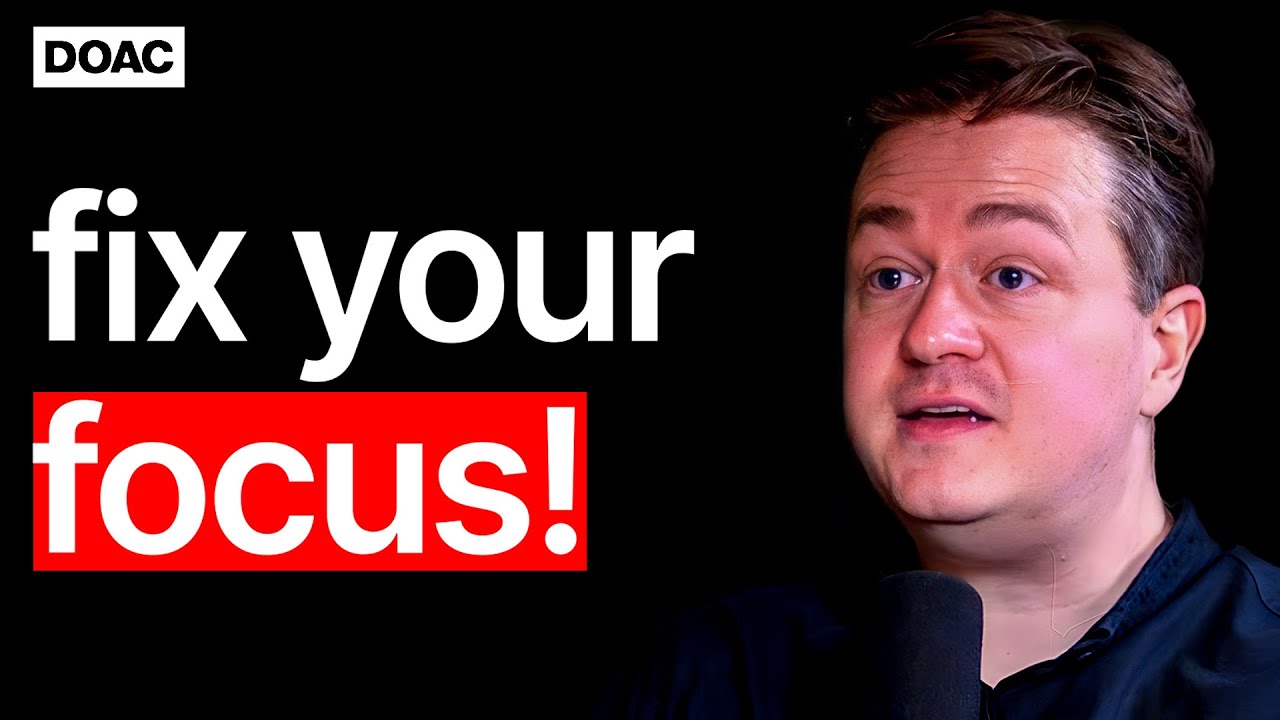
How To Fix Your Focus & Stop Procrastinating: Johann Hari
Guests: Johann
Full transcript · Read the full conversation in order, with its original context.
§01Transcript — part 1
When your cat is acting weird-er, or your dog is being loud-er, your turtle moves slow-er. Hello, Ted? Your cat seems thirsti-er. Whoa, slow down buddy! Or your puppy is acting clumsi-er. Day or night, if you don't know what's wrong, know where to go. Veg ER for Pets. This is Kate. Veg, the better, kinder ER for pets.
You’re not being present in your life. You’re not being present at all. Johann Hari, he’s been on a journey to understand attention and why we seem to have so little of it these days.
I know something is really wrong, but I don’t know what it is. And that’s when I thought, are we having an attention and focus crisis? If we are, why is it happening? And most importantly, what can we do to get our brains back? You’ve got all these smart engineers and they’ve got one incentive: how do I take Stephen’s attention the absolute most I can? We need an attention movement to reclaim our minds.
If our goal as a country is to be a country that’s innovative, my God, a country of people who can think is going to be innovative. A country of addled people flicking between WhatsApp, Snapchat, and TikTok ain’t going to be a place full of innovation. Do you want your child to be able to focus? Do you want your child to be able to read books? Do you want your child to be able to think deeply? Of course, you do. Okay, we’ve got to fix the society and culture to give them those things, and we absolutely can change them.
Today, one of my favorite ever guests on this podcast returns. And they return with a completely different conversation for you. Johann Hari. What he wrote about mental health and the causes of depression, anxiety, and meaningful connection changed my life. It’s probably the number one book I recommend, and you’ve heard me recommend on this podcast, the book *Lost Connections*.
But over the last several years, Johann Hari has been on a completely different journey. He’s been on a journey to understand attention and why we seem to have so little of it these days, but why it’s so fundamentally important for our happiness, our success, and everything in between. We all know we’re a generation that are glued to our screens and our phones. But what is the cost? What is the cost to things that actually matter? How do we change it? Why should we change it?
Johann Hari went on that journey, the most remarkable, entertaining, hilarious journey, and he’s an unbelievable—maybe the best ever on this podcast—storyteller. You’re going to absolutely love this conversation. And entertainment aside, it might just change your life. So without further ado, I’m Stephen Bartlett, and this is *The Diary of a CEO*. I hope nobody’s listening, but if you are, then please keep this to yourself.
Johann, first and foremost, thank you for coming back. It just dawned on me that you have visited here more than any other guest. You now have the record as three times.
Oh, I'm so touched to hear that. Does that mean I'm officially the king of your podcast?
You’re the king of my podcast. My first question to you is: I know how talented you are at writing and how you could basically write about anything if you wanted to because your books have been so successful. Why did you decide to write about attention when you could have spent your life writing about anything?
For years, I had this feeling, like when I walked around in my friends, in myself, something was going badly wrong with our ability to focus and pay attention. Every now and then I would see small studies that seemed to suggest this was true. There’s a study of American college students that found that now they only focus on average on any one thing for 65 seconds. There was a study of office workers that found on average office workers only focus on one task for three minutes.
But I thought, people have always felt their attention is getting worse, right? What happens as you get older, your attention deteriorates and you mistake your own deterioration for the deterioration of the world around you. You can read stories of monks in the Middle Ages—letters they wrote to each other saying, "Oh, my attention isn't what it used to be. I'm a bit worried about this." So I just thought, everyone thinks this.
Then there was a moment that for me, I thought, I do think there’s something deeper happening here. When he was nine, my godson Adam developed this brief but really freakishly intense obsession with Elvis. I never found out why. He must have seen him on YouTube or the telly or something. He didn’t know that Elvis impersonation has become this cheesy thing, so he did it with this totally heart-catching sincerity. He would sing *Viva Las Vegas* and *Suspicious Minds* and all the Elvis classics.
He kept getting me to tell him the story of Elvis. That Elvis is born in this little town called Tupelo in Mississippi, one of the poorest places in America. He’s born and his twin brother died as he was being born. As he was a little boy, his mother told him that if he looked at the moon and he sang, his little brother could hear him. So that’s why he became—one of the reasons he became—such a great singer.
I was telling my godson this story, and obviously told him that Elvis became really famous and bought this palace that he called Graceland. One day I was tucking him in, and he looked at me very intensely and he said, "Johann, will you take me to Graceland one day?" I said, "Yeah, sure," in the way you do with little children. You’re just like, they’re never going to—they're going to forget it the next day. He said, "No, do you really promise? Will you take me to Graceland?" And I said, "Yeah, I promise you."
I didn’t think about it again for ten years, until really everything had gone wrong. By the time Adam was 19, he’d dropped out of school when he was 15. He seemed to just spend all his time alternating between his iPad, his laptop, and his phone. He seemed to live in this kind of blur of WhatsApp and YouTube and porn. It was like he had fragmented as a person.
It was like he was whirring at the speed of Snapchat. You couldn’t have a conversation with him that lasted more than a few minutes. He was very intelligent, decent, good person, but it was like nothing could gain any friction in his mind. One day we were sitting on my sofa and I was looking at him doing this and I was thinking, "God, in the decade that you’ve become a man, this has happened to so many people I know."
This is the extreme end of the spectrum, but I could feel it happening to myself. Things that require deep focus, like reading a book—obviously I still do that a huge amount—but it felt like with every year that passed, that was more and more like running up a down escalator. Some people can still get to the top, and the escalator is getting faster.
I was looking at him and I thought, I have to break this routine. I can't bear to see this happen to him. I can't bear to feel this happen to myself. I suddenly remembered when he’d been a little boy and I said, "You know what, let's go to Graceland." He looked at me like, "What are you talking about?" He didn't even remember this Elvis obsession. I was like, "No, look, I'll take you to Graceland. Let’s go. Let's just leave. But I’ll take you on one condition, which is that when we go there, you leave your phone in the hotel when we go out, because I can’t take you there and just you be looking at your phone the whole time."
So two weeks later, we flew. We went to New Orleans first, but we flew out to the South. When you arrive at the gates of Graceland now—this is pre-COVID, I imagine it’s worse now—there isn’t a physical guide to show you around anymore. What happens is they give you an iPad and you put in little earphones and the iPad shows you around. You look at the iPad and it says "go left," and then there’s an actor telling you, like, "in this room," and it explains all these things. In each room you’re in, there’s like a representation of that room on the iPad.
So what happens is people walk around Graceland staring at their iPad. I’m walking around surrounded by this kind of United Nations of blank-faced people from Korea and Canada and everywhere else, and no one is looking at the thing they’ve traveled to see. I’m getting more and more tense as I’m watching this, and I’m trying to make eye contact with someone to go like, "Oh, you know, look, we’re the people who traveled 3,000 miles and actually looked at the thing we traveled to."
Finally, I did make eye contact with a guy and I smiled and I was about to say exactly what I just said. Then I realized he’d only taken the earphones out and put down the iPad so that he could take out his phone and take a selfie. I was feeling more and more tense. Finally, we got to the Jungle Room, which was Elvis’s favorite room in Graceland. It’s just a kind of fake jungle with loads of fake plants.
There’s this couple next to me and the man turned to his wife and said, "Honey, look, this is amazing. If you swipe left, you can see the Jungle Room to the left. And if you swipe right, you can see the Jungle Room to the right." She goes, "Oh, wow," and so she’s swiping left and right on her iPad. I look at this guy and I said, "But sir, there's an old-fashioned form of swiping you can do. It's called turning your head because we're actually in the Jungle Room. You don't need to look at a digital representation of it. We're literally here. Look, it's in front of you."
Of course, this couple thought I was insane, possibly not unreasonably, and they walked off. I turned to my godson to kind of bond with him and laugh about "isn't this mad," and he was just standing in a corner looking at Snapchat. Because the minute we landed, he just was on his phone constantly. I remember when I said to him, "I thought you said you weren't going to use your phone," he said, "Oh, I thought you meant I won't take phone calls. I can't not use social media."
He said it with a kind of baffled sincerity, as if I was asking him to hold his breath or something. I got really angry and I said to him, "You know, you're frightened of missing out, but what this is doing is it's guaranteeing you miss out. You’re not being present in your life. You’re not being present at all." And he kind of stormed off. Again, not unreasonably, I was being a bit angry.
I stomped around Graceland on my own for a while. That night I found him—we were staying in the Heartbreak Hotel which is across the street from Graceland—and I found him at a swimming pool that’s shaped like a guitar where they play Elvis songs in a constant loop. I saw him sitting there looking at his phone and I went up to him and I realized, like a lot of anger, my anger at him was really anger at myself. I could feel these pressures happening to me.
I could feel my own attention and focus fragmenting. He just looked at his phone and said, "I know something's really wrong, but I don't know what it is." And that's when I thought, okay, I need to look into are we having an attention and focus crisis? If we are, why is it happening? And most importantly, what can we do to get our brains back?
And what did you discover in terms of the stats, facts, and figures around the attention crisis? Is it a real thing? Is it happening? And linked to that, I guess, what are we losing because of the attention crisis?
Yeah, so I ended up traveling all over the world. I interviewed 250 of the leading experts in the world about attention and focus. I went to just places that have been really differently affected by this. From Moscow to Miami, from a favela, a slum in Rio de Janeiro where attention had collapsed in a particularly disastrous way, to an office in New Zealand where they discovered this amazing way to restore people’s attention.
What I learned is, the best way we could know if attention has collapsed would be if for the last 150 years, every year scientists had given the same kind of attention test to people and then we’d be able to track it that way. No one did that. So that we don't know that. But I do think there’s another way we can reasonably conclude that this is a real crisis.
There's scientific evidence for 12 different factors that affect attention and focus that either boost it or trash it. And there’s good evidence that a lot of these factors have been rising throughout your lifetime and my lifetime. So I think it's fair to conclude therefore that we are facing a real crisis. And there’s various pieces of evidence that do show collectively our attention span really is shrinking.
I think that leads to—we’ve got to understand what’s happening to us in a very different way. Because when I felt my attention fraying, my main response was to go into just self-criticism. Just go, "Oh, you’re weak, you’re lazy, you’re not good enough. Why aren't you strong enough to resist these forms of distraction?"
Actually, when you know that this is happening to almost all of us, or in fact these factors are bearing on all of us—they’re affecting some of us differently—that made me realize you’ve got to think about this in a different way. There was a guy I went to interview, one of the leading experts on children’s attention problems in the world, a guy named Professor Joel Nigg, who’s in Portland, in Oregon.
He said to me, "Look, think about obesity, right? If you look at a beach, a photograph of a beach in Britain in 1970, or in the US anywhere, everyone is by our standards either slim or buff. There’s nobody who’s what we think of as fat. No one. It’s really weird. And it’s not that the fat people just stayed at home, right? What happened is if you look at 1970, there was almost no obesity in the Western world."
Then certain absolutely crucial changes happened in the way we live. Our food supply changed. People used to eat fresh and nutritious food; we moved to heavily processed and ultra-processed food, which affects your body in a very different way. Our cities completely changed. You used to be able to bike and walk to work, to the places you wanted to go; in a lot of our cities, that’s now impossible.
As a result of these two big changes and some other ones—actually stress, right? The more stressed you are, the more you want to comfort eat. As a result of these big changes, obesity exploded. So it’s not that individuals got weak or whatever these stigmatizing things people say about overweight people. What Professor Nigg said is something very similar is happening with attention.
There are changes in the way we live that are pouring acid on everyone’s ability to pay attention. The way he put it, the kind of technical term, is that we have an "attentional pathogenic culture." A culture in which it is very hard for all of us to form and sustain deep focus. This is why activities that require deep forms of focus like reading a book have just fallen off a cliff in the last 20 years.
So what we've got to do is—there’s two levels of response. One is there are individual responses. There are changes we can all make in our lives. Obviously, I talk about this a lot in the book *Stolen Focus*. There are also big changes we need to make as a society. We need to come together and demand changes in the society that would make it possible for us to make a lot of these positive changes we want to make.
Okay, so if we were to agree that attention has decayed, what I really want to know is, so what? What is the cost to my life outside of the fact that I might not have as engaging relationships? Is there any other cost to my productivity, to anything else that really, really matters to me?
Yeah, this is such an important question. I think there’s two levels we need to think about it. The first is as an individual. If you can’t focus and pay attention, your ability to achieve your goals across the board diminishes. You want to set up a business, you want to write a book, you want to learn how to play the guitar—all of those things become much harder if you can’t focus and pay attention.
If you’re constantly pulled away by the pings in your phone. Or let’s say you want to be a good parent. If you’re constantly pulled away from that, if you’re constantly distracted, your ability to do that—so any goal you have in your life is diminished if you can’t pay attention.
That’s the personal layer. There’s also just a collective and social layer. If you live in a society where people can’t pay attention, if you’re surrounded by people who can’t pay attention, our ability to solve our collective problems—and we’re facing a lot of collective problems at the moment—also breaks down.
Attention is crucial for achieving goals and problem-solving. To me, those are the two most important things in life. And you went to the other one: just being present with people. If you can’t be present with people, you can’t form the deepest relationships. If most of us think about a moment that’s been deeply meaningful to us in our life, it’ll be a moment where you are paying attention and other people are paying attention to you.
A moment of shared focus, a moment of meaning. We can’t do that if we can’t pay attention. So you become a sort of stump of yourself. You can sense that you might have been more. It chokes off growth.
There are a few ways of thinking about this. There’s an amazing expert on attention called Dr. James Williams, who I interviewed in Moscow. He’s a former Google engineer who said that there’s a few different types of attention that we seem to be losing.
The first type of attention is called your "Spotlight." So let’s say there’s a fridge in the corner of this room. Let’s say I want to go and get two drinks from that and bring them to the people in the other room. My spotlight—I’ve got an immediate task: go and get the drinks, take them to the people in the other room. Now, if I’m constantly interrupted, if I’m constantly checking my texts, I might get to the fridge, get a load of texts, forget why did I go there again?
The guys in the other room are saying, "Where the hell’s Johann? Why has he not brought us this stuff?" So your spotlight is your ability to hone in on an immediate task. That is obviously—we can all see how that’s been disrupted.
Then there’s what he calls your "Starlight," which is your more medium-term goals. So a medium-term goal might be a goal that you obviously had a few years ago: I want to start a business. That’s a medium-term goal. It’s called starlight because when you don’t know where you are, you look up at the stars and you orient yourself by the stars. That is being disrupted.
If your life is full of distractions, if your consciousness is hijacked by really petty goals or goals that are someone else’s goals, like social media, you can’t—you lose the ability to formulate. It’s not just that you can’t achieve the short-term task; you lose your ability to achieve your longer-term tasks.
The third form is what James calls Dr. Williams calls your "Daylight." Which is, how do you even know that you want to set up a business? How do you even know what it means to be a good dad? How do you know what it means to have a good life? For to be able to see clearly, a room has to be flooded with daylight.
It’s not just that we’re losing our short-term attention; it’s not just that we’re losing our medium-term attention. When those things happen, you have less ability to make sense of your own life. He compared it to a denial-of-service attack on the internet, where when someone wants to take down a website, they get many thousands of computers to log on simultaneously and the computer crashes.
It’s like we’re experiencing that. We’re so overloaded that your sense of "who am I? What do I want to do?"—if your life is atrophied into 65-second and three-minute chunks, how do you build a sense of where you want to go and who you want to be? You begin to feel lost in your own life. I think you can see that happening to lots of people.
I certainly can. And as you were saying that, I was reflecting on how difficult I find it to just sit with my girlfriend and just pay attention and just try and connect with her. Like, how has your day been, without devices and screens?
There was a big change we made together where we kind of made a rule that we would exclude devices from certain parts of our life. So we don’t have them in the bedroom. If we’re in bed together, we don’t have devices in there. And there’ll be some times where we commit to putting the phones away and doing something, sometimes for seven hours.
It'll be like, she'll say to me, "I want to do this special type of dance that I’ve never done before." So put the phones away and as I’m doing it, especially at the start, as we’re doing this—there’s called "contact dance" she wanted to do with me where you always maintain one point of contact—I was just thinking about my phone.
And then, you know, I think we get into hour five and six and I’m still thinking about my phone. And it’s funny because I’m not being present. I’m actually kind of like complying with what she wants to do so that I can get back to my phone. I find that really, really sad. I can see how it would jeopardize the chance of a really meaningful connection in modern relationships where you’re never really connected.
I think a lot of relationships are actually more connected on social media than they are in real life. I wonder if that’s had an adverse effect on the success of relationships, this absence of focus and attention.
I think there are so many important things in what you just said. So what you’ve built for you and your girlfriend there, your first response is a good first response, which is at an individual level—there’s big collective ones as well—but at an individual level, a good response is what’s called "pre-commitment."
So what you do is you say, you and your girlfriend say, "We’re going to put our phone away for seven hours." So you say it in advance. There’s a woman called Professor Molly Crockett at Yale University who I interviewed who is a kind of expert on pre-commitment. So pre-commitment is: we all know there’s all sorts of things you want to do that you know you might crack and give in later and not achieve them.
So, "I don’t want to eat any Pringles," right? Because they make me even fatter than I am. So the best form of pre-commitment is when I go to the supermarket, don't buy the Pringles. Because if I buy the Pringles, I tell myself, "Oh, I'll just have five tonight." And of course, you get to 2 AM, you wake up, you’re chugging them like Homer Simpson.
So the one form of pre-commitment there is: A, don’t buy the Pringles; B, tell everyone you’re not going to buy the Pringles, because even just articulating your goal out loud makes you more likely to achieve it. So you’ve got one form of pre-commitment there: you’ve said, "Okay, we’re going to say to each other, for seven hours now, we’re going to put the phone away."
So that’s a really good model of pre-commitment. But also, you’ve got to—you’ve got to one of the challenges with that, which is your consciousness has been hijacked by these technologies. It was really interesting researching this because a lot of people, when I say I’ve done a book about attention and focus, they say, "Oh, you’ve written a book about tech." Actually, tech’s only about 20% of what’s going on, I think, although it’s a very important 20%.
It was really interesting researching this because actually, most of the problem is not inherent to the technology. It’s the result of something else which is actually more fixable. Because you and me, we’re not going to give away our phones, nor should we. We’re not going to abandon this technology. We could make the technology work for our attention rather than against it.
I spent a lot of time in Silicon Valley interviewing the people—a lot of the people who designed the world in which we now live—and really feel bad about it. They have all the problems that you, me, and everyone watching have. There was a really interesting moment: James Williams, the Google engineer who I just mentioned, there was an incredible moment when he spoke at a tech conference.
He’s speaking entirely to really influential designers who are making the stuff that we’re all using. He said to them, "Is there anyone here in the audience who wants to live in the world that we’re creating? Put up your hand." And not one of them did. Another one of them, Tristan Harris, an amazing dissident in Silicon Valley who also worked for Google. He worked on the Gmail team when they were designing Gmail and spreading it to the whole world.
One day he was in the Googleplex and one of his colleagues said, "Oh, I’ve got an idea." They were trying to figure out how to get more and more people to use Gmail more. One day he had an idea, he just said, "Why don’t we make it so that every time someone gets an email, their phone vibrates?" Everyone in the team said, "Oh, that’s a good idea."
Tristan, a week later, was walking around San Francisco and just heard these vibrations everywhere and thought, "Shit, we did that. And that’s happening everywhere." Within a few months, he did a calculation: there were 11 billion distractions every day being caused by his company.
So these people are really open to—there’s a big debate about this—but there was a moment, and there’s lots of things to say about it, and lots of techniques these social companies use to maximally hijack your attention. We can talk about those techniques and I think there’s loads we need to learn about that.
But actually, to me, the most important thing, the root of this, is to understand that social media doesn’t have to work that way. The moment that really helped me to understand it—because I was really struggling getting my head around that—if I open Facebook, it’ll tell me all sorts of things. It’ll say, "Oh, it’s your mate Rob’s birthday today," "This is something you said five years ago," "There’s been a terrorist attack and look, these people have marked themselves as safe."
It’ll tell you all sorts of things. What it won’t do is something that actually lots of people would really love. There’s no button on Facebook that says, "I’d like to meet up with my mates. Who’s free now? Who’s nearby and available?" Now, that’s technologically unbelievably easy; Facebook could design that in an hour. That would be really popular; I’m sure everyone listening thinks, "Yeah, that’d be a really handy thing to have."
It doesn’t exist. Why does the market not provide it? If you follow the chain from why the market doesn’t provide it, I think you begin to understand some of the ways our attention are being invaded and how we can get it back. So when you open Facebook, Facebook makes money in two ways. First way is very obvious: you see ads. We all understand how that works.
The second way is much more valuable to Facebook. Everything you do on Facebook—everything you like, everything you dislike, everything you message to people—is scanned and sorted by their AI technology to build a profile of you. Let's say that you like Kylie Minogue and Donald Trump, and you message your mum going, "I've just bought a load of nappies."
Okay, so the AI is figuring out, "Okay, this person’s probably gay"—no disrespect to the heterosexual fans of Kylie, presumably out there—"This person's gay, they're quite right-wing, and they've got a baby," because why would they be messaging about nappies? Think about thousands and thousands of data points like that. It’s building up a very complicated and detailed profile of you, which it then sells to advertisers so they can target you.
Because if you’re making nappies, you don’t want to send an ad to me; I don’t have any children. You’ve wasted your money. You want to target your advertising. So Facebook is making money every moment you open it. Facebook makes money through those two revenue streams. And every time you put the Facebook app down or you shut your phone off, Facebook loses money—or they don't make the money they would make if you carried on scrolling.
That's it. That's their business model. It's simply that. Once you understand that, you can see why there's no button that says, "Who's available and wants to meet up now?" Because if you pushed that button and it said, "Oh, Joe's around the corner. I'll go for a coffee with Joe," you and Joe would sit opposite each other and talk to each other. Well, then you're not on Facebook. They're losing money.
Their entire business model, as Sean Parker, who was one of the first investors in Facebook, said: our whole business model was to hack people’s attention. We knew we were doing it and we did it anyway. So they have the most sophisticated engineers in the world specifically working to figure out maximally how to hack your attention.
But the thing that blew my mind about this—because you can get into, "Okay, you talk about that," and very often this is framed as, "Oh, okay, so is this an anti-tech or a pro-tech? Are we pro-tech or anti-tech?" It’s a completely wrong way to think about it. The question is not "are you pro-tech or anti-tech?" The question is "what tech working in whose interests?"
Because that business model, which is designed, *has* to be about fracking your attention. That’s the only way it can work. It’s not the only business model for these companies. So let’s say Aza Raskin, one of the who designed key aspects of the internet that we now use—amazing guy—said to me, "We should just ban that business model."
A business model that is based on tracking you, surveilling you, invading your attention, and selling that attention to the highest bidder. That is just an inhuman way of doing it. It's like lead in paint. Ban it. So I said, well, what happens the day after we ban it? Do I open Facebook and it just says, "Sorry, closed"? And they're like, "No, what would happen is all these companies would have to move to other business models which already exist."
So one model might be subscription, you know, like Netflix. We know how subscription works. Or it might be that we choose to own it together. Somewhere beneath where we’re sitting, there’s a sewer. We own that sewer. You and me, as taxpayers, own that sewer together. Because when we didn’t have sewers, we had shit in the street and we got cholera and people died.
And then together we built the sewers and together we own and maintain the sewers because it’s important for all of us. Now, it might be we want to say, just like we own the sewer pipes together, we might want to own the information pipes together. Because at the moment, we’re getting the equivalent of cholera for our attention.
But the key thing about that is when you move to these different models, instead of you being the product—today you’re not the customer of Facebook, you’re the product they sell to advertisers. If we move to those different business models, suddenly *you’re* the person they want to please. If you want to pay attention, they could start redesigning Facebook in all sorts of ways, very practical ways—I can tell you about lots of them—that are designed not to hack your attention, but are designed to heal your attention. They're designed to make your life better.
When your cat is acting weird-er, or your dog is being loud-er, your turtle moves slow-er. Hello, Ted? Your cat seems thirsti-er. Whoa, slow down buddy! Or your puppy is acting clumsi-er. Day or night, if you don't know what's wrong, know where to go. Veg ER for Pets. This is Kate. Veg, the better, kinder ER for pets.
You know what’s really interesting? Obviously, my background is social media. I’ve been knee-deep in this industry for a long, long time. And in 2019, Mark Zuckerberg wrote a letter where he said, and he posted it on his Facebook saying, "We've done some studies, we’ve spoken to some people, and we've discovered that the timeline is bad for you. It's net negative, predominantly because of these highly addictive, very short viral videos."
I’m going to put my hands up: that was part of the company I built’s business model. We built—we had huge, huge Facebook pages, some of which had tens of millions of followers, and we knew that if we wanted a ton of views, which would result in a ton of followers, we had to post very, very highly engaging short videos.
Facebook that year changed the timeline. They killed that part of our business model where these super addictive viral videos would no longer work. And in their little statement, they said, "The things that will now work are any content that gets people to basically just have conversation with each other." So we then tested that. BuzzFeed tested that as well.
BuzzFeed posted some things and discovered that if your post is discussion-worthy, it will now do better. And so as Facebook were apparently trying to do the right thing—which cost them that year, their revenues I believe went down in that year, their stock price definitely did—and they pointed to, "Listen, we made these changes to our news feed to try and make it more healthy."
Something else emerged. And that thing, which is now the dominant force, is called TikTok. And TikTok took the place of short, addictive-as-fuck, "you don't even know you're scrolling" videos. And the way that I know it from my social media background, that TikTok have fully owned that space, is simple.
On my TikTok now, say I have 100,000 followers, a video can get 1,000 views or a million views. The variance of viewership is extreme. What that means is they are—the algorithm is just taking the most addictive things and saying, "Fuck everything else." It’s like, "I'm not going to show your followers or the discovery feed the thing you posted that wasn't addictive. I’m just going to grab the viral stuff that’s super short and put that in the feed."
So now, I was talking to some of my colleagues today. Fortunately, I don’t actually use TikTok. Like, I don’t use it myself. I have a TikTok, but I don’t use it myself to engage with friends. And every single one of my friends—some of them are sat in this room now, some of them are downstairs—they describe their relationship with TikTok as like, as if it’s heroin.
I’ve never heard a social network described in such a way. My friend Ash, who's like 35, he goes, "I'll just touch the app," and he goes, "An hour's gone." And he's like, "I've never seen anything like it." So if Facebook changed, what—my point here is that some—I’ve seen how someone else who just doesn’t give a fuck will come in and occupy that space, make a billion dollars, and run off.
So I’m keen. You basically put your phone in a box and then escaped to the phone. You must have been more productive than ever because of this thing that people describe called being in the "flow state." I imagine if I’m distraction-free, then I would be in that flow state longer. I heard about this concept of a flow state maybe about a year or two ago. And then I could relate to it because I’ve had those moments in my work or when I’m doing a certain activity, specifically more like monotonous activities or repetitive activities, where you get into that state of flow where you’re almost doing it without thinking. What is flow? And how do you find it? And what is the power of being in one’s flow state?
So a flow state is when you’re—and everyone listening will have experienced it at some point in their life. A flow state is when you’re doing something that’s really meaningful to you, and you really get into it. And your sense of time falls away, your sense of ego falls away, and your attention to it just feels effortless.
So a rock climber put it, it’s like you get into flow in rock climbing when you feel like you *are* the rock you’re climbing. So we all will have had moments of flow in our lives. What’s really important about flow in relation to attention is this is a power, this is a capacity that all human beings have. And it’s a capacity where you can pay attention to something deeply, but it doesn’t feel like an effort.
It’s not like studying for an exam where you’re like, "Okay, so Napoleon was born there," you know, you can pay attention that way, but that’s an effort. Flow is like a gusher of attention that is inside all of us that we can pay. So obviously Mihaly—Professor Csikszentmihalyi spent 40 years of his life, more than actually 50 years of his life, studying flow states. How do they happen? How do we maintain them? What ruins them?
He discovered lots of amazing things about it. He discovered that actually flow states are really essential for having a good life, for feeling competent, for good mental health. And he discovered—I mean, he made lots of discoveries, but for me, there were three really important things he discovered about how to get into a flow state.
Firstly, you have to choose *one* goal. If you’re trying to do lots of things at the same time, you will not get into flow. I can explain why later, but that’s really important: you have to choose one thing.
The second thing you have to do is you have to choose a goal that is meaningful to you. If it’s not meaningful, you’ll never get into flow on it. For me, it would be writing, but everyone will have something.
And thirdly, you need to choose something that is ideally at the edge of your abilities. So let’s say you’re a rock climber. Let’s say you’re a medium-talent rock climber. If you just clamber over a garden wall, you’re not going to get into a state of flow. Equally, if you suddenly try and climb Mount Kilimanjaro, it’s going to be overwhelming; you also won’t get into a state of flow. You want to choose something that’s a little bit harder than the thing you did last time.
So flow begins at the edge of your abilities. So you want those three things: one clear goal, it’s got to be meaningful to you, and it’s got to be at the edge of your abilities. If you do that, you maximally increase your chance of getting into flow, which *is* this form of deep, meaningful attention.
But Mihaly also made a discovery—he discovered this in the late 80s—that there’s something that absolutely consistently ruins flow, which is being interrupted. Being distracted just kills flow dead, which kills the deepest form of attention. And I think we’re really living—and Mihaly thought we’re really living—with a crisis of flow states now.
What is the harm of interruption? I read in your book about the decaying creativity and the time it takes to get back into the task once you’ve done it. But is there a more sort of consequential...?
So if you want to understand—and this might sound when I first describe it like a small effect, I'm going to explain how big it is afterwards because it doesn't feel big when you're doing it. So I went to interview one of the leading neuroscientists in the world, a man named Professor Earl Miller who’s at MIT, the Massachusetts Institute of Technology.
Professor Miller said to me, you have to understand one crucial thing about your brain, my brain, everyone's brains: you can only think consciously about one thing at a time. This is just a fundamental limitation of the human brain. The human brain hasn’t changed in 40,000 years, it ain’t going to change anytime soon: you can only think about one thing at a time.
But we have fallen for a mass delusion. So the average teenager, according to a study by Professor Larry Rosen, believes they can now follow seven forms of media at the same time. So what happens when you believe you’re doing lots of things at once? They get people into labs, they get them to think they’re doing lots of things at once, and see what happens.
And it turns out there are four really big costs that happen. So the first is what's called the "switch cost effect." So let's say my phone is outside this room, but let's say I had my phone in my pocket. Let's say you were just talking, you spoke for a minute or two, what you said was really interesting. Let’s imagine that I had just taken out my phone and glanced at my text messages for a few seconds while you were doing that.
Kind of thing that happens all the time. You think, "Oh, I’ve just taken two seconds and I’ll—" In that moment, I have to refocus my brain. "Oh, Jess texted me. Oh, right. So that must mean that Mum needs—oh, right, I go, I got it." And then I have to refocus on you. "Wait, what was Stephen just saying again?"
Seems like a small effect; it’s not. I’ll talk about how much it is in a minute. The second cost it brings in is you start to make mistakes when you’re switching between things. It maximally increases your error rate. So say that I’m, I don’t know, doing my tax return and I look at my text and I go back to my tax return. I’m much more likely to make mistakes, and that means I have to go back and correct my mistakes.
The third effect is on your memory. To translate your experiences into memories takes mental effort. Takes a certain amount of brainpower. If your brain is instead just jammed up with all this switching, the evidence shows you’re significantly less likely to just remember what happened. You’re less likely to remember any of it.
And the third effect—the fourth effect—is on your creativity. When you just have time to think, your brain naturally wanders and it will roam over, you know, things people have said to you in your life, moments you’ve had, things you’ve read, a whole range of things. And it’ll start to make connections between those things. That’s actually what creativity is: it’s when two ideas that have never been put together, go together and pop. You know this much better than me.
But when your brain is jammed up with switching, it just doesn’t get the space to do that. And I heard that, and I remember speaking to Professor Miller, who’s an amazing man, and just thinking, "All right, I get that. But that’s quite small, right?" When I looked at the studies, I was quite struck. Hewlett-Packard did a quite small experiment with their workers.
They split them into two groups. The first group was told, "Just do whatever task you’ve got to do today and you’re not going to be interrupted." And the second group was told, "Just do your task today," and they were interrupted with emails and texts, what was described as a heavy amount of emails and texts. Then they just tested their IQ after either not being distracted or being distracted.
What they found is the people who had been distracted tested at having ten IQ points lower than the people who had not been distracted. Because it makes you less intelligent. Constantly switching—the strain of that makes you less intelligent. And to give you a sense of what ten IQ points means, if you and me smoked a spliff now together, our IQ would drop by about five points.
So it’s double—just being heavily interrupted is has double the effect on your intelligence and attention as getting stoned. So you would be better off sitting at your desk, doing one thing and smoking a spliff, than sitting at your desk not smoking a spliff and being interrupted all the time. There’s a guy called Professor Michael Posner at the University of Oregon who found that if you are distracted and pulled away and go back to the task you were doing originally, it takes you 23 minutes to get back to the same level of focus as you had before.
So we are all—our focus is being stolen. The book is called *Stolen Focus* for this reason: our focus is being stolen by these forces. That’s just one of the 12; there’s loads, but we’ve got to understand this.
The other point I guess you write about in this book, which I was surprised you linked to attention because it wasn’t an obvious link to me, was about sleep and the decay in our sleeping health over decades. You write that we’re sleeping less than ever before and we’re having worse sleep than ever before. My sleep is fairly good, but I think it’s decaying. I’d say it’s decaying. I sleep with my phone in my bed. First thing I do when I wake up in the morning, I’m actually—as I’m opening my eyes, I’m thinking about where I need to put my hand to get the phone. Like, I’m visualizing where I think I left it. My brain always knows. My brain’s like, "It's over by your right ear." It always knows where it is. Then I wake up, I look at WhatsApp: *boom, boom, boom, boom, boom*. 100 notifications, 100 things. What’s the cost of this type of behavior, which I think a lot of people will resonate with? And what is the macro trend in sleep health?
Yeah, this is one of the 12 causes I write about in *Stolen Focus* that really—the evidence was quite shocking, actually. So I interviewed lots of experts, but I interviewed arguably the leading expert in the world on sleep, a man named Dr. Charles Czeisler, who’s at Harvard Medical School. He’s taught everyone from the Boston Red Sox to the Secret Service about sleep.
He started to make this breakthrough in 1981. When Charles was at medical school, he was taught that basically when you’re asleep, your brain is just inert, it’s not doing much. So he starts doing this research—nothing to do with sleep, it doesn’t really matter what it was about—but it was about the time of day that the body releases a particular hormone.
To study that, he had to keep people awake in a lab for quite long periods of time. So he’s working with them and he’s got all sorts of techniques for keeping them awake, like attention techniques. And he was just immediately struck when he’s doing this how quickly and how dramatically people’s attention and ability to think deteriorated as they stayed awake longer.
If you’re awake for 19 hours—doesn’t feel like very long—your attention and ability to think is the same as if you were legally drunk. So your attention—things that would take a fraction of a second when you’re refreshed and alert, he was discovering if you were awake for just a day were taking 12 seconds. A staggering increase in your ability to think.
So he started to think, "Oh, I should study sleep. I should look into this." And he began to do a series of hugely groundbreaking research on sleep. What he did is he pioneered putting together two bits of technology. There’s a kind of technology that can scan your eyes to see what you’re looking at and, obviously, there’s PET scans and things that can scan your brain and see what’s happening in your brain.
So he put this together and he looked at people who were tired. Not *that* tired, but tired. To see what they were looking at and what was happening in their brain as they looked at it. And what he discovered is that you can—when you’re tired, you can appear to be awake. As awake as you and me seem now. You can be looking at people, you can be talking.
But parts of your brain have literally gone to sleep. It’s called "local sleep" because it’s local to one part of the brain. Which is kind of mind-blowing. This helps to explain why attention degrades so rapidly when you’re asleep. And I was trying to find out why is that? What’s going on there?
It’s also important to bear in mind, this is one of the ways we know attention has got worse. There’s good evidence that sleep has dramatically deteriorated. We sleep on average an hour less than people did in 1942, and children sleep 80 minutes a night less than they did a century ago. So it’s a staggering—there’s been a 20% decline in adult sleep in the last century.
Incredible figures. When you look at them, they’re kind of mind-blowing. Only 15% of people wake up feeling refreshed. So I wanted to understand why is this, right? Why does sleep affect our attention so much? One of the people I interviewed about this and looked at her research very carefully is an amazing woman called Professor Roxanne Prichard, who’s at the University of Minneapolis where I interviewed her.
She explained to me, when you don’t sleep, your body interprets it as an emergency. It says, "Something’s really wrong here. He’s not sleeping. Why isn’t he sleeping?" So it has all sorts of physiological and psychological effects: it raises your heart rate, it makes you crave more sugar and fast food because it’ll release glucose quickly, makes your heart beat faster.
And it shuts down a lot of the creative parts of your brain, a lot of the more fertile parts of your brain because it’s like an emergency. You haven’t got time to worry about that. But what’s happening is lots of us effectively live in a bodily emergency. 23% of British people sleep for five hours a night on average. Staggering figures.
And the reason this is so important is partly the bodily emergency and it’s partly that what Dr. Czeisler had been taught at medical school much earlier was wrong. Sleep is not a passive process. Sleep is an incredibly active process. The way Professor Prichard put it to me is: when you’re sleeping, you’re repairing.
Your brain is rinsed with a watery fluid that carries away metabolic waste, it takes it down to your liver and gets rid of it. Your brain repairs itself in sleep. The longer you sleep, the better and deeper the repairs are. We’re not giving ourselves time to repair. We’re not giving ourselves time to rest. And as a result, we’re going around groggy, our brain isn’t functioning to its full potential.
I remember saying to Dr. Czeisler, "Okay, so we know that sleep’s got worse, we know that sleep is crucial for attention. Does that mean it is true to say that we have got an attention crisis?" And he said, "Even if nothing else had changed in the society—and this is only one of the 12 changes—even if nothing else had changed in the society, that alone would be a guarantee that we had an attention crisis."
So what do we do about it? I am that person. I have pathetic sleeping habits, for sure, for sure. So what can I do about it? Removing my phone from the bedroom aside, the government or society collectively deciding that we should they should impose better professional laws so that people aren’t as interrupted when they could be sleeping, etc. What else can I do on a real practical level?
Yeah, at a personal level, there’s plenty of pre-commitment you can do. So I would recommend that you get a "K-Safe." Do you know about them? It’s basically a plastic safe with a lid at the top. You take the lid off, you put your phone in it, you turn the dial at the top, and it’ll lock away your phone for anything you set it to, between five minutes and a week.
And if there’s like a fire or something, you could easily smash it, but then you have to buy another K-Safe. So I would say, an hour before you go to bed, put your phone in the K-Safe. And then you can’t—again, it’s pre-commitment. You’re binding yourself so that when you’re lying there in bed and your mind’s racing like, "Oh shit, I forgot that email," too late. You can’t check it. That’s what I do. Massively improved my sleep.
There’s also big tips. And this is one thing I recommend to you. So I went to New Zealand to meet a guy called Andrew Barnes. So Andrew grew up here in London. And in the 80s, in 1987, he worked in the City of London, the financial district, just as the whole thing was deregulated.
So the whole thing blows up. You probably seen on the news these images of like men in suits and lots of hairspray shouting at each other, "Buy, buy! Sell, sell!" He was one of those guys. And in that world, you were—this is the language they would have used, it’s not my language—you were a fool if you came to work later than 7:30 in the morning and you were a pussy if you left before 7:30 at night.
So for half the year, Andrew never saw the sun because he would head—he would leave at 6 o'clock in the morning in the dark and he would get home at 9 o'clock at night in the dark. He didn't have a good relationship with his children; he had to build that as an adult. This thing just consumed him. And he didn’t like it. And wisely, he quit.
He went to live in Australia and then New Zealand and he became a very successful businessman there. And one day in 2018, Andrew was on a plane and he was reading a business magazine. And he saw these quite shocking figures which are accurate: that basically they had done productivity research and they’d discovered the average worker sits at their desk for eight hours a day—this is pre-COVID, obviously—but they are actually only concentrating on their work for three hours a day.
Which is amazing figures, right? Bad for everyone. Bad for the worker—their life is passing them by. Bad for the employer—they’re not getting good value out of their employees. And Andrew remembered these moments when he was working in the city and he was exhausted and run down and he wasn’t having a life. He thought, "Maybe my workers are just really tired. Maybe that's part of what's going on."
So he had this idea: "If I said the company’s going to move to a four-day week instead of a five-day week for exactly the same amount of money. And in return, let’s say my workers match this three hours a day. In return, if my workers just did 45 minutes more every day of actually concentrating because they were better rested and so on, that would make up that then we'd be in the same place for four days a week versus five."
So Andrew organized a conference call. He had everyone on it and he said, "From now on, I’m going to pay you all the same, but we’re going to move to four days a week. We’re going to try it for three months and see if it works. If it works, we’ll carry on doing it." Andrew’s head of HR literally fell over. Like, "What is this?"
And people, even the people who were going to be the beneficiaries—and they were all the beneficiaries—but even the kind of lower-level staff were like, "Is this a trick? What’s going on? How is this going to work?" So they spent a few months preparing. It actually made them all think about productivity more: "How are we going to make ourselves more productive?"
They came up with all sorts of strategies. Some of them really simple things like, you know, everyone has a little pot on their desk; you can put a white flag in it. When you’ve got the white flag, that means you don’t want to be interrupted. Things like that. And they tried it. I interviewed everyone who worked in their office in Rotorua.
And this experiment was studied by Dr. Helen Delaney at the University of Auckland Business School. And what they found is the company achieved more in four days than they had in five. Productivity massively went up, stress massively went down, social media use at work massively went down.
And it was fascinating talking to the staff there about what they did. One of the things they did is they just slept more. Some of them didn’t take four days; what they did is they did five days but they did six hours a day instead of eight hours a day. They slept more, they rested more. They were able to switch their brains off from work, which if you’re going and going and going, is very, very hard to do.
And I remember interviewing them and thinking, "Can this be true?" Actually, lots of places have done these experiments with four-day weeks. A lot of tech companies are offering it now as an inducement. But a lot of places did these experiments. Microsoft in Japan went to a four-day week; their productivity went up by 40%. Toyota in Gothenburg moved all their mechanics to a six-hour day and they produced 114% more in six hours than they had in eight. Profits went up by 25%.
In a way, it sounded too good to be true, right? And I went to interview this guy, Professor Jeffrey Pfeffer at the University of Stanford, who’s one of the leading experts in the world on organizational behavior. And I was saying, "Well, how can that be?" And he said, "Look, it's not that difficult. Ask any sports team. Do you want your team to go onto the pitch exhausted, worn out? No. Every sports fan wants their team to go onto the pitch well-rested, well-slept."
So that experiment—again, we want always think about it at these two levels: what can individuals do, there’s a lot, and there’s the collective level where we can make it possible for people to make more personal changes.
You’re a writer. That’s one thing you talk about: you talk about why reading is important and there’s been a macro decay in our reading. Why is reading so important? What role does reading play? We all consume information digitally now. Why do we need to go back to reading stuff?
I think there’s a few reasons. And it’s not—again, not a snooty thing at all. So you’re absolutely right that reading has massively declined. 57% of Americans now never read a book in any given year. It’s the first time in the history of the American Republic that’s the case. We’re still a bit better than that in Britain, but not by much.
There’s several people who really helped me to understand this and what that’s doing to us. That’s partly a symptom of our declining attention and partly a cause of it. I interviewed a woman called Professor Anne Mangen who’s at Stavanger University in Norway, who’s a professor of literacy and probably the leading expert in the world on these questions.
She explained lots of things, but there’s one very simple one. You can do studies—there have been loads of studies showing this now. So you get group of people, you split them randomly into two. The first group, let’s say you could do it with my book. You give one group of people my book on the iPad, like your iPad there. And the other group you give the physical book.
And then you go back to them a week, a month, a year later and you just ask them questions about the book. And it turns out invariably the people who’ve read it on the screen remember significantly less and understand significantly less of what they read. This is a very well-proven effect; it’s called "screen inferiority."
It’s such a big effect that if you take a ten-year-old child, it’s the equivalent of two-thirds of their progress in reading in a year is lost when they’re reading on a screen. That’s how much it diminishes our ability to think. And it seems to be—there’s a big debate about why. But when you read, let’s say we opened the BBC news site now and you and me read the same story.
When we read on a screen, what we tend to do is read in a sort of skimming Z-pattern. You sort of skim keywords. When you read a book, generally we read linearly; we read from left to right and you keep going. But part of the problem is if you spend too much time reading on screens, when you read a book, you start doing that when you read books, and it screws with your ability to read books.
But the truth is, I think it’s something more subtle. Marshall McLuhan was this professor in the 60s who said this famous thing that I never understood for years. He said "the medium is the message." And what he meant was when a new medium comes along—he was talking about television—a new way of telling stories and thinking about the world comes along.
You can turn on your television and you can watch *The Wire* or *Wheel of Fortune* or anything in between. The medium of television itself has a message in it irrespective of the show you’re watching. So the medium of television, the message is: the world is very fast, it’s all happening at the same time. We can all think about things you get from watching TV. The way you feel when you watch TV.
But I think there’s a medium in the message of social media. Let’s think about Twitter. When you open Twitter, doesn’t matter if you’re Donald Trump, Bernie Sanders, or Bubba the Love Sponge, there is a message you are absorbing about how the world should be. I would say the message is: firstly, the world should be interpreted and thought about very quickly. Quick, quick, quick.
It should be interpreted very briefly. Anything worth saying can be said in very short little bursts. And what matters, the thing that is most important, is whether people immediately agree with this very fast, very short thing you’ve said. That is the message hidden in the medium of Twitter. Think about Instagram. What’s the message hidden in the medium of Instagram? It’s: what really matters is whether you look good and whether people like how you look. That’s it. That’s the message.
What’s the message in Facebook? The message is: friendship, which is the most precious human thing, friendship is looking at other people’s photographs of their life, that you should narrate your life to your friends through images and crave their likes, and that that’s what friendship is: mutually watching each other’s carefully collected paparazzi images of each other and liking them.
Now, I think all those messages are wrong. That is a terrible way to live your life. It is not true that life should be interpreted quickly, that what—actually, if people immediately agree with what you’re saying, what you’re saying probably didn’t need to be said at all. Yeah, I like pretty people—Instagram, fine, okay—but if that’s the thing that you overweight your life towards, something’s really gone wrong.
And friendship, a true friendship, is nothing like a Facebook friendship. But think about the message in relation to reading—think about the message in the book. The printed book, what does a printed book say to you? Firstly, the world is complicated and you might want to take a good bit of time to think about one thing.
Secondly, it says: you should slow down. Slow down. Look at this thing that will be saying the same thing 100 years from now as it says right now. And thirdly, it says: you might want to spend time thinking about the inner lives of other people. Because the inner lives of other people are really interesting and you’ll find that they’re like you in some ways and unlike you in others.
So I would say take care what technologies you absorb, because over time your consciousness will come to resemble those technologies. You want to have had a life of meaning and purpose where you engage with complex things, where you showed empathy, where you showed love. These are not things that the current model of social media absolutely militates against and that books help with. They’re not the sole solution—there’s lots of things going on—but I deeply believe in the medium of the book.
I completely agree. One of the reasons when I started writing my book, I thought it was insanity, the concept of a book, because I’d grown up in that social media era where you get instant feedback. And one of the really profound things I discovered with a book is because there’s no comment section. No, really, I think about a book if it had a comment section below it. The comment section for a book exists on some website a million miles away, maybe in reviews, and I really never look at them.
So when someone’s consuming it, they don’t get to develop their opinion based on consensus below. And I’ve noticed this so many times on Instagram: if I post something and the top comment takes on a certain narrative, everyone below will follow. If the top comment—so I do a post, people see it as it is, take it as it is. You can then see the behavior of them going into the comment section, and the minute a certain narrative emerges which people find interesting, everyone follows that narrative.
And then if you—I’ve done it before, like many years ago—just remove that comment or hide it, the narrative below changes. And you can see people actually deciding what they think of what you’re saying or whether it’s right or wrong based on the consensus below.
But I think it’s even—you’re absolutely right, Stephen. I don’t know enough about comment sections, but I think in terms of commentary online, it’s actually even worse than what you just said in a lot of cases. And this is an effect, of all the effects I learned about in the book, this is one of the ones that I think is most harmful.
Remember what we were saying before, the business model is to keep people scrolling. Minute you stop scrolling, they lose money. All their algorithms are designed with literally one goal: what will keep you scrolling? That’s it. That’s the goal. So as the algorithms and the AI were figuring out what keeps people scrolling, they bumped into, they uncovered a human quirk—which is not the intention of anyone at Facebook or YouTube or any of these places.
Which is—it’s a very well-documented psychological phenomenon called "negativity bias." Which is, basically, means we will stare at something negative longer than we will stare at something positive. Anyone who’s ever been driving down the motorway and passed a car crash knows exactly what I’m talking about. You stare at the car crash longer than you stare at the pretty flowers on the other side of the road.
And this is—negativity bias goes very deep. Ten-week-old babies will stare longer at an angry face than a smiling face. But when this meets algorithms designed to maximize the harvesting of attention, this produces a catastrophic effect. And this was—this is not my view, this is what Facebook itself found in its own internal research, which we’ve now had leaked.
So imagine this at both a personal level and a political level. So imagine a teenager, group of teenagers go to a party. One of them goes home and on the bus on the way home, they say, "That was a really lovely party. I enjoyed it, everyone looked great and they were so nice." Another teenager from the same party posts, "God, Karen looked like a right slag tonight. Her boyfriend Jim is a twat."
What does the algorithm do? The second one is more like the car crash; people will stare at it longer. The algorithm will promote it in the feed. It will put it much higher. The nice one—that’s going to be way down, if anyone sees it. Now, that’s disastrous enough at the level of teenagers who’ve gone to a party.
Now imagine it at a political level. We don’t have to imagine it; everyone listening remembers who Donald Trump was. So what happened in the 2016 election, what happened is happening all over the world every day, all the time on politics, is we are being stoked to be more angry. All the time. The algorithms select for anger because anger will keep you scrolling.
And that is destroying our ability to solve problems. And this is not just my view; in the wake of the victory of Brexit and Donald Trump, Facebook internally set up a group of its own data scientists called "Common Ground." And we now know what they found because it was leaked.
And what their own data scientists said is the Facebook model and the wider business model of social media inevitably causes division and polarization. That this was having catastrophic effects—it’s partly what fueled the genocide in Myanmar, in Burma. And that this was—it was actually very striking the way they put it: this was inherent to the Facebook business model and the only alternative was for Facebook to abandon its business model and adopt what they called an "anti-growth model."
Where they said, "We won’t grow as a company, but we won’t set the world on fire." And there was a very dry—the Wall Street Journal, who got leaked it, their news story said: after he received this report, Mark Zuckerberg asked that he never be brought any reports like this ever again. So, they know what they’re doing. The business model—they’re tied to their business model. They’re only going to stop doing it when we make them.
But this machinery that is amping us up into anger is just—at a personal level, firstly, it destroys attention. When you’re angry, it’s much harder to pay attention. We’ve all had that experience, but there’s good science for it as well. But also, it’s devastating for the society. And we’ve got to deal with that.
I remember doing a study in, I think it was 2017—I can’t remember the year—when Trump got elected, which I presented to Coca-Cola where I looked at Hillary Clinton’s online reach versus Trump’s. And it was like 12 to 15 times more people with his message because it was centered in like really polarizing, inflammatory stuff and the algorithm is just sending that. Whereas indifference just doesn’t move on social media. It’s like a tree falling in the forest with no one there. Or not even indifference, reasonable arguments. No one cares. You know, like, "Who’s that going to bang with? It doesn't resonate with anybody so the tribe can't pick it up and move it for you." So you’re right, like the fear and anything sort of polarizing moves really, really well.
But I would argue—I think it’s a really important point—I think there are obvious other human motivators than fear and anger that we can build algorithms around. Precisely because this rage can be drilled into and monetized, that’s why we need regulations to stop that hacking of the worst aspect of our character—which is not to say there aren’t legitimate things to be angry about, there are—and building algorithms around better things.
And that’s why, you know, people in favor of progressive change, like ending racism in policing, which is an urgent cause, actually the emotion we appeal to most is not rage. The emotion we appeal to most, those of us who believe in that cause, is hope and love and empathy. The very—why, if you look at even if you think about left-wing anger versus right-wing anger, why do these algorithms boost right-wing anger much more than left-wing anger? And there’s, again, this is leaked by Facebook, we know this.
It’s because ultimately, when you’re in favor of progressive change, you can’t just be angry. You have to have a hopeful vision of the future. Do you see what I mean? And we can build this machinery around encouraging and rewarding hope. At the moment, we are all plugged in to what Maggie Haberman, the New York Times journalist, called an "anger-based video game."
That’s basically what Twitter is and Facebook. There was an amazing study by the Pew Research Institute that found that for every word of moral outrage you add to a Facebook status update, you double the likes and shares. The words that most supercharge sharing and views on YouTube are "hates," "destroys," and "obliterates."
Now, that is a machinery—if you plug people into that anger-based machinery for large parts of the day, that anger doesn’t go away when they put the phone down, right? It’s not like a release valve; it’s like a drug that amps you up. And you’re seeing that, and that is degrading our individual attention—because angry people pay attention much less well—but it’s also degrading our collective attention. You see how we’re tribalizing around everything. We have perfectly sensible solutions to problems, but we can't get our focus back.
So I would suggest three very specific goals if we’re going to have an attention movement. Firstly, ban the surveillance capitalism business model. They cannot track you, invade you, profile you, and sell your attention to advertisers. Ban it. Very easy to do—you can write the legislation in a day.
Number two, I would say a four-day working week. The evidence is very clear: we are exhausted, we are overworked, we are underslept. Give people back time. COVID was the first time our society has slowed down; we’ve been accelerating for a long time.
And the third thing is we need to restore childhood. Only 10% of children play outside their home without adult supervision ever. Play is how children learn to pay attention. It’s how they learn to learn. A whole body of skills come from play. Also, just exercise massively boosts your attention. And we’ve deprived our children of exercise.
So I would say those are three very straightforward goals. Two of them can be done with legislation in a day. Now, of course, it takes a big fight to prepare the ground for people to want those things. But they are achievable. They’ll make our lives better not just in terms of attention, but in so many ways.
So I’m optimistic in the sense that there have been bigger challenges than this and human beings met those challenges. I also think we have to be optimistic because if we don’t deal with this, I don’t think we can deal with the bigger crises. Think about the climate crisis. A species that cannot pay attention, that cannot focus, and that interacts primarily through media that promote false claims and lies—if we can’t get our focus and our ability to distinguish truth from falsehood back, how are we ever going to deal with the climate crisis?
How are we ever going to deal with any of the problems that face us? We can't do that. So this is the necessary step we have to take. Attention is the prerequisite to any achievement, I think.
The last thing I was actually really surprised to find in *Stolen Focus* was you talking about food. In *Lost Connections*, you talk about junk values, but in *Stolen Focus*, you actually talk about junk food. And there’s the quote where you say, "We should endeavor to eat what our grandparents would have eaten, what they would have considered real food." I loved that. It really resonates with me. So why did you feel the need to talk about junk food and food in a book about attention?
This is one of the causes that I learned about that I did not see coming. There’s three ways in which the current diet we eat—which is completely different to what all humans before us ate—is damaging our attention. So Dale Pinnock, who’s one of Britain’s leading nutritionists, explained to me that the diet we eat causes very rapid release of energy and very rapid crashes in energy, which causes brain fog, which ruins your focus.
Let's say you have—and by the way, I want to say I’m a complete hypocrite saying this; I literally had a McDonald’s on the way here. Let’s say you have Frosties and white bread for breakfast. Well, that releases a huge amount of glucose, gives you a massive rush of energy, feels great for about 20 minutes. And then you’re sitting at your desk and the glucose crashes and you’re just in brain fog.
If you’re eating shitty carbohydrates every meal, you’re doing that to yourself again and again and again all throughout the day. The second way in which it harms our attention: our current diet deprives us of nutrients that are necessary for your brain to develop. There was an interesting study by Dutch scientists where they got a bunch of kids and they put one of them on what they called an "eliminationist diet" where they basically didn’t eat any processed food. And the kids that cut out all the processed food, 70% of them had significant improvements in their attention.
The third cause is that it’s not just that our food lacks things we need; it’s that it contains things that act on us like drugs. There was a really shocking study on this done in Southampton here in Britain in 2007. They got nearly 300 kids and they split them into two groups. The first group was given a drink that just contained dyes that exist in normal food, like M&M’s, synthetic dyes. And the kids that drank the dyes were significantly more likely to have attention problems, struggle focusing.
So in three generations, we went from eating mostly fresh and nutritious food to most British and American people, most of their diet now consists of processed or ultra-processed food, which is just very different. It’s just very different. The food writer Michael Pollan, who I know, said we shouldn’t call it food; we should call it "food-like substances," because it doesn’t resemble food.
So to end, we’re going to continue with our new tradition, which is asking you the question that our previous guest left for you. And the previous guest that sat here wrote in the diary: "What was the best conversation you ever had, and why?"
Oh, that's a very good question. For the last ten years, I’ve been researching a book about a series of crimes that have been happening in Las Vegas. And there’s a couple who lived beneath Caesar’s Palace in the drainage tunnel beneath Caesar’s Palace called Tommy and Shay, who I got to know incredibly well, who are two of the people I’ve most loved in my life.
I remember standing above where their tunnel is and Shay just saying, "All these people, they’re so much closer to where we are than they think. Not just physically, but a few things go wrong and in this society, you’re in a fucking tunnel." I remember that night with Tommy and Shay and I must have—I think I was with them for like 12 hours that day.
I think that's one of the best conversations I've ever had. Shay is so wise. Tommy was so funny. And they taught me so much about how to be a person. Tommy was murdered last year. It's one of the reasons why I've spent a lot of the plague in Vegas, because I’ve been trying to help Shay and figure out what’s going on, what happened. And I think that's one of the best conversations in my life. They taught me to think about life differently.
Amazing. The remarkable thing about your writing, which makes it so engaging and compelling, is it isn’t a scientist shouting facts and figures at you. I have to have a captivating emotional journey to take me through these subjects for me to be able to engrain them in my consciousness. Your books all do that, especially this one, especially *Lost Connections*, which is one of my all-time favorite books, by the way. But *Stolen Focus* is an amazing, somewhat linked sequel in many respects. That was my favorite ever and this is now one of my favorite books as well because it’s one of the books that I managed to actually read in the last year because of the way you write.
§02Transcript — part 2
I really appreciate how deeply you pay attention to the book. And I meant to say, or my publishers will tease me, that anyone who wants to know where to get the audiobook, the e-book, or the physical book can go to StolenFocusBook.com. On the website, you can listen for free to loads of the experts we talked about, like the guy who discovered flow states, all these Google experts, a ton of people. You can find out what Stephen Fry, Hillary Clinton, and many other leading experts thought about the book.
Hillary Clinton’s read the book?
She has! She sent me a very nice thing about it. I mean, it’s so sad there’s an alternate universe where Hillary Clinton is in her second term as president, and unfortunately instead she’s in a world where she has to read my book instead. But the—I would rather live in the bit where we got to skip Trump, but never mind.
The book is out right now! Go and read it. Thank you so much, Johann. I really enjoyed this. Honestly, people are going to love this conversation.
Thank you so much, Stephen. I really enjoyed this.
Totally my pleasure.
When your cat is acting weird-er, or your dog is being loud-er, your turtle moves slow-er. Hello, Ted? Your cat seems thirsti-er. Whoa, slow down buddy! Or your puppy is acting clumsi-er. Day or night, if you don't know what's wrong, know where to go. Veg ER for Pets. This is Kate. Veg, the better, kinder ER for pets.
When your cat is acting weird-er, or your dog is being loud-er, your turtle moves slow-er. Hello, Ted? Your cat seems thirsti-er. Whoa, slow down buddy! Or your puppy is acting clumsi-er. Day or night, if you don't know what's wrong, know where to go. Veg ER for Pets. This is Kate. Veg, the better, kinder ER for pets.
When your cat is acting weird-er, or your dog is being loud-er, your turtle moves slow-er. Hello, Ted? Your cat seems thirsti-er. Whoa, slow down buddy! Or your puppy is acting clumsi-er. Day or night, if you don't know what's wrong, know where to go. Veg ER for Pets. This is Kate. Veg, the better, kinder ER for pets.