
Cole Sprouse: My Narcissistic Mum Sacrificed My Childhood For Fame!
Guests: Cole Sprouse
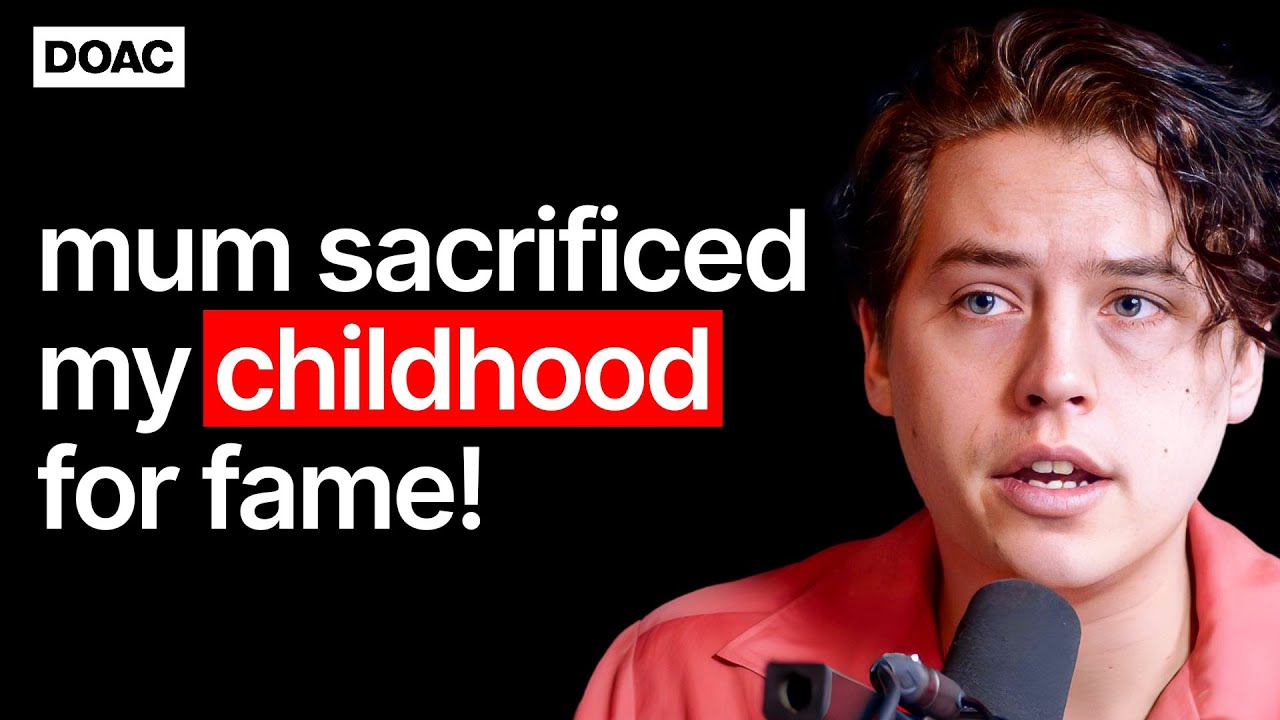
Full transcript · Read the full conversation in order, with its original context.
§01Transcript — part 1
No two companies are alike. That's why the American Express Corporate Program can help you customize rewards, reporting, and billing options, all designed for your business. Build your program with American Express at americanexpress.com/corporate. Terms apply.
Have you ever had a conversation like this one publicly?
No. I think it'll be fun.
Cole Sprouse. From Disney Channel's *The Suite Life of Zack and Cody*, *Riverdale*, *Big Daddy*, and *Friends*. Were you pushed into acting?
I would hardly call it pushing because I was eight months old. Single mom, two twin boys, put food on the table. So the choice never really existed.
My mother was living vicariously through the success of her children. A person that grapples with mental illness, drug abuse, but primarily narcissism—a wicked narcissism. But that selfishness is something that the legal system also observed and said that she was unfit. The court had to step in.
Your relationship with acting and the entertainment industry—it's been a journey.
I loved being on stage. I didn't like the things that came with it. This industry encourages the worst qualities of you: selfishness, greed. Authenticity and vulnerability are not really encouraged traits.
How do you feel about that?
You're given these lessons in your life so that you can triumph over them and use the traits that you've acquired over time to carve out who you are.
I've got two pictures here then. What are the words unsaid to this individual?
I'd probably kick his ass.
Cole, much of what I do here, especially at the start of these conversations, is I'm trying to understand somebody. I get to see the finish line, I get to see their achievements, the behaviors, their personality during my research. I'm always trying—this is ultimately why this podcast came to be. On one hand, in the name you hear *The Diary of a CEO*, and it was really me trying to show that there's this other side of these people, including myself, that we don't often talk about.
And on the other hand, just from a very personal perspective I've come to learn, I am so interested in human beings, why they do what they do, and what causes them to do what they do at the very core of it.
What do I need to know about you when we zoom back to your earliest years to understand the most influential things, moments, and influences that caused you to be the complex, inspiring individual you are today?
I'm really glad I'm doing this podcast with you at this time in my life because for the last year and a half, I've really been thinking about questions like this. What is it that still compels me into certain professional pursuits or artistic pursuits now?
I think when I was younger, it was definitely a financial pressure. There were kind of two kinds of kids: working kids, really. There were the kids that were doing it to put food on the table for mommy and daddy, and then like the "thespian" children.
"Mommy, I want to go into acting!" And they would show up, and it would be this huge gap between philosophies—between "Yeah man, it's a job" and "No, this is a craft, this is an art."
Those kids kind of showed up around 14. For me, I think I had trained a kind of workaholism since I was a child in order to, one, feel valued by my environment—both immediate family and audience in very many cases—that has stuck with me. A work ethic that has stuck with me now to this day. I do not feel good when I am not working.
I think a lot of people can say that. That's something I've been trying to unpack over the last year and a half: what would happen if I just simply stepped away for good and enjoyed my life, which is really the purpose of why we're all here?
Would I be content with sitting down and fishing, growing my own vegetables, and living sustainably? Or would I get so disenfranchised and bored that I would have to take back to the arts in some way or another? I think the pressure of my upbringing really compelled me to continue doing what I am today. I cannot live without the arts. I cannot live without performance or expression in some kind, because it's truly all I know and have known since I was eight months old.
Since you were eight months old? You hold the record for being the guest on this show that started working the earliest. Tell me more.
Well, to be fair, I don't know if we can call it work. I don't believe I keyed into consciousness until about ten years ago. When you're a baby, you have that kind of lantern consciousness where only whatever exists is only in your immediate purview. As you age and you start to become less present, you're like, "Wow, I'm an adult and I feel like shit all the time."
So I don't know about if I perceived it as work, but it certainly infused within me a kind of work ethic as I have aged. But yeah, it established a relationship with work.
It established a relationship with work?
It did. I mean, it started for me financially. Single mom, two twin boys, put food on the table. She was still able to be a mother while we could still pursue a sort of improvement of our lifestyle. In very many ways, she was living vicariously through the success of her children, but I think it certainly developed a relationship to professionalism much earlier than almost anyone else I know.
You used the word "pushed" earlier. Were you pushed into acting in your view?
Well, I would hardly call it pushing because I was eight months old. I don't even think I knew. I was on screen; I don't remember much of like the early diaper commercials and things like that. So the choice never really existed. I was there. That's it.
How do you feel about that?
I think gratefulness and ungratefulness can exist simultaneously. I am tremendously grateful for the financial stability I have acquired now as a 30-year-old and being able to say, "Yeah, I'm okay now."
I think in many ways I traded sort of the lantern consciousness of youth and sort of the carefree present-mindedness of youth for financial stability that I would come to appreciate as an older man. I don't regret too much. I don't.
I think if I were to sit here and talk about regretting my childhood within the industry, I think that would be silly. It toughened the hell out of both my brother and me, and many kids that go through that same thing. But I'm grateful for the financial stability of it.
I also am grateful to have done it in a time where you could get your Gladwell 10,000 hours in anonymously. If you did a crappy direct-to-DVD movie just for kicks—I'm looking at you if anyone knows this—if you did your crappy soccer movie, it would go to the back of Blockbuster and no one would see it.
Now with social media, there's no way that you can cut your teeth in silence anymore. Everyone sees your portfolio globally, and you're expected to put it on display. I feel quite afraid for young actors now who have to hone their craft over time but do it to a global audience. That sucks.
You've got a twin brother, 15 minutes older than you. As he always likes to help people, shove it in your face. Your parents—you mentioned a single mother. As I read through your story, I saw a ton of similarities between the way you described your relationship with your mother and the way that I often describe the relationship still to this day with my mother. Can you tell me about both your mother and your father and the journey you kind of went on? I know at five years old, roughly, they divorced.
I don't remember the exact timeline of the divorce, but I remember only having one memory of them being together when I was very, very young. From that point on, my father was in Switzerland and my mother was in LA. He would eventually move out to LA in order to try and repair the family.
But my mother was—still is—the kind of tortured artist type. She struggled with, in very many ways, her place in the world. I think she found a tremendous amount of self-identity through motherhood and tried to turn it into a profitable business at the same time.
For identical twin boys, going into acting is a sort of economic loophole through labor laws that can be incredibly profitable. So that's what she did. As I've thought about it, it seemed to me it made a lot of financial sense to her to put us into acting. It satisfied some sort of narcissism that she probably had in order to be recognized as this sort of artistic success. She was a wonderful painter, so she always wanted sort of artistic legitimacy and validation.
But as time went on, I think the entertainment industry just kind of broke her. This industry in very many ways encourages the worst qualities of you as a person: narcissism, selfishness, greed. A lot of these things that we have come to know as practically cardinal sins.
It's one of those things that encouraged a kind of selfishness that was directly opposed to the very fundamental idea of motherhood. As I grew older, in my case, the court had to step in and rend my brother and me towards our father, who's an incredible guy.
But that selfishness is something that the legal system also observed and said that she was unfit. I think as I've aged and I've looked back on a lot of the circumstances of that entire environment, I see a person that grapples with mental illness, drug abuse, but primarily narcissism—a wicked narcissism. The inability to perceive anything else outside your own perspective would probably be the biggest sickness I see.
That just doesn't work with being a mother. That just doesn't work with being in a family in general. When it rains, it rains on everyone's roof. That's how it goes. It takes a village, man. Selfishness that is encouraged very much, like I said, from the industry, just doesn't really work. It doesn't work for being a mother.
It's easy to look at that situation objectively and go, "Okay, just don't speak to them." But this is your mother.
Of course. Yeah, that's something I've dealt with a lot too.
That's my question: how have you tried to separate the two? There are so many people listening to this right now who have a member of their family that is a toxic influence in whatever way, and they struggle with this idea that "Because they're blood, I have to persist with the relationship, I have to tolerate it." Whereas if this was someone I just met on the street or in school, I would chop off the relationship straight away. How have you dealt with the duality of both it being blood but also unacceptable behavior?
It's a great question. I don't think you ever fully reconcile it. I think it's the difference between this kind of immortal, abstract connection to someone—this thing that we call love, this energy, not to sound too Californian—but this sort of immortal connection between a mother and a child, or a father and a son, or whatever it is.
How do you distinguish that from anyone else who you would immediately cut off? I think for me, I've recently arrived at the philosophy that almost everything is some sort of lesson that we must take. I think lessons like this, when it comes to parents, when it comes to people who are supposed to be these sort of immortal, almost god-like figures in your life—especially during your youth—that is the greatest lesson for your humanity that you can acquire.
The distinction between love and care, and abandonment and pain as you grow. I really wouldn't call myself a religious man, but I do believe that everyone is put here in your life to have these interactions with you for some kind of reason.
I think it's a lesson that you have to learn, and it's all in a way reflecting back and carving you into the person that you're supposed to be. I also think it tests your patience and your love. The people that really persist and continuously try and find the love after all the pain, consistently re-arrive to the care and the connection and the love, even though you've been deeply wounded by the ones who are supposed to be at your round table—those are the strongest individuals in my opinion.
If you can consistently come to the other side of that conversation and go, "I will still choose to care, I will still choose to love," that speaks a lot about you.
At some point, you have to put your love for yourself first. It's the old oxygen mask analogy. Your journey with your mother—you're very young, you don't really know what's going on, you're acting, you're doing these things. At some point in your adolescence or beyond, you figure out that this is not normal behavior. This is not acceptable behavior for a mother and a son. When was that?
I guess when social services came knocking is usually when it happens. I don't know. I would go over to my father's house because the court gave primary custody to my mother. This is one thing—I don't know too much about the UK legal system in this regard, but the United States legal system is incredibly biased towards the mother in cases of divorce and custody. In this case, it certainly should have been my father taking custody.
This is obviously a case-by-case basis, but we'd spend some time with my father like once a week and we wouldn't be able to eat candy and do whatever the fuck we wanted. He would make us go and exercise and play outside, and there was a regimen—there was a healthy regimen. We weren't allowed to do whatever the fuck we wanted.
I think at that point I was going, when you're a child, you go, "Man, this is no fun!" But as you sort of pan out for a moment, you go, "Wow, I'm actually feeling a lot better here. I'm present here, I'm happy here," even though I don't get to eat ice cream all the time.
Social services don't get called for eating ice cream.
No, no, they don't. I won't go too much into that because I don't want to make this whole podcast about another young man in LA with mommy issues. But I do think that the circumstances of my childhood are much like the sort of cliché narrative that you hear a lot about child stars.
I don't talk about it too much because I don't ever want to be perceived as a victim of it. I am not, and have never been, and never will be a victim of any circumstance that I am in. I don't wear victimhood on my shoulder. I don't like to act like I am my wounds and to repeatedly be reminded of my wounds.
What happened in my youth happened and carved me and forged me into the person I am today.
For better and for worse, right?
For better. For purely better, even through pain. We trade trauma for wisdom. That's what we do as humans. When we go through heavy experiences, it deepens our eyes. I think for me, the reason I haven't really talked about it too much in the past is because, one, the media has a way of sensationalizing scars and victimhood like this is a person's character—and in very many ways, it is.
But they don't talk about the strength that is the byproduct of pain. They talk about the pain, which is useless. All it does is perpetuate the past, or a pain that existed in the past, rather than going, "My God, look how well he's done for himself even though he's had such a tough upbringing."
Oprah is another wonderful example of this, where her story, her origin tale so to speak, is very well known. Look at what a beautiful example of success she's become over time. That to me is the most beautiful way that I think media can sensationalize a story of pain, but I find that it's often times not.
I also feel like we're in a climate right now that really encourages people to talk about the victimization of pain more than they do about the triumph over it, the strength that comes as a byproduct of that pain. And so that's mainly why I don't talk about it too much because I don't want to be that guy. I don't want to be that guy that's like, "Owie!" all the time. No, man. You're given these lessons in your life so that you can triumph over them and use the traits that you've acquired from those lessons over time to carve out who you are.
One of the things I've pondered from speaking to people on this podcast is about this idea that that trauma you describe—if it ever goes away?
Should it? Ask yourself that.
It's a good question.
It probably, I have to say, it probably shouldn't because, as you asserted earlier, it's a lesson that you learned so that you could deal with your environment or circumstance. Just like the lesson I learned of not putting my hand into a fire—I'm not going to unlearn that at 30. There's no therapy that could help me unlearn that.
Yeah, of course. And unfortunately—I'm speaking for myself here, I don't know about you—but I'm a dumbass that needs to learn by his own mistakes. I mean, I can watch my father go, "Hey man, you need to drink water at this watering hole," but I can't—you can't drag me there and make me drink. I have to make mistakes in order to learn from my mistakes. A lot of my friends are very similar. But I don't think those lessons should ever go away.
Like I said about my validation thing sticking around with me—what's stuck around with you?
The workaholism has definitely stuck with me. I need validation. A lot. I think that's a pretty common thing for most artists just to have. But I am the byproduct of moments of incredible narcissism and moments of severe self-loathing. And right in the middle is when I do my best work.
A lot of that operation and the fluctuation between those two things is determined by people going, "God damn, you're good."
What if they say—what if they invalidate you? What if they say, "God damn, you suck"?
I spiral. Of course. But I don't let it hang on me. I try not to let it hang on me.
What does a spiral look like?
"Man, maybe I should just run away and not do this and, you know, get some chickens and raise some eggs and live off the grid" and whatever it is. It also manifests as the inability to sort of say your desires out loud for fear of looking like a fool. I think LA does that too, because I think vulnerability is just something that we don't really encourage here in Los Angeles.
Why is that?
Because it's not cool. But it's not cool to Angelenos because someone that is cool hasn't said it like that before. You know what I'm saying? It's a lot of imposter syndrome in Los Angeles. And so, authenticity and vulnerability are not really encouraged traits.
Before you arrived, I was saying to my team, I watch all these interviews with people like yourself from LA that are stars, actors, and I go, "No one's ever asked them an interesting question, it seems." Genuinely, that's what I was saying before you walked in. Because Lucy Hale was the same. She goes, "This is the first time I've had a deep conversation." And I'm like, "Why?" And then I mimicked what interviewers are like here. It's like, "Hey, where'd you get your shoes?" And then you're like, "So can you speak to your twin in your mind?"
Yeah, of course. Who the fuck wants to talk about that?
Do people actually—
Yeah, because it's safe. It's a safe thing. This is why I love the podcast space, because the podcast space creates nuance and context. It gives you the whole context right there, which is something that a lot of people in interview settings or otherwise are completely devoid of. When you're selling a publication, when you're selling an interview with someone on paper, you don't really get the context. "Oh, well the context was it was pouring rain outside and you arrived to the studio and you got to sit down and have a tête-à-tête and we talked about having similar birthdays and we talked about Botswana beforehand." You get the context, you get the connection, which I think is gorgeous.
I think it also creates a really beautiful way to discover the honest humanity and opinion of people, because entertainment media is sensational. We're only going to sell the worst person in the world and the best person in the world. We're not going to sell the human in between. Most of us fit within a sort of gray morality that doesn't really—we're not all these outliers that are like these really firm, radical people that are saying these radicalized things in order to preach to the sensationalism of the internet. Most of us have these kind of moderate places that we sit. So I think the podcast space is fucking awesome for that, man. You really get to sit and connect to people and have a conversation, and for people that are interested, they listen. It's great.
Your journey with your relationship with acting and the entertainment industry—it's been a journey.
Oh, for sure, man.
Can you give me kind of like a timeline of that journey and how you've felt through the process with your relationship with acting?
Absolutely. Started at eight months old. Diaper commercials, things like that. Did commercials. Worked on a sitcom for a bit; still wasn't really fully conscious. We were still doing the baby acting thing. Did a sitcom called *Grace Under Fire*, a couple of other little TV spots here and there—identical twins switching places, blah blah blah. Then we booked *Big Daddy* with Adam Sandler when we were around six, and that was like the big thing at the time.
This point about the use of twins in acting—some people might not understand the context. Could you explain for those—
Children can only work a certain amount of hours, which is a very strange thing to say out loud. In the button factory, in the coal mines, we can only work for two hours a day! No, but we can only work for a certain amount of hours, and so if you have two twins that look identical to each other that people can't perceive as anything other than the same character, you double the amount of hours you can work. Which is an incredible economic loophole for a lot of young actors.
Like hitting the jackpot as a mother.
Yeah, of course. It was great. Work the system, baby. But the problem is when you start at least from that philosophy and you go into an art—we've commodified almost all of the arts that exist—but when you enter into a form of expression in a professionalized work dynamic, it's hard to see that as a pursuit of passion.
So my journey through acting over time has been one of trying to balance art and commerce in a way—one for the money, two for the show sort of thing—where I need to be reminded consistently to myself that I love this thing. Making my money, becoming financially stable, getting financially stable, taking jobs that aren't paying as much but doing cool projects and making yourself feel more in love with the discipline.
I think this is a particular approach that has to come from a certain socioeconomic background. If you are—this "nepo baby" conversation has been huge out here in LA, I don't know how big it's been out in the UK—but if you come from a financially stable background, and you can see it with any actor that has a really stellar resume where you're like, "God, you've picked great movie after great movie after great movie, you've been a part of all these really cool projects"—well, they probably had a lot of financial stability because those projects pay you fucking nothing.
Right? So if you have the sort of patron that is allowing your freedom of expression to take these artistic projects and reinvigorate this passion for you even in the face of commodification of an expression, then you can have a really stellar career. But if you also have to make money alongside it, you're probably not going to take the super cool jobs. You gotta sell drinkable yogurt for a little bit in order to go to college. This is the balance between art and commerce that a lot of people don't understand. In almost every other art—at least in photography, this is a great example—no one looks at someone doing a commercial gig and then going back to the editorial world and going, "Why would they do that commercial gig? That's so strange." But in acting, they do. There's a huge division between those two people.
*Big Daddy*. That's where we left off, wasn't it?
Yes, *Big Daddy*. So got *Big Daddy* at six. Adam was just incredible. We shot that movie for far longer than it needed to be shot in New York City. My first time going to New York, and then that was a whirlwind.
Were you cognizant at this point of your feelings with acting, your relationship with the industry?
No, I was super present. Which is good, which is what I think we're all trying to get back to—that sort of lantern consciousness of youth in terms of acting, this state of play. Because no one should go into acting and be like, "I'm going to act!" That's painful.
But I was still very present at the time. And then *Big Daddy* came out, and alongside it came this whirlwind of opinion and conversation and fame and all this sort of stuff, which was very polarizing. But it would lead me into—I worked on a couple of other direct-to-DVD movies at the time for some cash money.
And then did *Friends*. I was a recurring role on *Friends*. And then Dylan and I would end up booking *The Suite Life* on Disney, which of course was another huge lifesaver.
And your relationship with acting at this point is what?
Very commercial.
Are you enjoying it?
Not really. Because now it had become a thing that was taking me away from playing in the cul-de-sac with the friends. I loved school—like, I loved going to school, I loved playing with my friends and all that sort of thing. So at the time I couldn't see it as anything other than that. But that's what a child does.
And then we did *The Suite Life*. And then I actually really didn't mind not going to school. So we were homeschooled from *The Suite Life* onwards, and then every conversation—because I kept a lot of my super close friends—when we got to high school age, all of my friends would tell me these stories from American public high school that were just like, "God damn, you lived through that shit? I don't want to be part of that at all! This sounds horrible." And so then I was quite thankful to not be doing that. Then I went to college.
You picked up photography around this time?
I did, around 18. I actually went to London, and the first time I went to London I said, "I should get myself a camera and document my brother and I's little journey through London."
I found a really curious quote that you said about the reason why you chose photography—relating to it allowed you to escape your depression.
Yeah. Yeah, I think a lot of people have sort of discussed that one quote. I think I was certainly—I had gone through a huge breakup after college, right at the end of college, and picked my camera up again. And put a lot of my emotional state into just shooting.
Hobbyism, which is a real wonderful thing to do when you are feeling sad. Pick up a hobby, dive into hobbyism. And so I pushed myself into a lot of that, and in very many ways it allowed time to pass more quickly and for me to heal more effectively.
But I also did it because I wanted to express my vision in very many ways. When you're an actor, you are the byproduct of the writing, the direction, and the editing. And a lot of people assume you have much more creative agency over a project than you do, but I don't find that to be the case when you're a commercial employee actor. When you are working on commercial projects, in very many ways they are controlling the image of you that people are seeing. They control the takes, and you're as bound to the project as the writing is good or bad, and the directors are changing week to week. So it's a difficult relationship to expression and self-identity. I think at the time I was really looking for a way to tell people, "Hey, this is what I can do if I'm given creative freedom." I think I've achieved that.
No, your work is amazing. As I was saying to you, I wasn't just blowing smoke up your ass. I went on your website and thought, "Ooh, we're moving into a new house, me and my girlfriend, this would be brilliant as we come out the elevator."
Oh, well, I'll just send you some. Some of the newer work. I hate anything I do after two weeks, so I'll send you some of the newer stuff.
Textbook creative. When's the moment in your life where you both loved and then the moment you hated acting the most?
I came back to it. I was at a real fork in the road and I made a promise to someone that I would return to acting, but I never anticipated I would. And I was reminded that I love performance, which is—I love to perform in front of people. And I love the present-mindedness of a performance, like when you wake up at the end of the take and you go, "Man, I barely remember what I was even doing right there, I just felt that."
I love that. I love performing for the crew. I loved being on stage. I didn't like the shit that came with it. Because when I was young, acting was like the grilled chicken of the dish; it was the biggest part of the course. And the side salad was like the red carpet stuff and whatever the fuck it is. Now that social media has made it so that the whole thing's just a grilled chicken salad now—the salad is almost a bigger part of your success than the act of performance. I think in very many ways your celebrity profile has become far too intermingled into your work as a professional, and all of us within the industry are recoiling and trying to figure out a way to deal with that.
I have to be honest, I had a good laugh at your other Instagram account.
Camera Duels. Yeah, that's polarized a lot of people.
But at the same time, I thought, I understand—I read about your sort of social anxiety that came along with the fame, and then I heard you'd created this Instagram account of taking pictures of people taking pictures of you covertly without asking permission. And then I thought to myself, "This is a great idea, but it's going to encourage it."
Yeah, of course it did. It totally did. Which I don't mind as much that it encourages people, because all it's done is further reinforce why I've done it. Which is like, hey, people are not going to care about anything other than bragging about a place they've been or a person they've seen.
How do you feel about that?
I don't mind it because all of us kind of just do it. We're taught to do that sort of thing. But I don't know if I'd necessarily make those people my friends.
How does it feel to be on the receiving end of it every day?
I understand it.
Did you always?
Yeah, actually I did.
Did you ever struggle with it?
Of course I struggled with it, for sure. Well, I think, look man, we're always searching for a much deeper emotional connection to another human being. It would—I would much rather have someone be like, like this podcast is a great example: "Tell me about what it was like growing up in your position." And if anyone ever asked me that, I would be an open book. You truly could come up to me and ask me any question on the street and I would probably hold a tête-à-tête with you. But people want to show other people—but don't. Please don't. Don't do that!
But I think people want to show what they're up to right now, and that's totally fine and natural. Well, I don't know if it's natural, but we're conditioned to do that. But I think whether it's you're doing it ironically or authentically or you're truly excited or you admire someone or you want to just prove to other people—I think most people have to understand that there is probably a greater connection to be made that exists. There's a choice that you make when you're asking for a very surface-level, shallow interaction with someone, and that the alternative does exist where you could probably deepen your relationship to an individual that you've wanted to talk to.
So I don't really mind when people do it. It just means that person's not going to be a cool connection to me personally. I'm not going to remember that connection in my life when I'm telling stories and things. Whereas, I did a movie called *Five Feet Apart*, which dealt a lot with cystic fibrosis, and I've had a lot of people who live with cystic fibrosis come up to me and talk to me about cystic fibrosis and that film. Those are connections, in my opinion, that have lasted with me. I'll remember almost every single conversation I've had with something like that because it's not a "Yo, let's take a pic"; it is "Hey man, I want to let you know that I go through something that you were trying to portray in this and it affected me like this." It's a discussion that enriches both people.
And even if you don't like the individual—let's say you see someone that you really don't like the work of or you don't like the persona of—going up and asking them a question is probably going to yield so much more to you than the alternative. But we want to show everything on Instagram and social media and TikTok and whatever it is because we want—we're all creatures of validation. We want to see the likes and the whatever the fuck it is. And I've done it too, I'm not saying I haven't done it. I've taken a picture, or tried to take a picture, of John C. Reilly, who I really admire. There's a lot of people that I deeply admire, but if I were given the choice between asking them a compelling question and taking a photo, I would probably choose the compelling question for sure.
That social anxiety—few really know what that's like. People without fame will often experience social anxiety for their own reasons as well, but when you say social anxiety, can you give me a picture of what that feels like in reality?
Paint an image of it.
You're very good at painting images with your words, by the way. It's very enjoyable to listen to.
My social anxiety feels a lot like sitting in a sauna when it's just a bit too hot, like the sauna right before you have to get out. You know what I mean? It's like this warm sort of blanketing feeling, but it's not warm; it's fucking hot. It's a blanket over me for sure. And it is—for me, anxiety's really present. Even though I'm thinking about future possibility or past actions that I have made, it is a consistent "I'm living in this, I'm living in this, I'm living in this." And so in that way it's almost blanketed over me.
And what I'll do for that anxiety is I will activate my five senses: What do I see? What do I smell? What can I hear? Can I taste anything? What do I feel on my skin? And it immediately grounds me in the present. These things are grounding mechanisms that I really enjoy when I start to feel social anxiety.
Have you learned that somewhere?
Yeah, I think I did. I went to therapy—I've gone to therapy off and on my whole life—but he was a wonderful man up in Vancouver that taught me the sort of grounding techniques. And he's right. I mean, it doesn't—it can be a therapist, it can be a father figure, it can be anyone that teaches you. Essentially, the root of it is: be present, ground yourself in the present. It's an Eastern philosophy, it's all the Eastern philosophers and the Buddhists were trying to tell you to do this shit the whole time. Meditate, ground yourself in the present. Grounding yourself in the present is the greatest enemy of anxiety.
What other tools have you learned from therapy? I feel like I can learn a lot from you without having to pay the therapist.
Well, that's flattering. I try not to talk too much about mental health just in general because everyone has an incredibly personal relationship to it. And I feel like there's a lot of armchair experts on the internet right now acting like—or diagnosing people or doing stuff like that, which I find incredibly—that is so atrocious. I can't believe people even do that.
And I think the conversation around mental health, unless it's being done by truly a trained professional, is probably not the greatest thing to listen to. So with that disclaimer, I will say: whenever I am feeling heightened emotionally, I will take a break from whatever I am doing. I will truly walk away from whatever I am doing. I will tell, if it is an argument with someone, I will go, "Hey, right now I'm feeling some heightened emotion. If you don't mind, let's pick up this conversation in about 20 minutes."
Give yourself time. I try to approach everything with a kind of logos that allows me to think more clearly and calmly about what I do, which can be off-putting to some people because not a lot of people like being met with logos when they are heightened emotionally, or being met with solutions when they are just trying to vent. It's one of the first things you learn when you're in a serious relationship, especially as a guy. For sure, because a lot of us are solution-based people. But I'll take a break. That's honestly the most helpful thing I've done. I've also tried to remind myself of grounding myself in the senses, or I will remind myself that, one, you're not the only person that's ever gone through anxiety or will ever go through anxiety, and two, the problem as you perceive it—the vastness of the problem as you perceive it—is not the way other people perceive it.
What about your relationship with boundaries? The very first story you told about being eight months old—at eight months old, you don't have boundaries. So they are obviously easily exploited. As you grow older, sometimes when those boundaries weren't firm when they were young and you were maybe people-pleasing or you were seeking validation, that can have a sort of cascading effect into adulthood. What's your relationship been like with saying no and protecting boundaries, whether it's professionally, personally, in relationships?
Well, that's a great question and one I'm far more qualified to answer now than I was even two years ago, three years ago. I can honest-to-god say that I did not love myself enough as a younger man, especially my mid-to-late 20s. For sure did not love myself enough, did not respect my own boundaries.
What did that look like?
That looked like rolling over in the face of a lot of adversity, especially when it came to romantic relationships. I was a people-pleaser. I was a people-pleaser professionally, I was a people-pleaser romantically. I was practically a fucking nurse to whoever needed my help in very many ways—likely as a byproduct of my upbringing. But what that meant was oftentimes crossing my own boundaries as an attempt to make others feel better.
And as I've gotten older, I've become more okay with turning people off, which is all right. You're going to polarize individuals. You are going to get along with certain people and not get along with other people. That's totally okay. And I think as I've aged, I've tried to remind myself, "Yeah, that was an awkward interaction, that was a bad interaction with someone," but you're going to have those, man. That's okay. Move on.
And as I've loved myself now—and thankfully I'm in a relationship right now with a woman who's so emotionally understanding and just the best—it helps when others can be like, "Yeah, dude," encourage you in the right direction and be like, "It's okay." Because I will—I know myself—I will fall back on "Are you all right? Is everything okay?" like trying to control a situation through making sure everyone is happy. But it's not a fucking video game. You can't get like the best solution where everyone is okay. Sometimes you're going to really have to polarize some people, and that's all right.
My only boundaries I would say when it comes to my professional career or otherwise—I really don't like condescension. So like, if I feel condescension in any sort of way, if I see other people being condescending to others, if I can sense a kind of pretentiousness or condescension, that's usually something that will either take me to leave the room or confront another person about it and be like, "Hey, why'd you do that?"
What has that relationship you described—what has love taught you about yourself?
Oh, so much, man. I've had the pleasure of being in love three times. Three big relationships in my life, three girlfriends in my life. I mean, my first one when I was like a kid, but that was just kind of puppy love stuff. And then I had one in college, and then I dated a co-star on *Riverdale*, and now I'm in love again.
Every time it has been pretty distinct. I think maybe the first two—college and my last girlfriend—were far more similar because of me, because I was still approaching it the same way. And then I did a lot of self-work and I fell in love again, thankfully.
And it has taught me a lot. Like I mentioned, I was a people-pleaser. I was deathly afraid of being perceived as anything other than perfect for a long time. And so I would roll over quite a bit in order to make sure that as long as they were happy, that's what love is—this sort of consistent happiness. And I was also actively suppressing my emotions and like not really discussing what I actually felt about a situation because I was afraid of retaliation in very many ways. I was afraid.
Where did that come from?
Oh, I mean, certainly my youth. I think growing up and building an entire life and business model off of the validation of other people certainly made me open to it. But I also think the first relationship I ever had with a female figure—which is the mother figure in everyone's life—was an incredibly tenuous and fractured relationship with a tortured individual, which made me go, "I can fix things! Don't worry, I got it. No, you're all good, it's okay." And I brought that in. I brought that in a lot.
Were you trying to make her happy?
Oh, of course. Yeah, I think so. When I was younger especially, but even now as an adult.
Even now? You don't speak to your mother anymore?
I don't, I don't. But she put me on this path. And there was once a woman who was very clear-headed and who had a beautiful vision of the kind of people my brother and I could be. In very many ways, I honor the dream she once had so that if she were lucid enough and came back and saw what I had become, she would go, "Man, I was right." And in that way, it would validate the entire life of pain and trauma that she has gone through.
Are you sad about where your relationship is with her?
Of course. Everyone is. Everyone is sad about something that could—I mean, unless you're a sociopath. When something beautiful and lovely goes rotten, it can be a very sad thing. And it does make me sad, but it's also life. And that's the lesson that I've had to learn from it: that sadness is okay. It means I'm human. It means I loved something outside of myself in a way that was so beautiful and so boundless that it makes me feel one of the strongest and most eternal of human emotions, which is sadness—like, real sadness. And that's okay.
Does part of you like hold out—and this is kind of speaking from my experience as well—does part of you kind of hold out for things to just get better?
No, I don't think that anymore.
What about the opposite? You seemed more compelled by the opposite outcome—get completely wrong.
I mean, I'm sure you've reconciled this as well, but there's a part of you that goes, "Oh, what if this is my last communication with an individual?" Of course you have. How would that make me feel as a consequence thereof?
How would it make you feel if this was—you never got to speak to your mother again?
You know, and going back to the previous question, I tried for very, very many years to try and do everything I could. But at some point or another, it comes down to the individual, which is the hardest part. Like you want someone to change or do something, and this also goes to romance, this goes to friendships, this goes to blood, to whatever it is. You can really yearn for someone to do the right thing and the hardest part is even if you set up the entire environment for them to do so, unless they choose it for themselves, it's just not going to happen.
And so I used to blame myself quite a bit for not just my relationship to blood, but I used to blame myself for all of the relationships in my life going wrong until I realized that in almost every relationship it takes two to tango: friendships, romance, blood. The other person has to be a participant in the dance just as much as you are participating in the dance in order for the outcome to be the one that you guys both desire.
When you say that you used to blame yourself for relationships in your life going wrong, does that mean that you originally blamed yourself for the relationship with either your mother or father, or the relationship between you and your mother going wrong?
I did, because unfortunately as a consequence of being a working child, you're forced into an authority position when you're quite small. Right? Which is: now you're the breadwinner of the family over the adults. So in very many ways, you take this very strange role of authority and positioning when it comes to the subsistence of a nuclear family, which is not a role a child should be put in. So when it does go wrong, as a natural byproduct of the authority that you feel as a consequence of your professional life, you can adopt some of the blame on yourself—which I will say I do not do anymore.
It should be said that the working child—a child that has worked since they were eight months old—you have to understand that is a—not to sound like a fucking special snowflake—as an identical twin, which is the greatest contradiction. But that is a life, an upbringing that is very, very, very, very rare. There's only a handful of people that have that really weird path through the world. Most of them are in the United States, and most of them, you know, the sensationalism of their upbringing is talked about all over. So that comes with a lot of bullshit.
And it affects—to tie us all back, I'm getting us back!—it affects how you navigate everything in your life: your relationships—which is what we were talking about—friendships, blood, all that stuff. And my relationships were deeply affected by my upbringing, of course. My friendships were affected by my upbringing. My relationship to my family was affected by my upbringing. But at some point or another, you have to go, "Yeah, I'm on the right path," and even if it's not, I'll try and make it the right path and I'll grow from it.
What makes you alive then? Like what brings—what brings your heart alive these days?
Passionate conversation. For sure. Without a doubt.
How many of them have you had?
Lots.
Publicly?
Not publicly. No. In fact, I've only done one other podcast. And these kind of public conversations are quite rare, which is why I love this medium so much. But I've thankfully I've surrounded myself with individuals that are capable of all having these conversations and for really diving into what it is that makes us all feel alive.
And I think truthfully, I think seekers of this kind of conversation find each other. It's weird. They really do. And you can see it in others' eyes. Like you can see people that love this shit in their eyes. And so I've thankfully—I mean, I host dinner parties and stuff and try and get as many people together to have these sort of conversations. And it can be a little bit awkward for the first five minutes like, "Oh, what are we talking about?" But that's incredibly enriching to me.
Okay, so you've just—you've just teed this up so perfectly. Everything you've just described—the type of person that likes deep conversations is very much the type of people that listen to *The Diary of a CEO*. And we have a closing tradition on this podcast where guests write a question in the diary for the next guest. They never get to see who they're writing it for.
So because we know that the type of person that listens to this is, by clear linkage—terrible use of words—the type of person that likes deep conversations, we wanted to take all of the questions out of this diary that have ever been written into them and allow people to play at dinner parties *The Diary of a CEO*, which is: they can ask their friends deep conversations that have been written into this book. You also get to see who wrote the question for the first time. I want to play with you right now.
Yeah, please. Ask me some questions.
I took some cards out—there's about 100 cards in total, but I took the ones that I thought were the biggest stitch-up.
Oh man, that's a great idea! I love that.
So what I'm going to do, I will also answer one. But I'm going to lay them out here. You pick one that you want to answer, whichever one feels right for you, and then I'll pick one as well and I'll answer it. We'll go through all of them, so we'll pick one at a time.
Okay, I'll pick one. You answer that one. (Cole picks a card). This is by Tim Grover. This is: "What is your dark side?"
I think the dark side of myself is definitely the narcissistic side of myself that can come out when I am feeling super proud of something that I do. And I will oftentimes try to humble that. It'll get me seeking decadence, it'll get me seeking external stimulation from my environment and yearning for that, which is, you know, what every Stoic philosopher would be like, "Dude, shut up." And I really relate to that. I think my worst side is the side that is seeking validation from other people rather than understanding and placing myself in my environment and going, "Wow, I'm so privileged to have what I have and where I'm at." I believe that's a nice thought. Yeah.
What a beautiful answer. Okay, mine is from Will Storr, who is an expert on the topic of status and wrote a book about it, which is kind of about the validation and wanting to be famous, etc. "Who is the person you'd most like to say sorry to but haven't?"
Oh, stitch-up! I told you! I picked these questions to stitch you up, but I decided to answer them when I laid them out. So mine would actually be my mother. Because she didn't get an education. So I've often framed her in my story as being, I don't know, like she's been the center point of difficult moments in my life, but she is also—like the 95% of my story with her is just this woman that absolutely took care of me, absolutely loves me, and my whole life—her whole life is me.
And you know, growing up she did everything for us. She raised us five days a week. She can't read or write herself growing up. She raised these four kids that I think are all pretty good, decent kids. So I'd say I'd probably say sorry to her for not spending enough time in conversation talking about her brilliance and the fact that I am the reason—she is the reason I'm an entrepreneur.
Great answer, man. Great answer. Okay. (Cole picks another card). Rochelle Humes. "If you could turn back the clock on one day this year and do it differently, what day would it be and why?"
That's difficult. I try not to live doing that too much where I feel like I need to change something. But—so I am sober. I've been sober for about a year and some change, and it's been a wonderful thing in my life. But I have thankfully had the self-awareness to apologize to some people in my life in the past, in a similar way that the card that you just pulled.
And in order to protect another person's feelings, I did not tell them that I was going to be apologizing to an individual. Because I was afraid of the consequences of that face-to-face meeting. I know this is a little confusing. But if I could turn back and do it differently, I would be so transparent about that meeting over coffee to the affected individuals in order to be like, "Hey, I'm letting you know this is happening, I know that this is blah blah blah, but I just want to let you know with full transparency this is what it is."
Got you. So I'm clear—you apologized to someone and there was a repercussion of that apology which you wish you'd kind of foreseen and addressed?
Yeah. Exactly right. Because sometimes meeting with other people makes others uncomfortable. Like there—especially as you grow older, some people are like, "Why'd you meet with that individual?" But I think for me I would have just been super, super transparent about it and been like, "Hey, this is happening, blah blah blah." And that's been a consequence of the work I've done as I've cleaned my life up. So I look back on that one day and I go, "Hey man, the work you did should have told you that you could have been fully transparent with that even if it made other people uncomfortable." And I probably would have done that differently. But otherwise, I really try not to think like that.
Because they're lessons, right?
Because they're all lessons. Because I made that mistake for a reason. And now I'll never do it again. And the fact that I even said that as an answer means I've already learned my lesson.
You'd rather the lesson was in the past.
Yeah, of course. Of course, and not in the future at some point. So place you're at. Okay, here we go. (Steven picks a card). "Tell me something about yourself that nobody knows and would be surprised to know about you." Fucking hell! Let's hear about your internet history, bro! Marisa Peer.
So I had a guest on this podcast called Steve Peters, who's just this incredible like psychiatric therapist, etc. After he left, I contacted him and spoke to him about something—I was dealing with this predicament in my mind and I was bouncing between two outcomes, and it's the first time in my entire life—and I've spoken to so many therapists—that I've ever spoken to a therapist privately to try and resolve something.
And I say that because—I say that for one reason honestly, which is I've spent so many on this podcast talking to therapists, including Marisa Peer who wrote this question, but I've never spoken about the fact that I too have spoken to a therapist about personal challenges that I've faced. And Marisa Peer is just one of the best ever, and so is Professor Steve Peters.
§02Transcript — part 2
Do you feel embarrassed to talk about it?
I think I did. I think I always have. I think it's funny because this is therapy for me. Me too. And I lay it all out, you know? *The Diary of a CEO* started as like my therapy. It was like me writing things in this diary then sharing with them—with the world. But I, despite my guests telling me about the profundity of speaking to someone else as you have today, as you did in Canada I believe, I've never done it myself until that moment where I spoke to Steve and said, "This is what I'm dealing with, like how do I navigate through this?" and it's incredible.
I think it is, because you can't—your brain can't think yourself out of the fucking—no, I also think a good therapist is like, you know, your first house—like it arrives to you precisely when it's supposed to. Because ultimately what we're all seeking, at least in therapy with the help of a trained professional, is a human connection. We all want our *Good Will Hunting*. We want to sit down and have someone who has a deeply enticing personal connection to you and goes, "I hear you, man. I hear you, you're okay. Like have you thought about it this way?" And so I do find a lot of these kind of conversations can be inching close to that.
And in that way, I'll say I do think there are a ton of different forms of therapy: of self-soothing, of methods. I find a tremendous therapy by going into the wilderness, for example. Amen! I find that a really healthy thing for me to do—to sort of disconnect and leave and go into the woods and do all that sort of stuff. But I also think the other stuff is super valuable too, and I don't think there's any shame in talking about it. I think that's great.
I've thought about it so many times in my life—there's been so many moments in my life, I think like ten, where I've seriously considered like, "I need to go speak to someone else about this because I can't figure this out myself." I remember like maybe two, three years ago I was—there was some like business challenge I was facing and it was just like keeping me up all night. And I remember going on the internet, contacting someone and being like, "Can I speak to you about this?" And it's because I'm looking for a trained professional like that can coach me through my thought processes.
What you've described is so interesting to me because you said two things: the first thing you said is therapy in essence is like a pursuit of connection with someone, and then the second thing you said is about how nature is therapy. These are all things that humans knew very well in our natural life 10,000 years ago.
Oh man, look, I studied archaeology. You don't gotta tell me that we've become more disenfranchised over time because I know that shit.
Isn't that funny that therapy is just being more human?
Oh, I also think, look, we just want to be heard, man. We look for soul. We all look for soul in other people. We want to know that soul exists. We want to justify our soul by looking for soul in other people, and when you find people with soul, you want to hang on to people with soul. That's what we do. And I think when you're baring your soul—especially in a sort of therapy environment—you want someone to pick it up and go, "God, I see this thing, man. Yeah, I see it. I did something like this."
For me, it took me a while finding a therapist that was willing to be hands-on. There's this sort of hands-off approach to a lot of mental health work, just in general, and I just can't do that, man. I need someone like in a sort of similar way to this—two people sitting down and going, "God, man, yeah, for sure."
If therapy is therefore connection, then the thing that drives us to therapy must be disconnection—a feeling of disconnection. Whether in that disconnection could be anything: disconnection from nature, from people, from life, from purpose, whatever.
Yeah. It's—you become afraid of your own soul being too disconnected from everything around you, or that you feel so entirely alone or unique that no one else really understands you. So when you go into therapy as an example and someone goes, "Yeah, dude, I hear you." But then if the fucking alarm rings and they go, "Your hour's up. Okay, thanks." That to me—that's disconnection! Because then it feels like a monetary exchange. I'm like, "I don't want that."
Okay, last one. (Cole picks a card). Fern Cotton. "How could you be more authentically you?"
How could I be more authentically you? I mean, I think stuff more like this. I gotta be less afraid of people going, "Wow, he said what?" I just don't care anymore. I'm 30. I lived a lot of that anxiety shit in my 20s. And I truly believe that your 20s are meant to be a petri dish for mistakes that you're supposed to learn lessons from and go into your 30s and be better at. And I don't know, I think I am practicing authenticity in a way.
But I think it's complicated because I don't know if a life in entertainment people actually seek authenticity. Which is something I'm dealing with, and I think for acting, it's also a real dilemma because the more you show an authentic version of yourself, the harder it can be for people to suspend that and see you as a character. Which is something I'm sort of sitting down and having a conversation with myself about. But I'm not going to control what other people think, and I think I am practicing authenticity in very many ways. How could I be more authentically me? Standing my ground, set my boundaries, recognizing my own bottom-line behaviors before I stumble into that shit.
Have you ever felt the cost of inauthenticity? What is the cost in your view? The personal toll.
Exposure. If you're exposed to be a fraudster? Yeah, if you're exposed to be a sort of snake-oil salesman, that can be quite embarrassing. Inauthenticity can also get you into a place where you actually don't have the skill set to perform whatever you're trying to perform. But I also think inauthenticity or feelings of inauthenticity are a natural part of courage. You're going to doubt yourself a little bit before you go into anything. And I always find my most effective means of surviving anything is just kind of being thrown into the fire and being like, "Alright, I'm here. What are we doing? Let's go!"
Alright, here we go. Fucking another stitch-up. (Steven picks a card). James Watt. "What is the belief that you hold that most people disagree with you on?" So many, in fact!
That's great, man. That's good.
The first one I'm going to say is—what's the thing that most people disagree with me on? Trying to decide between—I'm going to say the point about manifestation. I think this is super controversial because anything that gives centers people on a sense of personal responsibility is typically not well received. People don't love the concept of personal responsibility. Obviously, there's lots of nuance to this, but I would say that the way that society and culture and Instagram have described the process of manifestation is largely bullshit.
And I think that manifestation—the example I always give is getting in the car and setting the satnav is of course important, because if I just drove without direction, I would be lost. But if I don't drive, I'm also just sat in my garage with a satnav set all day. I don't think you can just manifest yourself your way there in life. I think luck plays a huge role, circumstance plays a huge role—where you live. If I were still in Botswana, there's not going to be a *Diary of a CEO* interviewing you today, right? If my mom hadn't met my dad—so there's circumstance, there's luck, there is will, there is hard work, there is trauma, there's conviction, and then there is also an importance to know the direction you're going in. But I think manifestation as an idea is oversold because it makes life easy and comfortable, and it also obfuscates us of the responsibility of work and personal responsibility.
I agree. I think it's absurd to pursue comfort in anything you do. Absurd. I think at some point or another, when your hands are on the wheel in this car with the satnav, you're going to have to fucking drive. And if the satnav goes out—mhm, okay man, you're still behind the wheel driving a fucking vehicle. You also have to really strongly believe in yourself. Because there's a lot of things that people love gatekeeping shit. It's crazy. Everyone loves it, especially on the internet; they love gatekeeping. It's like the first thing you're going to interact with when you jump into something new. People are going to go, "Not that guy. Why weren't you doing this?" or "Don't do that. Don't talk about that. Don't do this." People love gatekeeping, which is so funny because the idea that we have to be like these incredibly specialized needle-fine kind of people is ridiculous. Try everything, go into it boldly, but you gotta believe in your success and you have to take accountability.
Have you struggled with that idea of being labeled as something? Because there's people listening to this now who are like a lawyer, or they are a whatever, right? And they want—they have this passion for something else—it could be photography like you—but they're a lawyer. Their bio says lawyer, their LinkedIn says lawyer, and the resistance—the social resistance but also the psychological resistance—that that label is creating keeps them confined in a way that is not fulfilling or conducive with a happier life. So breaking out of those labels—when you're a star from such a young age, you get your label super early. Cole, you are an actor.
In very many ways, a child star is what I'm called quite often. Which, okay. But dude, I mean, look, anyone that doesn't think outside of terms of labels is just useless to me. I gotta be real. Like anyone that cannot find a deeper humanity in whatever kind of person they're sitting across the table from is probably a pretty useless person to talk to in my opinion. I think labels can be difficult and also helpful in very many ways. Let's say you're a lawyer—yeah man, make that money on that label. Sure, make that money on that label. And then surround yourself with the people that don't see you as "This is my lawyer friend." Because you don't need that many people. You need a round table of people that are going to be like, "Yeah, that's cool. Cool. Wow, what a Renaissance human that guy is." That's what you really want people to say: "Oh man, what a good person that person is."
The label thing can be difficult, but I think it's useless to think like that. I think anyone that goes, "Wow, you know, this anything outside of human is silly." And I know this sounds a bit woo-woo and pretentious because it does—it'd be like, "Don't label me! Oh!" But I think it's true. I don't think thinking in terms of labeling is useful in the slightest. In the slightest. And I would like to think at the end of all of our lives we've surrounded ourselves with a rich enough body of experience to go, "Yeah, man, I tried blacksmithing for a period of time. Yeah, dude, I crafted a little necklace. I was a silversmith for about a year and tried that shit out and it went really well."
And I think people are going to try and gatekeep you, but I think what I mean is that you're always going to have to fight against some sort of label regardless of what it is. And if there's a bouncer at the door gatekeeping you from getting inside the club, I guarantee you that there's a fucking side entrance. Guarantee it. And you gotta fight your way to get there, man. I'm a firm believer in that, and you have to also recognize the kind of restrictions that are being put on you, but I think you always got to fight for yourself. If you don't fight for yourself, legitimately no one else is going to.
Earlier on you said something to me—you said, have I ever hypothetically played out the scenario that that person in my life, my mother, might not be here? Reflecting upon that being the last conversation I'd had with her, how would I feel? I've got two pictures here. What are the words unsaid to this individual?
That's my father. And that could be my brother or myself, I have no idea. What are the words that are not said to that individual? You were at the exact place that you were supposed to be. For sure. My father was 27 when he had two identical twin boys. That's big. I'm 30. I can't imagine having two identical twins. Sorry to expose you, Papa, but he immediately got a vasectomy right after he found out he was having two twins. I just find that hilarious; that's my favorite story about him.
He was in Italy at the time. I'd say, "Man, what is your hair routine? It's looking great." He looks like a stud in that photo. Dude, he's—this is a stud photo! Yeah, for sure. Good job, Pop. You're at the exact place you need to be right when you are supposed to be there, and whatever happens in the following years are all the lessons that you need to take for the future of your life. But every step of the way you've been exactly where you're supposed to be. For sure.
The words unsaid to this person? (Showing Cole a picture of himself as a child).
It's funny, I was thinking about writing that in this journal: what would you say to your childhood self? This kid—this is me on the left, Dylan on the right. I wouldn't want to condition this kid at all. I see a kid that's like so present in this moment. And I've had this dilemma because I have some step-siblings, and I find myself wanting to ask them like, "Hey, you been thinking about college? Hey, like what are you thinking about in the future?"
I think I'd probably just talk to this kid about like hippos or platypus or something. Some fun shit, Pokemon, whatever it was. I don't think it's wise to put the future or past tense thinking of an adult onto a child. And I think it's your responsibility as an adult who loves a child to encourage that lantern consciousness and that present-mindedness for as long as you can and as far as you can. And anything that takes them away from that present-mindedness should be the enemy of your life and that child's life.
Isn't that what happened to you?
Yeah, it is. It is. And that was the perfect lesson I needed to know for my eventual children.
What about Dylan?
My brother and I have made it this far and have been as okay as we have become because we did not feel lonely. We always had each other as a frame of reference to grow up in and alongside. And I think I'm incredibly privileged for that, and he is too. We thankfully got to go through everything we went through alongside each other. And I think that's built him into the exact kind of person he's supposed to be, and me as well. And I really am living my life now in a place where I don't look back with regrets or anger or or pain or anything like that. So I don't know, I'd probably kick his ass, honestly, if I'm thinking about it now. I'd probably smile at myself and then beat the hell out of Dylan. And I'd have reach advantage and stuff; it would be great. Just throw him by his legs like Bowser.
We have a closing tradition on this podcast where the last guest asks a question for the next guest. The question that's been left for you: "You have one last piece of work to do. What is that piece of work and why?"
If I had children, make sure that they were okay. Try and make sure—ensure—that whatever I could do is my last action would create more easiness for them. Because life is going to roll over you regardless of how easy you've had it. I would try to have one last thing said or done that helped them in the future.
You went straight to children.
Yeah. And if I was a grandfather, I would take all of my cash and convert it into some sort of gold doubloon and I would bury that shit—I'm not telling you where!—but I would send them on the greatest treasure hunt ever. I mean, really give them one thing that they said, "God, Grandpa Cole was insane, but what a story he gave us." Goonie style. I want to be the guy that like sends his grandkids on like—"Ah, Grandpa Cole was just insane, man. But man, he was a wacky guy. We found the treasure!" I wouldn't make it too hard, you know, but I'd want them to go someplace.
Sounds like a great movie's plot.
Yeah, maybe. Maybe they'll write it, who knows? Grandfather Cole. Work is interesting, though. That's a really interesting question, because I hope I'm not working. I don't hope I see it as work. You don't see photography as work? No. I don't see acting—the stuff I feel really passionate about—as work either.
Have you ever had a conversation like this one publicly?
No. I think it'll be fun.
Cole, thank you. A huge honor. Tremendously valuable for me, more than I could probably tell you. But meeting people like you that have gone through unique life experiences and are able to look back introspectively and sort of historically and depict that in such a self-aware, honest, vulnerable way is the very reason I started doing this and the very reason I continue to do it. So I thank you because it's a real—I feel like you've—I feel like I owe you something for—and this is how I always feel—for all of the lessons I now for the rest of my life get to go on with from your journey. And as a fan of yours now, both your art and your photography—I guess they're the same thing, your art—I'm going to follow—I'm going to continue to follow you with a renewed perspective on your humility, your talent, and your humanity.
Well, thank you. And by the way, every conversation like this we trade just as much. For anyone that's empathetic, which you seem to be, you trade just as much. This is the beauty: you and I were both August 1992, from very different backgrounds, and yet we can still sit around a round table and go, "Man, I know the feelings of what you've gone through, even though you and I are very different people." And I think that's the beauty of it. That's the beauty of that connection I've been talking about. I think empathy is the currency of all this stuff, and you've asked some really wonderful questions and I'm glad that I was able to answer in a way that hopefully brought out something. But thank you again, thank you for having me. That was really wonderful.
Thank you.
At Emory University, we believe in those with the ambition to achieve, the passion to learn, and the optimism to see the possibilities ahead. Founded on the belief that the wise heart seeks knowledge, an Emory education combines experiential learning in Atlanta and beyond with unrivaled collaboration and discovery, all to prepare you for a world that needs your leadership. Learn more at emory.edu.
When your cat is acting weird-er, or your dog is being loud-er, your turtle moves slow-er... Hello, Ted! Your cat seems thirst-er... Whoa, slow down, buddy! Or your puppy is acting clums-er... Day or night, if you don't know what's wrong, know where to go. VEG ER for pets. VEG, the better, kinder ER for pets.