
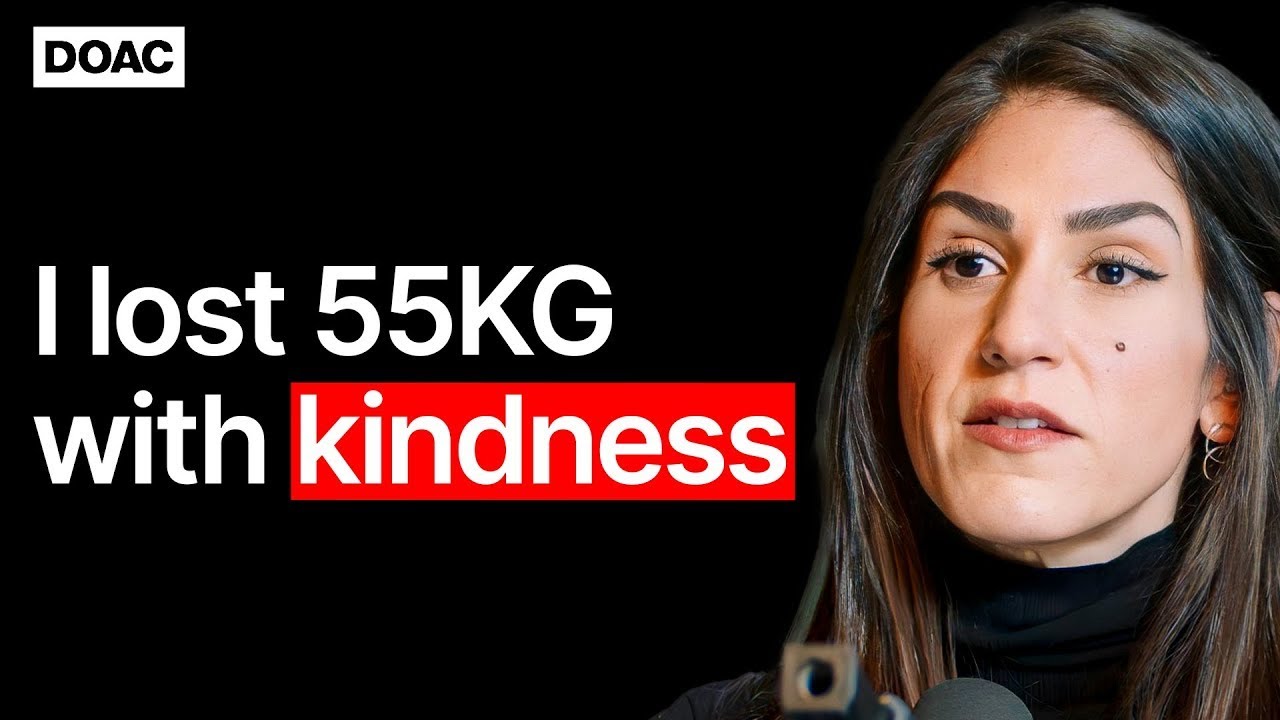
Behaviour Change Scientist: How I Lost 120lbs With Kindness: Shahroo Izadi
Guests: Shahroo Izadi
Full transcript · Read the full conversation in order, with its original context.
Contents1 chapter
§01Transcript — part 1§01Transcript — part 1
This message is brought to you by Apple Card. It's a great time to apply for an Apple Card. You'll enjoy earning unlimited daily cash on every purchase. That includes 3% daily cash when you buy the latest iPhone, AirPods, or Apple Watch from Apple. Through this special referral offer, when you get a new Apple Card, you can earn bonus daily cash. To qualify, you must apply at apple.co/getdailycash. Apple Card is issued by Goldman Sachs Bank USA, Salt Lake City Branch. Offer may not be available elsewhere. Terms and limitations apply.
Imposter syndrome. How does one move past it? Sit back. Shahroo Izadi. She is an expert in breaking bad habits and beating addiction. Women's Health magazine has called her Britain's answer to Brené Brown, and she's also an author, including the number one bestseller, *The Kindness Method*.
I am determined to have binge eating and powerlessness and lack of trust that people have as a direct result of weight loss diets to die with my generation. I started dieting from a really young age, and I was using food as a drug. When I got to my heaviest, I was like, "That's it, I'm done."
How heavy?
126 kilos. It eventually culminated in secretly getting a gastric band fitted. I started working in addiction treatment and I started realizing that I was going about this the wrong way. I wasn't meant to be making my body smaller; I was meant to understand why I didn't like myself enough to take the same advice I'd give someone else.
That's where people feel super disempowered because they're not taking the advice they'd give another person. I think people feel patronized because what they needed was understanding why, if I have all this information and I want to do this, I'm not doing it. What I always tell them is...
Shahroo, can you tell me what your academic professional bio might say?
Yeah, I did an undergrad in psychosocial sciences in Norwich and then a postgrad in psychology. Then I went on to work for the NHS. I did a one-year placement as an assistant psychologist in substance misuse in Northwest London. During that time, I was trained in all sorts of different evidence-based approaches that are used to help people change really ingrained behaviors, mainly around opiate and alcohol addiction.
Now, what about your personal context? Take me below the age of—you know, I'm a big believer on this show that that origin story in our childhoods really shapes who we become. Tell me about that.
Well, I was born here in North London. My parents are from Iran and they came after the revolution or during the revolution. My first language was Farsi, so I learned how to speak English later. Then I moved to the States for my dad's work for a little bit and ended up coming back. During that time, I started to struggle with trauma responses to things and I started stammering to the extent that I found it really hard to speak at all at school.
Then we came back to the UK and I started going to school here. I didn't have a great time. I was really overweight, and kids weren't super nice to me about it. Then I started dieting from a really young age because, of course, that's what doctors were recommending at the time. I started to have a really mean relationship with myself. Everything from the way I spoke to myself to what I thought I deserved, to how un-boundaried I was, to behaviors of really, really low self-esteem.
I had a lot of really shameful behaviors: a lot of codependency, a lot of anxiety, and controlling stuff. I just didn't have the best time at school, to be honest. I didn't like myself at all—like, really didn't. Now that I work with people who don't like themselves, I can say with confidence that, sadly, I was on the more extreme end of things. I developed what I now realize was a binge eating disorder.
I was using food as a drug, essentially. I didn't know that at the time. I was just eating and eating loads. It eventually culminated in me secretly getting a gastric band fitted, which gave me all sorts of other issues—lying to people, lying to my friends about it, feeling ashamed like it was an easy way out. Then I had to have it removed by emergency surgery and it was terrifying.
When I think now about the lengths that I went to, and weirdly the fact that I never thought to change my relationship with food—I always just thought if I was smaller, the world was telling me if you're smaller, everything will sort itself out. So that was the angle I was going in for. Plus, I seemed to think that getting smaller would teach me how to change behaviors, which kind of does a disservice to the whole science of behavioral change anyway.
Then I went to work in addiction treatment. Long story short, when I went to uni, I made the same friends I have now. I started working in addiction treatment and I started realizing that I was going about this the wrong way. I was going about this completely the wrong way. I wasn't meant to be making my body smaller; I was meant to understand why I didn't like myself enough to take the same advice I'd give someone else.
Or I didn't like myself enough to think I was worthy of liking food. I didn't trust myself. I felt powerless. These were the fundamental things I should have been dealing with. So I went to therapy and I started getting onboard with the fact that I didn't need fixing, and then my habits started changing really, really quickly, and I was like, "Wow."
You said a second ago you had to figure out why you didn't like yourself. Why didn't you like yourself? Did you ever figure that out?
Yeah, using the tools that I hand over to people now. It isn't a plug; that was the whole thing. The reason I personally didn't learn to like myself—and this will be different for each person—but my value was wrapped up in how I looked and my size. So if the scales weren't making me happy, then I wasn't having a good day.
As a result, I wasn't treating myself well in ways that may seem unrelated to other people. But I'd got into my head that unless you look like this, you don't deserve—it's almost silly for you to do the things that people who like themselves do: acts of self-care, even taking pride in my appearance. All kindness was conditional on me looking a certain way.
Why? Like, where had that come from?
All sorts. We can start with the fact that, you know, if you're a kid in the 90s and you're being bullied for being fat, then you go to the GP and they were going to put you on a diet. With the best of intentions, that was happening. Second of all, I think the generation particularly of women before me—I think weight loss dieting's got a lot to answer for in that sense. The "this is your goal weight and this is how you'll look and then reward yourself with a new wardrobe because then you'll deserve it" mentality.
So it was a time. That's what was going on. It isn't just that it was my own stuff. Sometimes people will say, "What was it deeper than that?" and I just think women especially at that time, that's all you got. That's all you were shown anyway. Successful women, women who made money, women who were in relationships with people of value—they were shown to you as a particular type of woman. And I never looked like that.
So I just never saw that people like me did stuff like that. And then the worst bit was, some of it would have been really useful to me, frankly. Like, "I'm not going to exercise until I'm thin." I'm not going to drink water, I'm not going to take care of myself, I'm not going to engage in the habits that would actually make it easier for me. So I speak to people now who are the same, who have sort of learned to put kindness towards themselves—they made it conditional on achieving a goal.
But they're making it harder to get there because the goal will be achieved more quickly if you take your life off hold. And I learned this—I write about this in the first book. I went to counseling and I was really, really low. This was maybe in 2010 or something like that. My north star my whole life had been like, "One day you'll be slimmer and you'll be someone who does exercise and you'll be someone who stands up straight and does their hair." And then you can do all the stuff.
You can start enjoying the stuff. Because at this point, I was so wrapped up in not liking myself that I wasn't even listening to a piece of music that I liked because I'd be like, "No, no, no, hold on, wait. My day is coming." Or even if I caught myself having a nice time, like on holiday or something, I'd look down and catch a glimpse of myself and think, "Oh no, actually, you'd be having a much better time if you'd actually sorted this out."
What I didn't realize is that none of those things had anything to do with how I looked. I just picked up this idea along the way that I didn't deserve those things because I didn't see people who looked like me being allowed to feel sexy and being allowed to feel all this stuff. I just didn't see it. And so then I had a session with my therapist and she said something—she was like, "What if you never change?" And I was so angry, I can't begin to tell you.
And I'm not a particularly angry person, but I was really angry with her. Because I thought, well, if I don't change, then I never start living. I never start being nice to myself. What if that day never comes? So I came out, I started thinking about it, I sort of entertained it, and long story short, I spent a couple of weeks acting like "If I don't change, I'm never going to change." And I just started doing the stuff that I was putting on hold, and then everything changed.
What changed?
Well, what I needed to address were things like boundaries, binge eating, having no impulse control, putting a space between trigger and response. This was what was holding me back from the results I wanted both mentally and physically, right? So what needed to change is that I needed to do the sorts of things and engage in the sorts of habits that enabled me to put that friction in place, to put a space between trigger and response.
And it turns out, if you start from a place of feeling like shit and depriving yourself of all the stuff that makes you feel calm and positive, it's considerably harder to impose that space and to calmly decide which version of yourself you want to behave from. So as such, I was depriving myself of a real asset that could have helped me to do things in a row until they get easier. Which ultimately is how I see all behavioral change.
We're all trying to make people do things in a row until they're easier. My way about it is just saying that if you're nicer to yourself and you have the same conversation with yourself in that space, and you do the things that make that space calm and positive and feel mature in the way of self-care and self-soothing and self-compassion and affirmation, then you can take it choice by choice in the direction of it becoming easier until you really do update the fact—this assumption that you can't do it.
And this leads on to *The Kindness Method*, which was the first book you wrote, very much inspired by your own experience with weight loss and struggles there. You work with people that want to change. Many of them I'm sure are successful in that change, some are unsuccessful. If you were to try and identify why some people are unsuccessful in their change, what are the overarching themes?
Oh, sit back! So I've got—one of them is focusing on the outcome. Thinking that your long-term desired outcome is going to be compelling enough on the spot to get you where you want to be. So you start from a place of desperation—"This is it, this has got to change. I want the health, I want the outcome, I want the progression." And then you forget that that isn't going to be enough. Your motivation will waver, your plans will not go to plan.
And you're going to need to have a conversation with yourself when your plans don't go to plan that talks you into making a decision you'll be proud you made the next day. So I think one, people wildly underestimate how much it's about zooming in and getting involved in and excited about demonstrating your capacity in a row, as opposed to hoping that remedying some negatives long-term will be exciting enough to keep you on track long enough to make that habit automatic.
The other thing that people do wrong, I think, is focus on what's wrong with them as opposed to their assets. And they don't have that "locked and loaded" for that moment where they doubt themselves, they want to throw in the towel, and think, "I can't do this." They need to be ready to have to really debate with that with genuine evidence to the contrary in the spirit of wanting to update it more generally, not just in the context of that habit. Taking life off hold.
So all those things I said now, everything you're going to reward yourself with—really look at it and ask yourself, "If I started doing it now, would it put me in a better position to do difficult things?" which is ultimately what behavioral change is—simple but not easy. The other thing people do is—of course, you've had Gabor Maté on here—they focus on what's wrong with the behavior that they're engaging in as opposed to how it's serving them.
They look at it as a problem as opposed to a solution. And not only does that take away the component of compassion and understanding that's required when they're stuck thinking, "Why am I finding this so hard? I have no willpower, I must be stupid," or whatever it is, it also deprives you of understanding whether there's a problem that still needs solving when you take that away. And with compassion, and sometimes people find themselves filling that gap with another solution as opposed to doing it in a way that says, "You know what, this behavior is doing a job for me."
So if I'm not changing, something's going on, and that needs some curious, compassionate inquiry. That definitely. I think the other thing is that this whole "tough love," the way you speak to yourself thing—people think that tough love when you're speaking to yourself often isn't very smart love.
So if, let's say for example, you came to me and you're like, "Shahroo, I'm trying to stay on track with this plan and I've just fallen off track," and my task was to get you back on track believing in yourself as quickly as possible and equipping you to carry on—ultimately making myself redundant to you—I wouldn't say to you, "Come on, you shouldn't be finding this so hard. This should be easier. This is just like your teacher told you when you were little. You're just the sort of person who starts things and doesn't finish them. And then you should start on Monday."
You know? That's not smart. And that's where people feel super disempowered because they're not taking the advice they'd give another person. That's the important bit here. That's the self-esteem bit. We don't have a problem in knowing how to change habits, and people don't have a problem in knowing what habits they want to change and how they would benefit them. And now, thanks to many of the books behind you, we don't have a problem understanding exactly how habit change works.
I think people feel patronized because what they needed was understanding why, if I have all this information and I'm smart and I want to do this, I'm not doing it. And instead of beating themselves up about it, to delve into the story. How did I come to be this way? With compassion. How cool is it that this isn't my fault but I've decided to make it my responsibility? How can I use behavioral change as a Trojan horse?
And the discomfort I have to sit in that's unavoidable—short term, urges, cravings—to listen in on the way that I speak to myself and work out whether these predictable alerts from my body are turning into commands that I'm obeying. I just think these are check-ins we should do. And I wanted to give people something so that they didn't feel like they had to wait until things got really bad, and also so it was a private process.
That's what *The Kindness Method* became. It was basically everything useful I wish I'd had, everything useful I saw in addiction. And then when I went on to train addiction staff, which was my next job after that and working in criminal justice, just everything useful I saw with the most challenging, resistant client—myself included. Bear in mind I started using this stuff and iterating using it on myself, using it in different ways.
And I put it in the book step-by-step just in case there were people like me who wanted to change habits on their own terms, kind of checking in with the program that they're running. Where did it come from? Who's it from? Do I want to switch it up? Do I want to update it? Some of it fake news. I think habit change is a great Trojan horse for listening in on the way you speak to yourself and debating with it until it's updated. And I'm really surprised that we don't do that in life.
If I've got a really stubborn story that I tell myself—really stubborn—you know, something traumatic that happened to me under the age of, I don't know, 10, and it's created a story, a narrative in my mind that is just—has control of the wheel, is driving my life, my decisions, and is driving the self-talk in my head that's utterly negative. You must encounter people who have that, that just can't shake it. Is that possible that there are some things that we just can't—that just have too much power over us? They've changed the circuitry in our brain to an extent that we can't change?
I don't think people like me should say yes or no to things when they don't know who they're talking to with the size of the platform that you have, to be honest with you. Of course there are traumas that I can't speak to. I mean, I worked in addiction, with young people in addiction. I wouldn't have the audacity to sit here and say, "Yeah, just—" and that's actually what really pisses me off about Instagram sometimes.
I'll see something and it'll be like, "Oh, just replace a negative thought with a positive one." And it's like, "Oh wow, are you a wizard? You should be on the news." But I think one thing I will say is I have been really pleasantly surprised by what happens when you appeal to people's need for evidence. Disprove it. The stuff we tell ourselves a lot of the time, it's not true. Or it hasn't been true for a long time. That's compelling.
People think they can disprove it by looking in the mirror and saying, "That's not true. You're—I love you and you're amazing and you're fantastic and you're going to be so successful." Does that work?
Helps.
Does it?
For some people, yeah. Affirmations help. Yeah, of course. I think with all this stuff, it's got to be a combination of things. I think people just have to be given the permission to not be judged to strip this harmless stuff down, you know, and do it in a combination of ways that makes them feel good. You want to do a couple of affirmations for a while, fine. Then you go off it and you want to do something else, whatever, fine.
I just feel like we have to hold it lightly and stop calling it remedial. You're just checking in with yourself. But no, I think listen, I was a pretty extreme case. And for me it was a case of saying, "Right, when you write down—" it's one of the exercises in the first book, in both books actually—"When you start writing down like what are the things I say to myself when I fall off track," a lot of people realize that they don't even use that vocabulary in their day-to-day life. That's not theirs. And that makes it compelling to change it too.
What is it that people tend to say when they fall off? What did you say when you fell off?
Me? Oh, all of it. Like, "Of course I'm not going to be able to do it. I'm weak-willed. Some people can do it. That was just a fluke anyway that I had a bit of a streak. People like me don't get things like that." Mainly "I'm weak, I'm stupid, I must hate myself." Because bear in mind, always people are giving you these like legit reasons why you should do other stuff, and you're going the other way and telling you that you're harming yourself. And you know that you are. You know? "I'm powerless, I'm weak, I can't trust myself." All of it. And then thinking up extreme ways to sort it out.
They do that because they love you though, right? Like that's the paradox, is they're doing that to try and help you. They're saying, "You're doing something wrong, you're—"
Well no, actually, if you think about it, like when you tell someone you—when someone you love is struggling to get back on track, you don't pretend that what they're trying to do is simple. And you don't tell them to throw in the towel. You remind them of their capacity to do something difficult. You remind them of the times they've done difficult things in the past, and you support them. Plus you give them perspective. This is what I mean about the smart thinking too.
You don't go, "Oh well, that one blip, that's—you just got to spiral, this is a terrible catastrophe." You say, "Well, just get back on track." And you know, back in the day, like the first thousand times I had this conversation about self-talk, I used to always use the example in groups and stuff—like, think of someone you love. Write down what you'd say to someone you love. Write their name in the middle of the page.
If they'd fallen off track and you were tasked with getting them back on track and through the discomfort involved in achieving their most meaningful long-term goal, so their behaviors and their values are aligning. And people would write like, "You can do this, you're amazing, what can I do for you? It's just a blip, you can learn from it, think of all the other amazing things you've done." And then I would get them to cross that person's name out and write their own name. In the spirit of starting to say, "Look, this is by your own admission, these are the things that you would tell someone you love."
Then over time I realized, if I gave someone 100 grand to motivate someone who's fallen off track, they're not going to say, "Oh, it's because you're weak and you're rubbish. There's no point starting until Monday. You might as well, you know, destruct this whole thing for now. You might as well throw the whole plan out just because of one tiny blip because you weren't perfect." It's not just kind; it's just not good advice. Yeah, I'm just not here for the tough love.
There's this word we use a lot in society at the moment, which is imposter syndrome. It's a really interesting concept. I mean, the word itself, the phrase itself is kind of loaded with a series of assumptions that I don't think are necessarily helpful, but you must in your practice deal with a lot of people that are showing signs of what we know as imposter syndrome. What's your—what's your take on it, and really like how does one—how does one move past it?
Well, this is a very new—this is a hot take, because it's through an observation. The way that I come up with things is I spend as many hours as I can speaking to people, human beings, one after the other, as many human beings as I can in different contexts and seeing how they are using these tools and what's working for them and what isn't. And for imposter syndrome—essentially not being able to internalize your accomplishments, feeling like a fraud—which I've had.
Managing my binge eating and my anxiety differently helped me change my imposter syndrome for the better. And I'm seeing why that is now. I've just started work—well, now that I'm so passionate about binge eating as a result of weight loss diets being a thing that goes with my generation. What I've noticed is that when people give themselves permission to find whatever they find difficult, difficult—whatever it is, even if it's objectively far more simple than all the things they're managing to do every day—something extraordinary happens.
And that tends to have a really extraordinary impact because usually with the people I work with, because I'm talking about like booze and other drugs and food and stuff, there's a lot of shame and guilt associated with it. So that extra bit—we all find it difficult to acknowledge, a lot of us find it difficult to say "I was great at this" and that's the end of the sentence without any caveats. "And it could have been..."
When it comes to acknowledging, say our professional accomplishments or academic accomplishments, the people I work with a lot of the time feel so ashamed and guilty about this thing that still eludes them that that's the bit. They'll be like, "Yeah, I got a pay rise but I still haven't sorted this out and people don't know how I behave when no one's watching." And like that bit, that's what drags people down. It doesn't let them really internalize and process their capacity.
Because for example, I've written two books. That's cool. They've done well. Writing books was not hard for me. Doing this—this is a, you know, being able to not stammer while I speak to you because I had the confidence to sit and breathe before I came in here rather than look at notes. Or only binge eaters will understand this, but being able to start a binge and then bring it back as opposed to just starve myself for weeks or whatever I was doing before, is a power and a trust in myself and an ability to close the gap between what I would tell other people to do and what I do.
And a sense of integrity when no one's watching that seeps into every area of my life. But the trick was to allow myself to find something incredibly difficult that other people thought was a no-brainer and not think that that meant I was stupid or weak.
Taxes was waiting on the refund you needed yesterday.
Alright, your car repairs are going to run about three grand.
Now Taxes is getting back on the road with TurboTax and Credit Karma, where you can get your refund up to five days faster and get personalized guidance to take every dollar further. Now this is Taxes. Intuit Credit Karma with TurboTax. Deposit of federal refund into a Credit Karma Money account and early submission of refund data by IRS required. Terms apply. Banking services provided by MVB Bank Inc., member FDIC. Credit Karma is not a bank.
When you fly Emirates on business, you can relax from the start. You get a complimentary chauffeur-driven transfer from your door to the airport. Then when you land, your chauffeur will be ready to take you wherever you want to go. It's exclusive for Emirates First and Business Class travelers. And with world-class service in the Emirates Lounge and exceptional comfort onboard, it's just a better way to do business. Book now on emirates.com.
But just that's the way things have gone for me.
I remember sitting with Marisa Peer, and she said that she's never had a patient—whether they were a sports star or a, you know, successful millionaire or whatever—that believed they were enough in terms of her patients. So the people that had come to her struggling with something, at the root of it is that they didn't believe they were enough in some capacity. Do you agree with that?
I think—yes. I think self-worth. Self-worth is something that comes up a lot.
And if I come to you and, you know, it's clear that I have—my self-worth is in the proverbial bin. I just think I'm a, you know, useless, worthless, don't deserve anything. What's the start of that process to get me to a better place? Like, what do you do with me?
So if you came to me, it wouldn't be just the problem wouldn't be "I have low self-worth." It would be "I want to change this behavior," right?
Yeah, and I want to change it. I've been, you know, drinking too much alcohol, smoking too much of that, sniffing too much of this. Where would you start with me?
Well, we would get an honest baseline of where you're at now. So that's why in the book, we do like a snapshot letter, without judgment, totally private. To just say like—I think a lot of the time we create plans for who we want to be as opposed to who we are. And we use this stuff to find ourselves. And I think first of all, you meet yourself and you get onboard with who you meet.
And then I would help you to understand why you've come to be this way.
So in that first step, getting to understand who I am and getting onboard with who I meet—that's through a snapshot letter?
Yeah. So it's essentially saying, "Here we are today. This is where I'm at. This is where I've got to. This is where I'm starting." Usually it's quite a "fed up" letter, like "Something's got to change, here we go." But what it does is it sort of anchors the process and says, "Right, this is where we begin." And then what we start moving onto is the fact that you already know what to do.
I believe that the people who buy my books already know what to do. And I believe that a lot of people feel really patronized when they're told what to do. They know what to do. And if they don't, they can Google it. They don't know why they're not doing it despite wanting to do it. So then we start thinking about closing the gap between the advice you'd give another person. So I just say to people, "What would you like to be doing?" I don't give them an A or a B.
I would like to be running a marathon every couple of months. I'd like to be fit, I'd like to be skinny, I'd like to be a good partner. I want to be perfect.
Okay. Why are we having this conversation?
Because I'm not. I'm drinking so much alcohol, sniffing so many things, and doing all the naughty things I shouldn't be doing, and I can't stop myself. But I know you're right; I do know what I should be doing. I just can't do it.
Okay. And in the past when you've created plans to change, what have they looked like?
I've basically thrown all of the alcohol out of my house and everything that I could possibly sniff, and I have emptied the fridge and put only vegetables in. And I have written it down on a piece of paper. And then a week later, I'm back to all of the naughty habits.
So what you've done is you've punished yourself. You've put things in place to say, "This has got bad. I need to create this environment and control and isolate so that I don't do the bad thing." Did you establish what you're afraid you might have to experience if you change? Did you identify if you get there, what if it's not as good as you think? If you get there, will you have to do all the things that you tell people you're going to do when you get there? Is the process of getting there one that you're familiar with?
No. All of that. What do you think you're going to have to get through? What are you going to have to prove? What triggers are you going to have to respond to differently? These are the things people don't talk about. What self-doubt are you going to have to push against and disprove and update along the way? It's not about thinking you're going to be able to focus on what's bad. And also, you should anticipate that in a week's time you're going to want to use. You should put things in place.
What can I put in place to—this is what I found really compelling in your book, the—because it's something I think about a lot. You know, we think of motivation as being this constant. People ask stupid questions like, "How do you stay motivated all the time?" which is again an assumption that people that are successful in whatever facet of their life are able to always feel a sense of motivation. But how does one prepare for that dip, that speed bump, the regression, the relapse?
It's—I think the best bet you have is the conversation you have with yourself when your plans don't go to plan. And I think first of all, you prepare by—yeah, you can have the best plans in the world, but you should assume that your plans will not go to plan. And even with the best tools in the world, you should assume that you're not able to preempt every single trigger, every single challenge. The way that you do it is you start to reframe challenge as an opportunity to voluntarily demonstrate your capacity.
You're like, "Here we go. I am off-grid right now. And all I've got is the advice I'd give another person and the conversation I have with myself that's going to turn into what I do with my hands, or don't do." And I think that if you really focus on making that conversation one that holds firmness and compassion together, then that's the best thing you've got. Because what you're chasing there is to feel smart and calm and proud of yourself.
And you already know what you'd tell someone else. So the more you do that, and the more you take that advice and you see the results obviously—and it actually works—the more you start doing it in other areas of your life. And my job is to make myself redundant to people as quickly as possible. I think we should have been taught this at school. We have to change habits our whole lives. Why is life dragging us along and making us change them when we're all depleted and desperate?
So yeah, I would say it's the conversation you have with yourself. And the conversation you have with yourself, very often people say to me like, "How can I hold kindness and firmness at the same time?" right? So "How can I change habits, which involve sitting in discomfort and cravings and urges, and still be kind to myself? Because being kind to myself means doing whatever I want whenever I want to do it."
And what I always tell them is it's kind of like if you—let's say you have a kid and you read an article somewhere and realized that this treat you've been giving your kid at 11:00 AM every day for the last year is actually not very—it's really unhealthy. So as of tomorrow, you're not going to give the kid the treat. You know you're not going to give the kid the treat. The kid doesn't know you yet. Kid wakes up tomorrow, it's 11:00, you're not going to give them the treat. What's the kid going to do?
Want the treat. And cry. Kick off, yeah.
Would you blame the kid for crying?
No.
You'd expect the kid to cry. It's used to something. You wouldn't make its life miserable. You'd make it as comfortable as possible and you'd just repeat that in a row until it realizes that it's come out unscathed. Compassion: "I know why you feel this way. Of course you feel this way. You deserve to feel this way. You scream all you want, babe. That doesn't mean I'm going to do what you want." That's the conversation you have with your body over and over again where you hold compassion and firmness together until you've done it in a row until it's easy. That's my angle.
And does it help to remove the—you know, the kid wants the candy or whatever the thing the kid was expecting in the morning. Does it help to remove it from the environment? So if it's, you know, I've struggled sometimes with like—I had this like sweetie drawer in my house at one point. And I knew I didn't want to eat the sweets. But when something would happen, maybe it'd be late at night, I feel a bit hungry, maybe a bit stressed, I'd end up in the drawer. And so I always wondered to myself, would it just help to just remove the drawer? Just like pour it in the bin. I ultimately did. But I'm just wondering if those cues, those triggers, removing them completely is the answer.
I have this question all the time about abstinence and sobriety and whether—you know, again, there are some people for whom it's easier. My approach is very much more for the general population. And so a lot of the time it's more, you know, we all sit in the middle and I want you to feel like you can have chocolate in your house and consume it and enjoy it and not feel powerless over it. So at the core of my message is: you decide what you do with your hands.
And any negotiation you have internally about it is a jumping-off point and doesn't actually make you do anything. And is an insight into what you're telling yourself about the sugar and what it means and how you'll feel if you don't have it. If you were trying to build up a streak, get some time under your belt, yeah maybe. But ultimately, what I would recommend under those circumstances—impose some friction. Give yourself some speed bumps to start thinking about whether you actually want to do it.
So for example, if I want to—if I'm working into the night writing, which I love doing, invariably at like 1:00 AM I start thinking about Deliveroo. And about 3:00 AM I regret it strongly. So with that in mind, I don't just delete Deliveroo. Card details are out, addresses out. It's not because I don't trust myself. It's because I want to put in moments where I think, "Ah, remember you didn't want to do this? Do you remember why you didn't want to do this?" Make it harder for myself to do the thing that I don't want to be doing and easier for myself to do the thing that I do.
Like back in the day when I used to hate exercise, I used to go to sleep in my gym kit so there was just one less thing to do. So that's like removing friction versus adding it. Exactly. So I would, if I were you, I'd impose friction first. Like put that drawer somewhere else. And then when you go looking in another place, start thinking to yourself, "God, why is that drawer—" It disrupts the autopilot.
That's what something I've struggled with. I do a lot of like late-night eating. And then I always regret it in the morning because you wake up feeling bad. You know, especially if you've eaten just before you fall asleep. The body hasn't really had a chance to digest it. You sometimes get like some, I don't know, reflux or whatever they call it. And I've always wondered how to stop myself doing that when I have—when I have the urge. How do I break that habit? I guess, what's the friction that I could add?
Don't be hungry at that time. True. That's—you know what? Sometimes I get really deep in the weeds about binge eating and policy around it and obesity and how we've got to take down all the diets and everything. And sometimes I forget to say stuff like, "Just don't be hungry." That helps, you know? Like there's so many like deep psychological stuff and we all have our own complex relationship with food and stuff.
And the—that's what's really difficult about talking about food is because it is all the good things too. It really is. And much like with alcohol and other drugs, when people struggle and feel powerless around it, they feel really misunderstood because they hate it by that point. It's the bane of their life. It's all they think about all day. "Have I been good? Have I been bad? What am I going to have? Was that okay?" Conflicting nutritional advice. It's gone out of hand.
You wrote a book about that topic, called *The Last Diet*. Why did you call it *The Last Diet*?
Because I will never go on a diet again. And I don't want anyone to go on a diet again. They didn't work. They just didn't work. Like whenever anybody says to me like, "Yeah, but so-and-so is overweight and it's unhealthy or whatever, they have to go on a diet," I'm like, well no, actually quite the contrary. I'm now working with people who have not only been left not with the physical results that they wanted, but have been left with a much more serious issue, which is an eating disorder.
A binge eating disorder, which is wildly damaging their mental health and their self-esteem and their ability to enjoy their lives. Most of the people who come to me now couldn't give a shit about losing weight anymore. They're like, "Remove this lack of trust, remove this powerlessness. How did this come about?" And that was because of weight loss diets, in my opinion.
On the back of this book it says, "This is the last diet you'll ever go on." What is that diet?
It's the diet of learning to stop—of trusting yourself and taking common-sense advice. Now obviously we can—we can go into like whose body what and blood types and blah blah blah. But ultimately the people I speak to are doing so much—so many of their behaviors are causing them to gain weight, a lot of weight, because of the guilt and the shame and the all-or-nothing and the scarcity mindset and the feast or famine that has come with weight loss diets with the best of intentions.
And so once they have managed that and built the self-efficacy that they so deserve from managing to break the all-or-nothing thinking, trust themselves around food, learn to enjoy food again, sit in the discomfort of realizing that they're going to be okay without it, get onboard with the fact that they find it hard when other people don't, and build their self-esteem that way and use the unhelpful behaviors as a vehicle to remembering how capable they are—then they can just take the same advice they would give to another person because they're not scared of food anymore and they're not scared of themselves anymore.
And they like themselves, so they're more inclined to make—to make judgments that feel smart. You know, I got to a stage where I was doing diets where someone would show me a banana and a canister of cream and I would be like, "Well the canister of cream is obviously better for me." That's how messed up diets—and you know what, I know you think it's weird, I assure you I've spoken to enough people now who are going, "I know exactly what she's talking about."
That's the extent to which intelligent people start moving away from intelligent decisions because diets needed us to come back. They needed you to be powerless. They need you to need guidelines or else you need to pay more and pay someone else and go find another guru or get another diet, as opposed to teach you how to take the same advice you'd give another person. There is no way that if someone was trying to manage their weight and they ate something bad, you would say, "Oh well, you've blown it now. You should have 15 more."
You said earlier you secretly had a gastric band fitted.
Well, secretly close friends knew, but a lot of my close friends didn't know. I was just done. When I got to my heaviest I was like, "That's it, I'm done."
How heavy?
126 kilos.
And then you had it removed in like an emergency operation.
Yeah, I'm always careful about talking about it because again I'm afraid that people are going to be—actually, you know what, I'm not promoting it by any means, sorry. I know that there are people for whom it's been really helpful. But it did not teach me to eat differently. And the reason I had an emergency operation is because my relationship with food was so profoundly important to me—I didn't understand at the time—that I—I've never talked to anyone about this but the band moved because I overate.
But I kept having it tightened because I didn't want to be allowed to overeat because I thought if I've done this to myself and honestly, Steve, like the pain—it was horrible. It was horrible. I felt so ashamed. And then I lost a bunch of weight because it actually can—I won't go into details—but it can cause a different eating disorder. I lost a bunch weight and people started being really nice—like, you know, they reflect back to you your worst fears when you lose weight. They'll be like, "Oh wow, we were so worried about you. Finally now you can live your life." And you're like, "Shit, I thought that was just me."
And then I felt ashamed because I thought like I had copped out. Now I realize on reflection it's extraordinary that I thought I'd copped out. And you know what, the first version of *The Kindness Method* doesn't have that in it. I wasn't ready. I wasn't—I hadn't forgiven myself for being so mean to myself. I hadn't forgiven myself for feeling so shameful. And I hadn't told some of my closest friends who were there at the time and I'm sure knew, but had the grace and the kindness not to embarrass me.
But it was horrible. And the day I came out of surgery, I remember the emergency surgery—they told me they were going to try and keep it in. And I remember I came out and the woman went, "I'm really sorry we had to take it out," and I burst into tears of joy. I hated it. I hated the whole thing. I hated the lying, I hated the shame, I hated the guilt. My body didn't feel good. Because even when I lost weight, it wasn't because I was taking care of myself. It's because I was living on so little. It just felt like another version of punishment, you know? It did not do good things for me.
How do you feel about that person that you were? That young woman who made the decision to fit that band and went through all of that pain. How do you feel about her?
I can't believe how quick she was to think that people would be upset with her or ashamed of—or that she should be ashamed. I can't believe there wasn't that extra layer that said, "Gosh, this is tough. This isn't nice. Look what you're having to put yourself through or you think you have to put yourself through." There wasn't even a bit of that. It was as though I was born with the knowledge—as though I had told myself that I was born with the knowledge to make the best decisions for myself ever, and if I wasn't then it was a failing on my part and I was faulty.
And I don't feel that anymore, thank goodness. But you know, I think it's also important to remember that I was all the great things I am now, then. That was the point. I was allowed to enjoy my life then. So there's also a part of me that's just like, "Wow, it's a real shame. It's a real shame that you didn't kind of lean into the other stuff." Because I was always fun, I was always funny, I was always kind. I wish I had known at that age that you're allowed to think that you're good things too. And that, you know, that's okay.
What were—were there any sort of specific moments or catalysts or dominoes that fell that created the change you've seen in your life? From the person you were then to now. Was there—you know, if someone can relate strongly to that situation where you're having that gastric band removed in an emergency op, and they're looking at the person you are now, what's the piece in between, the actionable piece in between that they can—or even the first step in that journey? Is it going and seeing a therapist? Is it...
The first actionable step is practicing listening—listening into the way you speak to yourself. I think it all—I think ultimately it comes down to that. I think listen in. And the great news is, if you try to change a habit, however small, it's an incredibly effective way to turn up the volume. Listen in on what's going on. Inquire compassionately, curiously. What am I telling myself? What are my assumptions about myself in this situation? What are my assumptions about what I deserve? Curiously. Write them down, think about whether you'd say that to someone else, and then start thinking about where it came from. Start seeing whether it's true. Just start curiously inquiring because I think that's the best thing you've got. And it's free.
Where are you now in terms of your own self-talk and your own process and your own perception of self?
I am really good. I am—this is the best I've ever been. Because everything's not great. There's a lot going on and I'm fine. That's why. That's how I know. I know how I would have responded to things that are happening right now two, three, five years ago. This! You know, I slept really well last night, I don't mind telling you. I kind of felt like this would go well. Like this was my time to tell people what I'm passionate about and speak to the people who feel like some people don't get them.
So right now I feel great because it's kind of—it feels like my nervous system's kind of got the message: "You're safe, you're harmless, you're just trying to be nice, and no one's coming for you." And so far, the more I'm myself, the more it seems to go all right—which for me personally is, of course, considering what I've told you, an extraordinary thing. And other than when I have to say my name on the spot, which I know a lot of stammerers have, I don't seem to be stammering. And I know that it was a trauma response now. And I think that a lot of the self-compassion work that I've done has helped me to calm down and, like a lot of this stuff, realize that if I stammered all the way through this, it would—I'd still be someone who was worth listening to.
That nervous system, the anxiety you talked about—what sort of methods have you put in place to help you calm down?
Writing for sure. So when I'm panicking about something, most of the time you know there's that confirmation component of just like, "Yep, and it did happen—" You only remember the times it did happen, right? So I started collecting all the things I thought were going to happen that I was worrying about and realizing—like just writing them down or just saying them into my phone. And then every now and then I'd reflect and be like, "Wow, good to know that like—I need evidence!" You know, I need stuff.
So I was like, "Alright, well the last 100 times you worried about this it did not happen." And so that helped me calm down. That made it compelling for me. Breathwork. Talking about anxiety, understanding anxiety and what it is and what the brain's trying to do about keeping you safe and all that stuff. And eventually much like, you know, whether it's the militant mindfulness that I come at or the more like meditative stuff and the more old school stuff, it was essentially a separation between what I'm thinking right now and what's actually going on. And a curious, compassionate look into why my thoughts are going the way they are.
And also it's an understanding, it's a preemption. So for example, I should—well, I probably won't now that I've said it, which is another thing—get it out! Put it in the—put it in the light. Loads of us are suffering with anxiety to a different degree, of course. But preempting it made it a lot more predictable and a lot less personal. So for example, the last big podcast I went on, I anticipated—I actually wrote myself a letter before and I was like, "After you leave, even if you think you smashed it, you're going to start second-guessing everything you said. You're going to sketch out not wanting to talk to anyone about it because they're going to ask you questions and you're going to think you forgot something."
So I just preempted it. I just, as we say in addiction, I played the tape forward. And then it started making it more like, "Ah yeah, this is what my brain does to keep me safe, take me back to my place where I'm used to. But actually, the last 100 times it tried to do that I had nothing to be worried about." So I kind of just realized that I wasn't by myself anymore; I was with myself. And we were working out what was going on, and it got a lot more predictable, and that made it a lot less personal, which made me a lot more calm.
And in terms of food?
Yes.
What's your relationship like with food these days?
Calm and wonderful. I never thought this day would come. I eat what I like, I look forward to eating, I don't feel like I need to justify to anyone what I'm eating or why I'm eating it. And great thing happened—which for me, you know, with writing self-help books and stuff, you know, especially when you're telling people you're going to change for good and I've changed for good. Well, they wrote it five years ago, what do they know, you know? So sometimes you have to do things privately for your own integrity to be like, "Oh, thank fuck for that."
And lockdown, I put on weight. I didn't eat differently, I didn't feel bad. I thought I looked great. And I was like, "Yes! I needed this." And then after lockdown I got into fitness and I've lost weight—lost a bit more weight. And I honestly I don't like myself less or more. So during lockdown what I saw was an example of what it is to just be a human whose body fluctuates without much judgment or emotion around food. And it was a wonderful, important lesson for me.
And I'm really glad now on reflection, even though it wasn't planned, that I did put on weight during that period because I needed to see that it didn't matter anymore. And it wasn't because I was neglecting myself, it's because usually I run around town all day and I wasn't doing that. And it was so lovely to just have that be for regular body reasons and not shame or guilt or sadness or abuse or numbing out or whatever. So yeah, I love food now. Plus, I'm really glad no one talks to me about it anymore. Because of the book, I think they're scared to. I think people don't quite know where I sit. Because I think it's fine for people to want to lose weight.
I think it's really messed up that we got told for a lifetime, especially women: "Lose weight, lose weight, lose weight, lose weight. Oh no, you can't go on a diet and you're not allowed to want to lose weight. You have to love your body exactly how it is." Meantime, a bunch of us tried to do what they said and came out of the diets bigger and with an eating disorder that makes us feel powerless even to follow common-sense nutritional guidelines. So yeah, I don't have any problem with people wanting to do whatever they want to do.
It's just that in my case, it came as a result—I was never before lockdown, when I'd done all this work and I had all the methods and all the things I share, there was never a time when I was overweight because I liked food or I was enjoying food or it was too much of a good thing. That's why I understood addiction. If you saw that I was overweight according to whatever scales and society and whatever, bigger than I am now, it was always because I—those were the times I hated food the most. It was the bane of my life, I barely tasted it. I know.
But the same if you speak to someone who feels dependent or powerless over alcohol. They're not going to be like, "Oh, I love booze." It becomes, when you're powerless, it becomes horrible. And so there was a space for me to like myself a lot more when I was bigger. But because I neglected all these other habits of self-care—I wasn't drinking water, I wasn't—just basic stuff. At times when I was bigger, it meant that I wasn't being good to myself. But that is not the case for everyone, by any means. In fact, for many people it's quite the opposite. So that's where I think because it's quite a nuanced conversation and one that I've given an enormous amount of thought to—don't get me wrong, I wasn't naive about coming out to talk about things like this—I knew I needed to work out where I sat. But I knew I meant well. And I knew I was on the right path, but I had to understand where I sat. So that's where now I think people sometimes they don't ask me about it because they're not sure which side I'm on. And the fact is, it's both.
What is your mission now? What's your personal mission? What are you trying to do?
It's twofold. I want one—I want to convince people that kindness gets shit done. Being nice to yourself and taking the same advice you would give the people you love and closing the gap between what you would tell them and what you tell yourself, and what actions you would tell them to take and what actions you take yourself. That's kindness, and it gets shit done. One. And two, now that I've seen what's come back from the second book with *The Last Diet*, I am determined to have binge eating and powerlessness and lack of trust that people have as a direct result of weight loss diets to die with my generation. Like, it's got to go. Because people my age, they know they don't want to pass this onto their kids. No one does. It's going with me.
We have a closing tradition on this podcast where the last guest asks a question for the next guest, not knowing who they're leaving it for. The question that they've left for you: "Is it ever appropriate to hurt someone's feelings?"
Yes. I think so. I've recently hurt someone's feelings and it was very upsetting for me as well, but it was appropriate because it wasn't all mine to carry and it was appropriate to share. It wasn't nice for me either. But it wasn't all mine. So it was okay to say to them, "This is—this is what's upset me about you, and I know it will upset you to hear this, but I shouldn't be carrying all of this when you're responsible for some of it." And that will have upset them. Yeah.
Shahroo, thank you. Thank you so much for your time. Thank you for these wonderful books. Thank you for all of your work. Thank you for the wonderful way that you articulate and deliver your opinions. It really does cut, and that's exactly what makes for a great conversationalist and podcaster. And I love your no-BS approach to the way that you communicate and serve and think because it's—it's really refreshing to be honest. And that's very much why I wanted you to come here because I saw your conversation with Mo. You have a really no-BS way of articulating yourself, which I think is very much needed. And your perspective on kindness as a method to many of these things that we're trying to solve as humans and we often default to like the opposite of kindness—we're mean to ourselves about and mean to others about—I think is, I've learned the hard way, that is very much the way forward. So thank you so much.
Thank you for having me.
[Closing Music]
This message is brought to you by Apple Card. It's a great time to apply for an Apple Card. You'll enjoy earning unlimited daily cash on every purchase. That includes 3% daily cash when you buy the latest iPhone, AirPods, or Apple Watch from Apple. Through this special referral offer, when you get a new Apple Card, you can earn bonus daily cash. To qualify, you must apply at apple.co/getdailycash. Apple Card is issued by Goldman Sachs Bank USA, Salt Lake City Branch. Offer may not be available elsewhere. Terms and limitations apply.
This episode is sponsored by Morgan Stanley's *Thoughts on the Market*. Today's financial markets move fast; Morgan Stanley moves faster with their daily podcast *Thoughts on the Market*. *Thoughts on the Market* covers daily trends across the global investment landscape with actionable insights from Morgan Stanley's leading economists and strategists. And with most episodes under five minutes long, staying informed has never been easier. Listen and subscribe to *Thoughts on the Market* wherever you get your podcasts.
This year, most business owners have had one thing top of mind, which is how to make AI work for them because its potential is limitless. But if you don't know what you're doing, then you're guessing, which can be incredibly risky. Our sponsor NetSuite by Oracle helps businesses to get AI embedded throughout their organization, whether they're earning millions or hundreds of millions. NetSuite is the number one AI cloud financial system. Through their platform, you get all of your accounting, financial management, inventory, and HR in one place. Their AI connector also lets you pick the AI of your choice. Connect it with your business's data, then you can ask it questions, like how much cash on hand have we got in the company or who are our key customers? And because all of that data is connected, it makes your AI smarter so it can automate routine tasks, deliver specific actionable insights, and help you cut the costs. Already over 43,000 businesses have chosen to future-proof their business with NetSuite. So if you'd like to learn more and how you can help your business, just get their business guide, which is called *Demystifying AI*, and you can get that for free at netsuite.com/bartlett.