
Charles Koch: Charles & Chase Koch on How They Quietly Built a $150B Empire
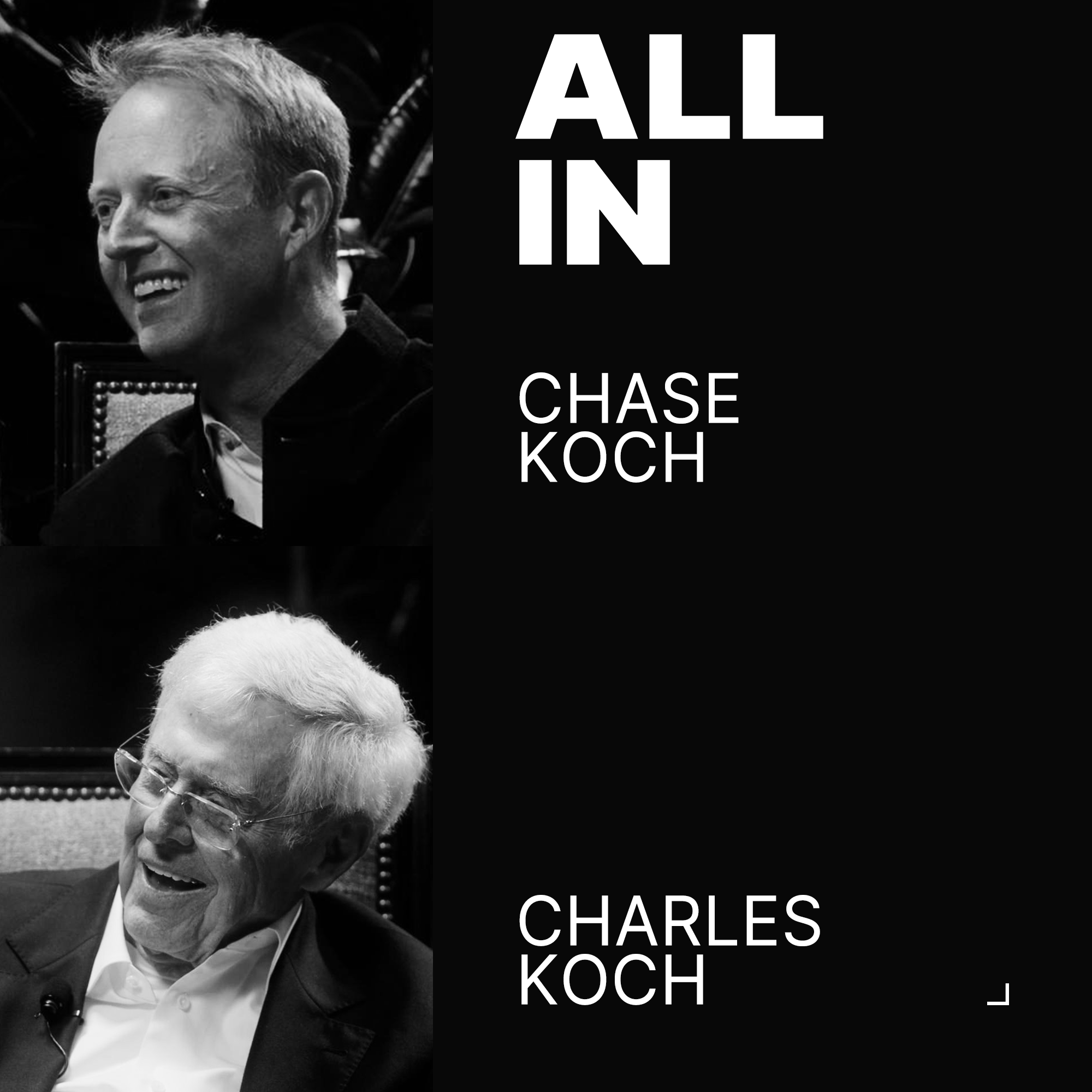
Guests: Charles Koch, Chase Koch
In-depth read · Key ideas, reasoning, and examples, organized by topic.
§01Setting the stage: a large private company with an untold story
The conversation was recorded at a Forbes-hosted event and released as an All-In interview. The host says he has known Chase Koch since 2013, when they overlapped in the agriculture industry, and that the two have been business partners. He has met Charles Koch a few times over the years.
The host presents Koch Industries as a business story that Silicon Valley entrepreneurs and CEOs rarely hear. He calls it probably the most profitable private, family-owned business in the world, and adds that he may be "off on a couple points". His figures: if the company were public, its revenue would easily rank in the top 25 of the Fortune 500. Fred Koch founded it in 1940, and it is based in Wichita. Its businesses span energy, agriculture, chemicals, building products, consumer products and cloud computing, alongside an active minority investment portfolio. He cites more than 120,000 employees across 60 countries, then says himself that the employee figure "might be off". Later in the interview the company side gives more than 130,000.
The host lists the features of the operating model he wants to explore: principles around disruptive innovation, reinvesting 90% of profits in new businesses and growth, and meritocratic values.
§02Origins: a reluctant return to a struggling 300-person company
Asked about scale, the answer measures growth from the early 1960s. The company then had 300 employees. It now has more than 130,000 in 60 countries, and its value has increased 9,000 times over that period.
The account of joining the business begins in childhood. The family lived on a farm. When the speaker was six, his father said he did not want his son to be a "country club bum" and made him work all his spare time. The speaker says he hated this and was often in trouble, but now judges the strictness right. Years later he asked his father why he had been tougher on him than on his younger brothers. The answer was:
Son, you plum wore me out.
At the time the company had two main businesses. One designed and made fractionating trays, which separate liquids by differences in boiling points. The larger one was a crude oil gathering system in Oklahoma. The speaker had finished MIT a few years earlier and was a management consultant at Arthur D. Little at age 25, which he now calls absurd. He turned down his father's first request to come back. A few weeks later his father said that either his son would return to run the company or he would have to sell it, because his health was bad, the companies were not doing well, and he did not have long to live.
Among his reasons for agreeing, the speaker gives a frank self-assessment. He earned three engineering degrees at MIT but "sucked as an engineer". He was strong at math, science and theory and weak at making or operating things. So he concluded he needed to be an entrepreneur. Being good at principles, he says, he kept looking for principles that would help him contribute and succeed, and he credits this with transforming the company.
§03The first turnaround: from control and protectionism to customer value
The fractionating-tray business is the first worked example. Its president was top down and "obsessed with controlling everybody". He sent weekly memos demanding details on spending and activity, and frustrated employees started ignoring him. The culture was also protectionist. Customers who bought internals for a fractionating tower were refused the design, even when they wanted it in order to correct problems. For the European market the company had no plant of its own. Several subcontractors each made parts of a tray, and another contractor assembled them, which the speaker says was bad for both speed and cost. The business was losing money heavily.
The fix was to change both management and philosophy around three moves: focus first on creating value for customers; empower employees so they want to do this; and build the company's own plant in Italy to serve Europe, doing the work in-house. The business became profitable and began adding related products.
The host asks how someone around 25 had the confidence to replace management so quickly. The answer is that it "was life or death". The father had also promised a free hand: the only decision needing his approval was a sale. The speaker adds that the growth continued after his younger brother David joined the business in 1970.
§04Capability-bounded, not industry-bounded
The central strategic idea is that the company should be "capability bounded, not industry bounded." Because Koch gathered crude oil, conventional thinking said it should become an integrated oil company present in every segment. The speaker rejects this in favour of specialization by comparative advantage. A company should occupy the part of the value chain where it can create more value than others, or it will fail. He says the economy now shows more of this specialization.
He calls the resulting principle "creating virtuous cycles of mutual benefit". It produces a continuing cycle of growth, innovation, successes and failures. Failures, when handled correctly, teach the company how to apply its principles to create value. He ties this to creative destruction in new ventures:
If you're not failing at everything, you're not doing anything new.
Asked for the first major failure, the speaker names several from the era when the company was called Koch Engineering. One was an effort to use petroleum coke from its refining operations as a base for making activated carbon, which he says cost "a fair amount of money". He adds that there were many more failures like it.
On when to walk away, a problem the host says many entrepreneurs have with ventures they love, the speaker first jokes that it is when losses get big enough. His real test is the point when the company concludes it lacks the capability to create superior value for customers that it will be rewarded for. Sometimes the obstacle is the business's structure. His example is a company connected to the Koch Disruptive Technologies effort, rendered in the transcript as "Insight Tech". He says it "does tremendous things" but has a structure that makes profitability hard. Each such case is reviewed for which principles were not applied.
§05Today's portfolio and how capabilities migrated across industries
The current businesses listed are engineered projects and engineering construction; building solar plants; commodity trading and distribution; fertilizers; refined products; chemicals and polymers; glass; forest and consumer products; electrical products; software systems for management; and four investment firms with different comparative advantages. The list is then summarised as roughly eight wholly owned business-unit platforms plus four investment businesses.
A second participant, who refers to the capability principle as what "my father said", says people in the tech community often ask what Koch is, since a large private company in Wichita, Kansas is not well known. In this participant's view, the capability approach is what most sets Koch apart from almost any other company. The participant recommends it to anyone scaling a business. Identify the capabilities you have shown add value to customers, then point them at new industries where you can experiment. The experimenting should follow the principle of experimental discovery: test whether customers value the product instead of trying to do everything at once.
Keep reading as a member.
You've read the free preview. Become a member to read the rest, with side-by-side reading and downloads where available.