
Professor Green - How To Overcome Life’s Hardest Challenges & Find A Purpose
嘉宾:Professor Green
全文文稿 · 按对话顺序保留完整内容,深入理解上下文。
§01Transcript — part 1
With an Amex card, my benefits suit me. So I earn on both big and little things in life, and so can you. Are you a foodie who dines in or one who takes out? Maybe a traveler searching for new destinations and travel perks? Saving rewards for something big or maybe for someone small? There's an Amex card waiting for you. See if you pre-qualify for an American Express card with no impact on your credit score. Learn more at americanexpress.com/check-for-offers. Your credit score may be impacted if you accept a card. Terms apply.
To say that Professor Green, aka Stephen Manderson, has faced and overcome adversity in his life is such a gross understatement. There are moments in this podcast today where you realize how unfortunate his life has been at certain moments and how much of a seemingly unfair start he had, that it almost doesn't seem like it can be true.
We know Professor Green. We know his music. I grew up listening to Professor Green's music. We know his documentaries more recently and how inspiring and vulnerable those documentaries have been. Most of us will know about the tragedy that met him in his early years when his dad decided to commit suicide.
But it's interesting to see how all of these events came to shape this man. A man that is empathetic, a man that refuses to be bitter, and a man that has overcome and thrived despite all of this. Professor Green is a remarkable person. He's a remarkable guy. He's self-aware, he's honest, he's critical of himself where he feels he needs to be.
Because of that, and because of the content, the documentaries, and the music he's made, he is one of my sincere inspirations, especially as it relates to mental health and the change that he's been able to make in the conversation. This is an honest conversation today, and it's one that I think everybody should and needs to hear, especially men, especially in the world we live in. So without further ado, I'm Stephen Bartlett, and this is the Diary of a CEO. I hope nobody's listening, but if you are, then please keep this to yourself.
I did a lot of research on you, and I've listened to podcasts you've done. I've read parts from the book that you authored, and I want to know from your perspective what you think the most pivotal moments were from your early years that came to shape the man that you became later in your life.
Wow, let's start with a big one. It'd be really easy to draw from some of the more traumatic events, I think, because they're the more obvious ones and they're highlighted quite often. They come up in conversation all the time, but I don't think they're specific moments in the same way. I think the worst traumas that I actually endured weren't any single moments. They were cumulative. They were things that happened over time.
I think it was probably more a case of what shaped me being cumulative as well. It was the time that I spent with my great-grandmother. There were six of us in the flat when I was born. There was me, my great-grandmother, my grandmother, my mother, and my two uncles. So my Nan's three kids. My mom was the first person to leave the house when I was a year old.
She was there consistently throughout my life, but my Nan was my legal guardian by the time I was three. At a point where my Nan could have started a new life for herself, she took on the responsibility of her mom and her grandson. But it was amazing because, apart from the ancestral shit that I absorbed...
What's the ancestral shit?
Yeah, well, just, you know, you think like my great-grandmother went through two World Wars, whatever relationship she had been through, the relationship that she had with my grandmother, all the problems that they had as a mother and daughter, the problems that my Nan had with my mother, the problems that my mother had with my grandmother.
What were those problems?
I couldn't tell you because they weren't my problems, but they existed and I was aware because there were arguments and there was stress and there was shouting. There were financial problems and struggles, and there was robbing Peter to pay Paul. Me being shuffled off into a room when a money lender would come round to pick up money. In a three-bedroom flat that was about as big as the room that we're sitting in, it was quite difficult to avoid being aware of these things.
But there was a lot of good. People always go, "It must have been really tough growing up in Hackney," but I didn't know anything different. It wasn't like I grew up in Wiltshire until I was 13 and then was just airlifted and dropped off in Hackney and told to survive. It was all I knew. But in hindsight, there was a lot that wasn't mine to take on but that I absorbed.
That stress and that anxiety definitely seeped into me and I was a very anxious child. I was always, "Nan, I've got a tummy ache." But at the same time, I was really fortunate because when people talk about kids who aren't brought up by one or both parents, they normally miss out on the nurturing that I definitely didn't because my great-grandmother was always at home. She hardly left the house, not least because of her age.
That time I got to spend with her is probably what made the larger part of what good is in me or encouraged the good in me. I would run out into the living room, which was where she slept on a chair that folded out, every morning when that weird holding screen was on the BBC with the little girl holding that puppet.
Before the cartoons would come on, she would read to me. I always remember her blue blanket that I'd jump underneath. She taught me to read well ahead of my years, basic numeracy and stuff. When I went to school, I was ahead of most kids because of that time spent with my great-grandmother and I enjoyed learning. So I sought validation in the right places rather than throwing tantrums at school like a lot of people did because they weren't getting attention.
In single-parent homes, parents have a tough decision to make: Do I go out and work and lose out on the time of my child but be able to provide, or do I lose out on the money that I would make which would make supporting a child easier? That's a conundrum. That's a really difficult situation to be in. I was really fortunate I didn't lose out on that. I think it's that that shaped me. It wasn't any single event really. It was that period of time.
And you said your mom was the first to leave the house?
Yeah, my mom was 16 when she had me. My dad was 18. They were separated very quickly and my mom had a lot of growing to do. I'm more than twice her age and I've just become a father. I can't imagine having tried to have been a parent when I was 16.
16. Such a crazy age. You're a baby yourself. And what was your relationship like with your mom from that point onwards?
Me and my mom have had an on-and-off relationship in the later years of my life. I don't talk about it too much. There’s loads of stuff about my relationship, or lack thereof, with my dad because of how his life ended. But I was brought up to not air dirty laundry. My mom did try. She did. Like I say, she was a much more consistent part of my life than my dad was. She made the effort.
Has it taken you some time to get to the point where you can be compassionate about your experiences with her?
I think it's taken me some time to get to the point where I can be compassionate about my experiences with everyone that I was involved with growing up. I think I got to that place quite a while ago. It's quite liberating, man. It's quite freeing. Holding onto anger becomes resentment and that leads to bitterness. Bitter is not something I'm interested in being.
I think a lot of people end up quite bitter and jaded quite early on and that determines the rest of their lives. I used to be quite scared to even say the words "I'm happy" because I would worry about what was round the corner that I couldn't see round. Now, I'm never going to develop the power to see round corners. Worrying about what's out of your control and preempting things that may or may not happen is not the healthiest way to live.
It's not great for your mental health. It's not great for the quality of life that you have. If you're constantly worrying, I can enjoy a lot of what I've achieved with hindsight, but actually, when I was going through the early years of the successful part of my music career, there were a lot of things I didn't enjoy in the moment as much as I should because I was worried about dropping the ball.
Because I experienced loss quite early on and come from quite a disadvantaged background, I wasn't used to a lot of the things that I was starting to encounter. I was scared of loss and of losing it and of dropping the ball. It's why I didn't take holidays. I would attach a few days here and there onto work, but I was scared to enjoy myself or to let go of that almost incessant need to keep working because I was worried about losing it.
But I wasn't enjoying what I had, so did I ever really have it? It took me a while to get to a point where I'm in a place where I enjoy things as they happen. Life is a lot more pleasant because I don't spend my time catastrophizing about what may or may not happen. Not least of all because I've survived things.
I know that if shit does hit the fan and things do happen, it's quite likely that I'm going to get through them. So I can worry about them happening and ruin my life day by day because all I do is worry about what may or may not happen, which is also distracting and doesn't allow me then to focus on the things that are in front of me and that are important, which will build a happier, a steadier, and more consistent life for me. Or I can deal with things as they come, knowing that I have the strength and the resilience in myself to handle things.
It's taken me a while to get to that point. It's taken some therapy as well. But it's you know, I feel quite calm and relaxed in saying right now that I am happy and I feel quite secure in that I can handle what may or may not come my way.
Talk about worry there. You referenced earlier you would say to your Nan that you had like a pain in your belly. You didn't really know what that was when you were younger. What did you come to learn about that pain in your belly?
That it was anxiety. It was a knot in my stomach. The problem was I was born with a problem in my digestive tract. I had what’s called pyloric stenosis. Stenosis is narrowing. My stomach, basically your pylorus muscle at the bottom of your stomach, should open and close to let food pass, but mine was just closed. So at six weeks old, I had an operation which has left me with a scar that goes from here to there.
Whenever I said, "Nan, I've got a bellyache, I've got a tummy ache," it was straight to the doctors. That then meant that I would go to the hospital and have cameras up me, down me, be put into machines to be scanned to make sure there wasn't something physically wrong, which there wasn't. It was psychological.
I was diagnosed with IBS really early on and that's still quite misunderstood. Is it something psychological that manifests physically, or is it physical and causes mental problems? I think that really highlights the intrinsic link between the gut and the brain. Again, I guess that's a bit of a chicken and egg situation.
Never really considered that there might be a link between the two. And with IBS especially, it's something that I've become increasingly curious about. As I said to you before we started recording, I've definitely got a problem with my gut, I just haven't figured out quite yet what it is.
Going back to your formative years, was there anything else through that period that would shape the man you became between the age of zero and 16? Like school life and stuff like that?
Yeah, so I was quite a bright kid. Education wasn't big in my family. No one had been to university. So me being as bright as I was, I wasn't pushed as hard as I should have been because my Nan sympathized with my situation. My dad being in and out of my life, me being a very sensitive child, my mom not bringing me up, and that all quite clearly affecting me.
My only problem at school was ever my attendance. I went from leaving primary school with the opportunity to sit the exam for St. Paul's to, at the age of 11, to a pupil referral unit by the time I was 13.
Because of attendance?
Yeah, because of attendance. By that point, at 13, I didn't really join the dots or draw a parallel between the two things happening, but my great-grandmother passed when I was 13. That was very, very difficult for me because she was the person who, if she said to me that everything was going to be alright, she was the one person I believed up until that point when I realized that sometimes it isn't. Some of her last words to me when we were in the ambulance on the way to the hospital were, "I can't fight forever." I knew at that point that was her saying, "Hey, I've had my innings." She was 90. She had a good innings. Two World Wars, one World Cup.
"I can't fight forever." What was the context of her saying that to you?
I believe that was her saying that she had made her peace. She lived with arthritis, diabetes, and was made of good stock to go through what she went through. A metal plate in her leg—she got run over when she was 19. I believe she was placed on a doorstep when she was a baby and she was brought up in foster care. Her sister wasn't. I didn't even know she had a sister until recently. When we talk about ancestral shit, you can see where these things start and come from. The issues that abandonment and detachment cause, they're more than just social issues. They impact development.
I can just see how a lot of my family experienced a lot of trauma early on. My great-grandmother, to my grandmother, to my mother, to my dad. They all had pretty difficult childhoods. My dad ended up in care because he was the sixth of six children and his mom walked out. So he was in care for the first few years of his life. He was also born a twin; his twin died at birth. My namesake, my uncle who I never met, Stephen, died when he was 19. Went into a diabetic coma and passed away two years before my dad took his own life. His brother took his own life in the same way. In the year in between them two taking their own lives, he lost his sister to cancer. Trauma's been pretty constant throughout almost all of my elders.
When you think about all that's happened in your generational cycles and with your elders, had I been through that, I think I'd be overly conscious about how I, maybe unconsciously, can work to make sure that—you've just had a boy, right?—can make sure that it like stops with me.
I see it in my own family. There are parts of my parents that I've become that I don't love. My parents were actually really unaffectionate, relatively unaffectionate and quite vacant. I still call them by their first names and I find it really awkward to call them Mom and Dad. I've never in 27 years looked at my mom or dad and called them Mom or Dad ever. Not once.
And even like, I'm not close to them at all. I'm terrified by the prospect that when I have my kid, the same thing will happen. So that's what I want to ask is like, what's your thinking and your like concerns when you think about your child and making sure those generational cycles end with you?
My concerns around that, to be 100% honest, there aren't any. Had I had a child years before now, I think there would have been many. But I've done a hell of a lot of work on trying to understand myself. It's weird, right? You spend so much time learning and then you get to a point where you're like, fuck, now I've got to unlearn all of this shit.
If you're fortunate enough to be smart enough to be able to take a long hard look at yourself and be self-aware, which is painful at times, but then you can put your hands up and you can own your behaviors. You can take responsibility for your choices and your decisions. You go through relationships and I found at points I was finding the same person in a different body. And then the same problems occur in the relationship.
What's the common thread throughout that narrative? I am the common denominator. So I can't keep projecting my problems onto other people and blaming them for just being themselves. I've got to do some work on myself here. Things need to change. Well, one thing needs to change: me. How do I do that? I have to understand myself better. I have to understand my behaviors. I have to understand my insecurities.
It's hard to do.
It is, because it's the most, you know, it's that kind of... if you're going to go and see a therapist, look, you have to go in and be honest. You can't lie to a therapist, otherwise it won't work. So you have to explore your deepest, most darkest and frightening insecurities in order to understand why you have certain behaviors, why you respond so defensively in situations, what makes you insecure.
How did you go on that process of unlearning all the shit you had to unlearn and turning the lights on, I guess? That started with therapy?
I think it started before therapy. I don't think I was ready for therapy until I'd started to do some of that work myself. I think, like you similarly, I have grown up with a mindset that I can do everything on my own. It's definitely helped me achieve a hell of a lot, but it also has put distance between me and people that it shouldn't have, and it's also made it hard for me to develop lasting relationships at points in my life, some which I look back on and think I could have done better. I could have been better.
What were the key things you had to unlearn through that process about yourself?
Mine was mainly defensiveness. Defensiveness and a kind of want to—I guess the attendance thing, that played out throughout my life. I found it very, very difficult to finish things. I would always have ideas, I would always begin things, I would get to a point where that sort of... you know, I didn't have my Nan as much of a present figure for me to be able to just go, "Nan, I've got a tummy ache."
But I would still get that feeling which would make me want to withdraw and would make things harder. Despite that, I've managed to kind of use that same energy. This is why I think stress comes down to perspective because work can be stress or work can just be work, right? It depends on your perception of it. And so my anxiety can be anxiety or it can be nervous energy. Energy is what you need to get shit done.
I've done a lot of work around mental health, not least of all because of my encounters with my own problems, but also what first made me aware of even the phrase mental health was that my father took his own life. That work kind of, I think around the conversation of mental health and encouraging people to be more open and honest with their sensitivities—and you shouldn't be open to everyone, be smart enough to be open to the people that you can trust because if you're open to everyone then you're opening yourself up to be taken advantage of.
But the word, the one thing that goes missing in that conversation all too often is resilience. Resilience is incredibly important and I think the only time that you can learn or become resilient without going through trauma and surviving it is therapy when you're not at a point of crisis. So that's why I was saying I had to do some of the work on my own for me to be able to go to therapy and then be able to grow through that. Because if you just go to therapy when you're at a point of crisis, it's like waiting until you get sick to go to a doctor. I try now to take a more proactive approach to my own health, and that's not just my physical wellbeing, that's my mental wellbeing. Ultimately they should be one and the same. It's just health. But I think we have a very reactive nature to most things in Western culture. We're not encouraged to be proactive.
And we also probably have a foolish sense of optimism about how life will unfold, right? We think it'll be okay, our health will be fine, we think we'll never really get old because it kind of creeps up on you.
It's crept up on me. I'm 38 this year.
Me too. I looked in the mirror the other day, I saw gray hairs. I was like, what the fuck is going on here?
I love it though. You know what makes me laugh? People always moan about getting older. And I'm just, I can be quite simple and matter-of-fact about things and it's just like, well okay, the alternative is you die, right? That's the only way you stop getting older is you die. So what's, you know, unless you're biohacking and trying to lengthen your telomeres. But you know, I just think growing old is great. Growing older is great if you can do it with good intention.
I've always had good intentions, but I've made a lot of bad decisions. I think growing older once you get to a point where you feel happy and comfortable in your skin, it makes it easier. I'm not stressed about getting older because I'm really happy with who I'm becoming.
That's exactly it. When I looked in the mirror the other day and I saw gray hairs, it's funny because the most comforting thought that I had was like, but I'm happy. I'm getting older, yeah, but I'm happy and I'm doing myself justice. What I mean by doing myself justice is like I'm living my life, I'm being myself.
And so I'm happy to get... you know, the worst possible scenario would be I look in the mirror, I see gray hairs, and I've been working at fucking KPMG because my mom said that was success. And I'm like, I'm on my way to a midlife crisis. I'm not being myself. I've not pursued my dreams. It would feel like the clock is ticking. But when I look in the mirror because I feel like I'm living my true self, I'm like cool. Ultimately I'm like cool because it's... because I'm living my life. And that's also made me not fear death like I used to. I used to be scared of death.
Yeah, because I guess it's getting to the point of your life where you feel as though—and I do wonder if this played a part in what my dad did—getting to a point in life where you think you can't start over. "I'm too old to make the decisions that I wish I made." And it makes me, it's given me more I guess more comfort is the wrong word, but like I've always been quite happy to fall on a sword as long as it's my own.
And I'm always more scared about having—look, I worked 10 years speculatively as far as music from 18 to 28. I was 28 when I first sold a record. I had people round me going, "Come on bro, you've got to find something else to do." And I just, I don't know if there was like a bit of self-belief buried beneath all of the insecurities that kept me going or if it was just blind stupidity or a combination of the two, but I kept going because I wanted it so badly.
And I loved it. I loved it. I really, really loved it. There was nothing in my life at that point that made me shake my hands like writing a good lyric. You know, that type of excitement when you nail something. You're walking around the room trying to get that last line of something and then you get it and you're like, that feeling is not something that I get from many aspects of my life. And so I continued.
I think it's something that's, it's not the easiest thing to do is it? When you've got, especially if you're from a disadvantaged background, because you don't have a fallback or a plan B or a grandparent that will die and leave you inheritance so you're set. You don't have that security. But at the same time, you know, I know a lot of people with that security who don't push for anything. And every time I talk to them, they've got a different idea and a different business venture but they execute and achieve nothing because they don't have to.
Yeah, yeah. There's two sides to that coin. If you grow up entirely comfortable, do you ever want to push that hard to get to where you want to get to? It's interesting, isn't it? Because that hunger of not having it is also an advantage, as is the privilege of having it.
You mentioned your dad there, and I watched the documentary you made—I think there was two separate documentaries that I saw about the topic. You went on the journey of understanding him, the life he lived, and why he made the choices he ultimately did. Can you tell me what you learned through that process?
Yeah, quite concisely as well at the point I'm at now. It's that I think the difference between someone who will take their own life and someone who won't is the ability to tolerate how you feel at any given time. I've had moments where I've wanted to scratch my skin off, but I've never contemplated suicide. I've never suffered suicidal ideation. There's a big difference between lows.
And also I think there's something that's quite scary is the hyper-awareness that people have now around everything. Everything has a tag, everything has a name, everything is a condition. I think we're getting to a point now where you need awareness before understanding and then awareness, understanding, action. To me, that's the train of things.
Whether it's... let's keep it to depression. I think now there's a conversation around it, but how much is being actioned? Not enough yet. But I do think it comes down to being able to tolerate how you feel. Because at my very lowest lows, I've come out by carrying on. And my dad got to a point where he couldn't and there wasn't the support around him to help him in those moments. And sometimes I think even if the support is there, that choice is that person's.
It just seems so unthinkable.
But be lucky for that.
When your cat is acting weird-er, or your dog is being loud-er, your turtle moves slow-er. Hello? Ted. Your cat seems thirst-er. Whoa, slow down buddy. Or your puppy is acting clums-y. Day or night, if you don't know what's wrong, know where to go. Veggie ER for Pets. This is Kate. Veg, the better, kinder ER for pets. (Repeated once)
You're right. I've just spent the longest amount of time... so when I first started hearing about mental health, which was probably about 10 years ago when I was about maybe 18, the term started to emerge in our society.
It wasn't this, "He's mental, she's mental." It was "You're crazy" or whatever. And then thankfully the stigma has slightly changed over time.
And I just have always struggled to understand—and this is why it's almost become a bit of an obsession of mine—to understand the position someone must be in to believe that, to feel that, that is a better outcome for them. And this is why it was so powerful watching your documentary because, you know, even when you were doing the role-play with the guy in the chair and you were being the friend and the guy sat in the chair, he was the person having suicidal ideation. Even in the role-play session, I was like, oh god, this is unthinkable. It's just something that I think someone who has had the privilege of good mental health will always struggle to understand. And that's a problem because if you can't empathize with it properly, we can't I don't think address it properly.
But you can, I think you can empathize without understanding. And I think we all too often we want to fix things as soon as someone says they're sad. You're like, "Come on, cheer up." That's not helpful. I'm like, okay, be upset. Let's go through this. You have to kind of go through the upset rather than trying to suppress it, because you push things down, they come at you sideways.
When my dad took his own life, one of the first things I wanted to do was understand how he was capable of doing that. I quite quickly realized the only way I will ever understand how he was able to do it is if I'm in that situation, which I'm never going to be. So I let that go quite quickly. I don't think it's a good idea to try to—I mean, unless you're studying psychology and understanding the workings of the mind, which would allow you to empathize—I don't think it's good to try to understand. If something seems irrational or, forgive me for using this word, "crazy" to you, you will drive yourself mad trying to understand it because they are not the workings of your mind.
That's not healthy either. But just going back to the hyper-awareness thing, I think people will find themselves in situations where they will call themselves depressed when actually they've had something traumatic happen or something sad happen. Something sad happens and your cat dies and you don't want to get out of bed for two days. That's not depression, you're upset. You're dealing with grief and loss. That's normal. If nothing has happened in your life that's traumatic and everything seems great but you feel horrendous, or you can't feel anything, then that's something to be addressed.
I think we need to be careful of everyone—not everyone, but people starting to diagnose themselves with conditions that they perhaps don't have. I think that's a danger in everything having to have a tag now and everything needing a name and everyone needing to be put in a box.
Yeah, and then the way that we treat people in those scenarios, when we've misdiagnosed them or too quickly diagnosed them, is also unhelpful. I've spent the last six months working pretty much full-time at a mental health company in London called ATAI. They are a psychedelics company. They're probably the biggest in Europe.
One of the things that I came to learn from working there, but also from reading one of my favorite books called *Lost Connections* by Johann Hari, was I used to think growing up that—because this is what I was told—depression was a chemical imbalance in the brain because something was broken. No one ever told me that trauma or what happened to you can cause depression. So you'd think, "Okay, well..." and that makes you also almost blame the victim more so than saying like, if it's like "What's wrong with you?" then it's like "You're broken." But if it's "What's happened to you?" it's a much more empathetic approach.
And that was the big shift that I've experienced in the last three years was I used to think everything was just chemical imbalance, "broken."
Yeah, and then what comes with that is often how do you fix a chemical imbalance? With chemicals. Exactly. Not always the best prescription in the beginning. Listen, there are some people that will always need medical intervention to help. It does help some people, yes it does. But I also think that sayings like "you are what you eat"—you can eat yourself into depression.
All of those things, they kind of become part of a self-perpetuating cycle. If I feel like shit, I don't move as much, and then I'll make bad decisions with food, and then I feel worse. Especially during this time when people aren't as active as they were, they're not engaging socially as they would have otherwise. The sales of alcohol went through the roof. Alcohol is a depressant. The more you drink, the lower you are. All of these contributing factors that can contribute to negative mental health, or can negatively impact your mental wellbeing. A great prescription sometimes is eating better, going for a walk.
Exercise doesn't have to be a 45-minute HIIT class that leaves you wanting to not get out of bed for two days because that's you putting your body through another stress on top of all the stress you're already going through. Just movement, eating well, good conversation.
Something I've found quite difficult but has become more apparent is my need to move away from certain people because they aren't moving in the same direction as me and they encourage certain things that hinder my growth and stop me moving forward. My life has changed and I found that very hard.
When you talk about grief, you instantly think someone's died, but you can grieve parts of your life. Saying goodbye to certain things, certain people in my life has felt like the same loss as when I've actually lost someone who's passed away. But you have to do those things in order to grow and to get to where you want to be. It sounds selfish, but selfish has so many negative connotations attached to it. But I think selfishness not at the detriment of others and selflessness not at the detriment of yourself is good. Because how else do you... you're no good to anyone if you're no good to yourself. That was a huge, huge learning curve for me and one that I found really, really difficult to execute: to start making decisions based upon what was right for me because I felt obliged to be here for that person and then doing the same things as those people. It wasn't helping me.
It took me back to this time I met this monk, world-famous monk. I said, "Is it bad that I'm focusing on building my business and making money right now? Is that like a selfish thing for me to be doing when I could be off in Africa helping kids?" And his response to me was, he goes, "You have to fill up your own bottle so you can pour it out for other people."
And I always remember him saying that because, you know what the crazy thing is, when I was 18, I sat in my Moss Side in this room and I was sat there thinking, "Steve, you're making a wrong life decision because you know you've got a brain and you know you can affect change. And the fact that you're trying to build this business and not in Africa saving even just one life means that you're being terribly selfish." My way that I rationalized myself out of that state of mind, which was like stopping what I'm doing and flying to Africa, was this belief that if I was to be successful, I would be able to help more people one day.
It links to what you said there about how selfishness in many cases is actually selflessness.
Yeah, especially if you find yourself in a position later on where you can affect change for the better on a much grander level. You have a much bigger stage now. I love a lot of the stuff that you say. I generally don't like motivational speakers, but I find when you speak, it's motivational, which is quite different.
Most of the time I am in the gym and I write something in the notes of my phone and it ends up on the internet. So it's like I'm not trying to be... but that's why it works. And it's like whenever I did my documentaries, I didn't try and tell anyone else's story. I was just a catalyst for them to speak. It's my opinions which were formed during the process of the filming. I didn't go into them with any idea. It was often changed and my opinion was shaped throughout the course of filming that documentary.
I think all too often people think that by instructing people or telling them how they should live their lives, they're going to affect change. I don't think that's the best way to engage people. I think people switch off. I think the way in which you communicate is brilliant because you put stuff out there and people can take to it if they connect with it. Because of that, they do, because it's natural and it's organic and it's not forced. I think that's really, really important.
I don't think you have to go to Africa in order to affect change because people will be inspired by watching what you do and are able to achieve. And that in itself, you almost don't have to... you can just *do* and you will inspire.
Yeah, this is a crazy thing. The thing we have in our society today with young people especially is they all want to change the world. And they think—and genuinely, I get this all the time—I'll be on stage somewhere and a kid will come up to me that looks like me, like a young Black kid, and he'll be like, "I want to be a motivational speaker. How do I do..."
And I know what the right answer is because I look at this kid or, you know, whether it's someone in my Instagram DMs that wants to change the world because they think... I think the way I've rationalized it is they don't want to change the world, right? They want to be *seen* as someone that changed the world because of the admiration that they believe they'll get from that, because of the admiration that they saw me getting. So in fact, they're not connected to the right thing.
No, they're seeking validation.
Exactly. If they wanted to change the world, if that was their objective, they would actually be in a lab somewhere working on cancer, for example. They wouldn't be trying to get on the stage, right?
But like you ending up on stage is a product of the work you've done. You never worked to get onto that stage. Never thought about it. Exactly. It was a byproduct of working on myself. And that's exactly... thank you, actually, because I had lost my train of thought there and you just picked it back up.
That's what I was saying. I got on stage because I was focused on something else, right? And the way that people go on to change the world I think is because they work on themselves, they fix themselves. So that kid, my advice to him probably would be like go and like pursue your passions. In fact, all of my idols are on stage because they *didn't* copy anybody else. They thought they could make, you know, pocket computers and that Black was equal to White in terms of racial relations (Martin Luther King). They pursued their own thoughts and their own feelings, they didn't replicate people.
But then that's the... we live in an age where people live almost comparatively. It's such a shame. We have this incredible thing called the internet where we can communicate with people in any corner of the world, give or take, and we use it to post FaceTuned pictures. But it's a brilliant tool there, and when harnessed and used correctly, it can bring about good things. It's like anything. I was eating McDonald's in bed last night.
Uh oh. I didn't see it on your Instagram.
It is on my Instagram. I was complaining about the absence of fries in my large fries. I was like, let's avoid the fact that I'm eating McDonald's in bed and talk about where the rest of my fries are. I was devastated. Why order a large fry if you're going to get delivered a small fry in a large...
And then the next one's about gut health.
Balance, bro. Balance is really... I think balance is key. And I think all too often like, especially with and kind of moving into this sector now, anything that involves nutrition or supplementing or... I fucking hate #wellnessworld, man. The tone of it just like that, that kind of the softness of that and the approach to life that just having a green juice is going to correct everything, going to save the world, it's going to save you. Like, fuck off.
It's the wrong approach to everything. And I think everything is to... it becomes quite divisive, you know? "I believe in wellness, therefore I'm not going to indulge in any of the things which I used to find fun because now I'm going to take care of myself." Me taking care of myself involves me having a blowout once in a while with my friends and suffering the hangover that comes with it to remind myself why I don't do it all the time and the waste of time afterwards because I can't function as highly as I would normally. But I just think there has to be a balance struck.
It's all too often people, right, if you want to... you can't just cut back on meat, you have to be vegan. There's so much instruction out there whereas you don't... and it's all contradictory as well. So much of it is, man. And it's like, you've got vegans who will... I mean, is cocaine vegan? How many vegans do we know that go out on a Friday, or when we could go out on a Friday night, and will do cocaine? And you know, there's not a gram of cocaine, if it actually has cocaine in it, that doesn't have a dead body attached to it. Where are your... what is your moral... where is your moral compass now? Virtue signaling at its finest.
You talked about your documentary then and one of the things that, when I watched your documentary, really stuck out to me was you recounted the last conversation you had with your dad. And it made me think about the last conversation I had with my parents. Can you talk a little bit about that and your feelings towards that conversation now?
Yeah, so my dad... I'd opened, I said I would never, ever make myself vulnerable as far as my dad again. And by that I mean I would never give him the opportunity to let me down. And then I did. And it was just before Christmas that we spoke and we agreed to meet up the day after Boxing Day.
I was sat at the food court of the shopping center in Walthamstow with my then-partner at the time, Tear. I can remember it so vividly. And I called him to make arrangements for the next day. I wasn't driving, he'd moved to Brentwood, he was driving. I said, "So are you going to come and see me tomorrow?" And he was like, "Oh..." mentioned the name of his wife, now widow, and said, "Oh, you know, her and the kids would really love to see you."
They're step-children, they're no relation to me. And I was like, "This ain't about..." and this is the first time that I ever... I was always too scared to speak up to him about how I felt because I at times blamed myself or worried that I was the reason that he would disappear for a year and a half, two years at a time and not see me. So I would never speak up and tell him how much it hurt every time he did that.
And this time I went, "This is not about me coming to play happy families. This is about"—and I was 18—"this is about you and I sitting down and having a conversation as adults and trying to see if there's a way in which we can move forward and forge some sort of relationship with trust." And he was like, "Oh..." and I just went, "You know what? If I ever see you again, I'm going to knock you out."
And I wouldn't. I'd have balled my eyes out and given him a hug. But I was *right* to feel that anger because he had hurt me so, so, so much so many times throughout my entire life. And that's what I meant about it being cumulative. It wasn't any one moment. It was all of the moments that he wasn't there, that he missed, that he let me down. All the days spent looking out of my front room window which looked right at the bus stop that he should have got off of a bus at to come and see me when he never showed up.
It was all of that that added up to that moment. And people are like, "Wow, do you wish you could go back in time and change what your last words to him were?" No, of course not. Because that anger was just. How could I not be that angry? Why should I feel guilt over *his* actions or lack of actions? I can own that and I'm fine with it. And I don't feel like I should feel any which way about saying that to him because me being that angry was justified.
I mean like, I don't think a lot of people would have even been trying to rectify the situation at that point, right? And a lot of my friends who won't even entertain a conversation with their biological fathers or mothers because they were absent.
But have the conversation though. Get to a point where you can let go of... and don't... but the problem is, right, they have a narrative that they have to justify themselves. And this is something that I've learned. So they have a narrative that—and I still have this with members of my family now—if we get into that conversation about the past, they have a narrative which justifies their every choice, which makes it okay that they have to live with because they haven't dealt with their shit yet.
They're not going to deal with their shit. If they were going to deal with their shit, they would have done it. The chances of me getting those people through the door to see a therapist: nil. Not happening. Me taking that step and sorting my shit out doesn't mean that I can sort their shit out. It doesn't mean that if I make the room and give them the forgiveness that they're going to be able to accept that forgiveness and be honest with me because they still have to hold onto that narrative to justify their decisions. Because they haven't made amends with their decisions. And I can't expect them to.
And you can't *need* that.
I can't, but I can't need that. Because if I need that, I'm always going to be underwhelmed, offended, upset, let down and bitter. And I don't want to be any of those things. Not least of all now I have a child that I want... you know, the great thing is my child is born into a world where it's me and my partner. And she's amazing. She's incredible and has done, you know, a lot of the same work that I have in order to get to the place where she's at in her life. And we have this peace because we're able to have open conversations, we're able to discuss things rationally, we're able to be wrong. There’s room, we make room for each other to be wrong.
We make room for each other to be upset, no matter how irrational. We give each other room and space and time and we're considerate and we're kind and we don't, you know, we try our best not to revert to child and be defensive and offensive because of that. And you know, it's why we have had a child, because we feel safe with each other.
On that point of like moving on. So people, in our lives we all have to move on from things, whether it's a relationship, whether it's trauma, whether it's things that happened with our parents, whatever. People tend to think that, you know, they use this phrase a lot, one of my friends was saying it to me the other day: "I just need closure." And I just remember thinking, ah you're fucked then if you think that.
Because what is closure? Closure is insecurity about what happened. And a lot of the time, especially in romantic situations, basically someone has walked out the door with your self-esteem and what you're saying is, "I can't move on until they come back and give it back to me, until they justify why they cheated or they explain to me," you know? I think I wrote on my Instagram and I was like, closure is a choice ultimately.
Closure isn't... if you need closure, close the door. You do. Find closure in closing the door. Yeah, it is. Because if you're constantly... you're still giving over too much of yourself to someone else. They've got the keys, right? Yeah, like why are you doing that? Why are you handing over that power to someone who doesn't even want it anymore? They've left.
Why are you... but then it's also... people also find themselves in the situation where they try and take responsibility for other people's actions. It's good to take responsibility for your actions. If you've provoked something, then you can look at maybe being responsible for how someone's reacted because you've prompted that, you've provoked that.
But trying to take responsibility for someone else's actions, you'll drive yourself crazy because you can't take responsibility for everything that everybody does. We all make our own choices. That again is not a good place to find yourself. And always wanting to understand is like, why do we have to understand everything? People make choices, we're complex. There are so many variables in our lives. The only thing you can do is introduce less variables.
And that's been quite easy during the last year because, you know, I don't have to walk into crowded rooms full of people that I don't know. So when I have socialized, when it's been allowed, it's been amongst people that I want to see. Therefore less variables, the situation's more predictable. You know, I'm kind of more aware of the outcome.
And if you you apply that to life, you know, you if you... we all too often though, we make excuses not just for ourselves—and I hate excuses, it's why I don't like being late to anything even if there is a valid reason. It makes me anxious. I hate excuses. But we all too often make excuses for other people. "Oh, that's just Darren," you know? "That's just how Darren is."
But there's going to come a point where Darren just being Darren is going to have you respond disproportionately because you've not made clear to Darren that he's overstepping the line. So he's got no idea. And then he oversteps the line the eighth time and you respond, but you respond for all eight times at once and Darren's like, "Whoa, you could have told me the first time!" and we could have had a rational conversation, but actually you've allowed it to escalate to a point where you've held onto this thing that Darren's done every time he's done it and then exploded because you're not comfortable having awkward conversations because you find them awkward. When actually, if someone can't handle a direct and honest conversation and a rational conversation, is that someone that encourages you to be your best self?
Like I don't want to surround myself with yes-sayers or people who deflect or who hide from things. I in my life now cannot, I don't have the time for the bullshit. I really don't. I like direct conversations. I like friendships where we are able to be honest. Where if my friend... I don't have a huge group of friends now. I know a fuck-ton of people, but the people that I do... like if someone online calls me a twat from, I don't know, Greg from Skegness, I don't give a fuck. He doesn't know me. His opinion of me is made up of whatever he's read or seen and the dots that he's joined. He's built the rest of his own bullshit that he's projecting, right?
But if my best friend Felix says, "Stephen, you need to check yourself," I'm going to check myself. And it's important to have those people round you. You need to be able to... if you don't have honest relationships with people and open dialogue, they're not real relationships.
It's hard though when you've had some success, right? Did you even find that in your own friendship circle? I think I found that a little bit where because I had success, some of my closest friends actually ended up—they worked in my company and that's how they became some of my best friends. So I didn't know them before the company, but like you work with someone side-by-side for 10 years and they become...
But I was always the boss. So I've always worried that because I had that like, I was like the pack leader in my little group of friends, that they might not check me all the time when I needed to be checked. Because they feel like you know best. They know I know best and because I've always been like the boss, I've always been the one in charge, I've always been leading them as well.
So for me stepping into business now, it's really important for me to have co-workers that will challenge me. I don't want someone that just goes, "Okay, that's not working, we'll stop that." I want someone to go, "Yes, that is underperforming at the moment but given a chance in two months you're going to see results from that because you're going to build and grow your audience." I need educating on that because that's not my forte, you know, that's not my skill set.
And so you need co-workers and friends that will challenge you. And I believe in challenge, healthy challenge, because an opinion is not an opinion—it's an idea until it's challenged. So if I say, "I believe we should go this way," and you say, "Do you really?" and then I explain why, I've stood on the table for it. So now it's my opinion and I know it's my opinion, but up until that point it was just an idea. It was a belief, but not necessarily a correct one.
And when you started to see success in your life, were there people in your circle that were friends, people you considered to be friends, that were clearly not happy for you?
One of the best bits of advice I was ever given was by a rapper, but he was a friend of mine, Skinny Man, who said to me, "A real friend of yours will never be a hindrance to you." And there were definitely people who weren't as comfortable with me not being in the same situation that they were in, doing the same things.
A lot of people deal with this. I got a call yesterday from one of my best friends and he said, "One of my friends has just completely unfollowed me on all the social platforms." And I said, "Why is that?" He goes, "Well, I think it's because like I've started to do really well and he thinks it's a reflection on him. He thinks it means that he's a piece of shit because I'm succeeding."
Or an attack on...
Yeah, it's just... and I this is a conversation that I don't think people have enough, but at any point in your life when you divert from the like the path, especially the path that you share with your closest friends, quite often there will be some kind of force from them to try and pull you back to them and say, "Who the fuck do you think you are, Stephen? Get back in line." Did you experience that at any point when your music career started to really take off?
It's difficult because you can't take everyone everywhere. And there's almost an expectation to. And I'm a firm believer in opportunity. Like giving people opportunities and then beyond that it's up to them what they do with that. Like I'm someone who's not... I've had situations with people where I've seen them have opportunities but they've been too insecure to take them because they've felt like they're putting themselves beneath someone else.
I don't have that problem. I want to learn from you. If you're further along in your career and I'm trying to not mimic what you're doing but I want to be successful in the same sense—so you're a musician that's ahead of me and you're willing to take me on tour with you—I'm not going to say no to that because I'm insecure and I don't want to appear to be the support act. I'm going to say yes because I want to come along on that ride and I'm grateful for the opportunity that you're giving me.
Some people don't have that mindset. Some people don't want to learn from other people, they think they know it all. Or they're ultimately scared and insecure, they feel like they look smaller by putting themselves as a support, or by having someone feature on a song, or by accepting help. Whereas for me, it's always been a... like when Mike Skinner signed me and I had the opportunity to go on tour with him and battle at every stop of his 12 Rounds tour when he was at the height of his success, I didn't feel any which way about doing that. I was, you know, I was really, really grateful for that opportunity to go along and learn.
In the same way that when Lily said to me, "Oh, let me do the chorus on 'Just Be Good To Green' and we can perform it live at Bestival in front of 60,000 people"—bro, I was still selling cocaine! (laughs). I had graduated from weed to coke at that point because I had all of a sudden, after I signed to Mike Skinner's record label, developed this circle of model bookers and musicians and, you know, who all took it. Weed is large and smells a lot. Coke is quite easy to move around and, you know, I would never have got caught unless in transit. So it became quite an obvious decision for me to make because those things were normalized where I grew up anyway. I never sold crack or smack because I don't believe in dealing with people in the most desperate situations they've ever been in day in, day out.
When you think of Shoreditch, what do you think?
People pissing up people's doorsteps.
Interesting. That's my home. I was wondering if just the term Shoreditch alone would make you think about the scar you have.
Oh! Yeah. (laughs). No, I don't... it's weird, man. Like I got hit by a car in 2013. I got squashed between two cars. I managed to get myself up on the bonnet so it was only my left leg that got caught. The bloke didn't realize his car was in Eco because it was a new car. So he had his foot on the brake which put the car in Eco, he took his foot off the brake as I was walking between two cars and he felt the engine start so he panicked and slammed his foot down but instead of hitting the brake he hit the accelerator.
Joking.
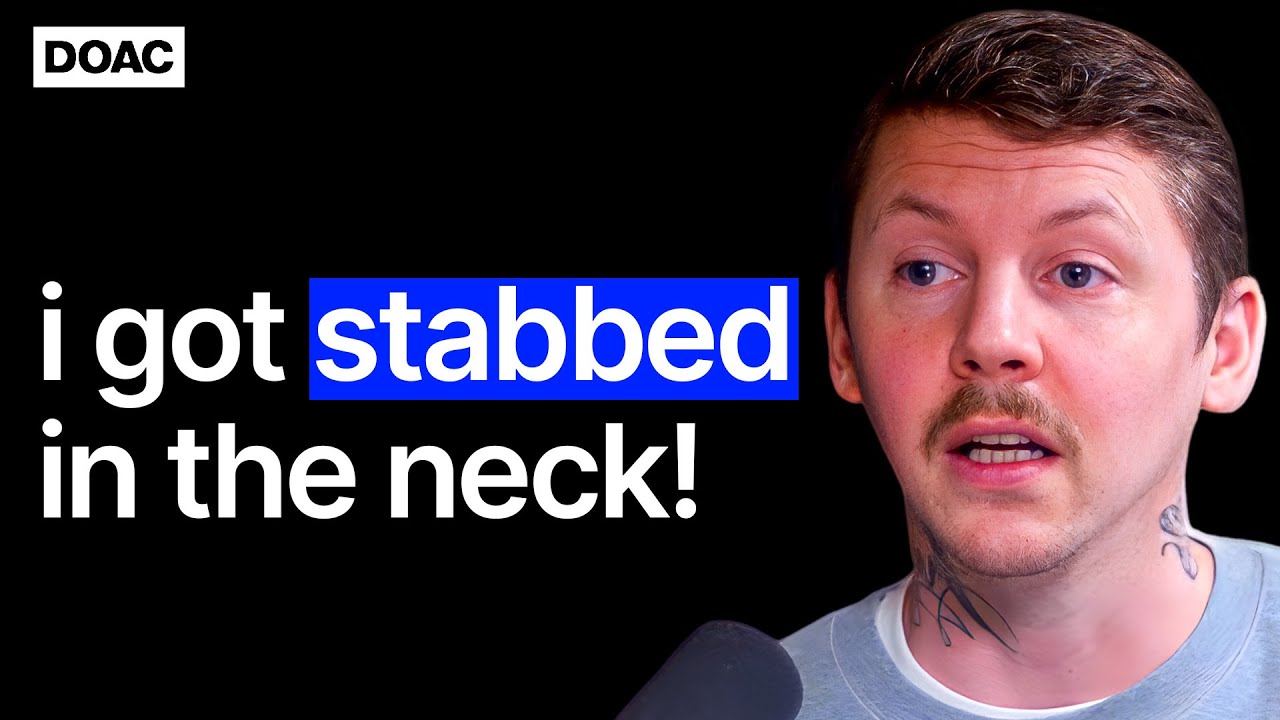
And that was a far more traumatic event for me than being stabbed. Because that was really unpredictable, nothing came before that that I contributed to. When I got stabbed, look, when I was—I think I was eight—when Chestie, someone from my flats who don't live in the country anymore, he got bottled and stabbed. One of my pals Jamal, who was younger than me, ran and—I might have been nine because Jams was like seven—and he ran and called the ambulance for Chestie. This stuff happened.
I didn't expect to get stabbed by someone I didn't know, that I had no history with. It didn't really feel like retribution for what had just happened. There was a little bit of bickering. He said I barged his mate. It was proper stupid young bravado macho shit in a club, yeah, in Cargo. And I just stood my ground really was all I did. That was all I did wrong in that situation, if you even think that's me doing wrong.
In hindsight, I could have just gone, "Oh, did I barge...? I didn't barge his mate." I said, "Excuse me" and I moved past with an open hand in a crowded club. I was as polite and as passive as I could have been, but he was just *on* one. So I stood my ground and in hindsight, like now at the age I am and especially with having a child and just thinking about how I want him to grow up and what I want him to understand being a man to be, you know, I could have just gone, "You know what? Sorry, bruv. I'm done with it."
But I felt like he was threatening me and I felt like I was right to stand my ground. I didn't expect that five minutes after that, he'd walk up behind me and put a broken bottle in my neck. But at least my mom and my Nan started talking again.
I heard you called your Nan in that moment.
Yeah, so we were still fighting outside. So he stabbed me, I managed to push him out the way, get out of the club, holding my neck together. Obviously you've got all kinds of adrenaline running through your body at that point, so you're not really aware of the... I mean, I know I've been poked in the neck and it's not really... if you're going to get poked, you don't want it to be in your neck. Your chance of survival is not high.
And then we got... the fight got broken up. I think there was police outside the club. I think it was broken up by a policeman. The whole thing is a bit blurry to me. And then I'm sat on the... because I ended up getting arrested as well. But I'm sat on the curb, my phone's come out my pocket and I can see on everyone's faces, you know, this is not... this ain't going well for me. So I asked to pass my phone, got my phone, I called my Nan and I just apologized for all the work she'd put into me that this was how it was going to end.
And she just said, "You're going to be fine. Shut up." I think she did actually tell me to shut up. And she's Cockney. (laughs). And she just said, "You're going to be fine, you're going to be fine." And she came to the hospital, as did my mom, and they both started talking over my table that I was on. And it's kind of weird because when I went to hospital, I was treated like I was some kind of notorious gang member. The hospital staff were not sympathetic to my situation whatsoever.
Bearing in mind I'd been stabbed. I'd never say I'm a victim because I don't believe in approaching life as one. But in that situation, I wasn't the perpetrator, I wasn't the aggressor. So it was a bit weird the whole thing, you know, to just be it be presumed that I was just part of something. That came out of nowhere, had nothing to do with no gang nothing, no dealing nothing, no historic problems from anywhere. It was just something that happened randomly. But no, that's not even what I associate Shoreditch with. As well as pissing up doorsteps, I think of New Balance trainers and beards.
You know, when I listen to that story about what happened with that guy in the club, it brought me back to a time which I've never talked about before in my own life where I was in New York in a club. And there was two tables in this nightclub and I was on one of them with a couple of my friends, one of the guys that runs Matchroom Boxing. And there was this table of guys from Jersey next to us. And the guys on my table were talking to the girls on their table.
And there became a soft case. So I know the bouncers in this club because I go all the time. So I said to the owner and the bouncer, I was like, "There's going to be a problem here if you don't move this table." And as I'm speaking to the manager, the guy from the table next to me picks up a three-liter bottle of vodka and hits me on the head with it.
I'm surrounded by... so the... I'm so good with these bouncers, like I've sent them Man United shirts and I... these people know me. I'm always in the club, I'm always on the same table, that kind of thing. Big Black bouncer, must be fucking seven foot massive Black guy—they're my boys. We talk about United every time I come in there. Like they're my boys. He reaches over the crowd of bouncers that I'm chatting to on my table and he hits me with this bottle of vodka.
And I go, "See?" because I was telling them to... I was like, "There's going to be a... if you don't move these two tables, there's going to be..." I go, "See?" And as I'm looking, blood—because I'm wearing this cap—blood just trickling down my face. But again, I did nothing to instigate this situation. And I when I was reading about what happened to you and you ended up in hospital and it, you know, it risked your life, I was thinking, what is the lesson here? How do you avoid these situations where...?
Variables. You know, and that's the thing. You walk into a room like that and there are many variables. Anything can happen. And for me, I was always like... I was always someone that scanned the room. I always wanted to know... I don't like sitting with my back to doors. Never have. I still half-sleep with one eye open. It's why I've always suffered with sleep problems, I think, because of... and that's my own doing to an extent, you know, because of some of the stuff that I used to do. When I was by no means like heavy, heavy, heavy into things, I just sold a bit of this and a bit of that because it enabled me to finance life while I worked towards what I wanted to do. If there was another commodity that I was aware of that I could have sold that wasn't illegal, I would have done it.
And that guy, he got eight years, right?
Yeah, that was a whole mad situation though because they moved the trial date to when I was on tour. So this was two years later that it went to court, right? I get a phone call on the Friday when I'm in Newcastle and they tell me from a police officer and they tell me when the trial date is and I just said, "You know what, I'm so far past that, you know, I really don't care. Like I'm not coming to court." And they said, "Well, we know where you are and we know what your next two tour dates are." They were Brighton and London, I think. "And we'll issue a summons. We'll arrest you."
If you don't come to court?
Yeah. And I cried, bro. I was in a conundrum because, see, this is where—I've never spoken about this—this is where my moral compass struggled because you don't snitch. They had four other witnesses, they had DNA, they had CCTV. The last thing they needed in court was me. But what did they get from me being there? They get press.
And then I get told by my record label, my TV plugger, my radio plugger, that I'll basically be looked at as an advocate for knife crime if I don't show up at court. But that goes against everything that I stand for. In hindsight, it's crazy because if I didn't grow up where I grew up, why would I care about that? I didn't do anything wrong in that situation. But I didn't want to be there. I didn't want to be there.
The whole thing, like it still troubles me now, you know, because it's like you can't have one foot in, one foot out. It's like, who are you and what do you stand for? Bro, I've been arrested before. I was looking at time when I was just before I signed to Mike Skinner's record label. And at that point, there were other people involved. If I was a snitch, I would have opened my mouth then.
But I found myself in an impossible situation. I'm like, I nearly lost my life and now I'm being told that I'm going to lose everything that I've worked for if I don't go to court when I got stabbed. But then it's going to... and listen, I've not lost a friend over it. There are people I don't know that have made comments. Never when I've seen them. Everyone's all cool, bro.
But it's weird, you know? It still, even to this day, it doesn't sit well with me. I haven't... so for all the work that I have done and all the distance between me and certain things, that that I still wrestle with because I was leveraged. And it's kind of mad to think that in that situation they would have... and I mean you only have... it was crazy. They wouldn't even... so even to just move the trial date to—or for the trial to just happen during my first headline tour.
So I would have missed two gigs as well for which there was no insurance. And at that point, and you won't like to hear this as good a business as you are, I was actually in two record deals and it was costing me about 10p to earn a pound. So it wasn't like I was... I wasn't in a situation where I could weather that storm.
And these weren't times where that sort of publicity was good publicity. There were no rappers on the radio bar like me, Tinchy, Chip and Tinchy. It wasn't a given that you could be a successful artist. We were really just opening them doors. So any negative attention was not just hurting me but shutting doors for other people as well. But there we are. I had to go to court and it’s not, you know, I never imagined testifying to be something that I would ever do. But in that situation, I kind of used to see that as a black and white thing, but I guess there are some shades of gray in between.
If someone stabs me in the neck, I'm at court 10 minutes early, bro. I'm thinking, fuck.
And that's how I should feel! You know, like it just... but then I also think about all the other shit that I've had with the police and all the stuff that I've, you know, that friends have gone through. And look, some if you bring it on yourself and you put yourself in a situation and you've got police who abide by the laws that they enforce, all well and good, that's what they believe, you know? But there's a lot of police that don't.
And I've had, you know, further troubles. I got nicked in 2013 and was re-bailed and re-bailed, lied to in part disclosure, lost over a million pounds in endorsements because of one copper's being a... he had a bee in his bonnet. And I was arrested for something I was never charged for. But that never made the papers. Everything else did.
So I don't really... and listen, I'm not saying all police are like that. Police have a purpose, but when it's when they take it... it's when, you know, they start to act out personal grudges that you kind of question. And the police police the police, right? That's the problem that we have. But I don't want to be bitter.
Yeah. I remember listening to your music when I was in secondary school a lot and I remember listening to a lot of your records more recently as well and even, you know, like as when I knew you were coming in today, I started like going back through my old back catalog of your music. At the time when you made it, as you said then, in the UK, in the UK hip hop scene, as a white male, that's a fucking staggering accomplishment.
Do you know? No, genuinely it is. I'm like, I know a lot because you might not know this but you're from the jump-off days.
Yep.
And I'm all the Don't Flop boys that are all best friends of mine. Like I don't know if you know—you know Unanimous? I don't know if you know who Unanimous is? No. Okay, he'll be offended. (laughs). No, but like you know Shotty Horroh?
Yeah, of course I know Shotty! I know Shotty Horroh.
Yeah, so like these are all my boys. They live in Manchester and like they used to come to my house sometimes for five days in a row and like stay at my house and we'd rap and stuff. I used to write music back in those days as well. But watching how talented a lot of these people are at what they do, and still a lot of them haven't made it like you did, makes me beg the question: what were the factors that came into play to make sure that you, as a white rapper in the UK scene, got through?
Do you know what? Just persistence. Really. Persistence, persistence. I just didn't stop. There were so many false starts as well. Signing to Mike Skinner's record label, me and him—me being lazy. Not working as hard as I should have.
When?
During the period when I signed to his label. I can put my hands up and say that. But us also butting heads and not agreeing on music up until a point. And then just as we did, he sent a really kind email and he was like, "Look, I've been spending too long trying to make you into something that you're not rather than focusing on what you're good at. Let's go."
And it was almost at that point when Warner pulled the finance from his label. They were subsidizing his label. They moved everything in-house apart from all of the rest—sorry, I think it was 679 was the label they kept and they moved that in-house and then they pulled the finance from the rest of the subsidiaries because of Napster and LimeWire. You know, the money they were seeing had fallen subsequently because of all the piracy.
So the album never came out for two reasons: because the label lost their financing and because I never worked hard enough. And then after that I went back to what I knew and what facilitated me being able to continue my quest to become a successful musician, which by the way I thought would absolve me of everything in my past and just make me happy.
What did you find out?
Well, it was bullshit, wasn't it? (laughs). What a stupid fucking idea that was. So you thought that becoming a successful musician would put your past at ease basically?
Yeah, and this is what's dangerous about pinning your happiness or your hopes of happiness on an ever-moving goalpost that quite often you move yourself. "If I sell this many records, I'm going to be happy." And then you sell that many records and then it's like, "Okay, if I get a number one single, I'm going to be happy." Then you get the number one single and then it's like, "Well, what's next?"
You talked about this earlier. You said about how you've got to enjoy the moment more, or else you'll never enjoy life, right? How do you do that though? In the moment?
In the moment. So for me, it's just been a really, really long journey towards not going back to the corners you can't see round. It's just taking it for what it is. It's like I'm here and I'm entirely present. My head is not worrying about the meeting that I've got to go to afterwards. I'm aware of it because I've seen my schedule, but I'm not thinking about it.
And I used to. Like I would lay in bed and my mind would be spinning, spinning, spinning about everything that I had coming up. There's no like... it's good to plan, and I find you worry more if you don't plan. But I try to look at—I don't look at my calendar too far ahead anymore because it doesn't help me. I want to be present. I want to be able to be here and have a conversation with you, to look you in the eye and talk to you without having other shit in my head. An empty head and an open heart, man. That's how you're present.
And they're not the easiest things to achieve when we all have so much going on in our lives. And when we're always so like ambitious. As you say, the moving goalpost analogy I really like because I will achieve something today, but before the date of even achieving it, I've already set the new goal. You know what I mean? And so you never experience the achievement.
And I've actually, since leaving my business, one of my mentors said to me—he's that old and he's done it all and he's way more successful than I'll probably ever be—and he was like, "The one advice I'll give to you, Steve, is just like try your very best to enjoy in the moment. Because you look back on it with rose-tinted glasses and you wish you'd just savored it more."
§02Transcript — part 2
Yeah, but you can enjoy it in hindsight, isn't it? As what I was saying earlier. You look back on it and you go, "Wow, I did that." But actually the accolades are not that important. The rewards are part of it if you're lucky enough to achieve, but the *process* is the part of it that you have to enjoy. And that's the struggle. That's why a lot of people don't necessarily find themselves that happy, because they're not in situations where they're happy to be doing the work that they're doing to get to where they want to be. And that's perhaps because they're in the wrong place. Where they want to be and what they're doing to get there don't marry up.
And we're fortunate. We do things we love. We get to pick and choose. That's a... I was going to say that's lucky, but it's not. It's hard work and perseverance.
What do you worry about then these days?
I mean most recently, in the last two weeks, it's been like, is that noise that my son's making in his sleep normal? (laughs).
So for context, Stephen's just had a new kid, a new baby boy, which is amazing. His first child.
Really, you know, just the things that I encounter day to day. I'm not really too... I don't know, man. Like it's weird to be at this point in my life, in my career, about to sign a new record deal, to be putting music out again. But to not have that—like my energy is different. I'm just excited in being able to have a route to market. I've had all this music that, because of some stupid problems I had with the label I was with, that I couldn't put out. I wasn't able to exercise that part of what I did that I missed terribly because that's my output. That's my creative output.
You know, I enjoy working on all the other things I'm doing, whether it's Aguulp or Giz & Greens—anything, all the ideas that I have that I will hopefully come into fruition later on that I'm chipping away at behind the scenes. But music is my output. That's my hobby. It always has been. So when I get suppressed and I'm not able to work on music or release music—and they kind of go hand in hand because it's kind of weird working on music that you know you can't release. Or that you know someone is standing in the way of. You don't feel as motivated to get in the studio and work.
Whereas now, I'm like... I don't know but I'm not worried about how it's received. I'm just really happy to be able to put music out. My worries are not what they were. All the things I used to worry about—you know, I mean I don't have financial security yet. I'm in a much better place than I could have been growing up. It wasn't what was expected. But you know, I have to pay my mortgage, I have things like that. But they're not worries. I have to work to pay... that's again, work can be a stress or it can just be work. My mortgage can be a stress or it can just be a mortgage. I just have to work. There are quite simple things that I have to do in order to pay my mortgage. So I try and not get bogged down by the everyday shit. My worries are just whatever pops up. And are they worries? And getting to know a child. Am I holding my child correctly? Things like that. That they're my current worries.
And your new record deal. I'm super intrigued to hear how different your music will be now that you're in a new phase of life, right? And surely that will be reflected in what you produce.
Yeah, I think there's... you know we've spoken about grief and loss and letting go of things throughout this whole conversation. And I think there's part of Professor Green that is still there, that still wants to be a lippy little shit, that still wants to poke and prod. I don't know, in the age of cancel culture I probably need to watch my mouth but it's not something I've ever been good at.
But then there's also the more mature side. And I think there'll be a point between now and perhaps an album that I have in mind that I've started working on. There's a bit in between where I need to just get a little bit of that angst out. And I think there is a transition to take place that will happen throughout the music because things are different.
And when can we expect to hear this music?
I'm having something out this summer. Whether I can tour it or not due to COVID, who knows. But...
Amazing. How do you feel about that? Must be all kinds of feelings.
Just, bro, just happiness. Yeah, proper. Because I've been sitting on this music for ages. And then having the conversation with the label that I may sign to, they hear the music and they pull out the songs which I would have hoped they do. And they're not necessarily the most obvious. And it's kind of cool to have that, or the beginnings of that working relationship. And it makes me excited about the music that I've been making and that I've been sitting on which sometimes, you know, these songs are not new to me but they will be to everyone else. So to have someone kind of relight that fire. It's amazing.
And a gulp?
Aguulp. So I'm going to try this now. Explain to me what it is while I try it. Okay, so I have a whole lifetime of gut issues. Most recently in 2017, I had an operation to repair a hiatus hernia. (Stephen takes a drink). Sorry, I should have done this a bit more professional. My bad. Carry on.
And when I came out of hospital after the operation went well, but I had terrible complications. I had distension, ileus, a collapsed lung, pneumonia, a CRP (C-reactive protein) which is an inflammation marker of 672, which is—I understand the looks on the surgeons' faces now. (laughs). And I nearly copped it.
And then the options that I had were more surgery or leave hospital with a paralyzed stomach and just hope it got better over time. And so I didn't want to chance more surgery because I was more likely to have the same complications again. So I started looking at ways I could treat myself more holistically. And this was an education for me. I found myself down every rabbit hole you could ever imagine. And am continuously still researching.
And actually, what I found out is the more consistent I was with looking after my gut, bar the odd McDonald's, is that the better my mood was, the more consistent my mood was, the better I slept, the better I felt, the more consistent my energy was. And it's just unbelievable how much your gut health contributes to every other pillar of your wellbeing. And how much your gut health is also impacted by them. So your sleep impacts your gut, your gut impacts your sleep. It's all interconnected.
So what exactly... so I've just had one of these sachets that I've got here in front of me of Aguulp. And what is this going to do for me in like dumb-ass terms?
In dumb-ass terms, so that's feeding your gut bacteria what it needs to thrive. And it's also packed with vitamins that support a healthy gut lining which help prevent or repair permeable gut.
And how often do I take one of these?
Every day. One a day.
Okay. A lot of people have gut issues and they don't understand why. I'm one of them. I've probably in the last, increasingly over the last five, six, seven years, I've got this sort of clear intolerance to something. It's definitely... like I can't eat bread or pasta without feeling it for like two, three days. And I just kind of trundle through life feeling like shit sometimes and not really doing anything about it or getting tested or thinking about it.
Yeah, that's the thing with, I think especially with gut health and just health problems in general. Like a lot of people go through life just feeling run down and it's because we're not educated. It's just accepted. And I think that's a real problem. And I think there's a lack of education and that's a really important part of Aguulp. It's not just us trying to sell these sachets, it's the educational piece which is really important because people should understand what they can do in order to thrive. You can live and be alive or you can optimize parts of your health and wellbeing so you don't have to have that trip to the doctor. Rather than... I'm all for proactivity, whether it's your mental health or your physical health.
You said to me before we started recording that you spent your whole career like being the product. And now you're the guy in the boardroom, the proverbial boardroom on the other end of Zoom. What's that change been like? Now you're an entrepreneur running a business, dealing with all of that bullshit? I'm so happy you said it. No, I mean it is bullshit, right? There's just copious amounts of bullshit when you're running a company. How have you found that process?
Business for me, I think things are all too often over-complicated. And there will always be problems, but it's like solutions. I like solutions. For me, it's been a pretty steep learning curve but I enjoy learning. I'm happiest when I'm learning. And I'm learning an awful lot. And it's quite nice being in the engine room. It's nice to have ownership. You know, that's something that I haven't really had as an artist.
What parts do you hate?
I like problem-solving, but sometimes when problems are presented, I don't like being presented with problems when there's not even an idea of a solution. And I think if you take half an hour between finding out the problem and making me aware of the problem, you can probably have thought of something that can contribute to the solving of that problem.
And the immediacy, the panic. I don't like panic. I don't want the culture in our firm to be one of panic. I want people to take ownership. I think ownership's important. I think accountability is important. And not to be punished, just so as you can own it, put your hand up and go, "I fucked it but I fixed it," and take some fucking pride in that.
And there's a certain type of... several types of people, I'm sure you'll encounter in your business where you've got one type of person who will like solve the problem and handle it before they even come to me. And they'll just come to me and say, "Steve, by the way, this has happened but don't worry, I'm on it. I fixed it, don't worry." I love that type of person. I'm like promotion, promotion, promotion.
And then there's other type of person who will be like, "Steve, the office is on fire! The office is on fire and we're all going to die!" And they're just screaming it in my face. "The office is on fire and *you're* going to die and I'm going to die and it's all over! We're finished! We're fucked! We're fucked!" That person can never be a manager because if they can't manage themselves, they can't manage anyone else here.
And this is a hiring thing because I've seen both in my business and I will always promote the people who caught... they grab hold of problems, extinguish them before I even realize it was a problem. Amazing, amazing individuals.
But then you also have, I think there's a third person as well. And that's where apathy comes into it. And it's like, "Yeah, the room's on fire and I'm watching it burn but I don't really feel any need to leave or to tell you. So we can just die here, but we'll... we won't even worry about putting the fire out, we'll just burn."
That's the problem even worse.
I prefer the panic over the apathy. It's like, do be panicked but please try and find a solution before, you know. Not that I want to wash my hands of all of it. I want to work, I want to understand. That's one thing, I've always been as meticulous with anything that I've done outside of music as I am with every word that I write. I saw a post that you put up about the details. And I agree, you know, this whole "the devil's in the detail" and people get really annoyed with me or can get annoyed with me throughout my life in every aspect of it being really obsessive over the minutiae. But that's fucking important! Those little things, I agree wholeheartedly, add up. All of those little things add up to make that one big thing. And for me, especially in brand comms, like I want it to be communicated in a certain way because communication's been my thing. I talk through my music and I want to talk through my product in the same way.
Yeah. I was just very detail-oriented my whole life. I think the problem I had is I never really explained to the people that I was talking to *why* I cared so much about details. So I'd say, "Look, that's not right. That little thing there, is that symmetrical?" The amount of times that I've got a ruler out in Social Chain, my old company, and I'd measure something to check the millimeters on both sides of it. And those little things. And I think people think you're being anal or whatever, but it's a philosophy that if you have within yourself about high standards, being obsessive about detail. As I say in my post, it's those... those small details culminate to great things.
So I'm just like these days, I don't give a fuck. Like I want to be detail-oriented. I want people to feel that I'm so detail-oriented that they won't show me something until they've been equally detail-oriented. And that's again a culture and a philosophy of "we give a fuck."
Well, I was going to say that encourages the right type of culture. It's caring. We're a very small team. We've been hitting some pretty punchy targets month on month since we launched in October.
You launched in October?
Yeah, ahead of our first raise.
Oh wow. In lockdown?
Yeah. Big balls. Either that or I'm a fucking idiot. (laughs). I did wonder, but it's that's the culture that I want to promote. It's like, you have to... I like what you said because I think it's important. You can't just keep pointing out what's wrong. You have to explain *why* it's important that it's right. Not just saying "That's wrong, fix it." I think it's important that if you know how to fix it, you explain how to fix it but also why it needs fixing.
People should be learning on the job all the time so as they can grow into roles that they may never have been employed for. You know, I've grown into a position I don't think I was, you know, ever, you know, as a child probably looked at being destined to be. Not from where I was from. And I'm continuously growing into that role because I want to learn and I have to. I have to keep learning, otherwise I don't see the point in continuing. That to me is like... people talk about death. Death to me is losing that... just not being curious, not wanting to learn, not wanting to understand.
Yeah, it's something I've come to learn as well. You talked about the goalposts moving and the importance of curiosity. It's one of the things I talk about in my book: I came to realize at some point that my life—the purpose of my life was probably just to keep myself in like forward motion of like chaos. That's the way I describe it. It's like I used to think stability was chaos and chaos was stability. Now I know that my stability is actually being in chaos, which is exactly what you've said there. Like being curious, being challenged until I die someday.
Which happens to all of us. Some sooner than others if they don't look after their gut health! (laughs).
There you go. Well listen Stephen, thank you so much for coming here today. You know, your story is remarkable because you're someone that is like unashamedly honest about everything. And that transparency and honesty has helped—I can't even imagine the amount of people it's helped. Even the rawness and openness of you doing that documentary. I mean, you see it on the documentary. You see how being open and honest and expressing yourself can save people.
And I know your... I think of all the guests I've sat here with, I think if there was one guest who I think is probably saved more people from themselves, from their thoughts, it's got to be you. So it's a great, tremendous service you've done to the world.
I get really awkward when people say kind things. I want to fold... like if I could get in my belly button right now and burn, I would.
No, but it is, bro! Like for real. No, but I was watching it and I was thinking, you know what, this is exactly what the world needs. Especially at the time when it came out and in terms of people that have the experience to say these things. You know, you're a rapper. You know what I mean? It's...
Rapper, documentarian... so many tags now. (laughs).
At that point, like the perception of you when you made that documentary was like, this is a tough guy, rapper, that comes from the ends or whatever. And for you to be talking about those things in the same way that Rio Ferdinand did, and crying, right? Having the courage to be that vulnerable, I think is just such a tremendous service you've done.
So thank you, because you know... you've been part of a change. You've been part of this change over the last couple of years in mental health in men specifically, talking about how they feel. And that is fucking hell, that is a moment I think we'll look back on in history and say, like thank God we realized that.
I hope so, man. I think we need to really encourage people to stop applying behaviors to genders. I shouldn't have to be called a girl for being sensitive. Why should only women be afforded the right to be emotional, or emotional beyond anger?
Yeah. Thank you brother, I appreciate you.
Thank you, bro. Been a pleasure. Thanks.
No two companies are alike. That's why the American Express corporate program can help you customize rewards, reporting and billing options, all designed for your business. Build your program with American Express at americanexpress.com/corporate. Terms apply.
When your cat is acting weird-er, or your dog is being loud-er, your turtle moves slow-er. Hello? Ted. Your cat seems thirst-er. Whoa, slow down buddy. Or your puppy is acting clums-y. Day or night, if you don't know what's wrong, know where to go. Veggie ER for Pets. This is Kate. Veg, the better, kinder ER for pets. (Repeated once) [01:34:00]